[Here’s the latest in an ongoing series of reviews of all of Lloyd Alexander’s non-Prydain books. To see all posts in this series, click on the “Lloyd Alexander” tag.]
 When you know an author only through his novels for children, reading his nonfiction for adults—his first published books—is as strange as it is illuminating. Lloyd Alexander was a bestselling author by the age of 40, but in the years leading up to his success he was a frustrated bank messenger, an occasional translator, husband to a woman he’d met in France after World War II, and a budding nonfiction author. His books from that period are entertaining, comic, and oddly personal—although they’re most revealing for the experiences they omit.
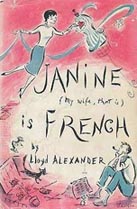
Published in 1959 to a mostly positive review in the New York Times, the memoir Janine is French is one of Alexander’s more obscure books, and it only occasionally turns up secondhand. For adult readers who tire of Alexander’s stock characters but enjoy his sense of whimsy, this rare book stars a more improbable heroine than anyone found in his fiction:
Janine, my wife, is French. Slight and brunette, she walks with the tiny, hurried steps of Parisian women. On a crowded street, I can distinguish her at any distance by this quick, decisive gait that makes her seem to be following an invisible thread. She is fascinated by Indians, by animals, and Martians. She collects rusty nails for good luck and hoards them in a little wicker basket. She detests ice cream and ice cubes. She is small but determined; I have seen her demolish a chimney, using a bread knife and a tack hammer. The only period in my life when I believed I understood Janine completely was in Paris, a dozen years ago, before I had known her very long.
The first chapter of Janine is French is a fine example of light comic writing, largely because Alexander sketches two characters: his eccentric wife and, by inference, himself, the most bemused of narrators:
In France, marriage is still contracted under the Napoleonic Code, and the husband is specified as master of the house, with the right and privilege to select the place of residence, to control the budget, and to exercise final authority in all domestic matters. During my life with Janine, I admit that my claim to the benefits of this arrangement has been for the most part theoretical.
Struggling to maintain calculated befuddlement across 226 pages, Alexander leads readers on a rather mundane mystery: Can the young couple save enough money to return to France? Along the way, he punctuates the quasi-plot with funny anecdotes about Janine’s conflicts with her conservative in-laws, her attempts to become a dressmaker and hairdresser, and her lurid first encounter with scrapple. Eternally good-natured, Alexander taps his wife’s bad English for easy laughs—when stuck in the cold, she complains that she is “frizzing to deaf”—but his affection is obvious even when showing how alien she seems in the Philadelphia suburbs. “She was,” he writes of Janine on her first American Halloween, “the only ghost I had ever seen who walked with a Parisian accent.”
As Alexander sketches Janine’s terrible homesickness, darker moments push aside the comedy, and chapters about vacations, home repair, and driving lessons feel forced. The problem, of course, is that the obscure author of Janine is French went on to become an enormously successful children’s novelist, so his well-known biographical details are at odds with the life he describes in this book. Janine is French tells the story of a young, childless couple, but in 1959, Janine was 42 years old, and when Lloyd Alexander married her, he also adopted her daughter, a child who never appears in this book. Her omission is conspicuous; even the dust jacket copy describes Alexander as “now living near Philadelphia with his Parisian wife and five cats.” Renowned for his decency, Alexander was, I imagine, either forced by his publisher to redact his stepdaughter for marketing reasons or eager to protect her from embarrassment.
Unsurprisingly, there is no malice in this gentle book, but Janine is French demonstrates how a memoir can be both true and incomplete. Later in his career, Alexander commented that writing fiction for children let him express his deepest feelings in far more satisfying ways than writing for adults ever did, and this book makes clear what he meant. Seeing 1950s America through the eyes of an eccentric Parisian is a treat, but Lloyd Alexander is never fully present in the telling. Read with a fresh sense of how many of his heroines must have been based on his wife and stepdaughter, Janine is French suggests that writing fiction really did let him tell the whole story at last.

 Quid Plura?