“There is a green hill far away…”

Despite the presence of noble-minded buffoons sitting around tables making futile plans, Washington is not an Arthurian town. Sure, there’s that suburb with corny Arthurian names, but Washington culture may be better suited for mocking fabliaux than the charming fictions of medieval romance.

Still, this city never stops sprouting quasi-medieval surprises. Trudge through the snow three days after a blizzard, and you do so alone; no one’s out taking pictures anymore, not even at the perpetually lovely Bishop’s Garden. Climb over a wall or two, send a few squirrels bounding away from the racket you make, and you’ll stumble onto this, in the driveway of a neighborhood school: a tree which the gardening guild claims was grown from the Glastonbury Thorn.

Of course, the “real” Glastonbury Thorn, dubiously rooted in history, has died several times over the centuries, and there’s reason to believe that my neighbors occasionally replace the local offshoot. Interest in the Washington thorn peaked in the 1950s, which partly explains why I’ve spent many a summer afternoon dozing on the Bishop’s Lawn unaware that this trace of Arthuriana prospered a few yards away, the quiet center of its own Tennysonian scene:

“The cup, the cup itself, from which our Lord
Drank at the last sad supper with his own.
This, from the blessed land of Aromat–
After the day of darkness, when the dead
Went wandering o’er Moriah–the good saint
Arimathaean Joseph, journeying brought
To Glastonbury, where the winter thorn
Blossoms at Christmas, mindful of our Lord.
And there awhile it bode; and if a man
Could touch or see it, he was healed at once,
By faith, of all his ills. But then the times
Grew to such evil that the holy cup
Was caught away to Heaven, and disappeared.”

It’s a silly thing, really, but after a week of Washingtonians grousing about winter, I’ll be glad when they’re back to chasing political grails. In a city that imports its legends, we could do worse than remember stories that teasingly promise perpetual spring.

“On a dark new year’s night, on the west coast of Clare…”

“The old year limps to its grave, ashamed,” mutters some uncomfortable actor in Sword of the Valiant, a movie that’s otherwise hard to recommend for either its eloquence or its insight. At first, I thought Christopher Howse’s review of the new Medieval and Renaissance Galleries at the Victoria and Albert Museum might prove to be an equally hollow endorsement of all things medieval, especialle because Howse embarrasses himself by howling about television, sneakers, and Kids These Days.

But then, with crusty wit, he writes this:

Thus it was, at the V&A, that as I stood in front of a splendid five-foot painted and gilt statue of St Roche and his dog (from about 1540), two women came up and glanced at it. “I like the dog,” said one. “He’s licking his leg,” said the other, and they moved on.

In 1540, every peasant or Cockney in Christendom knew all about St Roche. They could see not only the statue but also what it was about: the saint of the plague years, whose dog licked his sores and brought him bread. For it was always a libel to call stained-glass windows “the Bible of the poor”. The poor might not be able to read. But they knew their Bible and saints’ lives, or they’d never have been able to make out what the pictures meant. Modern tourists are more ignorant and purblind than the most sore-smeared Chaucerian beggar.

Today, what we wear is ugly, though the meanest medieval labourer wore hand-made clothes. We can’t name the stars, except the ones we see on TV. We can read, but can’t be bothered to. We save time by driving, only to lose it by slumping on the sofa. We can’t sing, can’t dance, can’t paint and can’t drink politely in company. Yet we have the childish gall to patronise past centuries as inferiors.

In Howse’s place, I might not have so readily drowned my opinion in a cauldron of molten snide nor so openly pined for medieval ways. Even so, whether medieval people infuriate or intrigue you, the full range of their humanity is worth remembering, especially on New Year’s Eve. Janus, after all, has two faces; the one that looks backwards sees truths that the other face still needs to know.

“Card sharks and blues harps and dolphins who leap…”

…and so a new week dawns in small-town Louisiana, where by all accounts, medievalism is dead, I tell you. Dead!

There are certainly no traces of it at this castle in New Orleans.

Nor in the suburbs.

Nor as we pass through a hamlet that every medievalist knows was named for the patron saint of, um…


Isn’t there anyone who knows what medievalism is all about?

Help me, O gigantic new relief of St. Anselm of Canterbury at the local Catholic church!

Whither medievalism? On the long, lonely interstate?

Won’t somebody give me a sign?

Won’t somebody give me another sign?

“And the motorway’s stretching right out to us all…”

So you’re cruising through suburban Maryland on a rainy Sunday afternoon. Daylight is fading, just as a semester spent focused on fantasy and science fiction is drawing to a close, and you idly wonder what you can do to steer your blog back to its original focus on medieval literature and unexpected manifestations of medievalism in everyday life. You round a bend, intent on little more than reaching the Korean supermarket before it closes, and—

Behind those trees…can that really be a textbook example of Romanesque vaulting?

And can it really be standing on the corner of Medieval Avenue and Renaissance Lane?

Okay, that last detail is wishful thinking. But check out this intriguingly unnecessary structure at the entrance to an otherwise unremarkable townhouse development on Randolph Road.
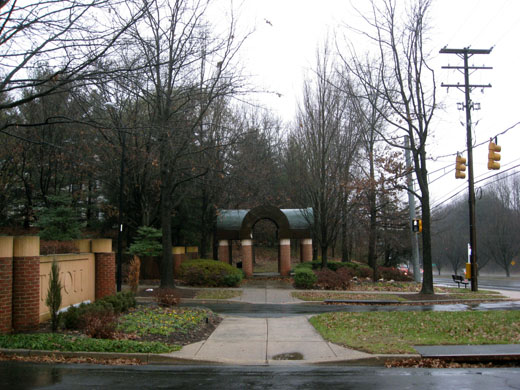
What’s that, you say? A mere arch? Well, look closer.

Yep, two barrel vaults intersecting, like in the textbook drawing—and just like in many Roman buildings and countless medieval and Renaissance churches (thus achieving the effect which Vasari famously dubbed “criss-cross applesauce”). The major difference here is that the architectural features, including those blank capitals, have been recast in the idiom of a circa-1988 shopping mall.

But lift your eyes above the lintel…

…and you’ll see how the intersecting vaults divide the interior into four bays to create…

…a good, old-fashioned groined vault. (You in the back, stop giggling.)

I don’t know why an architect decided to evoke the history of his profession here, with this whimper of traditional whimsy, in front of a subdivision that bears no other mark of architectural distinction.

However, this Romanesque doodad does serve a practical purpose. When it’s raining, you can seek shelter…

…and wait in grand style for the bus.

UPDATE:

Dave at Studenda Mira points out that this bus stop also suggests a tetrapylon, a four-way triumphal arch placed at street junctions in the Roman Empire. Here’s a well-preserved example from Antioch, and here’s another in Jordan.

“There’s talk in the houses, and people dancing in rings…”

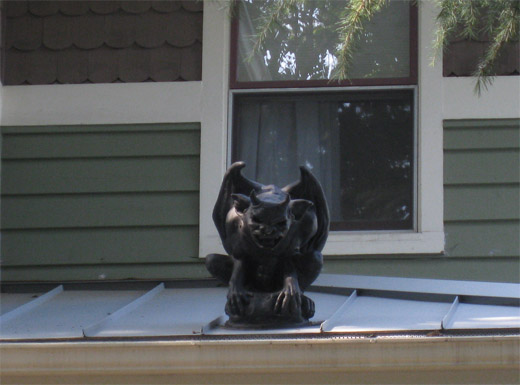
So I guess when a neighborhood’s most obvious medieval-ish draw is a gigantic new Gothic cathedral, it’s understandable that one might tromp up and down the street, possibly for years, and not notice, just two blocks away, the house with a gargoyle on the roof and a dragon in the front yard.

I don’t know who lives here, but they’re my new favorite neighbors. I hope they have trolls ’round the back.

“I never talk to my neighbours, I’d rather not get involved…”

“A gargoyle, Mother, is perched on the gable,
It searches and lurches, befickled by fable.
The gargoyle, Mother, has eaten the cat!”
“And what shall we do about that, my child,
What shall we do about that?”

“A gargoyle, Mother, is stalking our roof,
Its claw-pricks primeval, primordial proof.
The gargoyle, Mother, has eaten dear brother!”
“And why can’t we get us another, my child,
Why can’t we get us another?”

“A gargoyle, Mother, alights in the hall,
Its grindings and growlings begrizzled by gall.
The gargoyle, Mother, has eaten poor father!”
“And why must you be such a bother, my child,
Why must you be such a bother?”

“A gargoyle, Mother, is greedy for gore,
Befouled and bedeviled, beframed by the door.
The gargoyle, Mother, is coming for you!”
“And what do you dream I can do, my child,
What do you dream I can do?”

“A gargoyle, Mother, has eaten you whole,
Its hellmaw begobbling you, body and soul.
The gargoyle, Mother, is spitting you out!”
“And why did you have any doubt, my child,
Why did you have any doubt?”

“A gargoyle, Mother, bespews its hot breath,
Its burning and burbling betoken my death.
The gargoyle, Mother, has torn me in two!”
“And why must you mourn only you, my child,
Why must you mourn only you?”

(For all the entries in this series, hit the “looking up” tag.)

“Before you were born, dude, when life was great…”

This is the forest primeval. The murmuring crawfish, bearded with moss…

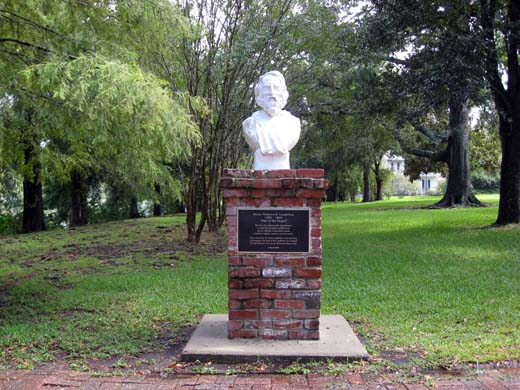
“But Jeff,” I hear yon straw man cry, “it’s been ages since you reaffirmed your obsession with literary and quasi-medieval statuary!” Indeed, the greatest truths are often the most lamentable. So look who reared his head (and a fragment of torso) today along the bayou in St. Martinville, Louisiana: None other than “Hexameter Hank” Longfellow, author of Evangeline, the epic poem that made Cajun history hip.

In St. Martinville, Longfellow keeps watchs over the “Evangeline Oak,” which offers ample shade just down the road from the Longfellow-Evangeline State Historic Site and a few paces from the lovely Acadian Memorial and Museum.

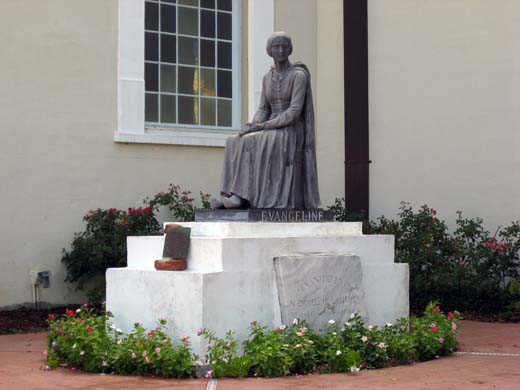
A block away, in the cemetery of the “mother church” of the Cajuns, is Evangeline herself, looking more sanguine than I’d be after decades of roaming North America in the name of deathless love. As bestsellers go, the poem that bears Evangeline’s name was the Twilight of yesteryear, but these days she gets fewer visitors.

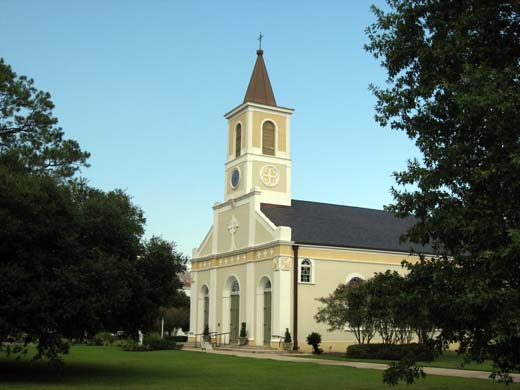
St. Martinville boasts a population of 6,989, but half of those residents appear to be statues. In front of the church stands A.M. Jan, the 19th-century pastor, on a pedestal that tells his story in Latin.

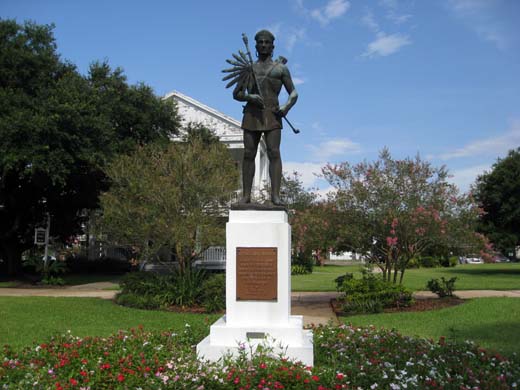
Also honored in the town square is this dapper Attakapa Indian. He’s been here since 1961.

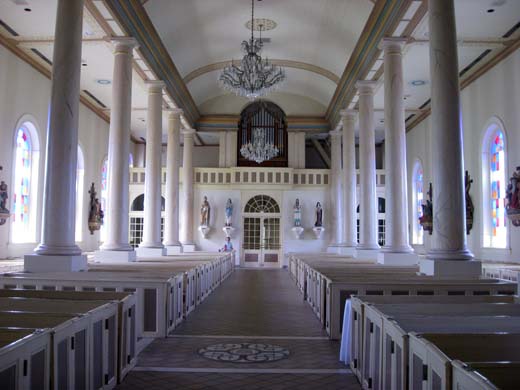
The interior of the church—”it is just the same as when it was built,” a plaque insists, “having been repaired but not changed”—is naturally full of old statues, too many to name.

But let’s not overlook two “Quid Plura?” favorites:

Noah’s wife…

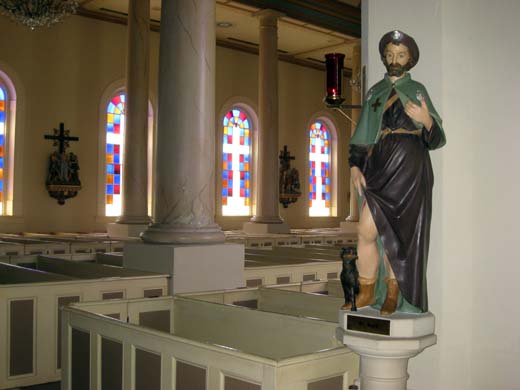
…and our old pal from New Orleans, St. Roch.

Mais où est le patron?

Aha! Here’s St. Martin of Tours, inventing the word “chapel” in front of the old presbytère.

Alas, my camera fizzled before I could get a picture of St. Martinville’s one truly unmissable statue, which depicts Charlemagne engaged in mortal combat with a giant crawfish. I’m sorry you won’t be able to see it, but trust me, dear reader: It was awesome.

“She rules her life like a fine skylark…”

The National Mall on the Fourth of July: America! Motherhood! Hot lunch for orphans! Red, white, and blue! Patriotic explosions!

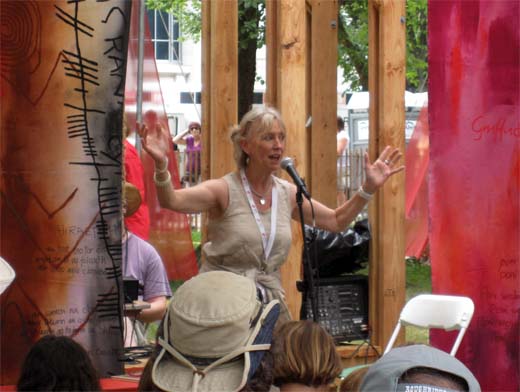
…and a Welsh woman retelling stories from The Mabinogion?

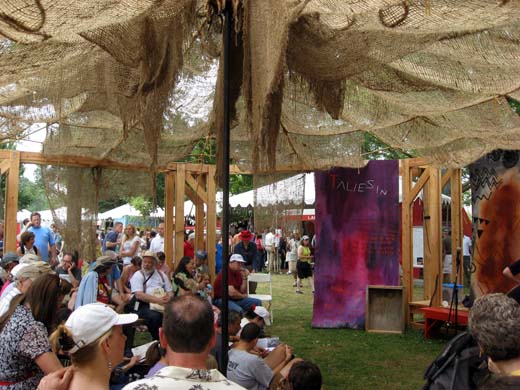
Yep: Wales is one of the three cultures featured at this year’s Smithsonian Folklife Festival. If you’re local, it’s not too late to hie thyself down to the Mall and take in some music, storytelling, crafts, and food. Maybe you’ll even get to hear spirited retellings of the stories of Branwen and Rhiannon adorned with violence, humor, and quirky modern digressions. Medievalism, you see, never takes a holiday.

“…we all leave before the morning light.”

There are now so many good blogs devoted to covering aspects of medievalism, from the scholarly to the popular and everything in between, that it’s not always easy for a hapless insomniac to make his mark. That’s why I’m inordinately pleased to be the first to report a crucial piece of quasi-medieval news: General Hospital has just kicked off a storyline about courtly love.

No, really! Someone on YouTube has compiled the relevant clips from the June 30 episode, wherein garrulous geek Damian “The Jackal” Spinelli proposes new rules for his relationship with Maxie Jones. Spinelli has long adored the woman he calls “Maximista,” but only recently has she loved him back. Spinelli and Maxie have already had sex—twice, according to Wikipedia—but the dramatic and chivalrous Spinelli wants to woo his true love properly, even if Maxie ain’t exactly qualified to book passage with St. Ursula, if you know what I mean:

SPINELLI.
Maximista shall remain the queen of The Jackal’s heart, and to honor her luminous beauty and transcendent presence, I will demonstrate my pure and epic devotion through the time-honored tradition of courtly love.

MAXIE.
Spinelli, you’re so amazing. You’ve actually come up with something I’ve never done. So what is this “courtly love,” and who gets to go first?

Watch the five-minute video and you’ll see Spinelli explain (not always accurately) the up side of courtly love, after which Maxie’s step-cousin Robin explains the down side.

If the frustrated English majors who write the other soaps decide to follow suit, we may have a genuine trend on our hands. The troublemakers on One Life to Live might stop stealing each other’s babies and generate real drama by debating notions of inheritance and lordship in The Mabinogion, while Days of Our Lives supercop Bo Brady could very well shelve his investigations of mafia feuds to focus instead on a groundbreaking new theory about the date and composition of Beowulf. Should all this and more come to pass, “Quid Plura?” will be ready to keep you informed—if not with great sentence, then at least with some full measure of solaas.

“The general sat, and the lines on the map…”

Today, as the world little noted nor long remembered, was the 620th anniversary of the Battle of Kosovo. According to AFP, “no incidents were reported during the ceremony” held by Serbian pilgrims and officials near the battlefield that’s no longer Serbian territory, although Belgrade radio station B92 reports—how reliably I don’t know—that some Kosovars marked the day by bulldozing a 1999 monument to the medieval Serb heroes.

Pundits and politicians have forsaken the Balkans, but medievalists should keep Kosovo in mind—not because outsiders should rush to take sides, but because nowhere is a medieval conflict still burning quite so brightly. Gavrilo Princip assassinated Archduke Franz Ferdinand in Sarajevo on this date in 1914, the 525th anniversary of the battle, and Slobodan Milosevic chose the 600th anniversary to visit the battlefield and rally nationalistic Serbs. The Battle of Kosovo hasn’t really ended, and one epic poet predicted what diplomats never fully grasped: “Earthly kingdoms are such passing things—/ A heavenly kingdom, raging in the dark, endures eternally.”

From the “Quid Plura?” archives, here’s the medieval background to Kosovo’s 2008 declaration of independence, and here’s the capture of Radovan Karadžić and the ugly side of modern medievalism.