“Ran down, and the lady said it…”

When the U.S. Postal Service issues a stamp tomorrow to honor Anna Julia Cooper, she’ll be remembered, rightly, as a remarkable woman. Born into slavery around 1858 in North Carolina, Cooper earned a degree in mathematics but also taught Latin and Greek. As principal of the nation’s best public high school for black children, she fought for high educational standards and prepared her students for top universities. In essays and lectures, she addressed racism, the concerns of black women, and other issues of the day. When women’s rights groups turned out to be white women’s rights groups, she started her own.

But Anna Julia Cooper was also a Charlemagne buff—and an inspiration to exhausted grad students everywhere.

From 1911 to 1913, Cooper spent summers studying French literature and history in Paris. In 1914—at the tender age of 56—she enrolled in the Department of Romance Languages at Columbia University with plans to earn her doctorate. Scholars of medieval French literature were clamoring for an accessible version of the epic Le Pèlerinage de Charlemagne to replace a hard-to-find German edition, and Cooper gave them one, but Columbia didn’t grant her a degree. As a widow raising her dead brother’s five children while holding down a full-time job as a teacher and principal in Washington, D.C., she couldn’t fulfill the one-year residency requirement.

In response, Cooper sought out a university with no such requirement. The Sorbonne accepted her credits but her work on the Pèlerinage didn’t meet their dissertation requirements, so Cooper wrote a second dissertation. In 1925, she earned a Ph.D. from the Sorbonne and found a Parisian publisher for her edition and facing-page translation of Le Pèlerinage de Charlemagne. She was 66 years old.

Cooper’s Pèlerinage was never published in America. When she offered the book and all its proceeds to her alma mater, Oberlin, the school hemmed and hawed—and then nervously declined. Even so, the book was the standard edition and translation for decades, American libraries and language departments sought it out, and several pages were included in an anthology of medieval French literature reprinted as recently as the 1960s.

Beyond its manageable size, it’s not clear what drew Cooper to the Charlemagne project she cheekily called her “homework,” but few American teachers have so aptly encouraged students, then or now, through indefatigable example. Cooper, who lived to be 105, understood the pedigree of that tradition:

Being always eager to carry out your wishes faithfully, I have sent back to you this dear pupil of mine as you asked. Please look after him well until, if God so wills, I come to you myself. Do not let him wander about unoccupied or take to drink. Give him pupils, and give strict instructions that he is to teach properly. I know he has learned well. I hope he will do well, for the success of my pupils is my reward with God.

Alcuin wrote that. It’s a Carolingian sentiment, but one that Cooper, a proper medievalist, could easily endorse.

“Walk without rhythm, it won’t attract the worm…”

When I was in Iceland in 1998, I stood where the locals chucked their pagan idols over the falls; I saw where Snorri Sturluson met his doom; and I got chased away from Hliðarendi by a dog. Five minutes later, Americans started visiting Iceland in droves; more recently, we all learned what happens when a nation that subsists on fishing and aluminum smelting decides to have a go at investment banking. I’m still abnormally fond of Iceland, but one of my sharpest classmates and traveling companions from ’98 has been busy indeed. He turned his passion into scholarship and became, to my delight, an expert on medieval Icelandic combat.

An award-winning acoustic engineer with a doctorate from MIT and nearly two dozen patents to his name, William R. Short made the sort of radical career change most people only dream of. Bill is now the Viking-in-residence at the Higgins Armory Museum and the author of Viking Weapons and Combat Techniques, a new book that reflects a decade spent researching, reconstructing, and demonstrating the fighting methods of saga heroes.

“Little in my academic training prepared me for life as a Viking in a museum,” Bill says on his Web site, but he’s being modest; his scientific background is exactly what makes Viking Weapons and Combat Techniques a valuable book. Rather than rush into the fray armed only with the romanticism that gives historical reenactors a bad name, Bill methodically defines his terms; he provides a taxonomy of Viking arms that extends even to such improvised weapons as rocks and household implements; and he surveys the written, visual, forensic, and archaeological sources, explaining their limitations and, most tantalizingly, pointing out where text and object disagree. Non-scholars and newcomers to the Viking arsenal will find this book quite readable, but medievalists in other fields will be intrigued by wonderfully trivial mysteries: For example, there’s no evidence for the chin-straps that surely held Viking helmets atop Viking heads, and nothing is known about several weapons named in the sagas but misleadingly translated into English as “hallberd.”

Already a useful reference work, Viking Weapons and Combat Techniques also documents efforts by Bill and his colleagues to rethink saga-era melee not as “two hairy men trading great blows with one another, almost as if they were trying to chop down trees” but as its own sort of martial art. Bill repeatedly stresses the conjecture and speculation that goes into reconstructing the combat techniques of medieval Icelanders, but the photographic sequences in this book convincingly show the versatility of a good, small shield, and also why a spear was no match for a sword.

I thought I had little interest in Viking combat, but the next time I pick up Njal’s Saga, I’ll be glad that Bill’s book has armed me with a whole new set of visuals. Viking Weapons and Combat Techniques is a concise but thorough handbook for scholars, saga readers, and even historical novelists; it’s the sort of work that puts a good face on independent scholarship and a worthy, bearded face on historical reenactment.

“Frame me, and hang me on the wall…”

Medievalists were some of the first folks in the humanities to embrace digital media, so it makes sense that medievalists are now the first to worry about the too-rapid demotion of the humble hard copy. As someone who’s searched in vain for quick and easy ways to transfer files from old Commodore-formatted floppies to a Mac running OS X, I loved Jonathan Jarrett’s nostalgic romp through old Internet protocols and was struck by the wisdom of his observation that digital media aren’t necessarily permanent media:

So keep offline copies and contribute to the Internet Archive, I guess, and remember that we work on sources that survived a thousand years or more because someone wrote them down in ink on skin and someone else, most likely, packed them between wooden boards and then generations of someones else kept them somewhere dry. Your CD-Rs will not last that long, or probably even as long as you do. Also, manuscripts (or books or print journals) don’t need mains power to be read. The low-tech will still be worth thinking about for a while.

That’s his conclusion; go see how he arrives at it. You don’t need to be a medievalist to care about the implications.

“The heroes rest upon the sighs…”

When I teach Wagner’s Ring of the Nibelung, my students look forward rather than back. Although they’ve read the medieval Saga of the Volsungs just one week earlier, their response to Wagner is always the same: “This is so much like Tolkien!”

So I tell them what Tolkien’s biographer wrote: “The comparison of his Ring with the Nibelungenlied and Wagner always annoyed Tolkien; he once said: ‘Both rings were round, and there the resemblance ceased.'” And still my students read Wagner’s Ring and declare: “This is so much like Tolkien!”

So I show them that scholars have wrung only half a dozen articles or book chapters out of the similarities between The Lord of the Rings and Der Ring des Nibelungen, and that the recent Tolkien encyclopedia didn’t even include an entry on Wagner. Undaunted, they write papers on the subject and find the sources wanting. And still they point to Wagner’s libretti and insist: “This is so much like Tolkien!”

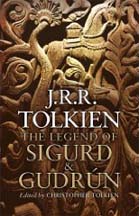
Last week, I laughed when I opened The Legend of Sigurd and Gudrún and saw that Christopher Tolkien spends an entire page of his eight-page foreword declaring, rather counterproductively, “there is no reference in this book to the operas of Richard Wagner.” He notes that his father and Wagner used the same medieval sources but insists that

Wagner’s treatment of the Old Norse forms of the legend was less an “interpretation” of the ancient literature than a new and transformative impulse, taking up elements of the old Northern conception and placing them in new relations, adapting, altering and inventing on a grand scale, according to his own taste and creative intentions. Thus the libretti of Der Ring des Nibelungen, though raised indeed on old foundations, must be seen less as a continuation or development of the long-enduring heroic legend than as a new and independent work of art, to which in spirit and purposes [Tolkien’s poems in Sigurd and Gudrún] bear little relation.

The Wagner-Tolkien question isn’t so easily dispelled. In a 2003 New Yorker article, Alex Ross waxed Wagnerian about the Lord of the Rings movies, and the subject still comes up on fan discussion boards, on neopagan Web sites, on Wikipedia, in conservative punditry, in Marxist punditry, in NPR’s opera reporting, and now in a new round of book reviews. In his perceptive review of Sigurd and Gudrún, Tolkien scholar Tom Shippey mentions Wagner three times; his piece even carries the headline “Tolkien out-Wagners Wagner.” Christopher Tolkien says that Sigurd and Gudrún was published because he finally found the “time and energy” to edit it, but the book’s defensive foreword suggests that its release was encouraged by recent Wagner-Tolkien comparisons.

The ad campaign for Sigurd and Gudrún hails Tolkien for unleashing “one of the most powerful legends of all time,” but the book is no easy read. Writing in English but imitating the meter of eddic poems, Tolkien reconciles inconsistencies in Nordic legend by composing two poems in hundreds of eight-line alliterative stanzas, many of them lovely, some of them too strange for modern ears. He assumes his reader knows the story, so these poems aren’t narratives; allusion supplants action, and stanzas jump from speech to speech. Some readers will praise Sigurd and Gudrún as a remarkable experiment in form; others will dismiss the book as a pointless antiquarian exercise. To the extent that the book prompts the old Wagner-Tolkien comparison, it shows that Tolkien was a professional medievalist who knew his sources intimately while Wagner was, in the best sense, an amateur. But who didn’t already know that?

What Sigurd and Gudrún doesn’t settle is the question of influence. We already know that Tolkien “disliked cordially” the plays of Shakespeare and yearned to revise Macbeth:

In later years he especially remembered “the bitter disappointment and disgust from schooldays with the shabby use made in Shakespeare of the coming of ‘Great Birnam Wood to high Dunsinane hill’: I longed to devise a setting by which the trees might really march to war.”

Which, of course, he did. At 18, Tolkien also recited “horrific episodes from the Norse Völsungasaga, with a passing jibe at Wagner whose interpretations of the myths he held in contempt.” Contempt implies familiarity; if Tolkien felt so strongly that Shakespeare was blind to the power of one nifty image, it’s reasonable to imagine that Wagner’s misdeeds further drove him to set right the legend he already loved.

The Ring of the Nibelung offered much to make Tolkien cringe: It’s a preposterous work about destroying the world to build it anew as a righteous, perfect, gods-free creation—but Wagner also denounces avarice, exploitation, oaths betrayed, love renounced, and power abused. Whether Tolkien objected to Wagner’s radicalism or hated seeing Wagner hew down, Saruman-like, the dark, archaic forests of “the Great Story of the North,” Tolkien’s reputation is unharmed by the suggestion that Wagner gave him a bit of a push. Only one of them read Old Norse on its own terms, and only one of them still compels readers to turn back and peer at the eerie, murky, maddening past.

“She moves with the music, ’cause it never gets old…”

When lawyers wax poetic, I get nervous. When they prop up their musings with medieval allusions, I start to feel proprietary. When they combine it all and stick it on a building, I find myself agreeing with Natalia Cecire: “what a strange thing to quote on the front of a law school.” Go see what Natalia spotted at UC-Berkeley: the confluence of Oliver Wendell Holmes, the Bayeux Tapestry, and the Lady of Shalott.

“And a strange dust lands on your hands, and on your face…”

When the sun is shining and the world is all a-green, it takes a tendency toward Tennysonian drear and a special leap of faith to study—and to teach—the Idylls of the King, especially Arthur’s “last weird battle in the West,” which falls on “that day when the great light of heaven / Burn’d at his lowest in the rolling year, / On the waste sand by the waste sea.” You’d think a week of rain would set the tone, but the present gloom is undeniably springlike. A sad tale’s best for winter; even in the stormiest May, students want to see suntans and beach umbrellas, not a despondent Bedivere sobbing on the bleak December seacoast.

Fortunately, Tennyson is a poet for all seasons. Arthur’s climactic rush-and-push against Mordred offers hardy perennial advice about facing a final exam:

Then spake the King: “My house hath been my doom.
But call not thou this traitor of my house
Who hath but dwelt beneath one roof with me.
My house are rather they who sware my vows,
Yea, even while they brake them, own’d me King.
And well for thee, saying in my dark hour,
When all the purport of my throne hath fail’d,
That quick or dead thou holdest me for King.
King am I, whatsoever be their cry;
And one last act of kinghood shalt thou see
Yet, ere I pass.” And uttering this the King
Made at the man…

My students, sharp and studious, will know whether Arthur is exhorting them to end on a note of defiant triumph or advising them to fail with dignity. This week, they’ll free themselves from my Vortigern-like tyranny, and they can remember the Mabinogion and William Morris however they like. I’ll remember them as the first group in ten years to find notes of perseverance and hope amid Guenevere’s severity. Generous and unexpected, that sort of personal response refreshes a tired-out teacher.

In Arthurian legend, when the old order passes, the world doesn’t end; instead, it gives way to something new. If Bedivere can watch the sunrise on the coast after the winter solstice, then melancholy at the end of the semester makes sense even when, as Tennyson puts it, “the world is white with May.” My students can tell you that there’s no more conventional month to revel in medieval romance; maybe there’s nothing inherently un-Arthurian, also, about going to the beach.

“Afraid of change, afraid of staying the same…”

Late in life, Charlemagne famously lamented the crudity of his early schooling. “I think of all the education that I missed,” he mused to Alcuin in a letter about a particularly baffling astrological problem, “but then, my homework was never quite like this.” Even 1,200 years ago, the Frankish king understood the need to rethink the ways of teachers and scholars—which is why Monday’s call for university reform by Mark Taylor, chair of the religion department at Columbia, is really nothing new.

Taylor’s New York Times mini-manifesto makes several points, a few of them good, many of them silly, most of them kicked around by academic bloggers for years. People who are more deeply invested in academia can debate the op-ed’s merits; I’m interested in the example Taylor uses to illustrate the pitfalls of hyper-specialization:

In my own religion department, for example, we have 10 faculty members, working in eight subfields, with little overlap. And as departments fragment, research and publication become more and more about less and less. Each academic becomes the trustee not of a branch of the sciences, but of limited knowledge that all too often is irrelevant for genuinely important problems. A colleague recently boasted to me that his best student was doing his dissertation on how the medieval theologian Duns Scotus used citations.

Hardly innovative, Taylor’s use of “medieval” is lazy shorthand: “OMG midevil is teh irrelevent.” If I were grading this op-ed, I’d ask him to explain this example rather than drop it, freshman-like, at the end of a paragraph as if its risible obscurity speaks for itself. Later, when Taylor claims “there is no longer a market for books modeled on the medieval dissertation, with more footnotes than text,” he uses “medieval” to suggest both obscurity and obsolescence. No other field or period rates a colorful pejorative in this generally bland piece; when political scientists fail to consider the role of religion, Taylor merely finds them guilty of a “significant oversight.”

A grad student working on Duns Scotus will need to know paleography, historiography, philosophy, theology, and possibly other fields. If, as Taylor claims, “[r]esponsible teaching and scholarship must become cross-disciplinary,” then the budding medievalist at Columbia is already more likely than his colleagues to embody that ideal. Of course, if Taylor is right to predict that “[t]hrough the intersection of multiple perspectives and approaches, new theoretical insights will develop and unexpected practical solutions will emerge,” then the medievalist enjoys another advantage, one that’s almost unfair: access to a deeper, richer vocabulary to characterize the unsubtle doctor who thinks it’s fine to use the New York Times to ridicule a student.

“…so you run down to the safety of the town.”

In 825, when Walahfrid Strabo was a teenager at the monastery of Reichenau, he started a notebook. The notebook went with him when he left to study at Fulda, and it followed him home when he came back to Reichenau as abbot. Walahfrid wrote a lovely poem about gardening, so it’s tempting to think that even when the abbot was traveling on a royal mission or tutoring the emperor’s son at Aachen, his heart was deep in the weeds—but his notebook, now in the abbey library at St. Gall in Switzerland, offers a sense of the learning that ran through his mind as he tended his wormwood and fennel.

Across 394 pages, Walahfrid copied mathematical tables, medical texts, and excerpts from chronicles and calendars. He transliterated runes, and he doodled a labyrinth, but he filled nearly half of his notebook with grammatical texts: examples of Latin usage, excerpts from the works of great writers, and guides to poetic meter. Many of these texts were centuries old, but Walahfrid copied them into his vademecum and went about his business, presumably delighted by the access to education and technology that allowed him to take Priscian, Seneca, Isidore, and Bede with him wherever he went.

I thought of Walahfrid’s notebook when Books, Inq. pointed readers to “Resisting the Kindle,” a piece by Sven Birkerts in The Atlantic. Birkerts imagines printed books disappearing, which I don’t think will happen, and he describes the advent of e-books as “apocalyptic,” which I don’t think it is. Although he makes a reasonable case, Birkerts can’t help but panic about the impending “decimation of context”:

So if it happens that in a few decades—maybe less—we move wholesale into a world where information and texts are called onto the screen by the touch of a button, and libraries survive as information centers rather than as repositories of printed books, we will not simply have replaced one delivery system with another. We will also have modified our imagination of history, our understanding of the causal and associative relationships of ideas and their creators. We may gain an extraordinary dots-per-square-inch level of access to detail, but in the process we will lose much of our sense of the woven narrative consistency of the story. That is the trade-off. Access versus context. As for Pride and Prejudice—Austen’s words will reach the reader’s eye in the same sequence they always have. What will change is the receiving sensibility, the background understanding of what this text was – how it emerged and took its place in the context of other texts—and how it moved through the culture.

The change Birkerts predicts isn’t “apocalyptic,” nor is it even new; multidisciplinary conversations about context occur every time someone studies or teaches a medieval work. When medievalists read a text, they often don’t know who wrote it; its original audience may be unknown; and it may be an edition based on a manuscript that was decades or centuries older than any copy the original author saw or touched.

Birkerts frets that e-books “will also have modified our imagination of history, our understanding of the causal and associative relationships of ideas and their creators,” but this semester, my bright students discerned, all on their own, that layers of context support the translations we read. They grasped that the Penguin Classics Mabinogion is a translation of an edition of a copy of a manuscript that the anonymous author or authors may never have handled or seen—and that the translation is also a conscious response to earlier translations, which are themselves products of their times. What Birkerts finds so terrifying—authors “no longer cohering in historical imagination but fragmented into retrievable bits of information”—is already a normal part of dealing with the ambiguity of any pre-modern work.

Twelve centuries ago, Walahfrid himself faced the question of context when he came across a copy of Einhard’s biography of Charlemagne. He didn’t panic; instead, he wrote a prologue that offered his own take on the historical background, and he alerted posterity to the handy section headers he’d inserted. In Walahfrid’s day, monks were copying texts in an innovative new handwriting, saving ancient works like Cicero’s Philippics for future scholars to contextualize—while happily copying, and thus making portable, the texts they also found vital for personal use.

My hunch is that the young abbot of Reichenau would have been more confused by our modern cult of the author than by devices like the Kindle, which promise to be a fancy codex, scroll, reference library, and vademecum all packed into one. Of course, Walahfrid knew what medieval monks knew, and what medievalists have learned from them: that the uncertainty ahead of us is nothing compared to the fog that we face when we turn to the past.

“…but on the way, you know that I will abide.”

Living through history is unnerving. As an unknown number of visitors descend upon the city—a million strong? Five million? A few hundred thousand?—the urban core becomes an armed camp, the river becomes a defensive wall, and mobs cross the bridges on foot. After clambering over monuments, some folks shack up with locals who’ve turned into hostelers, a few of them are bound to be scammed, and the authorities scramble to react to an influx of tourists whose movements are decentralized and largely spontaneous.

The medieval Romans may not have draped patriotic bunting across the facades of their buildings, but 710 years ago, they braced for unprecedented crowds. In late 1299, apparently with no official prompting, pilgrims began streaming into Rome, driven by the widespread belief that the year ahead offered special blessings to those who visited the graves of St. Peter and St. Paul.

Here’s Paul Hetherington on what became the Church’s first Jubilee Year:

The word spread like wildfire through Europe, and even by New Year’s Eve of 1299 a great crowd had assembled at St. Peter’s to greet the opening of the Jubilee Year at midnight. From then on, the crowds flocked to Rome from all over the known world. No one had ever experienced anything like it before. The crowds were so massive that the papal police had to institute a keep-right system for all the crowds crossing the bridge on foot that led over the Tiber to St. Peter’s . . .

The spontaneity and scale of the Jubilee took everyone by surprise. Even the pope, Boniface VIII, seems to have been nonplussed by it, and only issued the decree authorizing it late in February 1300. The various estimates made by contemporaries of the numbers that visited Rome vary so wildly that none can be regarded as trustworthy, but it was probably somewhere between one and two million.

Hetherington translates an eyewitness account by chronicler William Ventura, who visited Rome at the end of 1300:

It was a marvellous thing how many went to Rome in that year, for I was there and stayed for 15 days. Of bread, wine, meat, fish, and fodder for horses there was, but all at special prices…Leaving Rome on Christmas Eve I saw a great crowd that I was not able to number; there was a report among the Romans that there were then more than two million men and women in the city. Several times I saw men and women trampled under the feet of others, and even I was in the same danger, only just escaping on several occasions. The Pope received an untold amount of money from them, as day and night two priests stood at the altar of St. Paul’s holding rakes in their hands, raking in infinite money…And I, William, was there and earned fifty years and more of indulgence. Each hundred years it will be the same.

Like all pilgrimages, Tuesday’s inauguration and its attendant brouhaha will be a pageant of honor, corruption, villainy, and holiness, so if you’re in town, and if your peregrinations take you to Connecticut Avenue, look for me. Adapting the experience of William Ventura to Washington tradition, I’ll be pacing the sidewalk with ful devout corage and wielding my new favorite medieval-themed religious implement, the money rake. Commit yourself to change—or simply fling cash. I promise it will go someplace deserving. Weary pilgrim, have faith in me: I wol yow nat deceyve.

“Probi fuimus, sed non durabimus…”

[The trappings of Christmas, though bountiful, always include a rerun. Here’s a seasonal “Quid Plura?” flashback from last year.]

For all its opulence, the palace was a hall of drear. It glittered, but as the chamberlain observed, it had long ago ceased to shine. Enthroned, the pope passed the afternoon, as usual, without so much as a whisper. He had become just another of the chamber’s countless statues, a decoration to be dusted, an object of occasional veneration. Clerks and notaries flitted beneath him; they attended to petitioners and saw to the snuffing out of candles.

The chamberlain sighed. He wished for a window. How many more hours of misery awaited him? The incense stung his nose. He ached for a cup of wine.

“A chanter from Seville to see you, sir.”

The chamberlain blinked. The little priest before him was sweaty and red. Was this forgettable creature always so twitchy? No matter; it was time to be a tyrant.

“The Holy Father has no interest in Andalusian vagrants. Send him away.”

“Sir, you really want to see this.”

They always promised marvels. What came instead? Puppet shows. Mimes. That donkey with the law degree.

“Is there no legitimate business we can conduct?”

“No, sir, not after this.”

The chamberlain gave his usual hand-wave of resignation. Boredom trumped tyranny, especially on dull winter days.

Moments later, a dark-haired man wearing humble clothing walked quietly into the room. The chamberlain approached him, mindful of protocol.

The Spaniard strode right past the chamberlain and burst into speech.

“Holy Father! Far have I traveled, and strange sights have I seen, but today I bring music that shall warm men’s hearts and give glory to Almighty God!”

The chamberlain rolled his eyes.

“Your Holiness, in Sevilla, the city of my birth, I was a scholar of music in all its myriad forms. I knew the call of the muezzin, the savage chanting of ancient Gaul, the bawdy refrains of the Genoese shipmen. From Cordoba to Samarkand, my name was known to many. Raspy minstrels, cantors from the patriarchal tombs—strangers came from far and wide that I might discover their songs.

“But to my enduring shame, O Holy Father, one form of music was entirely unknown to me. Rumors reached me of a marvelous style of singing, a sound full wondrous to hear. Its secret, travelers told me, was guarded by monks at the ends of the earth, where they sang unending hymns of Saint Nicholas and other Christian subjects too numerous to mention. Desiring to know this music which few living scholars had heard, I left my comfortable home and my company of flatterers, and I chased vague whispers along strange and lonely paths.”

The chamberlain glanced at the motionless pope. Was he asleep? Was he breathing? Had this long-winded fool at last bored the pontiff to death?

“Holy Father, I sought this heavenly choir in the terrible places of the world. I sailed through ice in the realms of the north, where hard men laughed at my desperate quest. I traveled eastward into Araby, but I journeyed in vain, for there I heard only frivolities, and never celestial sound.

“Winter came. Forlorn, clad only in rags, I faced starvation on frigid mountain peaks. Through the intervention of God—for how else to explain that fortuitous day?—I was rescued by the brothers of an order whose patron I am forbidden to name. But there, Holy Father, while I rested, healing through Our Lord’s salvific grace, strange music amazed me as I lay in my cell.

“That miracle I bring to Rome this day.”

At the far end of the chamber, golden doors opened. Three tiny, hooded figures glided silently over the marble.

Bile rose in the chamberlain’s throat. A dwarf act! He crossed himself. These always ended in sacrilege. Where were the guards?

The Spaniard raised his right hand.

“Hit it, boys.”

A weird, piercing music filled the air: an unearthly chant that flowed magically from beneath three tiny cloaks, an eerie, impossible singing that bathed the great hall in a strange and transcendent good cheer. Priests and monks all froze where they stood, beguiled by a falsetto that not even castrati could create. Tears welled in the chamberlain’s eyes. Was this the choir of Heaven or of Hell? The verse of these singers was in some foreign tongue—alien, yes, yet oddly familiar. He understood none of it, not one single word—but he knew it would haunt him for the rest of his life.

And then, as quickly as it had begun, the singing ended.

The hall was silent for an eternity; no priest or monk dared blaspheme the place with motion—not a cough. Everyone stared at the singers.

Finally, with trembling voice, the chamberlain found nerve enough to ask: “Are you men…or angels?”

The three beings reached up with tiny hands and reverently lowered their cowls. Solemn faces peered out at the world, wide-cheeked faces with prominent teeth set beneath large, benevolent eyes. Their features were mingled in brown, shaggy fur.

The chamberlain gasped.

“What manner of monks are these?”

From far behind him came a stir of precious robes and a voice not heard here in ages.

“Non monachi,” declared the quaking, agitated pope, “sed chipmonachi.”

The giggling of the pontiff resounded through the hall. Priests rushed to his side, desperate to calm him. The chamberlain fell to his knees as confusion around him swirled.

The stranger from Seville folded his arms; then he looked at his singers and frowned.

“If they think that’s something,” he muttered, accustomed to such chaos, “just wait ’til they see you fellas dance.”