
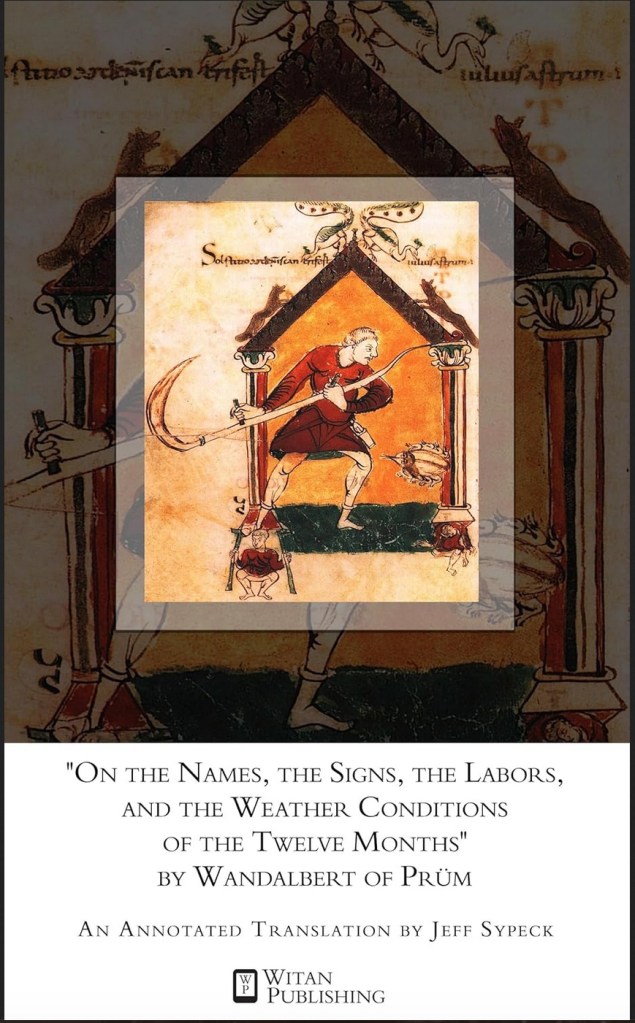
More than twenty years ago, I met Wandalbert of Prüm, a calendar-obsessed monk who was born the year before Charlemagne died. His loose translation of his long poem De mensium duodecim nominibus signis culturis aerisque qualitatibus (“On the Names, the Signs, the Labors, and the Weather Conditions of the Twelve Months”) caught my eye in the appendix in a hard-to-find academic book, where the poem was treated as an afterthought. In 2006, I cited a few lines from Wandalbert in Becoming Charlemagne to hint at daily life in the ninth-century countryside, but I wondered why no one had made the poem more accessible in English.
Years later, I’ve found a home for my own peer-reviewed prose translation of Wandalbert’s calendar poem, which includes an introduction and annotations that touch on everything others—mostly Germans—have ever said about the poem. Much of this material has never been available in English. De mensium duodecim nominibus isn’t one of the great works of the early Middle Ages, but it has its virtues: Wandalbert uses classical Latin models to describe the constellations, the human labors, and the weather for each month, usually in conventional language, but he also describes sights, deeds, and work traditions that feel specific, maybe unique, to his time and place. How reliable is Wandalbert as a source for the history of agriculture, for social history, for climate history? That’s the question I hope this translation will prompt others to pursue.
When I submitted my Wandalbert translation to academic journals, editors and peer reviewers sneered at the idea of publishing an annotated translation for students and non-specialists, a response that made me wonder how they’d never been students or non-specialists themselves. So be it. My rendering of Wandalbert is the sort of handy monograph I wish I’d had when I was a student. The folks at Witan Publishing have given his poem a home in their roster of academic works that are too long to be articles but too short to be full-length books. My Wandalbert translation is available as a paperback and an e-book, both of them quite affordable. (For unknown reasons, the book title on Amazon isn’t quite right.)
A decade ago, long before I finalized this translation, Wandalbert’s poem inspired me to write The Beallville Calendar, an alliterative, year-long poem about the disorientation of moving from the city to the country. I don’t know what Wandalbert would make of it. I hardly know what to make of it.
I no longer spend much time in the Middle Ages. Still, it feels good and right to finish a project like this one and fulfill a promise, hazy but haunting, to a wider-eyed past self. I’ll hang up my medievalist’s hat, but not yet. At least one more incomplete medieval translation project is nagging at me, and I’ll soon see it done. As Wandalbert could have told you, seasons change, but the work goes on.
 Quid Plura?