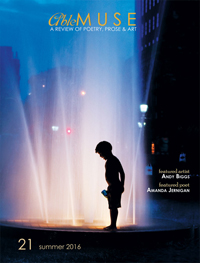
 When the journal Able Muse lands in my mailbox twice a year, I’ve typically torn through the cardboard and gotten to skimming before I’m back inside the house. As usual, the summer 2016 issue rewarded my exertions, opening with a piece that’s as solid as grapeshot in the wall of a clifftop villa: “It’s Time to Talk About Lord Byron Again,” Amit Majmudar’s overview of Byron’s Letters and Journals: A New Selection, published last year by Oxford University Press. Majmudar, a diagnostic and nuclear radiologist who’s also the current (and first) Poet Laureate of Ohio, has penned what’s ostensibly a review essay, but his immersion in the English poetic tradition makes it one heck of an inducement to revisit Byron’s sprawling corpus and his almost pointlessly preposterous life.
The precision that makes Majmudar a good poet lends a special shine to his prose. Here’s one of several passages that share the delight of a satisfied reader where other reviewers would dutifully summarize:
Byron’s Letters have what you find in the letters of few other poets: Tumult. He sought drama, and drama sought him. A future Prime Minister’s wife, jilted, cuts herself for his sake. A few months later, he’s sleeping with his half-sister. White-water torrents, adultery in Italy; gonorrhea, malaria, indigestion. We read of him stripping off his coat and boots to keep Shelley, who was unable to swim, from drowning in a storm (he managed to pull the poet to shore in the end after vigorous bailing). Random gunshots sound a hundred feet from his door, after which he carries a dying policeman into his room to bleed to death. Enough action for one life, perhaps. Only then he sets off to expel the Turks from Greece.
I loved this bit, too:
What with the prolific poetizing, the bisexual vortex of his bed set amid the smells and noises of a small zoo, the international fame, the international infamy, the looks, and the wealth, he must have struck people as a monster of nature, possessing a kind of preternaturally intense life-force.
[. . . ]
The promiscuity at the time did wax operatic, if only opéra bouffe, complete with shouting matches between the weeping cuckold and defiant adulteress, whilst the foreign interloper buttoned his breeches. In 1817, one of Byron’s mistresses moved into his house uninvited and refused to leave, even after her husband, her relatives, the police, and Byron himself begged her to go home. (He ended up employing her as a housekeeper-with-benefits; apparently she performed excellently in both her duties, reducing his daily expenses by half.) To gauge how sordid Byron got in those years, we need only go to the Letters of his neighbor and fellow exile, Percy Bysshe Shelley—who, for all his atheism and his shared contempt for British moral cant, was horrified to hear Byron haggle with Italian parents over the price of their daughter.
Majmudar writes wittily about Byron’s nigh-unbelievable adventures, as a fellow poet should, but he offers the benefit of a different expertise. As a doctor, he can’t help but mention, as few critics could, the modern connection between extreme promiscuity and suicidal depression, and that Byron’s hypersexuality was not atypical of what our age witnesses in a childhood abuse survivor—which, among so much else, he was.
Majmudar’s essay is 13 pages long. I’ve cited the bits that got a laugh out of me, but the rest is both a finer and more concise introduction to Byron than I ever got in college, covering not only his life and his erratic evolution as a poet but also his recent critical standing and international legacy. Apparently his poems translate congenially. Yet there’s one thing this titan of vitality was powerless to do: commend his spirit to the here and now. “We have had no Byronic poet for a few generations now, and we are the duller for it,” Majmudar laments, suggesting that poetry would do well to jog out into the dunes once in a while and shake the solemnity off its paunchy, pasty frame. Byron, he says, reminds us “it is possible for poetry to get written in the downtime between pleasure seeking and politicking, cussing and whoring and seeing (and saving) the world.” More of us can stand to hear this, and I liked that Majmudar embeds his exhortation in an example of what a strong review should be: proof that reading the book is a good, rousing start.








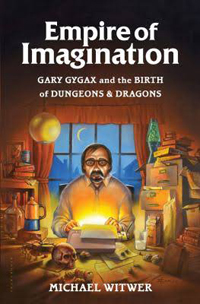 When Gary Gygax died in 2008, I called him
 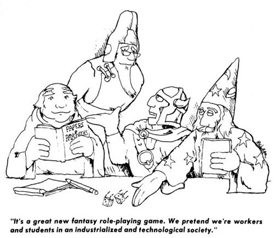 Fortunately, Empire of Imagination is also the story of a business—a lurid cautionary tale that Witwer relates with enthusiasm. In 1973, when no gaming publishers wanted the original Dungeons & Dragons manuscript, Gygax and two fellow gamers incorporated TSR—”Tactical Studies Rules”—and published it themselves. Like any empire, TSR was soon rife with enmity, backstabbing, and strife. The untimely death of one of the founders in 1975 reverberated for years: An investor who bought his widow’s one-third share would introduce a family of executives who, as Witwer tells it, despised everything about the gaming world but its potential revenues. By the early ’80s, their preposterous excess was worthy of a Simpsons episode: In Hollywood, Gary Gygax was blowing millions on D&D-based entertainment prospects, leasing King Vidor’s mansion, and snorting cocaine in a private booth at the Playboy Club, while back in Wisconsin, the colleagues who despised him were funding shipwreck excavations and investing in real estate on the Isle of Man. When Gygax recaptures the company in a startling coup and writes a book that restores solvency to the land, the tale takes a hopeful turn—until one Hollywood hanger-on proves to be an enemy in disguise…