
Twenty years ago, when I was living in Washington, D.C., and working on the book Becoming Charlemagne, a friend pointed out that the garden at the National Cathedral, my favorite neighborhood refuge, was home to a massive stone baptismal font from Charlemagne’s era. Surrounding the font were small signs I had somehow overlooked. The signs highlighted certain plants paired with snippets of a garden poem by a Carolingian monk describing their properties.
Intrigued, I tracked down an English translation of the poem published in a limited edition in 1966 by a botanical library in Pennsylvania. The book was packed with scholarship, plant lore, and a catalog of early printed editions of the poem, but the free-verse translation left me cold. Nothing was wrong with it, but I came away confused about why the poem had earned the praise it had, and I couldn’t discern the poem’s underlying order.
In 2013, knowing I would understand Walahfrid Strabo’s garden poem only if I translated it myself, I sat down and got to work, reacquainting myself with my grad-school Latin while trying to find an appropriate English form. On and off for 12 years, I tinkered with my Walahfrid translation. Most of the scholarship on the poem is in German, so I spent long stretches sifting through books and articles and scrutinizing two annotated German renderings. From time to time, I put the work aside for months or even years to write other books or tend to other areas of life, but curiosity about Walahfrid’s poem nagged at me, and it always summoned me back.
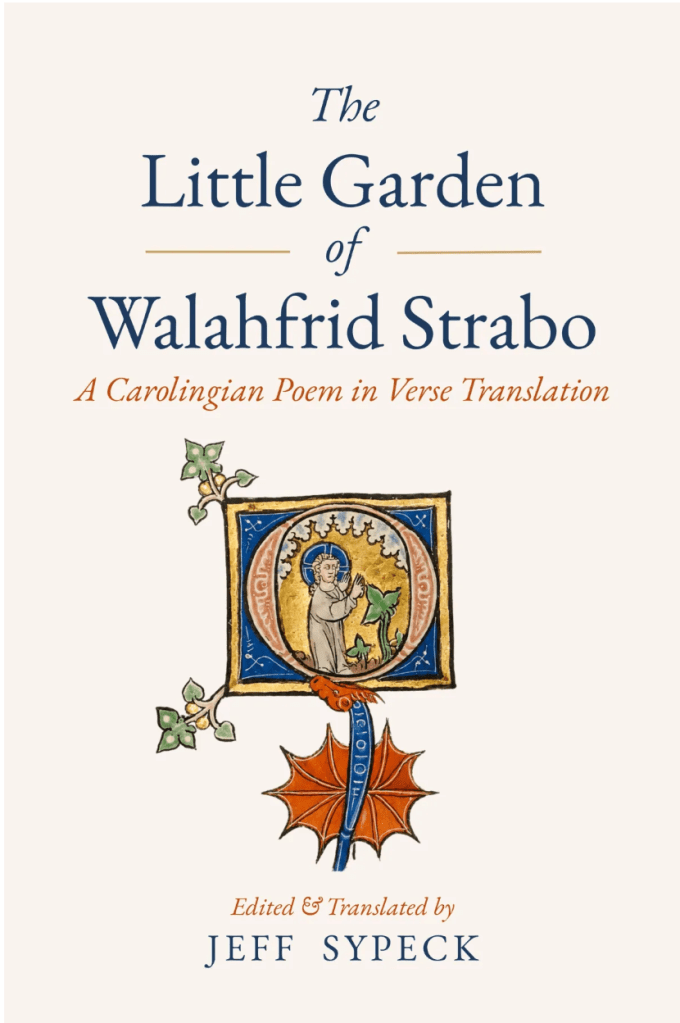
After all those years, Walahfrid is ready to be rediscovered: The good folks at Uppsala Books have published The Little Garden of Walahfrid Strabo: A Carolingian Poem in Verse Translation. Walahfrid’s Latin poem is only 444 lines long, but mine is currently the only English translation in print. It’s also the only English translation to be informed by more than a century of German scholarship. I’ve rendered it into an adapted version of metrical, alliterative verse to convey a sense of the formal nature of the original and to hint, as best as I can, at Walahfrid’s eloquence. A concise introduction and detailed notes help orient readers to Walahfrid’s rather unusual poem, which is all at once a personal ode to gardening, an exercise in classical imitation, a catalog of botanical lore, and a statement of faith.
The Little Garden of Walahfrid Strabo is available in affordable paperback and hardcover editions at Amazon worldwide, Barnes & Noble, Bookshop.org, or wherever else you buy your books.
If you’re interested in medieval literature and myth, I hope you’ll check out more from Uppsala Books, which was founded by Beowulf and Tolkien scholar Tom Shippey. Their catalog is growing fast. Like The Little Garden, many of their books are terrific introductions to works we don’t often read in the English-speaking world: the epic Waltharius, for example, or Die Minneburg (“The Castle of Love”) in its first-ever translation. Graham Scheper’s Venerable Bede anthology will be a welcome companion if you plan to visit historic sites in the north of England, and I’m particularly fond of Brian Murdoch’s anthology of Old High German poetry, which feels like a window onto a lost world. I find Uppsala’s selections to be welcoming introductions to their subjects for curious non-scholars. If you’re the sort of reader who once discovered the world’s great literature through Penguin Classics—solid translations with thorough introductions and useful notes—then Uppsala likely has something to intrigue you.
After leaving grad school in 1998, I taught medieval literature until 2009. I had a good run and was content to let the medieval world recede, with no hard feelings. In the years since, most of my writing projects have taken me to other places and other eras, so having Uppsala Books so enthusiastically support my return to the early Middle Ages has been a wonderful and unexpected delight, a circle closed, a promise fulfilled to my long-ago self.
Maybe The Little Garden is a capstone. Maybe it’s not. For now, I hope readers who wander in Walahfrid’s garden will find enjoyment, as I have, in his stated purpose: “to praise small things and prove them great.”
 Quid Plura?