“All the dishes got broken, and the car kept driving…”

The weekend approacheth. Here’s some neat new stuff from around the Web.

I recently posted photos from my visit to the New Orleans shrine and cemetery dedicated to a medieval saint. Last weekend, the Times-Picayune ran a piece about how the St. Roch neighborhood is doing.

Eternally Cool points out the impending return of chariot racing to Rome. (Put me in a gigantic Asterix helmet and I am so there.)

Steven Hart wants to see more Tamil pulp fiction.

Frank Wilson reviews a new Longfellow biography.

Some authors and bloggers are being sued. Contribute to their legal defense fund here.

D.C. now has a free litmag featuring excerpts from new books. The dissatisfied lawyer who founded Bit o’ Lit was recently profiled in the Washington Post. 

Ephemeral in New York digs up a curious phenomenon of yesteryear: Manhattan baby exhibitions.

“Clovis, Poitiers, Charles-the-Great, / Vikings, Verdun, papal state…” Apparently keen on producing a pre-modern version of “We Didn’t Start the Fire,” Carl at Got Medieval wants you to summarize the Middle Ages in seven words or less.

Action figures of Pope Innocent III are on sale: two for $4.99. (“I’m telling you, son, he was the Optimus Prime of the early 13th century. Now stop crying and blow out the candles.”)

Finally, I enjoyed this letter in the June 28th-July 4th issue of The Economist, which hints at the cultural connections between the East and the medieval West:

SIR – I am a musician by profession and it was profoundly gratifying to see that, of all the possible images you could have chosen for your cover on progress in Iraq, you went for a photo of an Iraqi luthier fixing an oud, the Arabic ancestor of all Western lutes (June 14th). I exhort each and every one of your readers to take up the oud, or at least buy one from an Iraqi luthier. All political disagreements notwithstanding, the one thing the people of Iraq will need most critically in the years to come is a clientele, and not only in the oil trade.

Victor Kioulaphides
New York

Kioulaphides has composed a piece solely for instruments in the mandolin family; his solo compositions include “El Malecón” and “Variations on a Basque Melody.” His home page is here.

Whether you’re spending the weekend oud-shopping, sunbathing, or lost in a book: enjoy!

“Wild kind of look to the day…”

[Here’s the latest in an ongoing series of reviews of all of Lloyd Alexander’s non-Prydain books. To see all posts in this series, click on the “Lloyd Alexander” tag.]
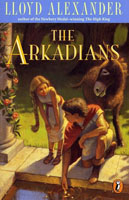
Partway through The Arkadians, Lloyd Alexander indulges an in-joke. Joy-in-Dance, the novel’s heroine, explains that during Arkadia’s golden age, mighty enchanters roamed the land. When she lists these mythic figures, they happen to possess Hellenized versions of names from three of Alexander’s earliest works. “She’s setting the scene very nicely for us,” declares one of her companions, ignorant of this rare wink to the reader. “It’s no doubt one of those tales of sentiment and tender feeling.”

The pleasant confusion of storytelling is, in fact, the entire point of The Arkadians, Alexander’s 1995 novel set in a variant of ancient Greece that’s all the more exciting for its strangeness. Here, the Trojan horse was actually a donkey, Odysseus’s wife wasn’t happy to see him, and American Indians rule the northern plains. With subtle but obvious glee, Alexander reshapes the world of Greek myth as if it’s been filtered through a child’s toy box, painted by Maxfield Parrish, and cast as Shakespearean comedy. The result is an amusing cast of oddballs that includes a befuddled clerk, a real live muse, a poet-turned-jackass, and a professional scapegoat. Each one has a reason for seeking help, Oz-like, from the mysterious Lady of Wild Things—and each one has a story to tell.

Those secondary stories told by the characters are the true delight of The Arkadians. Surprisingly playful for an author in his early 70s, Alexander whips up a prose pastoral romance, complete with digressions just lengthy enough to hold the interest of young-adult readers. Some of these stories are personal histories that retell episodes from Homeric epics. Others are creation myths, including one that reworks the Judeo-Christian story to make the loss of Paradise the fault of the male. Some tales are literally true, while others are shown to be blatantly false. As Lucian, the novel’s hero, tries to explain how he fled the royal court, his friend Fronto, the poet-turned-jackass, demands that he improve his biography:

“Conflict, struggle, suspense—that’s what’s needed to make a tale move along. You don’t just run off. They seize you. You fight them with all your strength, almost win; but they bind you hand and foot, get ready to chop you up with meat cleavers. You escape in the nick of time. I don’t know how. That’s a technical detail.”

“It didn’t happen that way,” Lucian protested.

“My point exactly,” said Fronto. “All the more reason to spice it up. The meat cleavers are an especially nice touch.”

Thanks to these sorts of knowing exchanges, The Arkadians becomes Lloyd Alexander’s clever and self-deprecating commentary on the human impulse to invent and embellish. Even as the novel’s heroes grow increasingly honest about their own stories, they learn that other people simply can’t help themselves: Catch-a-Tick, a starry-eyed young satyr, joins their fellowship, sees what he wants to see, and mythologizes their adventures on the spot.

To say more about The Arkadians would spoil its surprises, especially the in-jokes for readers of mythology. Snake prophets, talking animals, star-crossed lovers, shipwrecks, magic temples, feckless monarchs, goddesses and gods—Alexander recombines these classic elements of storytelling to illustrate such virtues as loyalty, love, mercy, and humility and to emphasize, as Shakespearean comedy often does, the complementary natures of women and men.

Alexander’s glee will displease dour nitpickers who don’t understand that the best myths are destined to mutate. Dogmatically respecting a myth’s provenance? Seeking its literal meaning? None of that, Alexander suggests, is particularly fun; joy in the telling is better by far. As Fronto, the poet-turned-jackass, aptly concludes, “If a storyteller worried about the facts—my dear Lucian, how could he ever get at the truth?”

“…as your little boat struggles through the warning waves.”

[Here’s the latest in an ongoing series of reviews of all of Lloyd Alexander’s non-Prydain books. To see all posts in this series, click on the “Lloyd Alexander” tag.]

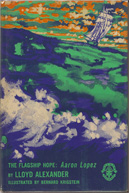
Lloyd Alexander wanted to like Aaron Lopez; the fact that he couldn’t is hardly his fault. In The Flagship Hope, his second novel for children and his second novel in a series “designed to take young people on an adventurous expedition into the realms of Jewish experience,” Alexander spins a highly fictionalized account of the wealthiest merchant in 18th-century Rhode Island. Published in 1960, four years before the first Prydain novel, The Flagship Hope shows what happens when an author is given a story he simply cannot make his own.

The novel begins in Lisbon in 1752, a ghetto of “fruit, spilled wine, and poverty,” as Alexander sketches the history of the Marranos, Portuguese Jews who were forcibly baptized but who practiced their religion in secret for centuries. When 21-year-old Duarte Lopez presses his luck with the authorities, he’s forced to flee to Rhode Island, where he finds a welcoming Jewish community in Newport and a wealth of opportunity. “This is a new world,” his brother assures him, “but you are not alone in it.”

Free to take a Jewish name, Aaron Lopez becomes a shipping magnate and a philanthropist. He lays the cornerstone of Newport’s first synagogue, he endows the town library with books, and he pays for the passage of Jewish refugees after a Portuguese earthquake. His flagship, the Hope, becomes the symbol of the freedom he never enjoyed in Lisbon, and Alexander portrays him as a perceptive man with a poetic soul:

As Aaron looked with satisfaction and thankfulness on the results of his work his thoughts returned to the day, long before, when he and Abigail stood by the ship railing and he pointed out a distant whale. Then, the whale, the leviathan of the deep, had meant all of the New World to him. He had vowed to make a hook to capture it. Had he now, at last, caught the great creature?

As Aaron Lopez courts his wife, speaks fondly of books, and faces harassment by royal agents, Alexander makes him eminently likable. But throughout The Flagship Hope, the nature of Lopez’s business remains vague. Lopez was indeed one of the great merchants of 18th-century New England, and while Alexander specifically mentions his investments in spermaceti candles and rum, he alludes only vaguely to other aspects of his “West Indian trade.” Therein lies the main problem with The Flagship Hope: it never mentions Lopez’s involvement in the slave trade.

Lopez’s outfitting of slave ships is no secret; historians have documented it, and much is made of it on antisemitic Web sites (to which I will not link). Readers of The Flagship Hope who know something about the real Aaron Lopez are bound to approach this issue with varying degrees of sensitivity to historical context that may temper their disappointment or anger. Unfortunately, readers who know Aaron Lopez only through Alexander’s novel aren’t given a chance to determine how much less they might have liked the man. Strangely, Alexander casts Lopez as a freedom fighter who justifies his own reluctance to fight in the Revolutionary War:

And what of liberty? Once Aaron had reproached himself for not taking up a musket. Now he saw clearly that all who worked for freedom, to the full measure of their means, even those who could offer only their suffering, had the proud right to call themselves her children. As Aaron looked across the icy field, he knew that liberty had many sons.

Alexander never saw even his worst characters as inhuman or monstrous, and his task in The Flagship Hope is, of course, to focus on Lopez’s experience as an immigrant, merchant, and patriot. But when a hasty epilogue documents Lopez’s premature death in quicksand at the age of 50, Alexander offers no praise, only the enigmatic graveside prayers of friends and family to “hear the voice of Aaron.” He seems relieved to be rid of a figure whose life story is more informative than it is inspirational, and I can’t really blame him. After enjoying the story of Alexander’s previous Jewish hero, August Bondi, and his principled fight against slavery, a novel about an 18th-century merchant that never mentions the slave trade is a strange and uncomfortable read.

“Hey-ho, rock ‘n’ roll, deliver me from nowhere.”

The van comes swerving toward me but misses the curb. The driver hits his horn, as if I hadn’t seen him—but where he’s from, they do things loud that way.

Squirrels scatter. Maintenance men stare. The wife rolls down her window and holds up a map. The husband leans across her lap to bark at me.

“Sir you know how t’gedteither of thesotels?”

I want to laugh at the sir. It’s not the gentle nicety of the Virginian, but the pained formality of a traveler in a foreign land. His question collapses by the end, but he doesn’t mean it to; he bites each word as it falls from his mouth, and he just gulps down too much.

“Watch wanna do is,” I begin, and then I poin him and his wife back thway they came, and tellm to make the firs right, and go awlway down, south on Cneticit, and make thright on Calvert—kyean missit.

“Jus likon’ map,” says the wife, enlightened.

“Jus likon’ map,” I agree.

No smiles, no thanks, not even eye contact—he’s on a mission, and his missions long ago became her missions—and the van spins around. They roll up their windows and roll down the street. Squinting at their license plate, I smile to see I was right.

You can’t go home; after a while, it’s foolish to try. But sometimes, if you’re lucky, you receive a surprise, something worth more than a picture: the old sownds of home awl come cawlin f’you.

“Between our quests, we sequin vests…”

Over at Unlocked Wordhoard, Scott Nokes has written a long and thoughtful post about why he’s taken his interest in medieval literature beyond the confines of the campus.

For those of you who don’t know Scott, he teaches medieval literature at Troy University. His very accessible, medieval-themed blog attracts not only academics but also writers, reenactors, gamers, students, fantasy authors, and pretty much anyone else who’s intrigued by medieval subjects.

If you’re interested in the relationship between academia and the rest of society, you should check out what Scott has to say. His suggestions for broadening the academic culture, and his ideas for encouraging “fanboys” to explore the scholarly side of the humanities, apply to many other fields as well.

Scott is also, I should state for the record, extremely hospitable—not like Egil Skallagrimson at all.

“…and a fire-dance through the night.”

[Here’s the latest in an ongoing series of reviews of all of Lloyd Alexander’s non-Prydain books. To see all posts in this series, click on the “Lloyd Alexander” tag.]

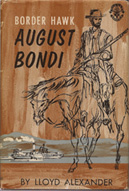
Before he invented the kingdom of Prydain, Lloyd Alexander sought out Jewish heroes on the plains of antebellum Kansas. Published in 1958, six years before the debut of the Prydain series, Border Hawk: August Bondi was the second release from Covenant Books, an ambitious series offering “stories of Jewish men and women to inspire and instruct young people.” Based on Bondi’s own accounts, this fictionalized biography of the Vienna-born Kansas abolitionist was also Alexander’s first book for children. The frequent exclusion of Border Hawk from the author’s later biographical sketches makes sense, perhaps, for marketing reasons, but the book doesn’t deserve its obscurity. For those who know Lloyd Alexander only as a writer of fantasy, this little-known work is a pleasant surprise.

The opening pages of Border Hawk are packed with action, all of it unfolding in tight, economical prose. It’s 1848, and student revolutionaries face off with soldiers on the streets of imperial Vienna:

The drums beat wildly, the bugles blew the piercing notes of the attack. Anshl heard the heavy boots of the advancing soldiers. Desperately he tried to raise himself. Before he could move, he felt a bayonet rip into his back. Another soldier struck him on the head and shoulders with a musket butt. Amid the clouds of smoke hanging over the square, the students struggled against the battalion. Above the rattle of musket fire rose the screams of the wounded and the shouts of the battling students. The attack passed over Anshl. In spite of his pain, he managed to drag Hershel to a side street. Carefully he rested the wounded boy against a doorstep. He tore shirts into bandages and tried to revive his friend.

Nothing in that passage is stylistically remarkable, but its pacing is perfect. Never an indulgent writer, Alexander demonstrates how to put readers in the moment: by letting them imagine the details for themselves.

After 18-year-old Anshl Bondi trades Vienna for New Orleans and changes his name to August, he seeks excitement on a riverboat—until the sight of a slave auction makes him turn away, “sick at heart,” as he remembers Jewish history and his own fights in the streets of Vienna. Later, when he accidentally strikes a defenseless slave, August is overcome with shame at having been proud of such trifles as his riverboat uniform. Resolving to leave the South and join the fight against slavery in Kansas, the young immigrant understands that “true adventure would come from doing something he could believe in and fight for.” In August Bondi, Lloyd Alexander discovers his typical hero.

Alexander’s lifelong focus on ethical quandaries is evident in Border Hawk, but here he specifically roots them in Jewish experience. One subplot focuses on a shopkeeper named Theo Weiner, who wrestles with his conscience, unsure of whether his desire to fight alongside the Free Staters outweighs his obligation to obey the law. A run-in with pro-slavery ruffians who are also antisemitic helps Theo make up his mind. “In the ghetto we feared the law,” he tells August. “But there is no ghetto here. A man makes his own life. In the ghetto we kept our mouths shut and suffered without a word. I left Warsaw. Now I have left the ghetto that was in my own heart.”

In Border Hawk, violence is a sad necessity, but Alexander doesn’t lose sight of its limits. When August and his Jewish friends become gunrunners, the author does not disapprove, but after they join John Brown in his Kansas campaigns, Border Hawk distinguishes between necessary violence and coldblooded vengeance. As Alexander presents him, John Brown is a frightening and ominous figure. When August meets the charismatic, wild-eyed abolitionist, he gets a glimpse of the horrors to come:

August stayed a few minutes longer, then took his leave of the Brown family. Slowly he rode back toward the creek. The image of Old Brown, like a patriarch of the Scriptures surrounded by his sons, remained in August’s mind. Now that he had met the Old Man face to face, August could not really be sure of what he had seen. A rock? An eagle? Yes, but something more. A sense of terrible destruction that was to come, that would consume all, even the Old Man himself.

Seething and tragic, John Brown prefigures Justin, the obsessive revolutionary of the Westmark series. In fact, Border Hawk is full of embryonic character types that recur in Alexander’s novels. In the few lines of speech she’s given, August’s wife, Henrietta, shows herself to be strong-willed and independent, a typical Alexander heroine. Learning new skills as he wanders and matures, August himself resembles Taran of Prydain; like Theo of Westmark, he continuously rethinks the moral calculus of war. Early in Border Hawk, the young hero pries loose the cobblestones of a Vienna street and piles them up to build the first student barricade. Alexander was clearly impressed by August Bondi’s ingenuity: he used that scene again, 26 years later, in the climax of the final Westmark novel.

With its moonlight shootouts and desperate battles between Free Staters and pro-slavery ruffians, Border Hawk is an engaging book, and August Bondi’s involvement in the tumultuous history of Kansas reminds young readers that we live in the events of our times rather than in front of them. Adults who grew up reading Lloyd Alexander will find Border Hawk a revelation, not only because the author handles non-mythological subject matter so deftly, but because the book shows that the heroes of Prydain and Westmark have Jewish-American roots.

“High time is no time for deciding…”

Need some random, mid-week links? Of course you do.

Linda meets Sir Salman. Jake reviews The Enchantress of Florence. Sam Sacks reviews the reviewers.

Steven Hart has some thoughts on avoiding scam literary agents and waxes nostalgic on the 30th anniversary of Animal House.

Heather Domin takes you on a tour of Roman gardens.

Adam at ALOTT5MA memorializes Madam Marie of Asbury Park, who featured in a well-known Springsteen lyric.

Scott Nokes points out his favorite part of Egil’s Saga. (Keep this in mind if you’re ever a guest in his home.)

What hath WALL-E to do with E.M. Forster? (Link via Books, Inq.)

Ephemeral New York introduces you to Brooklyn’s Civil War drummer boy and a facade of masks in the West Village.

Did you know the King Arthur Flour Company has its own blog? They also sell lots of neat Arthurian cookware. (Discovered thanks to the Naked Philologist.)

At Contemporary Nomad, crime authors contemplate the agony of publicity.

If you love to mix the sacred with the profane, why not buy this chavtaculoso Vatican hoodie?

“I don’t bother chasin’ mice around…”

[Here’s the latest in an ongoing series of reviews of all of Lloyd Alexander’s non-Prydain books. To see all posts in this series, click on the “Lloyd Alexander” tag.]

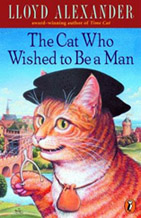
“Let me tell you about men,” complains the wizard Stephanus to Lionel, his restless and talkative cat. “Wolves are gentler. Geese are wiser. Jackasses have better sense.” Despite these warnings, Lionel persists: he wants to be a person. In The Cat Who Wished to Be a Man, Lloyd Alexander follows Lionel’s adventures as he get his wish and trades the secluded wizard’s cottage for the clamor and conflict of the town—and all the contradictions and complexities of being human.

Published in 1973, five years after the end of the Prydain series, this slim comic novel invites comparisons to Alexander’s longer, richer works. Several characters are less interesting versions of old favorites: Stephanus, the cranky wizard, could be Dallben in a particularly bad mood, and the dubious Dr. Tudbelly, a traveling purveyor of “exilirs, tinctures, and unguents” who sprinkles his speech with misused Latin, could have been understudy to Fflewdur Fflam. Although The Cat Who Wished to Be a Man never fails to entertain, its love story is simple, its innkeeper-heroine is underdeveloped, and its overall comic sensibility diminishes the dramatic tension by ensuring that our heroes are rarely in any real danger.

Fortunately, that comic sensibility distinguishes this little novel by giving Alexander opportunities for social commentary and allowing him to develop, in 107 pages, his own philosophy of human nature. Take Mayor Pursewig, the crime boss who rules the town of Brightford by intimidating the locals with legalese:

“These two, knowingly, willingly, and with malice aforethought, removed their corporeal presence from an interriparian structure for the purpose of absconding without disbursement of a legally constituted financial obligation.”

“What he says,” Dr. Tudbelly muttered to the puzzled Lionel, “is that we crossed Brightford Bridge without paying any toll.”

“But we didn’t cross the bridge,” Lionel protested. “We jumped off. And the reason we jumped off is that were were being shot at with those things called crossbows.”

Pursewig owns the bridge, operates its tollgates, and holds the mortgages to half of Brightford’s houses, but he maintains his power by operating outside the law. He floods his competitors’ basements with rats, detains out-of-towners, presides over kangaroo courts, and sentences the “guilty” to thumbscrews. Amusingly, although the township’s lawful government eventually sorts out this mess, Alexander sees the council members as the arbiters of last resort. Well-meaning but clueless, they are so cloistered, and so distracted by Pursewig’s proposal for a new tax on window-panes, that they have no idea how badly their people have suffered.

Despite social critiques that could shade into cynicism, Alexander resists taking a dim view of human nature, opting instead for a pleasantly comic perspective. He once wrote that his books deal with “how we learn to be genuine human beings,” and The Cat Who Wished to Be a Man explores that notion at its most literal. Lionel seems at first to be a tabula rasa: he learns to walk, he struggles to put on clothing, and he misunderstands figurative expressions such as “You’ll eat a big slice of humble pie.” But the former cat is not without human instincts: he is bemused by the corrupt mayor’s manipulations of the legal system, angered by human discourtesy, and shocked when his enemies attempt to murder him. At times, he is tempted to steal and kill—but in the end, he chooses to save a life.

As far as Lloyd Alexander is concerned, even a brand-new human can recognize the difference between good behavior and bad. Decency and cruelty are both innately human traits, but so is the ability to distinguish between them. Lionel’s mastery of his new, competing human instincts should hearten young readers who will soon face moral choices of their own. The hope Alexander offers them belies the misanthropic dictum of Lionel’s former owner: “Be glad you are a cat.”

“But she didn’t understand; she just smiled and held my hand.”

In recent weeks, Matt Gabriele at Modern Medieval has hosted a blog forum about communicating the relevance of the Middle Ages to people outside of academia. I took him up on his open invitation and wrote a short piece about the pleasures and pitfalls of “applied medievalism.” Because if there’s one thing I’ve learned after two years of book promotion, it’s that going on the road to talk about Charlemagne is a lot like touring with Mötley Crüe, if the Crüe attracted small, sober, courteous crowds whose health-care regimen never included a visit from “Dr. Feelgood.”

(That said, the next time a book festival fails to remove the yellow M&Ms from the candy dishes in my dressing room, I shall be forced to raise my voice. Surely Vince Neil would approve.)

Bardzo dziękuję – takk fyrir – danke schoen – thanks.

On Sunday, a few hours after I first posted about Paralyzed Veterans of America, I went to the grocery store and found myself in line behind a wheelchair athlete. That auspicious coincidence made me hopeful that this fundraiser was going to turn out well.

Fourteen donations came from California, D.C., Florida, New York, Virginia, Maryland, Pennsylvania, Kansas, Utah, and Australia. Ten people claimed books; three more kind souls donated just for the heck of it.

Three people donated $10 each.
One person donated $12.
One person donated $15.
One person donated $20.
Five people donated $25 each.
One person donated $50.
One person donated $100.
As promised, I donated $75.

The total amount donated by you to PVA: $427.

What can I say? For a three-day fund drive run by a small-time author with a tiny blog, that result is outstanding. I am amazed—and very, very grateful.

I also need to extend a special thanks to several blogs for helping spread the word: Books, Inq., Steven Hart, Unlocked Wordhoard, What’s the Rumpus, and World of Royalty. Encouraging their readers to come over here was a vital contribution all its own.

If PVA holds events in your area, then go, watch, and cheer. You’ll be impressed by the athletes and inspired by their accomplishments. More generally, as people tighten their budgets, donations to groups like PVA are sure to decrease, so in the coming months, keep in mind that your favorite organizations still need you.

Thanks for making this impromptu campaign a success! In a day or two, as the heady rush of philanthropy subsides, this blog will return to its usual preoccupations: medievalism, books, and indispensable Roger Miller chicken medleys.