“The check’s in the mail, and I’ll see you in church…”

Someday soon, Karl der Grosse and I will have to part company—but I’m glad that day has not yet come. Otherwise, I’d never find neat stuff like this in my mailbox.

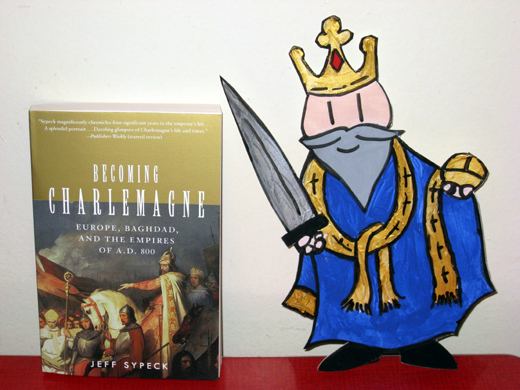
Yep, that’s a Charlemagne stick puppet, made by none other than medievalist and puppeteer Jennifer Lynn Jordan. Thanks, Jen!

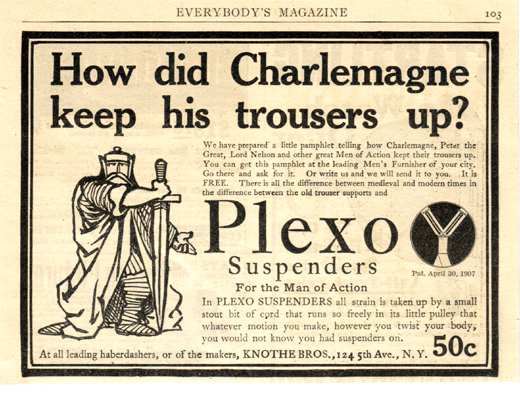
Perhaps Jen’s puppet can help us answer the timeless question posed by something else I recently got in the mail.

Of course, most readers of this blog know that Charlemagne wasn’t exactly renowned for keeping his trousers up in the first place. Alas, this ad doesn’t answer the question it poses; it only promotes a free brochure that does promise an answer. I haven’t yet located a copy of that brochure—but, as another legendary bearded figure once sang, the road goes ever on and on…

“And it takes a knight, and a girl, and a book of this kind…”

Gaudeamus igitur! I’m pleased to announce that tomorrow, the paperback edition of Becoming Charlemagne will finally hit the shelves. You can pick up a copy at your local bookstore (including Barnes & Noble, which will be hyping the book on its “new releases” tables), or you can easily order it through Amazon.

This trade paperback is the book as I’ve always envisioned it: compact, affordable, and easy to transport. It’ll make a fine last-minute stocking-stuffer for the history buff in your life—or a great way to spend that precious gift card.

While you’re at it, if you’re in a medieval mood, don’t forget to download my free translation of “The Tale of Charlemagne and Ralph the Collier.” Free medieval literature in translation! Not even Santa can promise that.

“It was dark as I drove the point home…”

When he paced the scriptorium and scowled at the monks, inspecting their handiwork, eyeing their script, he couldn’t have foreseen where their books would end up. Twelve centuries later, one of their most enlightening creations is stored away at the British Library: a Bible created under the watchful eye of Theodulf, abbot of Fleury and bishop of Orleans at the turn of the ninth century.

If his poetry is any indication, Theodulf was not a very sentimental man. A veritable connoisseur of verse warfare, the Visigothic refugee from Islamic Spain depicted himself as a masterful wit. He baited Frankish nobles with Latin insults they couldn’t understand. He blasted the poetry of an Irish competitor by criticizing his pronunciation, declaring him “an abomination” and announcing that “c” was the “letter of salvation” because it rescued Scottus, “Irishman,” from becoming sottus, “idiot.” Schooled in theology, trained in the law, Theodulf was brilliant. He made sure posterity knew it.

Theodulf couldn’t abide the impulses of pilgrims. He frowned on the veneration of icons. He would have rolled his eyes at the sight of museum-goers gawking at sacred objects simply because of their age. Multa scis et nulla sapis, he would have scolded them: “You know so much, and you understand nothing.”

But at the British Library, on the one decorated page of the “Theodulf Bible,” is evidence, maybe, of the bishop’s softer side. Facing a page of shockingly tiny script, the canon table doesn’t have a Northern European look to it. At the top, unmissable, are the horseshoe arches associated with Islamic Spain. They’re held aloft by five colorful columns, which aren’t decorated with the usual Romanesque doodads or acanthus-leaf designs. Steps, squiggles, and scroll-like details wind their way up each tall and slender column. They wouldn’t look out of place in an Andalusian mosque. Naturally, there’s not a single human figure in sight.

The scribe, of course, could have come from anywhere in Europe. We can’t dust the folios for the fingerprints of a scholar some twelve centuries dead. Theodulf himself—a bishop, an abbot, a counselor to kings—may never have touched that particular leaf.

But it is charming to imagine Theodulf, the great Carolingian sophisticate, recalling a scene from his own distant youth—impressions, clear ones, of places he would never see again, a streetscape of long-lost neighbors whose souls he continued to pray for—and then leaning over the shoulder of a nervous scribe, eager to tell him: “Here. These are the arches. It’s how I remember them. I want you to paint them exactly this way.”

What would Theodulf make of this speculation, this effort to spy on his medieval mind? If the bishop were as blustery as he portrayed himself, he’d have reacted like his rivals in poetic combat, attonitus, tremulus, furibundus, anhelus—”frantic, trembling, raging, panting.” But as an intellectual, a scholar who did his best to build a better Bible, Theodulf surely would have chuckled. In his heyday, he compared his colleagues to scurrying ants. He slandered them as drunkards, he made fun of their weight, and he dubbed all his rivals intemperate fools. The bishop ended his satiric poems with Christian pleas for forgiveness—but he knew full well that few of his hapless targets could truly reply in kind.

Theodulf loved a good joke—or so we imagine, based on some fragments in very old books. If we want to strip the man of his historical dignity, wrongly portray him as a sentimental sap, rebaptize the sharp-tongued Goth in mawkish, imaginary tears, we can. He can’t stop us.

Theodulf’s poems were a plea for someone to spar with, but now the joke is on him. For once, the great wit doesn’t get the final word. Let’s hope the bishop is laughing; at last, he found a worthy foe in time.

“Put it all down to chemistry…”

Yesterday, I posted one of the more humorous poems of Theodulf of Orleans. Here’s another one, loosely translated from quantitative meter into rhyming couplets. Those of you with kids may get a kick out of it.

DELUSA EXPECTATIO

Grande habet initium cum res vilissima dictu,
Tunc gignis murem, magne elephante, brevem.
Sic patri quidam retulit sua somnia natus,
Depromens animo frivola dicta suo:
“O pater, in somnis dicam quae mira videbam,
Moverunt animum talia visa meum.
Bos dabat humanas nostras hac nocte loquelas,
Ille loquebatur, nos stupebamus,” ait.
Tum pater attonitus rem sic inquirit ab illo:
“Dic, quod dicebat,” intulit ille: “Nihil.”

DELUDED EXPECTATION

When momentous beginnings mere trifles espouse,
Then you, mighty elephant, bring forth a mouse.
A son told his father his dreams; thus he heard
What fell from his thoughts, every frivolous word:
“Father, I’ll say what I see in my mind.
The most troubling visions in sleep do I find:
An ox who could speak I encountered tonight.
He talked! We were rather amazed at the sight.”
Inquired the father, “What news did he bring?”
Answering him, he replied, “Not a thing.”

“There were plants and birds and rocks and things…”

While I was writing Becoming Charlemagne, I spent a fair amount of time skimming the works of Theodulf of Orleans, the witty bishop who left behind a significant corpus of poetry. Most of his longer works about religious doctrine are a bit boring for the modern reader and way beyond my ability to parse, but a few of his shorter poems are gems—and a pleasure to translate.

Here’s one such poem, first in the original Latin, and then in my own translation (in rhymed couplets, an arbitrarily chosen form).

DE EQUO PERDITO

Saepe dat ingenium quod vis conferre negabat.
Compos et arte est, qui viribus impos erat.
Ereptum furto castrensi in turbine quidam.
Accipe, qua miles arte recepit equum.
Orbus equo fit, preco ciet hae compita voce:
“Quisquis habet nostrum, reddere certet equum.
Sin alias, tanta faciam ratione coactus,
Quod noster Roma fecit in urbe pater.”
Res movet haec omnes, et equum fur sivit abire.
Dum sua vel populi damna pavenda timet.
Hunc herus ut reperit, gaudet potiturque reperto,
Gratanturque illi, quis metus ante fuit.
Inde rogant, quid equo fuerat facturus adempto,
Vel quid in urbe suus egerit ante pater.
“Sellae,” ait, “adiunctis collo revehendo lupatis
Sarcinulisque aliis ibat onustus inops.
Nil quod pungat habens, calcaria calce reportans,
Olim eques, inde redit ad sua tecta pedes.
Hunc imitatus ego fecissem talia tristis,
Ni foret iste mihi, crede, repertus equus.”

CONCERNING A LOST HORSE

Brains can defend you where brawn can’t assist;
Often a weakling on wits can subsist.
So hear how a soldier, employing no force,
In his encampment retrieved his lost horse.
He stood at the crossroads and made this decree:
“If you stole my horse, then return it to me!
For if you should fail, I’ll be forced to proceed
Like my father before me in Rome—so take heed!”
The men all grew nervous; the thief felt remorse:
Fearing for all, he returned the man’s horse.
The owner rejoiced; celebration was made
By all of the men who had been so afraid.
At last they inquired of him, every one,
Just what it was that his father had done.
“His bridle, his saddle, his old traveling-sack
He flung ’round his neck, the poor man, and walked back.
So useless his spurs; on his heels they stayed put.
Once a great horseman, he came home on foot.
Believe me, I almost pursued his sad course:
I’d have done the same thing had I not found my horse.”

The Tale of Charlemagne and Ralph the Collier.

[UPDATE: As of December 2012, information on purchasing The Tale of Charlemagne and Ralph the Collier as either a paperback or an e-book can be found here.]

Do students better appreciate the artistry of great medieval poets if they also read some of the less studied works of the Middle Ages? After teaching a survey course for several years, I wondered about that—but I also knew that time constraints prevented me from assigning lengthy Middle English poems that would take students weeks to read. Instead, I decided to make my own classroom translations of several medieval romances, lively narrative poems that put more frequently studied works in context but which themselves rarely appear on an undergraduate syllabus.

“The Tale of Charlemagne and Ralph the Collier” is my third modern English translation of a Middle English work. It’s an entertaining 972-line romance packed with folktale motifs, elements of French chansons, burlesque humor, post-Crusades Christianity, and an examination of the rules of courtesy that may be more thoughtful than it first appears. (If you’d like to read “The Taill of Rauf Coilyear” in its original language, you can check it out at the TEAMS Web site.)

You don’t need a background in medieval literature to enjoy this translation. If you’re new to the storytelling of this period, you’ll notice a typically medieval mixture of the familiar and the strange. The lengthy alliterative stanzas and many of the plot twists may frustrate modern sensibilities, but I hope readers can benefit from greater access to a story that once delighted late medieval people.

This translation—a no-frills, low-resolution, 19-page PDF—is free to download. However, if you find it useful, edifying, or entertaining, please support my efforts by purchasing a copy of my book Becoming Charlemagne in hardcover, paperback, or Kindle edition.

If you’d like to refer someone to this translation, please don’t link directly to the PDF or distribute it through other Web sites. Instead, please link to this page.

I hope you enjoy this other Christmas story about an unlikely hero named Ralph.

“Looked at my kingdom, I was finally there…”

I collect Charlemagniana. Friends, family, and generous readers support my fixation by alerting me to Charlemagne-inspired novels, movies, news stories, pop songs, public gardens—any cultural spinoff that amplifies the muffled murmurs of the Matter of France.

Thanks to my friend Kate Marie, I now know where the emperor himself, were he a time traveler, might enjoy a hearty meal: at a remarkable Charlemagne-themed bistro in Weston, Missouri.

If I lived nearby, I’d be a regular. How could I resist such a menu? Turpin’s paella! Eggihard’s sirloin! Roland’s horn smothered in Childeric sauce! I’d take a ninth-century name, don my nephew’s helmet and a rakish Carolingian mustache, and stake my claim to a corner of the bar. Sing, O Theodulf! Bring on the dancing bears! Hel-lo, Gundrada…

Alas, it may be a while before I can partake of this unique neo-Carolingian repast. But Kate Marie and her husband, Sadeeq, are on notice: the next time I drive through the Midwest, we’re meeting there for lunch.

They needn’t worry, though. The helmets and mustaches? I’ll bring enough for three.

“Floating in this cosmic jacuzzi…”

This weekend, at a truly enjoyable fundraiser, I met several newcomers to Becoming Charlemagne, as well as a few people who had already read the book. As we got to chatting, I was reminded of the neatest thing about writing a book in the first place: the author’s obsession, developed over years and often nurtured in solitude, finally becomes a shared point of reference through which readers can look anew at some aspect of the world.

Those readers aren’t always strangers, either. I came home from the luncheon to find that a friend had emailed me the following news item:

Schwarzenegger Learned Dealmaking in Tub

San Jose, Calif. (AP) – Gov. Arnold Schwarzenegger learned the art of political negotiation in a setting that’s oh so California – soaking in his backyard hot tub. Keynoting a gathering of Silicon Valley business leaders Friday, the Republican governor explained how his wife – former television news anchor Maria Shriver – came to support his 2003 gubernatorial bid.

“We were sitting in the Jacuzzi. I said, ‘Maria, here’s an idea. What do you think about this, me running for governor?'” Schwarzenegger said to peals of laughter. “I said, ‘There’s a recall, there’s only a 2-month campaign. I think we can work our way through this two months and then I’m governor – isn’t that great?'”

After the laughter died down, Schwarzenegger turned solemn.

“In all seriousness, she had tears in her eyes. I had to work on her for 14 days,” Schwarzenegger said. “That’s where I learned to negotiate – bringing Democrats and Republicans together right there in the Jacuzzi.”

“Californian, eh?” my friend writes. “Seems to me Ahnold’s not the first leader of Germanic extraction to practice politics from the tub.”

He’s right. Here’s Einhard on—who else?—Charlemagne:

He took delight in steam-baths at the thermal springs, and loved to exercise himself in the water whenever he could. He was an extremely strong swimmer and in this sport no one could surpass him. It was for this reason that he built his palace at Aachen and remained continuously in residence there during the last years of his life and indeed until the moment of his death. He would invite not only his sons to bathe with him, but his nobles and friends as well, and occasionally even a crowd of his attendants and bodyguards, so that sometimes a hundred men or more would be in the water together.

Last year, during Thanksgiving and Christmas, my family and friends surprised me with their eagerness to talk about the conflicts of Charlemagne’s era, the culture of medieval Baghdad, and the cruelty of the Byzantine empress Irene. Maybe this year, inspired by historical parallels, we can debate a more urgent proposition: whether Karolus Magnus, for all his scholarly advisers, would have been able to pronounce the word “gubernatorial” without sounding just a little bit silly.

“…our only goal will be the western shore.”

What is it with the Sci-Fi Channel? Last weekend, as I prepared to teach The Saga of the Volsungs, they re-aired Dark Kingdom: The Dragon King, a sweet Teutonic smoothie that blends the Volsungasaga, the Nibelungenlied, and Wagner’s Ring into one lumpy Gygaxian confection.

And then, this weekend—right after my lonely blog post to honor Leif Eriksson Day—they premiered Wraiths of Roanoke, the story of—well, I’ll let MovieWeb summarize the plot:

In the late 16th century, colonists on Roanoke Island, Virginia, found themselves under siege against evil spirits left behind by the Vikings. The Wraiths are hunting the innocent souls of the first-born children in order to get into Valhalla.

I’m delighted that even the story of the Roanoke colony can be infused with a heady dose of spooky, horn-helmed medievalism, however unlikely it may seem. But as I glance at the Sci-Fi Channel’s prodigious roster of monsters and heroes, I notice one glaring omission—one legendary figure whose ability to carry a formulaic, CGI-laden B-movie has been grievously overlooked.

I refer, of course, to Charlemagne.

And so, as I await the release of the Becoming Charlemagne trade paperback, I’ll also hope for that phone call from the Sci-Fi Channel. As a reasonable man, I’ll happily make…adjustments…to history, as long as every change is consistent with Sci-Fi’s famously stringent standards of accuracy.

After all, if Coolio can fight a pterodactyl, and if Beowulf can wield a crossbow that blows stuff up, then I see no reason why Charlemagne can’t fight a giant scorpion—nay, ride a giant scorpion—on the slopes of a fiery volcano while battling Nazi super-mutants with the aid of lethal anthropomorphic mosquitoes.

There’s nothing in the sources that says he didn’t. And believe me, I’ve looked.

“And folded in this scrap of paper…”

What hath Nashville to do with Francia? Before this week, I might have answered “not much,” but that was before I discovered what may be the only country song that mentions the Emperor Charlemagne.

In “Charlemagne’s Home Town,” Texas-born James McMurtry becomes homesick while traveling abroad. During a pause in his travels, presumably at Aachen, he broods over an unresolved romance.

Near the end of the song, McMurtry lets his surroundings evoke the melancholy of the solo traveler:

Like the bones of some saint beneath a church floor
Who must have died for lack of light,
The color snapshots that I sent you
All came out in black and white.

Won’t you fly across that ocean,
Take a train on down?
Because the night’s growing lonesome
In Charlemagne’s home town.

At Aachen, homesickness is a time-honored tradition. Countless ambassadors, dignitaries, messengers, and merchants went there during Charlemagne’s reign. More than a few must have pined for their homelands.

Although he didn’t travel to Aachen, Paul the Deacon nursed a similar sadness when he was forced to linger at Charlemagne’s court. In the 780s, the Lombard monk journeyed north across the Alps to one of Charlemagne’s palaces on the Moselle, where he petitioned the king to release his brother, a hostage. In a letter to Theudemar, abbot of Monte Cassino, Paul claims that the Frankish courtiers are friendly enough, but his mind and his heart are both elsewhere:

Even though the world’s vast distances physically keep me from you, a tenacious love for your companionship affects me; it cannot be severed. I am tormented nearly every moment by love for our brothers and superiors, to such an extent that it cannot be related in a letter or briefly explained in a few short pages.

For when I think of the times we devoted to such holy works; the most pleasant station of my quarters; your pious and religious goodwill; the troop of so many soldiers of Christ laboring to do holy works; the shining examples of diverse virtues in each brother; and sweet conversations about the Father’s highest kingdom, then I sit stunned, I am amazed, I grow weary, and I am unable to hold back my tears.

I dwell here among Catholics and dedicated Christians. They receive me well, and they show me sufficient kindness for your sake and for the sake of our father Benedict—but compared to your monastery, the palace is a prison to me, and compared to the great peacefulness of your community, life here is a hurricane.

This land holds only my worn-out body; in all my thoughts, where I remain strong, I am with you.

James McMurtry and Paul the Deacon wouldn’t have had much to talk about; the politically charged musician and the history-minded monk were born at the far ends of different and distant worlds. But by touching on the same essential emotion, the two men are commiserating across cultures, as lonely travelers have always done. Together they give voice to a fellowship of forgotten wanderers whose business brought them to Charlemagne but who dearly longed to be home.

This letter and song are a shared round of beer, even across 1,200 years. They’re also a reminder: sometimes the common ground is nothing more than the place where you happen to be stuck.