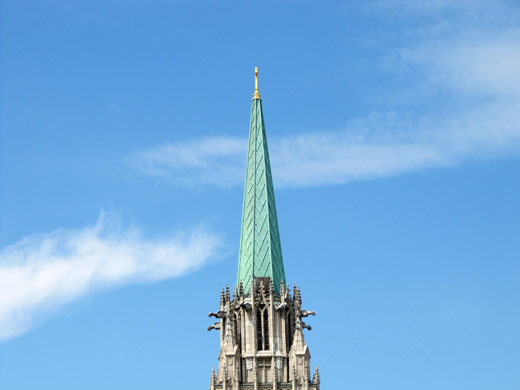
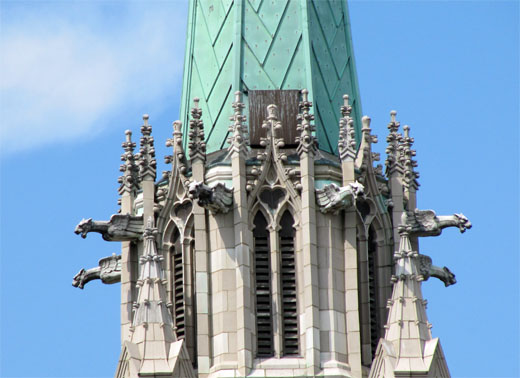
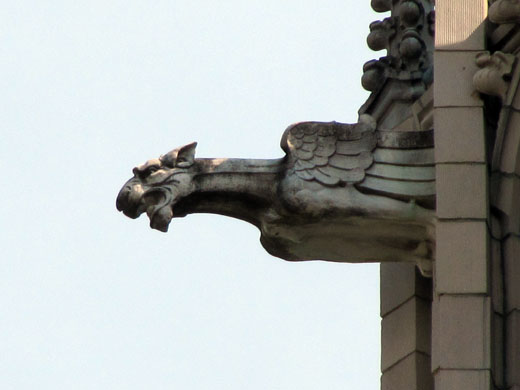
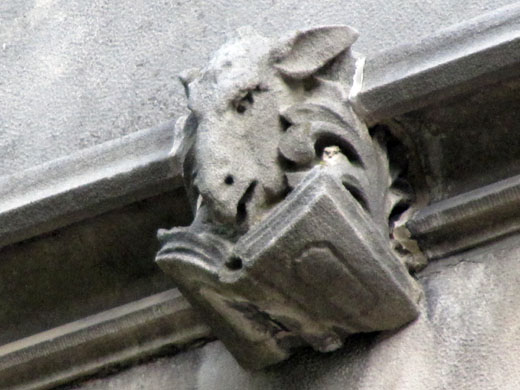
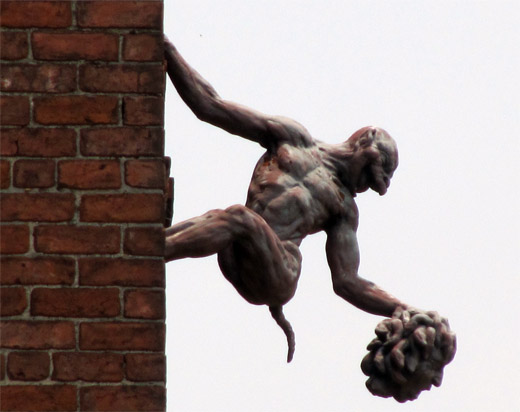
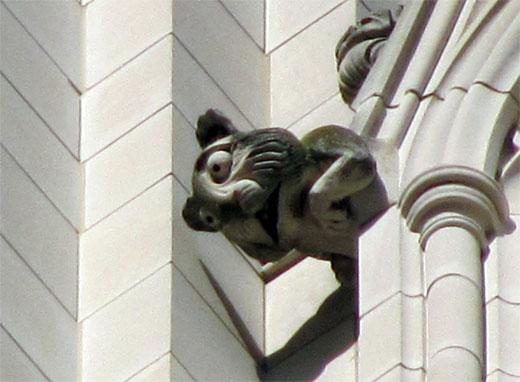
“My words trickle down, from a wound that I have no intention to heal…”

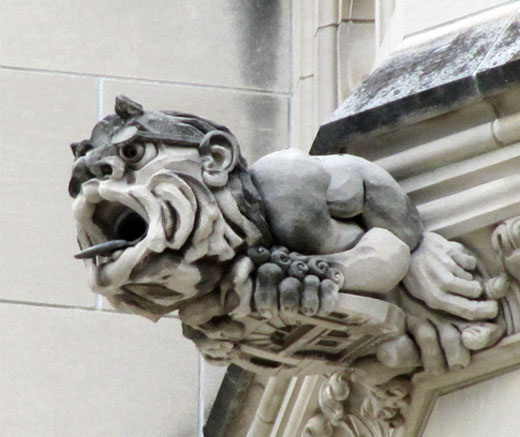
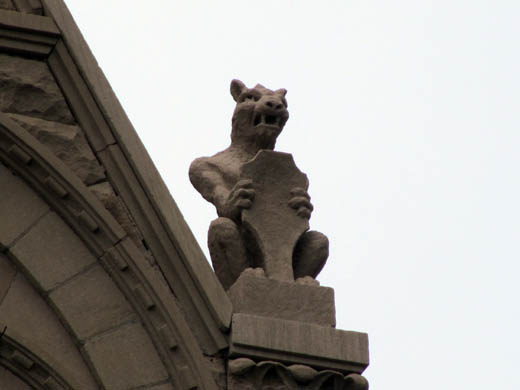
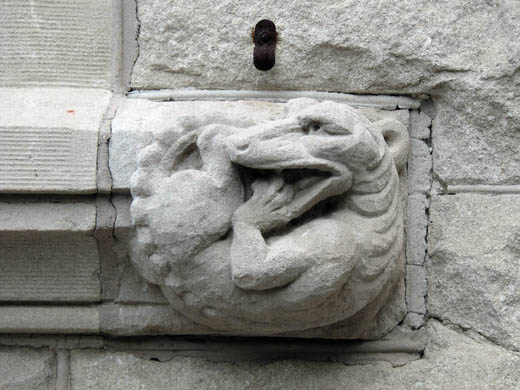
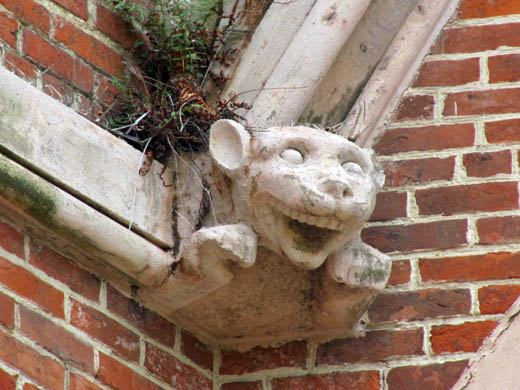
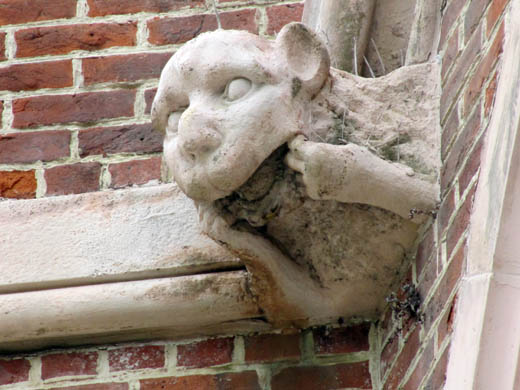
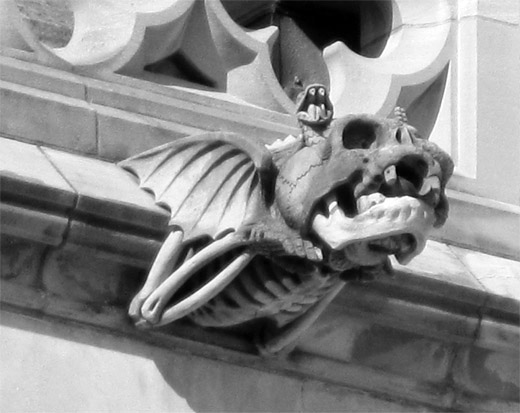
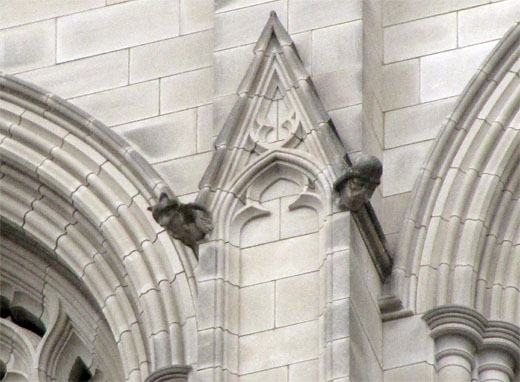
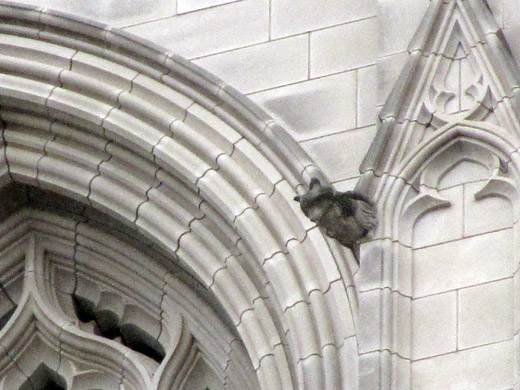
When the earthquake shook the National Cathedral on August 23, this bat-like beastie was damaged by falling stone. He clearly isn’t thinking straight; jilted, he may yet lose his head.

THEODICY
(DRÓTTKV
ÆTT)

rote & firmly formal,
first among the versed, we
spake no revolt, spelt our
spensings sans offenses.
dare we spect how dear my
dignant lord rewards me?
knife-stook bashes neck, &
never! I vow [bowing].

The broke-necked gargoyle on August 26, shot from the parking lot with a zoom lens…


…and photographed intact last summer from the observation deck:

(For all the entries in this series, hit the “looking up” tab, or read the gargoyle FAQ.)

“….and it’s true, if all this around us is paradise.”

“Excuse me, sir?”

He’s probably ten, but he’s small for his age. His purple ball has rolled into unbusy State Street, and while he’s forbidden to step off the curb, apparently he is allowed to talk to strangers.

“Can you please throw me that ball?”

I do. He’s polite enough not to tell me I’m a strange sight on a Sunday afternoon. Subdued salsa from Puerto Rican cookouts drowns out the car noise. People are chatting; it’s too hot to dance.

“Takin’ pictures, huh?” He holds his ball under one arm and glances at the sky. “You know what would make a good picture? Those gargoyles up there. They’re awesome.”

He’s right. They see everything in Perth Amboy.

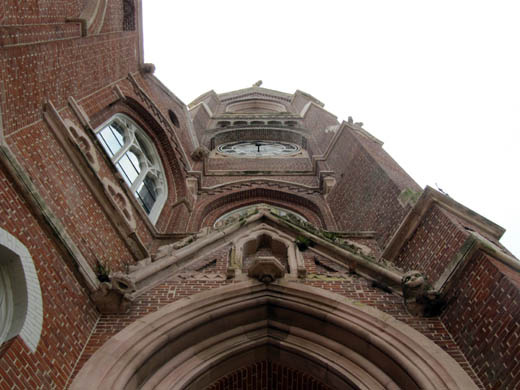
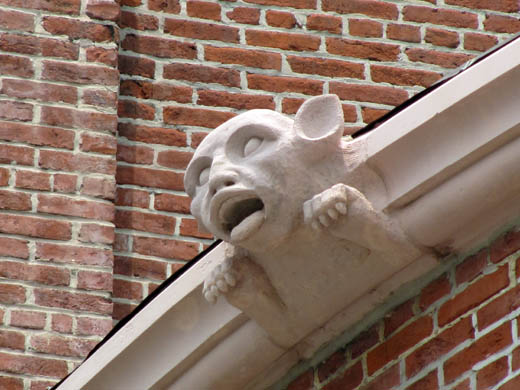
Built in 1919 by and for the Polish Catholics of Perth Amboy, St. Stephen’s Church is a fine example of American neo-Gothic, but despite its intricacy, it’s bereft of grotesques—except for the huge faux-gargoyles below the spire.

Weirdly, I can’t find any public information about the architect, but whoever he was, he didn’t Americanize this church, nor did he grant its parishoners (who still run a Polish CCD) a speck of Slavic idiom. No, the mind behind St. Stephen’s adored Western Europe; those gargoyles would be right at home on a cathedral like Bayeux.

Though these gargoyles seem like relics of the city’s better days, prosperity alone doesn’t explain them. In the late 19th and early 20th centuries, when neo-Gothic building was rampant, Perth Amboy was a gargoyle breeding ground. A local abundance of rich clay here and in nearby Woodbridge and New Brunswick meant that Perth Amboy firms like A. Hall and Sons (later the Perth Amboy Terra Cotta Company, later Atlantic Terra Cotta) made grotesques and ornamentation for buildings across the United States, providing decorations for the Woolworth Building, exterior details for the Philadelphia Museum of Art, and the entire roof of the U.S. Supreme Court.

So whose idea were the gargoyles of St. Stephen’s? A 1906 Architectural Record article shows similarly slender beasties made by the Perth Amboy Terra Cotta Company on the first City College of New York building, a neo-Gothic landmark by architect George B. Post.

Then again, Charles Follen McKim of the legendary firm McKim, Mead, and White had attended school in Perth Amboy, and he partnered with the Perth Amboy Terra Cotta Company to make multicolored brick when brownstone and red brick fell out of fashion. It’s tempting to see St. Stephen’s as a “forgotten” work by MM&W or one of the many architects associated with them, but then what if it’s a great Gothic sob by the fanatically medievalist church designer Ralph Adams Cram? Or maybe it’s a monument to the faith of an architect no one has thought to remember.

I asked the folks at St. Stephen’s if they know who built their church; I’ve yet to hear back. Regardless, I’ll bet that like the kid who pointed them out to me, the gargoyles of Perth Amboy were locally born—a hundred years distant, but raised in an age that perceives the medieval wherever you look.

“…all the best freaks are here, please stop staring at me…”

Lately, people point me to gargoylish doings wherever I go—including my home state. While rushing across Princeton last week, I learned that since the university’s guide to gargoyles (grotesques, to be accurate) is far from complete, hunting for neo-Gothic doodads still leads to charming surprises.

At McCosh Hall, I might have missed this erudite goat.

Or this monk. (“Prends moi—je suis a toi—mea culpa!”)

Or this macabre baker making Taylor ham the traditional way.

On 1879 Hall (built in 1904), monsters howl silent o’er summer lawns…

…monkeys tear apart a human face…

…and despite what a few lines of poetry claim…


…those “unseen things” may be studying you.

“I need him now to meet me face to face…”

From April to June, a local thief took advantage of dawn twilight to help himself to flowers from private yards, community gardens, and the cathedral grounds. In mid-June, the police nabbed him, and although he wasn’t arrested, his crime spree witheredbut not before a gargoyle on the north nave barked a bit of doggerel.

NOTEBOOK: FRAGMENTS FOR A FLOWER THIEF

They paced the plot for hours, as mothers would,
But understood: “His arms were full of flowers.”

      * * *

CHORUS
  The cruelest month: a cusp’d cliché
  That pricks the wisp of guilty May
  And breeds the thief of blameless June.
   Summer, unsurprise us soon.

      * * *

“In April it was lilacs.” (Listen how
she hates to blame the deer.) “Hydrangeas now!
Four times this spring.” (Of course it could be deer.)
My peonies at least were spared this year.

      * * *

The Lilack speaketh late of early Love.
The bolder Peon prospereth a-red.
The Seede abundant unifies the Figge.
We love thee numb, O Koriandrum, come—
Fragaria, redeem the injur’d Maid.

      * * *

“He sold us flowers first a year ago.
We called him—Shantih?” Shantih does not know.

      * * *

We conquer by the weapons we desert.
By dawn the dogs will bound ahead to find
The efflorescent errand you resigned,
The arrow shafts unwagoned in the dirt.

(For all the entries in this series, hit the “looking up” tab, or read the gargoyle FAQ.)

“Sie haben uns ein Denkmal gebaut…”

Known as “the administrator,” this gargoyle hangs just to the side of the cathedral’s west façade and grips a miniature of the façade of the school he faces. After all this time, he argues in admirably good faith.

FAÇADE

Behold the form: We found our faith in spires.
From balustrade to buttress, by design
We build upon the base of our desires.
The ape of human order we divine,
And carved creation lightly gives us praise.
On day and eve, proportion we impose:
The perfect sun sets perfectly ablaze
A thousand perfect petals on the rose;
An arch constrains the brunt of outward pride.
One hymn we hue: “Ennobling words are dear
In thee, all sacramental modes preside
In thee”
       as from the fading close I hear
a thing to tempt us out of rite and rhyme,
       a sole cicada singing out of time.

(For all the entries in this series, hit the “looking up” tab, or read the gargoyle FAQ.)

“Way over yonder in the minor key…”

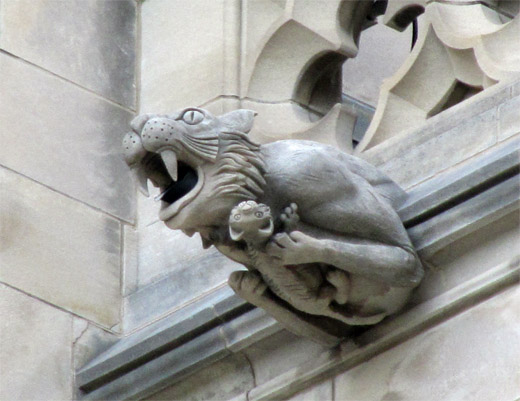
Sometimes a tiger mother makes more sound than sense, but obscurity is useful: It forces you to ask, “Will I understand this when I’m older, or is this nonsense?”

ST. JOHN’S EVE
(MIDSUMMER SONG)

When leaves that leach from every tree
Like bitten insects blight and curl,
The swollen moon may let you see
  But once a goblin girl.

Be quick: The brindled moths detest
To stir the brack and shallow air
Of seeping June, where scinnhiws nest,
  Yet you will find her there.

Their sodden boughs admit no strand
Of summer-wasted moon to stream
But one, but she must make her stand
  Within her sallow beam.

She snuffs the muck, but scarcely finds
The spoor of misremembered things,
As “Love, O careless Love, my mind’s
   Not right,” she sifts, she sings,

She scents, she turns—her eyes aflash
Like stars above a harrowed field
That starve their spark in cosmic ash,
  Eternity revealed

In silver curls, inflamed with sweat,
In reckless lilies, late awoke;
Their withring stems she stoops to let
  Enwreathe her, lest she choke,

While through the gloom, she stalks the word
That calls the rake of summer rain.
As some slight boy who nursed a bird
  But set her wing in vain,

She raises high her plunder fair,
She offers up a secret thing,
She grounds her glyph in graceless air,
  While wild around you ring

The beadling eyes that light abide
To see the perfect rind unfold,
To gnaw the hidden fast inside
  That goblins long to hold—

Her eyes will rise; you cast yours down.
Before her sneer, betray no guile.
And to her grin, extend a frown;
  In this, you whet her wile.

And if she riddles, answer straight;
And to her white, you echo black;
But when she fangs, embrace your fate,
  And her, and bite her back.

Then run, as you must always run,
And learn what you will never learn,
And goblin glances roundly shun;
  But let the memory burn.

Beyond the bramble, timbers blaze,
So join us as we rouse with song
The lazing dawn, and know our days
  Will never be this long.

Let seven into fathoms fall,
Let three around the wake-fire whirl,
And let your summer scant recall
  But once a goblin girl.
(For all the entries in this series, hit the “looking up” tab, or read the gargoyle FAQ.)

“…to holes of their own making in the cracks within the walls…”

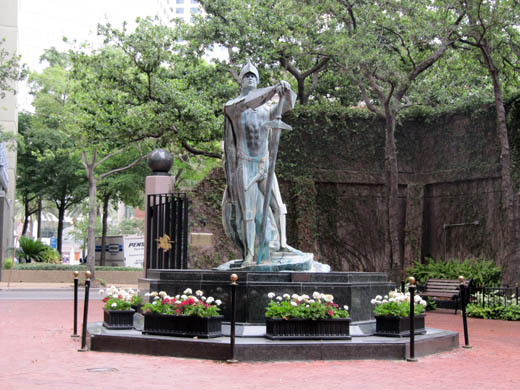
For four years, “Quid Plura?” has chased medievalist echoes in New Orleans—the statue of Ignatius Reilly, a shrine to a French saint, the glitter of Joan of Arc—as well as medieval-ish statuary in Cajun country and miscellaneous medievalism on the North Shore.

Yes, here there be saints—but where are the medieval monsters?

Earlier this week, on a hot afternoon, we sought to answer that question by turning to someone who slays them.

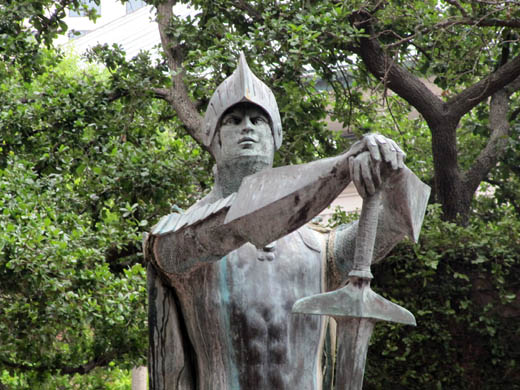
What say you, heroically-abdomened St. George in a hotel courtyard just outside the French Quarter?


George points west, so we’re off to the 16th Ward, where the beasts atop Tilton Memorial Hall at Tulane are timelessly monstrous rather than strictly medieval…

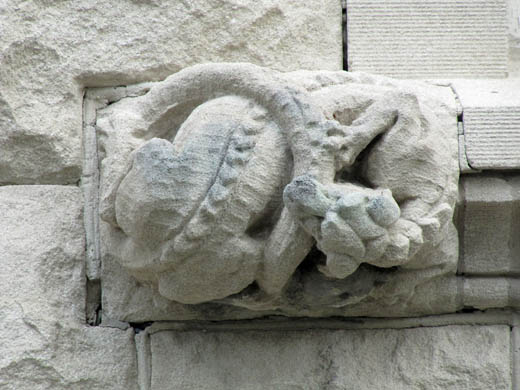
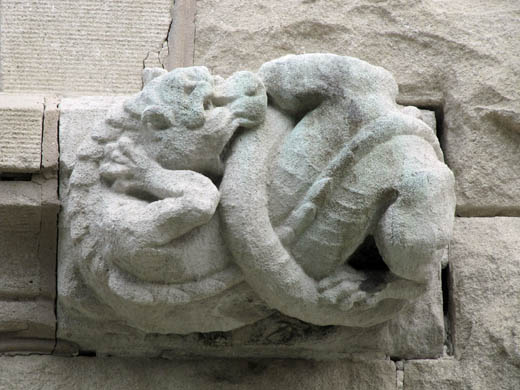
…but the alley behind the building hides a clutch of caudophagic dragons.

Heeding the call of the neo-Gothic, we take the streetcar east into Ward 12 and trudge down to the impressive St. Stephen Church on Napoleon Avenue…

…and when we look up…


…the neo-medieval mocks us.

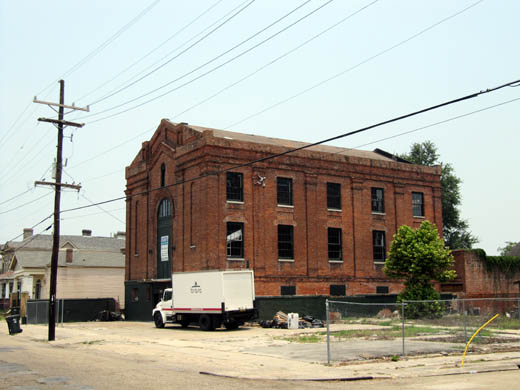
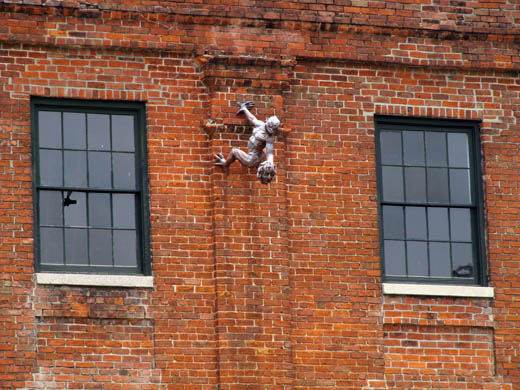
Yet we cling to the hope of grotesquerie, just as two miles to the east, on Jackson Avenue in Ward 10, something clings to the side of a gutted 19th-century synagogue…

…a creature not quite medieval…

…but poised to petrify your inner ten-year-old.

“So, I’ll continue to continue to pretend…”

CANTERBURY BELLS
(GOOD FRIDAY)

Campanula may bow; they dare not bend,
Though shafts of sun seem ever more remote.
I do not think the rain will ever end.

You breed prosodic lilacs and pretend:
“The drocts of April / pairst us to the rote;
Campanula may bow / they dare not bend,”

But poems (even this one) condescend;
You still need your umbrella and your coat.
I do not think the rain will ever end.

“I’ll drown my books!” you cry. (Yes: God forfend
Your graveside vigil lack some pithy quote.)
“Campanula may bow; they dare not bend—”

It comes out wrong. But what did you intend?
You plucked your eyes for pearls, and dimly wrote:
“I do not think the reign will ever end.”

Oremus: What can sodden bells portend
When even you misdoubt one hopeful note?
Campanula may bow; they dare not bend.
I do not think the rain will ever end.

(For all the entries in this series, hit the “looking up” tab, or read the gargoyle FAQ.)
“The rain water drips through a crack in the ceiling…”

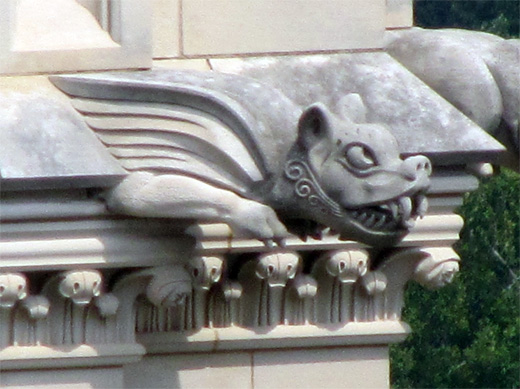
Every day, tour groups at the National Cathedral strain to see the grotesque of a certain famously evil pop-culture character, but they never notice the charming raccoon with whom he shares a buttress gablet. On rainy days like today, the raccoon deals with this recurring slight as any sensible creature would: by translating Rilke. (The original German poem is here.)

RAINER MARIA RILKE: SOLITUDE

Solitude is like the rain.
Along toward evening, rising up again
it slips the sea above the farther plain
to heaven, where it always rains, then down
from heaven falls alone upon the town.

Then down it rains in hours queerly cast,
when alleys turn to face the looming day,
when bodies, finding nothing, have at last
from one another glumly turned away,
and when, in their despite, two lives must stay
and side by side in one shared bed repose:

then solitude into the rivers flows…


(For all the entries in this series, hit the “looking up” tab, or read the gargoyle FAQ.)

“And the little wheel runs on faith…”

If you’ve ever owned a hamster, then you know how easily these creatures succumb to ontological and epistemological crises, especially when they look in a mirror. In this case, the mirror is Walters 71.170, a medieval artifact that also repays human scrutiny.

A HAMSTER CONSIDERS AN IVORY MIRROR COVER FROM MEDIEVAL FRANCE

Is this the wheel rabbanim learn
In serifed murmurs to discern
How beasts on every fourthwise spoke
Revolve by fours, but do not turn?

Is this the wheel the brahmin broke
When, himmel-eyed, she dared invoke
Her patient, wisdomed groom, then beamed
To bow her head for Roman stroke?

Is this the wheel a consul schemed
To wreathe with kaisers crudely dreamed
Who whirled their luckless lots away,
Yet leave one lady long esteemed?

Is this wheel the suras say
Was made of silver, not of clay,
And spelt like ash across the sky
To lift a grazing flock to pray?

Four beasts about the border fly;
Within, the aging never die.
For wheels in wheels I long to burn,
But which, the beast, the blest, am I?

(For all the entries in this series, hit the “looking up” tab, or read the gargoyle FAQ.)