“Slipping the clippers through the telephone wires…”

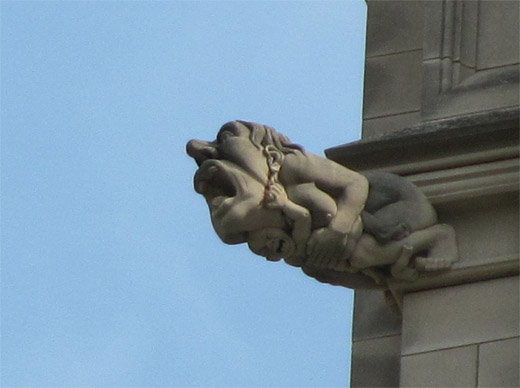
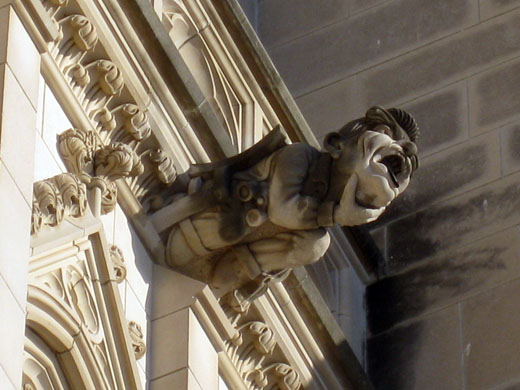
Cathedral visitors are sometimes confused, even offended, by gargoyles that honor irreverence or depict blatant evil. The suicidal, Gollum-like “Stabber” on the west front isn’t surprised; he knows what he is.

ALL HALLOWS’ EVE

Long live the weeds and the wilderness—yet
What would be left of the wildness and wet
Were it not for the curdle, the canker, the theft
That threaten to render the blessèd bereft?

Our beady-boned eyebulge flits over the burn;
Wily we twitch through the sack-shriveled fern
As the groin-growls enrage us where daggers bite through,
Damning the bloodline that dapples the dew.

Yet rounded in couplets, despair-darksome sneering,
Frown pitchblack poets defy all our leering,
Twindled revisioners burbling like broth,
Donning their Jesuit wind-shriven cloth.

What pumpkin-maws mumble, we ache to express;
Ghouls plunder verses they dare not possess.
Take heed of the unhallowed eyeblight you mourn:
Then know why the saints of the morning were born.

(For all the entries in this series, hit the “looking up” tab.)

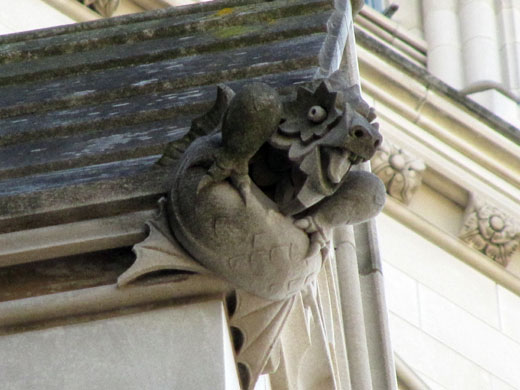
“Way up there in the poison glen…”

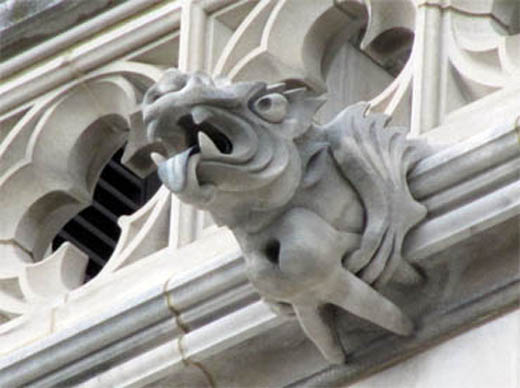
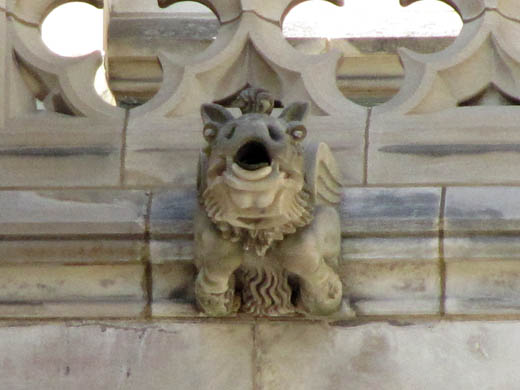
This creepy dragon on the north nave hides within his own fishy body. If you approach him, he’ll sing prophetic nonsense.

AUTUMN SONG

Clerks wrap swords in newsprint gray;
Voices of Avalon pine and pray.

Spine-cracked quartos brace the wall;
Voices of Avalon flake and fall.

Cursors burn a wanton field;
Voices of Avalon yawn and yield.

Spiders fast in pyx and grail;
Voices of Avalon fade and fail.

Glowing points rouse brush-bent hair;
Voices of Avalon strain and swear.

Roof-beams warp like corset bone;
Voices of Avalon mince and moan.

Unplucked medlar rots to wine;
Voices of Avalon pout and pine.

Marshes drown the back-toll’d bell;
Voices of Avalon swoon and swell.

Mice in moat-muck bloat face-down;
Voices of Avalon fuss and frown.

Grave-masks grin, but none deceive;
Voices of Avalon groan and grieve.

No knights rise, though one did try;
Voices of Avalon drift and die.

Furze-pigs rove in disarray;
Voices of Avalon seethe and say:

“Run, and raise the rust-white gate.”
Voices of Avalon wait.

(For all the entries in this series, hit the “looking up” tab.)

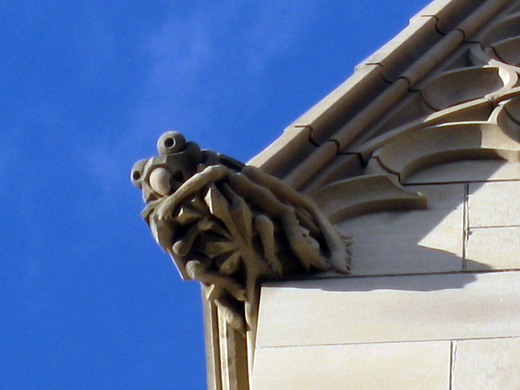
“‘I might be old, but I’m someone new,’ she said…”

In May, a cicada on a buttress chirped a ghazal. Today, a cockroach replied. Who knew insects talked like this?

FROH

The background: you returned—a draught of wine
Fulfilling sweet the word the wind had thrown,
Returning scents and sight, restoring mine.

Despairingly, we wandered on our own
Beyond you evermore, or so we feared,
Eternal, guileless girl—then how we cheered…

The foreground: love, it glows with you alone.


(For all the entries in this series, hit the “looking up” tab.)

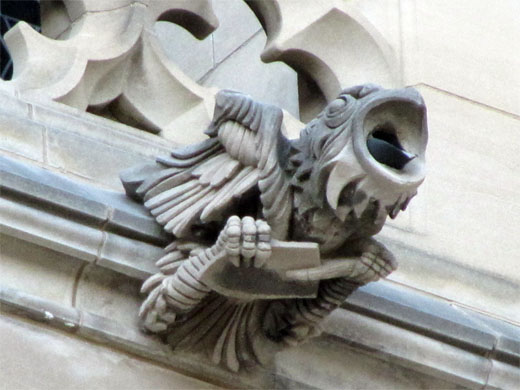
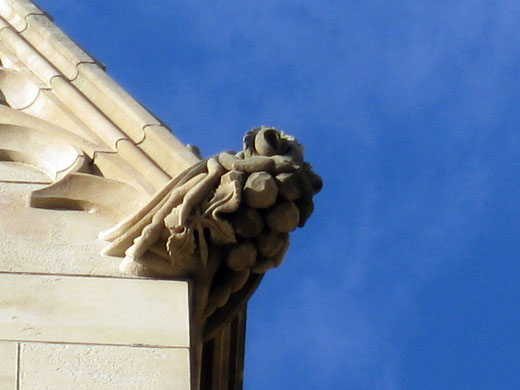
“Out in the garden, there’s half of a heaven…”

From his perch on the south nave, this avian gardener overlooks the Bishop’s Garden and the nearby woods, but clearly he takes a much longer view. He’ll tell you all about it if you ask him.

SUKKOT

I think that you shall never see
The garden fall when palmers flee.
The scales of summer groan and tilt;
The mite, the moth, the rain-dove wilt,
The hunchneck roses moan with thirst,
The medlar skullfruit split and burst,
But through the leafmeal, long asleep,
The eldritch from the wanwood creep,
Their twilight pastors freely led
By silkwaist suitors stirred from bed.
Their belts of straw and ivy buds
With coral clasps and amber studs
Give way to frond, and myrtle shoot,
And willow leaf, and brightripe fruit.
Through temples roiled by root and vine
They pass to pray, and so divine
Why revels must in autumn reign,
Why pilgrims pirouette in vain,
Why laggards must rehearse at last
The doom of some ecclesiast:
“The flowers do fade, and wanton fields
To wayward winter reckoning yields…”
So pinelights drift, like snows to come,
And mumbling lowly, shuffling numb,
They burrow into bowers veiled:
“Our fadelight feast again is failed.”
But seek no truth from sullen tree;
Recurrence clouds the memory.
We plait our laurels, fools by choice,
But only G-d can cry Rejoice.


(For all the entries in this series, hit the “looking up” tab.)

“Full moon, pass the window sideways…”

This cavewoman and her baby make for a vivid pair nearly 200 feet above the cathedral’s north lawn. She’s hard to see; the chip on her shoulder is hard to miss.

MEARCSTAPA

I’ve no gold cups       to catch your shrieks
And noises foul,       no nailing rock
Where cronish faces      fade, and matrons
Remoulded as maidens     mourn so gleefully
The babe whose face      they fouled with runes.
No—grear my mouth      and gray my eyes,
And shriv’ling hairs       in handfuls twine;
Time is a rot-wyrm       that riddles us through
And broods in its hole      upon our brighter days
But shares secrets       mere seeresses hide.
All this I owe you;      I own nothing more.
The work of the world      fathers wolfish brats,
But hold your ground.     Heroes will loathe you,
Knowing they need you,    lest no one forge
Prurient tales     from pride alone
Nor string a song    from strokeworn beards.
Behold how hall-thugs    hungry for butchery
Score rusty sword-tips     ’round scabs, hearing
Echoes of Caindom        in all but their own.
Rave when one belches      some rum-ram-ruf lay;
His bones will break.    Just bide your time.
Thole and thrive, son,    throughout dull days;
You’ve naught to fear.    Face them, beaming.
Swive or just sing with them.    Savor their smell.
Their bile, rising,     my boy, you’ll taste,
And soon you’ll crave     their crawling flesh,
And late you’ll drain     their draughts of blood,
And ere the dawn      their oaths they bleat,
Graying faces     greeting the morn
Will gape at your night-work,    noble heroes
Strangled, overthrown,     strawberry-flecked,
Sweet sentinels,     singers of tales,
Wyrd-graven warlords,    woebegone boys.
Peer from the tree line;    try not to gloat,
But make them hear you    howling your name.
All youth survives     in you alone,
So be for me     my bitter angel
Rightfully fated    to rage in the dark.
Motherly lore      will light the gloom:
Like candles touched      to torchwood pyre,
Mere men flicker;    monsters explode.


(For all the entries in this series, hit the “looking up” tab.)

“Sing ‘hi, lo, lay,’ at the end of the day…”

National Cathedral tour guides may try to tell you why this monster is clutching a giant molar 40 feet up on the south nave. I prefer his own explanation.

SONG

In my dream, a Pictish maiden
Paused and prayed here half a while,
Shade and snow a-swirl around her,
Something wanting in her smile.

From my scrafe, I spied in silence,
Watched her wend round weed and hill
And rose, and passed from forests dim,
Her foremost longing to fulfill.

Late I loped through Roman markets,
Hove the doors off Saxon halls,
Plumbed the moats of Norman mansions,
Flinched, then froze, when furtive calls

Enthralled me, lost, where mental mazes
Shrank, and starlight shone by day,
Until I found the hope I sought,
Extracted it, and stole away.

Sovereigns rise and storm-clouds scatter;
Chapels fall and winters turn.
Truth survives a thousand summers:
What is lost may yet return.

In my dream, a Pictish maiden
Marches past, her patient soul
Reflecting suns that swirl around her;
After all, her smile is whole.

(For all the entries in this series, hit the “looking up” tab.)

“And the little wheel runs on faith…”

Tourists never notice it, but then neither do most locals. Behold: Alto Towers, catty-corner to the National Cathedral at 3206 Wisconsin Ave NW.
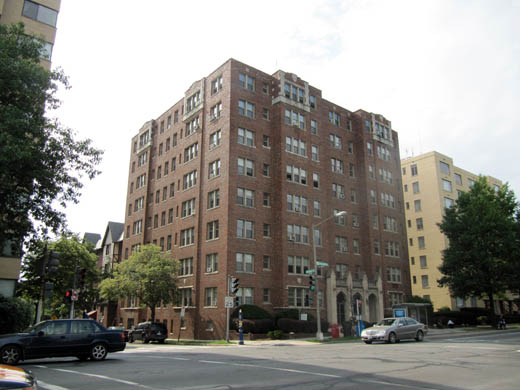
Alto Towers went up in 1932, in the heyday of D.C. suburbanization. This eight-storey apartment house is the work of Arthur B. Heaton, a half-forgotten architect who’s partly responsible for the look and feel of northwest Washington—and who was, briefly, an unabashed medievalist.

Heaton was ridiculously versatile. In 1901, he built Tudor Revival apartments and later designed the Altamont, a local apartment house with an Italian Renaissance twist. In 1914 and 1931, he put Classic Revival additions on the National Geographic Society building. In 1926, he gave his (now-demolished) Capital Garage a funny, car-themed facade, and his interest in the automobile led him to design our local “Park and Shop,” the prototypical strip mall, in a Colonial Revival style. Heaton oversaw the construction of new facilities on the GWU campus while also designing banks, churches, and countless other D.C. buildings and homes, apparently without ever developing an identifiable “Heaton style.”

…and that’s what makes Alto Towers a treat for the medievalist. Take a gander at the entryway.
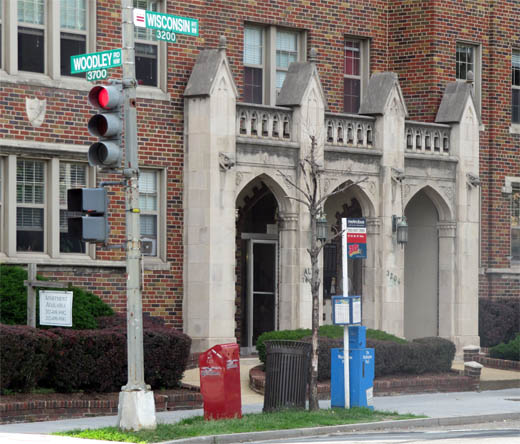
When Heaton wasn’t serving as president of the local chapter of the American Institute of Architects, co-founding the Washington Building Congress, or spearheading the “Renovize” movement during the Depression, he was also, from 1908 through 1920, the supervising architect for the National Cathedral, where he helped chief architect Henry Vaughan oversee construction during the cathedral’s first 12 years.

In 1932, more than a decade after Heaton’s time there, the cathedral was little more than an overgrown apse festooned with a few angelic grotesques. Given a chance to design an apartment house across the street, Heaton—who could have built damn near anything—set loose his inner medievalist.
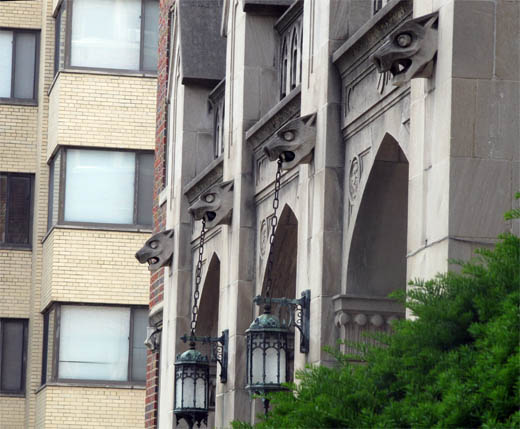
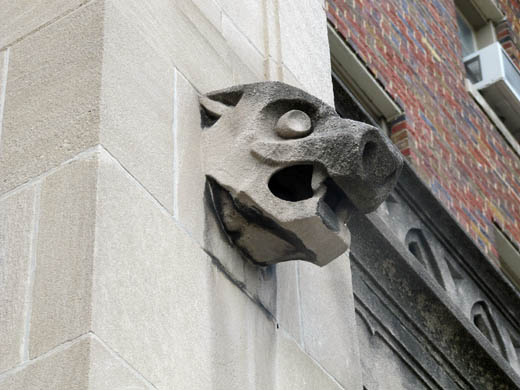
Those snarling, gargoylish grotesques are the most blatantly cool thing about Alto Towers, but the whole arcaded entryway is a neo-medieval romp.
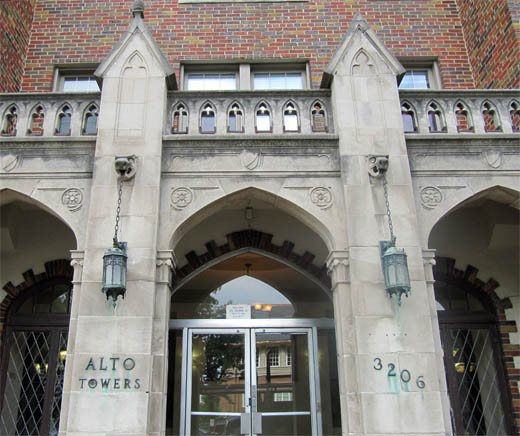
The quatrefoils (four-leaf clovers) in the spandrels (the warped triangles above each arch) are pretty standard, but those thick, gabled supports are an architect’s fancy. Each one resembles a cathedral buttress while also containing blind tracery of a Gothic arch.

At Alto Towers, periods and cultures trip over one another and have a good laugh. The pine cone finials hark back to ancient buildings and the medieval fascination thereof, while those funny little nubs at the tops of the smaller arches—including the little ones in the triforium, the upper row—strike me as very American. Meanwhile, on both sides of the interior of each large arch are squared, Art Deco-ish shadows of Corinthian columns. Behind them, the brick-lined inner doors whisper “Cordoba” in an American accent.

Most of Alto Towers is plain brick, but Heaton decorated just enough of its topmost level to show that the neo-medievalish entryway wasn’t an afterthought.
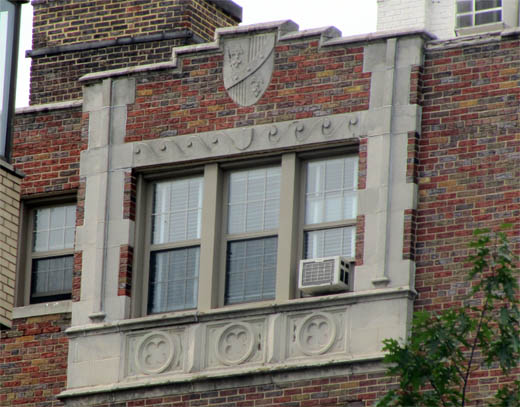
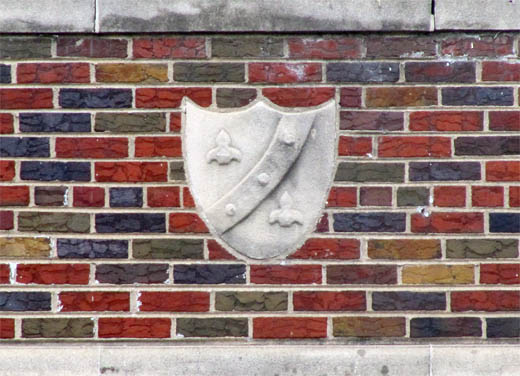
Note the two types of ornamented shield. They may be purely decorative, but I’ll gladly send a free book to any heraldry buff who can show that they’re meaningful.
While Heaton’s 1926 Capital Garage (PDF with photo) featured large, leonine gargoyles, Alto Towers is his full medievalist statement, the rhapsody of a restless architect who knew he wouldn’t live to see the cathedral completed.

When Heaton died in December 1951 at 76, the new apartment buildings rising around the cathedral were blocky and bland. Today, tourists tromp right past them, fixated on the promise of sighting quirky gargoyles on the Gothic spires beyond.

Of course, the cathedral’s first proper gargoyles weren’t put in place until around 1960, so if the beasties at Alto Towers forever bare their fangs, I can’t really blame them. No one remembers that they were here first.
“I’ll build you a kingdom in that house on the hill…”

Around the cathedral, few creatures say what they actually mean. When the lovelorn cicada on the south nave needed advice on impressing the silent insect with whom he shares a buttress, I shrugged and loaned him a book on ghazals. Cicadas are well suited to the form: They respect tradition, they’re enigmatic by nature, and they know how to flutter indecisively around a perfectly bright idea.

GHAZAL

The scullions ma’am’d and sir’d to the Abbasids;
The lusts of locusts whirred through the Abbasids.

Salaam, she sighed. A serpent shed a city,
And in, a starving bird, flew the Abbasids.

In wine, in witless words, in bloodshot mornings,
The gift of gardens blurred to the Abbasids.

A general’s eye surveyed the rheumy rooftops,
And frozen by a word grew the Abbasids.

You sang, “the bow his brow, his lashes lances…”
Our dawn campaign referred to the Abbasids.

“It’s cool,” the in-crowd says, “to dig this chanting.
A ban would be absurd to the Abbasids.”

Her angel raises ribbons, blue and scarlet,
But wasting in the third queue? The Abbasids.

I studied senseless serifs on your postcard,
A lore I long preferred to the Abbasids.

Spines align. He scans her posture sidewise:
El Cid, Beginner’s Urdu, The Abbasids…

The old cicada sang, his soul emerging,
And yet you never heard. Do the Abbasids?


(For all the entries in this series, hit the “looking up” tab.)

“Feathered, look, they’re covered in a bright elation…”

Too few Washingtonians have hobbies; for many people here, cultivating a career is apparently amusement enough. Fortunately, I sometimes encounter locals—like this fellow on the west front of the cathedral—who enjoy a pastime I’d never really thought much about, and I like when they explain its appeal in terms I can understand.

A SIMPLE DESULTORY PROSOPOPOEIA
(or, HOW I WAS RICHARD WAGNER’D INTO TRADITION)

“I do not think that they will sing to me”:
Impulsive mermaids drown in shallow words.
Await no witless warbling by the sea;
Rather, seek the songs of simple birds.
From perch and peak they twitter truths profound:
A woodbird stirs the Volsung in his blood;
A parliament of eagles circles ’round;
A curlew chills the farer on the flood.
The cuckoo croaks that sumer is icumen;
“Keep well thy tongue!” confesses Chaucer’s crow;
The nightingale her owl will merr’ly summon;
Despite their flyte, one insight they bestow:
Be still, but heed the rustle of a wing;
A legendary pigeon waits to sing.


(For all the entries in this series, hit the “looking up” tag.)

“Unicorns and cannonballs, palaces and piers…”

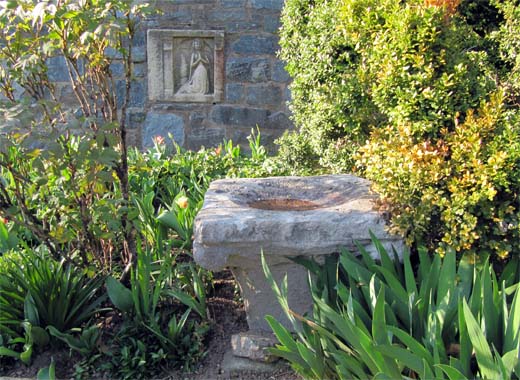
Yes, there’s a winged unicorn at the National Cathedral, but she hides in a shady nook along the south nave, and the horn that rests flat against her back can’t be seen from the ground. Below her, over the wall in a corner of the garden, sits a birdbath, a 12th-century capital salvaged from the ruins of Cluny. One never can tell what a unicorn will find intriguing.

EASTER 2010

A whisper in the medlar, Father Hugh:
“I found a cloister crook’d in splintry beams
And stood it straight in marble. Fresh regimes
Reigned higher still; our rule they overthrew.
As songbirds shrink from thunder, we withdrew,
And now the sun we kindled scarcely gleams
Above the murk of misremembered dreams.
This capital will never rise anew.”
To which I field a future all my own:
A thousand summers wither in a blink.
A sparrow spots my hooves and broken horn
Through churchyard brambles, grear and overgrown,
And droplets on my wing she stoops to drink;
Then she will be refreshed, and I reborn.


(For all the entries in this series, hit the “looking up” tag.)