“Asking for more only got us where we are today…”

A while back, two poets independently responded to my gargoyle-poem book by asking me if I knew Maryann Corbett. I didn’t, but when I looked her up, I was pleasantly stunned to find someone whose modus operandi I understood: a poet who tends to the formal, a medievalist who holds a non-academic day job. Her latest book, Mid Evil, collects only 40 poems, but together they show how we frame our yearnings with fragments of the past—both the world’s and our own.

At first, all I saw was Corbett’s medievalism. Mid Evil takes its title from a poem about an blasé student’s chronic misspellings; the book also includes poems about studying medieval manuscripts, facing cancer in light of Cathar heresies, seeing The Return of the King with costumed teenagers, and imagining J.R.R. Tolkien’s inner life. Corbett is a skilled translator, so Mid Evil includes modern English versions of several medieval poems: the Old English “Deor” and three Exeter Book riddles, all of them in a form that recalls Anglo-Saxon alliterative lines; two balades from the French of Christine de Pizan; and verses from Alcuin about a nightingale, rendered in a meter that evokes the long Latin lines of the original.

When medievalism inspires new works of art, I’m intrigued and delighted, so I might have decided that all this was enough. On a hunch, though, I decided to read Mid Evil not as a miscellany but as a collection with purposeful organization. What emerged was an even more meaningful book: the story of a halting but ongoing pilgrimage.

Appropriately, Mid Evil opens with two poems in which old books provoke unexpected emotion. In “Paleography,” Corbett describes the intermingled confusion and enthusiasm that comes from trying to read 16th-century handwriting, which leaves her feeling “like the child who listened, puzzled / by the cries in the next room.” She lets the reader decide whether her experience is a sign of cosmic immaturity or a rare opportunity for the renewal she later craves. In “Hand,” she finds a colophon in a Middle English manuscript that reads “pray for him that made this book,” which pits skepticism against faith but leads Corbett to contemplate the actual, physical existence of the long-dead scribe and to “wonder how long the bones of a hand would last.”

In Corbett’s poetry, such relics are forever surprising us; they suggest a larger, more more challenging context to our lives. A teacup, for example, is a tribute to centuries of human activity—slavery, alchemy, religion, myth—culminating in the morning sip that affords the poet a moment of peace. A blue bowl tells the story of the aging and the dead and holds memories of a loud, insulting father:

“Depression glass.” Imagine it: her mother,
using that gimcrack thing for sixty years,
remembering how a speechless misery feels.
A kind of sore the mind keeps picking at.
I think she’s kept a lot of things like that.

And see, the mother’s still around. That’s why
she hasn’t sold it yet to an antique store.
I’ve often told her that would be a mercy.
Honey, it would. That’s what collecting’s for.
Restoring things. We clear the clouds away
so people see good things for what they are.

If mundane objects can resonate with meaning, so can our lives, as long as we’re open to seeing them as stories. In “The Return of the King Screens at Midnight at the Multiplex,” Corbett’s disputatio between skepticism and faith takes on a secular cast as she notes a conflict familiar to medievalists: the detached study of the scholar versus the playfulness of the costumed fan. She realizes it’s not a conflict at all, but reason for an overdue reprimand:

And I
am riven in the dark, remembering
how, long ago, I swore the only way

into these glamours was to learn to sing
in ancient grammar. Oh my misspent youth:
As well escape your life with imagining

as riddle through the words of some dead mouth.

Settling into her theater seat, she bids herself “[t]o hear the tale that salves the sting of truth” and to think about the fleeting value of fantasy and escapism. “So make your minds / more bloody,” she later exhorts girls shopping for Halloween costumes at Goodwill, hoping they’ll revel in pretending to be monsters. Otherwise, they’ll miss a youthful opportunity, however modest, to experience something beyond themselves, like the hapless undergraduate of “Mid Evil”:

And the last blow is this, your final exam,
in which, over and over, you call the course
mid evil literature. Yes, I suppose
for you that is the word. We both are lost here,
mapless in Middle Earth and muddling through.
You’ll claim your paper. Mild civilities
will be exchanged, and then you’ll lope away,
a sad C minus in your grip ensuring
we’re done. It’s mid-December. Snow will fall—
hrim ond hrið, but no one says that now,
since this is the sphere of Time, beneath the moon,
where everything must change, and where the poems
evaporate like hoar-frost in the sun.

Poems, movies, stories, myths—they shore us against aimlessness, but they also nudge us toward generosity. Faced with a storyteller in “The Pandhandler’s Tale,” Corbett puts aside her reservations and welcomes “the willing suspension of disbelief, / which lets us yield ourselves to the tale of wonder,” even though she only ends up attracting more panhandlers. The experience is real regardless; we’ve avoided a mystery, perhaps even a moment of grace, by assuming a story is false. Imagining one of the Brothers Grimm rewriting tales told by a cowherd’s wife, Corbett wonders: “Does it matter / that now we know how far from truth it falls?” A poem about Abelard and Eloise finds fault with all parties, but encourages interpretation: “What can we know? Perhaps less love than pride / led to their woes. Read their own words. Decide.”

But myth, fantasy, stories, and scholarship all have their limitations, as Corbett makes clear in several poems with a tragic edge. A fond memory of watching the rousing “Victory at Sea” on television in the 1950s darkens with the adult realization that the veteran who was dozing in a nearby armchair likely saw horrific things; simple stories are for children. The myths in fashion magazines prove useless decades after our teenage years; a mysteriously returned gift from a daughter’s long-ago lover shocks us out of our personal fables and into complex reality. Even history itself has limited value: in “The Historian Considers the End Time,” a scholar wracked by cancer is tempted by the Cathars’ heresy of the evil of the body, but her medievalism is useless. She can only hope to leave behind scant relics that give meaning to someone else:

They must, those thirteenth-century prelates,
have known it with a blazing certainty,
the truth he’s going to know then, when he hugs
the clothes that hold her fragrance, when his chest knots
as he cleans her closet, when months past the funeral
he finds in a broom strands of the long, dark hair.

So what do we do when the shadow of nothingness looms? All of Corbett’s thematic strands rise and converge in “Sing, My Tongue,” the final section of Mid Evil. These seven poems find strength and revelation in singing as Corbett invites us to join her in church. “On Singing the Exultet” puts us in the choir at the start of the Easter Vigil, where the singer marvels at the audacity of what she is about to do:

It’s candlelight that makes it possible.
How otherwise could you, with your puny pipes,
expect to do this? yell to the end of space—
where air won’t carry sound—and order the nebulae
Exult? But here you are: you’re going to dare it.

Even feeling insignificant implies a cosmic context for our lives, as “the light of the unforeseen”

burnishes a quiet table
where lover and beloved look at each other
weighing a question that will change the world.
That has already changed it.

In these closing poems, Corbett grapples with doubt while singing at a funeral; one page later, she crashes to earth after the high of singing Mozart with an orchestra in a cathedral. “I’ve come to feel / how all my feasts are haunted,” she says after a child interrupts her attempt to find focus in church, and she falls back on translating Alcuin, who exhorts the nightingale to sing without end: “Sour as my soul had become, you could fill it with honeying sweetness.” She ends on a note of fatigue, physical and spiritual, but despite being disheartened by “wheezing gasps where nothing is inspired,” she still hopes for profundity:

I want it back: the confidence in air—
ruah, pneuma, spiritus—the breath
that stirs the vocal folds of nuns in choir.
The breath that Is. The sound of something there
guiding this gusty round of birth and death.
The rush of driving wind. The tongues of fire.

Mid Evil starts with scholarly study and ends in a wish for religious exultation; it begins with writing and ends in song, becoming a prayer for inspiration, confidence, purpose, and grace. Whether that prayer can or will receive an answer remains, for Corbett, an open question, but she comes to a conclusion I gladly endorse: that myth and medievalism are promising places to start.
“Well, it seemed to be a song for you…”

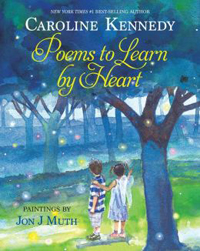
Two years ago, I was half-watching the Disney Channel with my nephew and niece when a commercial startled me—not because a fleeting tween sensation had finally done something funny, but because I couldn’t believe they were airing a two-minute promo for poetry. Backstage at a children’s poetry slam, Caroline Kennedy was chatting about her new Disney-backed anthology, Poems to Learn by Heart, without naming a single poem in the book. Naturally, I wondered: What sort of anthology do we get from a network that exalts dancing and singing above all other human endeavors?
As it turns out, a pretty conservative one. Poems to Learn by Heart isn’t the slam-tastic book the commercial makes it out to be; instead, it’s full of traditional, anthology-friendly names: Shakespeare, Byron, Elizabeth Barrett Browning, Stephen Crane, Wallace Stevens, Langston Hughes, Rita Dove, Richard Wilbur—around a hundred poets in all. Adults who want poetry to be “edgy” will find the selection cautious—the wildest poet here is Amiri Baraka, whose “Ballad of the Morning Streets” won’t shock grandma—but Kennedy has less seasoned readers in mind. To her credit, she knows that while most English majors have read poems like “We Real Cool” by Gwendolyn Brooks, most American children (and their parents) have not. She also gets that this book’s 183 pages contain more poetry than most kids will encounter in twelve years of school, so it’s a rare chance to show them what the English language has to offer, from Lewis Carroll to Nikki Giovanni.

Even though Kennedy arranges her selections by subject (“the self,” “family,” “friendship and love,” “faeries, ogres, witches,” “nonsense poems,” “school,” “sports and games,” “war,” and “nature”), Poems to Learn by Heart doesn’t feel guided by a clear editorial point of view. Of course, that’s an adult concern; young readers who don’t yet know their own tastes may enjoy discovering Ovid, Countee Cullen, and Robert Louis Stevenson alongside a Navajo prayer, the Gettysburg Address, the St. Crispin’s Day speech from Henry V, selections from the First Letter of Paul to the Corinthians, and Martin Niemöller’s “First they came for the Socialists” speech. I appreciate breadth, and even the inclusion of lyrical prose, but is it here to foster inclusiveness, or to deflect criticism? One could easily use the table of contents to reconstruct the minutes of Disney’s fretful editorial meetings: Something for the religious? Cultural-literacy conservatives? Social-justice liberals? Native Americans? Check, check, check, and check.

Despite these thoughtful, wide-ranging selections, this book doesn’t always fulfill the promise of its title. Kennedy may be gung-ho for memorization, but I didn’t always see the mnemonic value of her selections: Is “Peace” the one Gerard Manley Hopkins poem to remember? Why learn Shakespeare’s sonnet 94 instead of one of the others? Kennedy asked a six-member poetry slam team at a Bronx high school to help pick these poems, and she devoted four pages to their own passionate free-verse poem about racism, consumerism, child abuse, and mass media. While I hope the publication credit gave their lives a hearty boost, I do wonder, perhaps heartlessly, if their work belongs here. For whom other than the teens who wrote and performed it is it a “poem to learn by heart”?

I was also baffled by the selections in a final “extra credit” section: “Young Lochinvar” by Walter Scott, “Paul Revere’s Ride” by Longfellow, “Kubla Khan” by Coleridge, Robert Service’s crowd-pleasing “The Cremation of Sam McGee,” and the first 18 lines of the General Prologue of The Canterbury Tales. “Mostly they are old chestnuts that have fallen out of favor,” the scion of a privileged political dynasty warns us, lest she come off as a square, “but the feats of memory required to master them will impress even the most modern audiences.” Why can’t the editor of a poetry anthology write as if she actually believes that old things have value beyond their potential for self-exploration and showing off? (And who the heck drops Chaucer on kids without a pronunciation guide?)

That final section highlights this book’s major flaw: a lack of wild, wham-bang narrative. Jon J. Muth’s illustrations are beautiful, but his cover captures the overall mood: gentle, contemplative, dreamy. That’s fine for some kids, but what about action for the more rambunctious? It’s not my style to call for a book to be less intellectual (or for things Disney to be less introspective), but cripes, what about a good, gory chunk of Beowulf or Homer, or an Asian or African epic? Where are the pirates, cavemen, and ghouls of Robert E. Howard? Except in passing in its introduction, Poems to Learn by Heart forgets to teach kids that some of humanity’s best stories are told in verse—and that people proudly carry them around in their heads.

I hate to be hard on this book. For many kids, it will be their only introduction to poetry, and some, I hope, will adore it. Decades from now, if those readers fondly remember this book as adults, the Disney Channel will deserve praise for marshaling its legions of wolf-mounted marketing goblins in support of something more sophisticated than terrible sitcoms—nothing less than Octavio Paz, Seamus Heaney, Paul Laurence Dunbar, Elizabeth Bishop, and Ovid. Only then will I know if Poems to Learn by Heart has served children well or if it’s the century’s first great, unread gift book, a smart, well-intentioned effort to elevate young readers that’s (maybe) too pensive, too mousey, too nice.

“Turn on these theater lights and brighten the darkest skies…”

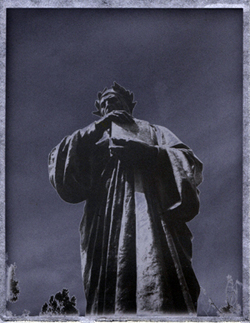
(Dante in D.C.: solarized Polaroid negative)

Most aspects of medievalism in America don’t baffle me. I understand why we want to lay down European roots through Gothic architecture, I get why the pedigreed chivalry of Charlemagne and King Arthur might appeal to us, and the imaginative pleasures of medieval-ish fantasy are (mostly) self-evident. But Dante? I’ve never grasped what Americans hope to do with him—maybe because the answer turns out to be “everything.”

While Dante helped rally Italian nationalism in the early 19th century, Americans looked to him for different shades of inspiration. Melville saw him as a guide through moral quagmires; Emerson considered him a simple genius; and others longed for his unshakeable certainty in their own supposedly weak-willed and overly tolerant age. Charles Eliot Norton, who promoted the study of Dante at Harvard and established the Dante Society of America, praised the poet for representing “the mediaeval spirit found in the highest and completest expression”—namely, an ahistorical vision of independence, individualism, and curiosity he hoped would prosper in post-Civil War America.

After American Protestants dunked Dante in their own ecstatic rivers, Eliot and Pound dwelt largely on his words, adoring him as a poet who wed precision to faith. More recently, the Big D has thrived in a popular culture beguiled by mysticism and the occult. Oh yes: You can pop “Dante’s Inferno Balls” candy while playing the Dante’s Inferno game for XBox or Playstation (with accompanying action figure). You can imagine the scent of Dante cigars, fondly recall the “Dante’s Inferno” ride at Coney Island, or show off your snazzy Dante earrings. You can also check out how two science-fiction authors Americanized Dante to make his Hell literally escapable.

So is Dante nothing more than a leering cadaver we clothe in our whims? In a blog post about two new Dante books, Cynthia Haven at Stanford suggests that il Poeta has something greater to offer us, a vision as priceless as it is stark:

A more interesting question might be: what does Dante tell us about our world that we do not recognize ourselves? Here’s my take: we live in a time and in a generation that thinks everything is negotiable, and that every psycho-spiritual lock can be jimmied. As W.H. Auden put it, we push away the notion that “the meaning of life [is] something more than a mad camp.” For us, there’s always a second, third, and fourth chance. It’s a strength – but it’s a weakness, too. Maybe that’s why we resist Dante. We don’t realize that some things are for keeps. There’s not always another day. Not all choices can be reversed with every change of heart – and no, our heart isn’t always in the right place. Words unsaid may remain forever unsaid. And perhaps no choice is trivial or innocent: it is the choices that bring us to ourselves, the choices that reveal and work as a fixative for our loves, our priorities, and our direction.

Just before Christmas, I checked out “The Divine Comedy: Heaven, Purgatory and Hell Revisited by Contemporary African Artists” at the SCAD Museum of Art in Savannah. The title was misleading, since the art wasn’t inspired by Dante; the works only echoed his concepts and themes. “The concern here is not with the Divine Comedy or Dante,” explained the curator, “but with something truly universal.” How gloomy, but how unsurprising, that another interpreter of Dante, another artist in search of the timeless, doesn’t discern that they’re one and the same.

“The walls are white, and in the night…”

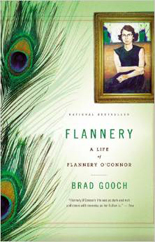
“Perhaps I have created a medieval study,” wondered Flannery O’Connor in 1960 after a professor of medieval literature penned a piece in a Catholic magazine that likened her novel The Violent Bear It Away to the movie The Seventh Seal. Sharing the essay with a friend, O’Connor was bemused: “Which reminds me, have you seen any films by this man Ingmar Bergman? People tell me they are mighty fine & that I would like them. They too are apparently medieval.”

I wonder, then, what O’Connor, a rigorous Catholic, would have made of the news that the Episcopalians just made her a literary saint:

This week, Flannery O’Connor was inducted into the American Poets Corner at St. John the Divine, the “only shrine to American literature in the country” (or so a church representative told me). Upon entering the cathedral for the small induction ceremony, attendees were greeted by two gigantic, sparkling sculptures suspended from the ceiling—they are phoenixes, part of an installation by the Chinese artist Xu Bing, but at first glance you might mistake them for peacocks, like the ones that O’Connor raised on her family’s Georgia farm, Andalusia . . . Those who spoke during the ceremony stood in front of a shining cross, towering choir stalls, and giant pillars illuminated with glowing yellow lights. A booming echo made them sound like somewhat unintelligible voices from beyond. The effect was fitting, evoking simultaneously O’Connor’s keen sense of the ominous, the numinous, and the ironic.

I don’t know if O’Connor visited the magnificent cathedral when she lived in New York City for a while in 1949. As a Catholic, she might have found modern Protestant cathedral-building a marvelous, misguided quest for transcendence, but the vast Gothic interior also might have engaged her intellect and gladdened her soul. After all, O’Connor grew up across the street from a gargoyle-festooned cathedral in Savannah and later lived on a farm called Andalusia, a name she encouraged her mother to restore. It’s been a while since she was seen only as a “Southern Gothic” writer; she also deserves to be remembered as a committed American medievalist.

By the time O’Connor attended college in 1942, her medievalism was apparent. She wrote poetry only briefly, but her later dismissal of her own juvenalia is knowing and sly. “All of my poems sounded like ‘Miniver Cheevy,'” she quipped, recalling the pathetic drunk in E.A. Robinson’s 1910 poem who wishes he’d been born in an age of chivalry. As an adult, she had little interest in romance and legend: Her philosophy professor would recall how much she hated the irreligious dismissal of the Middle Ages in the textbook he assigned, how passionately she studied the work of St. Thomas Aquinas, and how keen she was to debate with him when he argued, from an anthropological perspective, that medieval Christianity was polytheistic.

“She knew Aquinas in detail, was amazingly well read in earlier philosophy, and developed into a first-rate ‘intellectual’ along with her other accomplishments,” George Beiswanger later wrote. “It soon became clear to me that she was a ‘born’ writer and that she was going that way.” Beiswanger took such pleasure in their sparring that he recommended her to his alma mater, the University of Iowa, and helped her land a scholarship for graduate school.

In 1948, while wandering the grounds of Yaddo, O’Connor described herself to other artists at the colony as “thirteenth century” as she immersed herself in a book on scholasticism and medieval art by French Thomist Jacques Maritain. “Do not make the absurd attempt to sever in yourself the artist and the Christian”—she underlined that passage in Maritain’s book, and when she visited the Cloisters during her stint in New York City the following year, she was amazed to find support for Maritain’s exhortation in a Virgin and Child statue that showed both figures laughing—”not smiling,” she emphasized to a friend, “laughing.”

While writing her first novel, O’Connor read the lives of three female saints—Catherine of Siena, Catherine of Genoa, and Teresa of Avila—and was irked when the public found the resulting book pessimistic rather than comic. “Everybody who has read Wise Blood thinks I’m a hillbilly nihilist,” she told a friend, “whereas I would like to create the impression over the television that I’m a hillbilly Thomist.” Fascinated and challenged by the prolific saint, she joked about applying Thomist principles to the least events in daily life, including her mother scolding her to go to bed during her nightly readings:

If my mother were to come in during this process and say, “Turn off that light. It’s late,” I with lifted finger and broad bland beatific expression, would reply, “On the contrary, I answer that the light, being external and limitless, cannot be turned off. Shut your eyes,” or some such thing.

Soon after she was diagnosed with the lupus that would destroy her kidneys, O’Connor made two commitments: the first, to write like mad; the second, less formally, to St. Thomas Aquinas himself. In 1953, O’Connor purchased the 690-page Modern Library volume of selections from his work—and settled in for the rest of her life.

As she hobbled around Andalusia on the crutches she called “flying buttresses” and immersed herself nightly in Thomistic theology, O’Connor did what other medievalists do, from malevolent nationalists to benign reenactors: She redacted the Middle Ages down to the aspects that gave her full purpose and strength.

As for being enshrined as a poet by Episcopalians in an unfinished Gothic cathedral in Manhattan, O’Connor was too Southern to have told them that she was anything but flattered but also too Catholic not to have issued gleeful theological challenges to priests who would have stammered and sought for rejoinders in vain. Then, in private, mindful of her favorite statues, she would have laughed, and let her amusement linger long after the light went out.

“…with my eyes turned to a different time or hour…”

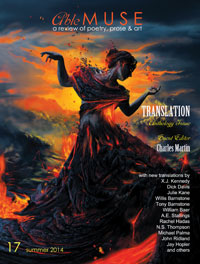
After translating a poem, I’m always left with a troubling handful of brackets and screws. The bookshelf sure looks like it stands on its own, but anyone peering at it closely, comparing the finished product with the instruction sheet, might spot the small, vital pieces I had to leave out. That’s the frustrating trade-off of this sort of writing, but I like to believe I’m getting better at it—and I’m pleased that one of my poems made it into the summer translation issue of Able Muse.
It’s a fine issue, too, with translations from Catullus, Martial, Victor Hugo, Christine de Pizan, Cavafy, Rilke, Rimbaud, Lope de Vega, and many more. My contribution is modest—ten lines of Latin, an epitaph for Charlemagne’s baby daughter Hildegard translated into alliterative, metrical English—but I’m among poets whose work I admire, including medievalist Maryann Corbett, classicist A.E. Stallings, and X.J. “Nude Descending a Staircase” Kennedy.

Last year, I let my subscription to Poetry lapse after realizing that I rarely found one memorable poem per issue. I put that money toward the biannual Able Muse instead, and it’s proven to be a far more satisfying read. Mirabile lectu, its editors are supportive of poems composed in recognizable forms, but they’re also open to good free verse, prose poems, essays about literature, and even the occasional visual-art portfolio. The 2010 Able Muse Anthology, which collects the best of their first decade, is a worthy introduction to their style and approach. Rather than serve as a one-way repository for CV enhancement, Able Muse feels like a journal its craft-conscious contributors actually read.

I’m busily working on a pile of new translations—and on this sun-baked afternoon, I’m happy to dredge up old “Quid Plura?” posts about this very subject:

“Like flames reaching out from the sun…”

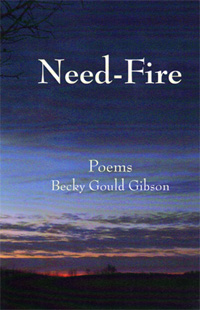
“Your life will be written / your written life lost”: That’s the prophecy a noblewoman dreams about her unborn daughter in the eerie prelude to Need-Fire, a slim but remarkable book that I can scarcely believe someone wrote. That girl will grow up to become one of the most influential women in Anglo-Saxon England, but most of her story will be forgotten, giving poet Becky Gould Gibson a chance to rescue her from obscurity—and to demonstrate that using poetry to tell longer, more complicated stories is an art we haven’t yet lost.
In 25 interconnected poems, Need-Fire dramatizes the lives of Hild and Aelfflaed, the two women who ran the double monastery that housed both men and women at Whitby in North Yorkshire during the seventh century. Hild educated five bishops, presided over the synod that pushed the English church closer to Rome, and served as abbess when the cowherd Caedmon, the first named English poet, reluctantly sang his first verse. Unfortunately, only a few pages in Bede’s Ecclesiastical History hint at Hild’s profound influence, and the other 29 women known to have run double monasteries in Anglo-Saxon England are hardly more than names. Gibson’s goal is to commemorate them, intertwining her own imagination with copious research to sing them back into life.

And so Gibson invents her own form: short, sparsely punctuated lines that resemble Anglo-Saxon verse, printed with a caesura in the middle of each. These lines don’t follow the rules of Old English meter and alliteration, which makes them feel like fragments straining to be heard across 1,400 years. The result is a stream-of-consciousness narrative that derives subtle power from the poet’s decision to rely on words derived only from Old English. Here’s Hild’s mother’s lament as she bathes her infant daughter:

Glass crosses the water     from Gaul
for church windows     in your name
yet nothing you say     will be found
only the little     said of you
Why then stay up late     daughter
evening by evening     candle by candle
shaping thoughts     never to be kept
in your smooth     steady hand?

Of course, you don’t need to know Anglo-Saxon scansion to enjoy Gibson’s poetry, nor do you need to scrutinize the historical notes and scholarly addenda that follow each poem. I enjoyed them—Need-Fire is one of those rare books for which I feel like the ideal reader—but you don’t have to be a medievalist to step into Gibson’s weird and haunting world. You just need to be willing to read an historical novel in telegraphic verse.

In Gibson’s hands, Hild is a “child with a will     never settled.” We meet her as a teenager eavesdropping on her uncle, King Edwin, as he and his advisers kick around the pros and cons of Christianity. Overhearing the parable about a sparrow that flies through a mead-hall in winter, enjoying a moment of safety and comfort before it returns to the harsh unknown, Hild doesn’t assume, as the king’s men do, that any religion shedding a bit more light on past and future mysteries is worth considering. Instead, she imagines that the sparrow is as lost as she feels:

She’s seen that sparrow     beat wild
about the walls     looking for a way out
how she feels     most of the time
when grownups talk     Where will she go
after she dies?     Where’s Father now?
She shivers     damp to the bone

A keen observer of a land where “[f]olks still/worship sticks,” Hild is beset by secret doubts. The real Hild was all packed up and ready to live with her sister near Paris, but she turned back at the last minute and established a hardscrabble monastery along the North Sea. Gibson might have chalked up this decision to an irrefutable religious vision, but her Hild believes it’s her duty to found institutions that promote peace and education in her war-torn kingdom. And so Gibson takes up the tricky task of dramatizing the apprehension that accompanies faith:

          Truly I wonder
when bone     becomes spindle
cliffs whittle     to teeth
how many     or rather how few
will have traded     their wooden war gods
for this sad-eyed     Hebrew man

As Hild lives a harsh life of religious service that demands great leaps of faith, her doubts mature into greater complexity. She worries less about the “the idle or giddy” in her flock and more about the monks and nuns who are unquestioning and meek, a sensibility that at times feels too 21st century. It flatters us to believe, for example, that a seventh-century woman couldn’t possibly have cared how monks cut their hair or what the date of Easter ought to be. Fortunately, Gibson understands the medieval mind, and she knows that a woman like Hild would eventually conclude that regularity rather than fervor offers solace and bolsters faith:

Belief’s a skill     like any other
we’re schooled in     must work at daily
What I’ve learned     keep learning
rule gives us     rooms of time
to breathe in     Without rule we are lost

Though Gibson’s form never varies, Need-Fire offers a fine and convincing array of other voices and perspectives: a monk terrified by an eclipse, a young nun dying of the plague, and another nun forced to write a thank-you letter to the author of a virginity handbook for women. (“At least we won’t die    in childbirth,” she quips, “though we may die    of boredom.”) Mothers and nuns have prescient dreams, abbesses’ bones cry out from their graves, and even God Himself weighs in, gently chiding his seventh-century children in verses they’re bound not to hear.

Gibson’s imagery is fresh, too. When Etheldreda, abbess of Ely, writes to her husband to warn him of a sneak attack, she muses on the extent to which her life revolves around eels. She spears them, salts and skewers them for Lent, observes their mating habits, and finds in them a homely metaphor:

What is man     in the clutches
of sin     but an eel
on an eel-fork     shivering?
Eels     by the thousands
eels     almost bodiless

[…]

God will keep you     He keeps
us all     How does an eel go
with no fins     to speak of?
Yet she takes     to the sea
knowing she’ll     get there
lay eggs     and die
knowledge older     than man
deep in her brain

The eel poem helps Need-Fire build to a thematic climax. Through layers of fine detail, Gibson builds her seventh-century world with careful references to native animals and plants and the things humans make from them, from salted herring to wormwood mulled in ale. Above all, this book pays tribute to forgotten women who did important work, but it also challenges readers to marvel at the infinite variety of nature, which Gibson sees, like many medieval people before her, as reflecting the nature of God. Simply walking outside is an inexhaustible antidote to boredom and, as a nun named Begu finds when she holds a mussel shell, a potential bestower of greater rewards:

        When I stare
into its pool     of blackness
it tells me     I’m here
Small wonder!     God always
shines back     if we’re looking

Blending scholarship, biography, and historical fiction, Need-Fire needs to be read at a careful pace that duly honors its subjects’ lives. Writers who rescue obscure figures from history’s margins aren’t always capable of dropping them into good stories, but by retelling the lives of Hild and Aelfflaed in stark, anecdotal poetry rather than a novel, Gibson crafts scenes that defy the monotony of the form she’s chosen to labor within, just as her characters do. Need-Fire isn’t a dutiful exercise in social history, but an eloquent argument that these abbesses and the men and women around them were real and alive, not stock characters in medieval-ish fiction.

Europeans and Americans have never been able to decide whether medieval people were our predecessors and brethren or the makers of a world that was grotesque, alien, unfathomably strange. There’s no reason both can’t be true, and Gibson shows us that an age we’d find physically and culturally inhospitable is also emotionally and intellectually welcoming. Fourteen centuries on, she hears familiar notes of doubt, desperation, and hope:

what is any of us     but one
of God’s beings     scrambling
for a foot-hold     on crumbling cliffs?

“When streams are ripe and swelled with rain…”

Every April, lines from two poems burst forth like emerald weeds. Rain might prompt someone to cite the General Prologue of The Canterbury Tales, but by the mid-month tax deadline, some doofy news anchor inevitably hits us with the opening of The Waste Land. “April is the cruelest month”? Again? Are you sure?

This year, consider Dame Edith Sitwell, the largely forgotten shaper of the heaviest light verse in the world. Perhaps you’ve read (or heard) “Waltz,” her ditty about fashion-fickle nymphs and other denizens of pseudo-pastorale:

The Amazons wear balzarine of jonquille
Beside the blond lace of a deep-falling rill;
Through glades like a nun
They run from and shun
The enormous and gold-rayed rustling sun;
And the nymphs of the fountains
Descend from the mountains
Like elegant willows
On their deep barouche pillows
In cashmere Alvandar, barège Isabelle,
Like bells of bright water from clearest wood-well.

You may be looking at those lines and thinking “What?”—but take a minute, read the full poem aloud, and swish it around in your mouth like strange new wine before you decide you don’t like it. Good writers get diction, but Sitwell was the rare poet who focused on sound, rhythm, and onomatopoeia almost entirely at the expense of concreteness and clarity. With a Sitwell poem, how it sounds is largely what it’s about.

That’s why it’s a treat to discover, among Sitwell’s late works, a poem called “The April Rain,” in which she uses her distinctive style and abstruse allusions not simply to please the ear, but also to evoke springtime and the innocence of young love.

“Such is our world, my love,” declares a boy to a girl, “[a] bright swift raindrop falling”:

The sapphire dews sing like a star; bird-breasted dew
Lies like a bird and flies

In the singing wood and is blown by the bright air
Upon your wood-wild April-soft long hair
That seems the rising of spring constellations—
Aldebaran, Procyon, Sirius,
And Cygnus who gave you all his bright swan-plumage…

As raindrops pool into symbolism, Sitwell falls back on wistfulness:

Such are the wisdoms of the world—Heraclitus
Who fell a-weeping, and Democritus
Who fell a-laughing, Pyrrho, who arose
From Nothing and ended in believing Nothing—fools,
And falling soon:
Only the April rain, my dear,
Only the April rain!

That fool-begotten wise despair
Dies like the raindrop on the leaf—
Fading like young joy, old grief,
And soon is gone—

Forgot by the brightness of the air;
But still are your lips the warm heart of all springs,
And all the lost Aprils of the world shine in your hair.

I doubt Sitwell’s closing lines will join the ranks of quotable April verses, but “The April Rain” is a charming reminder that if we’re spending the month digging through poetry, we ought to praise it as much for its sounds as for its far more obvious scents.

“Oh, we won’t give in, let’s go living in the past…”

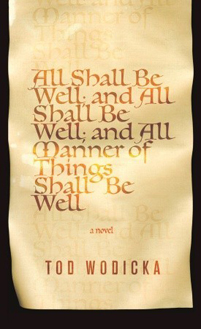
Because I’m always on the lookout for medievalism, I was naturally drawn to Tod Wodicka’s 2008 novel All Shall Be Well, and All Shall Be Well, and All Manner of Things Shall Be Well, with its gloriously unmarketable title based on a famous line from 14th-century English mystic Julian of Norwich. I expected an enjoyable story that didn’t show much awareness of medievalism or the Middle Ages, but instead I found just the opposite: characters and a plot that didn’t thrill me, but which were wrapped up in fresh, perceptive ideas about why some Americans throw themselves headlong into the medieval past.

The narrator of All Shall Be Well, homely and awkward 63-year-old Burt Hecker, owns an inn in upstate New York, but the true focus of his life is the Confraternity of Lost Times Regained, the medieval living-history society he founded in 1965. Burt makes his own clothing, brews his own mead, treats ailments with pinches of herbs, and spurns potatoes because they’re OOP, “out of period.” He’s the father of medieval reenactment in America but a lousy family man in every other respect. His son is a brilliant but deeply introverted musician, his daughter is a resentful sci-fi geek, his mother-in-law is obsessed with the persecution of her Carpathian countrymen—and all of them hate his guts.

The American wretch pining for the Middle Ages has become a recognizable literary type—think Miniver Cheevy or Ignatius Reilly in A Confederacy of Dunces—and there are obvious hints of Ignatius in Burt. He dislikes the modernity of California, reacts prissily to a Prague strip club, and regrets when necessity pulls him “toward the crashing promiscuity of the century waiting outside.” Unfortunately, his persnickety moralism is too inconsistent to be plausible, and any comparison with Confederacy would be misleading. All Shall Be Well isn’t anti-heroic farce; it’s a novel about alcoholism, family estrangement, and the burdens of the past. Much of the laughter here is rueful.

As Burt plods through a series of misadventures—in Europe in the 1990s and in flashbacks in upstate New York—we learn about his past, particularly the incidents that made his family flee. Can several strong, strange personalities forgive each other when the one woman who held them together is dead and gone? Wodicka doesn’t seem to know, and I confess that between Burt’s awkward passivity and the dislikability of his family, I was tempted not to care. Fortunately, All Shall Be Well takes on, however indirectly, a bigger and more interesting question.

Throughout literature and pop culture, medieval reenactors and Ren Fest aficionados tend to get one of two treatments: They’re either enlightened oddballs whose willful weirdness makes them morally superior to the rest of us Muggles, or they’re portrayed as dysfunctional losers who couldn’t possibly hold jobs, have sex, or survive in the world. Wodicka toys with both of these notions, but he sees that there’s more to American medievalism than mere escapism. He’s sensitive to the disorientation and frustration of “historically displaced people”—but he’s blunt about them too.

When Burt falls in women whose medieval music-therapy workshop focuses on Hildegard of Bingen, he finds them silly, but also he appreciates their need to decorate their inner lives with medieval spolia:

And though Hildegard affirmed the lowliness of womankind and the subjugation of female sexuality, Tivonia and the girls saw her as a proto-feminist New Age icon, not the Catholic scold she undoubtedly was. No matter. History is ever ours for the reliving . . . To the girls, the medieval woman was a person capable of great self-assertion, so they studied what they believed to be instances of this, ferreting out kernels of sassiness from the most minor of references, building a fairy-tale history and peopling it with sisters-in-arms. The medieval woman was them, only more real. Them, with a less cluttered connection to the eternal.

When Burt and the tunic-clad singers arrive in Germany as emissaries from the “vulgar, unself-conscious land of American make-believe,” he discerns that the medieval world exists far more vividly in his own imagination than in the European landscape outside the car window:

I plunge my thoughts back into the roadside tumult of greens and browns. How to reconcile these lands, this scroll of Bundesrepublik Deutschland with my Middle Ages? It happened here once. But where? Despite the castles and churches, and all those townships still adhering to thousand-year-old plans, modern Germany seems a most non-historical kingdom. Safe, well-ordered, tame, all mystery long since burned away in the conflagrations of this last century.

Wodicka has noticed, rather astutely, that Americans can write themselves into an ersatz Middle Ages unburdened by actual history. For us, medievalism is personal; for Europeans, it’s unavoidably political.

Burt’s mother-in-law drives this point home. Snarling and confrontational, Anna lives for the thankless task of donning her folk costume to tell the world about the persecution of her own Lemko people in the Carpathian Mountains. Her cause is righteous, but Wodicka, in an effective bit of dark humor, portrays the Lemko as backwards and cruel, making Anna a one-woman living memorial to people no one else cares to remember. Her nationalism and ethnic pride are, as these things tend to be in Eastern Europe, a dead end—but Burt wonders, in a moment of clarity, if his own frivolous approach to history mocks her cause.

Does whimsical reenactment of the past belittle real people who suffered and died? I’ve never seen this question asked in fiction, and I’ve rarely seen reenactors or their critics address it. “I believe that some of us were ourselves only during the act of re-enacting,” Burt says, arguing out that daily life is already a series of masks, costumes, and roles, even as he concedes that he may have taken it way too far. As he tries to reconcile with his family, he describes them as “twenty yards and six hundred years away,” finding in history an unfortunate metaphor for the awful consequences of his actions.

Although I wanted a more decisive plot, I found plenty to like in All Shall Be Well, including some good writing in two harrowing deathbed scenes and a beautiful prose poem from the perspective of Hildegard of Bingen that frames the entire book. Wodicka has thought deeply about how Americans mash-up European history to give their lives meaning, and his conclusions are stark: We don’t reenact the past, but reinvent it for our own purposes; eccentrics can cause their loved ones terrible pain; and there’s only so much hope for the unfortunate souls trapped in “the rotting present of of a life lived perpetually out of period.”

“…laughing as they glance across the great divide.”

When the windows glaze over with ice and snow and every spare word goes straight into projects that pay, this blog gets quiet—but in recent days, I’ve been thawing out drafts of old work while testing the view through my latest willfully outmoded lens.

Behold: a Polaroid Land Camera 230. After toying with someone else’s before Christmas, I found this one at an antique shop in Savannah and decided to make it my own. Fuji still makes film for it, but if you’re fond of the total control that digital photography gives you, then you won’t enjoy lugging this clunker around.

The Land Camera, you see, needs warm temperatures, its light and aperture settings are limited, it doesn’t zoom, it spits out chemical-drenched litter, the photos take hours to dry, and you need to time the development down to the second—and that’s after you clean the rollers, modernize the battery chamber, scrub away corrosion, and master the art of yanking the paper tabs without stranding the photos inside. “And besides,” a neighbor chided me, “the pictures from those things were never really great.”

True, the photos I’ve taken so far are not impressive, but the first round of peel-and-reveal was a thrill, and there’s plenty of online evidence that under good conditions, with the right light and a fitting subject, even a 50-year-old camera can work the occasional wonder. You just have to accept its many constraints and embrace their necessity. I’m ready; it’s a lesson that poetry already offers.

“I really did struggle writing dreadful free verse for a long time,” poet and classicist A.E. Stallings told an interviewer a few years back. Stallings began publishing her work only after she saw possibilities in traditional forms, having discovered the value (and fun) of using old tools to your advantage:

Form opens up all kinds of possibilities. Rhyme often leads you to write things that surprise you. A meter may help you tap into a forgotten emotion. With form, certain decisions have already been, arbitrarily, made for you—a certain number of lines, a designated meter with a particular pattern of rhymes. That frees you up to think about other, more interesting choices in the poem.

Billy Collins, an erstwhile Poet Laureate who’s hardly known as a formalist, has praised formal poetry as a teaching tool:

I started to appreciate the bravura aspect of still-life painting, where you have a chandelier reflected in a mirror. You start to see that Vermeer is essentially bragging. So I try to encourage students to look at the challenge of formal poetry, to see, for example, that the fewer the end rhyme sounds the more difficult the poem is. Frost has a poem called “The Rose Family,” I think it’s twelve or fourteen lines, it has just one rhyme: rose, goes, suppose, knows. He’s bragging: I can write a fourteen-line poem with A-A-A-A-A-A. Can you?

Others have noted that art often springs from a challenge. Recalling a classroom exercise in sonnet-writing, religion professor Debra Dean Murphy saw form give rise to unforeseen complexity:

In the end, writing a sonnet wasn’t easy but it was surprisingly freeing.  The constraints of the form were not, after all, limitations to creativity but their necessary precondition. Once the boundaries were acknowledged not as confinements but as “inducements to elegance, to fullness of relationship and meaning”  . . .  it was possible even to strive for and discover beauty: in choosing this word and not that one, in making the rhyme scheme work, in finding a fitting image or metaphor.

Of course, a Land Camera isn’t so adaptable; it’s a machine cleverly devised to meet certain needs within the limitations of its time. In that sense, it’s more like a poem than a form—an archaic sonnet whose vocative O!s and hammy Ah!s threaten to obscure its virtuosity.

Like A.E. Stallings, I once filled pages with dreadful free verse—until I translated 75 difficult 13-line rhyming, alliterative Middle Scots stanzas into modern English and chased that project with 53 gargoyle poems in dozens of forms, from Japanese tanka to the Old Norse dróttkvaett. Poetry need not (and generally does not) have practical value, but writing in difficult forms teaches lesssons—discipline, patience, honing your tools, acquiring terms of art—that carry over to other parts of your life.

Technology turns obsolete in ways that poetic forms can’t, but learning to make the most of this Land Camera feels like that first foray into form. Flip up the viewfinder, extend the bellows, set the shutter, slide the focus bar back and forth—and celebrate if even one shot in a stack of wan images surprises you with something more.

“…and I’ll climb the hill in my own way…”

“If art teaches anything (to the artist, in the first place), it is the privateness of the human condition. Being the most ancient as well as the most literal form of private enterprise, it fosters in a man, knowingly or unwittingly, a sense of his uniqueness, of individuality, of separateness—thus turning him from a social animal into an autonomous ‘I.’ Lots of things can be shared: a bed, a piece of bread, convictions, a mistress, but not a poem by, say, Rainer Maria Rilke. A work of art, of literature especially, and a poem in particular, addresses a man tete-a-tete, entering with him into direct—free of any go-betweens—relations.

“It is for this reason that art in general, literature especially, and poetry in particular, is not exactly favored by the champions of the common good, masters of the masses, heralds of historical necessity. For there, where art has stepped, where a poem has been read, they discover, in place of the anticipated consent and unanimity, indifference and polyphony; in place of the resolve to act, inattention and fastidiousness. In other words, into the little zeros with which the champions of the common good and the rulers of the masses tend to operate, art introduces a ‘period, period, comma, and a minus,’ transforming each zero into a tiny human, albeit not always pretty, face.”

—Joseph Brodsky, Nobel lecture, December 8, 1987