“Cover my eyes and ears, ’til it all disappears…”

“I feel like I spent the day scooping out portions of Mondoville’s memory—lobotomizing an educational institution,” writes Prof Mondo, lamenting a book-cull at his small college library:

We’re getting rid of some 25,000 volumes, somewhere between a quarter and a third of our overall holdings. To be fair, something had to be done. Our building is simply inadequate for our collection, many of the books are obsolescent, and many others hadn’t been opened in years — indeed, a colleague of mine found a set of Thomas Hardy’s works, many of which had unopened pages. The library has been held together with spit and baling wire, thanks to an overworked, underpaid, and insanely dedicated staff.

Furthermore, our students are ever less likely to venture into the stacks. They do their research online, relying on the library’s online databases to find articles and such.

The good prof finds the cull troubling for many reasons, but he ends on this desolate note:

Finally, there was the sense that I was engaged in a kind of intellectual Black Mass, inverting the sacrament that I was meant to perform. I love my students, but I also love the worlds of literature and ideas; indeed, I show my love to my students by offering them these other things I value so much. These books, these ideas in them, matter so much to me that I’m devoting my life to the business of letting those stories and ideas survive another generation. But instead, I spent today making it that much less likely that a Mondovillian might encounter someone’s story or idea, even through a confluence of idleness and serendipity. Education is meant to help the mind grow, and I see libraries as symbols of the growth that has gone before us. Instead, I spent today making our symbol shrink. I couldn’t shake the feeling that this was the opposite of what I do.

Also today, at the Atlantic Monthly, Megan McArdle makes a not-unrelated observation:

Today, according to Amazon, eBooks have surpassed print books entirely; they are selling more Kindle editions than they are selling from all of their print formats combined. Since April 1st, they’ve sold 105 Kindle books for every 100 print editions.

The speed is remarkable, but the outcome doesn’t surprise me.  I buy almost everything for Kindle now, unless it doesn’t have a Kindle edition, or it has lots of pictures that I want to examine in detail.  Which is to say, not many.  Frequently, if it doesn’t have a Kindle edition, I don’t order it at all.

McArdle is generalizing about trends in reading solely from her own experience, but I don’t mind countering with anecdotes of my own.

* * *

For example, if a pundit needed to research the background of the Icelandic financial crisis, the 2010 book Wasteland with Words: A Social History of Iceland might be a boon. Unfortunately, it’s not available as an e-book. Neither is The Islander: A Biography of Halldór Laxness, the first English-language bio of the author who brought Icelandic culture to the notice of the world. A clever pundit might know to allude to his novels.

If you’re dabbling in verse, The New Princeton Encyclopedia of Poetry and Poetics is indispensable (and addictively browseable). Many of its entries contain better, more, or just different information than you’ll find online. This 1,383-page tome has been in print for nearly 20 years, and apparently it still sells well, but there’s no Kindle edition.

For several years, I’ve wanted my students to read Brian Stone’s translation of the Alliterative Morte Arthure. I don’t know why Penguin Classics let it fall out of print. Fortunately, you can buy it used for two bucks or read it for free in hundreds of North American libraries. There’s no Kindle edition.

Last Thanksgiving, I made jawārish, a carrot jam from a 13th-century Islamic cookbook. Published in 2009, Medieval Cuisine of the Islamic World is packed with neat recipes and commentary. There’s no Kindle edition.

* * *

“But wait,” I hear yon straw man cry, “who cares about Icelandic social history? Who but you wants to read an encyclopedia entry about the Ultraism movement in Spanish poetry? And seriously, dude, medieval Islamic carrot jam?”

The digital age is supposed to help all of us pursue our passions and explore our intellectual interests. Ostensibly smart people—journalists, especially—shouldn’t endorse only what’s mainstream or popular or shut out sources of information because they don’t appeal to one’s sense of novelty.

It’s troubling for a pundit at The Atlantic to say, essentially, “If it doesn’t exist for my cool new e-reader, then as far as I’m concerned, it doesn’t exist.” That’s an admission of willful ignorance—and we already have problems with journalists who can’t see beyond their own worlds.

Besides, medieval Islamic carrot jam is tasty.

* * *

“You must be a Luddite!” Guess again, scarecrow. I share my home with thousands of books, but I’m increasingly unsentimental about them. Becoming Charlemagne is doing well on the Kindle, I’ve self-published an e-book of a translation of a medieval romance, I’m reading Ulysses on my smartphone, and I’m in the market for a 10-inch Android tablet for reading and storing academic PDFs. Liking technology doesn’t make you anti-print. You can be pro-both.

* * *

Another rustle from the straw: “Eventually, everything will be online!”

Verily, I say unto you: Are you so positive that we’ll have several more decades of the stability and prosperity required to digitize “everything” that you’ll bet centuries of accumulated knowledge on it?

I fled grad school 13 years ago, but I’d love to be a budding medievalist now, when I can access online dictionaries for Latin, Old English, and Old Icelandic and browse the Monumenta Germaniae Historica without schlepping over to campus. I’m keenly aware of how much progress universities, government agencies, corporations, and museums have made in digitizing material that many dismiss as obscure.

And yet, two years ago, at the National Park Service archive, I glimpsed just how far we have to go. Around 2,000 of the best photos in their historic image collection are online, but their physical archive holds millions of objects, including posters, newsletters, snapshots, and un-photographed doodads like vintage ranger uniforms. The entire collection was overseen by just two employees. When they weren’t scrambling to fulfilling never-ending requests from commercial publishers and calendar makers, they occasionally found a moment to scan some old slides. At this rate, unless a legislator takes up their cause, most of their collection will languish forever in file drawers.

So if you’re a pundit, a historian, or a photo editor and you’re relying on digitized stuff to tell a story, you’re likely spinning the same yarn as everyone else. To tell a bigger story, to show or say something new, you’ll need to push away from the computer and patiently seek out an archive.

* * *

Megan McArdle concludes:

What will happen to the pleasures of pulling a random book from the shelves of a home where you are a weekend guest?

They’ll be replaced by other pleasures, like instant gratification.  And it’s probably more gain than loss.  But I’m just a little bit sad, all the same.

It’s not just about “pleasures.” What about the brainy kid whose parents are either too poor, too disdainful of education, or just too ignorant to give him a Kindle or an iPad? Yes, nearly anyone who wants Internet access can get it, and inquisitive kids are resourceful kids, and the Internet offers brilliant opportunities for intellectual exploration—but there’s no reason to diminish or destroy one convenient, low-tech, time-tested way to feed the brain.

“But you know,” croaks yon straw man, flailing his arms, “it’s expensive to store books in a big building and pay for a staff to maintain them.” Of course it is—but preserving and propagating knowledge is a core function of a college or university. Most American campuses have dozens of costlier programs and facilities that would wither if anyone were challenged to justify their educational merit.

Harvard isn’t trashing a quarter to one-third of the books in its libraries or turning them into glorified Internet cafes. If your college your kid attends is, you may want to ask a dean why they assume their graduates will never compete against kids with big-name degrees. (You might also ask them: “Would you send your child here?”)

* * *

But then why would most people associate libraries with learning anymore? Ads in D.C. Metro stations tout public libraries as places to take yoga classes and hold meetings, and the library system’s website assures the aliterate that a new library “offers more than just books.” (Whew! No one will think you’re a nerd!)

My own neighborhood branch is extremely popular, and the staff is terrific, but when lawyers in million-dollar homes use their library cards to check out government-subsidized Backyardigans DVDs for their kids, we aren’t exactly living the Carnegie dream.

* * *

Maybe there’s hope. In November, I sat in a bayou and beguiled my seven-year-old nephew with the exploits of Beowulf. Last week, by phone, he told me that during a recent visit to the local library, his quest for a sufficiently gory version of Beowulf led him to books about Theseus and the minotaur, the labors of Hercules, and Odin and Loki.

These books may change the course of his life; they may be a fad. Either way, a first-grader in rural Louisiana senses what pundits and college administrators forget: Random access to analog information is a freedom all its own. The Internet is wondrous, and e-readers are great, but if you let technology circumscribe and define your intellectual world, you literally won’t ever know what you’ve missed.

“Ten hundred books could I write you about her…”

I don’t know much about fantasy novelist George R.R. Martin, but this New York Times review of the HBO adaptation of Game of Thrones intrigued me—not because I need more pseudo-mediaevalia in my life, but because all the bed-hopping in the TV series drove the Times critic to unsheathe one remarkably blunt assumption:

The true perversion, though, is the sense you get that all of this illicitness has been tossed in as a little something for the ladies, out of a justifiable fear, perhaps, that no woman alive would watch otherwise. While I do not doubt that there are women in the world who read books like Mr. Martin’s, I can honestly say that I have never met a single woman who has stood up in indignation at her book club and refused to read the latest from Lorrie Moore unless everyone agreed to “The Hobbit” first. “Game of Thrones” is boy fiction patronizingly turned out to reach the population’s other half.

Via Facebook, a friend of mine chimed in: “Admittedly, with all its rather graphic sex and violence and other nastiness, I’d guess GoT has a lower female readership percentage than, say, The Lord of the Rings.” He’s right to be wary of contrary generalizations. Male and female SF/fantasy fans don’t have identical tastes, and some authors’ readerships likely skew either more male or more female.

That said, the Times television critic is wielding yesterday’s oxidized ignorance. Women have long driven the expansion of the SF/fantasy universe: Starting from small but not insignificant numbers in the 1940s and 1950s, women were already one-third of Magazine of Fantasy & Science Fiction readers by 1965 and are nearly 40 percent today.

As of three years ago, women were 43 percent of the Sci Fi Channel audience.

As of two years ago, women were 40 percent of Comic-Con attendees.

A comment on this this 2008 post about SF fandom suggests that around 50 percent of serious fans are women:

While I have no empirical data on science fiction readers in general, I can claim a bit of expertise, derived from inter alia having chaired the World Science Fiction Convention, on the narrower subject of SF “fandom”, the hard core who attend conventions, publish zines, etc. Among that group, women are as numerous as men, and a sex-specific SF vs. fantasy split is just barely discernible.

While we’re at it: 40 percent of U.S. gamers are women, too.

And although I can’t find good statistics to support the rumors, I hear women also drive cars, do math, and vote.

Regular readers know (I hope) that Quid Plura? isn’t a venue for snarking at easy targets—but shouldn’t a newspaper critic know where the culture’s at these days? Has no one at the Times read these books? The print edition of the Sunday New York Times has a circulation of 1.4 million copies (and dropping). George R.R. Martin has sold more than 2.2 million fantasy novels. Which of them, really, is increasingly mainstream, and which is increasingly “niche”?

* * *

There’s another weird swipe in this review: “The show has been elaborately made to the point that producers turned to a professional at something called the Language Creation Society.” Yes, “something called” the Language Creation Society—I like that deniable hint of disdain for a worldwide organization of scholars who study constructed languages.

The reviewer concludes:

If you are not averse to the Dungeons & Dragons aesthetic, the series might be worth the effort. If you are nearly anyone else, you will hunger for HBO to get back to the business of languages for which we already have a dictionary.

Bloggers gleefully flay the New York Times for its politics, or the phrasematronic predictability of its columnists, or because the paper juxtaposes dire warnings about poverty with adverts for indoor lap pools. For me, the issue is sadder and more simple: With this review, the Times continues the trend of general-interest publications talking down to some hypothetical idiot and sneering at the intellectuals they assume aren’t among their readership. (Similarly, the Washington Post recently spent as many articles mocking one elderly National Humanities Medal recipient than it did covering all of this year’s honorees combined.)

Reader-starved newspapers don’t get that they’re alienating people with brains, people who pursue intellectual interests without regard for social approbation—in other words, people who actually read.

* * *

UPDATE: Annalee Newitz, who’s read Martin’s books, cheekily asks: Why would men want to watch this?

“And you know you cannot leave her, for you touched the distant sands…”

For half a century, autodidact and occasional actor Christopher Logue has rallied all the gimmicks of modern poetry to craft a loose, idiomatic version of Homer’s Iliad. “[I]t’s some of the best poetry being written in English today,” wrote Jim Lewis at Slate in 2003, “and it should be read widely and with great pleasure by anyone still interested in the art of verse.” For a few more days, New Yorkers have a rare chance to see Logue’s Homer come to life: With the poet’s approval, director Jim Milton has adapted the first 70 pages, “Kings,” for two actors on a mostly-bare stage. The production, at the Workshop Theater through April 3, is a wild, addictive hour that does remarkable justice to its source.

Literally irreverent, Logue frees himself from the tyranny of the Homeric text through one curious advantage: his ignorance of ancient Greek. Instead, he’s basing his still-unfinished poem on English translations published between 1720 and 1950. His Homer—currently collected in three separate volumes—includes scenes that aren’t in the Iliad; at one point, he cribs a passage from Paradise Lost. Sensitive to the distinction between scholarship and artistry, Logue calls what he’s doing an “account,” not a translation—and if that makes classicists cringe, they’re missing the point.

Known for his gleeful use of anachronism—like his description of Ajax, often cited by reviewers, as “[g]rim underneath his tan as Rommel after ‘Alamein”—Logue deploys evocative modern language to create quick, crisp snapshots. Here’s Agamemnon’s line-up of champions from All Day Permanent Red, a slim volume of battle poetry published in 2003 with a title nicked from a Revlon ad:

Nestor, his evening star.
Ajax, his silent fortress. Good—even on soft sand.
Odysseus (you know him), small but big.
Fourth—grizzled and hook-tap nosed—the king of Crete,
Idomeneo, who:
“Come on!”
Would sign a five-war-contract on the nod.

Logue’s Homer resounds with cries of war, but he also crafts domestic scenes with a deftness that other poets should envy. In “The Husbands,” an exchange between Zeus and a petulant Athena neatly reveals the condescension that defines their relationship:

The armies wait.

“Dearest Pa-pa, the oath said one should die.
The Trojan was about to die. He did not die.
Nobody died. Therefore the oath is dead.
Killed by a Trojan. Therefore Troy goes down.”

Drivers conducting underbody maintenance.

“Father, You must act.
Side with the Trojans, Greece will say,
Were we fools to believe in His thunder?
Why serve a God who will not serve His own?”

And giving her a kiss, He said:

“Child, I am God,
Please do not bother me with practicalities.”

When battle calls, Logue can craft a scene as thrilling as anything in 300, combining heroic deeds with colloquial diction while never undercutting the tone, as in this passage from “Patroclea”:

The air near Ajax was so thick with arrows, that,
As they came, their shanks tickered against each other;
And under them the Trojans swarmed so thick
Ajax outspread his arms, turned his spear flat,
And simply pushed. Yet they came clamouring back until
So many Trojans had a go at him
The iron chaps of Ajax’ helmet slapped his cheeks
To soft red pulp, and his head reached back and forth
Like a clapper inside a bell made out of sword blades.
Maybe, even with no breath left,
Big Ajax might have stood it yet; yet
Big and all as he was, Prince Hector meant to burn that ship:
And God was pleased to let him.

Now either you like this sort of thing or you don’t. I happen to love Logue’s knack for trotting out modern gimmickry not for its own sake, but in the service of narrative— and while Logue finds humor in his ancient source, he never treats Homer like a joke. Both Homer and Logue understand, from different angles, the maddening mindset of warriors. Jim Milton concedes its relevance, too; it’s why his adaptation of “Kings” is so good.

Milton is also lucky to have two nimble actors on his stage. Dana Watkins switches effortlessly between Zeus, Odysseus, Hector, and even a hammy Hephaestus, but he’s at his best as a furious, choked-up Achilles who’s never more than half a slight away from homicide. J. Eric Cook is funny as a shrill Hera and a rash, tipsy Thersites, but he’s also weirdly touching as Thetis, Achilles’ mother. His Agamemnon is unremarkable, but perhaps deliberately so, as Logue’s text renders him a slick politician before his homesick army:

“Thank you, Greece.
As is so often true,
Silence has won the argument.
Achilles speaks as if I found you on a vase.
So leave his stone-age values to the sky.”

Although Cook doesn’t look like a warrior king, he imbues the character with the smiling certainty of a psychopath. Logue’s text helps. As the Trojan Anchises later asks, “Indeed, what sort of king excepting theirs / Would slit his daughter’s throat to start a war?”

Seeing Logue’s Homer performed by two Americans makes clear that the text might be better declaimed by actors with droll British diction; once or twice, Cook and Watkins seemed too busy recalling Logue’s lines to give them their full weight. Still, both actors possess powerful, well-trained voices, and they and the director draw from a deep well of vocal tricks and physical gestures to make this production brilliantly audience-friendly. Before Thursday night’s performance, I heard a couple in front of me whisper that they had no idea what they’d gotten themselves into, but as soon as Watkins and Cook took the stage, they were beguiled. As Logue himself put it, “[i]t was so quiet in Heaven that you could hear / The north wind pluck a chicken in Australia.”

Unfortunately, “Kings” is tantalizingly brief. The show, which clocks in at 75 minutes, ends with howls of war just as the audience is dying to see (even though they know) how it all plays out. I hope the empty seats in the tiny Workshop Theater don’t dissuade director Jim Milton from further adapting Logue. Drearily, the Poetry Foundation can use its $185 million boon to build a $21 million headquarters and publish reams of mediocre verse, but a staging of Logue can’t fill 65 seats in midtown Manhattan. That says less about Logue than it does about the mannered insider-ism of the poetry scene, and Logue himself knows it.

“[N]one of my contemporaries seem to be interested in the things that interest me, such as fast, clear, several-stranded narrative, action, character, violence,” Logue told the Paris Review in 1993. His contemporaries are missing out. If you’re near New York, you have nine days to get to the Workshop Theater, see “Kings,” and hear how poetry sounds with a mouth full of blood.

“We are, we are, we are but your children…”

A couple years ago, I thought I’d closed the book on Charlemagne, but current events will forever conspire to take me back to dear old Francia—like this story from today’s New York Times:

New Year’s Surprise: 4,000 Dead Blackbirds

Times Square had the ball drop, and Brasstown, N.C., had its descending possum. But no place had a New Year’s Eve as unusual — and downright disturbing — as Beebe, Ark.

About 10 p.m. Friday, thousands of red-winged blackbirds began falling out of the sky over this town about 35 miles northeast of Little Rock. They landed on roofs, roads, front lawns and backyards, turning the ground nearly black and scaring anyone who happened to be outside.

“One of them almost hit my best friend in the head,” said Christy Stephens, who was standing outside among the smoking crowd at a New Year’s Eve party. “We went inside after that.”

Noting that there’s nothing new under the Arkansas sun, Scott Nokes at Unlocked Wordhoard points out that the Anglo-Saxon Chronicle mentions a massive avian death-fest in A.D. 671. He’s right—but let’s also not forget Theodulf of Orleans and his very odd poem, “The Battle of the Birds.”

Readers of this blog know Theodulf as a witty poet who served as bishop of Orleans during the reign of Charlemagne. In his later years, the old Goth was implicated in a plot against Louis the Pious, and he spent his exile pleading his innocence and composing a lengthy poetic epistle to Moduin, bishop of Autun. In what appears to be a murky personal and political allegory (Dümmler, MGH Poetae I, 563-569), Theodulf dwells first on a weird story about a dry river and then spins two yarns about flocks of birds that clash like ancient armies.

In verse rich with allusions to classical warfare, Theodulf describes the birds dispatching envoys back and forth and then rushing to slaughter each other like Romans and Phoenicians. Here’s what Theodulf claims an eyewitness, Gerard, told his informant, Pascasius, about the aftermath:

Glans cadit autumno veluti de stipite querna,
Maturum et folium iam veniente gelu,
Non aliter avium moriens exercitus illic
Decidit et magna strage replevit humum.
Nam teres aestivis impletur ut area granis,
Campus ita extincta sic ave plenus erat.
A borea in boream veniens pars parva reversa est;
Tota in utraque cohors parte perempta iacet.
Res sonat ista, venit populus factumque stupescunt,
Mirantur variae membra iacentis avis.
Ipse Tolosana praesul quoque venit ab urbe
Mancio; plebs rogat, haec ales an esca fiat.
“Inlictis spretis, licitas adsumite,” dixit.
Plaustra onerant avibus, in sua quisque redit.

(Here’s my own quick translation)

As autumn acorns drop from oaken branch
And old leaves yield before the coming frost,
In no contrary way that troop of birds
Did fall, and such great slaughter filled the earth.
Like summer grain on polished threshing floors,
The battlefield was strewn with slaughtered birds.
A few that flew from north were northward turned;
On either side, a cohort lay, all dead.

The word went out. The folk drew round, amazed,
And marveled where lay limbs of different birds;
The bishop of Toulouse came from the town.
“Are wingéd omens edible?” they asked.
“Leave what’s proscribed, take what’s allowed,” said he.
Their wagons packed with birds, they headed home.

There’s no evidence that Theodulf’s third-hand anecdote was based in reality, nor is it the source for the pseudo-Charlemagnian quip, “Let my armies be the rocks and the trees and the birds in the sky.” Alas, in this case, medieval precedent isn’t very instructive. My only hope is that the good people of Beebe, Arkansas, will seek advice from someone other than their local bishop when they ponder the edibility of creatures that plummet en masse from the sky.

“Turn the clock to zero, honey…”

[This post originally ran two years ago, but repeating it feels like a fine way to welcome 2011.]

From time to time, I dig through the poetry of Theodulf, ninth-century bishop of Orleans, looking for nuggets to translate. Theodulf was a wit, so I’ve had fun making modern English versions of his Latin verses about pilgrimages, libations, wildlife, stolen horses, and children’s dreams. But what, I wondered, could Theodulf do for me on New Year’s Day?

I shouldn’t have worried; the old Goth didn’t let me down. In the middle of a dull poem about faith, hope, and charity (Dümmler, MGH Poetae I, 466-467), I found four lovely lines of Latin, and I plucked ’em:

Nam pia dona spei tereti signatur in ovo,
Tegmine obumbratum quod vehit intus habens:
Ut pullum ova tegunt, sic spem praesentia celant,
Hic patet exutus, illa futura parat.

With the reckless optimism of a Leyendecker baby, I give you this translation:

To see the blessed gift of hope, behold
The egg that keeps a secret in its shell:
The present, hiding hope, conceals it well;
The future cracks it: tiny wings unfold.

Those of you who read Latin are shaking your heads at this rather free rendering. So be it! It’s a new year! Old habits limp to their graves, ashamed! Besides, I did some research and found that these four lines have been translated repeatedly throughout the centuries, often by poets who took far greater liberties than I did.

For example, here’s a little-known translation by Langston Hughes:

THEODULF AT THE 125th ST. DINER

The sunny side
An egg supplied
Upon t’morrow gambled.
It hides in a shell
That poached it well
And never got it scrambled.
The present keeps our dreams deferred.
The future hatches: out pops a bird.

And here—dear reader, I was as astonished to discover it as you surely are—is a translation of Theodulf by none other than T.S. Eliot:

PERTELOTE SENESCENS

The sea-birds race inland from the storm
Above the subtile chicken seeking quiet in the barn
Where she dares not hope
“Lasciate ogne speranza, voi ch’intrate“—
But for the egg:
The shell conceals our tatterdemalion past—
The shell incubates our necessitous future
—and hope becomes a farmer
With shards of egg in his desquamative palm
Forgetting the recrudescent monotony of the plow, straining
To hear the eager peeping in the straw.

My translation isn’t looking quite so loose now, is it?

On behalf of Theodulf, T.S. Eliot, Langston Hughes, and a room full of imaginary chickens, I wish you a happy and recklessly hopeful new year.

“And in this town of disco heat, the dancing of a thousand feet…”

When I was in fourth grade, I wrote to Lloyd Alexander’s publisher as part of some long-forgotten school assignment. Weeks later, the mailman dropped off a few brochures clipped to a generic cover letter. The impersonality didn’t faze me; simply receiving something from a publisher—someone who understood all that cryptic stuff on the opening pages of books—was a treat, not because I was enamored with the arcana of the industry, but because holding that packet was like receiving a transmission from the Mushroom Planet: These people, I marveled, really exist?

As a kid, I didn’t know any authors. I didn’t know any for much of my adult life, either—but I know a few now, and I’m happy to praise them, plug them, and let “QP?” readers know they exist.

Thanks to this blog, I’ve chatted with Alexis Fajardo, a cartoonist at the Charles M. Schulz Studio and the author of Kid Beowulf, a series of charming, all-ages graphic novels. The most recent volume, Kid Beowulf and the Song of Roland, is Lex’s humorous take on the Charlemagne legend; it combines his passion for world epics with a cartoonish style reminiscent of Jeff Smith or Albert Uderzo. Chat up Lex at comic cons, especially if you want to bring something home for your kids.

“Jeff,” I hear yon straw man cry, “you don’t seem like the ideal reader for a gay military romance set in ancient Rome.” No, I’m not, but The Soldier of Raetia by my pal Heather Domin is a sharp, engaging read. Knowing her book didn’t easily slot into existing genres, Heather opted out of the publishing industry snake-dance and instead went with Lulu—but hers is the rare self-published novel that’s as solid as anything on the bookstore shelves. Historical Novels Review liked it, too.

Steven Hart and I have yet to meet, but we keep finding people and places in common. He now owns a bookstore near my childhood home, and his 2007 book The Last Three Miles: Politics, Murder, and the Construction of America’s First Superhighway is a perhaps the world’s only page-turner about transportation infrastructure. On the surface, it’s the story of the Pulaski Skyway, but you’ll also learn how America built bridges and tunnels in a far less politically genteel era. (At 224 tightly-written pages, The Last Three Miles is also the perfect length; you don’t have to commit to a 600-page tome.)

While wandering Iceland in 1998, I met William Short, an award-winning acoustic engineer who documented his ten-year study of medieval martial arts in the excellent Viking Weapons and Combat Techniques (which I wrote about here.) An increasingly familiar face to Icelandic scholars and reenactors alike, Bill has written a second book, Icelanders in the Viking Age: The People of the Sagas, a terrific introduction for would-be saga readers who haven’t been sure where to start.

A few years ago, Neville Tencer of British Columbia wrote to me from out of the blue to see what I knew about the Via Francigena, the old Frankish pilgrimage route to Rome. (Alas, I knew little.) Neville and his partner, Julie Burk, laced up their boots and hoofed it through the Alps, documenting their travels in An Italian Odyssey: One Couple’s Culinary and Cultural Pilgrimage. This news video about their journey makes me want to follow in their footsteps, undaunted by the reviewer who praised the book for telling “the grubby truth about pilgrimage.”

I’ve never met Bill Peschel, but I do read his blog, and I suspect he’s too modest to hype the fact that his book Writers Gone Wild: The Feuds, Frolics, and Follies of Literature’s Great Adventurers, Drunkards, Lovers, Iconoclasts, and Misanthropes went on sale this week. The book looks like a fun peek into the libertine side of literary history, and I love that Bill has posted the book’s ideal soundtrack on the New York Times “Paper Cuts” blog. Black 47, Lou Reed, and Peter Gabriel—what’s not to like?

“Look, I must have a star on my door…”

No sun—no moon!
No morn—no noon—

No dawn—no dusk—no proper time of day—
No sky—no earthly view—
No distance looking blue—
No road—no street—no “t’other side the way”—
No end to any Row—
No indications where the Crescents go—
No top to any steeple—
No recognitions of familiar people—
No courtesies for showing ’em—
No knowing ’em!
No traveling at all—no locomotion—
No inkling of the way—no notion—
“No go”—by land or ocean—
No mail—no post—
No news from any foreign coast—
No Park—no Ring—no afternoon gentility—
No company—no nobility—
No warmth, no cheerfulness, no healthful ease,
No comfortable feel in any member—
No shade, no shine, no butterflies, no bees,
No fruits, no flowers, no leaves, no birds—
November!

Thomas Hood (1799-1845)

“Champagne corks are firing at the sun, again….”

Chaucer’s second and third Canterbury Tales are so full of sex that it’s easy to forget they’re specifically tales of college towns. The Miller spins a fabliau about an old Oxford carpenter and the guys who chase his hot young wife. The Reeve, a carpenter, snaps back with the story of a crooked miller from just outside Cambridge. Their bawdy back-and-forth is, I think, one of the earliest literary traces of the Oxford-Cambridge rivalry, a medieval squabble that landed yesterday, with it own Chaucerian flourish, on the banks of the Potomac.

When I shambled into D.C. many years ago, I crashed on the couch of a great friend who’s now the president of the Cambridge Society of Washington, D.C. Inspired by the annual Boat Race on the Thames, he and the Society convinced local Oxford alumni to adapt an Oxbridge tradition and revive a Washington one. According to local lore, the first Cambridge-Oxford boat race on the Potomac arose in 1985 as a challenge between Secretary of the Navy John F. Lehman, Jr. (who holds a B.A. and an M.A. from Gonville and Caius College, Cambridge) and Senator Larry Pressler (who attended St. Edmund Hall, Oxford, as a Rhodes Scholar). In the 1990s, the race grew into a multi-university regatta with 35,000 spectators, corporate sponsorship, and charitable causes. By 2000, the event was kaput.

Ah, but the past was merely General Prologue—because yesterday, latter-day proxies of the Miller and the Reeve schlepped to the Georgetown waterfront, the hooly blisful boatrace for to seke. Putting boats in the water, they battled not merely for glory but also for the Cambridge-Oxford Potomac Boat Race Trophy, a blindingly sumptuous goblet that will be forever hailed in story and song as “the Cup of Destiny.”

Behold, spectators and supporters began to gather within sight of the Watergate and the KenCen…

…as the “Quid Plura?” kobolds, half-stunned by the blazing sun, scrambled to take photos.

The women raced first, with Cambridge squeaking out a win over Oxford. Then the men raced, with Oxford…

…roundly out-rowing Cambridge, a defeat witnessed by bemused recreational boaters.

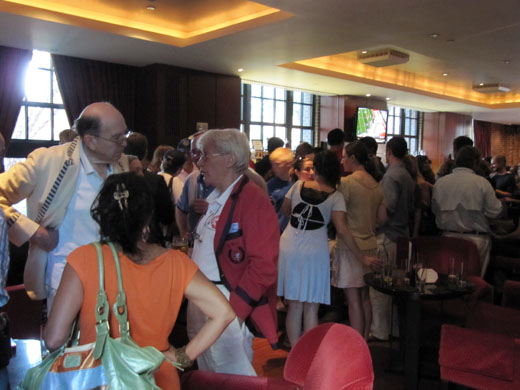
Alumni of both universities and their family and friends then adjourned to the Ritz-Carlton to convert each minute of boat racing into an hour of alcohol consumption.

“Quid Plura?” thanks the Cambridge Society for the invitation to hang out with a fun crowd and stretch a weak premise for a blog entry about medievalism into an excuse to drink on a hot afternoon, even if no one was overheard speaking Middle English.

“Is this the age of the thunder and rage…”

Few medievalists grace the saints’ calendars of American churches, but it’s fitting that back-to-school week coincides with the feast day of Nikolaj Frederik Severin Grundtvig, observed annually on September 2 by the Evangelical Lutheran Church in America and on September 8 by the Episcopal Church in the United States. The Danish bishop and polymath is little known outside his home country, but he was a monumental figure there—and if you’ve read any edition or translation of Beowulf, then N.F.S. Grundtvig was partly responsible for getting it into your hands.

After Icelander Grímur Jónsson Thorkelín published the first printed edition of Beowulf (with the support of the Danish government) in 1815, Gruntvig was the most vocal scholar to point out the many errors in Thorkelin’s transcription and Latin translation, from misreadings of Old English words to Thorkelin’s failure to recognize proper names. Thorkelin, a twitchy careerist, responded by accusing Grundtvig of “sweet dreams, absurd fantasies, and willful distortions of the original and of my work within the Chaos that surrounds him,” but Grundtvig, the superior scholar, was right. Grundtvig was also the first to notice that the Hygelac of Beowulf was the historical figure Chochilaichus named by Gregory of Tours in his History of the Franks, and Grundtvig’s 1820 version of Beowulf in Danish was the first translation of the poem into any modern language.

Although Grundtvig was peeved to see the Danes exeunt two-thirds into Beowulf, he never stopped grappling with the poem, seeking not only its universal lessons within the context of his own faith but also clues to the Scandinavian past. “[T]he language,” he wrote, “is ingenuous, without having the German long-windedness, and without remaining obscure in its brevity as so often in the Eddic poems.” Inspired by Beowulf, Gruntvig became an Anglo-Saxonist while rising through the Lutheran church, studying theology and languages, agitating for Norwegian independence, becoming the father of Danish folk schools, dealing with censorship and fines and exile, marrying three times, briefly serving in the Danish Parliament, and somehow finding time to translate hundreds of hymns and write countless poems and books. (For all I know, he even invented Lego and provided the theological foundation for his nation’s wonderful open-faced sandwiches.)

Something of an Anglophile, Grundtvig practically begged the English to appreciate this work by their native poet, and the tone of his 1831 proposal for an Anglo-Saxon book subscription program will amuse any medievalist who’s been accused of cultivating obscure interests:

I know there are tastes, called classical, which will turn away in disgust when they are told that this poem consists of two fabulous adventures, not very artificially connected, except by the person of the hero,—and that these episodes, which relate to historical traditions of the North, are rather unskillfully inserted. But I think such classical scholars as have a squeamish repugnance to all Gothic productions, should remember that, when they settle themselves down in the little circle of the ancient world, they have banished themselves from the modern, and consequently have made their opinions on such a subject of very little importance.

“For all his faults of expression,” writes Tom Shippey, “Grundtvig read the poem more acutely and open-mindedly than any scholar for decades.” Even those of us who will never be honored with hymns could do worse than aspire to earn such an epitaph. Thanks to scholars like Grundtvig, not only do we better understand how and why the Anglo-Saxons wondered, as others have, “Ubi sunt qui ante nos fuerunt?,” but we can also start to answer the question ourselves.

“…far away from dry land, and its bitter memories.”

Seamus Heaney is a fine poet, but his Beowulf and I have sailed past each other for ten hopeless years. When I skim his translation, I drift, and the audio version only lulls me to sleep, despite its potent brogue. Having failed to enjoy Heaney’s Beowulf as a poem all its own, I had hoped that the book might at least appeal to reluctant readers who’d otherwise flee from medieval lit. Instead, Heaney’s Beowulf is, I’d bet, one of the least-finished bestsellers of the last 25 years, while its omnipresence has overshadowed more recent attempts to draw readers into a lost heroic age.

One such Beowulf, the 2004 Longman Cultural Edition, comes packed with a timeline, a glossary, genealogies, and snippets of primary sources. At its core is a translation by Alan Sullivan and his partner, Timothy Murphy, whose respect for formal poetry dictated the guidelines Sullivan enumerates in his introduction:

(1) It would be written in four-beat lines, like the original, though differing somewhat in metrical detail. (2) It would follow a loosened variant of the Scop’s Rule, alliterating three times in most lines, but using other patterns of alliteration as well. (3) It would employ modern syntax, with some inversion for rhetorical effect. (4) Words of Germanic origin would be chosen preferentially.

Their boundaries set, Sullivan and Murphy spin a translation that evokes the craftsmanship of the original poem without the stringency of an antiquarian exercise. Here’s Beowulf and his men bidding farvel to Denmark:

They boarded their vessel,      breasted the deep,
left Denmark behind.     A halyard hoisted
the sea-wind’s shroud;     the sail was sheeted,
bound to the mast,     and the beams moaned
as a fair wind wafted     the wave-rider forward.
Foamy-throated,     the longboat bounded,
swept on the swells     of the swift sea-stream
until welcoming capes     were sighted ahead,
the cliffs of Geat-land.     The keel grounded
as wind-lift thrust it     straight onto sand.
The harbor-guard hastened     hence from his post.
He had looked long     on an empty ocean
and waited to meet     the much-missed men.

Heaney’s version of this same passage is a lovely bundle of lines—but Heaney, by his own admission, is “less than thorough” regarding meter and confesses that his alliteration “varies from the shadowy to the substantial, from the properly to improperly distributed.” By contrast, Sullivan and Murphy find power in form. Read their translation aloud, as I have since finding it in the library last month, and you hear—and feel—diction constrained by rules and traditions, restlessness evident in every line, the entire translation all the more vibrant and immediate for it.

Over the years, I’ve sometimes dropped by Fresh Bilge, Alan Sullivan’s blog about poetry, religion, politics, weather, and sailing. Since I share only the first of those five interests, I’ve never been one of Sulivan’s regular “rare readers,” but a few weeks ago I went to drop him a note telling him him how much I was enjoying his Beowulf—but I was too late. Alan Sullivan died on July 9, 2010, after a long battle with leukemia.

Blogger Brendan Loy has written a heartfelt appreciation of Alan Sullivan. Here’s Sullivan’s death announcement and obituary, plus a selection of his poetry. Here’s Timothy Murphy conducting a far-ranging interview of Alan Sullivan in Able Muse magazine, in which Sullivan discusses being critiqued by Richard Wilbur and implores would-be poets to pry themselves away from the campus:

I would add a more general comment that introversion and bookishness have harmed the estate of poetry. Teachers who encourage these traits do their students no favors. Better to foster the natural curiosity of the young, press them to acquire general knowledge, demand accuracy and precision in language, and promote monomanias as escape hatches from the self.

That advice, and the above translation of Beowulf’s leave-taking, aren’t a half-bad way for a poet to be remembered: as a man who knew the difference between worda ond worca, and made the best of both.