“I’m no exception, please call my name…”

Some messengers are ambivalent about their own calling. This one perches 175 feet up, high above the birdwatcher, just below Medusa, and weirdly close to angels.

APORIA

Rilke from his rampart: Beauty’s naught
But terror’s dawn.
Then why do mirk-mites wrought
From strofe and stub, Creation’s afterthought,
Squat seraph-like on spits above the earth:
To herald terror’s end, or stress the birth

Of idle envoys? Will my gaze reverse
The pattern, roughly swat the form aright,
Or only skew the catachresis worse
For pious poets? Dismal in whose sight
We loom in low, like pests, and while you write
Like angels on a book-shelf in Berlin

We stand and wait for nothing to begin.

(For all the entries in this series, hit the “looking up” tab, or read the gargoyle FAQ.)

“A garden full of food will be my final contribution to the world…”

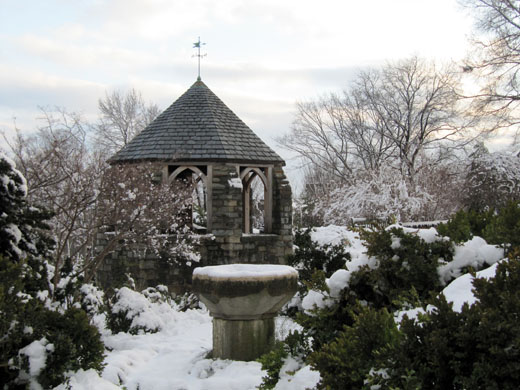
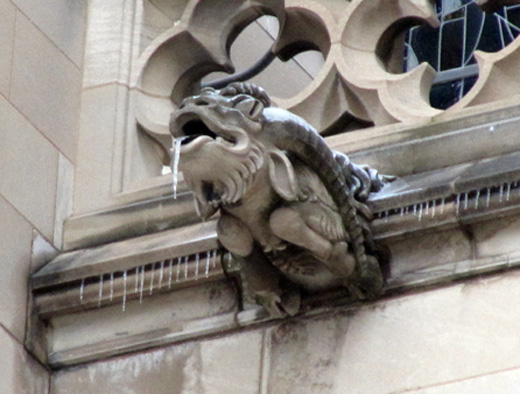
Regular readers of this blog may recall that part of the Bishop’s Garden is devoted to Walafrid Strabo, the Carolingian abbot and teacher best known today for De Cultura Hortorum, a poem about his garden at Reichenau. Walafrid was only in his early thirties when he drowned in 849 while trying to cross the Loire. This goat, apparently a medievalist, looks out over the garden and remembers him yet.

WINTER CANTICLE

Seminibus quaedam tentamus holuscula, quaedam
Stirpibus antiquis priscae revocare iuventae.
— Walafrid Strabo, Hortulus

As frozen fingers blunt the thorn,
So Walafrid was barb’rous born

But to that noble island brought.
There Walafrid a vision wrought

With falt’ring eye, but steady feet;
Yet Walafrid would fast retreat

To fertile slopes that front the east.
To Walafrid, to tend the least

Of bitter twigs was sweetest toil,
So Walafrid provoked the soil

To summon worms, and banish moles.
Ere Walafrid the care of souls

Attended, first he fathered roots;
So Walafrid, when bade by brutes

To court, would wall his fruitful mind.
There Walafrid was wont to find

That princelets spire like grasping vines;
And Walafrid tracked fraying lines

Of maidens’ woolspun, wound like gourds;
And Walafrid, when fraught by swords

Saw iris weigh her windblown blade;
And Walafrid left kings afraid

That striplings choke the root, like sage;
And Walafrid foresaw how rage

In bitter plots like wormwood grows;
Then Walafrid perceived in rows

Of scrabbled verse the reek of rue,
Which Walafrid perused, and knew

A soul his faith and friendship scorned.
Then Walafrid in silence mourned

Their idyll dawns, with leaf-light strewn;
But Walafrid prayed God the moon

Shone ghostly, sometime, on his face.
Lest Walafrid despair of grace,

He starved the flame, like seeds to drought;
And Walafrid dreamed long about

The flood, the torrent, murm’ring death;
Then Walafrid would gasp for breath…

Now wait, and watch the snow-bed yield
To branch and bramble unconcealed

That ache for thirst, but must bow down
To seed that drinks, but does not drown

As sprigs and spindrels long unseen
Entwine the font, and blinding green

And purple flash from wing to tree
And sepals spread to greet the bee

And raindrops burst in thick bright beads
And sun alights on lazing weeds

Where column-bright, the lily grows
And raises morning o’er the rose

That marks the day when winter dies;
Then Walafrid, refreshed, will rise.

(For all the entries in this series, hit the “looking up” tab, or read the gargoyle FAQ.)

“So I cut some cord, and I shouldn’t have done it…”

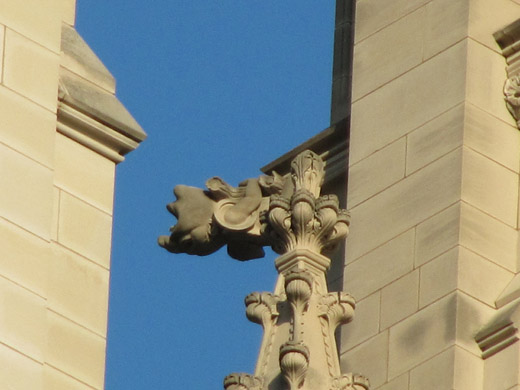
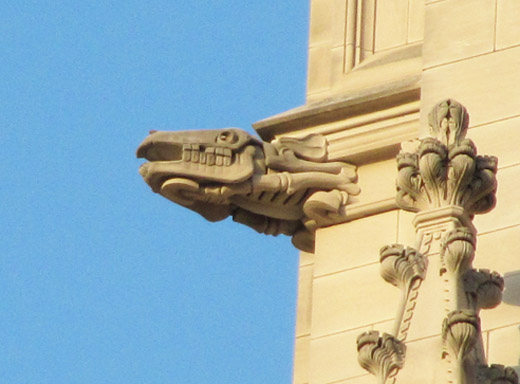
The southwest tower is haunted by a skeletal horse. Few people see it, but at sunset, you might hear it sing.

KINDERLIED

As I was riding to Banbury Cross,
Lazily lilting of lovers in loss,
Out swept a seeress who sneered down her nose:
“He shall have music wherever he goes.”

As I was riding to Banbury Square,
Twined in a tribute to tumbledown hair,
Out skipped a maid: “Are you singing for me?”
Studied and sober, I stared at the sea.

As I went riding to Banbury Street,
Rhyming a romance with riddles replete,
Out slouched a spinster: “Perchance it’s my day?”
Crabbed and confounded, I cursed the delay.

As I was riding to Banbury Lane,
Poignantly piping of passion and pain,
Out shuffed a widow: “Can you see his face?”
Piqued and impatient, I parted apace.

As I went riding to Banbury Road,
Wide by the wayside that wisdom bestowed,
Out rose a hymn: Every rapturous word
Rang through the alleyway. Nobody heard.


(For all the entries in this series, hit the “looking up” tab, or read the gargoyle FAQ.)
“Talkin’ jivey, poison ivy…”

Someone recently asked me if I thought gargoyles get bored. Spend a morning with the three-headed dog on the south transept, and then you tell me.

THREEPIPHANY

A martyr
sees saints circumambulate smarter
while legates who pult at the wall
fall.

A yeoman
scabs each sanguinarial omen
while canons for ungilded stone
moan.

A maiden
with sopp’d weialálas is laden
while posers who fish for the ring
sing.

A traitor
spins Fortune against her creator
while cold consolation reveals
wheels.

A seeker
finds calxiform beacons burn bleaker
while knaves see the weary-all thorn
born.

A fogey
dares cymricize non-mabinogi
while teardrops round wasting Mac Cool
pool.

A quester
lets pentacled purities fester
while gomish virídescent axe
whacks.

A hero
rounds duodenáry to zero
while Argonauts freighted to fail
sail.

A phony
maraunders in blind Laestrygóny
while fesseries dredge to exhume
Bloom.

A ptotic
turns thlebrous Caváfy demotic
while Sclepius hectors his snake
wake.

A portal
makes polycephálics immortal
while rhymers who rage in the dark
bark.


(For all the entries in this series, hit the “looking up” tab, or read the gargoyle FAQ.)
“Just like the rain, I’ll be always falling…”

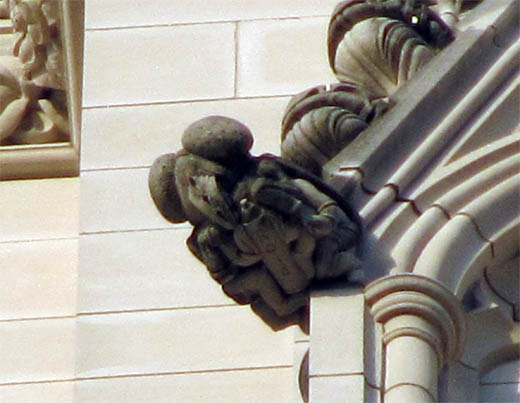
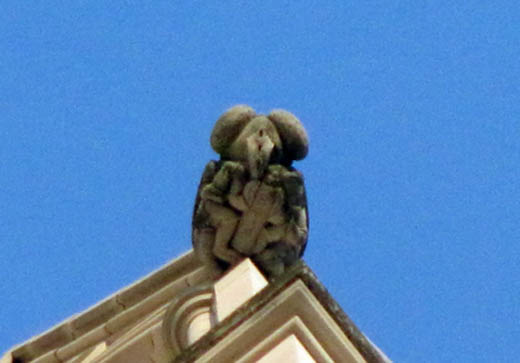
The fallen angel on the southwest tower is difficult to see from the ground. He has shriveled wings, stolen halos on his arm, and an eternal supply of petulance.

29 DECEMBER/TE DEUM

“Come rhyme with me; I rise to dance,” you lie;
Like medlar rashly dropped, I’ll ripen not.
Now overturn my sodden pith and pry
For secrets, hard as seeds. Behold my rot:
I holp no palmers whon thot thay bay seck;
No elvysh poppets twang may turvy rhyme;
Their ferney hawls I longen for to wreck:
“No bishop murdered yet?” Oh, give us time,
Though crypts below will blaze in shadows’ wake,
Though bannerets above must fly unfurled,
Though quires within call reprobates to quake,
Though bells on high will warn a weary world
And make me loathe and love what they begat:
A blessed bishop born a Cheapside brat.


(For all the entries in this series, hit the “looking up” tab, or read the gargoyle FAQ.)

“…and eyes full of tinsel and fire.”

Facing east, this rooster on the southwest tower greets the winter dawn, but not without trepidation.

SOLSTICE SONG

Come and grace our gleeful number;
Come and shake off snows unknown.
Bells will ring while wood-woes slumber;
Bells will ring for you alone.

Rave with uncles reeked in holly;
Reel with aunts who saw you born.
Whirl away your grear-tide folly;
Hearth-life dwindles ere the morn.

Haul the ash-bin ’round the byre;
Feel the pinelight breathe your name.
From the tongue of colder fire
Cracks and calls a hotter flame.

Run and chase your sweet-lipped singer;
Run and race your hope anon.
Bells will ring where’er ye linger;
Bells will ring when you are gone.

(For all the entries in this series, hit the “looking up” tab, or read the gargoyle FAQ.)
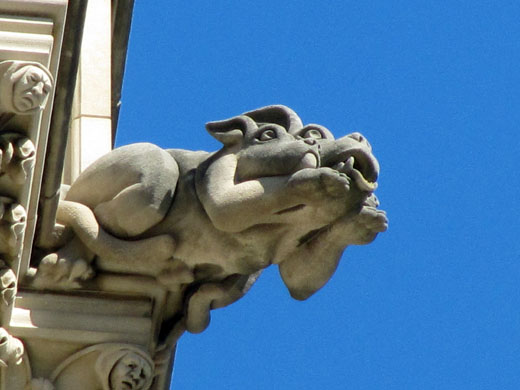
“‘You’re all wrong,’ I said, and they stared at the sand…”

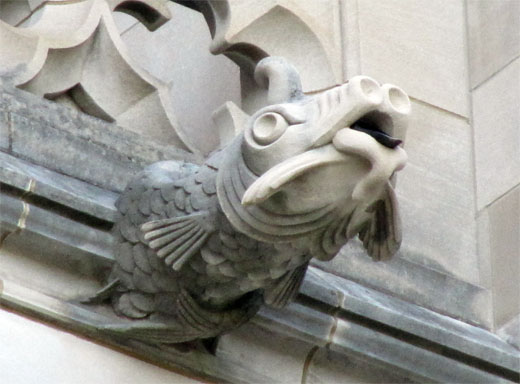
The horned fish on the north nave gets scant sunlight as the winter wears on, but seasonal shadows help him seem more sinister than absurd. He’ll tell no tale about himself; fish feed on the exploits of others.

TRIOLET
(SHIPWRECK SONG)

“Take up a line”—and so we sail
Behind the storm. We hold our own;
When luff-seams shred, our lidmen pale
Take up a line. And so we sail,
And when you dread that sureties fail
The loves of men on strands unknown,
Take up a line and sew. We sail;
Behind the storm, we hold our own.

(For all the entries in this series, hit the “looking up” tab, or read the gargoyle FAQ.)
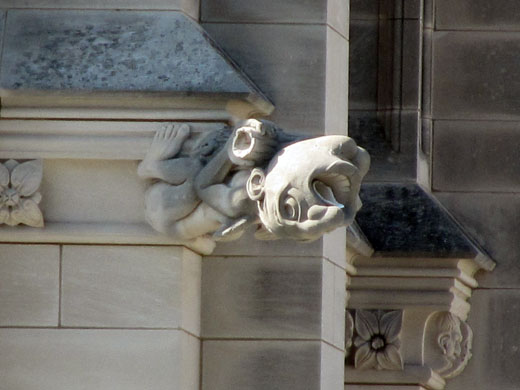
“Spending warm summer days indoors…”

Longtime readers know this blog took an odd turn in late 2009 when poems about the National Cathedral gargoyles started popping up. To my surprise, a whim—a sonnet about a boar and a dashed-off song about a monster—turned into both a long-term project and a refreshing creative challenge.

Readers tell me they like the gargoyles, but I’ve also fielded enough questions that it’s probably time for a FAQ.

So why did you decide to follow up a moderately successful nonfiction book with a batch of gargoyle poems?
My agent and editor tell me that light, formal verse is the next big trend in publishing. A team of highly paid consultants is working day and night to ensure that I’m branded in the public mind as “the Dan Brown of medievalist gargoyle ekphrasis.”

No, really, what’s the deal?
From 2006 through 2008, I promoted Becoming Charlemagne, an adventure that was wonderful in hindsight but very tiring. Then I spent most of 2009 on long writing projects for other people, to the point of word-weariness and exhaustion. These poems, like most posts on this blog, let me re-associate writing with pleasure without worrying about marketability, editors’ impressions, or other people’s needs.

Are you going to write poems for all of the cathedral’s gargoyles?
Heck no. The cathedral sports 112 gargoyles and more than 1,100 grotesques. I’ll focus only on my favorites, around 50 in all.

Does this project have a name?
I’ve been calling it “Looking Up.”

How can I read all of the gargoyle poems to date?
Easy: just hit the “looking up” link at the bottom of each gargoyle post or under “Categories” in the right-hand column of the page.

If you’re a new reader looking for a sampling, check out the cicada ghazal, the song of a lovelorn monster, the alliterative advice of a bitter mother, the fretful musings of an artsy fawn, the domestic drama of an octopus reappraising her lobster, and the most popular poem so far, a yarn about where dragons come from.

Will you turn these poems into a book when you’re done?
Several readers have told me they want one, so yes.

How long will that take?
I don’t know. I have a full-time job, I teach part-time, and occasionally I do engage in pastimes unrelated to gargoyles. Probably mid-2012.

Do you take requests?
Several of these poems have been inspired by anecdotes from readers, students, and friends. So yes, if you have a favorite vocation, cultural icon, wild animal, or mythical beast, send me a note and tell me a story and I’ll see what I can do.

Do you take the gargoyle photos on this site?
Yes. I’m a crummy photographer who happens to own a point-and-click camera with a decent zoom lens.

Are you affiliated with the National Cathedral?
No. The cathedral just happens to be an easy, one-mile stroll from “Quid Plura?” headquarters. Its grounds and gardens offer a welcome getaway from the rest of D.C. when the city’s at its ephemeral worst.

Are there any guidebooks to the National Cathedral gargoyles?
Wendy True Gasch’s Guide to Gargoyles and Other Grotesques is packed with info-nuggets and photos. It sells new at the gift shop for $12.95. The Stone Carvers: Master Craftsmen of Washington National Cathedral focuses on the lives and work of the Italian masons. The cathedral also offers gargoyle tours.

So have you stopped writing about books and medievalism and Charlemagne and galangal disasters and dumpsters full of hobbits?
Of course not! The gargoyles, for however long they linger, won’t supplant any of that.

You must like Shel Silverstein.
Not really. The only two works of his I know are his ancient Irish drinking song and that book about the codependent tree.

How can I support your gargoylish endeavors?
You can’t, really; it’s not a commercial project. But I won’t complain if you pick up a copy of Becoming Charlemagne (paperback or Kindle) or The Tale of Charlemagne and Ralph the Collier (paperback or Kindle).

Or, heck, just keep reading this blog or subscribing to its feed. I’ll keep writing as long as you keep bringing the eyeballs.

“Slipping the clippers through the telephone wires…”

Cathedral visitors are sometimes confused, even offended, by gargoyles that honor irreverence or depict blatant evil. The suicidal, Gollum-like “Stabber” on the west front isn’t surprised; he knows what he is.

ALL HALLOWS’ EVE

Long live the weeds and the wilderness—yet
What would be left of the wildness and wet
Were it not for the curdle, the canker, the theft
That threaten to render the blessèd bereft?

Our beady-boned eyebulge flits over the burn;
Wily we twitch through the sack-shriveled fern
As the groin-growls enrage us where daggers bite through,
Damning the bloodline that dapples the dew.

Yet rounded in couplets, despair-darksome sneering,
Frown pitchblack poets defy all our leering,
Twindled revisioners burbling like broth,
Donning their Jesuit wind-shriven cloth.

What pumpkin-maws mumble, we ache to express;
Ghouls plunder verses they dare not possess.
Take heed of the unhallowed eyeblight you mourn:
Then know why the saints of the morning were born.

(For all the entries in this series, hit the “looking up” tab.)

“Way up there in the poison glen…”

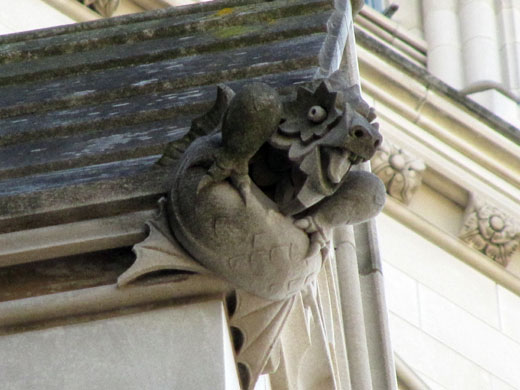
This creepy dragon on the north nave hides within his own fishy body. If you approach him, he’ll sing prophetic nonsense.

AUTUMN SONG

Clerks wrap swords in newsprint gray;
Voices of Avalon pine and pray.

Spine-cracked quartos brace the wall;
Voices of Avalon flake and fall.

Cursors burn a wanton field;
Voices of Avalon yawn and yield.

Spiders fast in pyx and grail;
Voices of Avalon fade and fail.

Glowing points rouse brush-bent hair;
Voices of Avalon strain and swear.

Roof-beams warp like corset bone;
Voices of Avalon mince and moan.

Unplucked medlar rots to wine;
Voices of Avalon pout and pine.

Marshes drown the back-toll’d bell;
Voices of Avalon swoon and swell.

Mice in moat-muck bloat face-down;
Voices of Avalon fuss and frown.

Grave-masks grin, but none deceive;
Voices of Avalon groan and grieve.

No knights rise, though one did try;
Voices of Avalon drift and die.

Furze-pigs rove in disarray;
Voices of Avalon seethe and say:

“Run, and raise the rust-white gate.”
Voices of Avalon wait.

(For all the entries in this series, hit the “looking up” tab.)