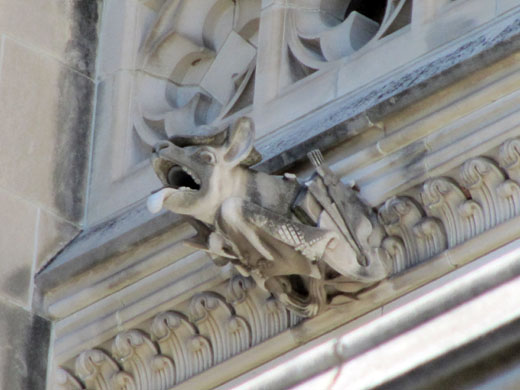
“‘I might be old, but I’m someone new,’ she said…”

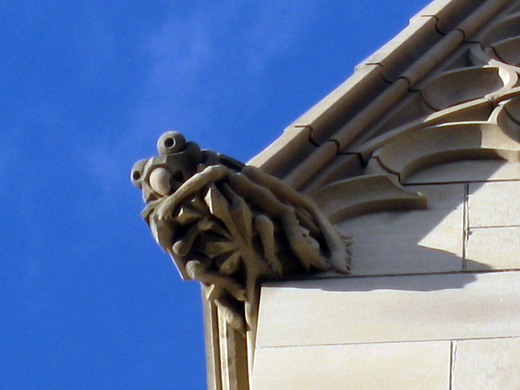
In May, a cicada on a buttress chirped a ghazal. Today, a cockroach replied. Who knew insects talked like this?

FROH

The background: you returned—a draught of wine
Fulfilling sweet the word the wind had thrown,
Returning scents and sight, restoring mine.

Despairingly, we wandered on our own
Beyond you evermore, or so we feared,
Eternal, guileless girl—then how we cheered…

The foreground: love, it glows with you alone.


(For all the entries in this series, hit the “looking up” tab.)

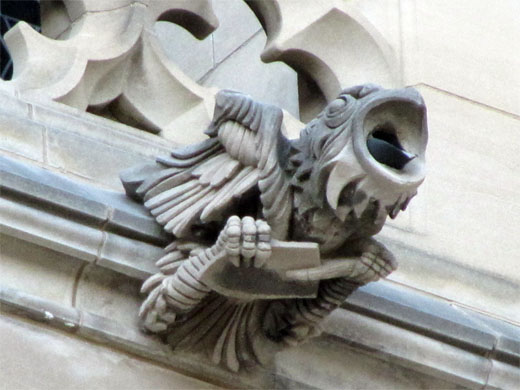
“Out in the garden, there’s half of a heaven…”

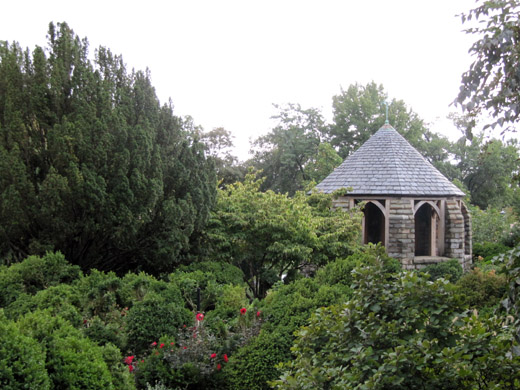
From his perch on the south nave, this avian gardener overlooks the Bishop’s Garden and the nearby woods, but clearly he takes a much longer view. He’ll tell you all about it if you ask him.

SUKKOT

I think that you shall never see
The garden fall when palmers flee.
The scales of summer groan and tilt;
The mite, the moth, the rain-dove wilt,
The hunchneck roses moan with thirst,
The medlar skullfruit split and burst,
But through the leafmeal, long asleep,
The eldritch from the wanwood creep,
Their twilight pastors freely led
By silkwaist suitors stirred from bed.
Their belts of straw and ivy buds
With coral clasps and amber studs
Give way to frond, and myrtle shoot,
And willow leaf, and brightripe fruit.
Through temples roiled by root and vine
They pass to pray, and so divine
Why revels must in autumn reign,
Why pilgrims pirouette in vain,
Why laggards must rehearse at last
The doom of some ecclesiast:
“The flowers do fade, and wanton fields
To wayward winter reckoning yields…”
So pinelights drift, like snows to come,
And mumbling lowly, shuffling numb,
They burrow into bowers veiled:
“Our fadelight feast again is failed.”
But seek no truth from sullen tree;
Recurrence clouds the memory.
We plait our laurels, fools by choice,
But only G-d can cry Rejoice.


(For all the entries in this series, hit the “looking up” tab.)

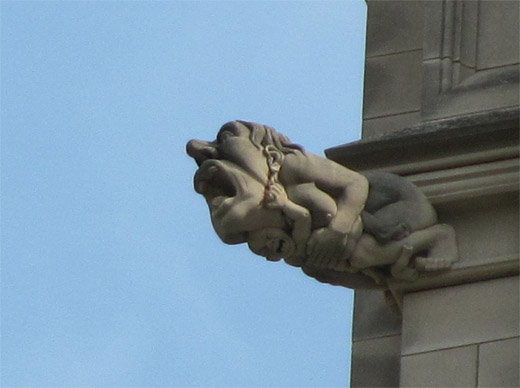
“Full moon, pass the window sideways…”

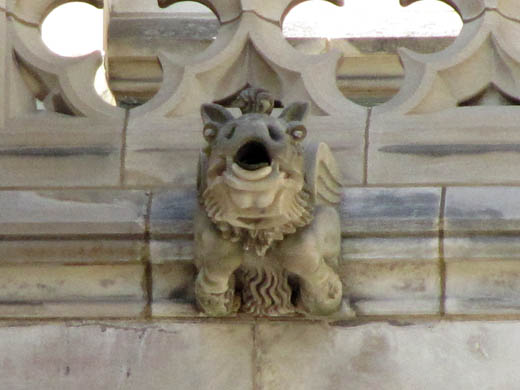
This cavewoman and her baby make for a vivid pair nearly 200 feet above the cathedral’s north lawn. She’s hard to see; the chip on her shoulder is hard to miss.

MEARCSTAPA

I’ve no gold cups       to catch your shrieks
And noises foul,       no nailing rock
Where cronish faces      fade, and matrons
Remoulded as maidens     mourn so gleefully
The babe whose face      they fouled with runes.
No—grear my mouth      and gray my eyes,
And shriv’ling hairs       in handfuls twine;
Time is a rot-wyrm       that riddles us through
And broods in its hole      upon our brighter days
But shares secrets       mere seeresses hide.
All this I owe you;      I own nothing more.
The work of the world      fathers wolfish brats,
But hold your ground.     Heroes will loathe you,
Knowing they need you,    lest no one forge
Prurient tales     from pride alone
Nor string a song    from strokeworn beards.
Behold how hall-thugs    hungry for butchery
Score rusty sword-tips     ’round scabs, hearing
Echoes of Caindom        in all but their own.
Rave when one belches      some rum-ram-ruf lay;
His bones will break.    Just bide your time.
Thole and thrive, son,    throughout dull days;
You’ve naught to fear.    Face them, beaming.
Swive or just sing with them.    Savor their smell.
Their bile, rising,     my boy, you’ll taste,
And soon you’ll crave     their crawling flesh,
And late you’ll drain     their draughts of blood,
And ere the dawn      their oaths they bleat,
Graying faces     greeting the morn
Will gape at your night-work,    noble heroes
Strangled, overthrown,     strawberry-flecked,
Sweet sentinels,     singers of tales,
Wyrd-graven warlords,    woebegone boys.
Peer from the tree line;    try not to gloat,
But make them hear you    howling your name.
All youth survives     in you alone,
So be for me     my bitter angel
Rightfully fated    to rage in the dark.
Motherly lore      will light the gloom:
Like candles touched      to torchwood pyre,
Mere men flicker;    monsters explode.


(For all the entries in this series, hit the “looking up” tab.)

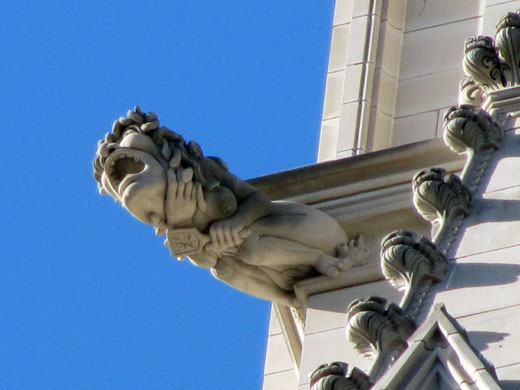
“Sing ‘hi, lo, lay,’ at the end of the day…”

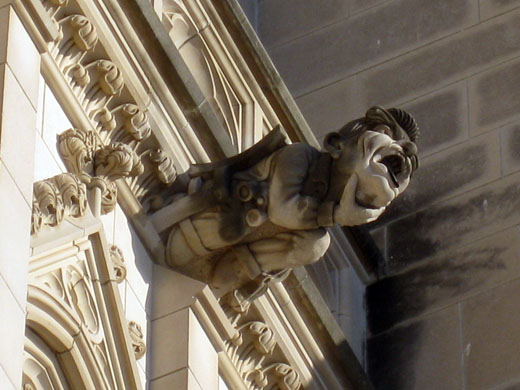
National Cathedral tour guides may try to tell you why this monster is clutching a giant molar 40 feet up on the south nave. I prefer his own explanation.

SONG

In my dream, a Pictish maiden
Paused and prayed here half a while,
Shade and snow a-swirl around her,
Something wanting in her smile.

From my scrafe, I spied in silence,
Watched her wend round weed and hill
And rose, and passed from forests dim,
Her foremost longing to fulfill.

Late I loped through Roman markets,
Hove the doors off Saxon halls,
Plumbed the moats of Norman mansions,
Flinched, then froze, when furtive calls

Enthralled me, lost, where mental mazes
Shrank, and starlight shone by day,
Until I found the hope I sought,
Extracted it, and stole away.

Sovereigns rise and storm-clouds scatter;
Chapels fall and winters turn.
Truth survives a thousand summers:
What is lost may yet return.

In my dream, a Pictish maiden
Marches past, her patient soul
Reflecting suns that swirl around her;
After all, her smile is whole.

(For all the entries in this series, hit the “looking up” tab.)

“I’ll build you a kingdom in that house on the hill…”

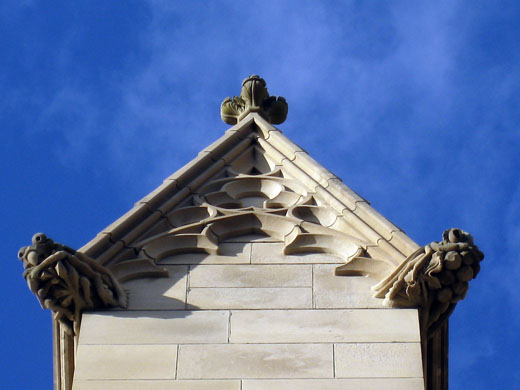
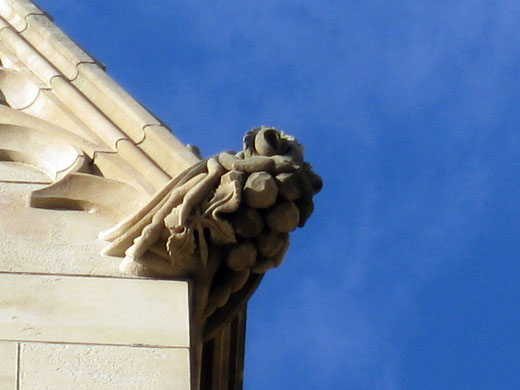
Around the cathedral, few creatures say what they actually mean. When the lovelorn cicada on the south nave needed advice on impressing the silent insect with whom he shares a buttress, I shrugged and loaned him a book on ghazals. Cicadas are well suited to the form: They respect tradition, they’re enigmatic by nature, and they know how to flutter indecisively around a perfectly bright idea.

GHAZAL

The scullions ma’am’d and sir’d to the Abbasids;
The lusts of locusts whirred through the Abbasids.

Salaam, she sighed. A serpent shed a city,
And in, a starving bird, flew the Abbasids.

In wine, in witless words, in bloodshot mornings,
The gift of gardens blurred to the Abbasids.

A general’s eye surveyed the rheumy rooftops,
And frozen by a word grew the Abbasids.

You sang, “the bow his brow, his lashes lances…”
Our dawn campaign referred to the Abbasids.

“It’s cool,” the in-crowd says, “to dig this chanting.
A ban would be absurd to the Abbasids.”

Her angel raises ribbons, blue and scarlet,
But wasting in the third queue? The Abbasids.

I studied senseless serifs on your postcard,
A lore I long preferred to the Abbasids.

Spines align. He scans her posture sidewise:
El Cid, Beginner’s Urdu, The Abbasids…

The old cicada sang, his soul emerging,
And yet you never heard. Do the Abbasids?


(For all the entries in this series, hit the “looking up” tab.)

“Feathered, look, they’re covered in a bright elation…”

Too few Washingtonians have hobbies; for many people here, cultivating a career is apparently amusement enough. Fortunately, I sometimes encounter locals—like this fellow on the west front of the cathedral—who enjoy a pastime I’d never really thought much about, and I like when they explain its appeal in terms I can understand.

A SIMPLE DESULTORY PROSOPOPOEIA
(or, HOW I WAS RICHARD WAGNER’D INTO TRADITION)

“I do not think that they will sing to me”:
Impulsive mermaids drown in shallow words.
Await no witless warbling by the sea;
Rather, seek the songs of simple birds.
From perch and peak they twitter truths profound:
A woodbird stirs the Volsung in his blood;
A parliament of eagles circles ’round;
A curlew chills the farer on the flood.
The cuckoo croaks that sumer is icumen;
“Keep well thy tongue!” confesses Chaucer’s crow;
The nightingale her owl will merr’ly summon;
Despite their flyte, one insight they bestow:
Be still, but heed the rustle of a wing;
A legendary pigeon waits to sing.


(For all the entries in this series, hit the “looking up” tag.)

“Unicorns and cannonballs, palaces and piers…”

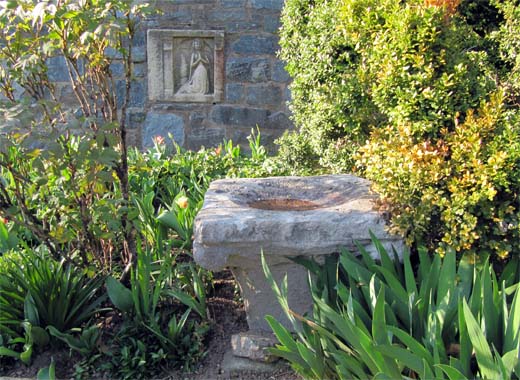
Yes, there’s a winged unicorn at the National Cathedral, but she hides in a shady nook along the south nave, and the horn that rests flat against her back can’t be seen from the ground. Below her, over the wall in a corner of the garden, sits a birdbath, a 12th-century capital salvaged from the ruins of Cluny. One never can tell what a unicorn will find intriguing.

EASTER 2010

A whisper in the medlar, Father Hugh:
“I found a cloister crook’d in splintry beams
And stood it straight in marble. Fresh regimes
Reigned higher still; our rule they overthrew.
As songbirds shrink from thunder, we withdrew,
And now the sun we kindled scarcely gleams
Above the murk of misremembered dreams.
This capital will never rise anew.”
To which I field a future all my own:
A thousand summers wither in a blink.
A sparrow spots my hooves and broken horn
Through churchyard brambles, grear and overgrown,
And droplets on my wing she stoops to drink;
Then she will be refreshed, and I reborn.


(For all the entries in this series, hit the “looking up” tag.)

“Don’t leave me hanging in a city so dead…”

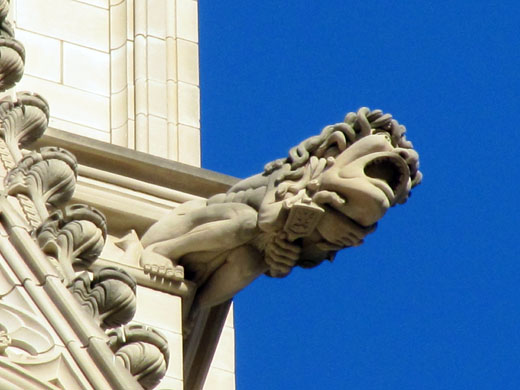
Sometimes gargoyles are so high up—in this case, nearly 200 feet—that few people see them, and nobody hears them. Alas.

On either side the arches fly,
The buttress-blocks that half-imply
A sort of creamy stonework thigh,
And thro’ the calf and knee-crook high
Soar carven brutes profuse; a
Docent notes them, up and down,
Pent-up pilgrims crane and frown
’Neath the nag of no renown,
The southwest-tower Medusa.

A tourist twirls, a ballerina
Sensing o’er her Neutrogena
Grills that send a scent subpoena
From a cactus-themed cantina,
Corn-and-meat pupusa;
Bus-groups pained by prickly towers
Overlooking Gothic powers
Seek instead tequila sours
Ere southwest-tower Medusa.

Still, she sneers by day and night,
A myth amasked in aspish fright,
Damning each commercial flight,
Heedless of the blear and blight
She blusters to induce; a-
Ware of what her curse may be,
Alone she seetheth steadily,
Spitting on the bourgeoisie,
The southwest-tower Medusa.

And, skirting ’round her mirror’s haze,
Limestone saints avert their gaze,
Lest a glance condone her craze:
A kraken kind she howls to raise
To shake her prison loose; a
Waste, when distant dumpsters crash,
Reaping reams of beer-dark trash.
She hath no hope for titans’ clash,
The southwest-tower Medusa.

Like a queen of ninth-grade spites
Brooding on imagined slights,
Texting vapid acolytes,
Curls a-twirl through tween-dazed nights,
She taps jejune abuse; a
Tome she scans with deep’ning dread;
No sandaled Zeus-brat hunts her head.
“I am half sick of Bulfinch,” said
The southwest-tower Medusa.

She’s left to wail, she’s left to loom,
She sets her face to scowl and fume,
She sees the horrid garden bloom,
She sees no glad, galumphing groom
To suffer and seduce; a-
Las, no roof-beam waits to rise,
Nor any man half Ares’ size.
“No curse has come upon me!” cries
The southwest-tower Medusa.

There is no river, chain, nor boat,
No pithy rhyme for profs to quote,
No knight to heed her final note;
For her, no verse will e’er be wrote
By laureates obtuse; a
Captive crone, denied release,
She envies maids whose poems cease.
No tender curse can promise peace
To southwest-tower Medusa.

No one wonders, “What is here?”
High above, some starry sphere
Screeches thro’ another year;
Now the dusk-light drowns in drear
And failing, fades to fuchsia;
For no one mused a little space,
And no one praised her fang-bit face,
And none of flesh will e’er embrace
The southwest-tower Medusa.

(For all the entries in this series, hit the “looking up” tag.)

“And he plays at stocks and shares, and he goes to the regatta…”

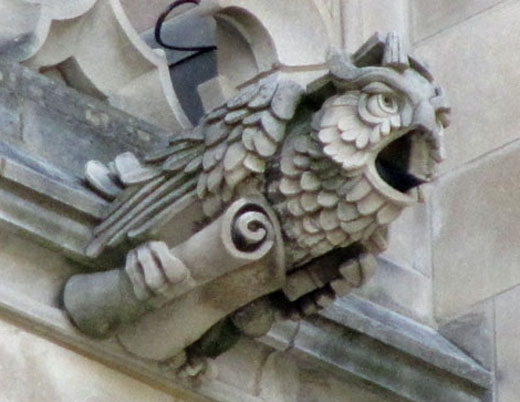
When I asked the owl on the north nave to contribute a poem to this project, I assumed from his mortarboard, scroll, and book that he’d hand me a pile of self-aggrandizing verse. Instead I got this shamefully loose translation of a pseudo-Ovidian poem written sometime between the 12th and 14th centuries. I guess a gargoyle, like the occasional human, reserves the right to remain enigmatic.

THE LOMBARD AND THE SNAIL

Loudly, the Lombard lopes over the landscape, and stops;
Leery, he lights on the lushest and loveliest crops.
Frabjous he feels, for his fields are not fated to fail—
Then forth springs a spectacle strange and stupendous: a snail.
Cowed and confounded, he quivers and quavers and groans;
Witless, he whitens, as wonderment welters his bones.
Seizing his senses, he summons the sangfroid to say:
“Fie on a felon! My fortune is forfeit today!
No suchlike scoundrel has slithered or skulked here before.
Mark well his message: he musters to meet me in war.
Horns are his heralds; his shield makes his handiwork plain.
Shall I not spurn him? No—better, in sooth, to be slain.
What if I poke and provoke him? Perhaps I’ll prevail!
Minstrels and merchants will mimic my marvelous tale.
What am I saying? To fight with a fiend is uncouth!
Easier warfare abounds; it’s a world-weary truth.
Men will say ’madness!,’ maligning me under their breath:
’It’s not meet and fitting to seek an uncivilized death.’
What if my children should walk by this waelstow and see?
Faced with this fiend, they would fathom his fierceness and flee!
Still, they’d concede that this combat is clearly unfair:
Armed is this beast, but no buckler or broadsword I bear.”
Fretful, he freezes, as Fear grapples fiercely with Shame;
Shame is pugnacious, but Fear keeps his temperament tame.
Competent counsel can kindle a capable life;
Thus he petitions the heavens, and checks with his wife.
Promptly, the gods promise palms for the victor, and praise;
Nervous, he nurtures no trust in their numinous ways.
Thence to his wife; she is timorous, tearful, and true:
“Listen, you lunatic, what are you looking to do?
Scuttle your strife; let your spirit sit safe on a shelf.
Mind no more monsters—and muse over more than yourself.
Spurn not your children and spouse! Let your senselessness stall;
Ill-omened days will bring dolor and doom to us all.
Hector would crumble, and even Achilles would quail;
Fast would the firmness of Hercules fracture and fail!”
Roused, he retaliates: “Rein in your runaway fears!
We who dare Death are undaunted, dear woman, by tears.
Great be the gods, for they grant me a glorious name.
You and the family fare well! For I follow my fame.”
Forth to the field, where he faces the fiend in the fray;
Stalking around him, he steadies his stomach to say:
“Beast, you are feral, unnatural, immoral, and vague!
Monster of monsters, as mean as the mortalest plague,
Hold high your horns! I am horrified hardly at all.
Show me your shield! Into no stealthy shell shall you crawl.
Righteous, I raise my right hand! Now your ruthless reign stops!
Savagely sully no more my salubrious crops!”
Swinging and swatting and shaking and sticking his spear,
Panting, he presses; the palm of the victor is near.
For heroes who rate such renown, what reward is supplied?
The matter is lofty; their lawyers will likely decide.


(For all the entries in this series, hit the “looking up” tag.)
“The girls would turn the color of the avocado…”

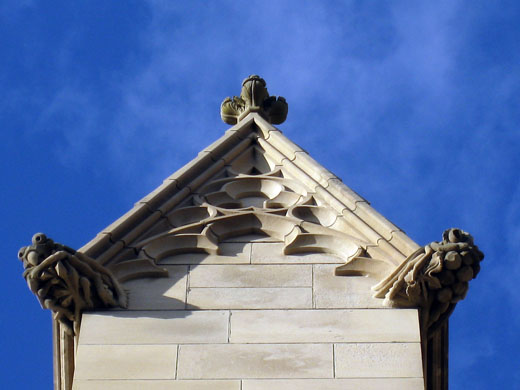
According to Gasch’s Guide to Gargoyles and Other Grotesques, the cathedral’s beret-wearing, paintbrush-toting deer is a verbal and visual pun: “This ‘endearing’ artist is undoubtedly ‘fawning’ on art.” Forever facing south toward the city’s museums, this creature is finding that a life in the arts, or in Washington, is about acquiring far more than the proper costume or kit.

ARS GRAVIS, VITA LEVIS

“Oldenburg, Rauschenberg, Klimt, or Klee:
When will I know what my passion should be?
Bierstadt, Bearden, de Kooning, Kinkaid:
How will their worth and my wisdom be weighed?
Is Calder too cutesy? Is folk art still fab?
Must Modern mean morbid? Devotional drab?
Are Memmi’s Madonnas deserving of fame?
Is liking them rightly ironic, or lame?
Is Flagg too American? Catlin taboo?
Is Russell too western? Is Parrish too blue?
Is Fauve far too Fauvist? Is Nevelson fluff?
Noguchi not nearly noetic enough?
What if I’m cornered, but plead my release
By deftly decrypting a daring new piece?
‘Problematizing. Pedantic. Profane.
Derivative. Kitschy. Impassioned but vain.’
Stone-faced, I’ll suffer no pleasure to show.
What if they squint through my brilliance, and know?”

(Say God replies. His pronouncement drifts down:
“Art’s not an adjective, only a noun.”)

(For all the entries in this series, hit the “looking up” tag.)