“Walking back to you is the hardest thing that I can do…”

Sure, the average American associates this week with football, tryptophan, and noncommital nodding during awkward conversations about politics, but here at “QP?” headquarters, Thanksgiving means only one thing: experimental recreations of carrot jam from the medieval Islamic world.

Carrot jam? Yes, carrot jam. Known in Arabic as jawārish, the dish appears in a cookbook called The Treasure of Useful Advice for the Composition of a Varied Table, probably compiled in Egypt or Syria in the 13th century. The recipe is translated in Medieval Cuisine of the Islamic World by Lilia Zaouali, and while Islamic cookbooks are just as blithe as European cookbooks about assuming expertise on the part of the reader, this one seemed like a no-brainer. After all, sweet carrot dishes are common today, and carrot preserves and marmalade aren’t terrible exotic—so again we endeavor to answer, probably in vain: What did the past taste like?

First, our ingredients: cookbook, carrots, honey from a friend’s New Jersey apiary (plus two plastic-bear backups), various spices, and a can of Chef Boyardee Ravioli that had nothing to do with this recipe but whined about being left out of a group photo.

From the recipe:

It is necessary to select fresh, red carrots, to wash them, clean them, and cut them as thinly as possible. Put them in a ceramic pot, add a little bit of honey, and cover them with water.

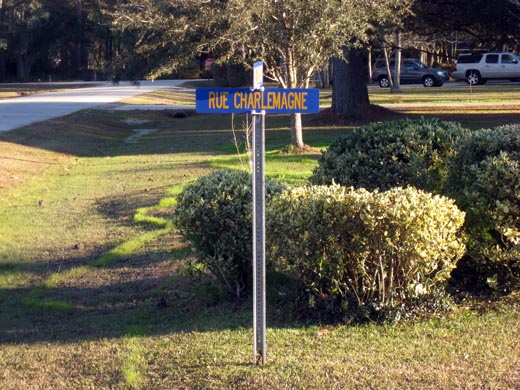
Lacking red carrots, I had to go with plain old orange. Here they are, simmering in the Le Creuset like flunkies in Charlemagne’s bath house.

Thus sayeth the recipe:

Cook them until they are soft, then strain off the water with a sieve and add a quantity of skimmed honey equal to that of the carrots.

An hour later, a pound of carrots yielded around a cup and a half of carrot glop, to which I added one cup of honey. Rather than bore you with lame photos, let’s hail the return, by popular demand, of the Trapper Keeper Unicorn of Applied Paleobromatology.

Distracted by the hard work of mushifying a few carrot chunks with the aid of Sir Braun de Hand-Mixer, I failed to witness a shocking crime on the countertop behind me.

Did you know that the tradition of selling honey in bear-shaped containers derives from the Abbasid practice of importing actual bears from Europe, squeezing them while upside down, and seasoning food with whatever spurted from their skulls? The caliphs really were that wealthy.

The recipe calls for spices:

Mix in seasonings chosen from among pepper, ginger, cardamom, cinnamon, cubeb, spikenard, mace, galangal, aloe wood [Aquilaria agallocha], saffron, and musk.

Fresh out of spikenard, and stunned by the recipe’s endorsement of a freeform jazz odyssey of spices, I opted for four I knew I had in my cabinet: 1/4 teaspoon each of pepper, ginger, cardamom, and cinnamon. (I’m not positive that “pepper” in a medieval Middle Eastern recipe meant “ground black peppercorn,” but so be it.)

I mixed up this little masala, dropped it into the honey-and-carrot mush, and did as I was told:

Cook to thicken the carrot jam.

Twenty minutes later, carrot jam was bubbling like sweet orange lava.

Two teaspoons of spices turned out to be too strong for fewer that two cups of carrot jam, but holy hopping Barmakids, hot jawārish a la Sypeck is tasty.

Medieval Islamic royalty had a sweet tooth to rival modern America’s, as I found when I whipped up a batch of tabaahaja, the wince-inducing candied lamb of the Abbasids, but carrot jam just isn’t that strange. Scale back the spices and you could probably convince Thanksgiving guests that you’re feeding them Aunt Harriet’s sweet potato mash, albeit with a throat-catching kick. (I suspect a version with spikenard, cubeb, and galangal might land harder on the Western palate.)

One question lingers: In the medieval Islamic world, was “jam” eaten hot? Zaouali’s book doesn’t say. The jawārish recipe includes only one more line: “Pour it into a glass jar and consume as needed.” Which is what I did.

You know what? Cold jawārish smeared on toasted naan isn’t bad either. The pepper and coriander give the jam a kick we more commonly expect from heated food, but that’s because of the spices and quantities I chose. Medieval Islamic cooks were free to make this stuff with whatever spices they wanted, as are modern paleobromatologists.

Of course, I can’t help but pine for the ideal jawārish chaser: a cold, fizzy glass of galangal soda.

“Champagne corks are firing at the sun, again….”

Chaucer’s second and third Canterbury Tales are so full of sex that it’s easy to forget they’re specifically tales of college towns. The Miller spins a fabliau about an old Oxford carpenter and the guys who chase his hot young wife. The Reeve, a carpenter, snaps back with the story of a crooked miller from just outside Cambridge. Their bawdy back-and-forth is, I think, one of the earliest literary traces of the Oxford-Cambridge rivalry, a medieval squabble that landed yesterday, with it own Chaucerian flourish, on the banks of the Potomac.

When I shambled into D.C. many years ago, I crashed on the couch of a great friend who’s now the president of the Cambridge Society of Washington, D.C. Inspired by the annual Boat Race on the Thames, he and the Society convinced local Oxford alumni to adapt an Oxbridge tradition and revive a Washington one. According to local lore, the first Cambridge-Oxford boat race on the Potomac arose in 1985 as a challenge between Secretary of the Navy John F. Lehman, Jr. (who holds a B.A. and an M.A. from Gonville and Caius College, Cambridge) and Senator Larry Pressler (who attended St. Edmund Hall, Oxford, as a Rhodes Scholar). In the 1990s, the race grew into a multi-university regatta with 35,000 spectators, corporate sponsorship, and charitable causes. By 2000, the event was kaput.

Ah, but the past was merely General Prologue—because yesterday, latter-day proxies of the Miller and the Reeve schlepped to the Georgetown waterfront, the hooly blisful boatrace for to seke. Putting boats in the water, they battled not merely for glory but also for the Cambridge-Oxford Potomac Boat Race Trophy, a blindingly sumptuous goblet that will be forever hailed in story and song as “the Cup of Destiny.”

Behold, spectators and supporters began to gather within sight of the Watergate and the KenCen…

…as the “Quid Plura?” kobolds, half-stunned by the blazing sun, scrambled to take photos.

The women raced first, with Cambridge squeaking out a win over Oxford. Then the men raced, with Oxford…

…roundly out-rowing Cambridge, a defeat witnessed by bemused recreational boaters.

Alumni of both universities and their family and friends then adjourned to the Ritz-Carlton to convert each minute of boat racing into an hour of alcohol consumption.

“Quid Plura?” thanks the Cambridge Society for the invitation to hang out with a fun crowd and stretch a weak premise for a blog entry about medievalism into an excuse to drink on a hot afternoon, even if no one was overheard speaking Middle English.

“Is this the age of the thunder and rage…”

Few medievalists grace the saints’ calendars of American churches, but it’s fitting that back-to-school week coincides with the feast day of Nikolaj Frederik Severin Grundtvig, observed annually on September 2 by the Evangelical Lutheran Church in America and on September 8 by the Episcopal Church in the United States. The Danish bishop and polymath is little known outside his home country, but he was a monumental figure there—and if you’ve read any edition or translation of Beowulf, then N.F.S. Grundtvig was partly responsible for getting it into your hands.

After Icelander Grímur Jónsson Thorkelín published the first printed edition of Beowulf (with the support of the Danish government) in 1815, Gruntvig was the most vocal scholar to point out the many errors in Thorkelin’s transcription and Latin translation, from misreadings of Old English words to Thorkelin’s failure to recognize proper names. Thorkelin, a twitchy careerist, responded by accusing Grundtvig of “sweet dreams, absurd fantasies, and willful distortions of the original and of my work within the Chaos that surrounds him,” but Grundtvig, the superior scholar, was right. Grundtvig was also the first to notice that the Hygelac of Beowulf was the historical figure Chochilaichus named by Gregory of Tours in his History of the Franks, and Grundtvig’s 1820 version of Beowulf in Danish was the first translation of the poem into any modern language.

Although Grundtvig was peeved to see the Danes exeunt two-thirds into Beowulf, he never stopped grappling with the poem, seeking not only its universal lessons within the context of his own faith but also clues to the Scandinavian past. “[T]he language,” he wrote, “is ingenuous, without having the German long-windedness, and without remaining obscure in its brevity as so often in the Eddic poems.” Inspired by Beowulf, Gruntvig became an Anglo-Saxonist while rising through the Lutheran church, studying theology and languages, agitating for Norwegian independence, becoming the father of Danish folk schools, dealing with censorship and fines and exile, marrying three times, briefly serving in the Danish Parliament, and somehow finding time to translate hundreds of hymns and write countless poems and books. (For all I know, he even invented Lego and provided the theological foundation for his nation’s wonderful open-faced sandwiches.)

Something of an Anglophile, Grundtvig practically begged the English to appreciate this work by their native poet, and the tone of his 1831 proposal for an Anglo-Saxon book subscription program will amuse any medievalist who’s been accused of cultivating obscure interests:

I know there are tastes, called classical, which will turn away in disgust when they are told that this poem consists of two fabulous adventures, not very artificially connected, except by the person of the hero,—and that these episodes, which relate to historical traditions of the North, are rather unskillfully inserted. But I think such classical scholars as have a squeamish repugnance to all Gothic productions, should remember that, when they settle themselves down in the little circle of the ancient world, they have banished themselves from the modern, and consequently have made their opinions on such a subject of very little importance.

“For all his faults of expression,” writes Tom Shippey, “Grundtvig read the poem more acutely and open-mindedly than any scholar for decades.” Even those of us who will never be honored with hymns could do worse than aspire to earn such an epitaph. Thanks to scholars like Grundtvig, not only do we better understand how and why the Anglo-Saxons wondered, as others have, “Ubi sunt qui ante nos fuerunt?,” but we can also start to answer the question ourselves.

“Take off your hat, sir, there’s a tear-stained eagle passing…”

Yes, we have heard the glory of the Founding Fathers, how the Second Continental Congress approved the Declaration of Independence on July 4, 1776, but this coming Sunday also marks the 234th anniversary of our birthright as Americans: the plodding bureaucracy that almost gave the United States a cool, medieval-themed emblem.

On that first Fourth of July, Congress handled a fair amount of business, but before they adjourned for potato salad and horseshoes, their penultimate motion was this:

Resolved, that Dr. Franklin, Mr. J. Adams and Mr. Jefferson, be a committee, to bring in a device for a seal for the United States of America.

I’m no fan of group work, but that’s a committee I wish I’d seen. Franklin, for his part, offered a grand biblical vision:

Moses standing on the Shore, and extending his Hand over the Sea, thereby causing the same to overwhelm Pharaoh who is sitting in an open Chariot, a Crown on his Head and a Sword in his Hand. Rays from a Pillar of Fire in the Clouds reaching to Moses, to express that he acts by Command of the Deity. Motto, Rebellion to Tyrants is Obedience to God.

Adams was gung-ho on an allegorical painting that depicted

a succession of appeals to the young Hercules, by female impersonations of Virtue and Vice or Sensuality . . . . Vice speaks first and points out the flowery path of self-indulgence; Virtue follows and adjures Hercules to ascend the rugged, uphill way of duty to others and honor to himself.

Jefferson, meanwhile, was chasing forest murmurs of his own. As Allen J. Frantzen explains in Desire for Origins: New Language, Old English, and Teaching the Tradition, Jefferson proposed an embryonic vision of Manifest Destiny, complete with a rarity in American allegory: Germanic barbarians. “On one side,” says Frantzen,

he wanted to picture the mythical Anglo-Saxon warriors, Hengst and Horsa; on the other, he wanted to portray the Chosen People following a pillar of fire. Jefferson saw Hengst and Horsa as ideal leaders of a free and democratic people who were, at least in Jefferson’s imagination, “chosen” to live in a free world of individual rights and communal blessings. The English Constitution and Common Law were Saxon “legacies” for Jefferson, a time of wide-spread liberties for freedom-loving Anglo-Saxons, a pre-Christian Paradise destroyed by Norman-led feudalism and restored by the Magna Carta.

Jefferson’s take on the Anglo-Saxons wasn’t unusual for the time. In the 16th century, Matthew Parker, Archbishop of Canterbury, busily promoted the notion that England’s break from Rome marked the restoration of a pure and primitive church. In the late 16th and 17th centuries, parliamentarians were so awed by the venerability of English legal and political institutions that they hailed the Anglo-Saxons as a nation of freedom-loving democrats: elected kings! assemblies! jury trials! common law! For centuries, English churchmen and monarchs and politicians squinted, wallowed in wishful thinking, and selectively saw themselves in the Anglo-Saxons—thus giving Jefferson a myth on which to help found America.

After establishing the study of Anglo-Saxon at the University of Virginia, Jefferson further hoped to stabilize a young nation by rooting Old English in the national elementary school curriculum. Looking ahead, he proposed ways to make Old English spelling more comprehensible to the statesmen and humanists charged with propagating Anglo-Saxon institutions in America. “As the histories and laws left us in that type and dialect, must be the text books of the reading of the learners,” he wrote, “they will imbibe with the language their free principles of government.”

In the end, fourteen people on three committees spent six years working out a design for the Great Seal of the United States; only the Eye of Providence, “1776” in Roman numerals, and the motto E Pluribus Unum survived those initial Franklin-Jefferson-Adams brainstorming sessions. Horsa and Hengist failed to stake their claim, and Thomas Jefferson failed to found an America where surveyors measure farmland in “hundreds” and Old English leaps from the tongues of country lawyers.

Had Jefferson been a more persistent medievalist, Americans might still have spent this weekend grilling meat and blowing stuff up, but we might also have swelled with pride to celebrate the founding of niw rice, geacnod on freodome and gegiefen to þæm geþohte, þæt ealle menn beoð gelice gesceapen—without having to turn to graduate students to tell us what that means.

“Some are mathematicians, some are carpenters’ wives…”

Being a medievalist isn’t as glamorous as you might suppose. Often I can’t find a peon within thrashing distance to pit the olives for my Old Yellers, and during those baleful episodes, I pry myself from the vampiric talons of my forthcoming magnum opus (working title: “Sommes-nous encore , Papa Schtroumpf?”: Henri Pirenne, l’Union européenne, et le médiévalisme prospective de Pierre ‘Peyo’ Cuilliford), disable the laser array around the DeLorean, and pursue intellectual regeneration in the shopping malls that serve as economic underwire to the sweat-dappled bosom of suburbia.

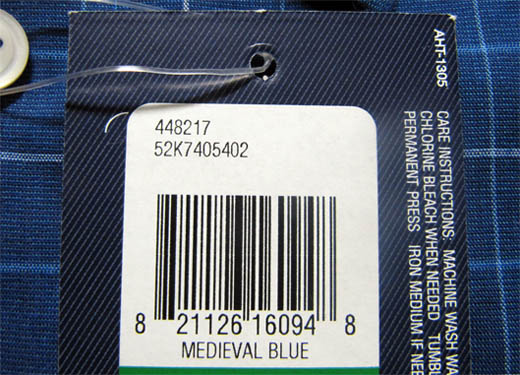
So did base commerce provide the hoped-for mental holiday? Alas, no. Having stumbled across an intriguing line of shirts at a charming cosmopolitan boutique, I found myself as startled as a stag in a Laibach video by the color designations on the tags. “Moonless Night” meant “black,” “Black Forest” meant “green”…and then a shirt hove into view, blue as the veil of Thetis:

Apparently, “medieval blue” is a real Pantone color, RGB #2F3654 (presumably inspired by medieval pigments), and all sorts of things are available in it, including wool, windbreakers, tank tops, snow boots, tennis shoes, and chiropractic pillows.

But isn’t “medieval blue” more of an idea—a simile, even? Trailed always by a trembling amanuensis, I made dramatic writerly gestures, paced the menswear aisle, and recorded these golden thoughts for later rumination:

  • “as blue as a miller’s Netflix queue”
  • “as blue as the metaphorical heavens in the pick-up lines of the Duc de Berry”
  • “as blue as the blood of Charlemagne’s nephews nibbling Roquefort while rowing in the Oxford-Cambridge Boat Race
  • “as blue as absinthe in Utgard”
  • “blue as the grass where Auðumbla moo’d indigo”
  • “as blue as a summer princess sprawled across a winter grave”

Readers are invited to pass the weekend conjuring tortured similes of their own. Meanwhile, some of us, draped anew in cerulean shades that Carolingian clothiers could never envision, shall return to crafting prose that is plainly, unflinchingly purple.

“And the little wheel runs on faith…”

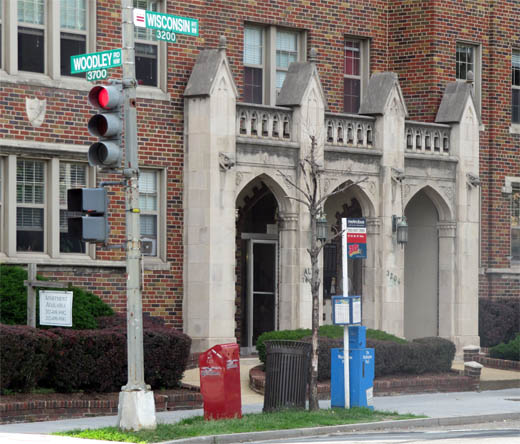
Tourists never notice it, but then neither do most locals. Behold: Alto Towers, catty-corner to the National Cathedral at 3206 Wisconsin Ave NW.

Alto Towers went up in 1932, in the heyday of D.C. suburbanization. This eight-storey apartment house is the work of Arthur B. Heaton, a half-forgotten architect who’s partly responsible for the look and feel of northwest Washington—and who was, briefly, an unabashed medievalist.

Heaton was ridiculously versatile. In 1901, he built Tudor Revival apartments and later designed the Altamont, a local apartment house with an Italian Renaissance twist. In 1914 and 1931, he put Classic Revival additions on the National Geographic Society building. In 1926, he gave his (now-demolished) Capital Garage a funny, car-themed facade, and his interest in the automobile led him to design our local “Park and Shop,” the prototypical strip mall, in a Colonial Revival style. Heaton oversaw the construction of new facilities on the GWU campus while also designing banks, churches, and countless other D.C. buildings and homes, apparently without ever developing an identifiable “Heaton style.”

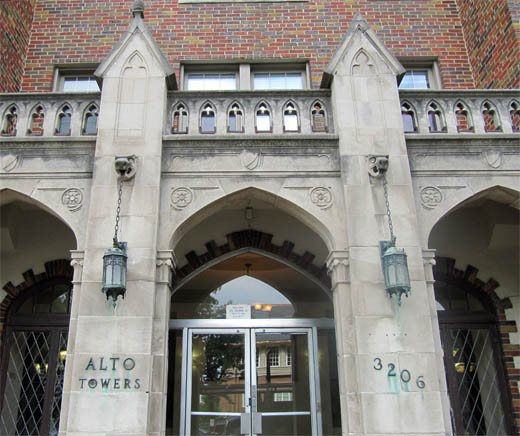
…and that’s what makes Alto Towers a treat for the medievalist. Take a gander at the entryway.

When Heaton wasn’t serving as president of the local chapter of the American Institute of Architects, co-founding the Washington Building Congress, or spearheading the “Renovize” movement during the Depression, he was also, from 1908 through 1920, the supervising architect for the National Cathedral, where he helped chief architect Henry Vaughan oversee construction during the cathedral’s first 12 years.

In 1932, more than a decade after Heaton’s time there, the cathedral was little more than an overgrown apse festooned with a few angelic grotesques. Given a chance to design an apartment house across the street, Heaton—who could have built damn near anything—set loose his inner medievalist.

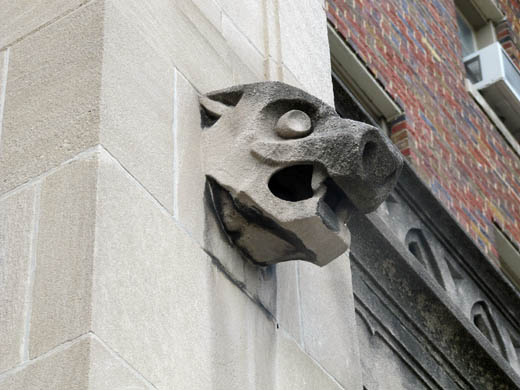
Those snarling, gargoylish grotesques are the most blatantly cool thing about Alto Towers, but the whole arcaded entryway is a neo-medieval romp.

The quatrefoils (four-leaf clovers) in the spandrels (the warped triangles above each arch) are pretty standard, but those thick, gabled supports are an architect’s fancy. Each one resembles a cathedral buttress while also containing blind tracery of a Gothic arch.

At Alto Towers, periods and cultures trip over one another and have a good laugh. The pine cone finials hark back to ancient buildings and the medieval fascination thereof, while those funny little nubs at the tops of the smaller arches—including the little ones in the triforium, the upper row—strike me as very American. Meanwhile, on both sides of the interior of each large arch are squared, Art Deco-ish shadows of Corinthian columns. Behind them, the brick-lined inner doors whisper “Cordoba” in an American accent.

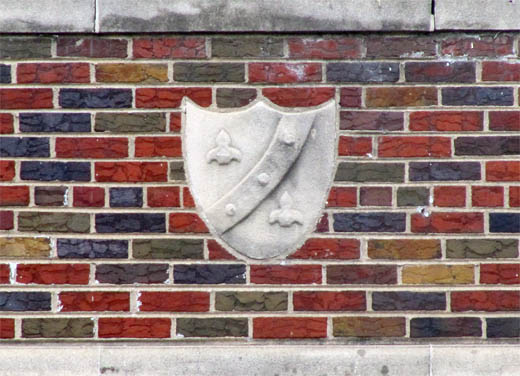
Most of Alto Towers is plain brick, but Heaton decorated just enough of its topmost level to show that the neo-medievalish entryway wasn’t an afterthought.

Note the two types of ornamented shield. They may be purely decorative, but I’ll gladly send a free book to any heraldry buff who can show that they’re meaningful.

While Heaton’s 1926 Capital Garage (PDF with photo) featured large, leonine gargoyles, Alto Towers is his full medievalist statement, the rhapsody of a restless architect who knew he wouldn’t live to see the cathedral completed.

When Heaton died in December 1951 at 76, the new apartment buildings rising around the cathedral were blocky and bland. Today, tourists tromp right past them, fixated on the promise of sighting quirky gargoyles on the Gothic spires beyond.

Of course, the cathedral’s first proper gargoyles weren’t put in place until around 1960, so if the beasties at Alto Towers forever bare their fangs, I can’t really blame them. No one remembers that they were here first.

“Feathered, look, they’re covered in a bright elation…”

Too few Washingtonians have hobbies; for many people here, cultivating a career is apparently amusement enough. Fortunately, I sometimes encounter locals—like this fellow on the west front of the cathedral—who enjoy a pastime I’d never really thought much about, and I like when they explain its appeal in terms I can understand.

A SIMPLE DESULTORY PROSOPOPOEIA
(or, HOW I WAS RICHARD WAGNER’D INTO TRADITION)

“I do not think that they will sing to me”:
Impulsive mermaids drown in shallow words.
Await no witless warbling by the sea;
Rather, seek the songs of simple birds.
From perch and peak they twitter truths profound:
A woodbird stirs the Volsung in his blood;
A parliament of eagles circles ’round;
A curlew chills the farer on the flood.
The cuckoo croaks that sumer is icumen;
“Keep well thy tongue!” confesses Chaucer’s crow;
The nightingale her owl will merr’ly summon;
Despite their flyte, one insight they bestow:
Be still, but heed the rustle of a wing;
A legendary pigeon waits to sing.


(For all the entries in this series, hit the “looking up” tag.)

“So many shots fired, so many daggers thrown…”

Seven years ago, I stepped into a musty workshop in the Balkans and faced the glares of a thousand ancient Serbs. They leaned against walls and rested sideways in racks; a few were upside down. All around, drawn from every corner of the late Yugoslavia, the silent icons were burned, torn, drenched, or devoured by mold. They had been sent to this office for safe keeping—and to await the conservation and restoration that the Serbs may never have the funds or personnel to finish. An eerie sense of patience pervaded the place; in the Balkans, a thousand-year art project is the least reason for despair.
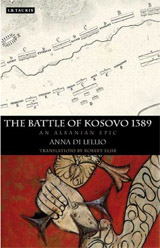
So as someone whose only friends in the Balkans hail from Serbia and Montenegro, I approached the publication of The Battle of Kosovo 1389: An Albanian Epic with caution. For a decade, I’ve taught the Serbian epic cycle about the Battle of Kosovo as a case study in medievalism that fosters the worst sort of nationalism and as one of the best examples of Balkan epic poetry, but I’d never heard of the Albanian take on the Serbs’ sacred story. Published only a year after Kosovo declared its independence, this book was bound to be sensitive; some condemned it as “science fiction” and sent its editor hate mail.

I suspect the angriest critics didn’t actually read the book, which turns out to be a relatively mild collection of eight poems about episodes tangential to the Battle of Kosovo. All but one of the poems were recorded between 1923 and 1955, each is presented in a facing-page translation by Robert Elsie, and the entire volume is introduced by Anna Di Lellio with a placid and decidedly un-Balkan ambivalence.

Most of the Albanian Kosovo variants tell the same basic story: The pious Sultan Murat has a prophetic dream. His seers interpret it, his mother weighs in, and soon the sultan sets off to conquer Kosovo. Like Moses, he prays to God to part the seas, and then he invades the Balkans. When a hungry soldier breaks the fast, the war goes badly, but after the sultan dismisses his less committed troops, his fortunes improve—until he is assassinated by Milosh Kopiliq, an Albanian Christian who picks up his own noggin and strolls away after the sultan’s men behead him.

Readers who know the Serbian poems about the Battle of Kosovo will be startled to see Miloš Obilić, a saint of the Serbian Orthodox Church, presented as an Albanian assassin, a variation that explains why Amazon reviewers have given the book one star if they’re pro-Serb and five stars if they’re pro-Albanian. In the Serbian texts, Miloš is a captain in the army of Serbian Prince Lazar. At the last supper before the ill-fated battle, Lazar unsettles him with a terrible prophecy:

Hail, Cousin! friend of mine and traitor!
First of all my friend—but finally my betrayer.
Tomorrow you’ll betray me on the field of Kosovo,
Escaping to the Turkish Sultan, Murad!
So to your health, dear Milosh, drink it up,
And keep the golden goblet to remember Lazarus.

Miloš does cross over to the Turkish side, but only to assassinate the sultan. Lazar is captured and beheaded. The Serbs are defeated, but their martyrdom wins them the “heavenly Serbia” promised by God—and a longing to reclaim Kosovo that haunted their descendants well into the 21st century.

The transformation of Miloš Obilić, Serb saint and patriot, into Milosh Kopiliq, Albanian Christian, may seem strange coming from the mostly-Muslim Albanians of Kosovo, but Di Lellio explains that a multifaceted Miloš represents an old debate: The Albanians claim ancient descent from the Illyrians, while the Serbs assert that they wandered into the Balkans more recently. Oddly, the existence of Milosh Kopiliq is, Di Lellio says, less a statement of division than a claim to brotherhood. Through Milosh, the Albanians are insisting that their ancestors fought and died alongside Serbs—and that Albanians have deep roots in Christian Europe.

Fortunately, despite a misleading subtitle that promises a far more inflammatory book, The Battle of Kosovo 1389: An Albanian Epic is not a propaganda pamphlet. In her 48-page introduction, Di Lellio carefully shows that the Albanians come by their assassin honestly, with a wealth of place-names near the village of Kopiliq attesting to centuries of belief in Milosh’s local roots. Still, Di Lellio leaps to no conclusions; she contrasts Albanian oral history with an overview of the development of Miloš Obilić in Serbian historiography, and she looks beyond the Balkans at a Catalan tradition that makes Milosh Hungarian. She also raises the possibility of etymological confusion based on the word kopil, which means “trickster” or “bastard.” The Albanian Milosh certainly is that: He gets close to Sultan Murat under false pretenses, he cracks jokes after being beheaded, and (in one 1955 variant) he uses magic to makes the eyeballs of two gawking maidens leap from their sockets.

Few scholars who lay a hand on Balkan folklore are objective. Di Lellio worked in Kosovo for the United Nations, and in 2006 she edited The Case for Kosova: Passage to Independence. This collection of texts was also published with the cooperation of the Centre for Albanian Studies, a reputable organization that nonetheless must have an opinion or two about the uses of history and legend. That said, The Battle of Kosovo 1389: An Albanian Epic was clearly published in good faith. Contrary to the claims of their critics, Di Lellio and translator Robert Elsie aren’t inventing the Milosh Kopiliq tradition; rather, the variants in this book were all recorded and published decades earlier by ethnographers and folklorists. (Students of medieval English literature will see a familiar name at the end of a 1937 variant: Albert Lord, whose theories about oral-formulaic poetry were picked up by Anglo-Saxonists.) Only one tale in this volume, a 32-line poem recorded in 1998, feels both too recent and too fond of its own historical awareness as it shows the decapitated Milosh Kopiliq striding into legend:

Mountain birds do chirp and wonder
Who is climbing up that hillside?
Headless now proceeds that body,
White with snow now turns the mountain.

Although these poets use Milosh to argue that Albanians are innately European, Di Lellio writes with detectable unease about official textbooks that treat the shadowy Milosh as an historical figure; refraining from overt judgments, she documents how Albanians have come to see themselves. “It is in this context,” she writes, “that I place the stories about Kopiliq, as I try to rescue them from turning into a new prison for collective memory.” With care, she catalogs “a unique production and diffusion of historical memory” since the end of the Balkan wars shaped by “war veterans, former political prisoners, journalists, teachers, politicians, and historians, engaged in owning and rewriting the past,” and no consensus emerges:

Interviews with a range of individuals, from intellectuals to political activists or ordinary people, confirm that Millosh Kopiliq occupies a contested place in Albanian historical consciousness. For some, the issue is a non-starter, a concern that remains confined to naïve nationalist circles. For many others, an Albanian Kopiliq is an undisputed fact: he was always “one of us,” just not always publicly.

If the unsettled yet minor role of Milosh Kopiliq in the Albanian national story makes him an ineffective foot soldier for propaganda, then the stories in this slim volume are also unlikely to eclipse the fame of the Serbian Kosovo epic. Even in its most witty variants, the legend of Milosh Kopiliq isn’t very engaging; the fact that an Albanian Kopiliq exists is itself far more interesting than the actual details of his brief, formulaic adventures.

Compared to the Kopiliq variants, the Serbian poems about the Battle of Kosovo are a far richer read. Their historicity is debatable, and they hold an unsavory place in the nationalist arsenal, but they’re also imbued with a sense of tragedy and loss that overshadows the tale of a single tricky assassin. I’ll continue to teach the Serbian epic in class, but I’ll also mention the Albanian poems for the way they highlight the Balkans’ baffling cultural churn. I’ll also be glad that a Serbian publisher has expressed interest in a translation of this book. Perhaps waiting for former countrymen to find amusement in each other’s cherished legends doesn’t need to become another of the region’s many thousand-year projects.

“Twisting like a flame in a slow dance, baby…”

Although no less a folklorist than Kermit the Frog wondered why there were so many songs about rainbows, someone once pointed out to me that there aren’t many songs about rainbows, really. Off the top of my head, I know only one or two others; few people can name many more. Such is also the case with volcanoes in medieval Icelandic literature: Given the relative size of the corpus, you expect to find far more of them than you actually do.

Norse myths smolder with the threat of fiery doom. According to historian Oren Falk, the great Sigurd Nordal perceived enough lava-flecked glimmers in the prophetic poem “Völuspá” to see in its portrayal of Ragnarok “a distinctively Icelandic apocalypse.” Falk also finds mountain-bound giants in the 12th-century poem “Hallmundarkviða” who watch as “glaciers blaze . . . coal-black crags burst; the curse of wood [that is, fire] unleashes storms; a marvellous mud begins to flow from the ground.” So where there’s lava there’s volcanoes, right?

Nope—these distant poetic wisps vanish when scholars get too close. Falk spots only four anecdotes in Landnámabók, the Icelandic Book of Settlements, that hint at medieval Icelanders’ perception of volcanic activity. He scours the late medieval Bishops’ Sagas and finds only two mentions of volcanic eruptions, while “[t]he entire corpus of Family Sagas, thirteen thick volumes’-worth in the standard modern editions, seems to know nothing of lava and ash plumes.”

Even if Icelanders didn’t work many volcanoes into their poems and sagas, the medieval world nonetheless responds with a low, subterranean rumble every time a flustered news anchor tries to say “Eyjafjallajökull.” Its name may look weird, and its proper pronunciation baffles the non-Icelandic ear, but as a simmering reminder of the relationships between Germanic languages, this billowing Aschenwolke of a word is very nearly English.

The first element of “Eyjafjallajökull” is familiar to English speakers as the suffix -ey. You see it in place-names like Orkney and Jersey, and it’s the related Old English ieg that gives us the first syllable of its modern descendant, “island.” (Eyja was the Old Icelandic genitive plural.)

The second element, fjalla, has mostly disappeared from English, but the OED points out that you can see it in northwestern England at Bowfell and Scawfell—the names of hills.

Jökull, the Icelandic word for “glacier,” is the diminutive of jaki, “broken piece of ice,” and had a cognate in Old English, gicel. When Anglo-Saxon scribes needed a homegrown equivalent for Latin stiria, they translated it as ises gicel. The original word became ikyl or ikel in Middle English, and you can still see it frozen in time at the end a modern noun that fuses all of these pieces: “icicle.”

Jóhann Sigurjónsson, one of the first Icelandic poets to write blank verse, foresaw an apocalypse both personal and cosmic in which jóreykur lífsins þyrlast til himna, “the steeds of life swirl their smoke to the skies.” The plume of the “island-mountains glacier” will eventually dissipate, but even if we can’t now see the volcanoes, we can at least watch the ash settle into craggy, unexpected places, and patiently look for the relevant words.

“…and the music there, it was hauntingly familiar.”

It’s a commonplace among historians that in the murky recording studio of medieval imperialism, Alcuin played a wizened Stevie Nicks to Charlemagne’s picky but regal Lindsey Buckingham. I can’t tell you how often some sharp young scholar has commandeered the conference lectern to rail against this tired way of imagining Europe at the turn of the ninth century, yet the metaphor persists, as metaphors do, because they’re the overwrought but ever-tempting self-guided audio tours that help us see beyond the bored security guards in the hushed, carpeted galleries of the past.

Similes, on the other hand, are like Canadian character actors in Sci-Fi Channel Original Movies: they jar you out of pseudo-historical reveries and lodge you unmistakably in the present. Case in point: the Los Angeles Times sent a writer to the Vancouver Olympics, and like Ignatius Reilly pursuing a Big Chief Tablet delivery truck, the King of the Franks followed him:

Besides, I don’t travel particularly well. Me flagging a media bus in a new city is like Charlemagne chasing the Saxons. But OK, whatever. I like the snow.

This curious simile is the brainchild of a reporter who assumes that the reader has some knowledge of medieval history, or at least possesses the basic curiosity required to look up stuff on Wikipedia. Bravo! That puts him ahead of other newspaper writers.

But what on earth does it mean? Is a portly king waddling with comical incompetence after a band of tireless warriors? Does the writer’s pursuit of public transportation take decades to accomplish while leaving headless corpses scattered among once-sacred groves?

I don’t know, but this simile slips from the reporter’s fingers (to quote Charlemagne himself) “just like a white-winged dove sings a song.” Perhaps, like the finest Carolingian poetry, this cryptic reference to Charlemagne is best read allusively, not logically. Otherwise, like a homesick reporter stranded on a Vancouver curb, we’re left to chase mysteries we weren’t really meant to understand.