“Angels we have heard on high, tell us to go out and buy.”

Christmas approacheth, and the e-mails keep coming: Jeff, what should I get for the medievalist in my life?

Come on, people; shopping for medievalists is easy. Here are some ideas for unusual presents, all of which will be more gratefully received than those Medieval Times gift certificates you got for everybody last year.

Tired of people defending the Beowulf movie by arguing that medieval texts are inherently unfilmable? Then hit them, literally, with this: the Icelandic film adaptation of Gisli’s Saga on VHS. (While you’re ordering across the whale-road, why not snag some soda named after Egil Skallagrimsson?)

Men and women of academia, I ask ye: of what use be tenure if it alloweth ye not to herald your arrival in the classroom?

GPS? iPhone? Mere playthings, by Jove! You calculate your own latitude with a noctural, you predict the sunset with your own lovely astrolabe, and then you blow your bosun’s whistle, just because you can.

Let fly the yams! Check out these fully functioning DIY tabletop replicas of a trebuchet, a catapult, and a ballista.

You just know that everyone gets these for R. Howard Bloch, and they all think they’re so clever, and it stinks to be him, because he of all people can’t possibly re-gift pillows, cushions, and curtains based on the Bayeux Tapestry.

If your child’s reenactments of the Fourth Lateran Council with R2-D2 and Spider-Man on a dune buggy don’t feel sufficiently reverent, then you’re in luck: get thyself a Pope Innocent III action figure.

But before your kids order their teddy bears to recapture the Holy Land, make sure those benighted bee-wolves are wearing hand-forged miniature helmets. Ursus lo volt! (Just be careful what you name them if they go native.)

From the “Nightmares of Jennifer Lynn Jordan” Collection comes this enchanting clash of the titans: the Unicorn vs. Narwhal Playset. (My money’s on the narwhal. Nothing escapes its vengeful horn.)

But perhaps you’re thinking bigger than toys and trinkets. If you can trust a Web site that looks like it was designed on a Commodore 64, then why not buy yourself a castle? You can fill it full of fiber-optic flying unicorns that sing “On the Wings of Love” by Jeffrey Osborne.

(No, you can’t have mine. I need it to protect me from the narwhals.)

“It was dark as I drove the point home…”

When he paced the scriptorium and scowled at the monks, inspecting their handiwork, eyeing their script, he couldn’t have foreseen where their books would end up. Twelve centuries later, one of their most enlightening creations is stored away at the British Library: a Bible created under the watchful eye of Theodulf, abbot of Fleury and bishop of Orleans at the turn of the ninth century.

If his poetry is any indication, Theodulf was not a very sentimental man. A veritable connoisseur of verse warfare, the Visigothic refugee from Islamic Spain depicted himself as a masterful wit. He baited Frankish nobles with Latin insults they couldn’t understand. He blasted the poetry of an Irish competitor by criticizing his pronunciation, declaring him “an abomination” and announcing that “c” was the “letter of salvation” because it rescued Scottus, “Irishman,” from becoming sottus, “idiot.” Schooled in theology, trained in the law, Theodulf was brilliant. He made sure posterity knew it.

Theodulf couldn’t abide the impulses of pilgrims. He frowned on the veneration of icons. He would have rolled his eyes at the sight of museum-goers gawking at sacred objects simply because of their age. Multa scis et nulla sapis, he would have scolded them: “You know so much, and you understand nothing.”

But at the British Library, on the one decorated page of the “Theodulf Bible,” is evidence, maybe, of the bishop’s softer side. Facing a page of shockingly tiny script, the canon table doesn’t have a Northern European look to it. At the top, unmissable, are the horseshoe arches associated with Islamic Spain. They’re held aloft by five colorful columns, which aren’t decorated with the usual Romanesque doodads or acanthus-leaf designs. Steps, squiggles, and scroll-like details wind their way up each tall and slender column. They wouldn’t look out of place in an Andalusian mosque. Naturally, there’s not a single human figure in sight.

The scribe, of course, could have come from anywhere in Europe. We can’t dust the folios for the fingerprints of a scholar some twelve centuries dead. Theodulf himself—a bishop, an abbot, a counselor to kings—may never have touched that particular leaf.

But it is charming to imagine Theodulf, the great Carolingian sophisticate, recalling a scene from his own distant youth—impressions, clear ones, of places he would never see again, a streetscape of long-lost neighbors whose souls he continued to pray for—and then leaning over the shoulder of a nervous scribe, eager to tell him: “Here. These are the arches. It’s how I remember them. I want you to paint them exactly this way.”

What would Theodulf make of this speculation, this effort to spy on his medieval mind? If the bishop were as blustery as he portrayed himself, he’d have reacted like his rivals in poetic combat, attonitus, tremulus, furibundus, anhelus—”frantic, trembling, raging, panting.” But as an intellectual, a scholar who did his best to build a better Bible, Theodulf surely would have chuckled. In his heyday, he compared his colleagues to scurrying ants. He slandered them as drunkards, he made fun of their weight, and he dubbed all his rivals intemperate fools. The bishop ended his satiric poems with Christian pleas for forgiveness—but he knew full well that few of his hapless targets could truly reply in kind.

Theodulf loved a good joke—or so we imagine, based on some fragments in very old books. If we want to strip the man of his historical dignity, wrongly portray him as a sentimental sap, rebaptize the sharp-tongued Goth in mawkish, imaginary tears, we can. He can’t stop us.

Theodulf’s poems were a plea for someone to spar with, but now the joke is on him. For once, the great wit doesn’t get the final word. Let’s hope the bishop is laughing; at last, he found a worthy foe in time.

“I’m looking for cracks in the pavement…”

Back in July, while visiting family, I discovered that downtown New Orleans had been deprived of a prominent literary landmark.

Today, an email missive brings good news: Ignatius has returned. All hail the restoration of theology and geometry to Canal Street!

Behold the grandeur of his physique! The complexity of his worldview! The decency and taste implicit in his carriage! The grace with which he functions in the mire of today’s world!

(Photo courtesy of the blogger’s very cool mom.)

“…gearowe oþþe na, her cumað cnihtas suðan.”

Beowulf is out, reviews are in, and blogs will soon be abuzz with the input of Anglo-Saxonists. Compared to other medievalists, Anglo-Saxonists are numerous on the Web, but then they’ve long been a forward-looking bunch. More than a decade ago, the now-vanished Old English Pages at Georgetown were some of the earliest online resources for studying any medieval language; the Anglo-Saxon poetic corpus was digitized even before most academics had personal e-mail addresses; and graduate students in the mid-1990s were already exploring the potential of hypertext editions.

Given access to the same technology as their fellow humanities scholars, why are Anglo-Saxonists such early adapters? A 1952 Time magazine article suggests one reason: they’re heirs to a decades-old “Anglo-Saxon boom”:

After, next week, Beowulf scholars will not have to worry too much about the fate of the original, nor will they have to travel thousands of miles to pursue their studies of Thorkelin, whose mistakes in copying (e.g., 599 “d’s” for “eth”) will still take years to untangle. But Beowulf is only the opening salvo of the new Anglo-Saxon boom. Within the next few years, scholars all over the world will have reproductions of everything from St. Gregory’s Pastoral Care to King Alfred’s translation of Orosins’ History of the World. Next volume on the list: an 8th century manuscript of Bede’s Ecclesiastical History, the original of which is now in the Leningrad Public Library, where Western scholars would have a hard time getting at it.

After reading the entire article, which summarizes postwar efforts to preserve and publish Anglo-Saxon manuscripts, I wanted to see if the magazine’s coverage of Old English literature had changed in the past half century. I poked around the Time archive and was struck by these excerpts from the magazine’s review of Seamus Heaney’s Beowulf in the year 2000:

“Just don’t take any course where they make you read Beowulf,” Woody Allen advised Diane Keaton in Annie Hall (1977). The throwaway line elicited laughs from Allen’s core audience of college grads, especially the one-time English majors among them who had learned to dread—if not actually read—what they had heard was a grim Anglo-Saxon epic filled with odd names and a lot of gory hewing and hacking.

The joke, it turns out, was on the chucklers…

Heaney’s Beowulf…has now been published in the U.S., giving American readers the chance to take the measure of this Harry Potter slayer, the deadest white European male in the politically incorrect literary canon. Judging by the electronic-sales ratings updated constantly by Amazon.com Beowulf is becoming boffo on this side of the Atlantic as well.

Note the difference in tone. The reporter in 1952 may have been ignorant of the continuing value of the Beowulf manuscript even after its copying and reproduction, but he reports on the state of Anglo-Saxon manuscript preservation without any snark. Amazingly, he even refers to “the famed Thorkelin transcripts” with no trace of irony. Time magazine didn’t expect its readers to know who Grí­mur Jónsson Thorkelin was, but the mid-century reporter kindly explains the scholar’s importance in four concise sentences—without jokes, without dismissive anecdotes, without caveats about political incorrectness, and without calling anything “boffo.”

Maybe the contrast is unfair. After all, a straight news article serves a different purpose than a book review that takes its subject seriously after three paragraphs of irony. But those three paragraphs sure are telling. The reporter in 1952 takes for granted that Anglo-Saxon manuscripts are important, and he assumes that the average Time reader, when briefed on the basics, is likely to agree. By contrast, the reviewer in 2000 assumes that the reader is inclined to think an Anglo-Saxon poem irrelevant based on a quip in a Woody Allen movie; that the reader needs a Harry Potter reference to make this material palatable; and that the reader requires inoculation against—or permission to enjoy, I’m not sure which—the work of “the deadest white European male.” The 1952 article respects the discernment of its readers, who may be receptive to the obscure. The 2000 review condescends. Really: “boffo”?

What’s especially strange to me is that Time magazine is so out of sync with the literate public’s genuine interest in the past. Except for bored patients in doctors’ offices, most of the people who still read general-interest news magazines must be doing so because they’re at least somewhat curious about the world. I don’t want to overstate the number of readers who might be interested in medieval manuscripts, but the massive success of the Beowulf translation tagged as “boffo” by Time magazine suggests that we shouldn’t understate their numbers either. Why preface a review with cutesy language that camouflages an implicit apology to the larger, incurious public? They’re not going to see the article anyway. How strange to let non-readers set the tone of a book review.

Then again, this is the same magazine whose technology bloggers write movie reviews with skittish disclaimers like this: “The little I remember about Beowulf the poem, which is nothing, since I never read it, is that it was incredibly boring.” Perhaps the writers and editors at a magazine with plummeting subscription rates should think twice before suggesting that reading is somehow uncool.

At the end of Carolingian Culture: Emulation and Innovation, Rosamond McKitterick writes, in a line I love to cite, that the Carolingians “imparted to future generations…the conviction that the past not only mattered but was a priceless hoard of treasure to be guarded, conserved, augmented, enriched and passed on.” That isn’t only a ninth-century sentiment. In the past year, I’ve spoken about Charlemagne in church basements full of senior citizens and I’ve met enthusiastic high-school kids who plan to become medievalists. This passion for history is hardly confined to the Middle Ages: One of my colleagues, a photographer and IT professional from Hawaii, recently drove through the Northeast visiting lesser known Revolutionary War sites; another toured ancient cities in Turkey. All of these people honor the memory of McKitterick’s monks and universalize their motives: To seek wisdom in the past is simply the impulse of civilized, literate people.

The big-screen Beowulf looks pretty silly, but its existence was inevitable, a function of the rampant public fascination with the Middle Ages that many of us witness firsthand. If this movie turns out to be one of medievalism’s more lamentable mooncalves, that’s fine; other opportunities will present themselves—at libraries, in classrooms, in the stillness of a museum gallery or in the raucousness of a Renaissance festival. No wonder that after fifty years, Old English experts, so often derided as fusty and dull, now have a better sense of the popular culture than do the editors of Time. The “Anglo-Saxon boom” continues; scholars are happy, but hardly surprised.
“…and no one knows but Lorelei.”

Ah, the Middle Ages: idealized by some, studied by many, and fated to serve as the wellspring of some truly awful motion pictures.

Scott Nokes at Unlocked Wordhoard is having fun with the “study guide” for the impending Beowulf movie. A sample: “As I searched for the actual number or e-mail to order the study guide, I realized that the glossy ads for the film on the back of the poster were the study guide. Oh.”

Carl at Got Medieval is grumbling, too, about Beowulf’s mother’s footwear choices.

Meanwhile, Jennifer at Per Omnia Saecula notes, with understandable dread, a film adaptation of Boccaccio’s Decameron starring fame’s latest love-children.

Alas, my Charlemagne-and-the-giant-scorpions miniseries is no closer to becoming a reality. However, Variety mentions another movie that may have tremendous potential:

Telepool also picked up “The Charlemagne Code,” Munich-based Dreamtool Entertainment’s $7 million TV movie about an archeologist on a perilous quest to find the legendary Nibelung treasure. Made for RTL Television in Germany, Telepool has already presold the TV movie to Telecinco in Spain and TV2 in Hungary.

Charlemagne, the Nibelung treasure, and a German Indiana Jones? I’ve been teaching Wagner for three weeks, so part of me would love to see this improbable, ridiculous gesamtkunstwerk find its way to American cable.

And if it happens to have a few giant scorpions in it? So much the better.

“As Grendel leaves his mossy home…”

The year I applied to graduate school, I was both an aspiring cartoonist and a wannabe scholar. My adviser, an English professor, liked that first part; it was that second part that made the dear man cringe. “I’ll write you a letter of recommendation,” he informed me, “but I’d rather help create one literate cartoonist than another academic desperately scrounging around for the next pot of grant money.” In the end, I opted for neither career, but I do sometimes wonder what that literate cartoonist might have looked like.

That’s why I was pleased to discover Alexis Fajardo. He’s the creative soul behind Kid Beowulf, an all-ages epic in which twin 12-year-old brothers Beowulf and Grendel romp across a Europe inspired by great works of classical and medieval literature. To Fajardo’s credit, he’s not just swiping names to gussy up unrelated characters; his comic adaptations are prompted by real affection for his sources. Last year, in fact, he made a surprising promise: “I want to be true to the material, the epic. As these guys travel, they will learn what it is to be a hero, what their destinies are. In the end, Beowulf will kill Grendel.”

The first volume of Kid Beowulf is already for sale; as you can see from his blog, Fajardo’s style is clearly inspired by Asterix, Pogo, Bone, and maybe even traces of Dragon-era Phil Foglio. As he fleshes out his 12-book series—which may include cameos by Sir Gawain, El Cid, Gilgamesh, and others—I’ll eagerly await one volume in particular, Kid Beowulf and the Song of Roland. Pedants may argue that Beowulf, Charlemagne, and Joan of Arc shouldn’t all find themselves inhabiting the same story—but if a gold-painted Angelina Jolie can play Grendel’s mother, then what’s the harm in a teenage Grendel skulking ahistorically across the canon? This one, at least, your children can enjoy.

“A secret to be told, a gold chest to be bold…”

Hail to the king, baby. In an essay for the quarterly Coyote Wild, Scott Nokes of Unlocked Wordhoard sets the 1992 guy-with-a-chainsaw-for-an-arm movie Army of Darkness firmly in its Arthurian tradition. Scott argues—persuasively, I think—that the film is more faithful to the spirit of Twain’s Connecticut Yankee than other adaptations have been, largely because it’s less willing to congratulate the modern world on its supposed superiority and doesn’t automatically sneer at the medieval.

My only regret is that Scott isn’t an Americanist. Then he could shed some critical light on another terrific Sam Raimi-Bruce Campbell collaboration, the little-noted nor long-remembered Jack of All Trades. You’ve got to love any series that keeps manufacturing excuses to place on the same East Indian island such figures as Lewis and Clark, James Madison, the Marquis De Sade, and Napoleon (Verne “Mini-Me” Troyer, in the role he was born to play). I like to think that if the show had lasted another season, King Arthur might have washed ashore, too. Avalon, Schmavalon—that funeral barge had to land somewhere…

“…our only goal will be the western shore.”

What is it with the Sci-Fi Channel? Last weekend, as I prepared to teach The Saga of the Volsungs, they re-aired Dark Kingdom: The Dragon King, a sweet Teutonic smoothie that blends the Volsungasaga, the Nibelungenlied, and Wagner’s Ring into one lumpy Gygaxian confection.

And then, this weekend—right after my lonely blog post to honor Leif Eriksson Day—they premiered Wraiths of Roanoke, the story of—well, I’ll let MovieWeb summarize the plot:

In the late 16th century, colonists on Roanoke Island, Virginia, found themselves under siege against evil spirits left behind by the Vikings. The Wraiths are hunting the innocent souls of the first-born children in order to get into Valhalla.

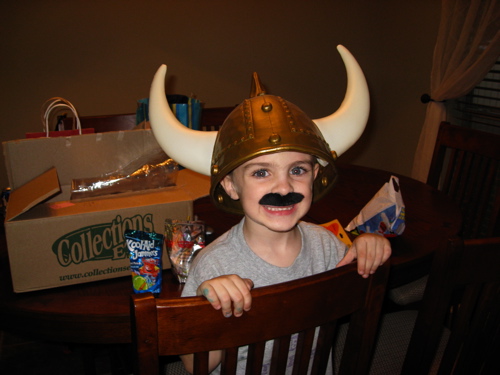
I’m delighted that even the story of the Roanoke colony can be infused with a heady dose of spooky, horn-helmed medievalism, however unlikely it may seem. But as I glance at the Sci-Fi Channel’s prodigious roster of monsters and heroes, I notice one glaring omission—one legendary figure whose ability to carry a formulaic, CGI-laden B-movie has been grievously overlooked.

I refer, of course, to Charlemagne.

And so, as I await the release of the Becoming Charlemagne trade paperback, I’ll also hope for that phone call from the Sci-Fi Channel. As a reasonable man, I’ll happily make…adjustments…to history, as long as every change is consistent with Sci-Fi’s famously stringent standards of accuracy.

After all, if Coolio can fight a pterodactyl, and if Beowulf can wield a crossbow that blows stuff up, then I see no reason why Charlemagne can’t fight a giant scorpion—nay, ride a giant scorpion—on the slopes of a fiery volcano while battling Nazi super-mutants with the aid of lethal anthropomorphic mosquitoes.

There’s nothing in the sources that says he didn’t. And believe me, I’ve looked.

“On we sweep, with threshing oar…”

It may not be a day off from work, but today, my fellow Americans, is Leif Eriksson Day. By happy coincidence, I’m teaching The Saga of the Volsungs tonight. Why not find your own way to mark this marvelous manifestation of medievalism?

If your belly cries out for a taste of goopy, chilled curds, then swing by your local Whole Foods. It’s the only chain in the U.S. that sells skyr, the “yogurt” of the Vikings, in all its tart, rennety goodness.

It’s never too early to plan a trip to L’Anse aux Meadows, the remote site in Newfoundland where the Northmen landed. (Just be prepared to eat the occasional cod tongue.)

Why not groove to a little neo-Viking pop? Take in a Skitamorall video or two, or read a very old article about Sigur Ros.

If you’re pining for the fjords, you can order a VHS copy of The Outlaw, the 1981 film adaptation of Gisli’s Saga, for only $68.63. You can specifically commemorate Leif Eriksson by reading the Vinland Sagas—or, for kicks, you can read the Havamal:

Deyr fé, deyja fraendr,
deyr sjálfr it sama;
en orðstírr deyr aldregi
hveim er sér góðan getr.

Deyr fé, deyja fraendr,
deyr sjálfr it sama;
ek veit einn at aldri deyr:
dómr um dauðan hvern.

Wealth dies, kin die,
The self must die as well;
But reputation never dies
For one who can obtain it.

Wealth dies, kin die,
The self must die as well;
I know one thing that never dies:
The renown of every dead man.

Leif Eriksson surely knew these bits of Nordic wisdom. A thousand years later, these eddic verses still find validation in the statues and airports that bear his name. Like this quasi-holiday, they’re unlikely and often overlooked tributes to a brave and lucky traveler—the one medieval Icelander whose name we Vinlanders are most likely to remember.