“One gun added on to the one gun…”

Now here’s a story Ken Burns might have retold: on Monday, the New Orleans Times-Picayune ran an article about retired archbishop Philip Hannan, who recently recounted his experiences as a military chaplain for the oral history project at the National World War II Museum. As a young priest, Hannan parachuted into battle alongside his men, and he helped to liberate a concentration camp—but one of his deeds that wasn’t a matter of immediate life and death also bears repeating:

When the regiment took Cologne, the first thing Hannan did was visit the cathedral to see whether its “wonderful collection of art” survived the war.

Hannan said the German prelates tried to protect the art by storing it in boxes made of brick. He worried those boxes would be bait for American soldiers, who had come into possession of some British-designed Gammon grenades and were eager for targets to test them out.

He was forbidden to cross the Rhine river, but he ignored the orders and set out in search of the German archbishop. That bishop appointed him protector of the cathedral, and Hannan made sure his paratroopers guarded it.

If not for Hannan, countless medieval treasures might have been destroyed, including several remarkable reliquaries, a famous tenth-century crucifix, and other irreplaceable artifacts that help us understand the past.

It’s become a cliché to say that during World War II, Allied forces “saved the world.” A few, showing foresight and decency, also saved the Middle Ages.

“Rent a flat above a shop, cut your hair and get a job…”

Via The Heroic Age comes word of a clever project: according to the Lincolnshire Echo, an archaeological group is adapting a medieval work for film. Interestingly, they’ve chosen not an epic, a romance, a ballad, or a saga; instead, they’re recreating scenes from the Luttrell Psalter, a 14th-century manuscript that depicts the people of Lincolnshire living and working through the changing of the seasons.

You can learn more about the Luttrell Psalter at the Web site of the British Library, which also offers an online, page-turnable version. Compare its illuminated pages with some rough footage of the Luttrell Psalter movie that’s already posted to YouTube. I’ve just spent four weeks teaching Arthurian romance, and I’m gearing up to teach an Icelandic saga, so for me these placid, rural scenes are a timely reminder that medieval hands were far less likely to be gripping a truncheon at a Winchester tourney and far more likely to be holding a shovel or milking a cow—the work that often goes unseen in “the kitchens of history.”

“And folded in this scrap of paper…”

What hath Nashville to do with Francia? Before this week, I might have answered “not much,” but that was before I discovered what may be the only country song that mentions the Emperor Charlemagne.

In “Charlemagne’s Home Town,” Texas-born James McMurtry becomes homesick while traveling abroad. During a pause in his travels, presumably at Aachen, he broods over an unresolved romance.

Near the end of the song, McMurtry lets his surroundings evoke the melancholy of the solo traveler:

Like the bones of some saint beneath a church floor
Who must have died for lack of light,
The color snapshots that I sent you
All came out in black and white.

Won’t you fly across that ocean,
Take a train on down?
Because the night’s growing lonesome
In Charlemagne’s home town.

At Aachen, homesickness is a time-honored tradition. Countless ambassadors, dignitaries, messengers, and merchants went there during Charlemagne’s reign. More than a few must have pined for their homelands.

Although he didn’t travel to Aachen, Paul the Deacon nursed a similar sadness when he was forced to linger at Charlemagne’s court. In the 780s, the Lombard monk journeyed north across the Alps to one of Charlemagne’s palaces on the Moselle, where he petitioned the king to release his brother, a hostage. In a letter to Theudemar, abbot of Monte Cassino, Paul claims that the Frankish courtiers are friendly enough, but his mind and his heart are both elsewhere:

Even though the world’s vast distances physically keep me from you, a tenacious love for your companionship affects me; it cannot be severed. I am tormented nearly every moment by love for our brothers and superiors, to such an extent that it cannot be related in a letter or briefly explained in a few short pages.

For when I think of the times we devoted to such holy works; the most pleasant station of my quarters; your pious and religious goodwill; the troop of so many soldiers of Christ laboring to do holy works; the shining examples of diverse virtues in each brother; and sweet conversations about the Father’s highest kingdom, then I sit stunned, I am amazed, I grow weary, and I am unable to hold back my tears.

I dwell here among Catholics and dedicated Christians. They receive me well, and they show me sufficient kindness for your sake and for the sake of our father Benedict—but compared to your monastery, the palace is a prison to me, and compared to the great peacefulness of your community, life here is a hurricane.

This land holds only my worn-out body; in all my thoughts, where I remain strong, I am with you.

James McMurtry and Paul the Deacon wouldn’t have had much to talk about; the politically charged musician and the history-minded monk were born at the far ends of different and distant worlds. But by touching on the same essential emotion, the two men are commiserating across cultures, as lonely travelers have always done. Together they give voice to a fellowship of forgotten wanderers whose business brought them to Charlemagne but who dearly longed to be home.

This letter and song are a shared round of beer, even across 1,200 years. They’re also a reminder: sometimes the common ground is nothing more than the place where you happen to be stuck.

“Get to know the feeling of liberation and relief.”

Belgium was the antechamber of Charlemagne’s imperial palace—or so wrote Henri Pirenne, who was eager to defend his little country. I thought about Pirenne after reading this Economist editorial, which calls for Belgium’s peaceful dissolution:

A recent glance at the Low Countries revealed that, nearly three months after its latest general election, Belgium was still without a new government. It may have acquired one by now. But, if so, will anyone notice? And, if not, will anyone mind? Even the Belgians appear indifferent. And what they think of the government they may well think of the country. If Belgium did not already exist, would anyone nowadays take the trouble to invent it?

The anonymous editorialist tries to hit all the highlights of Belgian history:

Belgium industrialised fast; grabbed a large part of Africa and ruled it particularly rapaciously; was itself invaded and occupied by Germany, not once but twice; and then cleverly secured the headquarters of what is now the European Union. Along the way it produced Magritte, Simenon, Tintin, the saxophone and a lot of chocolate. Also frites.

Despite The Economist‘s irreverent tone, I was sorry to see that Pirenne wasn’t included on their list. Henri Pirenne belonged to the first generation of Belgian scholars to professionalize the study of history; he was central to promoting the study of social and economic history; and seven decades after his death, medievalists still debate his theories about the growth of towns and the effects of Islamic expansion on Europe.

Even so, talk of Belgium’s dissolution makes me remember not Pirenne the medievalist but Pirenne the Belgian citizen, a fellow whose scholarly work is best understood by acknowledging the extent to which his life and the life of his nation were often one and the same. When Germany invaded Belgium during World War I, Pirenne’s son Pierre died fighting for his country. Pirenne himself refused to re-open his university as a pro-German institution; he was imprisoned for 31 months. In one concentration camp, where he was the only civilian among officers from four nations, Pirenne lectured on medieval history; later, in a civilian camp, he helped to open a school. After the war, he returned to his work with a distaste for all things German—while never ceasing to cultivate a certain pleasant, persistent optimism.

A French-speaking Walloon, Pirenne married a woman who was half-Walloon, half-Flemish; together they had four children. Their family reflected the Belgian national motto, l’union fait la force, a unity that Pirenne honored, and implicitly advocated, in his massive, seven-volume Histoire de Belgique. He denied writing the series out of national pride: “I have written a history of Belgium as I would have written a history of the Etruscans,” he insisted, “without reason of sentiment or of patriotism.”

In public lectures and in print, Pirenne rejected German arguments that racial heterogeneity and the lack of a common language made Belgium “une nation artificielle”; he also answered critics among his own countrymen who advocated Walloon or Flemish secession. In his Histoire de Belgique, Pirenne described a modern nation that had emerged from medieval antecedents, and he argued that the Walloons and the Flemish were united through shared historic, economic, religious, and cultural experiences. Belgian history, he claimed, was a microcosm of European history and a product of peaceful collaboration, a point he stressed at an awards ceremony in 1912:

To the contrary, and thanks to the variety of its influences and its place at the most sensitive spot in Europe, [Belgium] presents the spectacle of liberal, welcoming, confident and generous activity, in which is found the best of what we Walloons and Flemish have produced together.

Critics of the Histoire de Belgique complained that Pirenne lingered over cases of Walloon-Flemish collaboration but downplayed, even ignored, conflicts between the two groups. Those conflicts were always more relevant, and more open, than he was inclined to admit. Although Henri Pirenne was a hero, celebrated in street names, honored with statues, and later commemorated on a postage stamp, the Belgian government stopped short of giving him a state funeral in 1935. Officials fretted that national honors at the Palais de Academies would be seen as an affront to the Flemish—the sort of awkward incident that Pirenne was likely to pass over in silence.

Both halves of Belgium are increasingly keen on going their separate ways. I’m no pundit, and I can’t fake an interest in Belgian politics, but if an amicable split occurs, I may feel wistful, if only on behalf of Henri Pirenne. With a peculiar, dispassionate patriotism, he argued for the existence of a civilisation belge. Come what may, his life will be proof that it existed.

“So we go inside, and we gravely read the stones…”

Henry Adams was fond of statues. His 1904 book Mont Saint Michel and Chartres opens with Michael the Archangel “[s]tanding on the summit of the tower that crowned his church, wings upspread, sword uplifted, the devil crawling beneath, and the cock, symbol of eternal vigilance, perched on his mailed foot.” Later, when Adams notes a depiction of the Virgin Mary at the great cathedral of Chartres, he takes gentle, vicarious pleasure in imagining the twelfth-century mindset behind it:

The Empress Mary is receiving you at her portal, and whether you are an impertinent child, or a foolish old peasant-woman, or an insolent prince, or a more insolent tourist, she receives you with the same dignity; in fact, she probably sees very little difference between you.

Throughout Mont Saint Michel and Chartres, Adams plays the genial tour guide for his reader, whom he cheekily casts as his own wide-eyed niece. While the other faces of Henry Adams—novelist, academic, part-time Washingtonian, scion of a great political family—are shrouded by the author himself in the interest of efficient tourism, Adams the medievalist is a chipper fellow indeed. Faced with profundity, he is effusive, reactive, opposed to every pedantry. “To overload the memory with dates is the vice of every schoolmaster and the passion of every second-rate scholar,” he informs us. “Tourists want as few dates as possible; what they want is poetry.”

More than a century after its publication, Mont Saint Michel and Chartres is still a charming, imminently quotable work, an account of what happened when one of the sharper minds of late 19th-century America beheld the marvels of medieval France. I don’t know how well known the book is today, or how well regarded it is by scholars; I imagine it’s quite out of date. I do know that here in Washington, the influence of Henry Adams is most evident not at our cathedrals or in medieval history courses, but in a man-made grove at Rock Creek Cemetery—where, as Adams predicted, tourists seek poetry in a statue.

The tale of the statue is simple enough. Adams commissioned his friend Augustus Saint-Gaudens to create it in 1886, one year after his wife, Marian Adams, committed suicide. The larger structure later served as a tomb for both Marian and Henry Adams after the latter died in 1918, but the bronze figure became a tourist attraction even before Adams had seen it for himself. According to his third-person quasi-autobiography, The Education of Henry Adams, he hurried to the cemetery in 1892, as soon as he returned from Europe.

For readers who clung to the coat-tails of the avuncular tour guide of Mont Saint Michel and Chartres, the Henry Adams who visits Rock Creek Cemetery is unusually brooding and curt:

Naturally every detail interested him; every line; every touch of the artist; every change of light and shade; every point of relation; every possible doubt of St. Gaudens’ correction of taste or feeling; so that, as the spring approached, he was apt to stop there often to see what the figure had to tell him that was new; but, in all that it had to say, he never once thought of questioning what it meant.

Adams lets his reader infer the awkwardness of chatting with strangers who sought out the tomb of his wife:

As Adams sat there, numbers of people came, for the figure seemed to have become a tourist fashion, and all wanted to know its meaning. Most took it for a portrait-statue, and the remnant were vacant-minded in the absence of a personal guide. None felt what would have been a nursery instinct in a Hindu baby or a Japanese jinrickshaw-runner. The only exceptions were the clergy, who taught a lesson even deeper. One after another brought companions there, and, apparently fascinated by their own reflection, broke out passionately against the expression they felt in the figure of despair, of atheism, of denial. Like the others, the priest saw only what he brought. Like all great artists, St. Gaudens held up the mirror and no more.

Tourists to Rock Creek Cemetery still react in such strangely personal ways. During my visit there last weekend, I met a couple who had passed a few moments of sunny contemplation on the bench before the statue.

“She’s so beautiful,” the wife informed me. “She looks so hopeful—like she’s ready to cast off her shroud and fly.” When I told her about the suicide of Marian Adams, she seemed more bemused than troubled, reluctant to complicate her aesthetic experience with any newfound knowledge. Having cheerfully glanced into Saint-Gaudens’ mirror, she departed with an empty smile.

What did Adams see when he visited the cemetery? In the Education, he claims that the statue represented “the oldest idea known to human thought,” but his reader learns quickly to look past his loftier claims. The Education ignores the suicide of Marian Adams; in fact, it skips past twenty years, omitting the marriage entirely. Inclined to be silent rather than confess to sadness, Adams allows only traces of feeling to show. Perhaps his truest thoughts are better found elsewhere—in his defense of Norman architecture, for example, which, taken Adams-like and somewhat out of context, can be read as a case for the statue itself:

Young people rarely enjoy it . . . No doubt they are right, since they are young: but men and women who have lived long and are tired,—who want rest,—who have done with aspirations and ambition,—whose life has been a broken arch—feel this repose and self-restraint as they feel nothing else.

In his writing, Adams is an enigma: impressively learned, improbably modest, and always a little removed. He wanted that figure at Rock Creek Cemetery to be just as difficult to read—but each time he saw her, he hoped to discover something new. His books, although brilliant, will never reveal what he learned. To find the answer, you have to go: visit Rock Creek, sit across from that shrouded figure, and let her tell you about Henry Adams—not about his writing, wry and worldly and burning with praise for the archangel and the empress, but about the author and husband who finally ran out of words, and who counted on secrets that only a statue can tell.

“…to leave you there by yourself, chained to fate.”

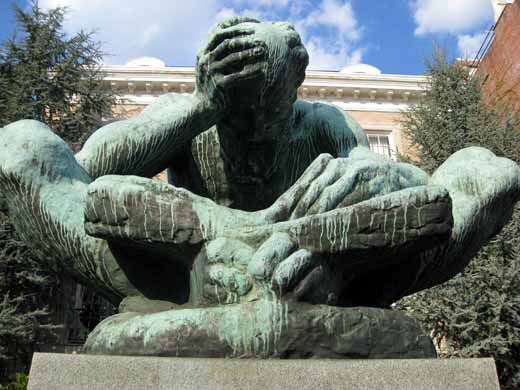
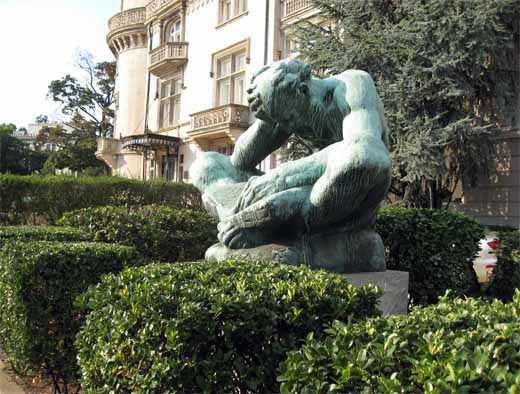
If you stroll along Massachusetts Avenue looking for inspiration on the day before school starts, you’ll encounter this figure at the Embassy of Croatia.

It’s Saint Jerome, who’s immersed in his work. If you’ve ever grappled with Jerome’s page-length Latin sentences, you’ve probably made this gesture, too.

For many of you, the coming weeks will call for much sighing and staring at tomes. Whether you’re a teacher or a student, here’s to a pleasant and productive semester—and not too much hieronymian clutching of the forehead.

“Hey there, laddie, internal exile…”

Like the rubble of Dinas Emrys raining down on Vortigern’s hapless masons, the barrage of books that purport to reveal the history behind the Arthurian legends still falls with some regularity on the just, the unjust, and the just plain uninterested.

This time, at least there’s a quirky twist: according to a new book, Merlin—yes, that Merlin—wasn’t merely a scholar from Scotland; he was also a resident of Glasgow from the year 600 until 618—and he lived on what’s now Ardery Street.

Local pride, dubious use of sources—the debate, quondam et futurus, continues, as Glaswegian conflicts do. Over at The Scotsman, the comments on the Merlin story became so heated that the editors had to shut them down. For now, I’ll stay neutral, but tonight, over dinner, I’ll honor the newly discovered McMerlin with an entree that also has its mythic roots in Glasgow. For all I know, King Arthur and Merlin invented it. Which, I can hear someone thinking, is a fine idea for a book…

“Walking in the park, dreaming of a spark…”

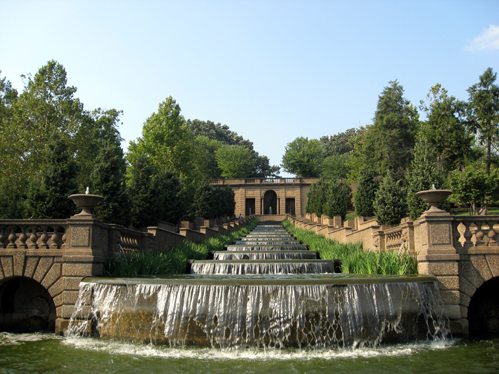
On a dull day in Washington, when the weather is dangerously hot, what better way to pass the afternoon than to look for medieval people at Meridian Hill Park, one of the city’s grandest public places?

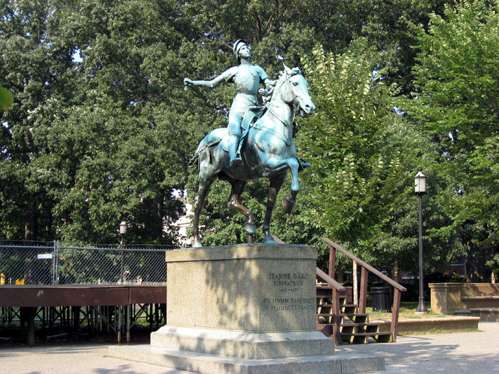
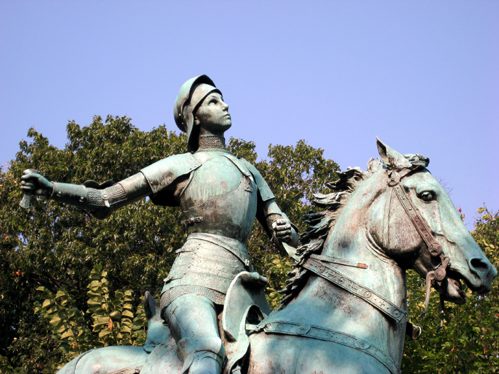
Climb to the source of the waterfall, and there she is, disarmed but not discouraged: la pucelle d’Orleans.

The pedestal sports a rather enthusiastic inscription:

“A most bodacious soldier and general, Miss Of Arc totally rousted the English from France. Then she turned this dude, the dauphin, into a king. And all this by the time she was seventeen!”

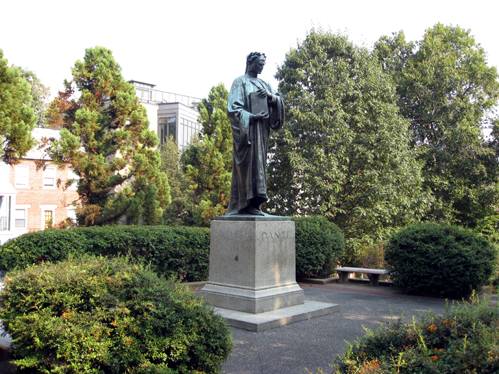
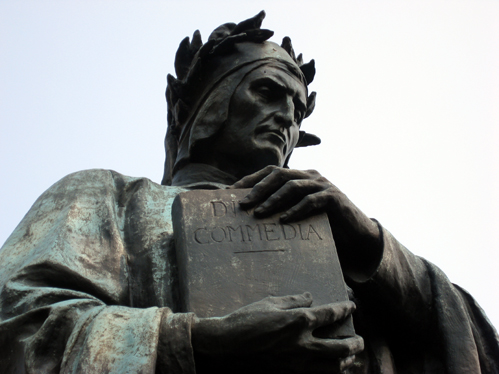
Wander into another corner of the park, and—non mi sembra vero!

It’s the Big D himself.

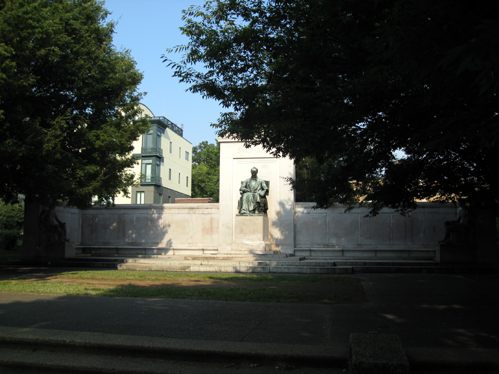
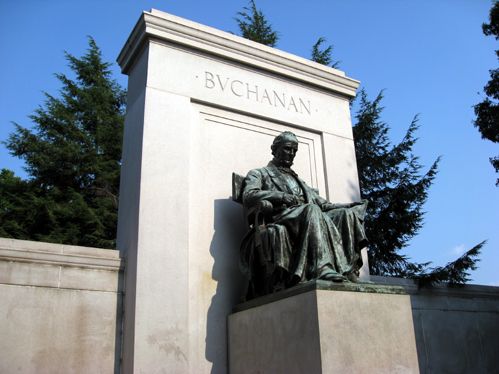
But wait…who’s that personage of historical significance seated behind those trees?

Aha! It’s that indispensable touchstone for all medievalists…

President James Buchanan!

“With his long, red beard, and his sister’s weird…”

If April is the month when longen folk to goon on pilgrimages, then maybe August is the month that priketh bloggers new in hir corages. Here are some neat blogs by medievalists: two new ones, and a third I’ve only now discovered.

At Per Omnia Saecula, grad student Jennifer Lynn Jordan plans to blog about Prester John, the Pre-Raphaelites, and Dante—and not just Rossetti, either, but also the Big D himself. Her interest in medieval bestiaries has already turned up one amusing discovery: the bonnacon, a creature whose primary defensive tactic, while repulsive, is not uncommon among humans here in latter-day D.C.

Michael Livingston, who teaches medieval lit at The Citadel, also has a new blog, where he answers the nagging question, “what would the sci-fi novel Old Man’s War sound like if Chaucer had written it?” If that question hasn’t nagged at you, then you may wish to keep your opinion to yourself; unlike most people who study and write about the Middle Ages, Livingston gerte him with a gode brond.

Not new—but new to me—is Jonathan Jarrett’s blog, A Corner of Tenth Century Europe, a site that combines Cambridge, coinage, and Carolingian Catalonia. It’s definitely the sort of blog that will teach you something—if you’re willing to C’s the day.

“But you, you’re not allowed, you’re uninvited…”

When you’re looking for him, Charlemagne is everywhere—but in April, he was noticeably absent from the celebrations of the 50th anniversary of the Treaty of Rome. EU member countries sponsored essay-writing and postcard-design contests for children, and museums in Brussels celebrated such curiously low-key phenomena as comic strips and photographs of offices in Luxembourg. The whole business was impressively stuffy—making Europe seem boring required an act of unprecedented bureaucratic genius—but I was still surprised when the party planners didn’t extend an invitation to Charlemagne, neither the very un-modern Christian warlord nor the burnished symbol of European unity whose name graces both a prestigious annual prize and the EU headquarters building in Brussels.

That’s why I was intrigued to see Jeffery Hodges, the Gypsy Scholar, pointing his readers to an essay, “Will ‘Europe’ Survive the 21st Century? A Meditation on the 50th anniversary of the European Community.” Its author, Walter A. McDougall, directs the International Relations program at UPenn. McDougall offers some thoughts on demography, demilitarization, and religion, subjects that merit ongoing debate—but he also remembers his Charlemagne:

What would Charlemagne make of Europe today? He would marvel, of course, at the wealth and technology. He would praise and bless the ubiquitous peace. He would recognize instantly the Islamic Challenge and tell Europeans it was ten times worse back in his day! Nor, having been a state builder himself, would he likely object to the intrusive EU bureaucracy. Indeed, it is fetching to think Charlemagne would discern in the EU the culmination of the great work he began over a millennium ago, and give glory to God. But three features of Europe today would doubtless grieve and trouble him greatly: military impotence; spiritual emptiness; and demographic decay. How long, the Emperor would surely ask, can a civilization expect to survive without arms, without faith, without children?

That is a question even the plodding Eurocrats will have to address before the twenty-first century gets very old.

What would Charlemagne make of Europe today? In the past year, several people have asked me that question. Not being built for punditry, I’ve mostly demurred, but after some informed guesswork, I came to the same mixed conclusion McDougall did: that Charlemagne would be astonished by Europe’s material prosperity but dismayed by European secularism.

That answer makes no one happy. Many want Charlemagne to be their like-minded hero, a flawless symbol of their own beliefs, while others bristle if you merely acknowledge that the question of religious faith is the largest philosophical chasm that separates Aachen in 797 from Brussels in 2007.

Fortunately, McDougall doesn’t make Charlemagne a simple repository for his own views, nor is his Charlemagne ideologically predictable. In fact, his claim that the emperor might have appreciated the EU’s sprawling bureaucracy, while plausible, is sure to rankle most of his Euroskeptic readers.

More debatable is McDougall’s assessment of the “Islamic Challenge,” his name for several intertwined issues: European identity, Muslim immigration, Islamic terrorism, and Turkish membership in the EU. Charlemagne “would recognize instantly the Islamic Challenge and tell Europeans it was ten times worse back in his day,” McDougall insists, but he offers no assurance that the situations are analogous across 1,200 years. History buffs remember that Charlemagne and his army were ambushed in the Pyrenees while leaving Spain in 778, but not everyone remembers why he was there in the first place: he had been invited to help the Muslim rulers of Saragossa and Barcelona against another Muslim, Abd al-Rahman of Cordoba. Later, Charlemagne also conducted cordial, long-distance diplomacy with the caliph in Baghdad, a consequence of their two empires having enemies in common.

The pragmatism of Franco-Islamic relations doesn’t mean that Charlemagne practiced “religious tolerance” in the modern sense—his foray into Spain was probably intended as a prelude to more ambitious military adventures—but it does suggest that if the old boy were to awaken from his 1,200-year slumber, he’d need a lengthy briefing to understand why immigration and assimilation had replaced military and diplomatic engagement as Europe’s real “Islamic Challenge.” It’s plausible, but not a given, that the events of the eighth and ninth centuries are akin to the situation in 2007, although the brave soul who argues the comparison is bound to disappoint everyone. Fans of cameras-and-handshakes diplomacy will cringe at Charlemagne’s aggressive militarism, while those who idolize him as an uncompromising proto-Crusader will find him insufficiently zealous in his opposition to the very existence of Islam.

But, as it turns out, sic semper Karolus. The most enjoyable part of my recent effort to introduce readers to Charlemagne as Karl, King of the Franks, has been witnessing the modern version of the centuries-old habit of creating a Charlemagne for all seasons. We play up favorite strengths, we prune those pesky weaknesses, and we see in him our highly personalized embodiment of an ideal Europe—whatever we think that may be.

Of course, some of us are completely, totally, utterly, infallibly immune to such anachronistic thinking. For that reason, I can admit that I know in my bones that Charlemagne, a famous patron of literature and art, would have grimaced at the sight of Europe’s monstrously tacky 50th anniversary logo. I mean, really, just look at it. The “Father of Europe” wouldn’t have needed knowledge of 21st-century typography or decades of bombardment by modern commercial branding techniques. Tasteful and discerning, he’d recognize a cheesy design when he saw one.

As for evidence of this humble assertion? Well, that’s the thing: You, dear readers, will just have to stretch your imaginations. Acknowledge the mindsets of medieval people; remember the premises of modern pundits; and take the matter, as they all so often do, on faith.