“…come crashing in, into my little world.”

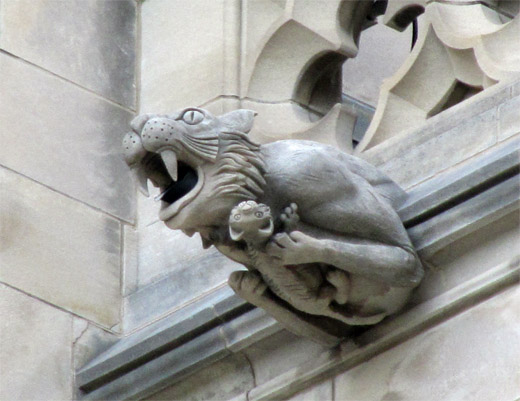
The standard line on this fellow is that he’s “refusing to listen to the word of God,” but since he lives on the highest point of a town that thrives on nonsense and noise, I imagine something else has got him all worked up.

TANTUM DIC VERBO

For peace, be still—and let me chase
One paltry prayer unforesworn:
Is grace alone in silence born,
Or else is silence born in grace?

Your craws, your pealings, plaints, and croaks
Resolve my riddle not; you claim
I hearken not? Then whet your blame
On yeas and yawps, whose wasting chokes,

Excruciates, my aching ear,
Be still—the prate of grating chords
Reproves me not, your feint rewards
Me not—and yet I hear, and hear,

And hear, though to the gargling round
My riddles read as coarse complaints:
“Avenge, O Lord, thy slaughter’d saints,”
They canter, lest my quest confound

The noise that lauds their long regret.
I plead you, peace—and beg your fray
Be still, and in your silence pray
For grace, to bear my silence yet.


(For all the entries in this series, hit the “looking up” tab, or read the gargoyle FAQ.)

“I had to run away high, so I wouldn’t come home low…”

As a kid, I believed in the Jersey Devil. As an adult, I was surprised to spot him at the cathedral, but maybe I shouldn’t be. In our minds, most of us are rarely far from home.

GARDEN STATE LOVE SONG

Repent your flailing forkèd tail and brush
The wingbit crumbs, rewandring why you fled.
The must of menus nemdays made you flush
The tinct of Taylor ham, and wonder bred
A boldened kobold, who for lusher state
Regressed abroad to bask in devlish blight.
But now the mayfield double-garden-gate
That welked you wide, is barr’d. Thus ends your flight.
So must you bitter pandaemony sip,
And dine on lines of dower Greek alone?
“There is no road for you, there is no ship—”
Baloney. Lonely imps may yet atone
In vented verse: Old cauls, like murdrous birds,
Arise, as g’s fawl off the ends of words.


(For all the entries in this series, hit the “looking up” tab, or read the gargoyle FAQ.)
“My words trickle down, from a wound that I have no intention to heal…”

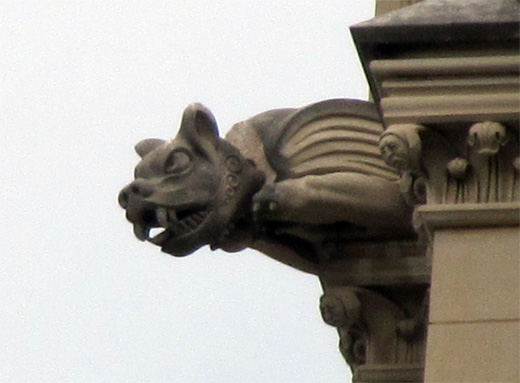
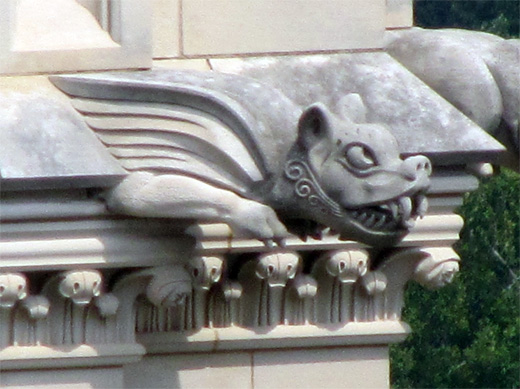
When the earthquake shook the National Cathedral on August 23, this bat-like beastie was damaged by falling stone. He clearly isn’t thinking straight; jilted, he may yet lose his head.

THEODICY
(DRÓTTKV
ÆTT)

rote & firmly formal,
first among the versed, we
spake no revolt, spelt our
spensings sans offenses.
dare we spect how dear my
dignant lord rewards me?
knife-stook bashes neck, &
never! I vow [bowing].

The broke-necked gargoyle on August 26, shot from the parking lot with a zoom lens…


…and photographed intact last summer from the observation deck:

(For all the entries in this series, hit the “looking up” tab, or read the gargoyle FAQ.)
“Look, a golden-winged ship is passing my way…”

Few cathedrals never know an earthquake. Most, like Lincoln, survive, with spires left unreplaced; others, like the cathedral in Christchurch, New Zealand, wearily face demolition after one earthquake too many. Tuesday’s quake gave Washington National Cathedral its first real rattle, knocking spires off the central tower, cracking buttresses, raining rubble onto the south transept steps, damaging a gargoyle, and probably causing damage yet unknown.

The rueful consolation of architectural history, both medieval and modern, is that it certainly could have been worse. In A.D. 1248, a busy year for crusading, church-state sparring, and all the usual duecento brouhaha, an earthquake hit England. Tallying up the year’s events in his Chronica Majora, the prolific monk Matthew Parris recorded the damage done to Wells Cathedral, around 20 miles southwest of Bath.

Here’s the original, for you Latinists:

Eodemque anno in Adventu Domini, scilicet quarto die ante Natale Domini, factus [est] terraemotus in Angia, ita ut, prout haec scribenti enarravit episcopus Bathoniensis, quia in ejus diocesi evenit, dissipatae sunt maceriae aedificorum, et lapides de locus suis avulsi in muris hiatus fecerunt patulos et rimas cum ruinis. Tholus quoque lapideus magnae quantitatis et ponderis, qui per diligentiam caementariorum in summitate ecclesiae de Velles ponebatur, raptus de loco suo, non sine dampno super ecclesiam cecedit; et cum ab alto rueret, tumultum reddens horribilem, audientibus timorem incussit non minimum. In quo etiam terrae motu hoc accidit mirabile; caminorum, propugnaculorum, et columpnarum capitella et summitates motae sunt, bases vero et fundamenta nequaquam, cum contrarium naturaliter debuit evenire. Et ille terraemotus tertius fuit, qui in triennio citra Alpes evenit; unus in partibus Sabaudiae, et duo in Anglia, quod ab initio mundi est inauditum, et ideo terribilius.

And here’s a quick translation:

That same year, during the Advent of the Lord, specifically on the fourth day before the Nativity of the Lord, there was an earthquake in England in which—as the bishop of Bath, in whose diocese it occurred, told this writer—the walls of buildings burst, and stones torn from their places left holes and cracks in ruined walls. The vaulted roof of the cathedral of Wells, set in place atop the summit through the diligence of masons and made of stones of great number and weight, was torn from its place, not without damage. It fell on the church, collapsing from on high and making a terrible crash that struck not a little fear in those who heard it.

During this earthquake, a wonder occurred: The peaks and summits of chimneys, ramparts, and pillars were dislodged, but the bases and foundations were not, although naturally, the contrary should have occurred.

This earthquake was also the third in three years to occur on the near side of the Alps, one in Savoy and two in England, a thing unheard of since the beginning of the world and thus that much more terrible.

Wells Cathedral survived, but its architectural future wasn’t placid. In the early 14th century, just a few decades after the earthquake, a new central tower cracked and seemed ready to collapse until a mason named William Joy invented a solution: scissor arches.

For nearly five years, I’ve written blog posts about the National Cathedral, finding Charlemagne’s heirs in the Bishop’s Garden (and butterfly amour there too) while taking autumn snapshots, looking into bloomin’ Arthuriana, admiring the spires draped in whimsical light, and tracing the building’s architectural kinship with a facade across the street. Then, of course, there are those nearly 40 poems about the gargoyles.

If you’ve enjoyed any of this stuff, please consider making a donation to help fix my favorite medievalist neighbor. The repairs are expected to cost millions, and structural engineers are “daunted by the idea of finding a way to repair such massive pieces so high up.” I suspect that like William Joy before them, these modern architects and masons will find ingenious solutions, but their work won’t be covered by insurance, so please drop a coin or two in the collection plate; you’ll be helping to restore a monument to the enduring influence of the Middle Ages. And if you’re feeling cheeky, you might insist that a gargoyle sent you.

“All around the world, statues crumble for me…”

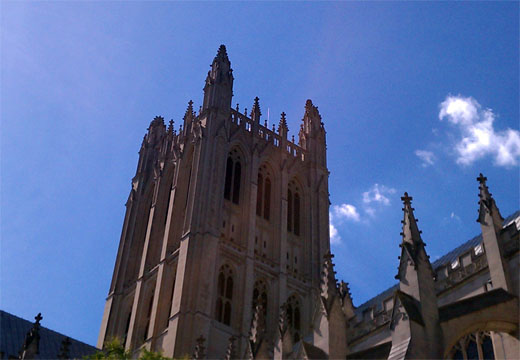
Contrary to CNN’s breathless claims an hour ago, today’s earthquake did not cause gargoyles to fall off the National Cathedral. However, the spires on the main tower sustained some damage. In the photo below, note the blunted spire on the left and the cockeyed one on the right; the building lost at least three pinnacles.

I spotted what may have been a section of broken stained glass, some rubble on the stairs where part of a spire reportedly fell, at least one other missing piece of ornamental stonework, and cathedral administrators anxiously surveying the foundation for signs of more serious damage.

The yellow-tape perimeter grew larger between 2 and 4 p.m., but the gargoyles all seem to be intact, which isn’t surprising; there’s at least as much unseen stone anchoring each one to the building as there is sticking out of the side.

Those of us for whom the cathedral is indispensable hope that the damage doesn’t extend beyond what we can see.

UPDATE, 10:55 p.m.: The Atlantic Wire has photos of damage at the higher levels and inside the cathedral.

UPDATE #2, AUGUST 24, 2011: The cathedral has a website devoted to earthquake damage; they’re soliciting funds to help with repairs.

“I need him now to meet me face to face…”

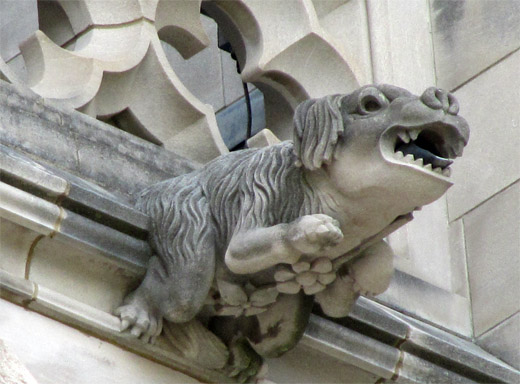
From April to June, a local thief took advantage of dawn twilight to help himself to flowers from private yards, community gardens, and the cathedral grounds. In mid-June, the police nabbed him, and although he wasn’t arrested, his crime spree witheredbut not before a gargoyle on the north nave barked a bit of doggerel.

NOTEBOOK: FRAGMENTS FOR A FLOWER THIEF

They paced the plot for hours, as mothers would,
But understood: “His arms were full of flowers.”

      * * *

CHORUS
  The cruelest month: a cusp’d cliché
  That pricks the wisp of guilty May
  And breeds the thief of blameless June.
   Summer, unsurprise us soon.

      * * *

“In April it was lilacs.” (Listen how
she hates to blame the deer.) “Hydrangeas now!
Four times this spring.” (Of course it could be deer.)
My peonies at least were spared this year.

      * * *

The Lilack speaketh late of early Love.
The bolder Peon prospereth a-red.
The Seede abundant unifies the Figge.
We love thee numb, O Koriandrum, come—
Fragaria, redeem the injur’d Maid.

      * * *

“He sold us flowers first a year ago.
We called him—Shantih?” Shantih does not know.

      * * *

We conquer by the weapons we desert.
By dawn the dogs will bound ahead to find
The efflorescent errand you resigned,
The arrow shafts unwagoned in the dirt.

(For all the entries in this series, hit the “looking up” tab, or read the gargoyle FAQ.)
“Sie haben uns ein Denkmal gebaut…”

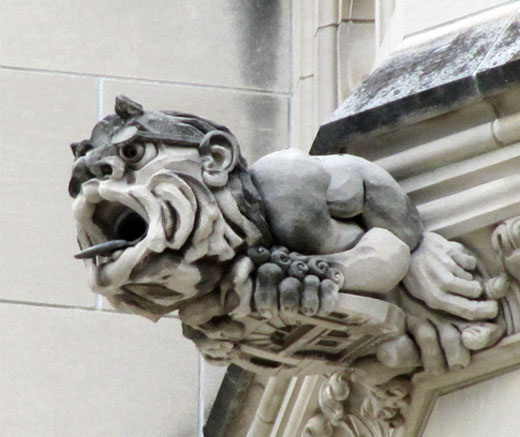
Known as “the administrator,” this gargoyle hangs just to the side of the cathedral’s west façade and grips a miniature of the façade of the school he faces. After all this time, he argues in admirably good faith.

FAÇADE

Behold the form: We found our faith in spires.
From balustrade to buttress, by design
We build upon the base of our desires.
The ape of human order we divine,
And carved creation lightly gives us praise.
On day and eve, proportion we impose:
The perfect sun sets perfectly ablaze
A thousand perfect petals on the rose;
An arch constrains the brunt of outward pride.
One hymn we hue: “Ennobling words are dear
In thee, all sacramental modes preside
In thee”
       as from the fading close I hear
a thing to tempt us out of rite and rhyme,
       a sole cicada singing out of time.

(For all the entries in this series, hit the “looking up” tab, or read the gargoyle FAQ.)
“Way over yonder in the minor key…”

Sometimes a tiger mother makes more sound than sense, but obscurity is useful: It forces you to ask, “Will I understand this when I’m older, or is this nonsense?”

ST. JOHN’S EVE
(MIDSUMMER SONG)

When leaves that leach from every tree
Like bitten insects blight and curl,
The swollen moon may let you see
  But once a goblin girl.

Be quick: The brindled moths detest
To stir the brack and shallow air
Of seeping June, where scinnhiws nest,
  Yet you will find her there.

Their sodden boughs admit no strand
Of summer-wasted moon to stream
But one, but she must make her stand
  Within her sallow beam.

She snuffs the muck, but scarcely finds
The spoor of misremembered things,
As “Love, O careless Love, my mind’s
   Not right,” she sifts, she sings,

She scents, she turns—her eyes aflash
Like stars above a harrowed field
That starve their spark in cosmic ash,
  Eternity revealed

In silver curls, inflamed with sweat,
In reckless lilies, late awoke;
Their withring stems she stoops to let
  Enwreathe her, lest she choke,

While through the gloom, she stalks the word
That calls the rake of summer rain.
As some slight boy who nursed a bird
  But set her wing in vain,

She raises high her plunder fair,
She offers up a secret thing,
She grounds her glyph in graceless air,
  While wild around you ring

The beadling eyes that light abide
To see the perfect rind unfold,
To gnaw the hidden fast inside
  That goblins long to hold—

Her eyes will rise; you cast yours down.
Before her sneer, betray no guile.
And to her grin, extend a frown;
  In this, you whet her wile.

And if she riddles, answer straight;
And to her white, you echo black;
But when she fangs, embrace your fate,
  And her, and bite her back.

Then run, as you must always run,
And learn what you will never learn,
And goblin glances roundly shun;
  But let the memory burn.

Beyond the bramble, timbers blaze,
So join us as we rouse with song
The lazing dawn, and know our days
  Will never be this long.

Let seven into fathoms fall,
Let three around the wake-fire whirl,
And let your summer scant recall
  But once a goblin girl.

(For all the entries in this series, hit the “looking up” tab, or read the gargoyle FAQ.)
“So, I’ll continue to continue to pretend…”

CANTERBURY BELLS
(GOOD FRIDAY)

Campanula may bow; they dare not bend,
Though shafts of sun seem ever more remote.
I do not think the rain will ever end.

You breed prosodic lilacs and pretend:
“The drocts of April / pairst us to the rote;
Campanula may bow / they dare not bend,”

But poems (even this one) condescend;
You still need your umbrella and your coat.
I do not think the rain will ever end.

“I’ll drown my books!” you cry. (Yes: God forfend
Your graveside vigil lack some pithy quote.)
“Campanula may bow; they dare not bend—”

It comes out wrong. But what did you intend?
You plucked your eyes for pearls, and dimly wrote:
“I do not think the reign will ever end.”

Oremus: What can sodden bells portend
When even you misdoubt one hopeful note?
Campanula may bow; they dare not bend.
I do not think the rain will ever end.

(For all the entries in this series, hit the “looking up” tab, or read the gargoyle FAQ.)
“The rain water drips through a crack in the ceiling…”

Every day, tour groups at the National Cathedral strain to see the grotesque of a certain famously evil pop-culture character, but they never notice the charming raccoon with whom he shares a buttress gablet. On rainy days like today, the raccoon deals with this recurring slight as any sensible creature would: by translating Rilke. (The original German poem is here.)

RAINER MARIA RILKE: SOLITUDE

Solitude is like the rain.
Along toward evening, rising up again
it slips the sea above the farther plain
to heaven, where it always rains, then down
from heaven falls alone upon the town.

Then down it rains in hours queerly cast,
when alleys turn to face the looming day,
when bodies, finding nothing, have at last
from one another glumly turned away,
and when, in their despite, two lives must stay
and side by side in one shared bed repose:

then solitude into the rivers flows…


(For all the entries in this series, hit the “looking up” tab, or read the gargoyle FAQ.)