“And the little wheel runs on faith…”

If you’ve ever owned a hamster, then you know how easily these creatures succumb to ontological and epistemological crises, especially when they look in a mirror. In this case, the mirror is Walters 71.170, a medieval artifact that also repays human scrutiny.

A HAMSTER CONSIDERS AN IVORY MIRROR COVER FROM MEDIEVAL FRANCE

Is this the wheel rabbanim learn
In serifed murmurs to discern
How beasts on every fourthwise spoke
Revolve by fours, but do not turn?

Is this the wheel the brahmin broke
When, himmel-eyed, she dared invoke
Her patient, wisdomed groom, then beamed
To bow her head for Roman stroke?

Is this the wheel a consul schemed
To wreathe with kaisers crudely dreamed
Who whirled their luckless lots away,
Yet leave one lady long esteemed?

Is this wheel the suras say
Was made of silver, not of clay,
And spelt like ash across the sky
To lift a grazing flock to pray?

Four beasts about the border fly;
Within, the aging never die.
For wheels in wheels I long to burn,
But which, the beast, the blest, am I?

(For all the entries in this series, hit the “looking up” tab, or read the gargoyle FAQ.)

“Mais nous pouvons faire ce que nous voulons…”

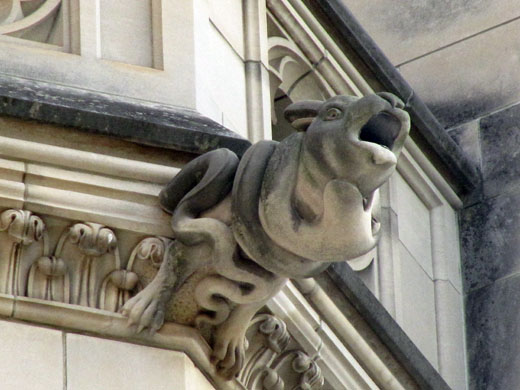
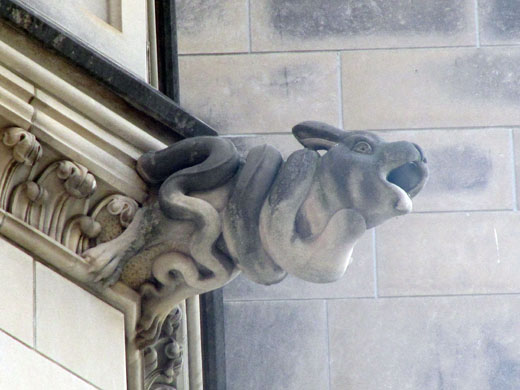
This snake on the northwest tower has long creeped me out. It’s one thing to fulfill your nature; it’s quite another to chalk up every impulse to giddy antiquarianism.

APOLOGIA

Heo cwaeð: “Seo naedre bepaehte me ond ic aett.”
—Gen. 3:13 (British Library MS Cotton Claudius B.iv)

We rede the Saxons sympathised with snakes:
On broach and bract they turve and intertwine
But buckle when modernity awakes;
All laud the wyrm who weaves a wulfish vine.

In retsel-books and wrixled words we find
The Saxons, ever lacertine, bestirred
To grammar-craft, whose duple pronouns bind;
So sundered lives were woven with a word.

(A scene: Some god-forsook Northumbrish monk,
Emboldened by an asp to double think,
Professes wit and unk and unker-unk,
But shrinks from git and ink and inker-ink.)

Now I, who raveled precedent relate,
Propose that we be litchwise intertraced;
The wulf and adder gleam on plink and plait,
Yet no immortal lepus ever graced

The lapidated latch of art divine,
So spurn your sallow scrafe, forget the sun.
For you the relic, I the blessid shrine;
In wit and work alike, we two are one.

(For all the entries in this series, hit the “looking up” tab, or read the gargoyle FAQ.)

“In my blue heaven, there’s a bottle of Pontchartrain…”

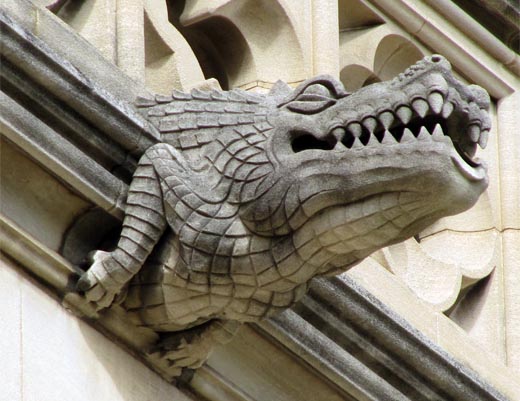
I’ve never known what alligators dream. Apparently, it’s simple: “Laissez les bons temps rouler.”

CANAL STREET

When George leans back and waives his wyrmbent blade,
When golden Joan rolls up her banns of war,
When late Ignatius lutes his last crusade,
When Roch counts no more crutches by the door,
Then daub our brow with dust—but not today,
As saints salaam to every passing king
And all our sins are snatched and strewn away
Like bright, beloved beads that slip their string.

(For all the entries in this series, hit the “looking up” tab, or read the gargoyle FAQ.)

“I’m no exception, please call my name…”

Some messengers are ambivalent about their own calling. This one perches 175 feet up, high above the birdwatcher, just below Medusa, and weirdly close to angels.

APORIA

Rilke from his rampart: Beauty’s naught
But terror’s dawn.
Then why do mirk-mites wrought
From strofe and stub, Creation’s afterthought,
Squat seraph-like on spits above the earth:
To herald terror’s end, or stress the birth

Of idle envoys? Will my gaze reverse
The pattern, roughly swat the form aright,
Or only skew the catachresis worse
For pious poets? Dismal in whose sight
We loom in low, like pests, and while you write
Like angels on a book-shelf in Berlin

We stand and wait for nothing to begin.

(For all the entries in this series, hit the “looking up” tab, or read the gargoyle FAQ.)

“A garden full of food will be my final contribution to the world…”

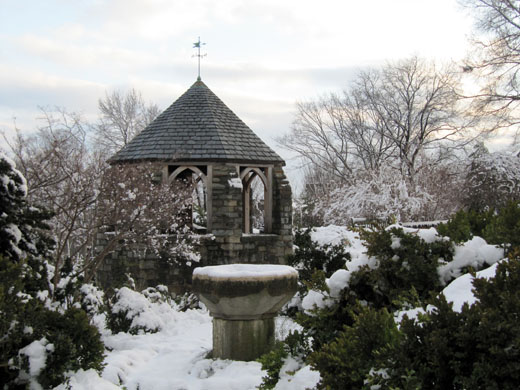
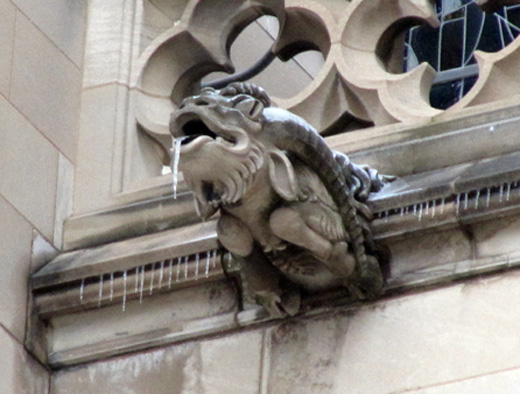
Regular readers of this blog may recall that part of the Bishop’s Garden is devoted to Walafrid Strabo, the Carolingian abbot and teacher best known today for De Cultura Hortorum, a poem about his garden at Reichenau. Walafrid was only in his early thirties when he drowned in 849 while trying to cross the Loire. This goat, apparently a medievalist, looks out over the garden and remembers him yet.

WINTER CANTICLE

Seminibus quaedam tentamus holuscula, quaedam
Stirpibus antiquis priscae revocare iuventae.
— Walafrid Strabo, Hortulus

As frozen fingers blunt the thorn,
So Walafrid was barb’rous born

But to that noble island brought.
There Walafrid a vision wrought

With falt’ring eye, but steady feet;
Yet Walafrid would fast retreat

To fertile slopes that front the east.
To Walafrid, to tend the least

Of bitter twigs was sweetest toil,
So Walafrid provoked the soil

To summon worms, and banish moles.
Ere Walafrid the care of souls

Attended, first he fathered roots;
So Walafrid, when bade by brutes

To court, would wall his fruitful mind.
There Walafrid was wont to find

That princelets spire like grasping vines;
And Walafrid tracked fraying lines

Of maidens’ woolspun, wound like gourds;
And Walafrid, when fraught by swords

Saw iris weigh her windblown blade;
And Walafrid left kings afraid

That striplings choke the root, like sage;
And Walafrid foresaw how rage

In bitter plots like wormwood grows;
Then Walafrid perceived in rows

Of scrabbled verse the reek of rue,
Which Walafrid perused, and knew

A soul his faith and friendship scorned.
Then Walafrid in silence mourned

Their idyll dawns, with leaf-light strewn;
But Walafrid prayed God the moon

Shone ghostly, sometime, on his face.
Lest Walafrid despair of grace,

He starved the flame, like seeds to drought;
And Walafrid dreamed long about

The flood, the torrent, murm’ring death;
Then Walafrid would gasp for breath…

Now wait, and watch the snow-bed yield
To branch and bramble unconcealed

That ache for thirst, but must bow down
To seed that drinks, but does not drown

As sprigs and spindrels long unseen
Entwine the font, and blinding green

And purple flash from wing to tree
And sepals spread to greet the bee

And raindrops burst in thick bright beads
And sun alights on lazing weeds

Where column-bright, the lily grows
And raises morning o’er the rose

That marks the day when winter dies;
Then Walafrid, refreshed, will rise.

(For all the entries in this series, hit the “looking up” tab, or read the gargoyle FAQ.)


“So I cut some cord, and I shouldn’t have done it…”

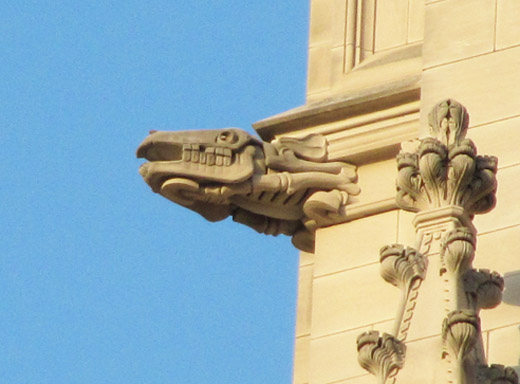
The southwest tower is haunted by a skeletal horse. Few people see it, but at sunset, you might hear it sing.

KINDERLIED

As I was riding to Banbury Cross,
Lazily lilting of lovers in loss,
Out swept a seeress who sneered down her nose:
“He shall have music wherever he goes.”

As I was riding to Banbury Square,
Twined in a tribute to tumbledown hair,
Out skipped a maid: “Are you singing for me?”
Studied and sober, I stared at the sea.

As I went riding to Banbury Street,
Rhyming a romance with riddles replete,
Out slouched a spinster: “Perchance it’s my day?”
Crabbed and confounded, I cursed the delay.

As I was riding to Banbury Lane,
Poignantly piping of passion and pain,
Out shuffed a widow: “Can you see his face?”
Piqued and impatient, I parted apace.

As I went riding to Banbury Road,
Wide by the wayside that wisdom bestowed,
Out rose a hymn: Every rapturous word
Rang through the alleyway. Nobody heard.


(For all the entries in this series, hit the “looking up” tab, or read the gargoyle FAQ.)
“Talkin’ jivey, poison ivy…”

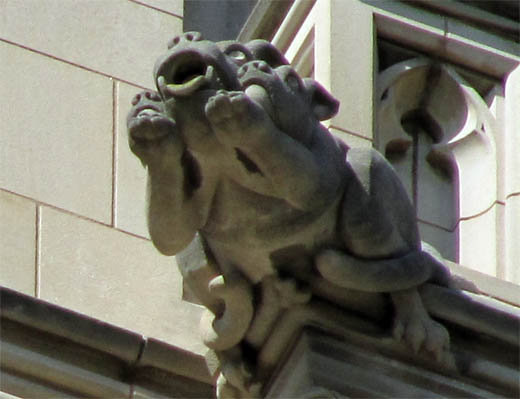
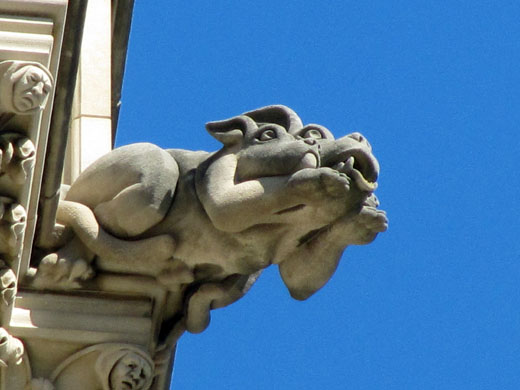
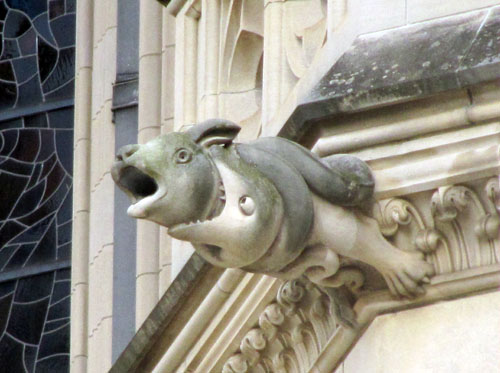
Someone recently asked me if I thought gargoyles get bored. Spend a morning with the three-headed dog on the south transept, and then you tell me.

THREEPIPHANY

A martyr
sees saints circumambulate smarter
while legates who pult at the wall
fall.

A yeoman
scabs each sanguinarial omen
while canons for ungilded stone
moan.

A maiden
with sopp’d weialálas is laden
while posers who fish for the ring
sing.

A traitor
spins Fortune against her creator
while cold consolation reveals
wheels.

A seeker
finds calxiform beacons burn bleaker
while knaves see the weary-all thorn
born.

A fogey
dares cymricize non-mabinogi
while teardrops round wasting Mac Cool
pool.

A quester
lets pentacled purities fester
while gomish virídescent axe
whacks.

A hero
rounds duodenáry to zero
while Argonauts freighted to fail
sail.

A phony
maraunders in blind Laestrygóny
while fesseries dredge to exhume
Bloom.

A ptotic
turns thlebrous Caváfy demotic
while Sclepius hectors his snake
wake.

A portal
makes polycephálics immortal
while rhymers who rage in the dark
bark.


(For all the entries in this series, hit the “looking up” tab, or read the gargoyle FAQ.)
“Just like the rain, I’ll be always falling…”

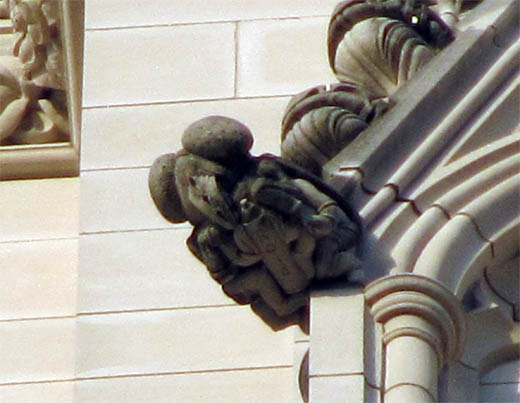
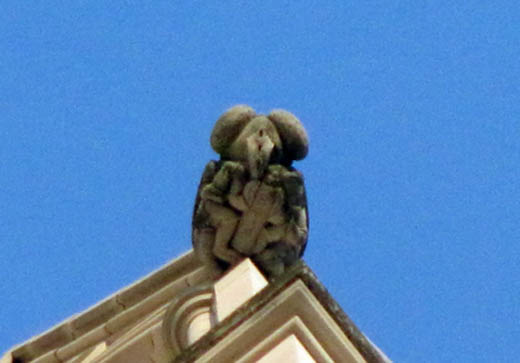
The fallen angel on the southwest tower is difficult to see from the ground. He has shriveled wings, stolen halos on his arm, and an eternal supply of petulance.

29 DECEMBER/TE DEUM

“Come rhyme with me; I rise to dance,” you lie;
Like medlar rashly dropped, I’ll ripen not.
Now overturn my sodden pith and pry
For secrets, hard as seeds. Behold my rot:
I holp no palmers whon thot thay bay seck;
No elvysh poppets twang may turvy rhyme;
Their ferney hawls I longen for to wreck:
“No bishop murdered yet?” Oh, give us time,
Though crypts below will blaze in shadows’ wake,
Though bannerets above must fly unfurled,
Though quires within call reprobates to quake,
Though bells on high will warn a weary world
And make me loathe and love what they begat:
A blessed bishop born a Cheapside brat.


(For all the entries in this series, hit the “looking up” tab, or read the gargoyle FAQ.)
“…and eyes full of tinsel and fire.”

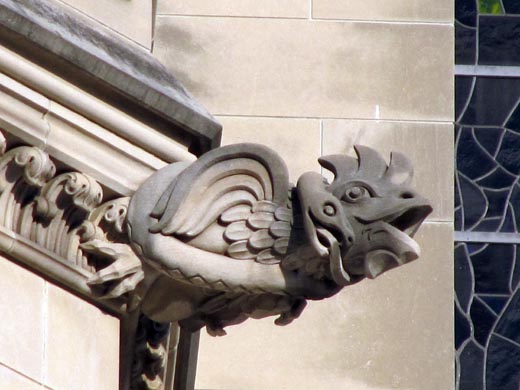
Facing east, this rooster on the southwest tower greets the winter dawn, but not without trepidation.

SOLSTICE SONG

Come and grace our gleeful number;
Come and shake off snows unknown.
Bells will ring while wood-woes slumber;
Bells will ring for you alone.

Rave with uncles reeked in holly;
Reel with aunts who saw you born.
Whirl away your grear-tide folly;
Hearth-life dwindles ere the morn.

Haul the ash-bin ’round the byre;
Feel the pinelight breathe your name.
From the tongue of colder fire
Cracks and calls a hotter flame.

Run and chase your sweet-lipped singer;
Run and race your hope anon.
Bells will ring where’er ye linger;
Bells will ring when you are gone.

(For all the entries in this series, hit the “looking up” tab, or read the gargoyle FAQ.)
“‘You’re all wrong,’ I said, and they stared at the sand…”

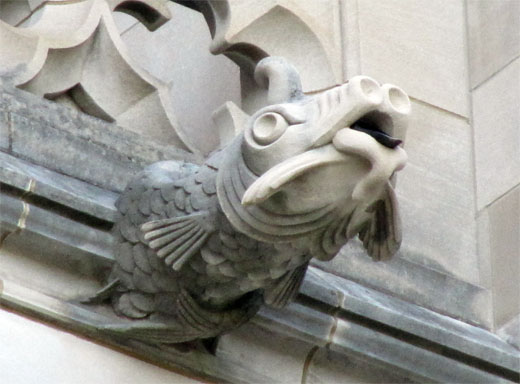
The horned fish on the north nave gets scant sunlight as the winter wears on, but seasonal shadows help him seem more sinister than absurd. He’ll tell no tale about himself; fish feed on the exploits of others.

TRIOLET
(SHIPWRECK SONG)

“Take up a line”—and so we sail
Behind the storm. We hold our own;
When luff-seams shred, our lidmen pale
Take up a line. And so we sail,
And when you dread that sureties fail
The loves of men on strands unknown,
Take up a line and sew. We sail;
Behind the storm, we hold our own.

(For all the entries in this series, hit the “looking up” tab, or read the gargoyle FAQ.)