“Keeping versed and on my feet…”

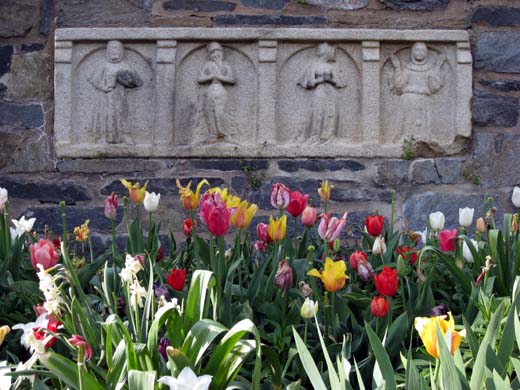
As Today in Literature reminds us, yesterday, April 18, was the day Chaucer’s pilgrims set out for Canterbury. Appropriately, my block was packed with pilgrims passing to and fro, some of them heading to the zoo, the hooly blisful pandas for to seke, others hiking up the hill to our friendly neighborhood Gothic cathedral.

The cathedral grounds were in full bloom today: camera-toting tourists, elderly couples asleep in the grass, wedding parties, flirting lovers, romping puppies, children fleeing bees, even bagpipers, as if to lead us grandly out of town. Beauty intermingled with chaos; Chaucer no doubt would approve.

But not every medieval poet took the path of the pilgrim for granted. Writing six centuries before Chaucer, that old wit Theodulf, bishop of Orleans during the reign of Charlemagne, rolled his eyes at peregrinatory pretensions:

Qui Romam Roma, Turonum Turonove catervas
Ire, redire cupis cernere scande, vide.
Hinc sata spectabis, vites et claustra ferarum;
Flumina, prata, vias, pomiferumque nemus.
Haec dum conspicies, dum plurima grata videbis,
Auctoris horum sis memor ipse dei.

Here, inspired by an afternoon on the green alongside the Bishop’s Garden, is a shamefully loose translation:

You clamor for the crowd, for something more;
So take your tour of Rome, and roam to Tours.
The tender crops are all we gather here,
By berries, brooks, and barns, and byways clear.
So go—for if you stay, you’ll just recall
In simple sights the one who made it all.

I know! Spring fever is my only defense. The tulips made me do it.

In denying the pilgrimage instinct, Theodulf fought, with snide futility, the tide of human nature. Geoffrey Chaucer better understood his fellow man—in fact, I think Geoffrey better understood a great many other truths as well—but Theodulf was right about one thing: Some days, whatever it is you’re looking for, that unnamed source of fulfillment and beauty which seems like it ought to be elsewhere, may turn up outside your own door.

“Dragging behind you the silent reproach…”

On Friday, a very medieval thing happened here on my corner: a car skidded on some ice, jumped the curb, smashed the fence and flowerbeds in front of the public library, and ran over a defenseless sign.

What’s so medieval about that? Well, for one thing, it reminded me of the ice-borne derring-do of Skarp-Hedin in Njal’s Saga:

Skarp-Hedin jumped up as soon as he had tied his shoe, and hoisted his axe. He raced down straight towards the river, which was much too deep to be forded anywhere along that stretch. A huge sheet of ice had formed a low hump on the other side of the channel. It was as smooth as glass, and Thrain and his men had stopped on the middle of this hump. Skarp-Hedin made a leap and cleared the channel between the ice-banks, steadied himself, and at once went into a slide: the ice was glassy-smooth, and he skimmed along as fast as a bird.

Thrain was then about to put on his helmet. Skarp-Hedin came swooping down on him and swung at him with his axe. The axe crashed down on his head and split it down to the jaw-bone, spilling the back-teeth onto the ice. It all happened so quickly that no one had time to land a blow on Skarp-Hedin as he skimmed past at great speed. Tjorvi threw a shield into his path, but Skarp-Hedin cleared it with a jump without losing his balance and slid to the other end of the sheet-ice.

Kari and the others came running up.

“That was man’s work,” said Kari.

Think I’m stretching things to draw a medieval connection? Just wait until the kin of that library sign and the foster-brothers of those murdered azaleas decide to seek revenge. My genteel neighborhood will erupt into hot-blooded discord. They’ll be burning down mead-halls (or at least shooting burning glances at the local California Tortilla), carving rune-spells into their enemies’ yoga mats, pitting book club against book club…I tell you, sometimes the foreknowledge provided by medieval literature is little more than a curse.

“For I smell of the earth and am worn by the weather.”

The medieval world had no patience for giants. Heroes of epic would send them to Hell; Thor, ever sporty, would hunt them for fun; in chivalric romance, knights smote them with glee. From Yvain to King Arthur to Bevis of Hampton, medieval heroes made giants extinct—except for one holdout, who fled from oppression, and napped on the outskirts of Washington, D.C.

Here in the District, we’re losing our giant. I went out this weekend to bid him adieu and was pretty surprised: he’d attracted a crowd. Strangers sat in his palm, children slid down his knee, and adults tapped his forehead and peered up his nose. In a city of pipsqueaks who long to be giants, that’s no way to send off the last of his kind.

“So we go inside, and we gravely read the stones…”

Henry Adams was fond of statues. His 1904 book Mont Saint Michel and Chartres opens with Michael the Archangel “[s]tanding on the summit of the tower that crowned his church, wings upspread, sword uplifted, the devil crawling beneath, and the cock, symbol of eternal vigilance, perched on his mailed foot.” Later, when Adams notes a depiction of the Virgin Mary at the great cathedral of Chartres, he takes gentle, vicarious pleasure in imagining the twelfth-century mindset behind it:

The Empress Mary is receiving you at her portal, and whether you are an impertinent child, or a foolish old peasant-woman, or an insolent prince, or a more insolent tourist, she receives you with the same dignity; in fact, she probably sees very little difference between you.

Throughout Mont Saint Michel and Chartres, Adams plays the genial tour guide for his reader, whom he cheekily casts as his own wide-eyed niece. While the other faces of Henry Adams—novelist, academic, part-time Washingtonian, scion of a great political family—are shrouded by the author himself in the interest of efficient tourism, Adams the medievalist is a chipper fellow indeed. Faced with profundity, he is effusive, reactive, opposed to every pedantry. “To overload the memory with dates is the vice of every schoolmaster and the passion of every second-rate scholar,” he informs us. “Tourists want as few dates as possible; what they want is poetry.”

More than a century after its publication, Mont Saint Michel and Chartres is still a charming, imminently quotable work, an account of what happened when one of the sharper minds of late 19th-century America beheld the marvels of medieval France. I don’t know how well known the book is today, or how well regarded it is by scholars; I imagine it’s quite out of date. I do know that here in Washington, the influence of Henry Adams is most evident not at our cathedrals or in medieval history courses, but in a man-made grove at Rock Creek Cemetery—where, as Adams predicted, tourists seek poetry in a statue.

The tale of the statue is simple enough. Adams commissioned his friend Augustus Saint-Gaudens to create it in 1886, one year after his wife, Marian Adams, committed suicide. The larger structure later served as a tomb for both Marian and Henry Adams after the latter died in 1918, but the bronze figure became a tourist attraction even before Adams had seen it for himself. According to his third-person quasi-autobiography, The Education of Henry Adams, he hurried to the cemetery in 1892, as soon as he returned from Europe.

For readers who clung to the coat-tails of the avuncular tour guide of Mont Saint Michel and Chartres, the Henry Adams who visits Rock Creek Cemetery is unusually brooding and curt:

Naturally every detail interested him; every line; every touch of the artist; every change of light and shade; every point of relation; every possible doubt of St. Gaudens’ correction of taste or feeling; so that, as the spring approached, he was apt to stop there often to see what the figure had to tell him that was new; but, in all that it had to say, he never once thought of questioning what it meant.

Adams lets his reader infer the awkwardness of chatting with strangers who sought out the tomb of his wife:

As Adams sat there, numbers of people came, for the figure seemed to have become a tourist fashion, and all wanted to know its meaning. Most took it for a portrait-statue, and the remnant were vacant-minded in the absence of a personal guide. None felt what would have been a nursery instinct in a Hindu baby or a Japanese jinrickshaw-runner. The only exceptions were the clergy, who taught a lesson even deeper. One after another brought companions there, and, apparently fascinated by their own reflection, broke out passionately against the expression they felt in the figure of despair, of atheism, of denial. Like the others, the priest saw only what he brought. Like all great artists, St. Gaudens held up the mirror and no more.

Tourists to Rock Creek Cemetery still react in such strangely personal ways. During my visit there last weekend, I met a couple who had passed a few moments of sunny contemplation on the bench before the statue.

“She’s so beautiful,” the wife informed me. “She looks so hopeful—like she’s ready to cast off her shroud and fly.” When I told her about the suicide of Marian Adams, she seemed more bemused than troubled, reluctant to complicate her aesthetic experience with any newfound knowledge. Having cheerfully glanced into Saint-Gaudens’ mirror, she departed with an empty smile.

What did Adams see when he visited the cemetery? In the Education, he claims that the statue represented “the oldest idea known to human thought,” but his reader learns quickly to look past his loftier claims. The Education ignores the suicide of Marian Adams; in fact, it skips past twenty years, omitting the marriage entirely. Inclined to be silent rather than confess to sadness, Adams allows only traces of feeling to show. Perhaps his truest thoughts are better found elsewhere—in his defense of Norman architecture, for example, which, taken Adams-like and somewhat out of context, can be read as a case for the statue itself:

Young people rarely enjoy it . . . No doubt they are right, since they are young: but men and women who have lived long and are tired,—who want rest,—who have done with aspirations and ambition,—whose life has been a broken arch—feel this repose and self-restraint as they feel nothing else.

In his writing, Adams is an enigma: impressively learned, improbably modest, and always a little removed. He wanted that figure at Rock Creek Cemetery to be just as difficult to read—but each time he saw her, he hoped to discover something new. His books, although brilliant, will never reveal what he learned. To find the answer, you have to go: visit Rock Creek, sit across from that shrouded figure, and let her tell you about Henry Adams—not about his writing, wry and worldly and burning with praise for the archangel and the empress, but about the author and husband who finally ran out of words, and who counted on secrets that only a statue can tell.

“…to leave you there by yourself, chained to fate.”

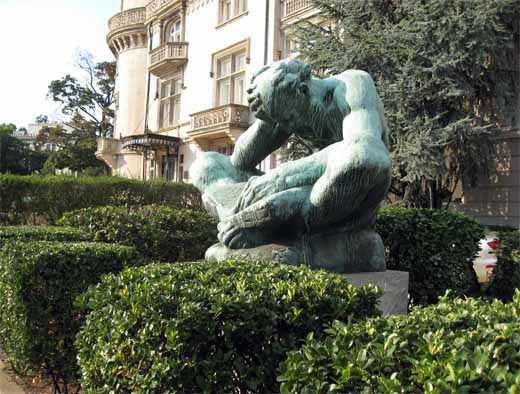
If you stroll along Massachusetts Avenue looking for inspiration on the day before school starts, you’ll encounter this figure at the Embassy of Croatia.

It’s Saint Jerome, who’s immersed in his work. If you’ve ever grappled with Jerome’s page-length Latin sentences, you’ve probably made this gesture, too.

For many of you, the coming weeks will call for much sighing and staring at tomes. Whether you’re a teacher or a student, here’s to a pleasant and productive semester—and not too much hieronymian clutching of the forehead.

“Walking in the park, dreaming of a spark…”

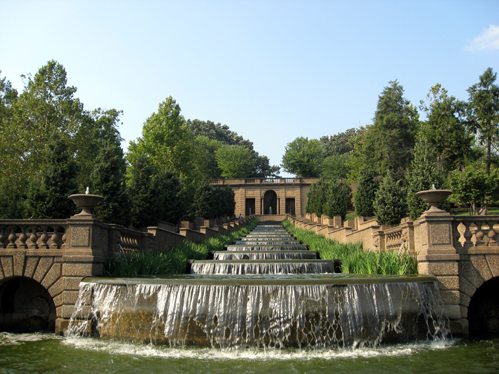
On a dull day in Washington, when the weather is dangerously hot, what better way to pass the afternoon than to look for medieval people at Meridian Hill Park, one of the city’s grandest public places?

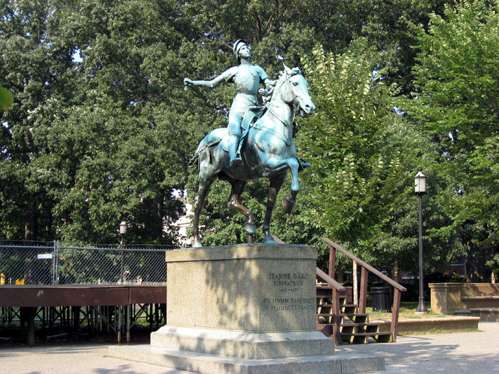
Climb to the source of the waterfall, and there she is, disarmed but not discouraged: la pucelle d’Orleans.

The pedestal sports a rather enthusiastic inscription:

“A most bodacious soldier and general, Miss Of Arc totally rousted the English from France. Then she turned this dude, the dauphin, into a king. And all this by the time she was seventeen!”

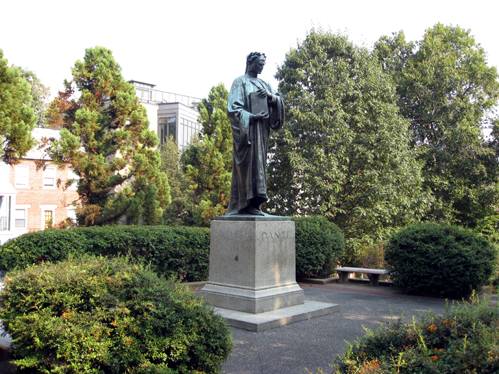
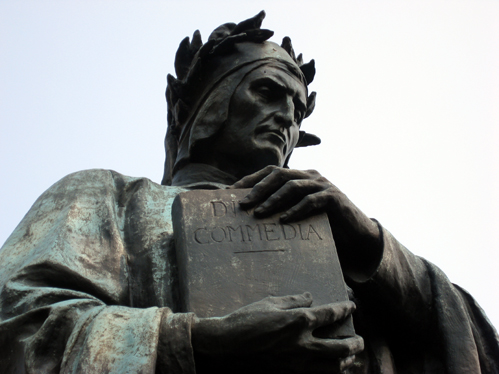
Wander into another corner of the park, and—non mi sembra vero!

It’s the Big D himself.

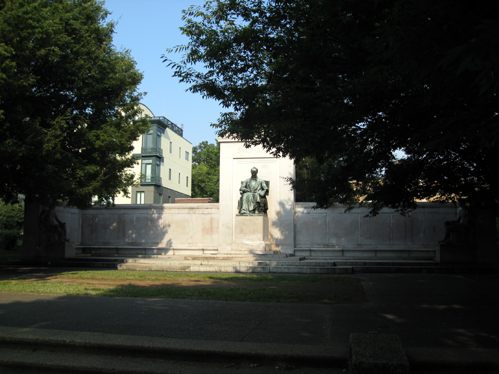
But wait…who’s that personage of historical significance seated behind those trees?

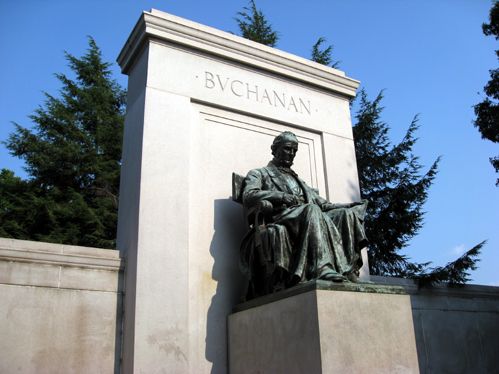
Aha! It’s that indispensable touchstone for all medievalists…

President James Buchanan!

“Painted in a corner, and all you wanna do…”

They sound familiar, but I haven’t said them in ages: names like Prismacolor, Pigma, and Bristol, old friends in their enigmatic way, back in the days when we drove halfway to Newark Airport to scope out the metal shelves and breathe in the chemicals we hoped we could turn into art.

Two hundred miles south, the store may be different, but the sights and scents are the same. The blank sheets of vellum shine with promise, the tubes of fresh paint reek of unexploded energy—but fifteen years later, sneaking through aisles of markers and paper and pens feels like driving past the house of an old girlfriend. Besides, I’m here for mats and frames, which are easy, not inspiration, which is hard, especially when every drawing board resembles the piles I’ve shoved into storage, and each color marker is a reminder that some things dry up when you just can’t be bothered to use them.

“I will walk in the garden, and feel religion within…”

On Sunday mornings, the ringing of church bells rolls right down the side-streets and echoes through the bushes and trees. Heed their call and hike up the hill; at the top you’ll find a gothic cathedral. Stunning in its own right, it also looms over one of Washington’s prettiest places: the Bishop’s Garden, a thriving reminder of 14th-century monastic life.

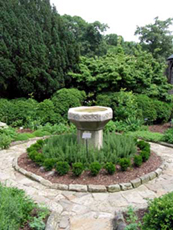
In one corner of the garden is something even older: an anachronism within an anachronism, a massive stone baptismal font encircled by special plants. This little “garden room,” a small sign explains, is here to evoke the ninth century, with each leaf and shoot a living monument to the era of Charlemagne. The emperor might have approved, in passing, of this collection of flowers and herbs. But twelve centuries later, its existence owes less to Charlemagne and more to the legacy of a mostly forgotten man, a monk named Walahfrid Strabo.

Walahfrid first beheld Reichenau at the age of eight. His parents were humble and poor, but the brothers on the island in Lake Constance saw promise in this strange little boy, this strabo—this “squinter”—who readily took to the life of the mind. In his later writings, he wryly recalled his barbaric roots, but the library at Reichenau was truly where Walahfrid Strabo was born.

Walahfrid’s heart never left that quiet island, not even after he was sent to Fulda for further study, nor during his nine years at Aachen, where he tutored Charles, the son of Emperor Louis. In 838, when Louis rewarded Walahfrid with an abbacy, the monk, then thirty, went home to Reichenau at last. Except for two years of political exile and the occasional diplomatic mission, Walahfrid spent the rest of his brief life there. In the decade left to him, he polished his poems, he wrote to a scandalous friend, and he worked, when he could, in his garden.

We know about the garden because of one poem: Walahfrid’s 444-line De Cultura Hortorum, “On the Cultivation of Gardens,” now more commonly known as his Hortulus, “the little garden.”

In a lively preface, Walahfrid exhorts others to share his commitment to gardening:

For whatever the land you possess, whether it be where sand
And gravel lie barren and dead, or where fruits grow heavy
In rich moist ground; whether high on a steep hillside,
Easy ground in the plain or rough among sloping valleys—
Wherever it is, your land cannot fail to produce
Its native plants. If you do not let laziness clog
Your labor, if you do not insult with misguided efforts
The gardener’s multifarious wealth, and if you do not
Refuse to harden or dirty your hands in the open air
Or to spread whole baskets of dung on the sun-parched soil—
then, you may rest assured, your soil will not fail you.

Although bookish by nature, Walahfrid makes clear that he is not merely transmitting found knowledge:

This I have learnt not only from common opinion
And searching about in old books, but from experience—
Experience of hard work and sacrifice of many days
When I might have rested, but chose instead to labor.

With quiet joy, Walahfrid walks the reader through his garden, a former mess of nettles and weeds now made useful and neat through careful springtime tending. His tour leads past rows of long-necked poppies, brilliant purple irises, pungent rue, and sprigs of fragrant mint. At every step, he catalogs the practical uses of his garden plants: wormwood, he claims, can cure a headache; fennel loosens the bowels, and it cures a cough when added to wine.

But Walahfrid’s thoughts range far beyond his humble garden, and his Hortulus is a fertile bed of budding notions. In sage, when new growth chokes its old leaves, Walahfrid sees “the germ of civil war.” Gourd-vines remind him of shields, ladders, and girls spinning wool; he admires their tenacity in a storm, and he marvels at how they aspire “to grow high from a humble beginning.” He points out that horehound counteracts the poisons of an evil stepmother, while pennyroyal lets him marvel at God’s bounty and contemplate the economics of scarcity. In a fit of Virgilian whimsy, Walahfrid even invokes the Muse, “who in sacred song / Canst stablish monuments of mighty wars / And mighty deeds,” all so he can more eloquently praise the heartburn-reducing properties of chervil.

Practical advice and classical flourishes, political allegory and good humor, philosophical musings and mock-epic—here and there, modest ideas and tender allusions break through the surface of the Hortulus, intertwine a little, and grow toward nothing in particular. In the end, Walahfrid’s garden path leads to the lily and the rose, Christian symbols both, each leaning against the other; he spots them just as he begins to tire. It would be odd indeed if a ninth-century abbot did not end his gardening book in this way—but it is odd already that Walahfrid has left this literary garden, in which he glimpses all creation, at fewer than 500 lines.

To understand Walahfrid’s brevity, close his Hortulus. Tuck it under your arm, pass beneath the open archway, and visit the real hortulus, which blooms in the shadow of a cathedral that Walahfrid never could have imagined. Here grows rosemary; here grows the fleur de lys; here grow fennel, black cumin, and green-leafed Gallic rose. In patches, bowing in their raised beds, the flowers and herbs surround the baptismal font, while around them grows a larger garden still.

Tourists and pilgrims walk its stone-paved paths. Beautiful women lounge on benches and bathe in the sun. Toddlers rush for the goldfish pond, while clergy lead visiting dignitaries beyond the bushes and bees. Across the lawn, and frozen in stone, a father forgives his lost son.

Sit and sweat in the swampy heat. Relish this riot of flowers and bushes and vines. Savor every scent. And look, if you can, for the gardener.
Squint, and you’ll see him; he peers back at you across twelve hundred years. He lives in the dear freshness of this garden, where his work is remembered by those who now spend their mornings exactly as he did: spreading dung, contending with vermin, and tending to fistfuls of moist, fragrant soil.

He wonders why your hands aren’t hardened by labor; then he glimpses his book. His smile is kind, but his glare is reproachful. He is, after all, an abbot.

“A poem is only a poem,” he tells you, his voice made tender by time, “but a garden, dear brother, is art.”


“Counting the cars on the New Jersey Turnpike…”

If you come to D.C. for Independence Day, or if you associate Washington only with monuments, museums, and feckless bureaucracy, then here’s an antidote: a lovely shot by local photographer Bill Adler.

Much about this city is maddening, but Bill’s photo captures why many of us take the good with the bad—especially when the good includes, occasionally, a touch of the medieval.

Thanks for reading! Have a safe and happy Fourth of July.

“Cartoon capers happen in reality…”

A while back, my neighborhood listserv was abuzz with important issues: road construction; the relative merits of rotisserie chicken; and, of particular interest to me, the sudden appearance of le renard.

Was he red? Was he gray? The neighbors didn’t know, but they analyzed his habits and traded fond tales with each sighting. They spotted him skulking through their yards, and they noticed his tail slipping furtively into the bushes at twilight. To my amazement, I saw him nearly every evening while walking on the side streets. Fleeting and indistinct, he was almost like something from a dream. Occasionally, he crept from the tree line; usually, he dashed from the grounds of the local schoolyard and hid himself deep in the woods. Once, I watched him trot up the sidewalk just like any other neighbor, happy and fat, a dead rat dangling from his snout.

Weeks passed. No one mentioned le renard on the listserv, and I stopped seeing him on the sidewalk. Our newcomer seemed to have gone.

And then, this week, he reappeared, darting in front of my car—just hours, I should note, after the block was infested by six-foot-high cardboard roosters.

At this point, I’m sure that you, dear reader, are thinking exactly what I thought: “Gadzooks, man, it’s like The Canterbury Tales have come to life!”

No, not the tales with all the farting and the saucy language, but “The Nun’s Priest’s Tale,” the story of Chaunticleer, the mighty rooster who defends the henhouse against the depredations of a fox. These days, I almost feel for old Chaunticleer, who was baffled by a creature in his dreams:

Me mette how that I romed up and doun
Within our yeerd, wheer as I saugh a beest
Was lyk an hound, and wolde han maad areest
Upon my body, and wolde han had me deed.
His colour was bitwixte yellow and reed,
And tipped was his tayl and bothe his eeris
With blak, unlyk the remenant of his heeris;
His snowte smal, with glowynge eyen tweye.
Yet of his look for feere almoost I deye…

Not nearly as perceptive as he is bold, Chaunticleer tries to divine the meaning of his dream. His wife thinks that her husband simply needs a laxative, the better “to purge yow bynethe and eek above,” but Chaunticleer is one erudite rooster. The barnyard sage delivers a dissertation on heeding the warnings in dreams, carefully citing hagiography, patristics, and Biblical lore—right before he’s distracted by a few spare seeds on the ground. Before the tale is over, though, Chaunticleer will encounter the monster from his dream; the conflagration to come, the Nun’s Priest tells us, will be of world-historical importance, a tragedy to rival the fall of Troy, the destruction of Charlemagne’s army, and the betrayal of Jesus Christ.

Can anyone doubt that similarly epic events are unfolding here on my sidewalk? A crafty fox, a giant cardboard rooster—you don’t need to be Chaunticleer, or even the Five Man Electric Band, to read those signs. No less a thinker than Chaucer himself might have suspected that something is up:

But ye that holden this tale a folye,
As of a fox, or of a cok and hen,
Taketh the moralite, goode men.
For Seint Paul seith that al that writen is,
To oure doctrine it is ywrite, ywis;
Taketh the fruyt, and lat the chaf be stille.

What is the moral of this tale, the “fruyt” to be plucked from this local drama, the grand doctrine to be drawn from this seemingly random affair? I haven’t the faintest idea—but often, in a neighborhood like this one, familiarity breeds so few surprises. Therefore: vive le renard! This time, I’m rooting for the fox.