“A place where nobody dared to go…”

[Here’s the latest in an ongoing series of reviews of all of Lloyd Alexander’s non-Prydain books. To see all posts in this series, click on the “Lloyd Alexander” tag.]

In 2005, fifteen years after penning the fifth Vesper Holly book, Lloyd Alexander concluded the series with The Xanadu Adventure. Vesper’s first-generation fans were grown by then, many with kids of their own, but Alexander gave them a book that respects their maturity—a book that, like the 2002 novel The Rope Trick, is friendly to children but feels written for wistful adults.

Although fifteen years passed in the real world, Alexander starts The Xanadu Adventure just months after The Philadelphia Adventure. It’s still 1876, and our narrator, Professor Brinton Garrett, remains vexed by a cloying houseguest, the rambunctious young scholar he nicknames “The Weed.” Readers of the Vesper Holly books long ago learned not to trust their well-meaning but stuffy narrator, but Alexander implies far more than familiar humor when “Brinnie” fails to apprehend the way 20-year-old Vesper beams at the boy.

At first, no crisis drives The Xanadu Adventure. The whole gang—Vesper, The Weed, Brinton Garrett, and the professor’s wife, Mary—sail to the Mediterranean to indulge their various interests: Minoan inscriptions, Etruscan history, sightseeing in Turkey and Greece. Unsurprisingly, the Rasputin of this series, Dr. Desmond Helvetius, resurfaces, undiminished in his ruthlessness. As one of Vesper’s new friends, a Romanian archaeologist, exclaims: “He assaulted me! With a violence I thought existed only in the realms of higher education.”

Although Helvetius isn’t a substantive character even after six books, his schemes grow ever funnier. From his newly constructed Xanadu in Asia Minor, he plots to usurp the Ottoman Empire and monopolize the world petroleum supply to build a terrible new explosive, the humbly named “Helvolene.” He’s also keen to discredit Heinrich Schliemann‘s claim to unearthing “Troy”—and, in his most dastardly plan of all, he intends to sit down and compose a proper ending to Coleridge’s “Kubla Khan.” (“I could not allow this to pass unchallenged,” insists Brinnie Garrett, outraged.)

Throughout The Xanadu Adventure, Alexander foregrounds this sort of eye-twinkling wit. As our heroes escape Xanadu through an air duct, Brinnie and Vesper share what could be their final moments. Their exchange is the banter of dear friends:

“Dear girl,” I said, as Vesper prepared for her turn, “should aught go amiss, if we are doomed to fail, one day we all shall meet in a brighter, happier place.”

“Philadelphia?” she said.

Alexander wrote only one more novel after The Xanadu Adventure, and this final Vesper Holly book, with its wistful dedication—”for adventurers, home at last”—is steeped with a pensive sense of endings. Without spoiling the book, I’ll say only that at 81, Alexander lends a very convincing voice to an aging narrator who helplessly watches his beloved ward become an adult and move on with her life.

The Xanadu Adventure abounds with references to classical literature and Shakespeare that promise a celebratory, comic ending, but misleadingly; this is still, in part, a novel about aging by an old man who survived war and mourned the loss of loved ones. One Amazon reviewer gripes that at the end of this book, Vesper Holly’s life suddenly moves at breakneck speed, without discussion or reflection, but perhaps that’s how the world seemed to an elderly Lloyd Alexander. I suspect he came back to the Vesper Holly series not only to conclude it, but also to point out that genuine endings are bittersweet in ways that children may yet comprehend.
“…’til the whippoorwill of freedom zapped me right between the eyes…”

[Here’s the latest in an ongoing series of reviews of all of Lloyd Alexander’s non-Prydain books. To see all posts in this series, click on the “Lloyd Alexander” tag.]

From 1986 to 1990, Lloyd Alexander published five Vesper Holly novels. While he clearly loved writing these slender adventures about an absurdly brilliant teenage polymath from 1870s Philadelphia, the third and fourth books fell back too easily on the formula established in the first, with an infallible heroine battling her nemesis in a world without any true danger. Fortunately, in the fifth book, The Philadelphia Adventure, Alexander tweaks the premise: Instead of sending Vesper and her guardian abroad to unravel the plots of the evil Dr. Helvetius, he sees fit to lure the villain to Vesper’s—and his own—hometown. 

“For these past few years, Miss Vesper Holly has adventured in imaginary places that seem real,” Alexander writes in an author’s note. “Now she adventures in a real place that seems imaginary, even fantastic.” With its cutthroat sailors, irritable Quakers, and disgruntled Civil War vets, Philadelphia is a worthy setting for a Vesper Holly adventure, even if Alexander embellishes his beloved city. Recalling his childhood perceptions of the Philadelphia suburbs, he turns Aronimink into an impenetrable wilderness, Kellytown into a pirate haven, and his own Drexel Hill into a jungle:

[By] late afternoon, we plunged into the harsh embrace of the Drexel Hills.

Our majestic Alleghenies may surpass the Drexel Hills in altitude, but not in spitefulness. For that, they can only be compared to the ghastly Haggar Mountains of Jedera. Most of the Haggar is bleakly devoid of life. In the Drexel Hills, there is entirely too much of it, mainly in the form of malicious biting and stinging insects, including an especially savage wood louse, unique to the area, almost as big as my thumbnail. Even the bramble bushes and wild barberry seemed possessed of malevolent lives of their own, plucking at us with their sharp talons. We were in constant danger of twisting our ankles on stones thrusting up like dragon’s teeth. Garter snakes the size of young anacondas slithered across our path…

Alexander’s Philadelphian grotesque, while funny, also strikes a necessary note of tension. When Vesper Holly and Dr. Helvetius finally come to blows, their fistfight on the banks of the Schuylkill recalls Moriarity and Sherlock Holmes—and the adult reader begins to wonder if death, in one of its innumerable forms, looms over this series at last.

Naturally, The Philadelphia Adventure has a wild Vesper Holly plot: President Ulysses S. Grant and Emperor Dom Pedro II of Brazil implore Vesper to ransom two royal Brazilian toddlers while saving the 1876 Philadelphia Centennial Exposition from the sabotage of Dr. Helvetius, who plans to use George Henry Corliss’s steam engine to blow up Grant, his Cabinet, and the Brazilian imperial family so he can install a puppet leader in America and raise a Brazilian-American empire from the chaos. All of this unfolds as a Vesper Holly book must, with demonstrations of language skills, displays of expert horsemanship, affirmation of scientific wisdom, and the musings of an affably fallible narrator, Dr. Brinnie Garrett, who seems surprised when decency wins in the end.

Of course, how a Vesper Holly book ends is less important than the gentle didacticism that drives each adventure to its closing page. The Philadelphia Adventure offers a quick snapshot of the troubled Grant Administration; it brings readers to the 1876 Expo; it shows Brinnie Garrett taking pride in the Etruscan history he never quite finishes, and a scholar nicknamed “The Weed” exploring yoga and Minoan inscriptions; and it introduces readers to Browning’s “How They Brought the Good News From Ghent to Aix,” Whittier’s “Centennial Hymn” (which Brinnie mishears as “bloodcurdling shrieks and dreadful wailing”), and Wagner’s “Grand Centennial March.” Meanwhile, Vesper’s carriage horses are named Horsa and Hengist. At one point, Max Schmidt rows by, straight out of Eakins.

I could gripe that after five books, the Vesper Holly cast, never very substantive, still seems slight, but The Philadelphia Adventure is a lively read, all the more so because it reinvigorates the series; without scolding us to eat our peas, Alexander makes clear that science, literature, history, and music can be sources of pleasure and joy. The romp wrapped around that message lets young readers know that success begins with cultural and scientific knowledge properly applied and buttressed by human decency—a formula Alexander might properly credit to brotherly love.

“It must be summer, ’cause you’re never around…”

Wherever you wander this weekend, languor will likely beset you—so why not cool off with these fine Friday links?

Jonathan Jarrett explores what it meant to call yourself a “Goth” in tenth-century Spain.

What did the Norse call Constantinople? The Ruminate expounds.

George writes of window restoration, skepticism, and New York Times trend pieces.

For August, Harper Perennial (disclosure: my paperback publisher) is offering 20 e-books for 20 bucks.

The New York Times points out that for archiving and preservation, digital stinks.

Cynthia Haven wonders if visual clichés affect how we write.

Hats & Rabbits wants to know if you’re living in the now.

First Known When Lost looks at the later poetry of Wallace Stevens.

Jake Seliger reviews Slam by Nick Hornby.

Jake also pointed me to this: the gargoyles of Albany, New York.

As a Linguist asks why some language errors bug us, while others don’t.

Interpolations echoes Bellow: “Visions of geniuses become the canned goods of intellectuals.”

Ephemeral New York spots an Iroquois canoeing in Central Park.

Friend-of-this-blog Steve Muhlberger discusses medieval warfare in the latest Chivalry Today podcast.

ZMKC remembers childhood loneliness.

“You can’t plant me in your penthouse, I’m goin’ back to my plough…”

It’s a sluggish season for blogging, but here at “Quid Plura?,” we’ve been called away from things online by the ageless yawp of agriculture.

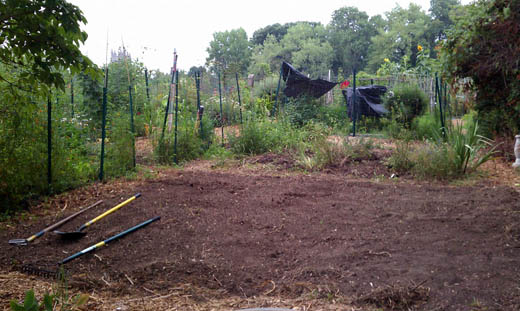
Two weeks ago, I inherited a local garden plot. Although abandoned by humanity, this desperate parody of circumcrescence was dearly beloved of weeds, roots, seashells, rotten bamboo, and countless plastic shards. The very sight, especially so late in the summer, was dispiriting; even Gerard Manley Hopkins might have let fly a guilty dream or two about the glorious symmetry of the lawnmower.

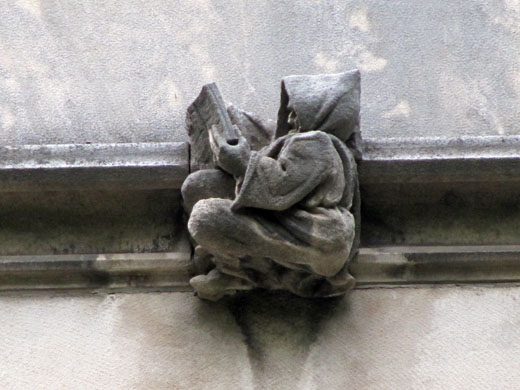
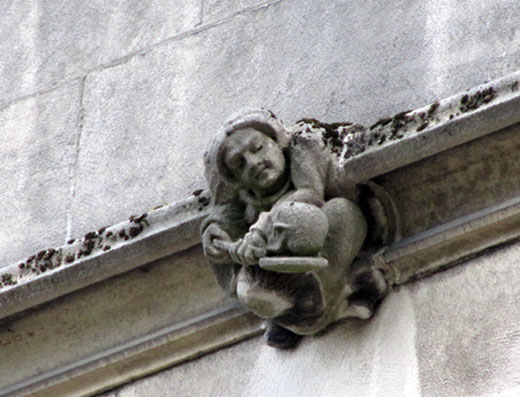
So I turned for inspiration to Walahfrid Strabo, the 9th-century abbot and scholar memorialized at the National Cathedral garden (and remembered there by at least one gargoyle). In De Cultura Hortorum, his famous gardening poem, Walahfrid recounts the nettled disaster he faces each spring, then calmly resolves to tame it:

So I put it off no longer. I set to with my mattock
And dug up the sluggish ground. From their embraces
I tore those nettles though they grew and grew again,
I destroyed the tunnels of the moles that haunt dark places,
And back to the realms of light I summoned the worms.
(trans. Raef Payne)

And so, ten days ago, buoyed by the spirit of Walahfrid, I set about turning this…

…into this.

In his little garden, Walahfrid raised bountiful herbs alongside vegetables, flowers, and fruit. While cautioning that hard work trumps book-learning in these sorts of labors, he offers, across twelve centuries, a mote of hope:

If you do not let laziness clog
Your labor, if you do not insult with misguided efforts
The gardener’s multifarious wealth, and if you do not
Refuse to harden or dirty your hands in the open air
Or to spread whole baskets of dung on the sun-parched soil—
Then, you may rest assured, your soil will not fail you.

We’ll soon see if this modern hortulus can bring forth plants that a sensible human will want to smell, admire, or eat. If so, I’ll be thankful for Walahfrid, and grateful, too, for the promise of applied medievalism.

“….and it’s true, if all this around us is paradise.”

“Excuse me, sir?”

He’s probably ten, but he’s small for his age. His purple ball has rolled into unbusy State Street, and while he’s forbidden to step off the curb, apparently he is allowed to talk to strangers.

“Can you please throw me that ball?”

I do. He’s polite enough not to tell me I’m a strange sight on a Sunday afternoon. Subdued salsa from Puerto Rican cookouts drowns out the car noise. People are chatting; it’s too hot to dance.

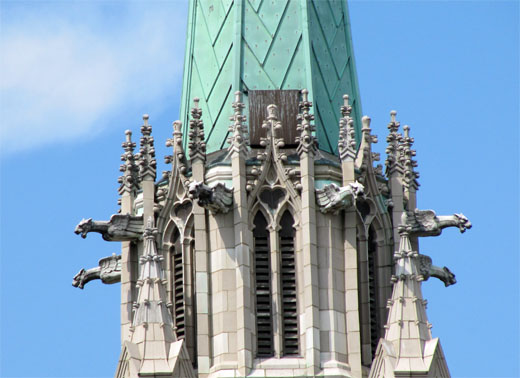
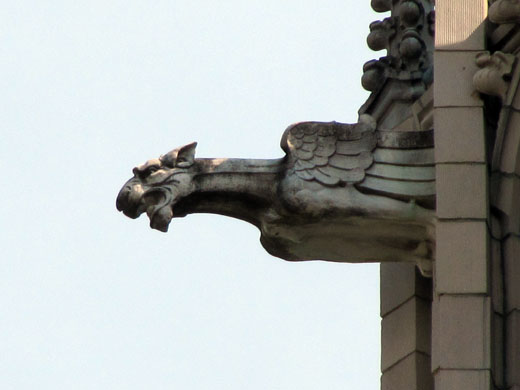
“Takin’ pictures, huh?” He holds his ball under one arm and glances at the sky. “You know what would make a good picture? Those gargoyles up there. They’re awesome.”

He’s right. They see everything in Perth Amboy.

Built in 1919 by and for the Polish Catholics of Perth Amboy, St. Stephen’s Church is a fine example of American neo-Gothic, but despite its intricacy, it’s bereft of grotesques—except for the huge faux-gargoyles below the spire.

Weirdly, I can’t find any public information about the architect, but whoever he was, he didn’t Americanize this church, nor did he grant its parishoners (who still run a Polish CCD) a speck of Slavic idiom. No, the mind behind St. Stephen’s adored Western Europe; those gargoyles would be right at home on a cathedral like Bayeux.

Though these gargoyles seem like relics of the city’s better days, prosperity alone doesn’t explain them. In the late 19th and early 20th centuries, when neo-Gothic building was rampant, Perth Amboy was a gargoyle breeding ground. A local abundance of rich clay here and in nearby Woodbridge and New Brunswick meant that Perth Amboy firms like A. Hall and Sons (later the Perth Amboy Terra Cotta Company, later Atlantic Terra Cotta) made grotesques and ornamentation for buildings across the United States, providing decorations for the Woolworth Building, exterior details for the Philadelphia Museum of Art, and the entire roof of the U.S. Supreme Court.

So whose idea were the gargoyles of St. Stephen’s? A 1906 Architectural Record article shows similarly slender beasties made by the Perth Amboy Terra Cotta Company on the first City College of New York building, a neo-Gothic landmark by architect George B. Post.

Then again, Charles Follen McKim of the legendary firm McKim, Mead, and White had attended school in Perth Amboy, and he partnered with the Perth Amboy Terra Cotta Company to make multicolored brick when brownstone and red brick fell out of fashion. It’s tempting to see St. Stephen’s as a “forgotten” work by MM&W or one of the many architects associated with them, but then what if it’s a great Gothic sob by the fanatically medievalist church designer Ralph Adams Cram? Or maybe it’s a monument to the faith of an architect no one has thought to remember.

I asked the folks at St. Stephen’s if they know who built their church; I’ve yet to hear back. Regardless, I’ll bet that like the kid who pointed them out to me, the gargoyles of Perth Amboy were locally born—a hundred years distant, but raised in an age that perceives the medieval wherever you look.

“…all the best freaks are here, please stop staring at me…”

Lately, people point me to gargoylish doings wherever I go—including my home state. While rushing across Princeton last week, I learned that since the university’s guide to gargoyles (grotesques, to be accurate) is far from complete, hunting for neo-Gothic doodads still leads to charming surprises.

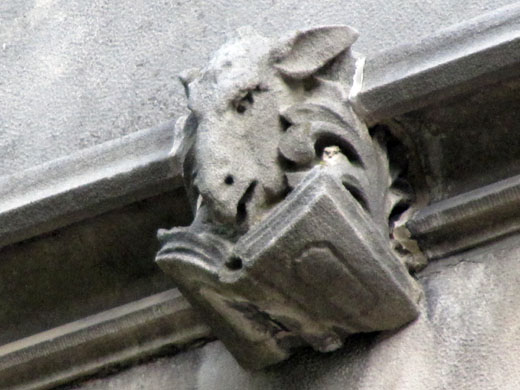
At McCosh Hall, I might have missed this erudite goat.

Or this monk. (“Prends moi—je suis a toi—mea culpa!”)

Or this macabre baker making Taylor ham the traditional way.

On 1879 Hall (built in 1904), monsters howl silent o’er summer lawns…

…monkeys tear apart a human face…

…and despite what a few lines of poetry claim…


…those “unseen things” may be studying you.

“Now half the world hates the other half…”

Here in D.C., soggy July makes gargoyles all fall silent—but let these links from clever humans kindle your conditioned air.

“365 Sonnets” chronicles “a Canadian teenager’s love affair with iambic poetry.” He’s up to #363. (Hat tip: Steven.)

“You’re the top / You’re Michele Obama…” Dylan at The Crystal Tambourine drags Cole Porter into 2011.

Dylan also rewrites pop songs in the voices of famous poets, asking questions dear to my heart, such as: How would Smiths lyrics sound from the pen of Gerard Manley Hopkins?

For years, I’ve read and linked to the blog of writer and historical reenactor Will McLean without knowing he was the fellow whose cartoons added vital levity to the first Dungeons & Dragons books. (“Papers & Paychecks,” anyone?)

At Open Letters Monthly, Steve Donoghue reviews a new book, The Last Vikings.

Also at OLM, Rohan Maitzen finds the voice of I, Claudius “very nearly without anything identifiable as a personal style.”

The Book Haven marks the “Orwell Watch” with several sad cliches.

As a Linguist listens to the Breton language.

Ephemeral New York sees a face over West 15th.

Hats & Rabbits ponders technology and life’s little (and not-so-little) tradeoffs.

Steve Mulhberger posts “tear-gas poems” from the streets of Egypt.

Jake Seliger thinks about Harry Potter and sophistication.

James Gurney asks: Do Parrish paintings boost your melatonin?

Ductor possum ad extremum tolerare! On Facebook, Julius Caesar kicks off his 2012 presidential campaign.

“I need him now to meet me face to face…”

From April to June, a local thief took advantage of dawn twilight to help himself to flowers from private yards, community gardens, and the cathedral grounds. In mid-June, the police nabbed him, and although he wasn’t arrested, his crime spree witheredbut not before a gargoyle on the north nave barked a bit of doggerel.

NOTEBOOK: FRAGMENTS FOR A FLOWER THIEF

They paced the plot for hours, as mothers would,
But understood: “His arms were full of flowers.”

      * * *

CHORUS
  The cruelest month: a cusp’d cliché
  That pricks the wisp of guilty May
  And breeds the thief of blameless June.
   Summer, unsurprise us soon.

      * * *

“In April it was lilacs.” (Listen how
she hates to blame the deer.) “Hydrangeas now!
Four times this spring.” (Of course it could be deer.)
My peonies at least were spared this year.

      * * *

The Lilack speaketh late of early Love.
The bolder Peon prospereth a-red.
The Seede abundant unifies the Figge.
We love thee numb, O Koriandrum, come—
Fragaria, redeem the injur’d Maid.

      * * *

“He sold us flowers first a year ago.
We called him—Shantih?” Shantih does not know.

      * * *

We conquer by the weapons we desert.
By dawn the dogs will bound ahead to find
The efflorescent errand you resigned,
The arrow shafts unwagoned in the dirt.

(For all the entries in this series, hit the “looking up” tab, or read the gargoyle FAQ.)

“I stand for motherhood, America, and a hot lunch for orphans…”

Here in the U.S., Fourth of July weekend is winding quietly down. While we groan over leftovers, sweep up carbonized fuses, and sew our blown-off fingers back on, here’s a sparkling assortment of links at once literary and linguistic, poetic and pontificatory, academic and amateur, medievalist and modern. Light ’em up and enjoy.

As a Linguist wonders where common nautical terms come from and ponders the literal meaning of freedom at Normandy Beach.

At University Diaries, Margaret Soltan marked Independence Day by discussing her Righthaven lawsuit.

At the always-eloquent Hats & Rabbits, Chris rides a roller coaster arabesque.

The Cranky Professor shows you how the Transformers are helping renovate the duomo in Milan.

Open Letters Monthly finds a secret magic library in New York.

The Washington Independent Review interviews “Professor X,” author of In the Basement of the Ivory Tower.

Monstrous Beauty spotlights a reliquary for St. Thomas Becket.

My fantasy-writing friend Anna Tambour charts a parrot confidence course.

Classical Bookworm discovers a forgotten Hungarian polyglot. Sixteen languages?

At A Momentary Taste, Stephen is in summer-reading mode with Gil’s All Fright Diner.

Prof Mondo reads Gardner’s On Moral Fiction in light of young-adult lit.

First Known When Lost reads Edwin Muir’s poem “The Interrogation” and thinks things got good when Philip Larkin looked into Thomas Hardy.

The New York Times tells Gothamites: Read Cavafy!

“I can’t see you, but I know you’re here”: Ephemeral New York finds the sad cemetery angels of Brooklyn.

He’s not really “the last of the rhyming poets,” but here’s a nice profile of Richard Wilbur.

Some say Jack Kent was the best cartoonist and children’s book illustrator you’ve forgotten.

I love the sonnets of Edna St. Vincent Millay, but the fellow who loved Millay herself wrote poems worth reading as well.

Fly, my pixelated minion! In the 1980s, who among the Colecovision set didn’t long to master “George Plimpton’s Video Falconry”?

“Sie haben uns ein Denkmal gebaut…”

Known as “the administrator,” this gargoyle hangs just to the side of the cathedral’s west façade and grips a miniature of the façade of the school he faces. After all this time, he argues in admirably good faith.

FAÇADE

Behold the form: We found our faith in spires.
From balustrade to buttress, by design
We build upon the base of our desires.
The ape of human order we divine,
And carved creation lightly gives us praise.
On day and eve, proportion we impose:
The perfect sun sets perfectly ablaze
A thousand perfect petals on the rose;
An arch constrains the brunt of outward pride.
One hymn we hue: “Ennobling words are dear
In thee, all sacramental modes preside
In thee”
       as from the fading close I hear
a thing to tempt us out of rite and rhyme,
       a sole cicada singing out of time.

(For all the entries in this series, hit the “looking up” tab, or read the gargoyle FAQ.)