“Those words are all remainders…”

“Sometimes I sleep,” Alcuin wrote to Charlemagne shortly before his imperial coronation. “Sometimes,” he confessed, “it’s not for days.” Plagued by visitors to the shrine of St. Martin, the abbot of Tours wrote wistfully about the transience of earthly pilgrimage. “The people I meet,” he noted, “always go their separate ways.”

Alcuin was a busy man, as am I this week—but not so busy that I can’t offer you these neat literary links.

Cynthia Haven has the latest Robert Conquest poem fresh from the poet’s own hand.

Ferule and Fescue reviews the movie Agora and wonders why it’s hard to dramatize the “life of the mind” on film.

John Scalzi tells would-be writers: “Find the time or don’t.”

The folks at Open Letters Monthly review all ten books on the New York Times bestseller list. They also ask: “Does Gone with the Wind hold up as a book?”

Four thousand emails? Big-timey YA fantasy novelist Maggie Stiefvater describes a day in the life of an author.

Adam Golaski (the poet behind the terrific, quirky translation “Green”) peruses a new anthology, Werewolves and Shapeshifters.

Here’s something you don’t see every day, unless you have John Keats below your stairs: a call for ekphrastic poetry.

Learn how a ghazal works by reading one: John Hollander’s “Ghazal on Ghazals.”

Jake Seliger sees good advice for writers in Tony Bourdain’s thoughts on becoming a chef.

Classical Bookworm digs into the world of French dictionary publishers.

Bill Peschel remembers Jean Shepherd (of A Christmas Story fame) and his greatest literary hoax.

PeteLit winds down his “summer of classics.”

Julie K. Rose has posted two new short stories, one of them intriguingly titled “Treatise on the Efficient Cause of the Ebb and Flow.”

Bibliophile Bullpen (the post is from 2007, but it’s new to me) visits a bookstore I remember fondly, and with a bit of heartache: the incredible Old Number Six Book Depot in Henniker, New Hampshire.

Finally, on a dignified note: a video of Alfalfa from “The Little Rascals” singing Joyce Kilmer’s “Trees.”

“Out in the garden, there’s half of a heaven…”

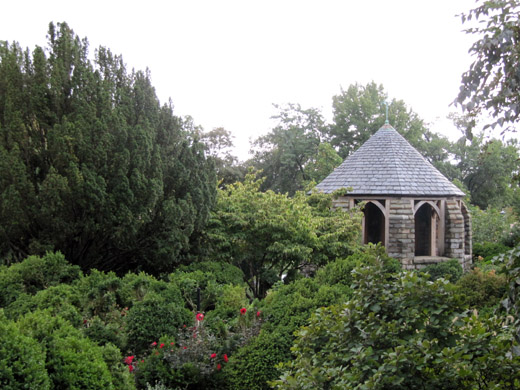
From his perch on the south nave, this avian gardener overlooks the Bishop’s Garden and the nearby woods, but clearly he takes a much longer view. He’ll tell you all about it if you ask him.

SUKKOT

I think that you shall never see
The garden fall when palmers flee.
The scales of summer groan and tilt;
The mite, the moth, the rain-dove wilt,
The hunchneck roses moan with thirst,
The medlar skullfruit split and burst,
But through the leafmeal, long asleep,
The eldritch from the wanwood creep,
Their twilight pastors freely led
By silkwaist suitors stirred from bed.
Their belts of straw and ivy buds
With coral clasps and amber studs
Give way to frond, and myrtle shoot,
And willow leaf, and brightripe fruit.
Through temples roiled by root and vine
They pass to pray, and so divine
Why revels must in autumn reign,
Why pilgrims pirouette in vain,
Why laggards must rehearse at last
The doom of some ecclesiast:
“The flowers do fade, and wanton fields
To wayward winter reckoning yields…”
So pinelights drift, like snows to come,
And mumbling lowly, shuffling numb,
They burrow into bowers veiled:
“Our fadelight feast again is failed.”
But seek no truth from sullen tree;
Recurrence clouds the memory.
We plait our laurels, fools by choice,
But only G-d can cry Rejoice.


(For all the entries in this series, hit the “looking up” tab.)

“Champagne corks are firing at the sun, again….”

Chaucer’s second and third Canterbury Tales are so full of sex that it’s easy to forget they’re specifically tales of college towns. The Miller spins a fabliau about an old Oxford carpenter and the guys who chase his hot young wife. The Reeve, a carpenter, snaps back with the story of a crooked miller from just outside Cambridge. Their bawdy back-and-forth is, I think, one of the earliest literary traces of the Oxford-Cambridge rivalry, a medieval squabble that landed yesterday, with it own Chaucerian flourish, on the banks of the Potomac.

When I shambled into D.C. many years ago, I crashed on the couch of a great friend who’s now the president of the Cambridge Society of Washington, D.C. Inspired by the annual Boat Race on the Thames, he and the Society convinced local Oxford alumni to adapt an Oxbridge tradition and revive a Washington one. According to local lore, the first Cambridge-Oxford boat race on the Potomac arose in 1985 as a challenge between Secretary of the Navy John F. Lehman, Jr. (who holds a B.A. and an M.A. from Gonville and Caius College, Cambridge) and Senator Larry Pressler (who attended St. Edmund Hall, Oxford, as a Rhodes Scholar). In the 1990s, the race grew into a multi-university regatta with 35,000 spectators, corporate sponsorship, and charitable causes. By 2000, the event was kaput.

Ah, but the past was merely General Prologue—because yesterday, latter-day proxies of the Miller and the Reeve schlepped to the Georgetown waterfront, the hooly blisful boatrace for to seke. Putting boats in the water, they battled not merely for glory but also for the Cambridge-Oxford Potomac Boat Race Trophy, a blindingly sumptuous goblet that will be forever hailed in story and song as “the Cup of Destiny.”

Behold, spectators and supporters began to gather within sight of the Watergate and the KenCen…

…as the “Quid Plura?” kobolds, half-stunned by the blazing sun, scrambled to take photos.

The women raced first, with Cambridge squeaking out a win over Oxford. Then the men raced, with Oxford…

…roundly out-rowing Cambridge, a defeat witnessed by bemused recreational boaters.

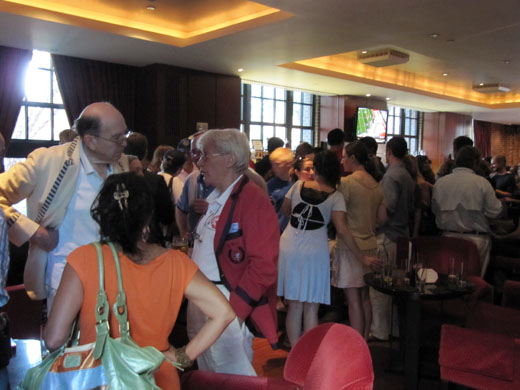
Alumni of both universities and their family and friends then adjourned to the Ritz-Carlton to convert each minute of boat racing into an hour of alcohol consumption.

“Quid Plura?” thanks the Cambridge Society for the invitation to hang out with a fun crowd and stretch a weak premise for a blog entry about medievalism into an excuse to drink on a hot afternoon, even if no one was overheard speaking Middle English.

“Na na na na na na, make my mind up for me…”

When I was 20 years old and no paragon of intellectual maturity, I drew a weekly comic strip for my university paper. The strip had its smarter moments, but more often it served as a vehicle for what I deluded myself into believing was provocation. I advocated seal clubbing, and I called for all campus disputes, however minor, to be settled with firearms. I graduated no longer convinced that most cartoonists are brave tellers of truth, because honestly, nobody cared. My biggest critic was a jerk who called me at home to tell me I’d misstated the number of people in the Rolling Stones. He called me “buddy,” in the snidest possible way.

One strip did cause a problem. A single panel depicted a haloed, self-satisfied Jesus handing Mary a souvenir. It read: “My Son Went to Hell and All I Got Was This Lousy T-Shirt.” When I asked a Christian friend if he thought the comic was appropriate for Easter week, he shot me a look of deep parental disappointment. He also let it pass.

The editor-in-chief of the newspaper did not. Because his letters page had recently hosted a contentious debate about religion, he told me he planned to end the discussion of religion in the newspaper for a while. Therefore, any depiction of Jesus on the comics page was out. “But I don’t want you to be Bil Keane,” he assured me. “I want you to be edgy!”—a weirdly confident lie from a young man holding his first position of authority. We spoke by phone for an hour. When we were done, he confessed that he didn’t understand my comic anyway.

Citing time constraints, I declined to draw a replacement. That week, the newspaper ran 20 square inches of blank space. A year later, I left cartooning behind. The editor-in-chief joined the New York Times. I didn’t really know him, but Google tells me he’s still climbing the career ladder at the paper while teaching journalism nearby.

These days, I have zero interest in provoking or offending, and I find most attempts to tweak the religious to be lazy at best. Even so, my cartoonist years seemed all the more idyllic when I read this morning, with horror and nausea, that Molly Norris of the Seattle Weekly has ceased to exist:

The talented cartoonist who launched the “Everybody Draw Mohammed Day” on Facebook, and then regretted and withdrew her proposal, has nevertheless had to go into hiding — moving, changing her name, washing out her identity — at the suggestion of the FBI.  It’s just like the witness protection program.  The government, however, will not be picking up the tab.  She will.

Norris viewed the situation with characteristic humor: “When FBI agents, on a recent visit, instructed her to always keep watch for anyone following her, she responded, ‘Well, at least it’ll keep me from being so self-involved!’”

Some quick background: when someone on the “Revolution Muslim” Web site threatened to kill the South Park guys for a segment that included a depiction of Muhammad, Comedy Central caved, and Norris responded by drawing a cartoon. Someone other than Norris started an “‘Everybody Draw Muhammad’ Day” Facebook page based on her drawing, and she became the obvious target.

How permanent is Norris’s identity wipe? The Seattle Weekly explains:

She likens the situation to cancer—it might basically be nothing, it might be urgent and serious, it might go away and never return, or it might pop up again when she least expects it.

In my own speech, I choose reticence, but I take a very liberal position otherwise: As far as I’m concerned, if you’re breaking no other laws, then you can say whatever you want, draw whatever you want, and deface or defile anything that’s your own property, be it a flag, a holy symbol, an effigy, you name it. However, in return, I reserve the right to judge you, denounce you, lobby against you, tell others how wrong you are, and speak vociferously in reply. Speech invites consequences, and I’m open to arguments about responsible, voluntary limits. That said, I’ll always put threats and violence on the far side of that line, and I’ll never suggest that in a free society, an artist or writer was asking to be forced to erase herself from existence.

So yes, despite being a pretty inoffensive writer, I took the news about Molly Norris personally, just as I did in 2008 when I read that Sherry Jones’s publisher was firebombed. I’ve written a book in which Muslims guzzle wine, Jews own slaves, and Christians kill in the name of religion. While nothing about my take on the early Middle Ages is all that wild, what’s to stop some hateful, publicity-seeking pastor from hagriding me, or some Islamic fanatic from registering his disapproval via DaggerGram? If doodles can incite worldwide riots, how can I know that my 20-page depiction of a liberal, even libertine, Baghdad won’t light a madman’s fuse?

In a few days, Banned Books Week will roll back around. Writers and teachers and academics and librarians will wear “I read banned books!” buttons, trumpet the cause on blogs and Facebook, and assert their superiority to the withered River City shrews who object to the dandelion-sniffing scenes in Naked Came I. Like many religious practices, it’s a liturgy everyone recites but few really live. On the day a woman begins erasing herself—for how long, no one knows—for drawing pictures and writing words, the National Cartoonists Society is spotlighting Li’l Abner, while the day’s offerings on the Association of American Editorial Cartoonists website take inconsequential stands against Newt Gingrich, Barack Obama, Fidel Castro, and that dingus pastor in Florida.

And my former editor? He’s tweeting about a fabulous new café. We should totally go. We’ll call our book club and talk about the new Franzen novel. Big news: Oprah likes it! What’s it called again?


“Is this the age of the thunder and rage…”

Few medievalists grace the saints’ calendars of American churches, but it’s fitting that back-to-school week coincides with the feast day of Nikolaj Frederik Severin Grundtvig, observed annually on September 2 by the Evangelical Lutheran Church in America and on September 8 by the Episcopal Church in the United States. The Danish bishop and polymath is little known outside his home country, but he was a monumental figure there—and if you’ve read any edition or translation of Beowulf, then N.F.S. Grundtvig was partly responsible for getting it into your hands.

After Icelander Grímur Jónsson Thorkelín published the first printed edition of Beowulf (with the support of the Danish government) in 1815, Gruntvig was the most vocal scholar to point out the many errors in Thorkelin’s transcription and Latin translation, from misreadings of Old English words to Thorkelin’s failure to recognize proper names. Thorkelin, a twitchy careerist, responded by accusing Grundtvig of “sweet dreams, absurd fantasies, and willful distortions of the original and of my work within the Chaos that surrounds him,” but Grundtvig, the superior scholar, was right. Grundtvig was also the first to notice that the Hygelac of Beowulf was the historical figure Chochilaichus named by Gregory of Tours in his History of the Franks, and Grundtvig’s 1820 version of Beowulf in Danish was the first translation of the poem into any modern language.

Although Grundtvig was peeved to see the Danes exeunt two-thirds into Beowulf, he never stopped grappling with the poem, seeking not only its universal lessons within the context of his own faith but also clues to the Scandinavian past. “[T]he language,” he wrote, “is ingenuous, without having the German long-windedness, and without remaining obscure in its brevity as so often in the Eddic poems.” Inspired by Beowulf, Gruntvig became an Anglo-Saxonist while rising through the Lutheran church, studying theology and languages, agitating for Norwegian independence, becoming the father of Danish folk schools, dealing with censorship and fines and exile, marrying three times, briefly serving in the Danish Parliament, and somehow finding time to translate hundreds of hymns and write countless poems and books. (For all I know, he even invented Lego and provided the theological foundation for his nation’s wonderful open-faced sandwiches.)

Something of an Anglophile, Grundtvig practically begged the English to appreciate this work by their native poet, and the tone of his 1831 proposal for an Anglo-Saxon book subscription program will amuse any medievalist who’s been accused of cultivating obscure interests:

I know there are tastes, called classical, which will turn away in disgust when they are told that this poem consists of two fabulous adventures, not very artificially connected, except by the person of the hero,—and that these episodes, which relate to historical traditions of the North, are rather unskillfully inserted. But I think such classical scholars as have a squeamish repugnance to all Gothic productions, should remember that, when they settle themselves down in the little circle of the ancient world, they have banished themselves from the modern, and consequently have made their opinions on such a subject of very little importance.

“For all his faults of expression,” writes Tom Shippey, “Grundtvig read the poem more acutely and open-mindedly than any scholar for decades.” Even those of us who will never be honored with hymns could do worse than aspire to earn such an epitaph. Thanks to scholars like Grundtvig, not only do we better understand how and why the Anglo-Saxons wondered, as others have, “Ubi sunt qui ante nos fuerunt?,” but we can also start to answer the question ourselves.

“Because the sun still shines in the summertime…”

August has been a whirlwind; fortunately, plenty of people have been pleasantly prolific. The following links don’t always drink beer, but when they do, they prefer Dos Equis.

A Corner of Tenth-Century Europe hosts the latest Carnivalesque, and it’s chock full of medieval goodness.

Issue 13 of The Heroic Age is out, and it includes translations that first appeared as drafts on this blog.

A link courtesy of my mom: New Orleans is celebrating the 30th anniversary of A Confederacy of Dunces.

Jake Seliger (who has his own interesting collection of August links) pointed me to some thoughts about writers and envy.

If you’re interested in Scottish fantasist George MacDonald, then Jason Fisher has news you’ll like.

Ann Crispin at Writer Beware tells aspiring authors how to write a query letter.

Nicole at Bibliographing is reading Melville’s poetry.

Neil at Ducks and Drakes shares an anecdote about bugs, museums, and prejudice in Toronto.

Ephemeral New York highlights “the three gores of Brooklyn.”

August wanderlust got you down? Lost Fort takes you to Xanten.

The history of American illustration being a work in progress, Ian Schoenherr looks into whether Maxfield Parrish studied with Howard Pyle.

Prof Mondo pens an appreciation of the late Michael Been, bassist and vocalist for The Call.

Need some Finnish monster-themed retro metal? Course ya do.

Finally, here’s a 1968 BBC broadcast about The Lord of the Rings with Tolkien interview footage—and lots of very dated talking heads.

“Full moon, pass the window sideways…”

This cavewoman and her baby make for a vivid pair nearly 200 feet above the cathedral’s north lawn. She’s hard to see; the chip on her shoulder is hard to miss.

MEARCSTAPA

I’ve no gold cups       to catch your shrieks
And noises foul,       no nailing rock
Where cronish faces      fade, and matrons
Remoulded as maidens     mourn so gleefully
The babe whose face      they fouled with runes.
No—grear my mouth      and gray my eyes,
And shriv’ling hairs       in handfuls twine;
Time is a rot-wyrm       that riddles us through
And broods in its hole      upon our brighter days
But shares secrets       mere seeresses hide.
All this I owe you;      I own nothing more.
The work of the world      fathers wolfish brats,
But hold your ground.     Heroes will loathe you,
Knowing they need you,    lest no one forge
Prurient tales     from pride alone
Nor string a song    from strokeworn beards.
Behold how hall-thugs    hungry for butchery
Score rusty sword-tips     ’round scabs, hearing
Echoes of Caindom        in all but their own.
Rave when one belches      some rum-ram-ruf lay;
His bones will break.    Just bide your time.
Thole and thrive, son,    throughout dull days;
You’ve naught to fear.    Face them, beaming.
Swive or just sing with them.    Savor their smell.
Their bile, rising,     my boy, you’ll taste,
And soon you’ll crave     their crawling flesh,
And late you’ll drain     their draughts of blood,
And ere the dawn      their oaths they bleat,
Graying faces     greeting the morn
Will gape at your night-work,    noble heroes
Strangled, overthrown,     strawberry-flecked,
Sweet sentinels,     singers of tales,
Wyrd-graven warlords,    woebegone boys.
Peer from the tree line;    try not to gloat,
But make them hear you    howling your name.
All youth survives     in you alone,
So be for me     my bitter angel
Rightfully fated    to rage in the dark.
Motherly lore      will light the gloom:
Like candles touched      to torchwood pyre,
Mere men flicker;    monsters explode.


(For all the entries in this series, hit the “looking up” tab.)

“Couples loiter in the cloisters, social leeches…”

On an August afternoon when D.C. is balmy and the news is all nonsense, it’s a nice surprise to wander through the cathedral garden and find queen butterflies swyving.

“Sire Monk, namoore of this, so God yow blesse!
Youre tayle anoyeth al this compaignye.
Swich talkyng is nat worth a boterflye…”
Geoffrey Chaucer, Prologue to the Nun’s Priest’s Tale

“Boterflyes beþ smale fleynge bestes þat comeþ by night / in candeles and fondeþ to quenche þe light.”
— John Trevisa (c.1342-1402), trans., Bartholomaeus Anglicus’ De Proprietatibus Rerum (On the Properties of Things)

“And we’re glowing like the metal on the edge of a knife. Come on! Hold on tight!”
— Meat Loaf, c.1977

When queen butterflies mate, the male flies around with the female hanging beneath him. It’s quite a sight.

Even squirrels are impressed by that.

“Back to the rhythm that we all came from…”

It’s Friday, the D.C. skies are cloudy, but worthy links shine through the murk.

Someone has put the 1963 Caedmon LP of Murder in the Cathedral on YouTube. Performers include Paul Scofield, Cyril Cusack, and Glenda Jackson. The play has been broken into in 11 parts; the first part is here.

Also from YouTube: two-and-a-half minutes from a 1987 production of The Lady’s Not For Burning.

I’ve known the proprietress of Ephemeral New York for 20 years, so she had to know I’d enjoy this book-reading grotesque at City College, an angel on East 14th Street, and weird carvings on Madison Avenue.

At Ferule and Fescue, consider “Facebook, savior of democracy!”

Books, Inq., ponders age and forgetfulness. 

How do you plot a novel? Jake Seliger has some thoughts.

Prof Mondo remembers the literary exploits of Freddy the Pig.

Lynnspace seeks to bend your mind with cows.

If you’re not following Julius Caesar on Twitter, hora venit, et nunc est.

You know what’s good on a humid Friday? Long-forgotten ’80s anthems. Here’s “Voices of Babylon.”