“Feathered, look, they’re covered in a bright elation…”

Too few Washingtonians have hobbies; for many people here, cultivating a career is apparently amusement enough. Fortunately, I sometimes encounter locals—like this fellow on the west front of the cathedral—who enjoy a pastime I’d never really thought much about, and I like when they explain its appeal in terms I can understand.

A SIMPLE DESULTORY PROSOPOPOEIA
(or, HOW I WAS RICHARD WAGNER’D INTO TRADITION)

“I do not think that they will sing to me”:
Impulsive mermaids drown in shallow words.
Await no witless warbling by the sea;
Rather, seek the songs of simple birds.
From perch and peak they twitter truths profound:
A woodbird stirs the Volsung in his blood;
A parliament of eagles circles ’round;
A curlew chills the farer on the flood.
The cuckoo croaks that sumer is icumen;
“Keep well thy tongue!” confesses Chaucer’s crow;
The nightingale her owl will merr’ly summon;
Despite their flyte, one insight they bestow:
Be still, but heed the rustle of a wing;
A legendary pigeon waits to sing.


(For all the entries in this series, hit the “looking up” tag.)

“So many shots fired, so many daggers thrown…”

Seven years ago, I stepped into a musty workshop in the Balkans and faced the glares of a thousand ancient Serbs. They leaned against walls and rested sideways in racks; a few were upside down. All around, drawn from every corner of the late Yugoslavia, the silent icons were burned, torn, drenched, or devoured by mold. They had been sent to this office for safe keeping—and to await the conservation and restoration that the Serbs may never have the funds or personnel to finish. An eerie sense of patience pervaded the place; in the Balkans, a thousand-year art project is the least reason for despair.

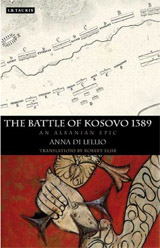
So as someone whose only friends in the Balkans hail from Serbia and Montenegro, I approached the publication of The Battle of Kosovo 1389: An Albanian Epic with caution. For a decade, I’ve taught the Serbian epic cycle about the Battle of Kosovo as a case study in medievalism that fosters the worst sort of nationalism and as one of the best examples of Balkan epic poetry, but I’d never heard of the Albanian take on the Serbs’ sacred story. Published only a year after Kosovo declared its independence, this book was bound to be sensitive; some condemned it as “science fiction” and sent its editor hate mail.

I suspect the angriest critics didn’t actually read the book, which turns out to be a relatively mild collection of eight poems about episodes tangential to the Battle of Kosovo. All but one of the poems were recorded between 1923 and 1955, each is presented in a facing-page translation by Robert Elsie, and the entire volume is introduced by Anna Di Lellio with a placid and decidedly un-Balkan ambivalence.

Most of the Albanian Kosovo variants tell the same basic story: The pious Sultan Murat has a prophetic dream. His seers interpret it, his mother weighs in, and soon the sultan sets off to conquer Kosovo. Like Moses, he prays to God to part the seas, and then he invades the Balkans. When a hungry soldier breaks the fast, the war goes badly, but after the sultan dismisses his less committed troops, his fortunes improve—until he is assassinated by Milosh Kopiliq, an Albanian Christian who picks up his own noggin and strolls away after the sultan’s men behead him.

Readers who know the Serbian poems about the Battle of Kosovo will be startled to see Miloš Obilić, a saint of the Serbian Orthodox Church, presented as an Albanian assassin, a variation that explains why Amazon reviewers have given the book one star if they’re pro-Serb and five stars if they’re pro-Albanian. In the Serbian texts, Miloš is a captain in the army of Serbian Prince Lazar. At the last supper before the ill-fated battle, Lazar unsettles him with a terrible prophecy:

Hail, Cousin! friend of mine and traitor!
First of all my friend—but finally my betrayer.
Tomorrow you’ll betray me on the field of Kosovo,
Escaping to the Turkish Sultan, Murad!
So to your health, dear Milosh, drink it up,
And keep the golden goblet to remember Lazarus.

Miloš does cross over to the Turkish side, but only to assassinate the sultan. Lazar is captured and beheaded. The Serbs are defeated, but their martyrdom wins them the “heavenly Serbia” promised by God—and a longing to reclaim Kosovo that haunted their descendants well into the 21st century.

The transformation of Miloš Obilić, Serb saint and patriot, into Milosh Kopiliq, Albanian Christian, may seem strange coming from the mostly-Muslim Albanians of Kosovo, but Di Lellio explains that a multifaceted Miloš represents an old debate: The Albanians claim ancient descent from the Illyrians, while the Serbs assert that they wandered into the Balkans more recently. Oddly, the existence of Milosh Kopiliq is, Di Lellio says, less a statement of division than a claim to brotherhood. Through Milosh, the Albanians are insisting that their ancestors fought and died alongside Serbs—and that Albanians have deep roots in Christian Europe.

Fortunately, despite a misleading subtitle that promises a far more inflammatory book, The Battle of Kosovo 1389: An Albanian Epic is not a propaganda pamphlet. In her 48-page introduction, Di Lellio carefully shows that the Albanians come by their assassin honestly, with a wealth of place-names near the village of Kopiliq attesting to centuries of belief in Milosh’s local roots. Still, Di Lellio leaps to no conclusions; she contrasts Albanian oral history with an overview of the development of Miloš Obilić in Serbian historiography, and she looks beyond the Balkans at a Catalan tradition that makes Milosh Hungarian. She also raises the possibility of etymological confusion based on the word kopil, which means “trickster” or “bastard.” The Albanian Milosh certainly is that: He gets close to Sultan Murat under false pretenses, he cracks jokes after being beheaded, and (in one 1955 variant) he uses magic to makes the eyeballs of two gawking maidens leap from their sockets.

Few scholars who lay a hand on Balkan folklore are objective. Di Lellio worked in Kosovo for the United Nations, and in 2006 she edited The Case for Kosova: Passage to Independence. This collection of texts was also published with the cooperation of the Centre for Albanian Studies, a reputable organization that nonetheless must have an opinion or two about the uses of history and legend. That said, The Battle of Kosovo 1389: An Albanian Epic was clearly published in good faith. Contrary to the claims of their critics, Di Lellio and translator Robert Elsie aren’t inventing the Milosh Kopiliq tradition; rather, the variants in this book were all recorded and published decades earlier by ethnographers and folklorists. (Students of medieval English literature will see a familiar name at the end of a 1937 variant: Albert Lord, whose theories about oral-formulaic poetry were picked up by Anglo-Saxonists.) Only one tale in this volume, a 32-line poem recorded in 1998, feels both too recent and too fond of its own historical awareness as it shows the decapitated Milosh Kopiliq striding into legend:

Mountain birds do chirp and wonder
Who is climbing up that hillside?
Headless now proceeds that body,
White with snow now turns the mountain.

Although these poets use Milosh to argue that Albanians are innately European, Di Lellio writes with detectable unease about official textbooks that treat the shadowy Milosh as an historical figure; refraining from overt judgments, she documents how Albanians have come to see themselves. “It is in this context,” she writes, “that I place the stories about Kopiliq, as I try to rescue them from turning into a new prison for collective memory.” With care, she catalogs “a unique production and diffusion of historical memory” since the end of the Balkan wars shaped by “war veterans, former political prisoners, journalists, teachers, politicians, and historians, engaged in owning and rewriting the past,” and no consensus emerges:

Interviews with a range of individuals, from intellectuals to political activists or ordinary people, confirm that Millosh Kopiliq occupies a contested place in Albanian historical consciousness. For some, the issue is a non-starter, a concern that remains confined to naïve nationalist circles. For many others, an Albanian Kopiliq is an undisputed fact: he was always “one of us,” just not always publicly.

If the unsettled yet minor role of Milosh Kopiliq in the Albanian national story makes him an ineffective foot soldier for propaganda, then the stories in this slim volume are also unlikely to eclipse the fame of the Serbian Kosovo epic. Even in its most witty variants, the legend of Milosh Kopiliq isn’t very engaging; the fact that an Albanian Kopiliq exists is itself far more interesting than the actual details of his brief, formulaic adventures.

Compared to the Kopiliq variants, the Serbian poems about the Battle of Kosovo are a far richer read. Their historicity is debatable, and they hold an unsavory place in the nationalist arsenal, but they’re also imbued with a sense of tragedy and loss that overshadows the tale of a single tricky assassin. I’ll continue to teach the Serbian epic in class, but I’ll also mention the Albanian poems for the way they highlight the Balkans’ baffling cultural churn. I’ll also be glad that a Serbian publisher has expressed interest in a translation of this book. Perhaps waiting for former countrymen to find amusement in each other’s cherished legends doesn’t need to become another of the region’s many thousand-year projects.


“Twisting like a flame in a slow dance, baby…”

Although no less a folklorist than Kermit the Frog wondered why there were so many songs about rainbows, someone once pointed out to me that there aren’t many songs about rainbows, really. Off the top of my head, I know only one or two others; few people can name many more. Such is also the case with volcanoes in medieval Icelandic literature: Given the relative size of the corpus, you expect to find far more of them than you actually do.

Norse myths smolder with the threat of fiery doom. According to historian Oren Falk, the great Sigurd Nordal perceived enough lava-flecked glimmers in the prophetic poem “Völuspá” to see in its portrayal of Ragnarok “a distinctively Icelandic apocalypse.” Falk also finds mountain-bound giants in the 12th-century poem “Hallmundarkviða” who watch as “glaciers blaze . . . coal-black crags burst; the curse of wood [that is, fire] unleashes storms; a marvellous mud begins to flow from the ground.” So where there’s lava there’s volcanoes, right?

Nope—these distant poetic wisps vanish when scholars get too close. Falk spots only four anecdotes in Landnámabók, the Icelandic Book of Settlements, that hint at medieval Icelanders’ perception of volcanic activity. He scours the late medieval Bishops’ Sagas and finds only two mentions of volcanic eruptions, while “[t]he entire corpus of Family Sagas, thirteen thick volumes’-worth in the standard modern editions, seems to know nothing of lava and ash plumes.”

Even if Icelanders didn’t work many volcanoes into their poems and sagas, the medieval world nonetheless responds with a low, subterranean rumble every time a flustered news anchor tries to say “Eyjafjallajökull.” Its name may look weird, and its proper pronunciation baffles the non-Icelandic ear, but as a simmering reminder of the relationships between Germanic languages, this billowing Aschenwolke of a word is very nearly English.

The first element of “Eyjafjallajökull” is familiar to English speakers as the suffix -ey. You see it in place-names like Orkney and Jersey, and it’s the related Old English ieg that gives us the first syllable of its modern descendant, “island.” (Eyja was the Old Icelandic genitive plural.)

The second element, fjalla, has mostly disappeared from English, but the OED points out that you can see it in northwestern England at Bowfell and Scawfell—the names of hills.

Jökull, the Icelandic word for “glacier,” is the diminutive of jaki, “broken piece of ice,” and had a cognate in Old English, gicel. When Anglo-Saxon scribes needed a homegrown equivalent for Latin stiria, they translated it as ises gicel. The original word became ikyl or ikel in Middle English, and you can still see it frozen in time at the end a modern noun that fuses all of these pieces: “icicle.”

Jóhann Sigurjónsson, one of the first Icelandic poets to write blank verse, foresaw an apocalypse both personal and cosmic in which jóreykur lífsins þyrlast til himna, “the steeds of life swirl their smoke to the skies.” The plume of the “island-mountains glacier” will eventually dissipate, but even if we can’t now see the volcanoes, we can at least watch the ash settle into craggy, unexpected places, and patiently look for the relevant words.

“It’s based on a novel by a man named Lear…”

Mirabile visu: Modern technology comes to “Quid Plura”!

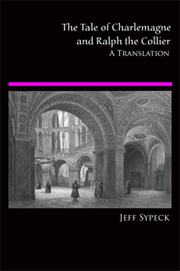
You can now use a spiffy pulldown menu to buy a paperback copy of The Tale of Charlemagne and Ralph the Collier (here or on the original post) with either your credit card or your Paypal account.

It’s so easy, a Lombard could do it.

Just specify your location, hit “Buy Now,” and order a copy of what Charlemagne surely would have called “an engaging translation of the only chivalric romance where I totally get slapped in the face,” had the Frankish king spoken colloquial modern English and not been above providing marginally humiliating book endorsements.

Select a shipping option:
Book + shipping within U.S. $12.50 Book + shipping to Canada or Mexico $14.50 Book + shipping outside North America $16.50


This translation, which mingles folklore, chivalry, and burlesque humor in a riot of alliteration and rhyme, should appeal to fans of medieval literature, readers who get a kick out of formal narrative poetry, and those of you who come here for the gargoyles. By buying a copy of this literary oddity, you’ll be helping keep “Quid Plura?” afloat while also letting me know there’s a readership for future translations of lesser-known medieval tales.

For more information about The Tale of Charlemagne and Ralph the Collier (including a PDF preview), check out the original post from January. To order a Kindle copy, proceed post-haste to Amazon. And thanks, as always, for your eyeballs, which make this whole medievalist undertaking entirely worthwhile.

“I thought it was confetti in our hair…”

Like all clouds, the cherry blossoms bring their own sort of storm. Their petals swirl on the sidewalks, they mingle in your hair, they fall among the tulips that spring like rested children from their beds. Smacked with the sweat and smells of premature summer, Washingtonians don’t notice, behind the blossoms and buds, the hardy, faithful lavender, the modest source of a half-forgotten nursery rhyme:

Lavender’s blue, dilly dilly, lavender’s green,
When I am king, dilly dilly, you shall be queen.
Who told you so, dilly dilly, who told you so?
‘Twas my own heart, dilly dilly, that told me so.

Maybe you know this song. Burl Ives popularized it in 1948, and Sammy Turner and Gene Vincent covered it, too. The Jackson Five gave it a Motown spin, Lloyd Robinson made it Jamaican, and in 1985 Marillion reimagined it as the love song a drunk, regretful poet dearly wished he had written. Many lovely amateur versions hark back to Ives, but “Lavender Blue” predates the modern hit parade. On hot spring days, the song might almost be medieval.

The oldest recorded version of “Lavender Blue” is “Diddle Diddle, or, The Kind Country Lovers,” a ballad that dates to the 17th century:

Lavender’s green, diddle diddle, lavender’s blue
You must love me, diddle diddle, ’cause I love you.
I heard one say, diddle diddle, since I came hither,
That you and I, diddle diddle, must wed together.

You can see for yourself that it does goes on, with eight additional verses that focus far more on sly young rustics all a-diddle than on the whole lavender business. Still, it’s charming, and maybe revealing, that later versions so fondly return to the line about lavender, even when singers smile and pass it off as a bit of nonsense, since it may point to the deeper roots of the song itself.

According to the OED, “lavender” as a word to describe a color—specifically, the color of the plant—goes back only to 1882, and “lavender” as a verb meaning “to perfume with lavender” pops up in 1820. In English, the plant name Lavandula dates to 1265, plucked from medieval Latin as a corrupt form of a diminutive rooted in a Latin term connoting things to be washed, and hinting (in ways the OED declares “obscure”) at associations with perfumed baths and freshly washed linen. Thus do the modern English words “launder” and “laundry” tumble forth.

More definitively, the 14th century gave us lauendere, the Middle English term for a washerwoman, as in this nugget from the Harley Lyrics:

prude wes my plowe fere
lecherie my lauendere

And here’s Chaucer, from the F-text of the prologue to The Legend of Good Women:

Envie ys lavendere of the court alway,
For she ne parteth, neither nyght ne day

So did “Lavender Blue” grow out of a medieval ode to a washerwoman amused by the prospect of a royal life with her rustic “king”? Is it a later tribute, knowing or half-knowing, to the roots of the word itself? No academic paper is forthcoming; these questions are simply the fancy of a sunstruck medievalist who suspects that an inscrutable mention of lavender in a ballad about “kind country lovers” wasn’t always meaningless.

One further usage from around 1300 gives us a dash or two more: a reference to the seizure of the chattels of fugitive “Johannis le lavendere”  to remind us that there were washermen as well. Appropriately, modern versions of “Lavender Blue” give the “queen” a chance to pipe up on equal terms:

I love to dance, dilly dilly, I love to sing;
When I am queen, dilly dilly, You’ll be my king.
Who told me so, dilly dilly, Who told me so?
I told myself, dilly dilly, I told me so.

So are the young man and woman laboring side by side, crooning on the banks of some gnat-clouded river or stealing kisses over the washbasin, loving their lives even though there’s nary a courtier or castle in sight? It’s spring, for Heaven’s sake; go outside, and imagine whatever you wish. And if and when you stop to smell the flowers, spare a sniff for the lavender, and don’t be shy; dig deep for a story, whether you’re inspired by scents—or by quasi-medieval nonsense.

“Unicorns and cannonballs, palaces and piers…”

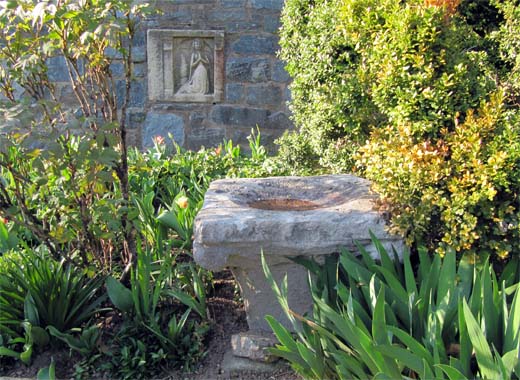
Yes, there’s a winged unicorn at the National Cathedral, but she hides in a shady nook along the south nave, and the horn that rests flat against her back can’t be seen from the ground. Below her, over the wall in a corner of the garden, sits a birdbath, a 12th-century capital salvaged from the ruins of Cluny. One never can tell what a unicorn will find intriguing.

EASTER 2010

A whisper in the medlar, Father Hugh:
“I found a cloister crook’d in splintry beams
And stood it straight in marble. Fresh regimes
Reigned higher still; our rule they overthrew.
As songbirds shrink from thunder, we withdrew,
And now the sun we kindled scarcely gleams
Above the murk of misremembered dreams.
This capital will never rise anew.”
To which I field a future all my own:
A thousand summers wither in a blink.
A sparrow spots my hooves and broken horn
Through churchyard brambles, grear and overgrown,
And droplets on my wing she stoops to drink;
Then she will be refreshed, and I reborn.


(For all the entries in this series, hit the “looking up” tag.)

“The wind doth taste of bittersweet, like jasper, wine, and sugar…”

And so we come to April, when longen folk to goon on pilgrimages, the hooly blissful Web-links for to seke.

Michael Drout provides an update on his plan to extract sheep DNA from medieval manuscripts.

My good friend at Ephemeral New York finds knights in the West Village and “angry chick” grotesques in Brooklyn Heights. 

At The Cimmerian, William Maynard ponders writing, suicide, and Robert E. Howard.

Also at The Cimmerian, an appreciation of Ronnie James Dio, who’s battling stomach cancer.

Lingwë looks at Tolkien, C.S. Lewis, and alliterative poems.

Kid Beowulf and the Song of Roland has hit the shelves.

Got Medieval debunks that baloney about super-sized meals in depictions of the Last Supper.

The Wall Street Journal reports on “a recent wave of early-music recordings that show a radical disregard for concerns of historical authenticity.”

Classical Bookworm reviews The Overflowing Brain.

Collected Miscellany reads dueling reviews of Angelology.

Open Letters Monthly introduces you to Ugo Fuscolo.

“Dinotopia” artist James Gurney visits Blizzard Entertainment.

Michelle Kerns uses the top-20 book-review cliches in a single review.

Planning a holiday? Here are ten places you don’t want to visit.

Oh, to be in Switzerland in the springtime, when villagers harvest the spaghetti.

“Don’t leave me hanging in a city so dead…”

Sometimes gargoyles are so high up—in this case, nearly 200 feet—that few people see them, and nobody hears them. Alas.

On either side the arches fly,
The buttress-blocks that half-imply
A sort of creamy stonework thigh,
And thro’ the calf and knee-crook high
Soar carven brutes profuse; a
Docent notes them, up and down,
Pent-up pilgrims crane and frown
’Neath the nag of no renown,
The southwest-tower Medusa.

A tourist twirls, a ballerina
Sensing o’er her Neutrogena
Grills that send a scent subpoena
From a cactus-themed cantina,
Corn-and-meat pupusa;
Bus-groups pained by prickly towers
Overlooking Gothic powers
Seek instead tequila sours
Ere southwest-tower Medusa.

Still, she sneers by day and night,
A myth amasked in aspish fright,
Damning each commercial flight,
Heedless of the blear and blight
She blusters to induce; a-
Ware of what her curse may be,
Alone she seetheth steadily,
Spitting on the bourgeoisie,
The southwest-tower Medusa.

And, skirting ’round her mirror’s haze,
Limestone saints avert their gaze,
Lest a glance condone her craze:
A kraken kind she howls to raise
To shake her prison loose; a
Waste, when distant dumpsters crash,
Reaping reams of beer-dark trash.
She hath no hope for titans’ clash,
The southwest-tower Medusa.

Like a queen of ninth-grade spites
Brooding on imagined slights,
Texting vapid acolytes,
Curls a-twirl through tween-dazed nights,
She taps jejune abuse; a
Tome she scans with deep’ning dread;
No sandaled Zeus-brat hunts her head.
“I am half sick of Bulfinch,” said
The southwest-tower Medusa.

She’s left to wail, she’s left to loom,
She sets her face to scowl and fume,
She sees the horrid garden bloom,
She sees no glad, galumphing groom
To suffer and seduce; a-
Las, no roof-beam waits to rise,
Nor any man half Ares’ size.
“No curse has come upon me!” cries
The southwest-tower Medusa.

There is no river, chain, nor boat,
No pithy rhyme for profs to quote,
No knight to heed her final note;
For her, no verse will e’er be wrote
By laureates obtuse; a
Captive crone, denied release,
She envies maids whose poems cease.
No tender curse can promise peace
To southwest-tower Medusa.

No one wonders, “What is here?”
High above, some starry sphere
Screeches thro’ another year;
Now the dusk-light drowns in drear
And failing, fades to fuchsia;
For no one mused a little space,
And no one praised her fang-bit face,
And none of flesh will e’er embrace
The southwest-tower Medusa.

(For all the entries in this series, hit the “looking up” tag.)

“So I associated myself with fossilized figures…”

Memes come, memes go, and I rarely inflict personal stuff on readers of this blog. However, this meme is fun: list the ten books that most influenced you. Forget the books you love, or the books you think you need to say you’ve read; instead, list the books that answer the question, “Who are you, and how did you get that way?”

Anne Terry White, The Golden Treasury of Myths and Legends (1960).
They’re all here: Theseus, Narcissus, the Volsungs, Beowulf and Grendel, Charlemagne, Tristan and Iseult, all strikingly illustrated by Alice and Martin Provensen. Finding this book in my elementary school library was like falling into a whole new universe, one I haven’t quite climbed out of yet.

Literature I: The Oregon Curriculum (Holt, Rinehart and Winston, 1968).
When my fifth-grade teacher saw me reading The Golden Treasury of Myths and Legends, he decided I was ready for this more advanced textbook. He marked the Greek myths with a paperclip, but I soon moved on to the Norse myths, literary ballads, fables, folktales, and short stories, not knowing I was reading Aesop, Goethe, Kipling, Poe, William Morris, Ray Bradbury, and Robert Graves. Thirty years later, I’m amazed by the breadth of this book’s gorgeous color illustrations: ancient and medieval art from India, China, and Scandinavia, colonial American folk art, and paintings by Breughel, Rembrandt, Chagall, Grandma Moses, Calder, Warhol, Dürer, and Klee. Could we even publish such a sophisticated textbook today?

All of those hardcover Dungeons & Dragons rulebooks from the early 1980s.
Judge me if you must, but I stand by what I wrote in my appreciation of Gary Gygax: “[f]or those of us who were raised outside of an academic milieu, D&D also offered a valuable experience that later served us well: the game offered a preview of the systems, organization, and culture of a worldwide scholarly community.”

Commodore 64 Programmer’s Reference Guide. (Commodore Business Machines, Inc., 1982).
We humanities types blather on about “critical thinking skills,” but if you really want to create English majors who can ace an upper-level college course on symbolic logic, make them program a computer.

Douglas Hofstadter, Gödel, Escher, Bach: An Eternal Golden Braid (Basic Books, 1980).
I bought this book in high school on the recommendation of a friend who went on to become an engineer. I didn’t entirely get it, I don’t think I finished it, and I doubt I’ll ever return to it, but the lesson was useful: The world is full of people who are much smarter than you are, and you sound like a fool when you call their work “weird” or “esoteric” just because you don’t understand it.

J.D. Salinger, Nine Stories (1953).
It’s exciting to be 17, and to be charmed by a book, and to think, “I want to write like that.” Only when the author kicks the bucket 20 years later do you realize what his book was trying to tell you: “This isn’t the sort of thing you’re meant to write.”

Ben T. Clark, Russian: Third Edition (Harper and Row, 1983).
It’s 9 o’clock in the morning on your first day of college, no one can yet imagine a world in which the Berlin Wall falls and “Winds of Change” is the #4 song in America, and you’ve never seriously studied another language—but within minutes, you’re learning a new alphabet, holding rudimentary conversations, and absorbing terms and concepts that will help you dabble in languages for years to come. Спасибо, Ben T. Clark.

Henry Treece, The Crusades (1964).
I still have my crummy paperback copy of this lurid pop-history, which introduced me to all sorts of wild medieval nutjobs, including Pope Urban, Peter the Hermit, Peter Bartholomew, and Henry Dandolo. Wanting to understand why angry mobs would tear people apart for the sake of relics, I became a medievalist—and as a result, here you are, reading this blog.

Bruce Mitchell and Fred C. Robinson, A Guide to Old English, Fifth Edition (Blackwell, 1992).
So maybe you don’t grow up to become an Anglo-Saxonist. So what? Spend a semester working through this tome and you ought to agree with C.S. Lewis: “The taproot, Anglo-Saxon, can never be abandoned. The man who does not know it remains all his life a child among real English students.”

A.S. Byatt, Possession (1990).
Few novels matter, so it’s nice when a work of fiction speaks to you, offering assurances that leaving grad school is okay—and that trying your hand at writing might be more fun than making a career out of studying the works of others.

“And he plays at stocks and shares, and he goes to the regatta…”

When I asked the owl on the north nave to contribute a poem to this project, I assumed from his mortarboard, scroll, and book that he’d hand me a pile of self-aggrandizing verse. Instead I got this shamefully loose translation of a pseudo-Ovidian poem written sometime between the 12th and 14th centuries. I guess a gargoyle, like the occasional human, reserves the right to remain enigmatic.

THE LOMBARD AND THE SNAIL

Loudly, the Lombard lopes over the landscape, and stops;
Leery, he lights on the lushest and loveliest crops.
Frabjous he feels, for his fields are not fated to fail—
Then forth springs a spectacle strange and stupendous: a snail.
Cowed and confounded, he quivers and quavers and groans;
Witless, he whitens, as wonderment welters his bones.
Seizing his senses, he summons the sangfroid to say:
“Fie on a felon! My fortune is forfeit today!
No suchlike scoundrel has slithered or skulked here before.
Mark well his message: he musters to meet me in war.
Horns are his heralds; his shield makes his handiwork plain.
Shall I not spurn him? No—better, in sooth, to be slain.
What if I poke and provoke him? Perhaps I’ll prevail!
Minstrels and merchants will mimic my marvelous tale.
What am I saying? To fight with a fiend is uncouth!
Easier warfare abounds; it’s a world-weary truth.
Men will say ’madness!,’ maligning me under their breath:
’It’s not meet and fitting to seek an uncivilized death.’
What if my children should walk by this waelstow and see?
Faced with this fiend, they would fathom his fierceness and flee!
Still, they’d concede that this combat is clearly unfair:
Armed is this beast, but no buckler or broadsword I bear.”
Fretful, he freezes, as Fear grapples fiercely with Shame;
Shame is pugnacious, but Fear keeps his temperament tame.
Competent counsel can kindle a capable life;
Thus he petitions the heavens, and checks with his wife.
Promptly, the gods promise palms for the victor, and praise;
Nervous, he nurtures no trust in their numinous ways.
Thence to his wife; she is timorous, tearful, and true:
“Listen, you lunatic, what are you looking to do?
Scuttle your strife; let your spirit sit safe on a shelf.
Mind no more monsters—and muse over more than yourself.
Spurn not your children and spouse! Let your senselessness stall;
Ill-omened days will bring dolor and doom to us all.
Hector would crumble, and even Achilles would quail;
Fast would the firmness of Hercules fracture and fail!”
Roused, he retaliates: “Rein in your runaway fears!
We who dare Death are undaunted, dear woman, by tears.
Great be the gods, for they grant me a glorious name.
You and the family fare well! For I follow my fame.”
Forth to the field, where he faces the fiend in the fray;
Stalking around him, he steadies his stomach to say:
“Beast, you are feral, unnatural, immoral, and vague!
Monster of monsters, as mean as the mortalest plague,
Hold high your horns! I am horrified hardly at all.
Show me your shield! Into no stealthy shell shall you crawl.
Righteous, I raise my right hand! Now your ruthless reign stops!
Savagely sully no more my salubrious crops!”
Swinging and swatting and shaking and sticking his spear,
Panting, he presses; the palm of the victor is near.
For heroes who rate such renown, what reward is supplied?
The matter is lofty; their lawyers will likely decide.


(For all the entries in this series, hit the “looking up” tag.)