Yep, we’ve fallen into lazy summer hours here at “Quid Plura?” headquarters. August is about writing, reading, and walking in gardens—but new posts are coming soon.


Yep, we’ve fallen into lazy summer hours here at “Quid Plura?” headquarters. August is about writing, reading, and walking in gardens—but new posts are coming soon.
 The books are tired: They let themselves yellow, they reek of teenage habits, and they laze around the shelves as if they own them. Stone-faced, you say: You there, all of you: Goodbye. With soft groans, they sprout little legs, stumble down the stairs, and march away. You admire their sense of duty; you commend yourself for knowing how to treat them.
You wonder where they went only years later, when an email asks: “Would you like to teach Modern Fantasy and Science Fiction?”
Thus begins the blur: creeping through library basements, climbing over warehouse piles, swinging a sun-bright shopping basket where books replace groceries in long, looming rows. Look: A spaceship reminds you of a long-lost friend, the guy who once loaned you this book. Over there is the novel you never quite got; its crude, trippy cover still mocks you. A fantasy trilogy leaps from a shelf, desperate to be held again; years ago, you all spent a week at the beach. Paperbacks peep and cry out sideways, and people gawk as titles start to blur: Axaxaxas mlö, dhcmrlchtdj…
You bring them home in plastic bags.
That face you make as you drive? It’s the thousand-year stare, the result of looking too long at the Middle Ages. The cure is a holiday, a summer spent sniffing ’round the future—but when you come home and toss those bags on the floor, they rustle, and you look down. Some books squeak and hide under the sofa; others dance and do flips before clambering onto your shelves. In the chaos, you catch a whiff: musty, sure, but sweetly familiar, and you know that you’re not in the future at all. You draw a deep breath and you think, Well, I’m back.
This week, I’m busier than Shane McGowan’s dental team—but here are some spiffy links.
At Writer Beware!, Victoria Strauss compiles recent links about the business of writing.
Much discussion ensues when John Scalzi upbraids the three biggest science fiction magazines for not accepting electronic submissions.
Strange Horizons tells aspiring writers the “stories we’ve seen too often.” So does Clarkesworld: “stories about young kids playing in some field and discovering ANYTHING. (a body, an alien craft, Excalibur, ANYTHING).”
At Science Fiction and Fantasy Writers of America, Bruce Sterling and Lewis Shiner offer a “turkey city lexicon” of writing errors and hackneyed plots. Heck, the SFWA’s entire roster of writing-advice articles is superb.
Steven Hart serves up a link-rich post about editing, book promotion, and publishing contracts.
Jake Seliger wants to know: What’s the deal with white covers on nonfiction books?
Jason Fisher explains “the Lewis/Tolkien collaboration that might have been (but never was).”
Steven Till points us to John Crowley on the art of historical fiction.
Per Omnia Saecula bravely continues its “bad medieval movie” series.
This is the forest primeval. The murmuring crawfish, bearded with moss…

“But Jeff,” I hear yon straw man cry, “it’s been ages since you reaffirmed your obsession with literary and quasi-medieval statuary!” Indeed, the greatest truths are often the most lamentable. So look who reared his head (and a fragment of torso) today along the bayou in St. Martinville, Louisiana: None other than “Hexameter Hank” Longfellow, author of Evangeline, the epic poem that made Cajun history hip.
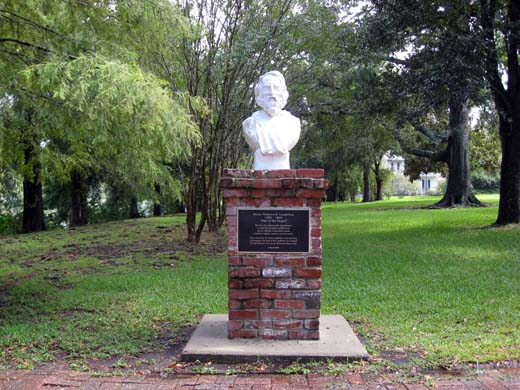
In St. Martinville, Longfellow keeps watchs over the “Evangeline Oak,” which offers ample shade just down the road from the Longfellow-Evangeline State Historic Site and a few paces from the lovely Acadian Memorial and Museum.
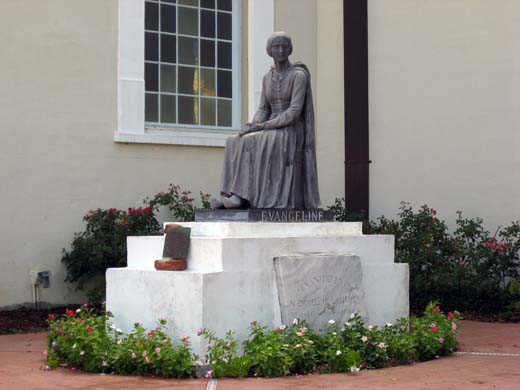
A block away, in the cemetery of the “mother church” of the Cajuns, is Evangeline herself, looking more sanguine than I’d be after decades of roaming North America in the name of deathless love. As bestsellers go, the poem that bears Evangeline’s name was the Twilight of yesteryear, but these days she gets fewer visitors.
St. Martinville boasts a population of 6,989, but half of those residents appear to be statues. In front of the church stands A.M. Jan, the 19th-century pastor, on a pedestal that tells his story in Latin.

Also honored in the town square is this dapper Attakapa Indian. He’s been here since 1961.

The interior of the church—”it is just the same as when it was built,” a plaque insists, “having been repaired but not changed”—is naturally full of old statues, too many to name.

But let’s not overlook two “Quid Plura?” favorites:
Noah’s wife…
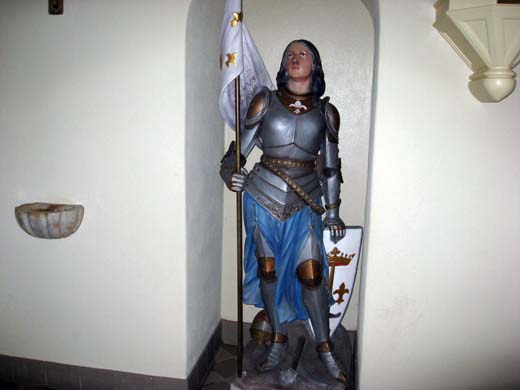
…and our old pal from New Orleans, St. Roch.

Mais où est le patron?

Aha! Here’s St. Martin of Tours, inventing the word “chapel” in front of the old presbytère.

Alas, my camera fizzled before I could get a picture of St. Martinville’s one truly unmissable statue, which depicts Charlemagne engaged in mortal combat with a giant crawfish. I’m sorry you won’t be able to see it, but trust me, dear reader: It was awesome.
The National Mall on the Fourth of July: America! Motherhood! Hot lunch for orphans! Red, white, and blue! Patriotic explosions!
…and a Welsh woman retelling stories from The Mabinogion?

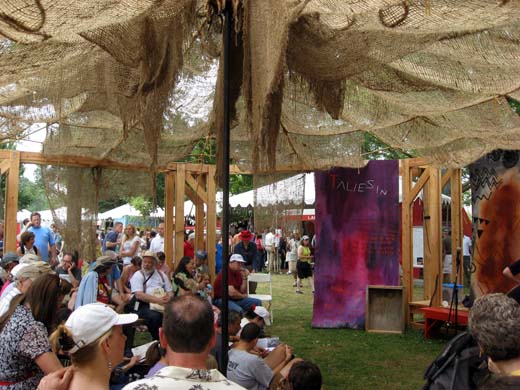
Yep: Wales is one of the three cultures featured at this year’s Smithsonian Folklife Festival. If you’re local, it’s not too late to hie thyself down to the Mall and take in some music, storytelling, crafts, and food. Maybe you’ll even get to hear spirited retellings of the stories of Branwen and Rhiannon adorned with violence, humor, and quirky modern digressions. Medievalism, you see, never takes a holiday.
There are now so many good blogs devoted to covering aspects of medievalism, from the scholarly to the popular and everything in between, that it’s not always easy for a hapless insomniac to make his mark. That’s why I’m inordinately pleased to be the first to report a crucial piece of quasi-medieval news: General Hospital has just kicked off a storyline about courtly love.
No, really! Someone on YouTube has compiled the relevant clips from the June 30 episode, wherein garrulous geek Damian “The Jackal” Spinelli proposes new rules for his relationship with Maxie Jones. Spinelli has long adored the woman he calls “Maximista,” but only recently has she loved him back. Spinelli and Maxie have already had sex—twice, according to Wikipedia—but the dramatic and chivalrous Spinelli wants to woo his true love properly, even if Maxie ain’t exactly qualified to book passage with St. Ursula, if you know what I mean:
SPINELLI.
Maximista shall remain the queen of The Jackal’s heart, and to honor her luminous beauty and transcendent presence, I will demonstrate my pure and epic devotion through the time-honored tradition of courtly love.MAXIE.
Spinelli, you’re so amazing. You’ve actually come up with something I’ve never done. So what is this “courtly love,” and who gets to go first?
Watch the five-minute video and you’ll see Spinelli explain (not always accurately) the up side of courtly love, after which Maxie’s step-cousin Robin explains the down side.
If the frustrated English majors who write the other soaps decide to follow suit, we may have a genuine trend on our hands. The troublemakers on One Life to Live might stop stealing each other’s babies and generate real drama by debating notions of inheritance and lordship in The Mabinogion, while Days of Our Lives supercop Bo Brady could very well shelve his investigations of mafia feuds to focus instead on a groundbreaking new theory about the date and composition of Beowulf. Should all this and more come to pass, “Quid Plura?” will be ready to keep you informed—if not with great sentence, then at least with some full measure of solaas.
Today, as the world little noted nor long remembered, was the 620th anniversary of the Battle of Kosovo. According to AFP, “no incidents were reported during the ceremony” held by Serbian pilgrims and officials near the battlefield that’s no longer Serbian territory, although Belgrade radio station B92 reports—how reliably I don’t know—that some Kosovars marked the day by bulldozing a 1999 monument to the medieval Serb heroes.
Pundits and politicians have forsaken the Balkans, but medievalists should keep Kosovo in mind—not because outsiders should rush to take sides, but because nowhere is a medieval conflict still burning quite so brightly. Gavrilo Princip assassinated Archduke Franz Ferdinand in Sarajevo on this date in 1914, the 525th anniversary of the battle, and Slobodan Milosevic chose the 600th anniversary to visit the battlefield and rally nationalistic Serbs. The Battle of Kosovo hasn’t really ended, and one epic poet predicted what diplomats never fully grasped: “Earthly kingdoms are such passing things—/ A heavenly kingdom, raging in the dark, endures eternally.”
From the “Quid Plura?” archives, here’s the medieval background to Kosovo’s 2008 declaration of independence, and here’s the capture of Radovan Karadžić and the ugly side of modern medievalism.
If you really want to hear about it, the first thing you’ll probably want to know is that it was in The New York Times, and what the lousy novel sounds like, and how the author was occupied and all before he wrote it, and all that J.D. Salinger kind of crap, but I don’t feel like going into it, if you want to know the truth:
On Wednesday, a federal judge granted a temporary restraining order forbidding publication in the United States of “60 Years Later: Coming Through the Rye,” a takeoff on — J. D. Salinger’s lawyers say rip-off of — “The Catcher in the Rye,” written by a young Swedish writer styling himself J. D. California.
Until the judge makes her final ruling, Mr. Salinger’s fans will be spared the prospect of encountering Holden Caulfield, the ultimate alienated teenager, as a lonely old codger who escapes from a retirement home and his beloved younger sister, Phoebe, as a drug addict sinking into dementia.
The Times adds that Catcher is showing its age: “Teachers say young readers just don’t like Holden as much as they used to. What once seemed like courageous truth-telling now strikes many of them as ‘weird,’ ‘whiny’ and ‘immature.'”
Of course: In a culture overripe with Facebook confessionals and reality TV, a million Holdens and Holdenettes have made the novel obsolete, and distance obscures what made it distinctive in 1951. Certainly no kid in 2009 gets the goofiness of Holden Caulfield’s name, the equivalent of “Affleck Paltrow” today. I’m surprised Salinger fans took it as earnestly as they did.
The debate over Holden Caulfield’s dwindling relevance is boring, but the plot of 60 Years Later is intriguing: It suggests that “J.D. California” left good ideas untapped.
Fifteen years ago, I found a photocopy of the pirated edition of Salinger’s other magazine stories, the ones that have never been legally republished (but which are now all over the Web). I read the thing in three sittings; I closed it enlightened and disappointed. With few exceptions, Salinger put his best material to better use in his tiny canon of “authorized” works; fans should be especially relieved that the dreadful 1965 novella Hapworth 16, 1924 was never republished.
But angstkind Holden earned my pity. In the early stories that became The Catcher in the Rye, Holden Caulfield never grows old; he vanishes in the Pacific during World War II.
Now, suppose Holden’s alternate fate explains his aimlessness and moping. He’s a smart enough kid, so he senses that something’s not right. And maybe one afternoon in the early ’50s, in a doctor’s office or a friend’s apartment or some other suitably phony place, a bored Holden picks up a chipped, battered copy of The Saturday Evening Post. He flips through its pages. He rolls his eyes at the goddamn fashion illustrations. He mentally draws mustaches on Jon Whitcomb’s elegant women.
But toward the back of the magazine, he freezes. There, somehow, is his name—no, not just his name, an entire story about some brother he didn’t know he had, and things he was certain were private.
He’s horrified—and baffled beyond cynicism. As night falls, he goes outside, and on the loneliest walk of his life, through a Manhattan that no longer makes any sense, he searches his soul, and he starts to understand what he is. In a flash of maturity no novelist could make plausible, the shaken young man knows what comes next. He’s forced to agree with the judgment of generations: despite the support of the people who love him and the universality of his youthful emotions, Holden Caulfield is living on borrowed time.
Twelve centuries ago, a certain Frankish king understood the need to remain clear-eyed after taking on too many tasks. “I know that I must do what’s right,” he confided to his queen in a letter from the front, “as sure as Kilimanjaro rises like Olympus above the Serengeti.”
O Charlemagne, how right you were! Because of work, writing, meine Deutschklasse, and preparing a syllabus from scratch, “Quid Plura?” has inadvertently slid into what can only be called “summer hours.”
This slowdown is temporary—but while I catch up with my commitments, here’s some stuff worth reading.
No one does medievalism better than Scott Nokes, who scours the Web for links you might otherwise miss. Check out his miscellanies from June 16, June 17, June 20, June 22, and June 23. Book reviews! Scholarly musings! Sentence and solaas! How can you go wrong?
What’s the hottest book in Louisiana right now? According to my family, it’s a memoir about a leprosarium.
Let’s welcome a sociolinguist to the blog world: “As a Linguist…”
Are you reading Ephemeral New York? Why the heck not?
According to Twitter, Julius Caesar is currently floating off the coast of Sardinia.
Everybody needs a little time away, so check out my snapshots from Aachen.
 When the U.S. Postal Service issues a stamp tomorrow to honor Anna Julia Cooper, she’ll be remembered, rightly, as a remarkable woman. Born into slavery around 1858 in North Carolina, Cooper earned a degree in mathematics but also taught Latin and Greek. As principal of the nation’s best public high school for black children, she fought for high educational standards and prepared her students for top universities. In essays and lectures, she addressed racism, the concerns of black women, and other issues of the day. When women’s rights groups turned out to be white women’s rights groups, she started her own.
But Anna Julia Cooper was also a Charlemagne buff—and an inspiration to exhausted grad students everywhere.
From 1911 to 1913, Cooper spent summers studying French literature and history in Paris. In 1914—at the tender age of 56—she enrolled in the Department of Romance Languages at Columbia University with plans to earn her doctorate. Scholars of medieval French literature were clamoring for an accessible version of the epic Le Pèlerinage de Charlemagne to replace a hard-to-find German edition, and Cooper gave them one, but Columbia didn’t grant her a degree. As a widow raising her dead brother’s five children while holding down a full-time job as a teacher and principal in Washington, D.C., she couldn’t fulfill the one-year residency requirement.
In response, Cooper sought out a university with no such requirement. The Sorbonne accepted her credits but her work on the Pèlerinage didn’t meet their dissertation requirements, so Cooper wrote a second dissertation. In 1925, she earned a Ph.D. from the Sorbonne and found a Parisian publisher for her edition and facing-page translation of Le Pèlerinage de Charlemagne. She was 66 years old.
Cooper’s Pèlerinage was never published in America. When she offered the book and all its proceeds to her alma mater, Oberlin, the school hemmed and hawed—and then nervously declined. Even so, the book was the standard edition and translation for decades, American libraries and language departments sought it out, and several pages were included in an anthology of medieval French literature reprinted as recently as the 1960s.
Beyond its manageable size, it’s not clear what drew Cooper to the Charlemagne project she cheekily called her “homework,” but few American teachers have so aptly encouraged students, then or now, through indefatigable example. Cooper, who lived to be 105, understood the pedigree of that tradition:
Being always eager to carry out your wishes faithfully, I have sent back to you this dear pupil of mine as you asked. Please look after him well until, if God so wills, I come to you myself. Do not let him wander about unoccupied or take to drink. Give him pupils, and give strict instructions that he is to teach properly. I know he has learned well. I hope he will do well, for the success of my pupils is my reward with God.
Alcuin wrote that. It’s a Carolingian sentiment, but one that Cooper, a proper medievalist, could easily endorse.
 Quid Plura?


