“…even if you do got a two-piece, custom-made pool cue.”

The figures are eloquent. Of 109 sovereigns, 65 were assassinated, 12 died in convent or prison, 3 died of hunger, 18 were castrated or had their eyes put out, their noses or hands cut off, and the rest were poisoned, suffocated, strangled, stabbed, thrown down from the top of a column or ignominiously hunted down. In 1058 years there were 65 revolutions of palace, street or barracks and 65 dethronements.

— René Guerdan, Byzantium: Its Triumphs and Tragedies

There’s something to be said for the peaceful transfer of power, isn’t there?

“…but on the way, you know that I will abide.”

Living through history is unnerving. As an unknown number of visitors descend upon the city—a million strong? Five million? A few hundred thousand?—the urban core becomes an armed camp, the river becomes a defensive wall, and mobs cross the bridges on foot. After clambering over monuments, some folks shack up with locals who’ve turned into hostelers, a few of them are bound to be scammed, and the authorities scramble to react to an influx of tourists whose movements are decentralized and largely spontaneous.

The medieval Romans may not have draped patriotic bunting across the facades of their buildings, but 710 years ago, they braced for unprecedented crowds. In late 1299, apparently with no official prompting, pilgrims began streaming into Rome, driven by the widespread belief that the year ahead offered special blessings to those who visited the graves of St. Peter and St. Paul.

Here’s Paul Hetherington on what became the Church’s first Jubilee Year:

The word spread like wildfire through Europe, and even by New Year’s Eve of 1299 a great crowd had assembled at St. Peter’s to greet the opening of the Jubilee Year at midnight. From then on, the crowds flocked to Rome from all over the known world. No one had ever experienced anything like it before. The crowds were so massive that the papal police had to institute a keep-right system for all the crowds crossing the bridge on foot that led over the Tiber to St. Peter’s . . .

The spontaneity and scale of the Jubilee took everyone by surprise. Even the pope, Boniface VIII, seems to have been nonplussed by it, and only issued the decree authorizing it late in February 1300. The various estimates made by contemporaries of the numbers that visited Rome vary so wildly that none can be regarded as trustworthy, but it was probably somewhere between one and two million.

Hetherington translates an eyewitness account by chronicler William Ventura, who visited Rome at the end of 1300:

It was a marvellous thing how many went to Rome in that year, for I was there and stayed for 15 days. Of bread, wine, meat, fish, and fodder for horses there was, but all at special prices…Leaving Rome on Christmas Eve I saw a great crowd that I was not able to number; there was a report among the Romans that there were then more than two million men and women in the city. Several times I saw men and women trampled under the feet of others, and even I was in the same danger, only just escaping on several occasions. The Pope received an untold amount of money from them, as day and night two priests stood at the altar of St. Paul’s holding rakes in their hands, raking in infinite money…And I, William, was there and earned fifty years and more of indulgence. Each hundred years it will be the same.

Like all pilgrimages, Tuesday’s inauguration and its attendant brouhaha will be a pageant of honor, corruption, villainy, and holiness, so if you’re in town, and if your peregrinations take you to Connecticut Avenue, look for me. Adapting the experience of William Ventura to Washington tradition, I’ll be pacing the sidewalk with ful devout corage and wielding my new favorite medieval-themed religious implement, the money rake. Commit yourself to change—or simply fling cash. I promise it will go someplace deserving. Weary pilgrim, have faith in me: I wol yow nat deceyve.

“The piano is firewood, Times Square is a dream…”

After Christmas, winter just gets mean. Here are some spiffy links to get you through the mid-week shivers.

Scott Nokes watched the horrible new Decameron-inspired movie so you don’t have to bother. Thanks, man!

Adrian Murdoch notes that the adventures of Asterix and Obelix have sold 250,000 copies in Plattdeutsch translation. (Bitte, was heißt “becoming Charlemagne” auf Plattdeutsch?)

The Economist visits pilgrimage sites in the Rhineland, an experience one commenter calls “redolent as all get out.” (I don’t know what that means either.)

Victoria Strauss shows you how not to e-publish.

Eternally Cool reports that the Forum is getting a makeover and shines light on the Ara Pacis.

Lingwë notes the pending release of an unpublished Tolkien poem, The Legend of Sigurd and Gudrun.

Lex Fajardo unveils the cover art for Kid Beowulf and the Song of Roland. (Note the prominence of Abul Abaz—and Charlemagne’s mustache.)

Via Books, Inq., comes a poem about bad, bad spelling: “The Ruba’iyat of the Maison Des Girrafes.”

Nothing escapes the notice of the Internet: Wikipedia has an entire page on television’s “unseen characters.”

American novelist Olen Steinhauer lives in Novi Sad, Serbia, which had its heat shut off on Christmas.

Ephemeral New York reminds us that once, the Bronx Zoo exhibited a human being.

“The tap-tap-tapping of the typewriter pays…”

Twenty-three years ago this month, I convinced my folks to drive me to the toy store to buy something that toy stores no longer sell. Most people didn’t know what a modem was, but when I whipped up an ASCII animation showing us making the trip as a family and emerging in triumph from the Toys R Us, my parents were amused enough to give me a lift, if understandably skeptical. In 1986, the online world was too tiny to be mythologized. Wild stories about local kids “changing the positions of satellites up in the blue heavens” sometimes made the news, but online bulletin-boards were “here there be dragons” outlands for all but a few, and no one noticed gaming pioneers as they racked up monstrous Compuserve bills playing Hangman at 300 baud.

Lacking any real plan, I used my modem to connect to a suburban archipelago of slow, single-line BBSes, not knowing that the experience would teach me how to write. A few years later, when I was the only English major banging out e-mail on an X-term in the basement of the computer science building, I didn’t know I was an early adapter of a network that would soon link millions of offices and homes while uprooting the business models of several industries, including publishing. I only knew that I sensed opportunity.

I thought about those days when I read Jake Seliger’s post about a New York Times article pointing out the obvious: the online market for used books is a boon for readers. Jake wondered how cheap books will affect the business of publishing, and while I don’t know what the future holds for companies that can’t adapt, I told him I didn’t think a bonanza of secondhand books was necessarily bad for authors:

As someone who recently entered the publishing world as a lower-midlist author, I’ve thought quite a bit about the implications of the online market for used and discount books. When someone buys my book used on Amazon for $4 instead of paying $12 for a new paperback, that’s around 75 cents in royalties I don’t see—but I’d be awfully short-sighted to gripe about that, because the glorious churn of the used-book market may help me in the long run. Today’s budget-conscious undergraduate may be tomorrow’s history teacher; perhaps he’ll assign my book to his class of twenty students five years from now. Or maybe he’ll recommend the book to a friend who then downloads a copy to his Kindle, thereby putting around $2 in my pocket. Or maybe he hates the book so much that he strenuously avoids my next one, thus sparing me a one-star Amazon review that would have dissuaded potential readers.

Who knows? I do know that I’d be a fool to gripe about the Internet, because thanks to the Web–which includes everything from Amazon to bloggers to podcasts to the online BookTV archives—I’ve sold more copies of my book than the 50 or so secondhand copies currently listed on Amazon. Fretful authors and publishers who dread the advent of the hyper-efficient online book market may yet be vindicated, but I’m not convinced that budget-conscious book-buyers are the only ones who stand to benefit from it.

Compared to a fantasy world in which Amazon, the big bookstore chains, and used-book dealers simultaneously thrive (and where all of our orders are, presumably, delivered by a Deschanel sister on a flying unicorn), the current situation looks bleak—but as an author, a voracious book-buyer, and someone who’d be nowhere without the Internet, I prefer the here-and-now to the real world of twenty years ago, when a suburban “bookstore” was a nook in the mall stocked only with bestsellers, a few shelves of genre fiction, some classics, and the latest comic-strip anthologies.

Whether my career thrives or stalls, I’m glad I’m a writer now. I can get obscure articles in minutes rather then weeks, and people on the subway can use a telephone to order and read my books from stores that never close. Best of all, my cable modem is more than 6,500 times faster than the modem I bought in 1986, but it cost the same amount: around 60 bucks (or half the price in 1986 dollars). Confusion may be justified, but hold off on the Anglo-Saxon elegies; not everything is worse than it used to be.

“…and all the lies the wise ones tell.”

[Here’s the latest in an ongoing series of reviews of all of Lloyd Alexander’s non-Prydain books. To see all posts in this series, click on the “Lloyd Alexander” tag.]

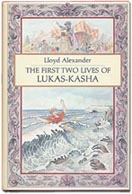
“I used the imaginary kingdom not as a sentimentalized fairyland, but as an opening wedge to express what I hoped would be some very hard truths,” Lloyd Alexander once said, explaining that fantasy and fairy tales, far from being escapist, are “the way to understand reality.” In The First Two Lives of Lukas-Kasha, Alexander asks a tricky question: What happens when reality must be lived but can never be explained, not even by fairy tales?

The novel starts abruptly: ne’er-do-well Lukas-Kasha wanders through the village square and decides to upstage Battisto, an itinerant magician performing hackneyed tricks. At Battisto’s request, Lukas stares into a bucket of water and suddenly washes ashore in the exotic land of Abadan—where, in fulfillment of prophecy, he is hailed as king. Quickly bored by royal luxury, Lukas develops a conscience and begins to study the workings of his government in an attempt to become a proper statesman. Hated by his scheming vizier but aided by a poet and a secretive slave-girl, Lukas also tries to end the pointless war with the neighboring Bishingari. Faced with failure, he discovers the grave responsibilities that come with being a serious person—all the while wondering why Battisto sent him to Abadan in the first place.

Published in 1978, The First Two Lives of Lukas-Kasha is rife with themes developed more carefully by Alexander in later decades. As in The Iron Ring and The Remarkable Journey of Prince Jen, a young king and queen learn humility; as in the Westmark books, a king concludes that monarchies are obsolete; as in The Rope Trick, the hero finds no answers to baffling existential quandaries. A fine novel in its own right, Lukas-Kasha stands out from those other books in its surprising and unconventional final chapter. Poignant but unsentimental, Lukas-Kasha offers something surprising and sad: the truth of a bittersweet ending.

“…in the shade of the blackthorn, and the chill of the frost.”

[Here’s the latest in an ongoing series of reviews of all of Lloyd Alexander’s non-Prydain books. To see all posts in this series, click on the “Lloyd Alexander” tag.]

When Mallory, an orphaned scullery maid with a head full of fairy tales, finds a grouchy wizard named Arbican trapped beneath the roots of a dead tree, her life is transformed. Arbican belongs to an earlier age; he literally missed the boat when his fellow immortals sailed away and took the world’s enchantments with them. As the wizard struggles to revive his dormant magic, Mallory has a problem of her own: a local tyrant is plotting to destroy her village—unless Arbican can be convinced to work an enchantment or two.

Summarized so conventionally, The Wizard in the Tree is as derivative as anything a fantasy publisher might toss in the “maybe” pile, even if the actual book behind that premise is a curious departure for its author. Largely bereft of Alexander’s characteristic humor, the novel is notable for its relentless grouchiness—and for Alexander’s gamble that his young-adult readers will be patient with a story that wanders well beyond their usual interests.

Despite the promise of magic in its title, The Wizard in the Tree is really a novel about politics and money. Scrupnor, the village squire and Alexander’s stock provincial bully, wants to raze the village to make way for a highway lined with coal mines. Greedy and murderous, Scrupnor monopolizes local industry through restrictive contracts with avaricious and gullible locals, an arrangement that prompts one of them, an innkeeper, to deliver a wistful monologue about his desire to buy cheaper victuals outside the village borders. State monopolies, restrictive contracts, and rapacious development aren’t mainstays of middle-grade fantasy, but Alexander’s determination to tell this story seems strangely personal, as if the author hopes to embarrass a real-life politician who once got on his bad side. Lloyd Alexander characters typically regret any loss of life, but here the demise of Scrupnor is met with only resignation from Mallory or Arbican—despite the villain’s gruesome incineration.

Just as Alexander skimps on humor, he also avoids sentimentality: Mallory and Arbican never become friends, and the ancient wizard departs the novel as pompous and unlikeable as he enters it. Arbican spends most of the book lambasting the ineffectiveness of magic in human affairs and decrying humans who take fairy tales literally, but his ranting serves a purpose: When Mallory discovers that oft-roasted fantasy chestnut, the magic within herself, it turns out to be nothing more wondrous than her ability to find courage when confronted by scoundrels and fools. As a result, The Wizard in the Tree stays true to itself, becoming something far more magical and rare: an anti-fantasy.

Alexander’s message is simple: magic happens when you understand, as Arbican does, that a fairy tale needs to be a metaphor, not just a Christmas tree festooned with empty genre tropes. A gruff wizard and a daydreaming scullery maid are only worth a reader’s time when an author uses them in a story that’s actually about something—in this case, fighting corruption through bravery and basic human decency.

As early as 1974, Alexander saw how cloying and derivative his genre of choice could become; The Wizard in the Tree was his response. Aspiring fantasy writers, take note: you shouldn’t copy Lloyd Alexander, but you would be very wise to read him.


“Turn the clock to zero, honey…”

From time to time, I dig through the poetry of Theodulf, ninth-century bishop of Orleans, looking for nuggets to translate. Theodulf was a wit, so I’ve had fun making modern English versions of his Latin verses about pilgrimages, libations, wildlife, stolen horses, and children’s dreams. But what, I wondered, could Theodulf do for me on New Year’s Day?

I shouldn’t have worried; the old Goth didn’t let me down. In the middle of a dull poem about faith, hope, and charity (Dümmler, MGH Poetae I, 466-467), I found four lovely lines of Latin, and I plucked ’em:

Nam pia dona spei tereti signatur in ovo,
Tegmine obumbratum quod vehit intus habens:
Ut pullum ova tegunt, sic spem praesentia celant,
Hic patet exutus, illa futura parat.

With the reckless optimism of a Leyendecker baby, I give you this translation:

To see the blessed gift of hope, behold
The egg that keeps a secret in its shell:
The present, hiding hope, conceals it well;
The future cracks it: tiny wings unfold.

Those of you who read Latin are shaking your heads at this rather free rendering of the original. So be it! It’s a new year! Old habits limp to their graves, ashamed! Besides, I did some research and found that these four Latin lines have been translated repeatedly throughout the centuries, often by poets who took far greater liberties than I did.

For example, here’s a little-known translation by Langston Hughes:

THEODULF AT THE 125th ST. DINER

The sunny side
An egg supplied
Upon t’morrow gambled.
It hides in a shell
That poached it well
And never got it scrambled.
The present keeps our dreams deferred.
The future hatches: out pops a bird.

And here—dear reader, I was as astonished to discover it as you surely are—is a translation of Theodulf by none other than T.S. Eliot:

PERTELOTE SENESCENS

The sea-birds race inland from the storm
Above the subtile chicken seeking quiet in the barn
Where she dares not hope
“Lasciate ogne speranza, voi ch’intrate“—
But for the egg:
The shell conceals our tatterdemalion past—
The shell incubates our necessitous future
—and hope becomes a farmer
With shards of egg in his desquamative palm
Forgetting the recrudescent monotony of the plow, straining
To hear the eager peeping in the straw.

My translation isn’t looking quite so loose now, is it?

On behalf of Theodulf, T.S. Eliot, Langston Hughes, and a room full of imaginary chickens, I wish you a happy and recklessly hopeful new year.

“…oblique suggestions, and he waited.”

The Web is full of fine writing—but things do tend to dry up during the holidays. To help get you through, here are links to some of my favorite posts written by other bloggers during 2008.

Gabriele at Lost Fort translated a lovely Rilke poem.

Steven Hart compared Bobby Fischer to Icelandic outlaw Grettir Asmundarson and wrote eloquently about poetry and the decline of New Jersey newspapers.

Terry Teachout visited Willa Cather’s grave and pondered Our Town.

Jonathan Jarrett saw traces of a love story in 10th-century charters.

Cell phones clashed with Gregorian chanting when Kate Marie went to Rome.

The Cranky Professor offered tips on dining in the Eternal City.

Jake Seliger defended fantasy lit, suggested that media pundits would benefit from reading The Best Software Writing, and revisited the cheeseball novel Day of the Triffids.

Studenda Mira wrote about Irish lighthouses and ancient monks.

Scott Nokes explained why he takes medieval studies beyond the confines of the campus.

When everyone else reviewed Salman Rushdie’s new novel, Sam Sacks reviewed the reviewers.

Adam Golaski continued to serialize the weirdest, funniest, most alluring translation of Sir Gawain and the Green Knight you’re ever likely to read.

Heather watched the National Spelling Bee and remembered her Bee time 25 years ago.

Michael Drout told a fun story about his daughter, ancient animal toys, and a Lord of the Rings actor.

Michael Livingston contemplated the ex-squirrel in his attic.

Frank Wilson suggested that T.S. Eliot might have enjoyed Cats.

The Gypsy Scholar turned a Philip Larkin poem upside down and discovered it was still quite readable.

Patrick Kurp poked around in the memoirs of Sir Alec Guinness, who concluded that “Shakespeare can take care of himself.”

“Walk on slowly, don’t look behind you…”

The old year passes, giving way to the new. I enjoy writing this blog, but 2008 was made especially worthwhile by those of you who’ve read, linked, and commented during the past twelve months.

Maybe you’re looking for something to read during a slow blog week; perhaps you’re a newcomer trying to figure out what this site is all about. Either way, here are some “Quid Plura?” highlights from the year that’s winding down.

“Who would cross the Bridge of Death must answer me these questions three.”

What hath Charlemagne to do with SpaghettiOs?

What hath Oscar Micheaux to do with Geoffrey Chaucer?

What hath C.S. Lewis to do with presidential polling?

Farewell, Prime Material Plane. This year, we bid adieu to one of the most influential American medievalists of the 20th century.

“Down by the sea…” The beach in winter is a fine place to meet Vikings and raid a dragon temple.

Lights, camera, incoherence! Yes, I’ll happily defend the Miles O’Keefe-Sean Connery masterpiece Sword of the Valiant. (Although it’s easier to make a case for Edith Sitwell.)

Dona eis requiem: Join me in the search for medieval saints in the Lower Ninth Ward of New Orleans. We’ll wave as my levitating niece flies by.

Bitte, wo ist der Dom? Live near a cathedral, translate a poem about pilgrims, gawk as an artist makes that cathedral psychadelic, mourn when they close down the greenhouse, ponder the controversial stained glass of Cologne.

Igra rokenrol cela Jugoslavija: This year, Balkan medievalism revived unnerving memories of the Battle of Kosovo and put the capture of Radovan Karadzic in context.

“Crom, I have never prayed to you before…” In 2008, war in the Caucasus meant rediscovering the medievalist nationalism of South Ossetia and muddling through the baffling history of Georgia.

I gave her cakes, and I gave her ale… This year, the “Quid Plura?” kitchen was filled with the sweet scents of medieval Baghdad and the rueful quacking of late-medieval England. Alas, we failed to find the holy grail in the cupboard.

Like a Yule log, except that it can eat you. Cherish the memory of Medieval Shark Week.

Money, so they say. This year, the credit crunch reminded us that financial derivatives have medieval roots.

My car is parked outside, I’m afraid it doesn’t work. As the global financial system flirted with Ragnarok, Icelanders propped up banks with names that hark back to Norse mythology and teach us Germanic linguistics. If the Icelanders can retain their fragile independence, they may end up preserving modern culture beneath man-made molehills.

Incommunicado, it’s the only way. Sometimes, it’s fun to be a writer.

Sha la la la la la la… When you’re born and raised in the Garden State, there aren’t enough antibiotics in the world to get the place out of your blood, thank goodness. You can’t help but remember the Jersey Shore, a favorite bookstore, and the way history meets at intersections. (The state of the state also explains why I don’t write about politics.)

Page after page: In May, I started reading and reviewing all of Lloyd Alexander’s non-Prydain books. I’m halfway done; read the reviews here.

No joke: In June, “Quid Plura?” readers gave $427 to Paralyzed Veterans of America, for which I am still very grateful.