“…and eyes full of tinsel and fire.”

In an ideal world, I’d give all my readers a gift for Christmas. Instead, like the Little Drummer Boy, albeit one with a modem and a seasonal Mastercard balance, I can give you only the rum-pa-pum-pum of music—specifically, this lavish buffet of Christmas-themed music videos.

When Sting decides to cover a Christmas classic, does he do “Jingle Bells”? Nope; he puts an ’80s spin on a venerable Basque carol.

If you’re of a certain age, you may remember John Denver and the Muppets singing “The Peace Carol,” or the sweet Christmas song Denver wrote for his infant son.

Roger Miller may have written the original, but Glen Campbell’s rarely-heard cover of “Little Toy Trains” sure is lovely.

I grew up in New Jersey during the ’80s, so to me, Twisted Sister covering “O Come All Ye Faithful” is the most natural thing in the world.

If you’re spending Christmas in Hollis, Queens, watch out for ill reindeer.

Join the Pogues and the late Kirsty MacColl in revisiting a bittersweet fairy tale.

If, like me, you’re as sentimental as a Polish babcia, then here’s Perry Como singing you-know-what.

No one has posted clips from the Fred Waring Christmas album on YouTube, but someone did upload the Pennsylvanians’ great, old-timey, choral version of “Greensleeves.”

Dear readers, a confession: the first version of “Greensleeves” I ever heard was belted out with a certain solemnity by three cartoon rodents.

Does the Yuletide season leave you disillusioned and wistful? Don’t worry; there’s a rock ballad for you, too.

What more can I say? Merry Christmas!

“Probi fuimus, sed non durabimus…”

[The trappings of Christmas, though bountiful, always include a rerun. Here’s a seasonal “Quid Plura?” flashback from last year.]

For all its opulence, the palace was a hall of drear. It glittered, but as the chamberlain observed, it had long ago ceased to shine. Enthroned, the pope passed the afternoon, as usual, without so much as a whisper. He had become just another of the chamber’s countless statues, a decoration to be dusted, an object of occasional veneration. Clerks and notaries flitted beneath him; they attended to petitioners and saw to the snuffing out of candles.

The chamberlain sighed. He wished for a window. How many more hours of misery awaited him? The incense stung his nose. He ached for a cup of wine.

“A chanter from Seville to see you, sir.”

The chamberlain blinked. The little priest before him was sweaty and red. Was this forgettable creature always so twitchy? No matter; it was time to be a tyrant.

“The Holy Father has no interest in Andalusian vagrants. Send him away.”

“Sir, you really want to see this.”

They always promised marvels. What came instead? Puppet shows. Mimes. That donkey with the law degree.

“Is there no legitimate business we can conduct?”

“No, sir, not after this.”

The chamberlain gave his usual hand-wave of resignation. Boredom trumped tyranny, especially on dull winter days.

Moments later, a dark-haired man wearing humble clothing walked quietly into the room. The chamberlain approached him, mindful of protocol.

The Spaniard strode right past the chamberlain and burst into speech.

“Holy Father! Far have I traveled, and strange sights have I seen, but today I bring music that shall warm men’s hearts and give glory to Almighty God!”

The chamberlain rolled his eyes.

“Your Holiness, in Sevilla, the city of my birth, I was a scholar of music in all its myriad forms. I knew the call of the muezzin, the savage chanting of ancient Gaul, the bawdy refrains of the Genoese shipmen. From Cordoba to Samarkand, my name was known to many. Raspy minstrels, cantors from the patriarchal tombs—strangers came from far and wide that I might discover their songs.

“But to my enduring shame, O Holy Father, one form of music was entirely unknown to me. Rumors reached me of a marvelous style of singing, a sound full wondrous to hear. Its secret, travelers told me, was guarded by monks at the ends of the earth, where they sang unending hymns of Saint Nicholas and other Christian subjects too numerous to mention. Desiring to know this music which few living scholars had heard, I left my comfortable home and my company of flatterers, and I chased vague whispers along strange and lonely paths.”

The chamberlain glanced at the motionless pope. Was he asleep? Was he breathing? Had this long-winded fool at last bored the pontiff to death?

“Holy Father, I sought this heavenly choir in the terrible places of the world. I sailed through ice in the realms of the north, where hard men laughed at my desperate quest. I traveled eastward into Araby, but I journeyed in vain, for there I heard only frivolities, and never celestial sound.

“Winter came. Forlorn, clad only in rags, I faced starvation on frigid mountain peaks. Through the intervention of God—for how else to explain that fortuitous day?—I was rescued by the brothers of an order whose patron I am forbidden to name. But there, Holy Father, while I rested, healing through Our Lord’s salvific grace, strange music amazed me as I lay in my cell.

“That miracle I bring to Rome this day.”

At the far end of the chamber, golden doors opened. Three tiny, hooded figures glided silently over the marble.

Bile rose in the chamberlain’s throat. A dwarf act! He crossed himself. These always ended in sacrilege. Where were the guards?

The Spaniard raised his right hand.

“Hit it, boys.”

A weird, piercing music filled the air: an unearthly chant that flowed magically from beneath three tiny cloaks, an eerie, impossible singing that bathed the great hall in a strange and transcendent good cheer. Priests and monks all froze where they stood, beguiled by a falsetto that not even castrati could create. Tears welled in the chamberlain’s eyes. Was this the choir of Heaven or of Hell? The verse of these singers was in some foreign tongue—alien, yes, yet oddly familiar. He understood none of it, not one single word—but he knew it would haunt him for the rest of his life.

And then, as quickly as it had begun, the singing ended.

The hall was silent for an eternity; no priest or monk dared blaspheme the place with motion—not a cough. Everyone stared at the singers.

Finally, with trembling voice, the chamberlain found nerve enough to ask: “Are you men…or angels?”

The three beings reached up with tiny hands and reverently lowered their cowls. Solemn faces peered out at the world, wide-cheeked faces with prominent teeth set beneath large, benevolent eyes. Their features were mingled in brown, shaggy fur.

The chamberlain gasped.

“What manner of monks are these?”

From far behind him came a stir of precious robes and a voice not heard here in ages.

“Non monachi,” declared the quaking, agitated pope, “sed chipmonachi.”

The giggling of the pontiff resounded through the hall. Priests rushed to his side, desperate to calm him. The chamberlain fell to his knees as confusion around him swirled.

The stranger from Seville folded his arms; then he looked at his singers and frowned.

“If they think that’s something,” he muttered, accustomed to such chaos, “just wait ’til they see you fellas dance.”


“…and we can all sit watching our Hawaiian island world.”

Becoming Charlemagne is not a racy book, but when I wrote it, I marveled at the rich potential of medieval history to perplex and offend. Wine-guzzling Muslims, Jews owning slaves, knife-wielding Christians who tried to relieve a pope of his eyeballs and tongue—to be honest, I had expected more complaints from readers who found that the eighth century either defied their Tolkienesque caricatures of the Middle Ages or failed to conform to their religious preconceptions. Instead, debates and discussions at book-talks and lectures have been downright genial, and to my knowledge, the harshest thing I’ve been called is a “Catholic apologist,” a charge that surprised and amused me. (Eat your heart out, Tertullian.)

Years ago, as a college cartoonist, I would have been disappointed by such a placid reaction, but today life feels way too short to make shocking the easily offended the highest goal of art. I’d much rather inform and entertain—but I do reserve the right to offend, a right I hadn’t thought to affirm until I read the review of Sherry Jones’s novel The Jewel of Medina in Sunday’s New York Times.

Jones’s novel is a highly fictionalized retelling of the story of A’isha, the third and youngest wife of the prophet Muhammad. Last year, after a scholarly expert on A’isha suggested that the novel might incite violence, Random House dropped the book and a small press quickly picked it up. In last weekend’s Times review, journalist and novelist Lorraine Adams lists some of the historical errors in The Jewel of Medina, dismisses the book as a bad example of genre fiction, and calls Jones’s prose “lamentable.” As a reviewer, she’s entitled to her opinion, even if the extent to which a novelist must hew to historical facts is debatable, but her conclusion is stunning and strange:

An inexperienced, untalented author has naïvely stepped into an intense and deeply sensitive intellectual argument. She has conducted enough research to reimagine the accepted versions of Muhammad’s marriage to A’isha, thus offending the religious audience, but not nearly enough to enlighten the ordinary Western reader. Should free-speech advocates champion “The Jewel of Medina”? In the American context, the answer is unclear. The Constitution protects pornography and neo-Nazi T-shirts, but great writers don’t generally applaud them. If Jones’s work doesn’t reach those repugnant extremes, neither does it qualify as art. It is telling that PEN, the international association of writers that works to advance literature and defend free expression, has remained silent on the subject of this ­novel. Their stance seems just about right.

That’s one bizarre paragraph, suddenly contrasting as it does Constitutional protections for “repugnant extremes” with what “great writers” applaud while suggesting that a book must “qualify as art” to be defended on the grounds of free expression. Sherry Jones may be no Salman Rushdie, but when it comes to The Jewel of Medina, the question of her free expression is not hypothetical: Adams notes earlier in her review that shortly after last year’s controversy, “somebody pushed a firebomb through the mail slot at the home office of Jones’s London publisher.”

Which leads me to wonder: If tomorrow I should find my car on fire, or death threats nailed to my door, or a dagger protruding from my sternum as I step outside my office, will Lorraine Adams think I had it coming? I suspect not, but in her zeal to pen a clever takedown of a book she thought was lousy, she implies that defending me from violent reader responses depends on whether or not critics and literary mandarins decide my book is art. Call me quaint, but I don’t have to like, or even read, The Jewel of Medina to know that Sherry Jones and her publisher deserve freedom from firebombing. I don’t have to read a novel by a glib reviewer to know that its author deserves the same defense as well.

“They make you believe it’s the status quo…”

The well-informed readers of this blog know that Charlemagne was famously supportive of commerce and trade. First as king and later as emperor, he enacted policies he hoped would nurture the feeble European economy and generate wealth. “Share it fairly,” he wittily decreed in the Capitula obscuri lateris lunae, “but don’t take a slice of my pie.”

So while I’ve never thought it peculiar to see the Frankish king shilling for shower gel, Plexo Suspenders, and Budweiser, I confess I was a little surprised by this: Charlemagne starring in his own cigarette commercial.

(Link via the Houston Press, which notes that this same series of ads included Catherine the Great, Genghis Khan, and an oddly un-threatening Ivan the Terrible. Am I seeing things, or does the mighty Temujin look and sound a little bit like Michael Palin?)

“Along the coast road, by the headland…”

From Disputatio Pipini cum Albino:

P. Quid est frigus?
—A. Febricitas membrorum.
P. Quid est gelu?
—A. Persecutio herbarum, perditio foliorum, vinculum terrae, fons aquarum.
P. Quid est nix?
—A. Aqua sicca.
P. Quid est hiems?
—A. Aestatis exsul.

Pepin: What is cold?
—Alcuin: Feverishness of the limbs.
Pepin: What is frost?
—Alcuin: Punisher of plants, ruin of leaves, fetterer of earth, source of water.
Pepin: What is snow?
—Alcuin:
Dry water.
Pepin: What is winter?
—Alcuin: The exile of summer.

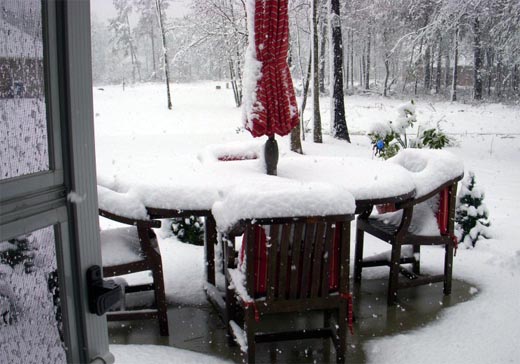
The scene earlier today on my family’s street in southeastern Louisiana:

(Photos courtesy mater Cuius Plurium.)

“We can go for a walk where it’s quiet and dry…”

Christmas approacheth, and naturally, you’re stressed. You have gifts to purchase, parties to wince through, and hey, those lampreys aren’t gonna exsanguinate themselves. So stop, take a break—and enjoy a tasty link.

As the festival of Sol Invictus draws nigh, Eternally Cool offers a Gladiator Gift Guide.

At Unlocked Wordhoard, one of Doc Nokes’s students sets “Caedmon’s Hymn” to music.

Michael Drout shows how witty rhetoric betrays a lazy mind.

Victoria Strauss looks at layoffs and cutbacks in publishing. It’s not a pretty picture.

Along those same lines, Steven Hart notes the passing of Bantam.

Maggie says it’s hard to name a werewolf.

Open Letters Monthly praises a new biography of Samuel de Champlain.

At My Life in Books, Nicole ponders Edgar Allan Poe.

Need a musical break that highlights the consistency of pop music? Compare the folk song “Lovely Joan” with “Touch and Go” by Emerson, Lake, and Powell.

Finally, as the year fizzles out, assess your accomplishments fairly, but keep in mind that whatever you achieved, you’re certainly no Alma Mahler Gropius Werfel.

Thanks for reading! More medievalism, and another harrowing kitchen encounter with galangal, are on the way.

“Relations sparing no expense’ll, send some useless old utensil…”

Christmas approacheth, and the e-mails keep coming, as relentless as pistachio vendors in eighth-century Aleppo: Jeff, what should I get for the medievalist in my life?

Come on, people; shopping for medievalists is easy. Here are some suggestions for unusual presents that are bound to be more gratefully received than those Medieval Times gift certificates everyone got stuck with last year.

You can’t get the Lego Medieval Market Village (which includes, yes, a turkey) in time for Christmas, but it’s not too late to order the very strange 2008 Lego Castle Advent Calendar.

If your medievalist adores Byzantine church history, Got Medieval sells an awesome assortment of household doodads with primates on them.

Do your loved ones live where Beowulf and business markets intersect? Then hit them with gift subscriptions to The Wiglaf Journal, which “comes to the aid of today’s executives in vanquishing their challenges.”

If you own a business in the U.K., perplex your cringing minions with medieval team-building exercises, or smite them with your inflatable morningstar.

Let’s pretend this also doesn’t sound dirty: Set your mouth on fire with Dante’s Inferno Balls.

Medieval Icelanders deployed the term “downward-facing dog” with unseemly specificity. Nonetheless, a lesson in runic yoga will de-stress your workaholic Viking.

Let fly the yams! Defend your Christmas dinner with a tabletop trebuchet, and then lay siege to the sweet, spongy fortress you baked in your castle-shaped bundt pan.

If your kid’s reenactments of the Fourth Lateran Council with R2-D2 and Spider-Man on a dune buggy don’t feel sufficiently reverent, then you’re in luck: get thyself a Pope Innocent III action figure.

Grendel’s mom sez: “Preserve your child’s teeth and hair in a pewter castle-shaped reliquary—but catch the shrieks in a cup of gold.”

From the “Nightmares of Jennifer Lynn Jordan” Collection comes this enchanting clash of the titans: the Unicorn vs. Narwhal Playset. (My money’s on the narwhal. Nothing escapes its vengeful horn.)

Like mistletoe, chipmunks, and cranberry-lamprey casserole, Charlemagne is an essential part of any old-fashioned Christmas. So buy Matt Gabriele’s new book, The Legend of Charlemagne in the Middle Ages, or the new paperback edition of Charlemagne’s Mustache. If cerebral tabletop games are your thing, try the highly abstract Carolus Magnus. If you reek, de-stinkify thyself with Charlemagne Shower Gel.

Incubus wearing you out at night? Secure your bedchamber with a dragon-themed lock and key.

Place a tiara on the brow of the lady in your life. (Or the man. I’m not here to judge.)

Men and women of academia, I ask ye: of what use be tenure if it alloweth ye not to herald your arrival in the classroom?

This year, shop secure in the knowledge that the best medieval-themed gifts can avert the most awful of Christmas disasters. I can hear it now: “The heavenly aroma still hung in the house. But it was gone, all gone! No lamprey! No lamprey sandwiches! No lamprey salad! No lamprey gravy! Lamprey hash! Lamprey à la king! Or gallons of lamprey soup! Gone, all gone!”

(And yes, if you do want to feast like a late medieval big-shot, there’s always tinned sea lamprey from Russia. You would even say it glows…)

“…with kitchen prose and gutter rhymes.”

[UPDATE: As of January 2010, information on purchasing or downloading The Tale of Charlemagne and Ralph the Collier can be found here.]

Last December, I posted a PDF of “The Tale of Charlemagne and Ralph the Collier,” a translation of a 972-line Middle Scots romance from the 15th century. This translation was, in part, an attempt to prove to myself that I could turn 75 of those complex, thirteen-line, rhyming, alliterative stanzas into modern English poetry.

Sharp-eyed readers sent me useful comments, and although I hadn’t expected anyone to be looking for a translation of this obscure poem, quite a few people do regularly search for it and find it via Google. As a result, I’ve corrected two typos, made minor edits, and posted a second revision of the text. You can download the new low-res PDF (for free!) from this page.

For students of medieval literature, “Ralph the Collier” has much to recommend it: combat, class warfare, burlesque humor, inclement weather, Yuletide feasts, politically incorrect proselytizing—plus it rhymes and alliterates. As another Christmas hero named Ralph observed, “sometimes, at the height of our revelries, when our joy is at its zenith, when all is most right with the world, the most unthinkable disasters descend upon us.” The hard-earned but ultimately comic lessons learned by Charlemagne and Ralph the Collier suggest that sometimes, a sad tale’s not best for winter after all.

“You stand in the shadows, or reach for the sky.”

If you spent any time in an airport this past weekend, you were probably frustrated by crowds, queues, and bureaucracy—but at least your aircraft was able to turn and land. Abbas Qasim ibn Firnas would have envied you. As an article in the latest Saudi Aramco World magazine points out, Ibn Firnas was a music teacher in ninth-century Cordoba whose technological and cultural accomplishments earned him an honored place in the annals of failed medieval attempts to fly:

About 875, Ibn Firnas, who was by then 65 years old, built a flying apparatus by placing feathers on a wooden frame that he could attach to his shoulders and outstretched arms. His is the first documented record of a primitive glider.

Thanks to the 17th-century Moroccan scholar al-Maqqari, two accounts of Ibn Firnas’s flight survive. One states, “Having constructed the final version of his glider, to celebrate its success, he invited the people of Córdoba to come and witness his flight. People watched from a nearby mountain as he flew some distance, but then the glider plummeted to the ground, causing him to injure his back.”

The second account says that he jumped from a wall, flapped up higher than his starting point, turned, and then landed hard back on the wall, claiming afterward that he had not noticed how birds use their tails to land, and that he had omitted to put a tail on his flying apparatus.

Given that he did not attempt to fly again, the first and less successful version of his flight appears most plausible, especially as his death at age 78 appears to have resulted from an ongoing struggle with a back injury.

The article mentions other medieval dreamers who failed to slip the surly bonds of Earth, but Ibn Firnas is arguably the most important symbol of the dream of flight in the Islamic world:

Today, although the name of Ibn Firnas is hardly known in the West, he remains a popular historical figure in the Arab world. In Qatar, the Doha International Airport’s computerized systems management program is named “Firnas.” In Baghdad, a statue of Ibn Firnas stands on the road to the Baghdad International Airport, and a smaller airport in northern Baghdad is named after him. The legacy he would perhaps appreciate most, however, is that his name has been given to a crater on the far side of the moon—the farthest humans have yet explored.

Of course, we Westerners know that the first medieval person to fly was Miles O’Keeffe, who built one heck of a hang glider—but the less said about that, the better…

“I’m up to my deaf ears in cold breakfast trays…”

Tomorrow is Thanksgiving, and as Americans gleefully rooste, and sethe, and broille, and frye, consider this culinary conundrum: what the heck happened to galangal?

Native to Asia and more pungent than the ginger it resembles, galangal was a princely part of the medieval European spice rack. Chaucer mentioned it, Hildegard of Bingen praised it, and 14th-century kings kept it on their shopping lists. I don’t know why Europeans later downgraded this noble root to medicinal status, but I’m gung-ho to explore the question in my next book, the 800-page Galangal: How a Rhizome Saved Civilization and Invented the Medieval World (and So Can You).

Since it’s been too long since my previous exercise in medieval cuisine, and because I’m eager to spearhead the Great Galangal Revival, I flipped through medieval cookbooks, shuddered at all the recipes for lampreys, and decided to cook “Goose in Hodgepodge,” a recipe from Kalendare de Potages Divers, circa 1420:

A goos in hogepotte. —Take a Goos, & make hure clene, & hacke hyre to gobettys, & put yn a potte, & Water to, & sethe to-gederys; þan take Pepir & Brennyd brede, or Blode y-boyled, & grynd y-fere Gyngere & Galyngale & Comyn, & temper vppe with Ale, & putte it þer-to; & mynce Oynonys, & frye hem in freysshe grece, & do þer-to a porcyon of Wyne.

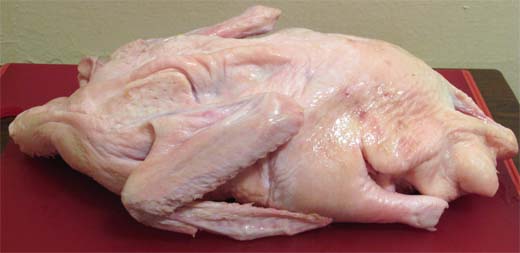
Motivated by stinginess, I substituted the $40 grocery-store goose with a fattier $14 duck, assuming my readers don’t mind the quack-quack, and the legs all danglin’ down-o. (I would have gone with lamprey, but it wasn’t on sale.)

People say you can’t replace a goose with a duck, but that’s just a canard.

“Take a Goos Duck, & make hure clene…”

“& hacke hyre to gobettys…”

(Out of consideration for my more sensitive readers, I’ve chosen to illustrate the hacking process with this magnificent image of galloping unicorn from the cover of a 1980s Trapper Keeper.)

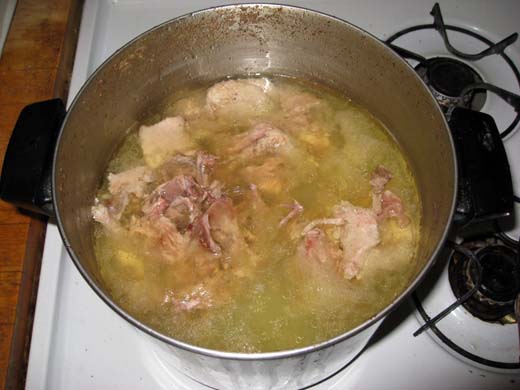
“& put yn a potte, & Water to, & sethe to-gederys”

After sethyng for two hours, the duck stock smells wonderful. (Although its smell probably isn’t as distinctive as lamprey stock. Did you know a mature lamprey can grow to nearly four feet long?)

Arise, my Cauldron-Born!

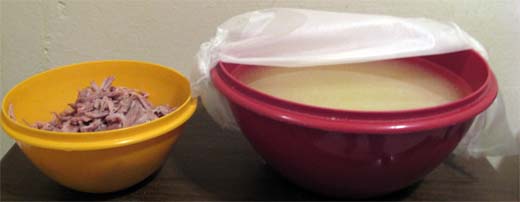
After discarding the bones and occasional pieces of skin, we’re left with a respectable pile of tender duck meat and tons of rich, delicious stock for next week’s soup. (Speaking of rich: during his time as an exile, Havelok the Dane took lampreys to market. It’s medieval literature, people!)

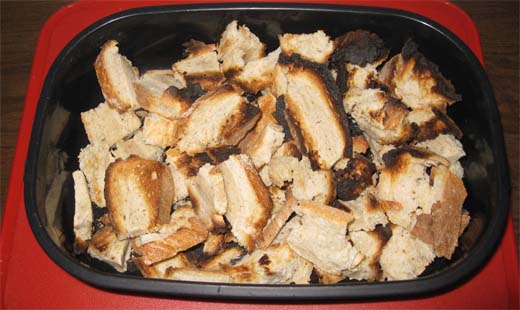
“þan take Pepir & Brennyd brede, or Blode y-boyled…”

Surprising, isn’t it, that boiled blood should be a suitable thickening substitute for burned bread? I’m not squeamish about cooking with blood, but I am squeamish about how blood curdles when it overheats. There aren’t enough unicorn pictures in the world (or enough lampreys to eat the mistakes).

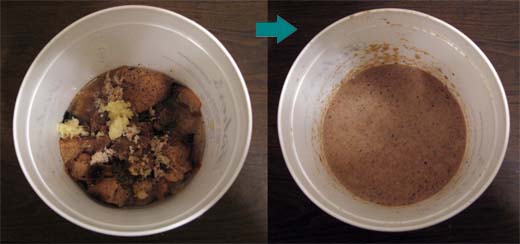
“…& grynd y-fere Gyngere & Galyngale & Comyn, & temper vppe with Ale, & putte it þer-to.”

While the bread soaks in the ale, let’s grate the fresh rhizomes, gather up the cumin and the pepper, and introduce the whole gallimaufry to Sir Braun de Hand-Mixer.

To distract you from the sight of that gravy, I’ll tell you that Henry I of England reportedly died from eating “a surfeit of lampreys.” (Today we know that you should never serve a lamprey to guests unless you’ve taken care to remove its surfeit.)

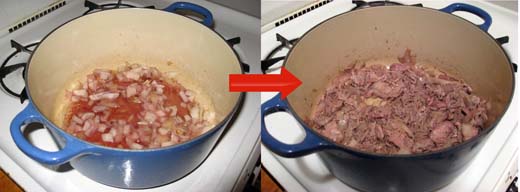
“…& mynce Oynonys, & frye hem in freysshe grece, & do þer-to a porcyon of Wyne.”

So yeah—add the meat and the gravy to the wine, grease, and onion base, and that’s what you get: duck hash. Add more gravy, and you get duck stew with the consistency of curry. Add even more gravy, and the meat vanishes in the glop.

And how does it taste? It’s hideous. Pepper, ale, and damp toast overwhelm the other flavors. Leave out the thickeners and all you taste is the cumin, even if you reduce the amount. The ginger and the galangal—which by itself tastes like a strong, perfumey mustard—barely register. Blood would not make it better.

So does that mean medieval people would have liked this slop? No: it means I botched it. I tried three times to vary the proportions and concoct an edible sauce, but the recipe is lacking. Like many medieval texts, it assumes a contemporary reader and omits crucial information for the ages: in this case, the secret to blending nearly a dozen disparate ingredients. I’ve learned my way around a kitchen—I can cook decent curries, tasty Chinese entrees, and a wide range of Western dishes—but without further experimentation and costly trial and error, I can’t help but find the medieval English kitchen as distant and exotic as Araby or Inde.

So this year, be thankful for the here and now, for the familiarity of turkey and New World tubers, and for the fact that I’m not at your door with a bundle of ducks in one hand and a medieval cookbook in the other. Although I can be, on pretty short notice, and with a casserole I like to call Medieval Surprise. The recipe is secret, but let’s just say its main ingredient rhymes with “famprey”…