“…and if we live the lie, let’s lie in trust…”

“The Green Knight is everything you love about King Arthur, but with a twist.” That’s the tag line Comcast is using to advertise streaming rentals of writer-director David Lowery’s visually sumptuous new movie. The angle surprised me: I didn’t know Arthuriana still sells. My sense was that the Arthurian boom peaked in the late ’90s with scores of fantasy novels and a few Hollywood movies, and I don’t think the streaming-video and Marvel Cinematic Universe generation has any particular love for the Matter of Britain.

Yet Lowery is undeterred, cheekily billing The Green Knight in its opening credits as “a filmed adaptation of the chivalric romance by Anonymous.” Of course, it’s not really an adaptation of Sir Gawain and the Green Knight. The court is never identified as Arthur’s Camelot, Gawain has a girlfriend, and the young squire takes up the Green Knight’s challenge out of a mixture of gratitude to his royal uncle and a yearning to star in a tale of his own. “Do not waste this,” warns the king, who doesn’t see the need to decide if the Green Knight’s wager is a trivial Yuletide game or an opportunity for greatness. Scenes, characters, and motifs from the medieval poem make cameos, but once Gawain sets off on his quest, even a reader familiar with the source material is well off the edges of the map.

The film provides signposts to amuse and misdirect the medievalist. To my amazement, a battlefield scavenger refers to a line from the ninth-century Welsh chronicler Nennius. At one point, Gawain reads “When the nyhtegale singes” from the 14th-century Harley manuscript in the British Library. The artwork showing the changing seasons behind a children’s puppet show is, I think, from a late medieval Book of Hours. I’m sure a ton of other visual references flew right past me. The Green Knight is a determinedly unfunny movie, but the art and design team clearly reveled in creating a setting that feels like an afternoon at the Cloisters, where one medieval century blurs lazily into the next.

Even without these gratuitous flourishes, the world of Lowery’s medieval fantasy would feel convincing. The king, never explicitly acknowledged to be Arthur, looks plausibly weak, aged, a tad unhinged. The queen, gray and mirthless, wears a dress that appears to be decorated with hundreds of medieval pilgrimage badges. Women dye and sew, bishops pray, woodsmen fell forests, and shepherds tend their flocks, and there’s a magical British bleakness to the land itself that suggests the hardness of life. The opening scene, a stationary shot of animals milling about in front of a shed on Christmas morning while a house burns down in the background, nicely suggests the natural world’s indifference to man. When Gawain sets off on his quest, one somber, uncomfortably long shot follows him away from the castle and through a heath, perfectly capturing the quiet uncertainty of preparing to travel alone.

If only The Green Knight had eloquent, poetic dialogue to match these rich visuals. Here’s a speech from the king early in the film:

I look out upon my friends here today and I see songs no muse could ever sing, or dream of. But I turn to thee and I see what? I recognize but I do not know thee. I say this not in reproach but in regret that I have never asked you to sit at my side before this day, or upon my knee when thy [sic] was newborn. But now it is Christmas, and I wish to build bridges.

For a film obsessed with lovely visual and cultural touches, The Green Knight shows no awareness of how speech in a pseudo-medieval fantasy world ought to sound. The mixture of “thee” with “you,” the ignorance of the simple “thou,” and the misuse of “thy” are constant, baffling oversights across the whole movie. At one point, the king asks Gawain, “What have thee?” When a medieval British saint turns up, even she doesn’t understand medieval or early modern pronouns. Some fine actors in this movie end up sounding like eight-graders at their first Renaissance fair, as if they’ve never heard a word of Shakespeare. The 1984 Miles O’Keeffe-Sean Connery fantasy movie Sword of the Valiant, also based on Sir Gawain and the Green Knight, flies hilariously off the rails after its first fifteen minutes, but at least its script gives good actors lines like “a sword is three feet of tempered steel, with death dancing on every inch and hanging like a dark star on the very point,” or “the old year limps to its grave, ashamed.” There’s a weird lack of wit and precision to the dialogue in The Green Knight, so strange for a movie that’s based on a gorgeous poem, uses quirky on-screen titles, draws directly from medieval chronicles and saints’ lives, and shows characters reading and adoring books.

Although I don’t plan to check, I’m guessing the Internet saw some ugly arguments in recent weeks about the decision to cast an Anglo-Indian actor to play Gawain. Who cares? Dev Patel is a compelling actor with a strong aura of vulnerability, and he’s a great Gawain in a movie where everyone is equally well-cast. Besides, the poem that inspired this film isn’t a historical document; it’s a weird, brilliant, stylized fantasy. Filmmaker David Lowery gets that, which is maybe why The Green Knight felt to me like a sincere 1980s American fantasy flick mated with the cinematographic resources of a humorless European art-house film. That’s not necessarily a deadly combination. Gawain’s episodic quest is packed with eerie images, and as a viewer you can write them off as random or try to find symbolic coherence in them as you please. In that sense, The Green Knight captures some of the unsettling weirdness of reading a medieval romance.

No one would ever take The Green Knight as an attempt at a faithful adaptation, and a generation of graduate students will likely pad their CVs with tiresome conference presentations about its loose relation to its medieval source. The film itself winks a few times in recognition of its creative deviations, first in a quick montage of the title in various typefaces, reflecting different editions and translations, and then in a character who admits to seeing “room for improvement” in certain stories whenever she copies old manuscripts. For me the question is not whether this movie is good or bad based on its level of faithfulness to its medieval source, but whether the filmmaker used his sources as a productive jumping-off point to create a new and interesting work of art.

I don’t think he did. The film puts forward some thoughts about following a code of honor to its thankless end, but the alternative, living a lie, leads to no less unhappiness—a much bleaker conclusion than the original poem’s gracious assessment of flawed human nature, where a hard tale’s leavened by lightness of heart. And so help me, the last fifteen minutes of The Green Knight recall one of the more unsuccessful efforts of Martin Scorsese, and it’s not remade more coherently here. The way Lowery has rooted through history, artwork, and scholarly scraps is an impressive act of medievalism, but his pastiche doesn’t say anything clear about the present or the past.

But maybe it will. Many “medieval” movies—I’m thinking of John Boorman’s Excalibur or that odd 2007 motion-capture Beowulf—need time to age, to cure or curdle into artifacts of their time. The Green Knight might someday be better in hindsight, when it’s influenced a generation of artists, aspiring historians, and would-be scholars who will recall how it felt in their bones to live through a pandemic, social unrest, and a disastrous military withdrawal. By then, this medieval dream and our current age may feel equally distant to them, and the despair in this movie will echo an overcome past.

“I’ve willed, I’ve walked, I’ve read, I’ve talked…”

Build your brand! Optimize your keywords! Like, review, subscribe! Writers now believe they have to carry on with this nonsense. Maybe some must, even though for most of us the returns are minimal and the requisite skills aren’t always inborn. Much good writing goes unread because a poet or novelist lacks the hucksterism of a real-estate agent or a window salesman. It’s a trend we won’t reverse but can resist, by writing whatever the heck we want and earning nothing, versus writing what a publisher wants to buy from us and earning something close to nothing.

And so I cheer when I discover writers who are willfully deaf to marketing trends, the siren song of self-promotion, or the empty allure of becoming Fame’s latest love-child. Since last year, a poet friend of mine has been doing just that with “Human Voices Wake Us,” and a more refreshingly uncommercial podcast I simply can’t imagine. He runs no advertising, not even for his own excellent books, and he doesn’t put his name on the podcast, wishing to be if not anonymous, then at least a wallflower, to let literature enjoy a rare moment of pure attention.

“HVWU” has no set format. Sometimes you might get a week of brief readings of poetry by Seamus Heaney, Robinson Jeffers, and other 20th-century stalwarts—but between those episodes, settle in for hour-long selections from a biography of Walt Whitman and scholarly books about ancient Egyptian religion, or thoughts on re-reading Gilgamesh. As I write this, he’s spending a week mulling over quotations from scientists, politicians, and military leaders about the making of the atomic bomb, to chilling cumulative effect. All of “HVWU” follows the whims of one man’s whirring, well-read mind, but only occasionally does the host consciously focus on his own work. In one episode, he speaks abashedly but with candor about the jealousy with which less successful writers look upon their better-selling peers. In another, he digs up one of his T.S. Eliot-inspired teenage poems about suburban life and reviews it with the pensive, tolerant eye of the 40-year-old husband, father, and poet that high school kid became.

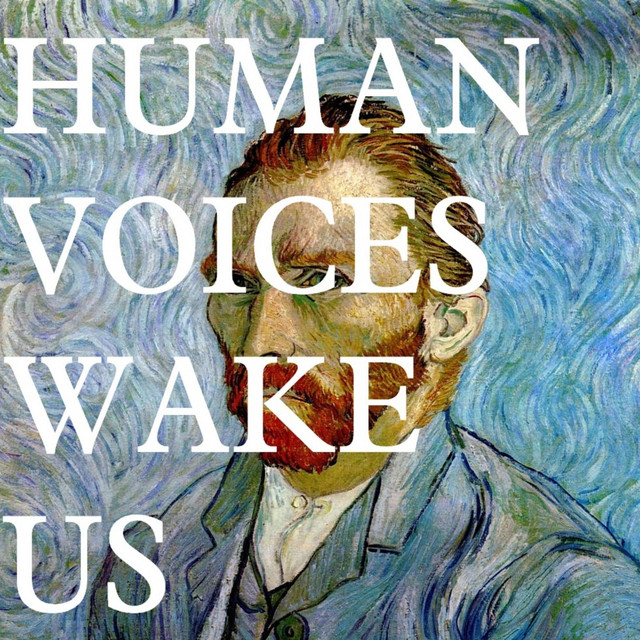
If you find National Public Radio unlistenable for its commercialism, predictability, and lazy arts reporting, and you don’t give a damn what everyone else is reading or talking about, and you appreciate an unrushed, gentle-voiced host sharing his favorite poets, ancient myths, and centuries of writers’ thoughts about creativity at a pace that’s entirely his own, then the “Human Voices Wake Us” podcast might fulfill a craving of your heart and mind. You can listen through Google Podcasts or Anchor.fm or whatever other podcast app you use; as long as you see the graphic with the self portrait of Vincent Van Gogh, then you’ve found it.

After enjoying more than a hundred episodes during my long drives through rural Maryland, I know the “HVWU” intro by heart:

The poem says, “Human voices wake us, and we drown.” But I’ve made this podcast with the belief that human voices are what we need. And so, whether from a year or three thousand years ago, whether poetry or prose, whether fiction or diary or biography, here are the best things we have ever thought, written, or said.

That’s a heady promise from someone who records episodes in a grocery store parking lot or in a basement after putting his toddler to bed. If the podcast turns out not to be for you, it might at least remind you what independent thought about books and art is supposed to sound like, and how much you’ve missed it.

“Something unseen, some hand is motioning…”

The Brood X cicadas have risen again, crawling up our tree trunks, our wooden posts, our concrete foundations—any upright surface suits them fine. The last time they emerged, I was living in a city and wondering where I’d find myself after 17 years. Now here I am in the country, with the cicadas’ deafening song rattling the farm fields like a siren, as if announcing an endless emergency just beyond the tree line.

In 1800, my fellow Marylander, Benjamin Banneker, recorded his evolving awareness of cicadas in his astronomical journal:

The first great locust year that I can remember was 1749. I was then around seventeen years of age, when thousands of them came and was creeping up the trees and bushes. I then imagined they came to eat and destroy the fruit of the earth, and would occasion a famine in the land. I therefore began to kill and destroy them, but soon saw that my labour was in vain, therefore gave over my pretension. Again in the year 1766 which is seventeen years after the first appearance, they made a second, and appeared to me to be full as numerous as the first. I then, being about thirty-four years of age had more sense than to endeavour to destroy them, knowing they were not so pernicious to the fruit of the earth as I did imagine they would be. Again in the year 1783 which was seventeen years since their second appearance to me, they made their third; and they may be expected again in the year 1800, which is seventeen years since their third appearance to me. So that if I may venture so to express it, their periodical return is seventeen years: but they, like the comets, make but a short stay with us. The female has a sting in her tail as sharp and hard as a thorn, with which she perforates the branches of the trees, and in them holes lays eggs. The branch soon dies and falls. Then the egg, by some occult cause immerges a great depth into the earth, and there continues for the space of seventeen years as aforesaid.

I like to forgot to inform that if their lives are short they are merry. They begin to sing or make a noise from the first they come out of earth till they die. The hindermost part rots off, and it does not appear to be any pain to them for they still continue on singing till they die.

For those of us who feel trapped these days between competing tribes of vandals, Banneker’s note on cicadas is a model of civilized thought. Time, observation, contemplation, and a willingness to amend his prejudices all add up to a more mature understanding of the world, one that still allows for amusement, enchantment, and even a flicker of poetry. Where I’ll be in 17 years doesn’t matter—probably here in the same patch of woods on the same quiet road—but I hope we’ll find more Bannekers among us.

“Night is day, and twilight’s gone away…”

When the pandemic began, friends asked me what insights I could glean from studying and writing about the Middle Ages for as long as I did. “Nothing,” I told them, which remains true.

Yet I can’t shake the feeling that we’re living through an apocalypse—not necessarily in the religious, end-of-the-world sense, but in the literal meaning of the Greek word for a revelation or an unveiling. Here in our small town, we’ve learned, sometimes contrary to ordinary-time assumptions, which neighbors, including putative leaders, are useless in a crisis, and which ones possess unforeseen reserves of resourcefulness, selflessness, and hope. If we’re being honest, we’ve each discovered a few unflattering things about ourselves too, whether we admit it to others or not. I expect the disquieting clarity will linger even after clouds and fog return.

Every December I post a “best of” recap of the year that was. This was the year I took down the blog because of technical issues and brought it back to life on a stable new host. I shared news of a book I’d been working on for two years with my friends and neighbors, and then I offered thoughts about Mike Tyson’s fascination with Frankish history.

And that’s it. That’s not a prolific year, blog-wise, but given what 2020 has otherwise brought, the fact that we’re still here and I’m still writing will have to suffice. If you’re pass through this blog in the days and weeks ahead, I wish you, in all sincerity, a healthy and prosperous 2021.

“And this world’s a fickle measure…”

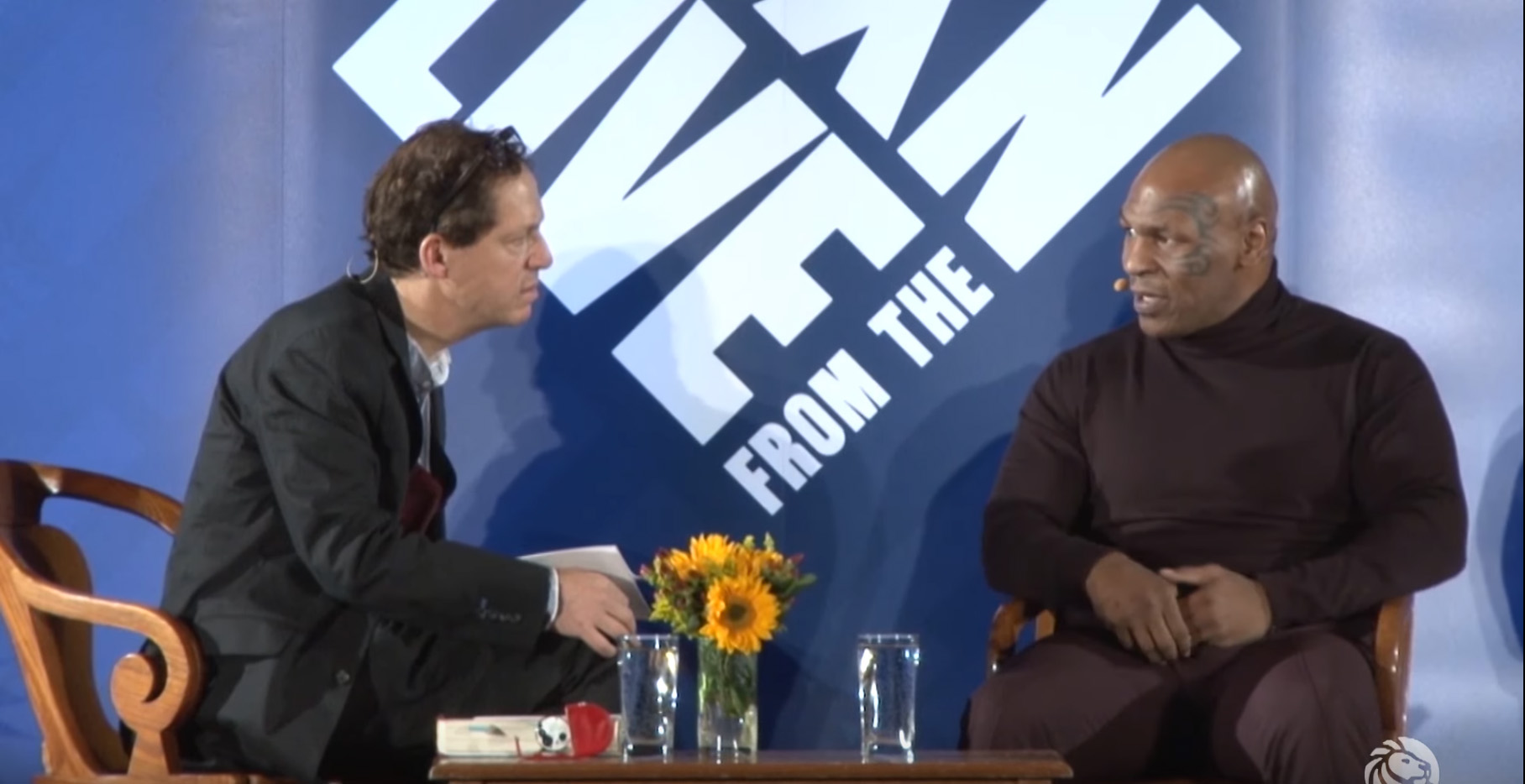
They told me, “You have to watch this interview where Mike Tyson talks about medieval history,” and so I did, and there he was at the New York Public Library in 2013 being interviewed by curator Paul Holdengräber, whose German accent strikes the American ear as both effortlessly intellectual and lightly amusing, and who would seem to have nothing in common with the face-tattooed boxer.

The two men do, in fact, find much to talk about. Their discussion is mesmerizing, because to most of us Mike Tyson is nothing but a face and fists, not a man who reflects aloud and at length about his inner life. Holdengräber prompts a reticent Tyson to narrate clips of his greatest moments in the ring, and newcomers to boxing will easily see why Tyson was such a sensation, but Iron Mike grows more animated when other matters arise.

Half an hour into the interview, Holdengräber says that their mutual friend, eccentric German filmmaker Werner Herzog, urged him to ask Tyson why he’s so fascinated by Clovis, the founder of the Merovingian Frankish dynasty, and Pepin the Short, the first Carolingian king of the Franks. Tyson’s answer, however halting, makes him come alive:

I don’t know—it all comes from my insecurity from being poor, and not having enough—to be insecure, and being—yeah, that’s what it is: obscure. I never wanted to be obscure. I was born in obscurity and I never wanted to deal with that again, never wanted to be that. And they came from obscurity.

Tyson then narrates a capsule history of the Frankish kings. He rambles, he doesn’t get all the details right, and his mispronunciation of names marks him as an autodidact, but it’s a shame to hear the audience laugh when Holdengräber asks, “Mike, how do you know all this shit?” Whether Tyson is mapping his own experiences onto medieval history or hearing echoes of the Franks in his troubled life, the credentialed, status-conscious audience is uncomfortable with his sincere interest in a past they find trivial.

Yet Tyson is the real deal, a book lover not because his peer group yaks about whichever author the New York Times has dubbed fame’s latest love child, but because he’s hungry for ideas, for meaning, for connections across time. He speaks with undisguised emotion about Cus D’Amato, the trainer and manager who turned him into a lethal boxer. Obsessed with Nietzsche and Clausewitz, D’Amato taught Tyson to see boxing as war and war as the key to decoding the world. “That is just what I do,” Tyson explains, an attentive pupil and dutiful son. “I love war. I love the act of war. I love the players in war, the philosophy of war.”

Tyson is searching for more than war on the pages of the past. Having grown up amid crime and chaos and founded his life on violence, he now relies on books to make moral and ethical sense of the world:

Yeah—they’re our most priceless possessions, because if you think about it, you know, a room without a book is like a body without a soul. It’s the only way that we can connect the future with the past. Without that, there’s no way that we can know about the future, and know about particularly the past, or the present, you know, that when you think about history, the value of history is not necessarily scientific but moral. By liberating our minds and deepening our sympathies and fortifying our will, we can control—pretty much history allows us to control not society but ourselves, which is a much more important thing to do, you know what I mean? And it would allow us to pretty much meet the future more so than foretell it, and for that reason alone, in order to predict the future we always have to look through the past, because very rarely does time not repeat itself, and it always will repeat itself.

I’ve heard a quote before in a book that we would be fools to think historically that the past is us in funny clothes, but the past is us in funny clothes, and that’s truly what it is. That’s from somebody who really said a really profound statement but he misquoted what he was saying, he must have been saying it backwards, because that’s really what the past was, it’s just us in funny clothes, in different times, that’s really what it is.

Of course, to hear Tyson cite a quip inaccurately attributed to Cicero, “a room without books is like a body without a soul,” is to wonder if he’s putting us on. Late in the interview, he jokes that if you quote books, you fool people into thinking you’re smart—but Tyson, for all his malapropisms and mispronunciations and odd mannerisms, is intelligent. He’s going round after round with big questions that many of the ostensibly educated attendees at his book-talk don’t bother to ask.

When Holdengräber suggests that Tyson’s knowledge of history didn’t improve his behavior, Tyson calmly disagrees. He compares himself to the fictional Ben-Hur, a fellow athlete and celebrity who achieved glory but was doomed to be unfree until he set his priorities in order: “He may not have been famous again,” Tyson points out, “but he got his family, and that was his success.”

After listening to Mike Tyson—childhood criminal, devastating fighter, struggling alcoholic and recovering drug addict, convicted rapist, pop-culture eidolon—speak for an hour and a half, I still don’t quite know who he is. He may be the closest thing 21st-century America has to a Robert E. Howard character, a born barbarian who’s ignorant of social niceties but possesses earned wisdom that the civilization around him disdains. I don’t know whether he’s all in on his bookish pursuits or one slight away from again gnawing off someone’s ear. Whether he’s a good man or a bad man feels foolish to ask about a professional punch-thrower who reads Nietzsche, but Tyson looks like a better man, one who has perhaps searched harder for his humanity than the onlookers snickering from the safety of their library seats. What has their pride gained them? Tyson’s, by contrast, has brought him perspective, and with it the humility to admit that his story is still being written—and has been before.

I Have Started for Canaan: The Story of the African American Town of Sugarland

I don’t have romantic notions about what writers do—but every so often, our work has profound implications for neighbors and friends.

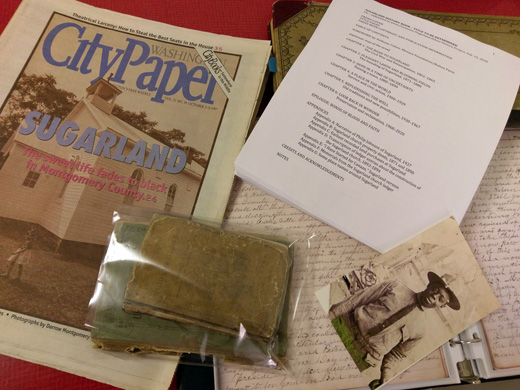
In January 2019, I met two great-granddaughters of the founders of Sugarland, a town established by former slaves immediately after emancipation in rural Montgomery County, Maryland. My new friends were tenacious historians who had collected 150 years’ worth of sources—photographs, meeting minutes, construction contracts, land deeds, funeral programs, military records, church ledgers, oral histories, artifacts, you name it—and they were ready to turn their collection into a book for a wide audience. After nearly two years of brainstorming and collaboration, we’re finally putting that book in readers’ hands.

Defying familiar narratives of the African American experience that focus on sharecropping or urban life, I Have Started for Canaan is a remarkable chronicle of rural self-sufficiency. In a corner of the countryside 20 miles from the nation’s capital, the Sugarland families owned 200 acres of farmland immediately after the Civil War. At its height, their town boasted a schoolhouse, a general store, a post office, a practice hall for a brass band, and a church that still stands today. To the best of our knowledge, I Have Started for Canaan is the first book-length history of a Reconstruction-era African American town in Maryland.

To learn more about the work that went into this book and the richness of the primary sources in the Sugarland collection, check out this online presentation I gave in May. If you’d like to buy a copy, you can order directly through the Sugarland Ethno-History Project online store.

I Have Started for Canaan was a volunteer project for me, so every dime of profit from book sales will go back to the Sugarland Ethno-History Project for the upkeep of their cemetery and historic 1894 church, the preservation of their collection, and—if all goes well—the eventual creation of a small museum. I’m proud to have helped bring this story to the world, and I hope you’ll be as inspired as I was to hear the clear, confident voices of the Sugarland founders resound across 150 years.

“…and in this town of stops and starts…”

It took a few months, but I managed to transfer this blog to a new host. Links to posts from outside sources may no longer work, so if you’ve linked to a book review or favorite post in the past, you’ll need to find it via the search box in the sidebar and re-link to it.

On the plus side, the entire blog going back to 2007 has been restored, with special thanks to George for technical assistance that made it possible to save all of the photos as well.

If you’re new to this blog, welcome! For 13 years, I’ve used this site to write about America’s obsession with the Middle Ages, but I’ve also veered off into literature, history, formal poetry, and other topics that aren’t of interest to editors who actually pay for eyeballs and clicks. To see what I mean, browse the “categories” list in the sidebar, which includes the yearly “best of” posts.

Right now I’m focused on a project with a definite place in the world. For the past a year and a half, I’ve collaborated with two friends on a history of a Reconstruction-era African American town. The book will be available this fall; check out this video presentation from May and you’ll see why I’m enthusiastic about the story my friends’ ancestors have to tell.

(If the video doesn’t play, try clicking through to YouTube here.)

Thanks to all of you who sent emails, left comments, or shared thoughts on social media back in the spring. You convinced me that it was worth the trouble to keep the blog up and running. The traffic I get from search engines further suggests that someone, somewhere is always searching for more about a book, a poem, or a scrap of history that once caught my attention too.

Words aren’t precious; I don’t understand why all writers don’t have blogs for catching the sheer overflow of ideas, but I thank you for visiting mine. I may never post on a regular schedule, but I’ll offer you this: whatever turns up here you’ll never find anywhere else.

“Check if you can disconnect the effect, and I’ll go after the cause.”

On June 1, 2020, almost thirteen years to the day since it began, this blog will disappear. My hosting service is shutting down, and I don’t have time right now to find an orderly home for hundreds of old posts.

In truth, this blog has been held together by pipe cleaners and putty for years. I grappled with outdated PHP, hopeless security issues, and chunks of code I cobbled together myself. The site crashed every time I uploaded a tiny image. Line spacing and photo placement were never right. Vital plug-ins were incompatible with each other. A database with a will of its own made it impossible for me to write and post when I wanted.

Yet it’s been fun. People are surprised when I say that much of my favorite writing is on this rickety site, even though some of it may be outdated, indulgent, or regrettable. Several posts still get quite a few hits per day from people looking for subjects they’ll only find here. Over the years, those posts have drawn more eyeballs, and sometimes better feedback, than books and articles I’ve written that carry the supposed prestige of someone else having published them.

When I started “Quid Plura?” in 2007, I had just written a book about Charlemagne, and I was still in my ten-year run of teaching medieval literature. Everything has changed since then—where I live, how I live, and even what I research and write. For the past year and a half, I’ve been collaborating with the descendants of the founders of a local town to tell their long-awaited story. As far as we can tell, the book we’ll publish this summer will be the first full-length history of a Reconstruction-era African American town in Maryland. If you’d like to learn more about our project, check out this video presentation, which will be viewable online through May 11.

Later this year, I’ll probably re-establish this blog with a new host. I like having my own little corner of the Internet. Blogs, however unfashionable, foster independent speech, the most potentially measured exchanges, and long-form writing on topics for which there aren’t paying markets.

In the meantime, if you need to find me, I’m available by email (jeffsypeck –at- gmail –dot- com), I check Twitter occasionally, and I have a new website to show off my professional writing. In the past thirteen years, this blog has brought me new real-world friends and many faithful long-term correspondents. People who still read blogs are the best kind of weird. They find, as I do, that corporate social media reins in discourse and smothers thought. If you’re one of those readers, thank you! Blogs give us room to breathe. That’s why I can’t imagine “Quid Plura?” not returning when the time is right. There’s always more to say.

“People don’t sing like they used to sing…”

Every December I do a roundup of blog posts from the passing year, mostly as an easy index for my future self. This year has been the least prolific in the thirteen years I’ve been doing this, and I’m okay with that. Since January, I’ve been helping a local organization write a book that’s going to mean a great deal to people in my community, and possibly far beyond. It’s a good kind of busy.

In the meantime, I’m glad “Quid Plura?” still exists, in all its archaic glory, to serve as a notepad for notions that no one would foolishly pay me to write.

This year, the Old English poem “Deor” gave me insight into a botched Smithsonian exhibition about Maryland sharecroppers—and vice versa.

In November, I was involved in a ceremony with implications I’m still mulling over, but studying a medieval martyrdom half a lifetime ago helped me make sense of a modern lynching.

I took some time to look at some of the bigger artistic and cultural questions in “The Banjo Player” by Fenton Johnson, a poet who never quite found the audience he craved.

A pithy post about the fire at Notre-Dame de Paris held up better, so to speak, than blogging about the news usually does.

By contrast, we’ll see if these thoughts about speech, online mobbing, weird thinking, and bad faith in academia make sense down the road.

Happy new year to those of you who still wander this way! Check back in 2020. To my eternal surprise, there’s always more to say.

“Break all the windows in the cold, cold ground.”

A knight sliced in half like a sesame bagel, a saint tossed down a hillside in a barrel lined with nails—pain is an ageless wellspring of humor, but we were too weirdly willing to laugh. As graduate students, we were honing our sense of which aspects of the Middle Ages were born of certain eras and places and which others were timelessly human. Yet something about the classroom made the medieval world harder for me to imagine. The line of scholars whose work helped us understand the past in the first place also stood in the way of a gut-level sense of real people’s lives. Then the violence was never real, only a source of other people’s pictures or words, like an idealized painting or flippant cartoon.

That changed in our second year when we studied an account of the martyrdom of St. Eulalia of Merida by the fifth-century poet Prudentius. Even though Eulalia’s faith emboldens her to taunt her tormentors and laugh off her own suffering, the descriptions of her mutilation are horrifically clinical. As a class and on our own, we translated each of the poem’s 215 lines, sobered to find that two years of Latin had brought us to such a repellent place. What made Eulalia’s martyrdom different was that we didn’t merely read words on a page. We hoisted huge dictionaries, paged through grammars, flipped through stacks of handouts, trudged across campus to recite the Latin verse and our graceless English, and tensed up when called on to read. It may have been faint, but we felt something real in our muscles and bones, a memory carried for twenty-odd years.

Last month, our town hosted a ceremony to remember one of the worst things that ever happened here, the lynching of a black man. He was accused of attacking a young white girl, but a mob denied him the justice of a trial. Not long ago, elderly locals might have heard enough from their parents to be able to name the killers or point out the dead man’s grave. Now, except for snippets from scanned newspapers, the victim is as distant as a figure in a medieval text, a fictional character rather than someone who lived.

The site is still there, just a few long strides from the main intersection. It’s eerily open, like the grassy remnant of a battlefield declared sacred only after the rest has been paved. Locals say that within living memory, a storm blew down a massive locust tree; it may have been the makeshift gallows. The church across the street hasn’t changed, except for a gravel lot for cars where the congregation used to park horses and wagons. Families arriving for Sunday services the morning after the lynching could not fail to notice the constable cutting down a corpse.

I’ve toured historic homes that looked as if their famous residents had just stepped out for lunch. I’ve stood at sites where thousands died, and others where worn-away ruts in the ground begged the imagination to run reckless over the post-holes of hill-forts and mansions. Those places made me think, and think, and think. At times, though, I wanted to feel something more. No matter how many years I hewed and hacked through ninth-century sources, not once did I hear the eldritch murmurings of kings or monks or sense a spectral hand on my shoulder. History was dead; my job as a writer was to gather and narrate its traces.

I was leery of the plan to take soil from the lynching site. The act sounded too pious and medieval, like sifting for relics to venerate, or too frivolous and modern, like filling a keychain with sand from the beach. Even so, the morning before the ceremony, I drove to the field with a shovel and spade and met others tasked with preparing the site. The ground was pliant from days of rain, so with no special reverence, I peeled up one of four grassy squares and loosened the dirt underneath. When I looked up, kids in pickups still drove to McDonald’s for breakfast, and tractors kept on rolling out of town toward the last shriveling fields of the year.

On the next day, a cold, cloudless Sunday, more than a hundred onlookers formed a crescent around the gazebo next to the church. Some of us don’t have deep roots here, but scattered among us, and settled unknowingly in nearby houses, were descendants and relatives of everyone whose lives converged on that spot in 1880: the men who raised the lynch mob; former slaves who knew the victim; the constable who tried in vain to stop the murder; and the black congregation that claimed the body and laid it to rest. Ashes and dust—our past and our future, summoned to gather in flesh and blood, shifting uneasily at the story retold.

After a benediction, a proclamation, speeches, and poems, we turned from the churchyard and crossed to the field. Squinting in the stark, clarifying sunset, people lined up to scoop soil into jars. Some filled small canisters of their own. The motion and effort made sense; no one was left to chase around their windblown thoughts. The ground gave everyone something to do, exertion their bodies might feel and remember.

An event that began in mourning and solemnity concluded with hugs and handshakes and an unforeseen lightness of heart. No ghosts hovered near us or stood by the roadside and watched. The veil of the past hadn’t risen or torn, but the chasm between old, unacquainted truths was maybe no longer so wide. Justice for the dead isn’t ours to bestow, but empathy for those who suffered, whether a century or a thousand years ago, can make a field full of strangers tremble as one, if they do more than offer up words. If you wait half your life and the earth doesn’t move, don’t just stand there. Move it yourself.