 After Becoming Charlemagne came out in late 2006, I spent nearly two years talking about the early Middle Ages wherever anyone asked me to do so—at libraries, bookstores, museums, senior-citizen programs, even a tea salon in a suburb of New Orleans. I had several templates for speeches, all of them customizable for different venues and occasions, including one really fun presentation about the founding and early decades of Baghdad. But when the branch of the University of Maryland where I was teaching asked me to give the plenary address at a conference for writing instructors, I got a little more nervous than usual.
I’ve never been a writing instructor—I don’t have the necessary patience—so I wondered: What did a part-time medievalist have to say to teachers who do some of the English department’s hardest and least glamorous work?
As is so often the case, once I reframed the question to be less about myself, I found there was plenty to say after all.
Here’s a transcript of the speech, edited to remove introductory banter, a couple of brief tangents, and legions of unflattering “ums” and “ahs.” I wish it hadn’t taken so long to post this somewhere, but hey, if something is worth saying, maybe it’s still worth saying eleven years later.
* * *
“The old wine of ancient learning”:
The medieval classroom and its lessons for modern writing instructors
Plenary address, Fourth Annual UMUC July Writing Conference, Adelphi, Maryland
Friday, July 27, 2007, 9:30 a.m.
Thank you for the invitation to come speak to you all this morning. It’s always an honor to be asked to give a talk, but it’s even more of an honor to be asked to speak with colleagues about writing, and putting some of what we do here at UMUC in its historical context. I’m really humbled by, and grateful for, the invitation.
Now, because I teach medieval literature and write about medieval history and culture, I wanted to do a little digging to find something appropriate and relevant to talk about. As Matt pointed out, I recently wrote a book, two little books, about Charlemagne, the king and emperor who was a patron of education and who, like many of our UMUC students, came to scholarship fairly late in life, but with tremendous passion. Charlemagne and the great teachers of the early Middle Ages revived and perpetuated ancient and time-tested educational methods, which helped keep learning alive for the past 1,200 years, so I thought I’d spent a little time this morning discussing the pedagogical traditions we inherited from them—what Charlemagne’s chief advisor, a man named Alcuin, referred to as “the old wine of ancient learning.” It’s a tradition that all of us in this room are working in to some extent or another, even if we’re not necessarily aware that we’re doing so.
So why look to the early Middle Ages? It’s an era commonly dismissed as the “Dark Ages,” and perhaps understandably so. Europe was a collection of competing kingdoms and tribes, very few people were literate, monasteries were the sole repositories of surviving knowledge, and the first universities were more than 300 years away. In fact, the brightest, most perspicacious people in Europe during the seventh, eighth, and ninth centuries couldn’t have imagined a day when there would be a sufficient number of literate, well educated people to populate such an institution.
But when you look at the manuscripts, the classroom texts, and the teaching methods of the early Middle Ages, you find habits and practices that I think would warm the hearts of pretty much everybody in this room. You find, for example, an obsessive attention to what today we would refer to as “literacy” and “critical thinking skills.” We find a true love of learning—even more admirably, a love of language, the nuts and bolts of language: how language works, how you put words together, how you put sentences together, how you communicate with other educated people. And you find that underlying all of this is an incredible sense of purpose, a real sense of mission. Thanks to the efforts of the monks of this era, within a generation or two, literacy was spreading, old books were being copied and preserved at unprecedented rates, and new books were being written for educational use.
So there are really a few things to discuss here this morning: What was this educational curriculum and where did it come from? And also, what made it so successful in such an uncertain and illiterate era?
The answers to those questions contain real lessons for those of us who teach writing, composition, and literature, and in the end I think they leave us with further interesting questions to ponder as well.
* * *
Now as to that first question: Where did this educational curriculum come from? Medieval people didn’t concoct it out of nothing. Medieval learning was derived from ancient Roman educational methods, so let me talk for a moment about what came before.
At the height of the Roman empire, when Rome was prosperous and powerful and stretched from Scotland to the Middle East, young boys began their education with somebody called a litterator, a tutor or a teacher who taught them the basics—who, as the name implies, “lettered” them, and gave them fundamental reading and writing skills. At the age of 12, they attended classes with the grammaticus, a grammarian, where, since they were ancient Romans, they studied Greek and Latin. They read literature, especially poetry, and emphasized grammar and syntax. On the side, they also studied history, mythology, and basic arithmetic. Around the age of 14 or 15, they moved on to the full study of rhetoric. They read prose writers, they practiced composition, and they attempted elaborate written and spoken exercises. They also studied law, philosophy, and science, but usually philosophy and science got short shrift in favor of law. The children of the wealthy were going to need that legal training if they were going to get a good job with the civil service. Some things really don’t change.
The Romans didn’t have a single name for this curriculum. Cicero had referred to it as the “liberal arts” and “liberal disciplines”—artes liberales and liberales disciplina—but he never really spelled out exactly what he meant by them or exactly how many liberal arts were in this curriculum, at least at first. The Latin adjective liberales here indicated an education worthy of a man who was liber, or “free,” but it also connoted courteousness, generosity, honor—in short, the behavior of a cultivated man, anachronistically someone we might think of as a “proper gentleman.”
This term “liberal arts” continues to pop up even after the heyday of Rome and well into Late Antiquity, even as there were fewer of these “proper Roman gentlemen” roaming the Forum. For a while there’s some disagreement in Late Antiquity about how many liberal arts there even are. Some say nine, but most agreed that there were seven, in two groupings: a primary grouping of grammar, rhetoric, and dialectic; and a secondary grouping of arithmetic, music, geometry, and astronomy. (A few ancient writers tried to squeeze medicine and architecture in there to form nine, but those never really stuck.)
Fast-forward a few centuries, and this was the basic educational philosophy, this curriculum of seven liberal arts, inherited by early medieval people.
They knew from reading the centuries-old works of Saint Augustine—Charlemagne’s favorite writer—that this curriculum was essential. Saint Augustine had said in his youth that the liberal arts “are learnt partly for the conduct of life, [and] partly for the understanding and contemplation of the Universe.” And by the year 800—the high point of the reign of the king and emperor Charlemagne—this curriculum was thriving.
Of course, the world was a very different place by this point. The Roman Empire was a memory; the social institutions of Europe had devolved and were rather unsophisticated, by the standards of a few centuries earlier; and Christianity, not Roman paganism, was the predominant belief system.
Yet this same basic liberal arts curriculum endured, and even gained new life, in the hands of these early medieval monks. The grouping of four secondary subjects—arithmetic, music, geometry, and astronomy—had already been known for centuries as the quadrivium. But the grouping of the three primary subjects got its name around this time. Sometime around the year 800, the curriculum of grammar, rhetoric, and dialectic became known as the trivium. This is literally, in Latin, the place where three roads come together; it’s also where we get our modern word “trivia.” Most people think that “trivium” is an old Roman term, but in the context of education, it’s not—it’s a medieval term.
So that’s where the curriculum came from, and how medieval monks found themselves in possession of it.
But what did these early medieval monks do with the trivium once they devoted themselves to it? And why and how where they so successful?
* * *
Well, they put their own early medieval twist on the old Roman subjects of the trivium.
At the core of it, of course, was grammar, with “grammar” very broadly defined. We think of it as a narrowly defined subject today, but to them it wasn’t. It was the study of literature, both secular and religious, but it was also “grammar” as we define it now: letters, words, parts of speech, even handwriting—orthography—and vocabulary. They began their study of grammar by memorizing the psalms. The psalter, the Book of Psalms, was their primer. They combined a tremendous amount of memorization with an emphasis on the underlying technical aspects of language. They used all these Late Antique writers and early medieval authors—Donatus, Priscian, and St. Isidore—and they had many newly compiled dictionaries and glossaries to help them understand exactly what it was they were reading.
When they were ready, when they had sufficiently studied grammar, they, like their ancient Roman counterparts, moved on to rhetoric and studied, among other books, the works of Cicero, or new books closely based on Cicero’s writings. (We would consider these books heavily plagiarized from Cicero, but they didn’t have those sorts of intellectual-property issues; they were able to get away with imitation in ways we wouldn’t allow today.) They learned practical skills when they studied rhetoric, and I find the list of these things rather interesting. They learned how to write a letter of condolence; how to describe a king (in a flattering way, of course); how to compose—and I love this one, we should all assign this at some point—a debate between winter and spring, the old classical debate genre, which they took up in the Middle Ages as well. They also wrote letters announcing the election of a bishop or the death of a member of their local community. And they learned how to do this with metaphors, rhymed prose, parallelism, and a host of other rhetorical skills drawn from ancient writing and ancient examples.
The rhetoric manuals from this time are really remarkable. I dug into one in preparation for coming to give this talk today. Medieval authors read Cicero and imitated him very closely, and in these early rhetoric manuals, rhetoric has a grammar all its own, with five parts: invention, arrangement, style, memory, and delivery; and three types of questions: demonstrative, deliberative, and judicial; and four types of disputes and debates—and so on and so forth, with all sorts of classifications and sub-classifications, with clearly defined rhetorical strategies outlined and described and meticulously classified along the way. I can tell you that the precision and thoroughness of medieval thinkers is dazzling when you first encounter it. It doesn’t at all fit the stereotype of medieval people as backwards.
Once a student sufficiently mastered rhetoric, he moved on to dialectic, which as far as medieval people were concerned was essentially logic: how to use language accurately by focusing on precise definitions and logical arguments. Here they did syllogistic exercises, often in question-and-response format. In the classroom and in the textbooks of the time, there are these great medieval dialogues between a thinker and whoever the king or prince happened to be, so conversational yet so precise, clear examples of the Socratic method in action.
Keep in mind that medieval students had the added difficulty of having to do all of this in Latin, which they were studying on top of speaking their own vernacular languages. At every step, they were encouraged to read the best and most difficult Latin texts available; they were encouraged to confront and engage with writings produced by the finest minds, such as Cicero and Virgil and Saint Augustine—and, of course, King David. Ultimately they did so that they could understand and interpret the most important text in their world, which of course was the Bible—but a great deal of rigorous work involving pagan and secular authors was required to get them to that point.
One dialogue in a rhetoric textbook quotes Charlemagne himself as saying this:
I confess…that to me these requirements appear at first glance to be very pleasant and just and moderate. But as I look at them and come to understand them, I see that they postulate constant exercise and daily practice, and that they cannot be perfectly fulfilled except by unremitting thought and close study.
I’d love to give that to every one of our students as they get ready to study writing and literature.
Charlemagne was right: the trivium was not to be breezed through. In fact, developing the ability to read, write, analyze, argue, and understand was a lifetime project. It began, in youth, with memorizing the psalms; it required years of composition practice and a tremendous amount of memorization and imitation; and it ended—if it ever ended—with being able to write original poetry in Latin, which many educated people were never able to do, and which even the best-educated people often got wrong.
But this was “lifelong learning” in the truest sense of the term. No matter what an educated person went on to study, whether he dabbled in music, astronomy, arithmetic, medicine, you name it, he never stopped studying grammar; he never stopped being obsessed with language; and he never stopped improving his own rhetorical skills.
The poets of the ninth century were very certain about this. A witty Goth named Theodulf who was bishop of the city of Orleans wrote a poem in which Grammar is an allegorical figure. She stands at the root of a tree that represents all knowledge.
Theodulf writes:
The entire tree seems to proceed from her, because no art can be brought forth without her. Her left hand holds a whip, and her right hand a sword: the first is to drive the lazy, the second is to weed out vices. And since wisdom is in the first place everywhere, a diadem [a crown] adorns her head.
So Grammar was the queen and the root of all knowledge. (Of course, Theodulf can’t get away without a dig at some of his lazier students. He’s a bit of a wiseguy by ninth-century standards.)
The standards he discusses in this little excerpt from his poem about the seven liberal arts are supported in many of the other classroom texts, poems, and other accounts we have from the early Middle Ages.
Amazingly, we have one manuscript, in the library at St. Gall in what’s now Switzerland, that’s the personal notebook of a well-educated abbot from around the year 850, and it demonstrates how medieval people truly made a lifelong commitment to studying language. The abbot’s name was Walahfrid Strabo—Walahfrid the Squinter. If any of you are gardeners, you may have seen references to Walahfrid. He wrote a famous book about gardening, and he tended a famous garden at Reichenau, and if you visit the National Cathedral and go into to the Bishop’s Garden here in D.C., there’s a little “garden room,” as they call it, devoted to the era of Charlemagne, with little signs with snippets from Walahfrid Strabo. (I like seeing these little snippets of the Middle Ages popping up unexpectedly.)
When he wasn’t writing, Walahfrid was the personal tutor of the Emperor Charles the Bald. And he apparently kept this notebook, this little vademecum, that he took with him wherever he went. It’s amazing we even have this.
It’s 394 pages long. It includes mathematical tables, medical texts, excerpts from chronicles and calendars, even a very clever little drawing of a labyrinth. Walahfrid was clearly, from his notebook, a man with a keen mind and a very broad range of interests.
But 169 of these 394 pages, around 40 percent of the book, are devoted to grammatical texts: examples of usage, excerpts from great writers, and guides to poetic meter, all things he could use later while refining his own writing. Many of them are excerpts from writers from Late Antiquity or the early Middle Ages, writers on grammar and rhetoric.
Can you imagine if 40 percent our students’ personal reference libraries years after they graduated still consisted of grammar and composition manuals and notes from your classes that they still used to improve and refine and perfect their writing? That may sound horrifying at first—you may thing, “gee, I didn’t send them out into the world sufficiently prepared”—but this wasn’t a sign of the weakness of their system; it was a sign of its strength. Prestige and reputation were bound up in your writing abilities. You didn’t want to look silly or ignorant when writing for other educated people.
So if you were a medieval person, no matter what you studied, you were always returning to the roots of your education in grammar. You were always, essentially, to use a phrase that’s been bandied about in the past few years, “writing across the curriculum.” You saw yourself as never really having completed English 101—and that was a good thing.
* * *
Fortunately—for them and for us—this emphasis on the Liberal Arts in general, and the trivium in particular, was a remarkable success. After the year 800, books were produced and copied at an unprecedented rate. Around 1,800 manuscripts or fragments survive from Western Europe before the year 800—but from the ninth century alone, we have more than 7,000 manuscripts or fragments. Quite a few of them were ancient books that we wouldn’t have today if medieval monks hadn’t copied them. For example, we wouldn’t have Cicero’s Philippics, in which the great orator rants about Mark Antony, if monks hadn’t seen fit to copy it in the early Middle Ages. No ancient copy of the book survives—the oldest is a ninth or tenth-century copy.
These were people who cared so deeply about the treasures of the past that in their zeal to preserve books and make them more legible, they developed a new form of handwriting. Today, scholars call it “Carolingian minuscule,” but you know it as the so-called “Roman” font on your word processors. It’s not “Roman” at all—that’s a mistake by typesetters of early modern books. It’s a medieval Northern European handwriting—and 1,200 years later, those lowercase letters are still used in nearly all printed books today.
So, not only did they keep the liberal arts curriculum alive, they kept alive a culture of literacy, a culture of the book—a culture that bore additional fruit 300 years later, during the twelfth century, when those traditional seven liberal arts were enhanced by Aristotelian logic and combined with law, medicine, and theology, as monastery and cathedral schools evolved into the first universities. The university was the medieval institution that set European history, and Western intellectual history, on its way. All of us here today are a part of this centuries-old tradition, and in fact we’re continuing it, 800 years after some teachers came together to form guilds in places like Paris and Bologna.
* * *
At the same time, you may be interested to know that there’s a modern movement to bring back the trivium in secondary schools. I recently discovered this after assuming that I’d be speaking this morning only about the hypothetical lessons and uses of the trivium. As it turns out, the Trivium Based Educational Movement is extremely popular among Christian educators and especially Christian homeschoolers.
But even though Christian monks and teachers used this curriculum successfully for centuries, there’s nothing necessarily or inherently Christian about the trivium, with its emphasis on grammar, rhetoric, and logic. In fact, if you search around the Web, you can find dozens of charter schools around the country—public schools with no religious agenda—that are basing their curriculum around the methodology of the trivium.
This is even true locally. If you go to the Web site of the Washington Latin Academy, a new public charter school down the road here in D.C., you’ll see them say this:
Every subject has its grammar, and its developmentally appropriate pedagogy begins with it. In the Lower School…direct instruction, drill, memorization of facts and recitation are essential strategies for teaching and learning. In the Upper School…students are led beyond the grammar to the logic and rhetoric of each subject.
Then the website adds that in these later stages, they employ the Socratic method—just like the teachers and the classroom texts of the early Middle Ages, just like many of you, in your classrooms, in 2007.
* * *
So what can we as writing and literature teachers, or even instructors in other disciplines, learn from the medieval monks who mastered the trivium? What can we learn from their incredible long-term success?
First of all, I think we can derive satisfaction from their very existence. We can take heart in their ability to keep grammar, rhetoric, and dialectic at the core of the curriculum. But their example also reminds us that just by being teachers of writing and composition and literature you—all of you—are working in a venerable and vital field, one that really does prepare students for everything else they will ever do.
And I think we ought to remember that what we teach, and how we teach, and what we discuss here at this conference in the next two days, could very possibly have an impact for centuries.
But I think we can also learn from acknowledging why they did what they did, and attempt to motivate ourselves accordingly.
If you would have asked one of Charlemagne’s monks to justify literacy education and to explain its purpose and importance—or even if you asked Charlemagne himself—he would have been bemused by the question. For these early medieval monks, there was only one answer to the question, and it was extremely obvious to them: the ultimate purpose of an education was to unlock and understand the layers of meaning in the Bible, and thus to save souls. Kings, abbots, and teachers believed that they would have to answer to God Himself if they didn’t educate their subjects and their students to the best of their ability.
This was why the most forward-looking medieval kings and emperors like Charlemagne supported more widespread literacy; why he issued edicts calling for more schools and better education; why he scolded his monks when they sent him incompetent letters; why he tried (unsuccessfully) to learn how to write himself; and why he summoned Europe’s most brilliant teachers to his court.
You see their motives spelled out most memorably, in my opinion, in a charming letter written by Alcuin, who was, as I’ve mentioned, Charlemagne’s chief advisor and one of the best educated men in Europe at the time.
Around 796, Alcuin sends a new graduate of his school back to England, and he sends with him a very tender and revealing letter of reference. It reads in part:
I have sent back to you this dear pupil of mine as you asked. Please look after him well until, if God so wills, I come to you myself. Do not let him wander around unoccupied or take to drink. Give him pupils, and give strict instructions that he is to teach properly. I know he has learned well. I hope he will do well, for the success of my pupils is my reward with God.
We can all relate to this very human nervousness about sending a student out into the wider world, but in Alcuin’s case the motive behind it was quite different, and quite un-modern. For early medieval people, the final goal of literacy was a religious one.
* * *
By contrast, if all of us in this room were to explain why we think literacy is important, we’d hear quite a few different answers.
We’d hear that a literate citizenry is vital to a functioning republic; that literacy offers better job prospects; that literacy leads to personal enlightenment, which is its own reward; and perhaps other reasons as well.
Now, I happen to think that all of these very un-medieval answers would be good answers—but if we were to start this discussion, we’d be here for hours, because the responses would be highly personal; all of us would list these motives in different proportions. Some of us would have other motivations still; and hopefully no more than a few of you would have to dig deep to remember why you still do this at all. (We all have those days.)
And even if we all miraculously agreed on the “why” of things, I’m sure we would never agree on the “how”—our methods, our theories, and our classroom techniques.
So even if we don’t have the same reasons for teaching as our predecessors, even if our reasons are far more diverse, I believe we can still admire, maybe even emulate, their consistency and their confidence.
They knew exactly why they did what they did.
And they all worked together toward the advancement of this great continent-wide, communal educational project.
And they weren’t shy about holding their students and themselves to high standards.
And they didn’t let their students wander aimlessly—they made sure they were well versed in the traditions they were joining. They encouraged them to read brilliant and challenging books, and they encouraged a culture that instilled pride in being educated rather than in being ignorant—a culture that made kings and emperors want to be literate, too, and made them want to be great patrons of education.
And they weren’t afraid to acknowledge that their work as educators could not be compartmentalized—that reading and writing and rhetoric were not temporary diversions that were quickly or easily learned, but that they took a lifetime, and that this knowledge, these skills were vital to the survival and progress of their culture.
* * *
That’s why I think a conference like this one can be extremely productive. During the next two days, all of us can move a little bit closer to having, once again, that same shared consistency of purpose and confidence as a profession, while enjoying more of the same shared techniques and methods as well.
We’re sure to disagree about many things, but I hope this conference renews and invigorates us as we get ready to spend days and weeks and months and years convincing students to make rigorous, thoughtful, critical reading and writing as central to their lives as the trivium was to educated people twelve centuries ago.
We can do that by keeping in mind what those medieval monks did with “the old wine of ancient learning”—these distant monks, who, in the words of medieval historian Rosamond McKitterick, “imparted to future generations…the conviction that the past not only mattered but was a priceless hoard of treasure to be guarded, conserved, augmented, enriched and passed on.”

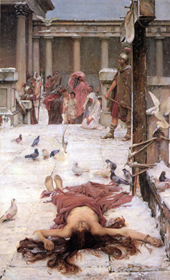 A knight sliced in half like a sesame bagel, a saint tossed down a hillside in a barrel lined with nails—pain is an ageless wellspring of humor, but we were too weirdly willing to laugh. As graduate students, we were honing our sense of which aspects of the Middle Ages were born of certain eras and places and which others were timelessly human. Yet something about the classroom made the medieval world harder for me to imagine. The line of scholars whose work helped us understand the past in the first place also stood in the way of a gut-level sense of real people’s lives. Then the violence was never real, only a source of other people’s pictures or words, like an idealized painting or flippant cartoon.
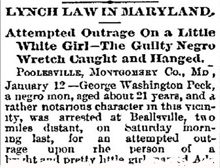 Last month, our town

 Not content to let publishing win the Worst Industry of the Week award, the student’s alma mater, Northern State University,
 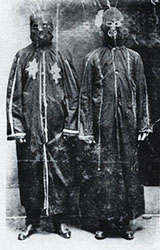 And yet I doubt that superheroes “are still very much white supremacist dreams of the master race,” and it’s too clever by half to claim that Birth of a Nation was “the first American superhero movie.” So what? Overstating causation doesn’t exclude the possibility of a connection. The creation of masked superheroes who operate outside or above the law overlaps with the era of
  But then sometimes, complexity and ambiguity overwhelm those who work isn’t given to clarity. In September, the International Society of Anglo-Saxonists
 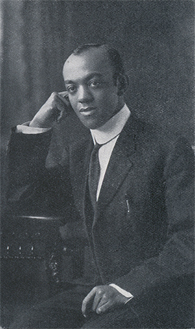 Poets pray for remembrance on the pages of an anthology—but whenever I saw Fenton Johnson’s poems in collections of African American verse, the selections were too limited for me to get a real sense of him. Fond of forgotten writers, I tracked down more of Johnson’s work to find out who he was and what he had hoped to become. My search only brought me back to his most anthologized poem, which takes on new meaning amid echoing debates about the medieval-ness of all things American.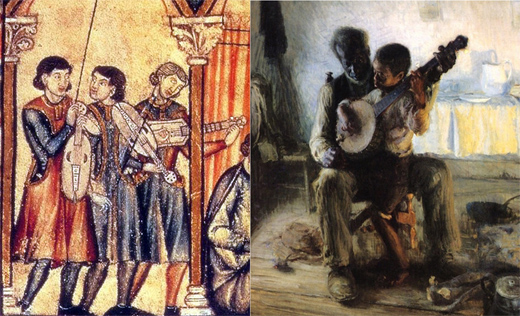
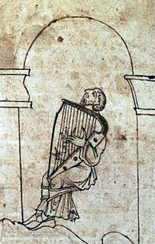 I hopped the barbed hedge of graduate school more than 20 years ago, but the burrs and brambles of medieval thinking still cling to my life. I never know if they’re brittle twigs, best brushed off and swept away, or green sprigs that can be woven into some new, small, useful thing. Take “Deor,” an Old English poem that puts on thorns at the strangest of times—even when I’m reading about a different culture thousands of miles away and a millennium later.
 My student’s speculations about “Deor” sprang to mind, unexpectedly, as I read
  None of this hasn’t been pondered for ages by much smarter people, but in the years since my student asked her question blessedly unimpeded by assumptions, few new opinions have formed about “Deor.” The author of
  Throughout the day I heard many melodramatic and sentimental pronouncements, most of them by commentators who don’t know much about the history of Notre-Dame. You don’t have to be an expert on the cathedral to appreciate that its survival since the Middle Ages is itself a marvel. By the 18th century, many of its gargoyles had disintegrated or were worn into stumps. Statues over the lintel depicting the dead rising from their graves came down in the 1770s, allowing royal processions to fit more easily through the doors; revolutionaries then denuded the cathedral of statues and artwork that had enshrined cléricalisme and féodalité. Ham-handed attempts to “fix” Notre-Dame in the early 1800s by attaching new stone with quick-rusting iron pins only made the building less structurally sound.
 Thanks to Victor Hugo’s efforts to lobby the July Monarchy in the 1830s, the French state agreed to fund restoration efforts, and architects Viollet-le-Duc and Lassus began to rescue the building in the 1840s. They turned a husk back into a cathedral, and their work was so convincing that the world largely forgot that Notre-Dame had ever been in shambles.
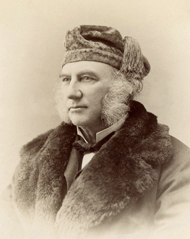 Only one man in American history can claim to have been both a baking-powder revolutionary and a passionate medievalist, and nobody else is going to note this anniversary, so let me do the unasked-for honors: This week marks the 200th birthday of
 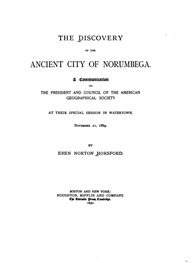 And so Eben Horsford—scientist, industrialist, education activist—apparently decided that since he had prospered in mathematics, civil engineering, chemistry, and business, then nothing else human was alien to him. And what were Vikings in America but the next laboratory puzzle to be solved? More than a century after its publication,
  The most lasting physical remnant of Horsford’s folly, though, is the Norumbega Tower, which he built in 1889 at the mouth of Stony Brook to mark the supposed site of the Viking city and fort. Architectural follies are usually their own justification, but Horsford gave more specific reasons than most people who build such things. In The Discovery of the Ancient City of Norumbega he explains, at first graciously:
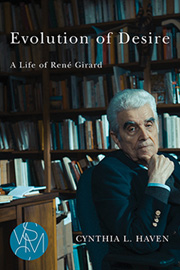 I’ve known the writing of Cynthia Haven for ages; she’s a
  Quid Plura?
,_fol._5r,_detail.jpg)