What did history taste like?
In Becoming Charlemagne, I used a pile of sources to speculate about how eighth-century Baghdad looked and felt. Scholars are fond of mentioning that the smells of medieval cities would have overwhelmed the modern nose—but the kitchens of the caliphs would have been a revelation.
As Charles Perry has pointed out, the cuisine of early medieval Baghdad was unlike the Middle Eastern menu of today. Rice wasn’t steamed but was mashed into porridge; dishes contained a medley of aromatic herbs; and stews were flavored with murri, the juice from moldy barley—which, Perry informs us, tasted exactly like soy sauce. “There’s no hummus or tabouli, no stuffed grape leaves, no kibbe, no baklava,” he explains. “Many dishes have strange, clanking medieval names like bazmaawurd, kardanaaj, isfiidhabaaj and diikbariika.”
Since Perry, author of Medieval Cuisine of the Islamic World, was kind enough to adapt several medieval Islamic dishes for modern ingredients and measurements, I thought I’d whip up some tabaahaja, a sweet lamb dish recorded by Yahya ibn Khalid ibn Barmak.
Yahya was an interesting guy. His family, the Barmakids, were the protectors of a Buddhist shrine in what’s now Afghanistan. After the family converted to Islam, Yahya’s father, Khalid, helped fund the revolution that brought the Abbasid caliphs into power, thus leading to the founding of Baghdad in A.D. 762. Yahya himself was tutor and mentor to the caliph Harun al-Rashid, who sent Charlemagne an elephant; Yahya’s sons, Fadl and Jafar, were two of the most powerful men in the caliphate.
Reveling in the Persianized culture of the urban elite, the Barmakids threw the best parties in Baghdad—until Harun, for reasons no one really understands, destroyed the family and hung Jafar in pieces from a bridge.
Today, when movies feature a sinister vizier named Jafar, that’s a distant echo of the Barmakid story as filtered through the Arabian Nights and 19th-century Orientalism. You also may be familiar with those irreverent early-Islamic pop singers, the Barmakid Ladies.
Okay, okay, back to Yahya’s recipe.
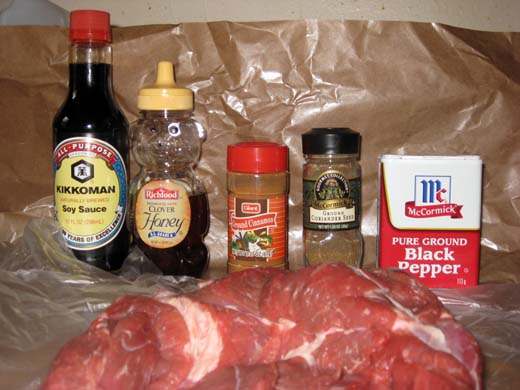
A pound of lamb leg waits to be smothered in a marinade of soy sauce (murri substitute), honey, cinnamon, coriander, and black pepper. I splurged on good lamb, but iffy kitchen experiments warrant only cheap-ish spices.
Fun fact: the Islamic world was centuries ahead of medieval Europe in its adoption of bear-shaped plastic containers.
Here are the lamb-leg bits and pieces, soaking like harem girls in a hot tub.
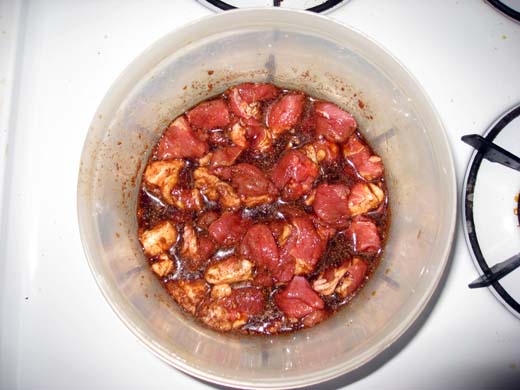
Two hours later, the marinade hits the oil in the Le Creuset saucepan with an excited sizzle.
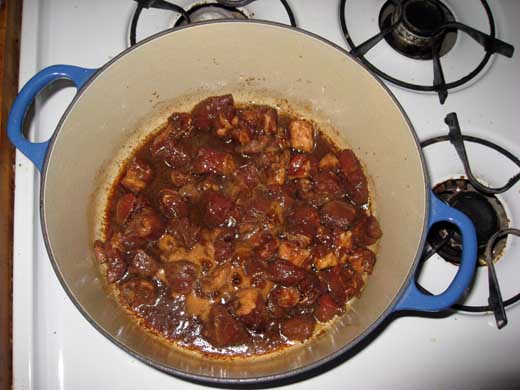
In an alternate universe where Charles Martel failed to stop the Muslim advance at Poitiers, the French never invented pricey cookware. Also, I would have a goatee.
Half an hour later, the lamb is ready for the vizier’s table. It’s been garnished with cilantro, but I left off the optional mustard greens and rue, the latter because finding a bitter abortifacent anywhere but in a garden store is difficult even in an area full of Asian markets, and hunting for it is too creepy to be worth the trouble.
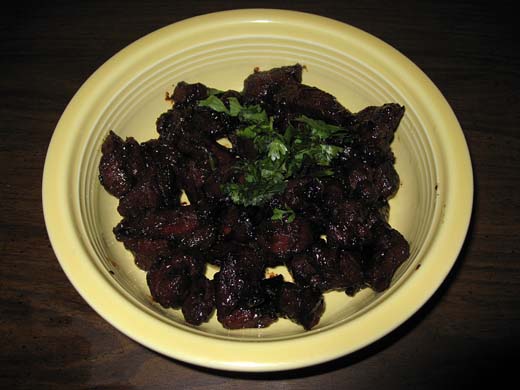
Behold: tabaahaja. If lamb were candy, it would be this. The marinade has become a glaze so sweet it’s wince-inducing; the most prominent flavor is cinnamon; and the overall taste is reminiscent of spare ribs at a Chinese restaurant.
The vizier and his entourage would have eaten tabaahaja with flatbread and washed it down with fruit juice. (I opted for a tortilla and black cherry soda.) Harun himself was partial to gazelle milk, so let’s spare a sympathetic thought for history’s forgotten hero: the servant whose job was to milk the gazelle.


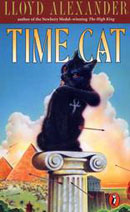 At your local Barnes & Noble, the Lloyd Alexander selection is probably small. You’ll find all five books in the Prydain series and rarely anything else—but these days, if the store stocks any other Alexander novel, you will see, inexplicably,
 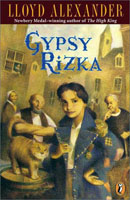 Lloyd Alexander described
 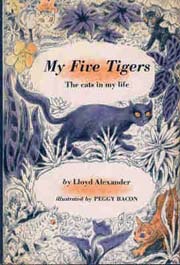 I had expected to kick off this review of My Five Tigers with a story about my own childhood cat: a plump, patient tabby named Scritchy who let us dress her in babushkas, who often sat upright like a human, and who clearly enunciated the word “ham.” I planned to deploy these and similar anecdotes more out of sarcasm than nostalgia, prepared as I was to cringe my way through Lloyd Alexander’s second book. How, in 1956, could a publisher commission an unknown author to write a 118-page account of his five house cats for adult readers? With a dismissive review half-composed in my head, I opened the book and braced for a great wave of treacle.



 Quid Plura?