“And if anything, then there’s your sign…”

Let there be links!

Carnivalesque XXXVII, an ancient-medieval edition compiled by Eileen Joy, is up at In the Middle. Ite, legete! (Thanks to Eileen for including my post about the Battle of Kosovo.)

Carl at Got Medieval pores over medieval manuscripts and finds pictures of monkeys doing remarkable things. (Medieval monkey school looks especially harsh.)

Brandon at Point of Know Return wonders about the Old English word wundor.

At Studenda Mira, Dave ponders the Akhdam people of Yemen and the value of oral tradition; he also looks into the Akhdam origin myth.

Medievalism meets the modern ethicist! At Chivalry Today, Scott Farrell broadly defines “chivalry” to encompass ethical codes, movie knights, Batman comics, ghost towns, and Andy Griffith. Scott recently invited me to gab about Charlemagne, and I was delighted to oblige. Visit the archive of Chivalry Today podcasts; downloads and iTunes subscriptions are free.

Finally, I was glad to see that Gary Gygax got last week’s back-page obit in The Economist, but if you want to read some truly epic obituaries, check out what the U.K. papers wrote about Steven Runciman in the year 2000. Now that was a life…

“Something like a recipe, bits and pieces…”

Unhappy tidings from the Philadelphia suburbs: the inventor of SpaghettiOs has passed away. Like their mother and uncle before them, my niece and nephew consume SpaghettiOs with a zeal that borders on the competitive, and while both of them are too young to imagine that someone invented their favorite lunch, this news saddens us grown-ups, as I’m sure it will give pause to any parent or caregiver who’s ever uttered those timeless words, “No! Not on the carpet!”

But you know, like a belly full of those diminutive sliced franks, something in the Philadelphia Inquirer obituary just doesn’t sit right. Behold, the official origin story of SpaghettiOs:

One of Mr. Eberling’s early challenges for Campbell’s was creating a spaghetti-and-meatballs product that would fit neatly in a can. He had a breakthrough, his son said, while cleaning up from dinner one night. He noticed a strand of spaghetti twirled in the sink and took the concept for SpaghettiOs to his supervisor, Ralph Miller. The new product, promoted by the popular “Uh-oh SpaghettiOs” jingle, became a big success.

That fable may have fooled the credulous media, but several years of graduate school taught me that there’s no reason to accept the homely simplicity of truth when one can weave an ingenious tapestry of fantasy from the wispy threads of whimsy and supposition.

The inventor of SpaghettiOs was born—aha!—in the German city of Aachen. A masterpiece of medieval architecture stands at the center of Aachen: Charlemagne’s octagonal chapel. As UNESCO reminds us, “[a]n octagon can be made by drawing two intersecting squares within a circle. The circle represents God’s eternity while the square represents the secular world.” Although “circularity” applies to any individual SpaghettiO, it also may signify the lesser known RavioliOs, a product that need not be circular in order to fit neatly in a can. Thus, the post-formalist rejection of square ravioli in favor of the circular demonstrates a deliberately supra-utilitarian intention to transcend the secular and destabilize the traditional reading of canned pasta. We can at last begin to de-problematize the systems of knowledge coordinated to produce SpaghettiOs by calling attention to the original name of the company that evoked the circular plan of the chapel of the rex Francorum by representing eternity in pasta: Franco-American.

I’ve much more to say on this subject, and in the coming months I’ll develop and defend my ironclad thesis in a lengthy paper, which I shall deliver at several hundred academic conferences. My peers, I predict, will be stunned into silence. Who will blame them if they’re forced to flee the room?

“I go out into the market, where I can buy or sell…”

If you’re curious about the journeys of 14th-century Islamic scholar Ibn Battuta, you can always read his own account of the decades he spent traveling in India, the Middle East, Africa, and Europe. But if you prefer a more tactile and commercialized approach to medieval Islamic travel narratives and you happen to need a new pair of sneakers, then think about hopping a flight to Dubai, where the Ibn Battuta Mall is open for business.

According to the latest issue of Saudi Aramco World Magazine, “the largest themed shopping center in the world” is divided into six courts based on the lands Ibn Battuta visited. If you’re but an amateur Battutaologist, never fear: you can partake of an “interactive learning experience” about the intrepid rambler:

The cultural message was getting through to the mall’s younger visitors, too. A screen showing the animated adventures of the Young Ibn Battuta (in appearance an Arab cousin of Pinocchio) attracted a small but enthralled audience. But for one of these at least, there was another star that even the cartoon hero couldn’t upstage: Adam Bashir, aged eight, from Manchester, England, didn’t have to think twice when I asked him what was the best thing in the mall. “The elephant!” he declared. (“Phew!” said his father. “I thought he was going to say McDonald’s.”)

My cynical self was by now so thoroughly disarmed that I went and had my photo taken with Ibn Battuta, or rather the young cartoon version of Ibn Battuta, brought to life by a roaming actor in a padded suit. I could see the real Ibn Battuta having some reservations about being played by a character out of Disneyland’s central casting, but at the same time, I couldn’t help feeling that he might have rather approved of his mall. After all, his own aim, stated in the introduction to his book, was to offer “entertainment … delight … edification … interest”—and what is that but “edutainment”?

Incidentally, if you don’t get Saudi Aramco World, why not subscribe? It’s free, it’s edutaining, the photos are lovely, and you’re already paying for it at the pump.

“‘And join with us, please,’ valkyrie maidens cry…”

Jet lag, a busy week, and other responsibilities conspire to keep me away from the keyboard. In the meantime, dear readers, here’s some worthwhile reading from around the Web.

Tributes to the late Gary Gygax abound, but this one is my favorite, at least conceptually: some players of the game EVE Online purchased a ship and gave the co-inventor of Dungeons & Dragons an online Viking space funeral. (At least that’s what they claim they were doing. I’ll have to take their word for it.)

The link between D&D and online gaming is nothing new. In fact, Dragon magazine once published a prescient short story on the subject: “Catacomb” by Henry Melton. Judging by the number of online message-board requests from people trying to track it down, this story made a huge impression on readers in 1985.

Open Letters Monthly has posted the third installment of “Green,” Adam Golaski’s strange and delightful translation of Sir Gawain and the Green Knight. (Part one is here. Part two is here.)

Steven Hart considers the best swordfight movie of all time.

At University Diaries, they’re debating the efficacy of Powerpoint in the classroom. Here’s a quoteworthy snippet from UD herself:

You know the happiest thing I experience teaching? The thing I’m going to remember most vividly from my years of teaching? The looks of open wonder, eager skepticism, scoffing disbelief, amusement, boredom, intense analytical energy, on my students’ faces. They show me those faces and I see them and they see that I see them… And that is the only way I know to begin serious intellectual study — mutual vulnerability, openness to the other person as a restless mind reaching out to other minds in real time and space.

I love most of all the first thing: open wonder. Students are quite unself-conscious when they show me that one. Their heads are tilted to the side. Their mouths are slightly open. Their eyes are narrowed. On me. These are the students who come up to me after class and want to know if Nietzsche really meant what he said when he said… Because it seems to me that…

Meanwhile, Brandon at Point of Know Return responds thoughtfully to a potentially hostile question: “What are you going to do with a degree in medieval studies?”

Thanks for stopping by! New posts—and maybe even an Aachen update—are coming soon.

“Behind bolted doors, talent and imagination…”

Two blocks south of the city center of Aachen, near the cathedral that encases Charlemagne’s famous chapel, you’ll find a gaming store with a window full of tiny knights and monsters. Its existence in this medieval city of emperors is an amusing reminder of the complex relationship between the actual past and the fantasy version of the Middle Ages we’ve never been able to shake. That relationship is always worth pondering, but it’s especially poignant today in light of the news about the fellow who was arguably one of the most influential medievalists of the latter half of the 20th century: “Dungeons & Dragons” co-creator E. Gary Gygax, who died yesterday in Wisconsin at the age of 69.

Four years ago, when hardcore gamers celebrated “Worldwide Dungeons & Dragons Game Day” amid the shuffling of graph paper and the plaintive plinking of dice against Coke cans, the event was mostly a nostalgia trip, not a notable phenomenon in its own right. That wasn’t because the culture had abandoned D&D, but because old-school paper-and-dice gaming had evolved as the larger culture embraced RPGs, developed them for new media, and midwifed their mass appeal. Online gaming? Tolkien and Beowulf movies? Girls who are unafraid to enter comic shops? All of these wonders, at one time unimaginable, can be traced back to “Dungeons and Dragons”—specifically, to the bearded sage of Lake Geneva and the arcana he co-bequeathed to the skinny-armed boys who raised fistfuls of dice in geeky solidarity during the early 1980s.

Contrast those humble nerdlings of yore with the polished, professional women who flip through Harry Potter novels during their subway commutes. These valkyries are the goddaughters of Gary Gygax and the unknowing heirs to the mainstreaming of fantasy. So are their kids, from the girls who swooned over Orlando “Legolas” Bloom—girls who, a generation ago, wouldn’t have been caught dead watching a fantasy movie—to the boys who have slain every goblin the XBox can throw at them.

It was not always thus. When I was in middle school in the dark days of 1983, a science teacher rescued me from study hall with a weekly session of RPGs and military wargaming. That class, for which several of us received academic credit, solved the mystery surrounding the sprawling scale models of the European countryside that took up half of the chemistry room and the elaborate maps of imaginary places stapled to the classroom walls. The teacher, a retired two-star general, was always an iconoclast. Years later, when faculty were forbidden to smoke on school grounds, he reportedly researched the property limits and spent his lunch hours loping just outside the borders, puffing away in furious protest. Those were the sorts of adults who embraced fantasy back then: outsiders, autodidacts, guys who literally brought their vast knowledge of military history to the table, and similar pre-Internet obsessives who made their classmates and co-workers—the type whom every eight-year-old in the Western Hemisphere now knows to call “Muggles”—very, very nervous.

Of course, for those of us who were raised outside of an academic milieu, D&D also offered a valuable experience that later served us well: the game offered a preview of the systems, organization, and culture of a worldwide scholarly community. Hardcover tomes served as authoritative published sources. Pages of rules, charts, graphs, classifications of moral and ethical philosophies, and endless systems of nomenclature were all punctuated with academic abbreviations (“cf.,” “q.v.,” and so on) that required training and memorization. Like knowing how to use the Patrologia Graeca and its accompanying scholarly apparatus, mastering the material in the various D&D manuals was a skill not easily acquired. All of this stuff was, like the foundational scholarship of any field, composed by sages whom we knew primarily through their written pronouncements. They published regular supplements, such as Dragon magazine, which featured articles as specialized and as arcane as anything in Byzantinische Forschungen. From disquisitions on the ecologies of imaginary creatures to lengthy debates about the physics of falling and its effect on the proper way to calculate hit-point damage taken by characters wearing variously configured armor, Dragon was a newsletter, marketplace, and academic journal all rolled into one. Its luminaries even hosted annual and regional meetings; in-the-know players became attuned to rumors of contentious professional politics among the inner circle.

As an adult, I’m too self-conscious and jaded to return to the world of old-school gaming. That initial interest didn’t die; it simply matured, thank goodness, and now I seek a similar buzz in hiking, traveling, teaching, and writing. I’ve never worn armor, I don’t attend Renaissance festivals, and I can’t tell one scion of the house of Gondor from another. I will admit, though, that while working on Becoming Charlemagne, I drafted sprawling, D&D-like maps of Aachen, Baghdad, Constantinople, and Rome, simply to give myself a mental picture of each setting. I loved it. So help me, I felt like I was ten again.

At this moment, countless kids are watching their Lord of the Rings DVDs, reading Harry Potter, or playing fantasy games on their computers; perhaps their parents are logging onto Web sites under handles and encountering no stigma as they play at being someone else. Twenty years ago, most of them wouldn’t have touched a set of polyhedron dice with a ten-foot pole; today, they all know what a hobbit is, and they find nothing odd about wizards and magic and the trappings of popular medievalism, recast as they have been into forms that have decreased in intelligence but certainly gained in charisma. So here’s to Gary Gygax, an unlikely popularizer whose almost wholly derivative work broadened the appeal of medievalism by energizing the geek culture that now reigns supreme. I wish him a tomb protected by ingenious traps, and an adventurous afterlife where all of the hallways are perfectly ten feet square.

“Come down off your throne, and leave your body alone…”

For more than a year now, I’ve written about Charlemagne, talked about Charlemagne, answered questions about Charlemagne, joked about Charlemagne, fielded emails about Charlemagne, translated poems about Charlemagne, and have otherwise come to see the old boy as a sort of ghostly roommate who makes dubious excuses (“dude, I totally left my wallet in my other rodent-fur cloak”) whenever he’s asked to contribute to the rent.

The thing is, there was one Charlemagne-related thing I hadn’t done—specifically, a Charlemagne-related place I hadn’t visited—and I got a little tired of people expressing surprise about that. So, on a whim and sort of at the last minute: greetings from Aachen.

A few lessons for those similarly inclined: Maastrict-Aachen Airport does not, in fact, service the city of Aachen. However, the airport does give you a wonderful opportunity to discover the Dutch language skills you didn’t know you had while you enjoy a crash course on the bus system of provincial Limburg. In the rain. Next to lots of billboards advertising a museum retrospective about Smurfs.

But you know what? As Chaucer’s Friar Hubert famously declared: It beats being in the office.

“Well, at least there’s pretty lights…”

Sacré Charlemagne! My Garden State broheim Steven Hart has meme-tagged me. I am rarely a perpetuator of memes—not because I wish to be rude, but because I often have nothing clever to add—but Steven makes it easy for me. He asks me to take my own book and do the following:

• look up page 123
• look for the fifth sentence
• then post the three sentences that follow that fifth sentence on page 123.

Thusly and forthwith:

Did the Holy Father really have, across his eyes, a scar as pure and white as any dove? Perhaps they paused in their work—hard days of August spent harvesting, a September spent sowing rye and winter wheat—to mutter half-hearted nonsense about foreigners. Strange men continually visited the king, but after all this time, few were exotic enough to concern the locals.

I haven’t read my own book since shortly before it was published, so it’s odd, even eerie, to revisit a passage I wrote in 2005 and almost see it anew, while recalling, not necessarily fondly, the crepuscular smudge of sleeplessness, stalling, and ambient cop-show marathons that got the book finished. (On the up side, I finally got to see, after ten years, what the guy who delivers the morning paper actually looks like. Imagine his surprise.) How strange that for an author, a published book is a private time capsule—even if it does emit a little voice that keeps intoning, “get cracking on the next one.” (A voice that sounds suspiciously like my agent.)

“Some kind of verb, some kind of moving thing…”

I’m a day away from traveling to exotic locales. While I roll up my socks and frantically search for my plug converters, here are some neat links for you, my dear, medieval-minded readers.

Scott Nokes ponders elves, faeries, and modern medicine.

Carl at Got Medieval notes how a medievalist can benefit from the culture and language of Appalachia. He also spots the sale of relics on EBay—which was, back in 2001, the subject of my sole foray into journalism.

Gabriele at The Lost Fort takes you on a lovely photo tour of Speyer Cathedral, while the Cranky Professor discovers the world’s ugliest pulpit.

Brandon tells you where the name “Gibraltar” came from.

For the classicists among you, don’t miss these red-figure Chuck Taylors featuring scenes from four Greek vases. (Just imagine if the same guy made sneakers featuring the Franks Casket.)

For you Renaissance art historians, go debate Donald Pittenger’s claim that Giovanni Battista Tiepolo “painted Mary as a babe.”

If you’re like me, you’ve often wondered what would happen if Henry VIII, a pseudo-Viking, a Pilgrim, an ancient Roman, and a Polynesian warrior all went on a road-trip together. Well, wonder no more! Several unaired Snickers “Feast” commercials are now officially posted to YouTube. What can one say? Sound the feasting horn! Crank up the “Greensleeves”! Just watch out for bloody Robin Hood.

“Dragging behind you the silent reproach…”

On Friday, a very medieval thing happened here on my corner: a car skidded on some ice, jumped the curb, smashed the fence and flowerbeds in front of the public library, and ran over a defenseless sign.

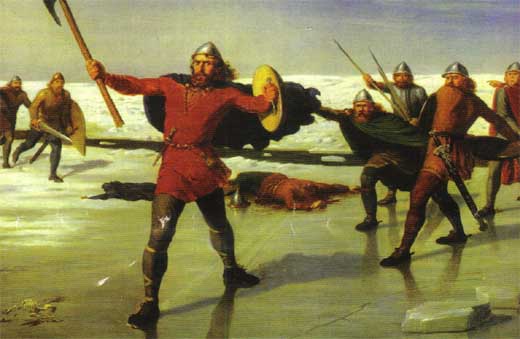
What’s so medieval about that? Well, for one thing, it reminded me of the ice-borne derring-do of Skarp-Hedin in Njal’s Saga:

Skarp-Hedin jumped up as soon as he had tied his shoe, and hoisted his axe. He raced down straight towards the river, which was much too deep to be forded anywhere along that stretch. A huge sheet of ice had formed a low hump on the other side of the channel. It was as smooth as glass, and Thrain and his men had stopped on the middle of this hump. Skarp-Hedin made a leap and cleared the channel between the ice-banks, steadied himself, and at once went into a slide: the ice was glassy-smooth, and he skimmed along as fast as a bird.

Thrain was then about to put on his helmet. Skarp-Hedin came swooping down on him and swung at him with his axe. The axe crashed down on his head and split it down to the jaw-bone, spilling the back-teeth onto the ice. It all happened so quickly that no one had time to land a blow on Skarp-Hedin as he skimmed past at great speed. Tjorvi threw a shield into his path, but Skarp-Hedin cleared it with a jump without losing his balance and slid to the other end of the sheet-ice.

Kari and the others came running up.

“That was man’s work,” said Kari.

Think I’m stretching things to draw a medieval connection? Just wait until the kin of that library sign and the foster-brothers of those murdered azaleas decide to seek revenge. My genteel neighborhood will erupt into hot-blooded discord. They’ll be burning down mead-halls (or at least shooting burning glances at the local California Tortilla), carving rune-spells into their enemies’ yoga mats, pitting book club against book club…I tell you, sometimes the foreknowledge provided by medieval literature is little more than a curse.

“For I smell of the earth and am worn by the weather.”

The medieval world had no patience for giants. Heroes of epic would send them to Hell; Thor, ever sporty, would hunt them for fun; in chivalric romance, knights smote them with glee. From Yvain to King Arthur to Bevis of Hampton, medieval heroes made giants extinct—except for one holdout, who fled from oppression, and napped on the outskirts of Washington, D.C.

Here in the District, we’re losing our giant. I went out this weekend to bid him adieu and was pretty surprised: he’d attracted a crowd. Strangers sat in his palm, children slid down his knee, and adults tapped his forehead and peered up his nose. In a city of pipsqueaks who long to be giants, that’s no way to send off the last of his kind.