“Walking in the park, dreaming of a spark…”

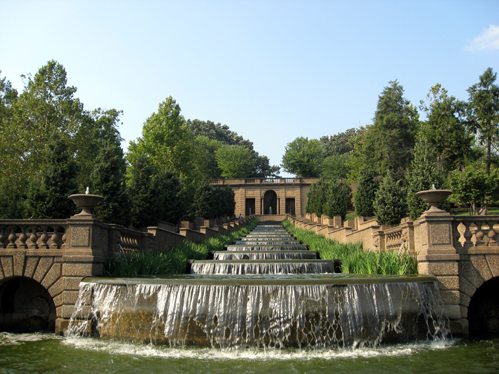
On a dull day in Washington, when the weather is dangerously hot, what better way to pass the afternoon than to look for medieval people at Meridian Hill Park, one of the city’s grandest public places?

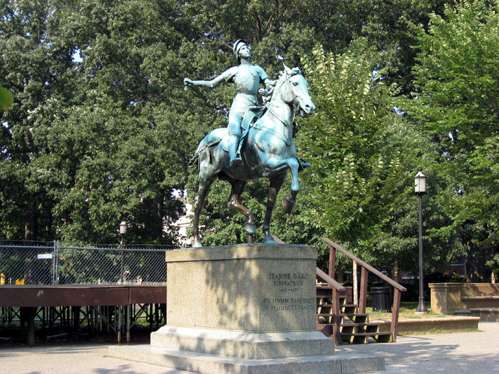
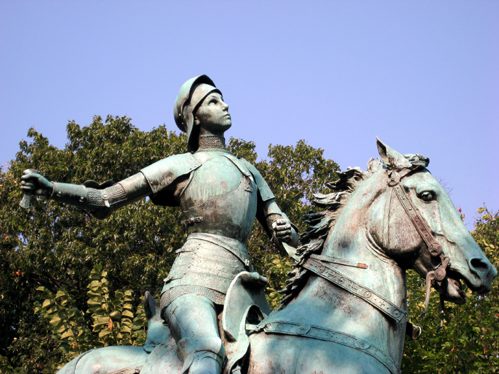
Climb to the source of the waterfall, and there she is, disarmed but not discouraged: la pucelle d’Orleans.

The pedestal sports a rather enthusiastic inscription:

“A most bodacious soldier and general, Miss Of Arc totally rousted the English from France. Then she turned this dude, the dauphin, into a king. And all this by the time she was seventeen!”

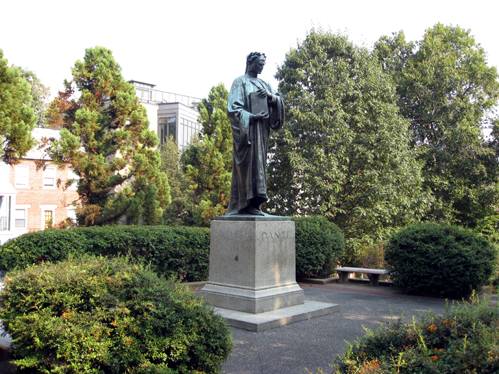
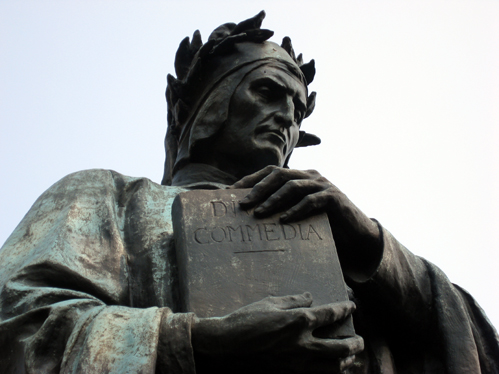
Wander into another corner of the park, and—non mi sembra vero!

It’s the Big D himself.

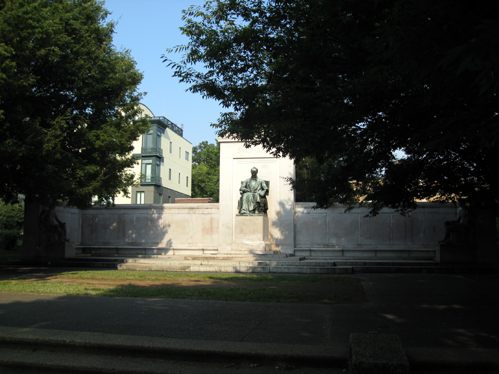
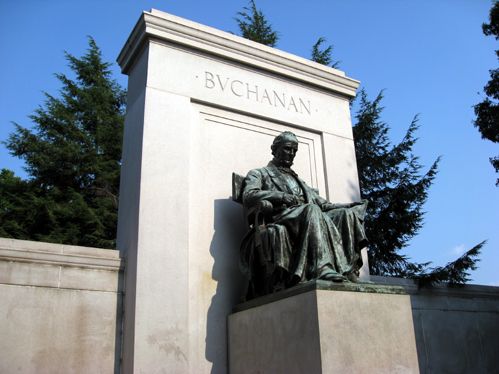
But wait…who’s that personage of historical significance seated behind those trees?

Aha! It’s that indispensable touchstone for all medievalists…

President James Buchanan!

“She knows what she knows, I know what she’s thinking…”

Jeffery Hodges, the Gypsy Scholar, is one of the more eclectic academic bloggers out there. His interests are far-ranging; whether he’s writing about John Milton or the language of the Ozarks, he approaches intellectual problems with erudition and wit.

That’s why I’m confident that none of us, in the same position, would have shown any greater wisdom than he did in mediating a singular conundrum: his children arguing in Korean about an imaginary rabbit.

Let the Gypsy Scholar proclaim, as did Justinian upon beholding Hagia Sofia, “Solomon, I have surpassed you!”

“We are detective, we are select…”

Occasionally, my students ask me what I read for fun. The question makes me smile, because it’s been years since I’ve had much time for recreational reading.

But once in a while, I discover a series of books that makes me remember why I used to enjoy reading—a series that makes me feel like I did when I plowed through novels as a kid, rapaciously seeking plot, desperate to find out only what happened next. A few months ago, I lucked out: I stumbled across the blog of author Olen Steinhauer, discovered his Yalta Boulevard series, and was hooked.

Steinhauer’s five novels center on a squad of homicide investigators who work in the capital of an unnamed Soviet Bloc country, a two-bit nation that seems to border every other Eastern European country while not fully resembling any one of them. The first novel, The Bridge of Sighs, is set in 1948; each subsequent novel leaps ahead a decade to tell the story of a different character. The fifth and final book, Victory Square, comes out today; it’s set in 1989, as the detective from the first book prepares to retire, and as the nation Steinhauer built in four previous novels begins to crumble.

Last week, the New York Times referred to Steinhauer’s “grim but fascinating police procedurals,” but that description, even in the context of a positive review, makes the Yalta Boulevard novels sound more beholden to the conventions of the genre than they actually are. The murder investigations are rarely the actual subjects of the story; often, the usual crimes fade into the background, giving way to worse transgressions, terrible choices, and mordant tributes to the people who endured Eastern European communism—”the puppets of history,” as one character explains in The Confession, “playing out a tragedy.” With their carefully crafted dialogue, relentlessly Slavic mood, and complex, fatalistic characters, the Yalta Boulevard novels remind me of the terrific 1990s TV show Homicide—which, most of the time, wasn’t about police procedure either.

If the constraints of so-called literary fiction weren’t so narrow, and if its readers were less terrified of being seen as slumming, Steinhauer’s books—especially The Confession and Liberation Movements, his two best—would garner more than 150 words in the Times. Those blurry spy-thriller covers probably dissuade book-browsers who aren’t naturally drawn to the genre, and few people these days are clamoring for Cold War novels. So be it—but those realities only further ensure that the Yalta Boulevard novels are elegies to overlooked places and times. Memorable, engrossing, and frequently sad, they’re also top-notch work by a novelist who isn’t really writing genre fiction at all.

[Disclosure: I’ve never met Olen Steinhauer, I’ve never exchanged a single e-mail with him, we don’t share a publisher, and to my knowledge we have no publishing contacts in common. Just in case anyone was wondering.]

“With his long, red beard, and his sister’s weird…”

If April is the month when longen folk to goon on pilgrimages, then maybe August is the month that priketh bloggers new in hir corages. Here are some neat blogs by medievalists: two new ones, and a third I’ve only now discovered.

At Per Omnia Saecula, grad student Jennifer Lynn Jordan plans to blog about Prester John, the Pre-Raphaelites, and Dante—and not just Rossetti, either, but also the Big D himself. Her interest in medieval bestiaries has already turned up one amusing discovery: the bonnacon, a creature whose primary defensive tactic, while repulsive, is not uncommon among humans here in latter-day D.C.

Michael Livingston, who teaches medieval lit at The Citadel, also has a new blog, where he answers the nagging question, “what would the sci-fi novel Old Man’s War sound like if Chaucer had written it?” If that question hasn’t nagged at you, then you may wish to keep your opinion to yourself; unlike most people who study and write about the Middle Ages, Livingston gerte him with a gode brond.

Not new—but new to me—is Jonathan Jarrett’s blog, A Corner of Tenth Century Europe, a site that combines Cambridge, coinage, and Carolingian Catalonia. It’s definitely the sort of blog that will teach you something—if you’re willing to C’s the day.

“Get the world on video…”

Today we hereby inaugurate a new, occasional, and decidedly un-medieval feature: Forgotten Video Friday!

This time, an ’80s edition…

Back in my youth, when penguin lust was the biggest affront to society, we wouldn’t have been caught dead mocking televangelists without our portable, mouth-blown synthesizers.

We also worried that wheelchair-bound teenagers would use cordless phones to simulate a nuclear attack. (Okay, only one person worried about that.)

Then again, we did worry that 8-bit computers would steal our girlfriends.

Ah, but bar singers knew that you’d come for the mullets, but you’d stay for a little-known Springsteen tune (and a cameo by Nigel St. Hubbins).

Freedom of speech was an issue—but the commissars were never as scary as grown men in sweater dresses.

Occasionally, punk met soul.

And sometimes, thank goodness, Beatles covers were better than the originals.

Thanks, as always, for stopping by—and for your bemused indulgence.

“But you, you’re not allowed, you’re uninvited…”

When you’re looking for him, Charlemagne is everywhere—but in April, he was noticeably absent from the celebrations of the 50th anniversary of the Treaty of Rome. EU member countries sponsored essay-writing and postcard-design contests for children, and museums in Brussels celebrated such curiously low-key phenomena as comic strips and photographs of offices in Luxembourg. The whole business was impressively stuffy—making Europe seem boring required an act of unprecedented bureaucratic genius—but I was still surprised when the party planners didn’t extend an invitation to Charlemagne, neither the very un-modern Christian warlord nor the burnished symbol of European unity whose name graces both a prestigious annual prize and the EU headquarters building in Brussels.

That’s why I was intrigued to see Jeffery Hodges, the Gypsy Scholar, pointing his readers to an essay, “Will ‘Europe’ Survive the 21st Century? A Meditation on the 50th anniversary of the European Community.” Its author, Walter A. McDougall, directs the International Relations program at UPenn. McDougall offers some thoughts on demography, demilitarization, and religion, subjects that merit ongoing debate—but he also remembers his Charlemagne:

What would Charlemagne make of Europe today? He would marvel, of course, at the wealth and technology. He would praise and bless the ubiquitous peace. He would recognize instantly the Islamic Challenge and tell Europeans it was ten times worse back in his day! Nor, having been a state builder himself, would he likely object to the intrusive EU bureaucracy. Indeed, it is fetching to think Charlemagne would discern in the EU the culmination of the great work he began over a millennium ago, and give glory to God. But three features of Europe today would doubtless grieve and trouble him greatly: military impotence; spiritual emptiness; and demographic decay. How long, the Emperor would surely ask, can a civilization expect to survive without arms, without faith, without children?

That is a question even the plodding Eurocrats will have to address before the twenty-first century gets very old.

What would Charlemagne make of Europe today? In the past year, several people have asked me that question. Not being built for punditry, I’ve mostly demurred, but after some informed guesswork, I came to the same mixed conclusion McDougall did: that Charlemagne would be astonished by Europe’s material prosperity but dismayed by European secularism.

That answer makes no one happy. Many want Charlemagne to be their like-minded hero, a flawless symbol of their own beliefs, while others bristle if you merely acknowledge that the question of religious faith is the largest philosophical chasm that separates Aachen in 797 from Brussels in 2007.

Fortunately, McDougall doesn’t make Charlemagne a simple repository for his own views, nor is his Charlemagne ideologically predictable. In fact, his claim that the emperor might have appreciated the EU’s sprawling bureaucracy, while plausible, is sure to rankle most of his Euroskeptic readers.

More debatable is McDougall’s assessment of the “Islamic Challenge,” his name for several intertwined issues: European identity, Muslim immigration, Islamic terrorism, and Turkish membership in the EU. Charlemagne “would recognize instantly the Islamic Challenge and tell Europeans it was ten times worse back in his day,” McDougall insists, but he offers no assurance that the situations are analogous across 1,200 years. History buffs remember that Charlemagne and his army were ambushed in the Pyrenees while leaving Spain in 778, but not everyone remembers why he was there in the first place: he had been invited to help the Muslim rulers of Saragossa and Barcelona against another Muslim, Abd al-Rahman of Cordoba. Later, Charlemagne also conducted cordial, long-distance diplomacy with the caliph in Baghdad, a consequence of their two empires having enemies in common.

The pragmatism of Franco-Islamic relations doesn’t mean that Charlemagne practiced “religious tolerance” in the modern sense—his foray into Spain was probably intended as a prelude to more ambitious military adventures—but it does suggest that if the old boy were to awaken from his 1,200-year slumber, he’d need a lengthy briefing to understand why immigration and assimilation had replaced military and diplomatic engagement as Europe’s real “Islamic Challenge.” It’s plausible, but not a given, that the events of the eighth and ninth centuries are akin to the situation in 2007, although the brave soul who argues the comparison is bound to disappoint everyone. Fans of cameras-and-handshakes diplomacy will cringe at Charlemagne’s aggressive militarism, while those who idolize him as an uncompromising proto-Crusader will find him insufficiently zealous in his opposition to the very existence of Islam.

But, as it turns out, sic semper Karolus. The most enjoyable part of my recent effort to introduce readers to Charlemagne as Karl, King of the Franks, has been witnessing the modern version of the centuries-old habit of creating a Charlemagne for all seasons. We play up favorite strengths, we prune those pesky weaknesses, and we see in him our highly personalized embodiment of an ideal Europe—whatever we think that may be.

Of course, some of us are completely, totally, utterly, infallibly immune to such anachronistic thinking. For that reason, I can admit that I know in my bones that Charlemagne, a famous patron of literature and art, would have grimaced at the sight of Europe’s monstrously tacky 50th anniversary logo. I mean, really, just look at it. The “Father of Europe” wouldn’t have needed knowledge of 21st-century typography or decades of bombardment by modern commercial branding techniques. Tasteful and discerning, he’d recognize a cheesy design when he saw one.

As for evidence of this humble assertion? Well, that’s the thing: You, dear readers, will just have to stretch your imaginations. Acknowledge the mindsets of medieval people; remember the premises of modern pundits; and take the matter, as they all so often do, on faith.

“He met the gazes, observed the spaces…”

It’s a pleasantly medieval Monday around the Web. Here are a few links for your reading pleasure…

At Studenda Mira, Dave ponders nomads, then and now.

Scott at Unlocked Wordhoard is reading the 1970s Beowulf comic books so you don’t have to. How bad are they? A sample: “Again, let’s say I buy that their alien spacecraft is crashing over Atlantis…”

Iceland Review Online presents photos and an audio tour of a reconstructed marketplace that was mentioned in the sagas.

News For Medievalists highlights a Sunday Telegraph review of a new Charlemagne novel.

Giving new meaning to the term “starving artist,” Wil at Moyen Age is trying out a medieval diet.

Mary Kate at Old English in New York catches Christopher Hitchens slighting Anglo-Saxonists.

Matthew at Modern Medieval meets the gaze of Otto III.

Thanks, as always, for stopping by! More to come later in the week…

“And when you declare the point of grave creation…”

The wisest of aspiring authors visit the Writer Beware Blog, where A.C. Crispin and Victoria Strauss respond to readers’ questions, discuss their professional experiences, and—best of all—expose scammers who prey on the uninformed. (Their parent site, the “Writer Beware” page of the Science Fiction and Fantasy Writers of America, is a useful resource even if you don’t write in either of those genres.)

In her most recent post, Strauss, the author of seven fantasy novels, sheds light on writers’ finances by pointing out the small advances typically earned by first-timers; she also provides links to some pretty dreary median-income figures. But her real focus is an e-mail from a reader who asked for advice and then insulted her when she didn’t tell him what he wanted to hear. His attitude is a fine example of how not to behave in the writing business—or, for that matter, in any sphere where courtesy is more productive than bluster.

For what it’s worth, I’ve discovered the secret to being satisfied with your own writing income: Take a job as an adjunct. Compared to those paychecks, your earnings from writing will glitter like the golden treasure of the Nibelung.

“He couldn’t quite explain it, they’d always just gone there…”

Ignatius J. Reilly may not be back at his post, but my spies in New Orleans have alerted me to two Ignatius sightings in the New Orleans Times-Picayune.

The first, a letter to the editor, remembers the meeting between Thelma Toole and the recently deceased Tom Snyder:

When that amazing novel was drawing attention from readers all over the world, Mrs. Toole flew with a friend, Joel Fletcher, to New York one morning and flew back that night—like Ignatius Reilly, unwilling to spend more time out of her native city. As Ignatius proclaimed, “Out there is the heart of darkness.”

She bantered and flirted with Snyder, who repeatedly called her “Mrs. O’Toole.” They joked about their Irishness and discussed the novel that had made her son posthumously famous. I’m not sure Snyder, who probably expected to interview some sedate elderly lady, was prepared for the phenomenon that was Thelma Toole on her mission to keep the memory of her son and his work before the public.

The other sighting occurs in this article about the Church of St. Henry, where the church, the pastor, the deacon, and the custodian are all named Henry. Unsurprisingly, this “confederacy of Henrys” is the church that convinced Ignatius to stop attending mass. The parish, the reporter tells us, is “as New Orleans as it gets.”

Can the return of Ignatius to Canal Street be far behind? Stay tuned…

“Flying birds, excellent birds…”

When you keep an eye on the media for references to Charlemagne, the results are sometimes peculiar—for example, this recent leadership profile in, of all places, Investor’s Business Daily—but even I didn’t expect to find Charlemagne in a preview of a video game based on the Lego version of Indiana Jones.

But there he is, mentioned by a writer who lists the scenes he hopes will be included in an Indiana Jones Lego video game:

A favourite funny moment from The Last Crusade… Indiana and his father, Professor Henry Jones, are in a car being chased by a couple of German aeroplanes and end up crashing on a beach. One plane turns through the air and bears down on the hapless pair. Professor Jones suddenly opens up his umbrella, flaps it around and starts clucking like a chicken while advancing on birds on the sand.

Indy looks at him as if he’s saying, ‘WTF?’, but the birds are scared into flight and the plane collides with the flock and crashes and burns. “I suddenly remembered my Charlemagne”, says Professor Jones. “Let my armies be the rocks and the trees and the birds in the sky…” What a guy.

The line attributed to Charlemagne by Sean Connery’s character has proven to be remarkably durable. It’s a favorite epigram on quotation sites, .sig files, and MySpace pages, and Wikipedia cites it as an example of Charlemagne’s “cultural significance.”

I’ve never seen any evidence that Charlemagne actually said it.

Granted, I haven’t read every word written about Charlemagne, nor have I read every romance, chanson, or miscellaneous fragment of the Matter of France. However, I have read everything that an inquisitive screenwriter with a Charlemagne fixation might have encountered, such as sources translated into English. But the line cited by Dr. Henry Jones, Sr., isn’t in Einhard or Notker; it isn’t in any of the commonly republished capitularies, annals, or letters; it’s not in The Song of Roland or in popular translations of the Italian Charlemagne stories; and it’s not in the main American source for modern, fictionalized Charlemagniana: Bulfinch’s Legends of Charlemagne.

Furthermore, the line doesn’t even appear in major literary and historical sources that would have been unfamiliar to most non-scholars when the movie was made in 1989. “The Battle of the Birds,” a political allegory by Theodulf of Orleans, sounds like the first place to look, doesn’t it? But Theodulf wrote his poem three years after Charlemagne’s death, and while he does liken flocks of birds to warring armies, he doesn’t much dwell on the rocks and the trees. The Visio Wettini, in which Walahfrid Strabo recounts the deathbed visions of his mentor, also seems like a likely source for philosophical musings, but even though Walahfrid does include a vision of Charlemagne in Hell, the emperor is too busy having his genitals eaten by an animal to utter anything as lovely as the line from the film.

More pedantically, the line quoted by the elder Dr. Jones is a dubious thing for the real Charlemagne to have said. According to Bernard Bachrach, the Carolingian army drew on a pool of approximately 2 million men between the ages of 15 and 55. They had inherited late Roman military tactics, the troops were well trained, and morale was high. Despite the wise observations his scholars sometimes attributed to him, Charlemagne had no pressing reason, beyond accounting for the role of topography and weather in military planning, to speculate about nature either as an aid to military power or as a peaceful, metaphysical alternative to it.

But those aren’t the only plausible readings of the pseudo-Carolingian quote. It might be the cry of a Luddite, the sigh of a nature lover, or the reassuring mantra of a pacifist. It might also be the credo of a Christian warlord who wants God’s creation to be his ally—or who fervently believes that it already is.

In the movie, the bemused reaction of Indiana Jones to the bird episode suggests that we’re meant to see his father’s literal enactment of the line as surprising, even ironic, as if its original context were more solemn or noble. Adding to the allure of the quote is its meter: it’s a pentameter line, but the final four feet are anapests; that many anapests signal formal poetic intentions to the ear of an English speaker. Finally, by attributing the quote to a medieval figure whose name is synonymous with legend—or whose French name is at least a euphonious enigma—the screenwriter cleverly evokes a mystical past while hinting at credible history behind lots of implausible fantasy. By seeming to allude to religion, nature, legend, and poetry, this little line plays right into modern assumptions about things medieval. It seems authentic, even if it’s not.

For centuries, medieval storytellers used Charlemagne to evoke a mythic past, and while it’s fittingly medieval of their modern counterparts to do the same by citing sources that never existed—just like Sir Thomas Malory claiming that “the Freynsh booke makyth mencion” of something that the French book maketh no such mention of at all—I find it charming that the Indiana Jones screenwriter wound up inventing the only Charlemagne “quote” that most people are likely to remember.

A few years ago, someone on the Mediev-L listserv asked about this elusive quote. The list archive is offline, but I do remember that the question stumped the scholars who responded. Dr. Jones’s pseudo-scholarly quip may have a genuine source; if so, I’d be pleased if a sharp-eyed scholar could come along to render this blog post obsolete.

In the meantime, I can easily see why a plausible but spurious reference to Charlemagne by an elderly, fictional medievalist has intrigued and enamored so many. Before 1989, this lyrical line didn’t mean anything to anyone, so today you can say it—let my armies be the rocks and the trees and the birds in the sky—and evoke a universe of medieval mystery, while really saying nothing at all.

[January 12, 2008: I posted an update of sorts here.]

[November 30, 2025: With the recent death of Tom Stoppard, people have been discussing his role as an uncredited script doctor for “Last Crusade.” Could he have added this line to the script? Perhaps a Stoppard scholar might offer a clue or two.]