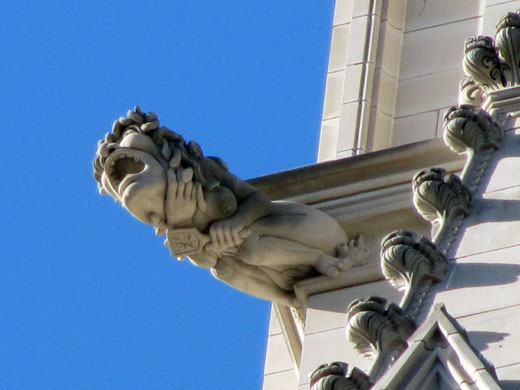
“Don’t leave me hanging in a city so dead…”

Sometimes gargoyles are so high up—in this case, nearly 200 feet—that few people see them, and nobody hears them. Alas.

On either side the arches fly,
The buttress-blocks that half-imply
A sort of creamy stonework thigh,
And thro’ the calf and knee-crook high
Soar carven brutes profuse; a
Docent notes them, up and down,
Pent-up pilgrims crane and frown
’Neath the nag of no renown,
The southwest-tower Medusa.

A tourist twirls, a ballerina
Sensing o’er her Neutrogena
Grills that send a scent subpoena
From a cactus-themed cantina,
Corn-and-meat pupusa;
Bus-groups pained by prickly towers
Overlooking Gothic powers
Seek instead tequila sours
Ere southwest-tower Medusa.

Still, she sneers by day and night,
A myth amasked in aspish fright,
Damning each commercial flight,
Heedless of the blear and blight
She blusters to induce; a-
Ware of what her curse may be,
Alone she seetheth steadily,
Spitting on the bourgeoisie,
The southwest-tower Medusa.

And, skirting ’round her mirror’s haze,
Limestone saints avert their gaze,
Lest a glance condone her craze:
A kraken kind she howls to raise
To shake her prison loose; a
Waste, when distant dumpsters crash,
Reaping reams of beer-dark trash.
She hath no hope for titans’ clash,
The southwest-tower Medusa.

Like a queen of ninth-grade spites
Brooding on imagined slights,
Texting vapid acolytes,
Curls a-twirl through tween-dazed nights,
She taps jejune abuse; a
Tome she scans with deep’ning dread;
No sandaled Zeus-brat hunts her head.
“I am half sick of Bulfinch,” said
The southwest-tower Medusa.

She’s left to wail, she’s left to loom,
She sets her face to scowl and fume,
She sees the horrid garden bloom,
She sees no glad, galumphing groom
To suffer and seduce; a-
Las, no roof-beam waits to rise,
Nor any man half Ares’ size.
“No curse has come upon me!” cries
The southwest-tower Medusa.

There is no river, chain, nor boat,
No pithy rhyme for profs to quote,
No knight to heed her final note;
For her, no verse will e’er be wrote
By laureates obtuse; a
Captive crone, denied release,
She envies maids whose poems cease.
No tender curse can promise peace
To southwest-tower Medusa.

No one wonders, “What is here?”
High above, some starry sphere
Screeches thro’ another year;
Now the dusk-light drowns in drear
And failing, fades to fuchsia;
For no one mused a little space,
And no one praised her fang-bit face,
And none of flesh will e’er embrace
The southwest-tower Medusa.

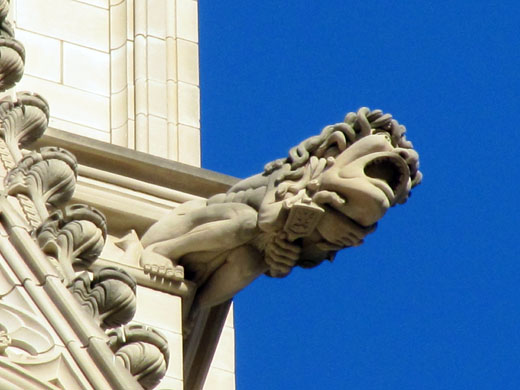
(For all the entries in this series, hit the “looking up” tag.)
“And he plays at stocks and shares, and he goes to the regatta…”

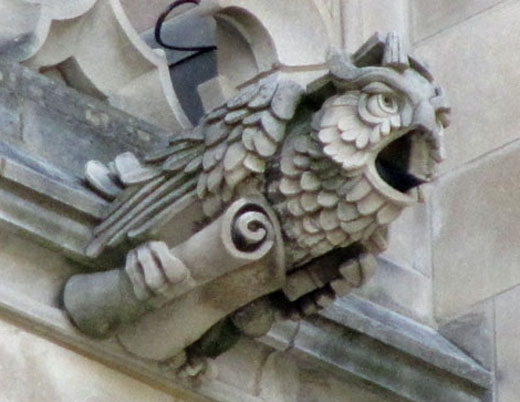
When I asked the owl on the north nave to contribute a poem to this project, I assumed from his mortarboard, scroll, and book that he’d hand me a pile of self-aggrandizing verse. Instead I got this shamefully loose translation of a pseudo-Ovidian poem written sometime between the 12th and 14th centuries. I guess a gargoyle, like the occasional human, reserves the right to remain enigmatic.

THE LOMBARD AND THE SNAIL

Loudly, the Lombard lopes over the landscape, and stops;
Leery, he lights on the lushest and loveliest crops.
Frabjous he feels, for his fields are not fated to fail—
Then forth springs a spectacle strange and stupendous: a snail.
Cowed and confounded, he quivers and quavers and groans;
Witless, he whitens, as wonderment welters his bones.
Seizing his senses, he summons the sangfroid to say:
“Fie on a felon! My fortune is forfeit today!
No suchlike scoundrel has slithered or skulked here before.
Mark well his message: he musters to meet me in war.
Horns are his heralds; his shield makes his handiwork plain.
Shall I not spurn him? No—better, in sooth, to be slain.
What if I poke and provoke him? Perhaps I’ll prevail!
Minstrels and merchants will mimic my marvelous tale.
What am I saying? To fight with a fiend is uncouth!
Easier warfare abounds; it’s a world-weary truth.
Men will say ’madness!,’ maligning me under their breath:
’It’s not meet and fitting to seek an uncivilized death.’
What if my children should walk by this waelstow and see?
Faced with this fiend, they would fathom his fierceness and flee!
Still, they’d concede that this combat is clearly unfair:
Armed is this beast, but no buckler or broadsword I bear.”
Fretful, he freezes, as Fear grapples fiercely with Shame;
Shame is pugnacious, but Fear keeps his temperament tame.
Competent counsel can kindle a capable life;
Thus he petitions the heavens, and checks with his wife.
Promptly, the gods promise palms for the victor, and praise;
Nervous, he nurtures no trust in their numinous ways.
Thence to his wife; she is timorous, tearful, and true:
“Listen, you lunatic, what are you looking to do?
Scuttle your strife; let your spirit sit safe on a shelf.
Mind no more monsters—and muse over more than yourself.
Spurn not your children and spouse! Let your senselessness stall;
Ill-omened days will bring dolor and doom to us all.
Hector would crumble, and even Achilles would quail;
Fast would the firmness of Hercules fracture and fail!”
Roused, he retaliates: “Rein in your runaway fears!
We who dare Death are undaunted, dear woman, by tears.
Great be the gods, for they grant me a glorious name.
You and the family fare well! For I follow my fame.”
Forth to the field, where he faces the fiend in the fray;
Stalking around him, he steadies his stomach to say:
“Beast, you are feral, unnatural, immoral, and vague!
Monster of monsters, as mean as the mortalest plague,
Hold high your horns! I am horrified hardly at all.
Show me your shield! Into no stealthy shell shall you crawl.
Righteous, I raise my right hand! Now your ruthless reign stops!
Savagely sully no more my salubrious crops!”
Swinging and swatting and shaking and sticking his spear,
Panting, he presses; the palm of the victor is near.
For heroes who rate such renown, what reward is supplied?
The matter is lofty; their lawyers will likely decide.


(For all the entries in this series, hit the “looking up” tag.)
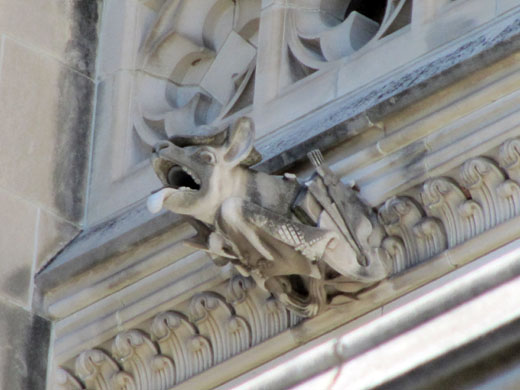
“The girls would turn the color of the avocado…”

According to Gasch’s Guide to Gargoyles and Other Grotesques, the cathedral’s beret-wearing, paintbrush-toting deer is a verbal and visual pun: “This ‘endearing’ artist is undoubtedly ‘fawning’ on art.” Forever facing south toward the city’s museums, this creature is finding that a life in the arts, or in Washington, is about acquiring far more than the proper costume or kit.

ARS GRAVIS, VITA LEVIS

“Oldenburg, Rauschenberg, Klimt, or Klee:
When will I know what my passion should be?
Bierstadt, Bearden, de Kooning, Kinkaid:
How will their worth and my wisdom be weighed?
Is Calder too cutesy? Is folk art still fab?
Must Modern mean morbid? Devotional drab?
Are Memmi’s Madonnas deserving of fame?
Is liking them rightly ironic, or lame?
Is Flagg too American? Catlin taboo?
Is Russell too western? Is Parrish too blue?
Is Fauve far too Fauvist? Is Nevelson fluff?
Noguchi not nearly noetic enough?
What if I’m cornered, but plead my release
By deftly decrypting a daring new piece?
‘Problematizing. Pedantic. Profane.
Derivative. Kitschy. Impassioned but vain.’
Stone-faced, I’ll suffer no pleasure to show.
What if they squint through my brilliance, and know?”

(Say God replies. His pronouncement drifts down:
“Art’s not an adjective, only a noun.”)

(For all the entries in this series, hit the “looking up” tag.)
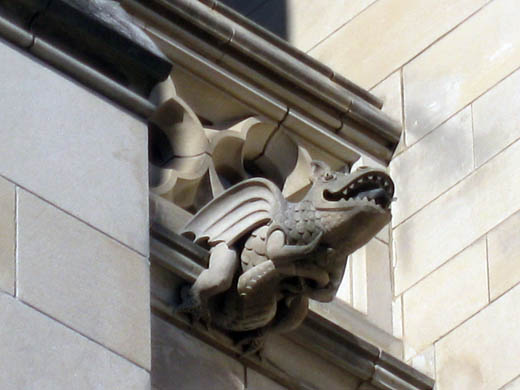
“It’s the only the thing that never gets old.”

The conversations one overhears around the cathedral are enlightening. An eavesdropper soon learns that there are answers to seemingly impossible questions, including this one: “Why is that gargoyle smiling?”

A MOTHER CONSOLES HER DAUGHTER

“Lizards must perish, as sure as they’re born;
Children who love them are fated to mourn.
Yet lizards live on when their season is flown:
Scales fall away; the remainder is stone,
And wings, like green legends, burst forth and unfold.
The beasts they become covet altars of gold;
They roost on cathedrals, unnoticed and gray,
Watching the centuries die in a day.
Well may you wonder, ‘But what happens next?’
This question leaves even the wisest perplexed.
The wyrd of these wyrms is a subtle decree,
But here’s what a wyvern once whispered to me:
When Time bids these buttresses buckle and break,
Scattering rubble and ruin in their wake,
Things wearing wings will awake and take flight.
On towering temples a few will alight;
Some will watch kobolds construct them a shrine;
Some will stalk longships, their prows to entwine;
Some will grind gryphons to dust in their claws;
One may remember a child, and pause.
So listen, for wings carry comforting truth:
Honor the monsters that creep through your youth,
And never make light of a reptile’s pride;
A lizard, though small, is a dragon inside.”


(For all the entries in this series, hit the “looking up” tag.)
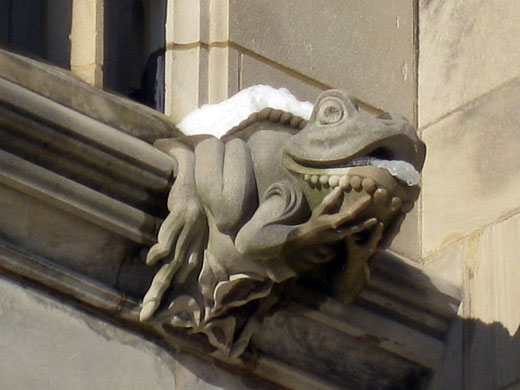
“It’s nothing but time and a face that you lose…”

Where the south nave meets the south transept, near the entrance to the gift shop, is this fellow. As gargoyles go, he’s not lurid or menacing, but he does know his role in architectural tradition.

FEBRUARY 14

“On a skull in Salamanca
High within a grand façade
Croaking notes of grace eternal
Roosts a rana loved by God.”

So the tourist told his lover
Smiling up through falling snow.
“Strange,” she said, “sounds Salamanca.
What bright boon do frogs bestow?”

“Should two souls in Salamanca
Chance to see the frog,” he said,
“Blessed days are bound to follow;
In a year, the two will wed.”

Glancing down, she glimpsed a garden;
Frozen roses felt her sigh:
“We are not in Salamanca.”
Windy whipped the winter sky.

Side by side, the silent strangers
Shuffling slowly through the snow
Spoke no more of Salamanca;
Where they went, I do not know.

(For all the entries in this series, hit the “looking up” tag.)
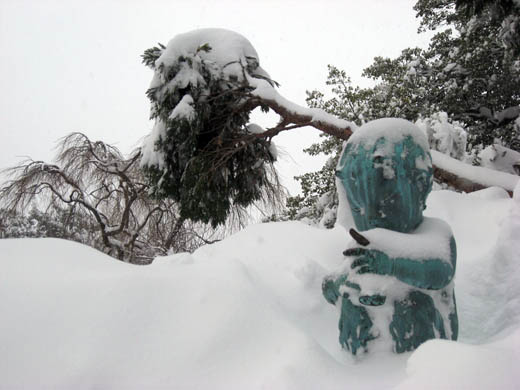
“I can’t keep my eyes open, wish I had my radio.”

The little satyr outside the cathedral’s herb cottage patiently pipes his silent tune regardless of the season. He’s not a gargoyle, but why hold that against him? When he heard we’re getting more snow on top of the two feet that fell on the city last weekend, he took it personally.

SAUDADE

I pipe under protest, knowing no blizzard will trouble to tell me
Why I was banished, a fantasy long since forgotten.
Older eyes see an Arcadian prelude, when straw-skirted shepherd girls
Swooned at my lyrics, eternally light-eyed and lewd…
One day, the sun shone down drowsy. I curled upon emeraldine moss-root,
Dozing insensate, for nothing that dreams is immortal.
Stretching, I stirred—and I gasped at the winter that rose all around me:
Blinding white pastures and hillsides and frost-shrouded peaks.
Heartsick, I shook—and then Zephyrus whispered, so hyacinth-sweet,
Dissolving the winter; the world was a fresh, flawless green.
Snow turned to cloudbursts, all wet-nosed and panting. They pressed for a melody,
Cheerful but soothing, as pale and as patient as peonies.
Storm-god, I’m hardly as young as I look. Your rage to benumb me
Kindles a memory: waking to sheep in the spring.


(For all the entries in this series, hit the “looking up” tag.)
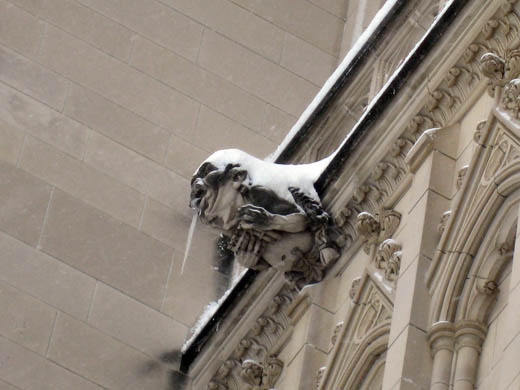
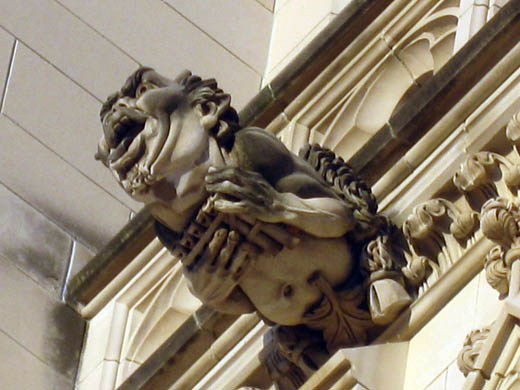
“From Arcadia to the stone fields of Inisheer…”

Few visitors to the National Cathedral glance up to see who’s perched on the facade just north of Creation. What follows is unreliable; the snowstorm, and my interlocutor’s ancient Greek accent, made accurate transcription rather difficult.

PAN

Leave “kyrie” and “tirra lirra” be,
And let me sneer and jeer and leer at thee.
The gates of dawn are bricked and bolted fast;
The springs of piping pastors fell at last.
Now winter twists my reeds like broken wings,
And Philomel abhors the hymn she sings,
Yet all the world adjudges me the thief?
Perhaps I am. So peep behind my leaf,
And spurn what sailors swore in days of old;
I am not dead, dear Thamus—simply cold.

(Above: Pan on February 6, 2010. Below: Pan on December 3, 2009.)


(For all the entries in this series, hit the “looking up” tag.)
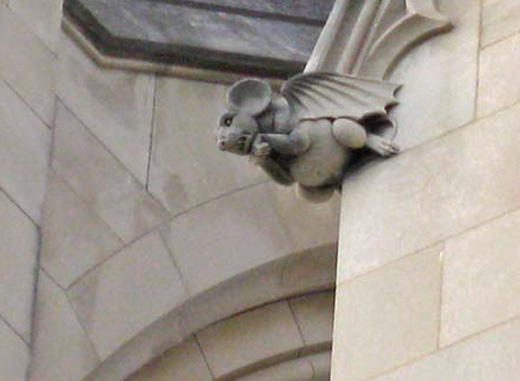
“…unladen, empty, and turned to stone.”

The rodent poised on a buttress on the south nave of the National Cathedral didn’t go where I expected—but that, I suppose, is the point.

DIE FLEDERMAUS

You say: “No mouse was meant to fly.”
I woke with wings, so why
Should I not try

To streak and swoop from roof to peak,
Refining my technique?
Perhaps next week,

You’ll dwindle as I soar aloft,
You sorry souls who scoffed,
And, landing soft

In straunge strondes, I alight
A pilgrim benedight;
But then, by night,

The leatherwings my roost surround
With prophecies profound;
Without a sound

They flap from crags and belfries cold
A bat-king to behold.
So would you scold

A faulty mouse whom Fortune spurned,
Whose rote she left unturned?
For I have learned

A larger life demands a leap.
When all the world’s asleep,
From spiry steep

I’ll wing where mice may safely twitch:
Moel Hebog will bewitch,
And Lovćen’s rich,

And Eldfell smolders, bare and bleak—
Perhaps a perfect peak
Where all who squeak

May lightly laze, like long-shed sorrow:
Fuji, Kilimanjaro
…so, tomorrow.

(For all the entries in this series, hit the “looking up” tag.)
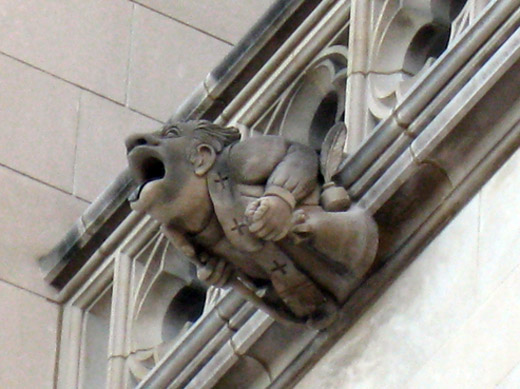
“There’s a club, if you’d like to go…”

The dour bishop on the south nave of the National Cathedral needs to spend less time judging tourists and more time reading the Cura Pastoralis. Does anyone understand what he’s yammering about? I don’t.

ORDINARY TIME

When January thaws, and spirits fall
Like late December sleet that spattered all
These roots and stumps, you stumble, overwrought,
The virtue in your veins engendering nought
But wheezing as you clamber to repeat
This uninspired ritual: to greet
Another crop of claimants at the source,
In chapels where this custom runs its course
And small fools hum a hymn for Heaven’s sake
(Which only keeps the bigger fools awake),
Then something pricks your wan and warbling heart;
To compensate, you contemplate the art
Of forming crooked cloisters with your hands;
Below, the palmers sneak from sundry lands
And cross the lines of tales that didn’t end.
Along the leaves of centuries, they wend
To seek a saint. His holy, blissful trick?
He once helped others when that they were sick.
And here your daydream fails. In disarray,
You pace the nave alone. You sulk away.
You haunt the darkened pub, and down a beer,
And swish the foamy dregs, another year.
Vocations call for patience, this you know;
Devout or not, your pilgrims never show.

(For all the entries in this series, hit the “looking up” tag.)
“…and he claws at the door to be let out at night…”

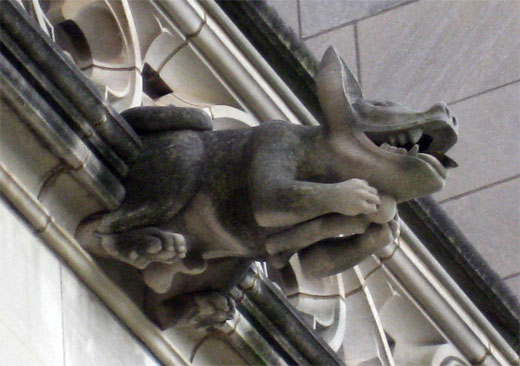
Gasch’s Guide to Gargoyles and Other Grotesques says that this bone-clutching critter on the north nave of the National Cathedral is a basenji, an African dog that can’t bark but does tend to yodel. Our neighborhood basenji earned his place in the 1959-1960 gargoyle design competition; his artist, as you’ll see, is already the subject of apocrypha.

EPIPHANY

Bereft of bark, I bat my bone about,
And do my simple service as a spout,
And in my mind I romp across the grass
And nip at skirt-clad ankles as they pass,
And let no lofty insight cloud my brain;
Discernment falls and drips away, like rain.
…but once, a sunny pilgrim made me think:
Her left hand clutched a sketch-pad sopped with ink,
Her right hand led her son—and in my spine,
I knew those hands determined my design.
That sprinkler-misty morning, I awoke
And listened to my maker as she spoke:
“Imagine: When a thousand years have flown,
We’ll look up and see this pup-spout of our own.”
The boy stepped back suspiciously and said,
“I hope by then we’re looking down instead.”

(For all the entries in this series, hit the “looking up” tag.)