“And still I hear that sharp tongue talking…”

When I skulk through used bookstores, I scan the spines for books by John Hollander, whose death on August 18 at the age of 83 was overshadowed by the passing of another fine poet whose work sits nearby on the shelves. Hollander got a nice obit in the New York Times, but he deserves a more appreciative sendoff—and many new readers. “[A]s far as endings are concerned,” he once wrote, “One does not begin feasting at dawn, but at sundown.”

Hollander published two dozen collections of his own verse, but far more books with his name on their covers attest to his calling as a sort of poetry evangelist. In addition to the Oxford Anthology of English Literature, he edited collections of poems for children, garden poems, war poems, and countless more. Spend five bucks on, and a long plane ride with with, Committed to Memory: 100 Best Poems to Memorize and you’ll have a sturdier acquaintance with well-known poems than most tuition-soaked English majors.

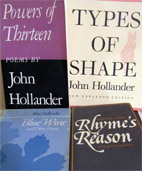
Last week, one of Hollander’s friends called him “the great explainer,” and that’s his exact role in Rhyme’s Reason, a short, chatty book that takes readers on a tour of common poetic forms and techniques. Hollander was no mere docent; to demonstrate most forms, he provided his own poems. Check out the first few lines from his “Ghazal on Ghazals,” which uses and explains the Persian form:

 For couplets the ghazal is prime; at the end
Of each one’s a refrain like a chime: “at the end.”

But in subsequent couplets throughout the whole poem,
It’s the second line only will rhyme at the end.

On a string of such strange, unpronounceable fruits,
How fine the familiar old lime at the end!

Hollander’s ghazal, a favorite of mine, is typical not only of his unfashionable championing of form but also the great fun he has with it. His 1983 book Powers of Thirteen contains 169 poems, each one consisting of 13 unrhymed 13-syllable lines. Types of Shape collects 35 carmina figurata, poems typed out in shapes—a cat, an arrow, the state of New York—to bolster or complement the words.

Some people assume that a love of form is an inherently conservative impulse, but Hollander harumphed. “I don’t know why some people have an ideology about form—’open,’ ‘closed,’ whatever,” he told the Paris Review in 1985; in the introduction to Rhyme’s Reason, he deems everyone else skittish and unadventurous:

In former times, the region of verse was like an inviting, safe municipal park, in which one could play and wander at will. Today, only a narrow border of that park is frequently used (and vandalized), out of fear that there is safety only in that crowded strip—even as the users’ grandparents would cling to walks that went by statues—and out of ignorance of landscape. The beauties of the rest of that park are there, unexplored save by some scholars and often abandoned even by them.

I am old enough to have grown up in the park, and to map a region one loves is a way of caressing it.

Hollander appears to have had a undramatic life, which is perhaps why one critic dubbed him “a virtuoso without a subject matter,” but the poet found it silly to separate the two:

Great poems are all fables about life. There are two popular and radically antagonistic views in the world today about what the best literature does. One is that literature is only about itself. The other view is that literature is all about life, and that the more directly it transcribes experience the better it is. These are two views I find equally implausible. I think one of the things about poetry (and certain great fiction would be included in this) is that the whole notion of “aboutness” is peculiar. One of the ways literature is about life is by way of being about itself. Or, to put it better, literature gets to be about life genuinely by taking very great regard of how much it is about itself.

Plenty of goofy writers declare that they “love language,” but Hollander was the real deal:

Let’s put it this way: I don’t take laudanum. I take pains. Actually, what summons up vision and voice from wherever they ordinarily hide is the dangerous charm, the potent magic of language itself. Language and its structures—the alchemy of syntax, the temples and sacred precincts of verse. Solving puzzles of construction that I’ve propounded for myself. Discovering secret doorways and hidden surprising staircases in formal rooms that had been lived in for centuries. Those are what lead to unfoldings for me.

I’ll keep expanding my Hollander collection; whether lucid or murky, each new book is a surprise. How could one poet possess such range, articulate so many voices? The first page of Powers of Thirteen suggests an answer, and a worthy epitaph:

This is neither the time nor the place for singing of
Great persons, wide places, noble things—high times, in short;
[ . . . ]
I do what I am told, and tell what is done to me,
Making but one promise safely hedged in the Poets’
Paradox: I shall say “what was never said before.”

“As we get older, and stop making sense…”

English teachers make great idols. Rich kids who can’t pursue their dreams should kill themselves. Such are the awful lessons of Dead Poets Society, a movie I love to hate—not only because real-life English teachers are dubious exemplars, but also because the movie takes too much glee in damning “Dr. J. Evans Pritchard, Ph.D,” the textbook author who supposedly reduces the evaluation of poems to a simple trick of geometry. Not even my worst English teachers would have endorsed the idea, so I assumed such a book didn’t and couldn’t exist—until I discovered the real Dr. Pritchard, but found that he’s hardly as bad as he seems.

When the Dead Poets Society teacher, played by Robin Williams, asks a student to read aloud from a textbook by “Dr. J. Evans Pritchard, Ph.D,” this is what we hear:

 To fully understand poetry, we must first be fluent with its meter, rhyme, and figures of speech, then ask two questions: (1) How artfully have the objectives of the poem been rendered; and (2) how important is that objective? Question one rates the poem’s perfection; question two rates its importance; and once these questions have been answered, determining the poem’s greatness becomes a relatively simple matter. If the poem’s score for perfection is plotted on the horizontal of the graph and its importance is plotted on the vertical, then calculating the total area of the poem yields the measure of its greatness. A sonnet by Byron might score high on the vertical but only average on the horizontal. A Shakespearean sonnet, on the other hand, would score high both horizontally and vertically, yielding a massive total area, thereby revealing the poem to be truly great.

As you proceed through the poetry in this book, practice this rating method. As your ability to evaluate poems in this manner grows, so will your enjoyment and understanding of poetry.

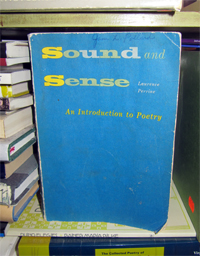
In 1956, Southern Methodist University lit professor Laurence Perrine published the first edition of Sound and Sense: An Introduction to Poetry, which he apparently developed for use in his own classroom. Flip through the book, and there it is, in similar wording, the notion that anthropomorphized a thousand bales of straw:

In judging a poem, as in judging any work of art, we need to ask three basic questions: (1) What is its central purpose? (2) How fully has this purpose been accomplished? (3) How important is this purpose? The first question we need to answer in order to understanding the poem. The last two questions are those by which we evaluate it. The first of these measures the poem on a scale of perfection. The second measures it on a scale of significance. And, just as the area of a rectangle is determined by multiplying its measurements on two scales, breadth and height, so the greatness of a poem is determined by multiplying its measurements on two scales, perfection and significance. If the poem measures well on the first of these scales, we call it a good poem, at least of its kind. If it measures well on both scales, we call it a great poem.

Boo! Hiss! Down twinkles! Blockin’ out the scenery, breakin’ my mind!

Dead Poets Society imagines this infamous passage occurring on “page 21 of the introduction,” but you won’t find it in Perrine’s introduction. Sound and Sense doesn’t have an introduction; Perrine’s shaky effort to quantify taste occurs way in the back of the book—on page 198, in the penultimate chapter, which focuses on learning to spot obviously bad poetry. In real life, Perrine chases this passage with a near-retraction:

The measurement of a poem is a much more complex process, of course, than is the measurement of a rectangle. It cannot be done as exactly. Agreement on the measurements will never be complete. Yet over a period of time, the judgments of qualified readers tend to coalesce: there comes to be more agreement than disagreement . . .

[…]

For answering the first of our evaluative questions, How fully has the poem’s purpose been accomplished? there are no easy yardsticks we can apply. We cannot ask, Is the poem melodious? Does it have smooth meter? Does it use good grammar? Does it contain figures of speech? Are the rimes perfect? Excellent poems exist without any of these attributes. We can judge any element in a poem only as it contributes or fails to contribute to the achievement of the central purpose; and we can judge the total poem only as these elements work together to form an integrated whole. But we can at least attempt a few generalizations.

Of course, all this comes not on the first day of school, but near the end of the course, after an absolute beginner has learned about figurative language, imagery, allusion, tone, rhythm, meter, sound, and pattern—subjects I daresay many English majors can’t discuss competently now.

Still, Perrine/Pritchard is a bit dry, isn’t he? Hasn’t his soul been smothered by tweed? Aren’t his whimsies constrained by the iron cage of reason?

Here’s what “Pritchard,” in his real first chapter, actually says.

Poetry is spiritually vital:

Poetry in all ages has been regarded as important, not simply as one of several alternate forms of amusement, as one man might choose bowling, another chess, and another poetry. Rather, it has been regarded as something central to each man’s existence, something having unique value to the fully realized life, something which he is better off having and which he is spiritually impoverished without.

Poetry lets us live deeply:

Indeed, the two approaches to experience—the scientific and the literary—may be said to complement each other. And it may be contended that the kind of understanding one gets from the second is at least as valuable as the kind he gets from the first.

Literature, then, exists to communicate significant experience—significant because concentrated and organized. Its function is not to tell us about experience, but to allow us imaginatively to participate in it. It is a means of allowing us, through the imagination, to live more fully, more deeply, more richly, and with greater awareness.

Poetry helps us live triumphantly:

We find some value in all intense living. To be intensely alive is the opposite of being dead. To be dull, to be bored, to be imperceptive is in one sense to be dead. Poetry comes to us bringing life, and therefore pleasure. Moreover, art focuses and so organizes experience as to give us a better understanding of it. And to understand life is partly to be master of it.

Poetry is rich:

If it is to communicate experience, it must be directed at the whole man, not just at his understanding. It must involve not only his intelligence but also his senses, his emotions, and his imagination. Poetry, to the intellectual dimension, adds a sensuous dimension, an emotional dimension, and an imaginative dimension.

Poetry can’t be quantified:

You may have been taught to believe that poetry can be recognized by the arrangement of its lines on the page or by its use of rime and meter. Such superficial tests are almost worthless. The Book of Job in the Bible and Melville’s Moby Dick are highly poetical, but a versified theorem in physics is not. The difference between poetry and other literature is one only of degree. Poetry is the most condensed and concentrated form of literature, saying most in the fewest number of words. It is language whose individual lines, either because of their own brilliance or because they focus so powerfully on what has gone before, have a higher voltage than most language has. It is language which grows frequently incandescent, giving off both light and heat.

And that’s just the first chapter! Despite that one iniquitous passage at the end of Sound and Sense, Perrine spends much of the book arguing against the quantification of poetry. At one point, he contrasts the chemical equation for sulfurous acid with the limitless connotations of the word “sulfurous” in a poem. “The poet, we may say, plays on a many-stringed instrument,” he writes. “And he sounds more than one note at a time.” If Perrine often mentions science and psychology, particularly in the chapter on imagery, he does so because he assumes his students already speak those languages. He’s not diminishing poetry; he’s offering novices a way in.

Perrine frequently sounds just as you’d imagine someone who got a Ph.D from Yale in 1948 ought to sound, but I find his old-fashionedness refreshing. “The difference between your figures of speech and the poet’s is that yours are worn and trite, his fresh and original,” he tells his readers, making clear that he’s not some fretful “facilitator,” but the expert in the room. A man of his times, he urges the cultivation of taste through study, scrutiny, and thought—and in his own genteel way, he advocates zeal:

Undoubtedly, so far in this chapter, we have spoken too categorically, have made our distinctions too sharp and definite. All poetic excellence is a matter of degree . . . But a primary distinction between the educated man and the ignorant man is the ability to make value judgments.

A final caution to students. In making judgments on literature, always be honest. Do not pretend to like what you really do not like. Do not be afraid to admit a liking for what you do like. A genuine enthusiasm for the second-rate is much better than false enthusiasm or no enthusiasm at all. Be neither hasty nor timorous in making your judgements. . . . Honesty, courage, and humility are the necessary moral foundations for all genuine literary judgment.

Yes, Perrine can be stuffy. The 1956 debut edition of Sound and Sense contains more than 200 poems, but there aren’t many by women, and as far as I can tell, only one is the work of a non-white poet, Countee Cullen. (Not even Paul Laurence Dunbar? Oh, professor.) Perrine’s idea of a wild, loosen-the-spats, extra-credit challenge? The Love Song of J. Alfred Prufrock. 

Still, the poets in Sound and Sense would make fine desert-island companions—Noyes, Tennyson, Millay, E.A. Robinson, Wilfred Owen, Emily Dickinson, Richard Wilbur, Robert Frost, Carl Sandburg, even James Joyce—and anyway, isn’t academia usually behind the times? My professors in the 1980s and 1990s taught the poets of the 1950s and 1960s as if they were the consummation of poetry itself. They didn’t clue us in to the New Formalism occurring off-campus. Perhaps they weren’t aware of it.

(Sound and Sense is still in print in an overpriced 14th edition. Two editors have updated and broadened the selection of poems—but amazingly, as recently as the 13th edition, the first half of the paragraph that bred “Dr. J. Evans Pritchard, Ph.D” is still stinking up chapter 15! At what point in the past 50 years did that passage get pruned: before or after Dead Poets Society in 1989?)

It’s a shame Perrine has been vilified in fiction, because in chapter 15the chapter with the dreaded Dead Poets Society passage—he begs students to think for themselves, with no histrionic page-ripping or standing on desks. He flings out examples of trite popular verse so students won’t be suckered by sentimentality, rhetoric, didacticism, and cheap appeals to emotion, patriotism, and religion. A truly excellent poem, he says, will be complex and fresh; it “will not be merely imitative of previous literature, nor appeal to stock, pre-established ways of thinking and feeling which in some readers are automatically stimulated by words like mother, baby, home, country, faith, or God, as a coin put into a slot always gets an expected reaction.” He would have liked Roger Ebert’s dismissal of Dead Poets Society as “a collection of pious platitudes masquerading as a courageous stand,” a movie that “pays lip service to qualities and values that, on the evidence of the screenplay itself, it is cheerfully willing to abandon.”

Four years ago, I sat across a conference table from an assistant dean with a Ph.D in the humanities who, with no evident trace of self-loathing, asked me to write bullet points summarizing the “workplace relevance” of medieval literature. (That day I confirmed that the soul really does exist, because I felt mine howling to leave my body.) More recently, I rolled my eyes at the news that a “professor emeritus and former chair of the department of recreation and leisure studies at Southern Connecticut State University” has developed the “Collegiality Assessment Matrix and Self-Assessment Matrix,” which are “designed to clearly assess the level of collegiality of a faculty member.”

This sort of dehumanizing Taylorism thrives in education these days, but you won’t find an endorsement of it even in the final subdued paragraph of Sound and Sense:

Yet, after all, we have provided no easy yardsticks or rule-of-thumb measures for literary judgment. There are no mechanical tests. The final measuring rod can only be the responsiveness, the maturity, the taste and discernment of the cultivated reader. Such taste and discernment are partly a native endowment, partly the product of maturity and experience, partly the achievement of conscious study, training, and intellectual effort. They cannot be achieved suddenly or quickly; they can never be achieved in perfection. The pull is a long pull and a hard pull. But success, even relative success, brings enormous rewards in enrichment and command of life.

Perrine’s conclusion is tepid, but his purpose is profound: He wants you to use poetry to think harder, live better, and feel more deeply. There’s more depth, pleasure, and (every committee’s Questing Beast) “critical thinking” in the stuffiest chapters of Sound and Sense than you’ll find in the latest platitude-sodden government report on the humanities. If you live to defend the value of literature, history, and the arts, turn your Dead Poets Society DVD into a drink coaster and take heart. In real life, “Dr. J. Evans Pritchard” is an ally after all.

“You’ve been in the pipeline, filling in time…”

No medievalism this week. Just some links and comments about the humanities, all of them hanging by a common thread.

* * *

From Do Androids Dream of Electric Sheep? by Philip K Dick, 1968:

“You androids,” Rick said, “don’t exactly cover for each other in times of stress.”

Garland snapped. “I think you’re right: it would seem we lack a specific talent you humans possess. I believe it’s called empathy.”

* * *

From a Chronicle of Higher Education story about Google Glass:

[Assistant professor of journalism and communication] Mr. Littau said he hoped to see further application of Glass in the classroom, although he could not say for certain what else it could be used for.

“It’s a device made for the liberal arts,” he said. “The whole device is about putting you in the shoes of the wearer to experience the world through their eyes. An auto-ethnography in history could be an interesting thing to experience.”

Only in a visually obsessed age would we believe that literally seeing someone else’s point of view qualifies as an experience. If that’s true, We Are All Cops Cameramen Now.

What’s it like to view a work of art through filters other than your own? How does someone with a trained ear experience classical music? How does someone feel, from his forehead to his gut, when his daughter is born, his candidate loses an election, or his childhood home is torn down? God help liberal-arts faculty who need Google Glass to develop empathy. To make that imaginative leap, just find time for reading and thinking—which are analog, and not recent inventions.

 * * *

Here’s a more delightful melding of tech and the humanities: Last week, I found a pocket universe of clever people composing poetry in programming languages.

Experiments with computer-generated poetry aren’t new, but for creative works wrought from the human mind, Perl has apparently been the language of choice. You’ll find poems written about Perl, poetry generators for Perl, Perl poems as April Fool’s jokes, and translations such as “Jabberwocky” rendered in (non-functional) Perl. The go-to text in the field is writer and software tester Sharon Hopkins’ 1992 conference paper and mini-anthology “Camels and Needles: Computer Poetry Meets the Perl Programming Language.”

A Spanish engineer and software developer also put out a call in 2012 for contributors to code {poems}, an anthology of verse in such languages as C++, Python, DOS, Ruby, and HTML. The poems couldn’t just be goofs, though; they had to run or compile. An April 2013 Wired story showcases one of the entries: “Creation?”, a poem in Python by Kenny Brown.

I love this. There’s great creativity here—and a reminder that computers speak only the languages we give them.

* * *

In “Cryptogams and the NSA,” which I’m assuming is not fiction, John Sifton of Human Rights Watch recounts how he was indicted in 2011 after he tweaked the NSA by emailing himself snippets of James Joyce and Gerard Manley Hopkins from a proxy server in Peshawar:

“There are a lot of references to mushrooms and yeast in Joyce,” I said. My attorney touched my arm lightly, but I ran on.

“Look—” I took the book up, “There’s a part late in the book. . . Here, page 613. Halfway down the page.” I pushed it across to Fitzgerald:

A spathe of calyptrous glume involucrumines the perinanthean Amenta: fungoalgaceous muscafilicial graminopalmular planteon; of increasing, livivorous, feelful thinkamalinks; luxuriotiating everywhencewhithersoever among skullhullows and charnelcysts of a weedwastewoldwevild. . . 

“See? Fungoalgaceous muscafilicial,” I said. “It’s a portmanteau of different types of cryptogams.”

The stenographer interrupted here, her north Baltimore accent like a knitting needle stuck in my ear. “Are those words in that book?” she asked, “Because – otherwise you’re going to have to spell them.”

She was waved off by one of the US attorneys.

Fitzgerald read the text, or looked at the letters anyway, and then he looked at me again. A kind, blank, innocent look. Unaware of the fear he was instilling in me, not knowing what he was doing, he suddenly twisted the knife.

“And why would someone write like this?”

My silence now. “Why?” I repeated, meekly. I was devastated.

“Just your opinion. A short explanation.” Absolute innocence in asking the question.

My hands began trembling. One of his assistants looked at the clock.

“I don’t know, sir – honestly I don’t.”

“And why would someone write like this?” Because it’s fun; because it’s artful; because government exists not to perpetuate itself, but to protect these odd, wonderful flourishes of civilization. And because it helps us know who the androids are.

“A kiss on the wind, and we’ll make the land…”

In the 1990s, I met grad students who dreamed of finding the “real” King Arthur; one would-be archaeologist was sure she’d pry Excalibur from the corner of some forgotten Devon field. Back then, most aspiring medievalists only dimly saw that we were riding multiple waves falling neatly into phase, as decades of “historical Arthur” scholarship drew energy from, but also fed, a pop-culture surge of movies, novels, comics, and games. Now that Arthuriana is waning—it’s overdue for a deep, restorative nap—the ghost of Tolkien comes drifting through to provide its “last assay / of pride and prowess”—or, perhaps, to promise its next reawakening.
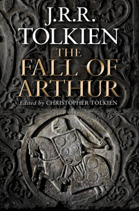
Published last week, The Fall of Arthur is an oddity: a 40-page poetic fragment easily lost amid 150 pages of commentary by the author’s son. Tolkien left the poem unfinished in the 1930s, and I’ll be curious to see how his fans greet this book. Having taught Arthurian lit and composed poems that mimic Old English verse forms, I enjoy seeing Tolkien take the Matter of Britain for an original, alliterative spin—but how many readers like me could there be?

The Fall of Arthur follows the daunting rules of Anglo-Saxon verse: A line consists of two half-lines, each of which must be one of five metrical types and must contain two stressed syllables. At least one stressed syllable in the first half-line must alliterate with the first (never the second) stressed syllable in the second half-line. Also, the vowels in the stressed syllables must be long, unless they come before a consonant cluster, or unless you’re letting initial vowels stand in for consonants. If you’re feeling saucy, you can add unstressed syllables in certain positions—but never in others, or an Anglo-Saxon simply wouldn’t hear the line as verse.

Beowulf and nearly all of the surviving 30,000 lines of Old English poetry follow this form, and Tolkien liked to play with it in modern English, well aware that it didn’t always work. “Our language now has become quick-moving (in syllables), and may be very supple and nimble, but it is rather thin in sound and in sense too often diffuse and vague,” he says in a lecture cited in The Fall of Arthur. “The language of our forefathers, especially in verse, was slow, not very nimble, but very sonorous, and was intensely packed and concentrated—or could be in a good poet.”

Is Tolkien such a poet? Sometimes. The surviving 954 lines of The Fall of Arthur set up a story about the last gasp of a doomed world—Arthur, in the autumn of his reign, is “in war with fate”—and Tolkien does a heck of a job conjuring bleak, clammy gloom. As the king and his army ride east across the Rhine, the sound and shape of the poetry emphasize brutality in eerie, alien lands:

Foes before them,    flames behind them,
ever east and onward    eager rode they,
and folk fled them    as the face of God,
till earth was empty,    and no eyes saw them,
and no ears heard them   in the endless hills,
save bird and beast     baleful haunting
the lonely lands.    Thus at last came they
to Mirkwood’s margin    under mountain-shadows:
waste was behind them,    walls before them;
on the houseless hills     ever higher mounting
vast, unvanquished,    lay the veiled forest.
(I:61-71)

The Fall of Arthur is packed with passages like this: evocations of the wild wastelands beyond the civilized world, scenes of shipwrecks and storm-battered coasts, shadowy foes lurking just out of sight. Tolkien clearly had a blast composing them, and even when his plot is derivative, these moments are original contributions to the Arthurian story in English. They’re also a pleasure to read aloud.

Once in a while, Tolkien serves up scenes that are remarkable for looking nothing like Beowulf. Here’s Lancelot, waking by his window, marveling at songbirds greeting sunrise on the sea:

His heart arose,    as were heavy burden
lightly lifted.     Alone standing
with the flame of morn    in his face burning
the surge he felt    of song forgotten
in his heart moving   as a harp-music.
There Lancelot,    low and softly
to himself singing,    the sun greeted,
life from darkness    lifted shining
in the dome of heaven    by death exalted.
Ever times would change    and tides alter,
and o’er hills of morning     hope come striding
to awake the weary,    while the world lasted.
(III:214-220)

As the Arthurian story demands, Lancelot’s hope fades before Mordred’s far more prescient gloom:

                           Time is changing;
the West waning;    a wind rising
in the waxing East.     The world falters.
New tides are running    in the narrow waters.
False or faithful,     only fearless man
shall ride the rapids    from ruin snatching
power and glory.     I purpose so.
(II.14-153)

Despite these euphonious examples, Tolkien does struggle to squeeze the bourgeois hand of modern English into the mailed glove of Old English verse. In need of words that alliterate on “f,” he uses “fell” as an adjective with offputting frequency—eight times in the first 153 lines, alongside variations of the verb “to fall”—and meter demands that he flip the order of words more often than even many readers with a patience for archaism are wont to tolerate. “Eager rode they,” “he was for battle eager,” “Ivor him answered”—the seams of this poem are easily frayed.

Christopher Tolkien, who discusses his father’s Arthurian poem as if it were a medieval work, calls it “one of the most grievous of his many abandonments” and suggests that such a slowly built, backward-looking poem “could not withstand the rising of new imaginative horizons.” Although enough notes survive to show that The Fall of Arthur was headed nowhere radical, its final, unwritten scenes might have been deeply revealing. Tolkien adored the language of the Germanic invaders who helped defeat the fictional Arthur, overran much of Britain, and gave England its name; this poem is composed in their style, as if it were sung generations later to honor a worthy foe. Had it shown Tolkien’s appreciation for the world that had to die to make way for the literature and language he loved, the finished Fall of Arthur might have been a memorable, much-quoted read.

When The Legend of Sigurd and Gudrun came out in 2009, I wondered how vast a readership awaited Tolkien’s obscure and scholarly pseudo-medieval verse. The Fall of Arthur likewise makes me wonder how many Tolkien fans will wade through a 49-page essay that places this poem in its medieval Arthurian tradition; whether a 954-line fragment deserves a 50-page overview of the notes and drafts behind it; and whether the 43-page essay linking this poem to the Silmarillion doesn’t seem like padding to people who know Tolkien far better than I do.

On the other hand, The Fall of Arthur is a wonderful rarity for our times: a book that makes gigantic demands of those who pick it up, published by a literary executor who assumes his readers are patient, curious, conversant with medieval traditions, and appreciative of formal verse.

Somewhere, I know, are readers who are baffled by Sigurd and Gudrun or The Fall of Arthur but also haunted by their dim awareness of the vast intellectual realms behind them. Perhaps these readers are on the cusp of cultivating a love of Arthurian stories, an ear for archaic English, or other weird passions that civilize the brain but defy popular taste. In the end, they may not prevail—in good Germanic style, The Fall of Arthur warns them that nothing lasts—but they’ll live and fight and revel in words and think deeply for a time, becoming through Tolkien what Tolkien dubbed Gawain: “defence and fortress of a fallen world.”

[Previous Tolkieniana on this blog: Tolkien und Wagner; hobbits at a beach resortThe Lord of the Rings as Methodist Bible study.]

“Now, the mist across the window hides the lines…”

As the dubious “National Poetry Month” limps to its grave, I’ll be glad not to have to pretend that poetry is anything but marginal in American life—but there’s so much good stuff out there that the “Quid Plura?” kobolds and I can’t help but offer a few recommendations. Some things are worth reading (and writing) regardless of popularity or relevance.

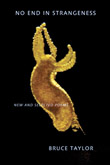
If you think there ought to be at least one good poem about the horrific life of the tomato hornworm, then you’re going to like Bruce Taylor. In No End in Strangeness, Taylor shows that even poems of personal reflection need not begin or end with the self, and that there’s much to be learned from peering at bread mold or using a microscope to marvel, as van Leeuwenhoek did, at the zoological wonders in backyard muck. (That poem, “Little Animals,” justified my purchase of this 2011 collection.) Taylor isn’t necessarily a “science poet,” but he also doesn’t indulge that romantic urge to dismiss or dream away technology, and I like that his poetry sent me to YouTube to look at digenea, rotaria, and amoeba for myself. (Check out a review of No End in Strangeness in the Contemporary Poetry Review and a nice appreciation of “Little Animals” by Anita Lahey.)
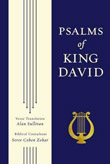
I first knew Alan Sullivan through the lively, form-conscious translation of Beowulf he published with his partner Tim Murphy, but the Psalms of King David were clearly the work of his life. While dying of cancer, Sullivan partnered with an Israeli textual scholar to translate the Davidic psalms with a particular emphasis on replicating the alliteration and meter of the originals. The resulting poems are lucid, lyrical, and fresh; through Sullivan, King David sings anew. Read selections from the Sullivan Psalter in this review and remembrance by poet Maryann Corbett, and don’t miss Sullivan’s famous villanelle about cancer.
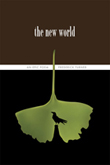
Part Virgil, part “Thundarr the Barbarian,” Frederick Turner’s The New World is a classical epic about an America yet to be—and holy crow, is it fun. Picture this: It’s 400 years in the future, and North America has evolved in bizarre ways. Brutal mutants rule formerly prominent cities (now known as Riots), and religious fanatics threaten the borders of the world’s last civilized place: an enlightened, chivalric, polytheistic republic based in Ohio. According to Dana Gioia, when Turner first published his epic in 1985, it “was met with bewilderment or abuse by academic commentators, even while it earned high praise in nonacademic journals.” Love triangles! Lofty language! Laser swords! Turner does a great job of fusing classical epic with science fiction, and while The New World is great fun, it’s also far more moving and beautiful than I’d expected. Late in the epic, there’s a passage about pregnancy and childbirth that really shows off Turner’s poetic chops; it’s one of countless images that will stick with you long after you put the book aside.

For half a century, autodidact and occasional actor Christopher Logue rallied all the gimmicks of modern poetry to craft a loose, idiomatic version of Homer’s Iliad. “[I]t’s some of the best poetry being written in English today,” wrote Jim Lewis at Slate in 2003, “and it should be read widely and with great pleasure by anyone still interested in the art of verse.” Literally irreverent, Logue freed himself from the tyranny of the Homeric text through one curious advantage: his ignorance of ancient Greek. Instead, he based his still-unfinished poem on English translations published between 1720 and 1950. His Homer—currently collected in three separate volumes—includes scenes that aren’t in the Iliad; at one point, he cribs a passage from Paradise Lost. If you like the idea of blatant anachronisms perfectly deployed—Ajax likened to Rommel alongside references to helicopters and camera angles—then start with War Music. This is exciting, engaging stuff. (I wrote about Logue after his death in December 2011.)

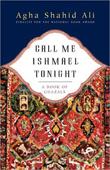
Agha Shahid Ali raised the profile of the ghazal in the English-speaking world. Not every poem in Call Me Ishmael Tonight hews strictly to the Persian form, with its unusual use of couplet-based rhyme within, and not at the end of, every other line, but Ali knows when to be flexible, and he never fails to strike strange, memorable chords. Some poets gripe that ghazals are tricky to write, but there’s an impressionistic quality to them that should excite Westerners: A ghazal’s couplets each tell tiny stories that don’t add up to a coherent narrative but do convey a consistent wistfulness that registers somewhere between heartbreak and hope. Ali adored the ghazal, and he makes the form look easy—even as he uses it to document a creeping awareness of his impending death.

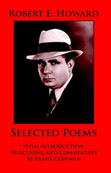
Most fantasy fans know Robert E. Howard as the pulp writer who invented Conan the Barbarian, but he was also a prolific poet. Some of his verse served as epigraphs to his own stories, a few poems appeared in magazines like Weird Tales, and most of it was never published at all. Howard’s Collected Poetry is already out of print—I wrote about it a couple years back—but this hearty Selected Poems should be enough for nearly anyone. As you’d expect of a writer in his late twenties who wrote thousands of poems, Howard composed plenty of clunkers, but his best works are loud, brawny fun. We’ve forgotten that poetry need not be about flowers and personal reflection; Howard knew that it’s also the province of Satanic wizards, voodoo queens, blood-flecked Vikings, Puritan swordsmen, and barbarous hordes. He ought to be “the poet laureate of restless boys, whose lives these days lack poetry, but who, as Howard comprehended, crave it more than most.”
“World tour, media whore, please the press in Belgium…”

Friends tell me I’m underzealous in promoting my own books. I see this blog as something other than a relentless sales pitch—but since April is the dubious “National Poetry Month,” it’s time to tout two titles. I’ll say only this: If you enjoy the way this blog chases down medievalism in everyday life, then the “Quid Plura?” team of kobolds would be grateful for your support.

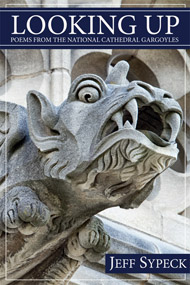
In 2009, after promoting my Charlemagne book and working on projects for other people, I was word-weary and exhausted. To make writing fun again—without worrying about marketability, editors’ impressions, or other people’s needs—I started composing poems inspired by the gargoyles and grotesques that adorn my friendly neighborhood neo-Gothic cathedral.

Light verse! Sonnets! Strange soliloquies and songs! Translations from Latin and German! Three years and more than fifty poems later, the folks at the cathedral graciously gave me permission to show their typically publication-shy beasties in print. The resulting book, Looking Up: Poems from the National Cathedral Gargoyles, is now available at the cathedral gift shop, through Amazon, or (most profitably) directly from me. I’ll donate 75 percent of the net profits to the National Cathedral to help repair damage from the 2011 earthquake. It’s my way of saying thank-you for the many quiet afternoons I’ve spent on the cathedral grounds. (Browse the first drafts of 51 of the 53 poems, and learn more about the book here.)

In 2007, I translated the 15th-century romance “The Taill of Rauf Coilyear,” a 972-line Middle Scots poem about the kerfuffle that ensues when Charlemagne, separated from his entourage by a snowstorm at Christmastime, seeks refuge in the home of a proud and irascible collier (a sort of medieval Tommy Saxondale). Combining folklore motifs with burlesque humor and elements of chansons and chivalric romances, “Rauf Coilyear” is a lively but rarely-read tale of courtesy, hospitality, and knighthood. To my knowledge, it’s also the only medieval romance in which Charlemagne totally gets slapped in the face.

The translation was an experiment: I wanted to see if I could imitate all 75 of the original poem’s tricky rhyming, alliterative, 13-line stanzas in a translation that was both readable and entertaining. (Check out “The Taill of Rauf Coilyear” in its original Middle Scots to see what I was up against.)

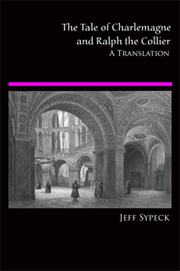
The Tale of Charlemagne and Ralph the Collier is now available through Amazon as a $10 paperback. There’s also an e-book specially formatted for the Kindle. (To get a taste of the translation, sample this low-res PDF of the first few pages.)

No one else has translated “Rauf Coilyear” into rhyming, alliterative, modern English verse, and I doubt anyone else will be nutty enough to try—so whether you’re a longtime reader of this blog, a student of medieval literature, a fan of old-fashioned poetic formalism, or a collector of truly obscure manifestations of Charlemagniana, I hope you’ll find this translation a satisfying read. Despite what Mamillus claimed, sometimes a sad tale isn’t best for winter after all.

“You say, ‘ere thrice the sun done salutation to the dawn…'”

If you’re wont to ask, “Where can I see plays that have rarely been staged for 400 years?”, then hie thyself posthaste anon to Staunton, Virginia, where the American Shakespeare Center reanimates old scripts in a reconstruction of London’s Blackfriars Theater, and under truly humbling conditions: The actors perform in as many as five plays at a time, with multiple roles in each.

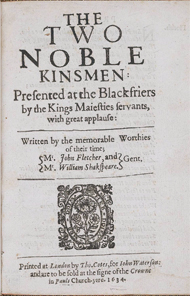
We popped down to Staunton this weekend to see The Two Noble Kinsmen, an adaptation of Chaucer’s “Knight’s Tale” by John Fletcher with an assist from William Shakespeare. The play is supposedly “deeply flawed,” but a dozen actors (who directed themselves) made it engaging and sharp. They earned a standing ovation—and propelled the Canterbury pilgrims through the 17th century and onto the sidewalks of a small Virginia town.

With my own ful devout corage, I did what I do in any new place: I hunted for further medievalism. After good finds in other Virginia towns—Williamsburg, Richmond, Annandale, and the imaginary Swallow Barn—I knew Staunton would come through, and it did, just up the hill from the theater.

Welcome to Thornrose Cemetery, designed by Staunton’s own Thomas Jasper Collins, who built eclectic homes and churches throughout his adoptive hometown.

Although Collins never visited Europe, he did (according to James Madison University) study Gothic Revival architecture in Baltimore, Richmond, and Norfolk. Just inside the cemetery gates is a monument to his medievalism: a stocky little keep.

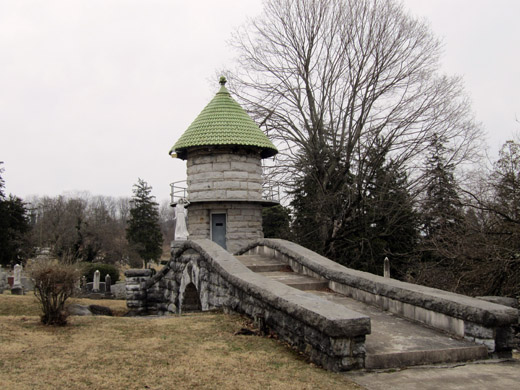
When Collins went medieval by the cemetery walls, his work was striking, if too weighty to be whimsical.

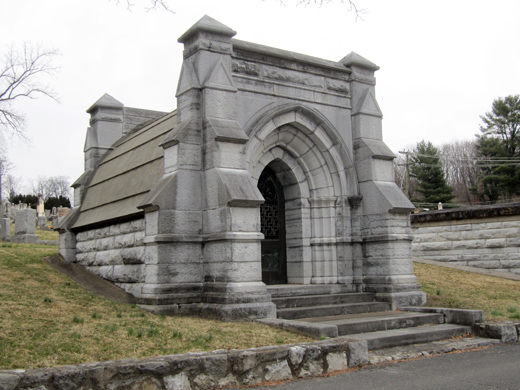
Collins also designed the lovely Effinger family mausoleum, which looks like a stone drawer pulled from the facade of a Gothic cathedral.

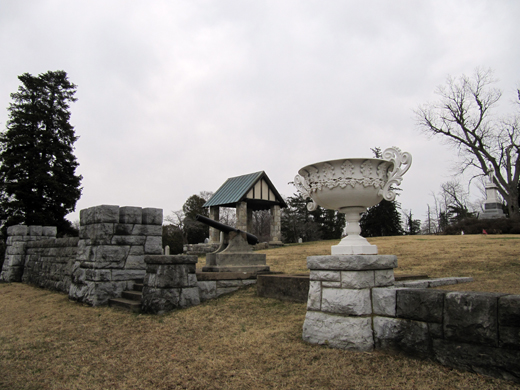
One of the weirder corners of Thornrose leads to a monument to the Confederate dead. There’s good reason to associate faux-medieval castle ramparts with Southern chivalry, but look:

A huge neoclassical urn! A chuppah with square stone pillars and Tudor half-timbering! Civil War artillery! The committee-driven incoherence is wonderfully American.

Like Staunton itself, Thornrose grows ever more eclectic. Its wind-worn headstones aren’t lurid or sad; there’s a matter-of-factness here that harks back to The Two Noble Kinsmen:

This world’s a Citty full of straying Streets,
And Death’s the market place, where each one meetes.

A few blocks away, on a gloomy Sunday morning, you might spot the fellows who play Chaucer’s knights leaning into freezing rain and muttering lines that have only been heard from a handful of actors in 400 years. Later, on stage, they’ll offer up a fine reminder for the week before Easter: not everything that dies is gone for good.

“Cool winds wash down your hope, and you slipped…”

When I was teaching, and books like Beowulf and The Faerie Queene hove into view, my students gamely kicked around a question: Does America have an epic?

Lonesome Dove. The Godfather. Roots. Each book or movie they floated was a lengthy, multigenerational take on an ethnic or regional experience. Other students brought up Star Wars and The Lord of the Rings, and one of them argued, with rare passion, for Stephen King’s Dark Tower/Gunslinger series. In the end, no one was satisfied. Ours, they sighed, is an epic-less nation.

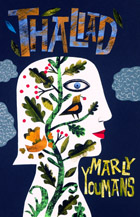
But if we don’t currently have an epic, the people who will live here someday may. That’s the premise of Marly Youmans’ eerie and beautiful Thaliad, a 24-book poem about seven children who survive a fiery apocalypse—and how one of them becomes the founding matriarch of a lakeside tribe in upstate New York.

Recounted 67 years later by Emma, a teenaged librarian who roves the wastes with sword and gun in search of unrescued books, the Thaliad fuses several out-of-vogue elements—formalist verse, narrative poetry, classical epic—to a familiar science-fiction trope. What grows from this grafting is a weird, fresh, magical thing: the story of a new world rooted in the ingenuity and optimism of “one who / Was ordinary as a stone or stem / Until the fire came and called her name.”

Like any classical epic, the Thaliad states its purpose: “to make from these paper leaves / A book to tell and bind the hardest times / That ever were in all of history.” Emma even invokes a muse, but in a nice teen-angst twist, she prays for inspiration from the dream husband she’s sure she’ll never have. “And so I am now married to the quill,” she vows with the melodramatic certainty of youth, recording the origins of her people in a tale that glows with mystical visions, prophetic messengers, and the hard bargain of a divine covenant.

What makes the Thaliad most compelling and real is a certain cheekiness in Marly Youmans’ choice of setting. The children who survive the unexplained holocaust migrate north, as Youmans did, and end up where she lives: Cooperstown, New York, with its nearby Glimmerglass Historic District and Kingfisher Tower, a (yes!) neo-Gothic folly on Otsego Lake. What fantasist hasn’t looked around and wondered what familiar streets and settings might someday become? In that sense, Thaliad recalls Ursula Le Guin’s Always Coming Home, and Youmans is at least as skilled as Le Guin at using mythic elements to solidify and universalize a story, from hints of Beowulf in the raising of funeral mounds to fateful echoes of Ophelia and the Lady of Shalott.

Because epic must be larger than life, Thalia and her fellow children are preternaturally articulate, as is their historian-poet, sometimes in amusing ways. When Emma praises Thalia’s ancestry, we learn that her mother was a doctor, while her father

           was unknown, donor of seed,
Impregnator without shape, a formless
Father of the mind who though a mortal
Receives immortal honors from our kind.

By crafting lofty language to describe an immaculate scientific conception, Youmans reminds Thaliad readers that we’re seeing everything in this poem through the eyes of a teenager and the distorting lens of epic—but also that we’re half-blind to the wonders of our own world. Three generations on, Emma doesn’t think much of us:

Then beauty was abolished by the state
And colleges of learning stultified,
Hewing to a single strand of groupthink.
It was a time bewitched, when devils ruled,
When ancient ice fields melted, forests burned,
When sea tossed up its opal glitterings
Of unknown fish and dragons of the deep,
When giant moth and demon rust consumed,
And every day meant more and more to buy.
Some people here and there lived otherwise,
But no one asked them for any wisdom,
And no one looked to their authority,
For none they had, nor were they like to have
The same—no one expects the end of things
To come today, although it must some day,
And so no one expected the great flares…

Fortunately, Youmans doesn’t rest on easy social criticism. Through unsettling depictions of cruelty, negligence, and loss, she argues that despair in times of horror is a choice, not an inevitability. Even as the Thalians struggle to preserve scraps of civilization, the stars over Cooperstown offer another chance for humanity to get things right. Keen to reinvent the constellations, Thalian poets gaze at a sky

Where unfamiliar constellations rule
A dazzling zodiac—the Nine-tailed Cat,
The Throne of Fire, the Fount of Anguishing,
Un-mercy’s Seat. I might go cruelly on,
But I have brooded for too long on fall
And desolation, hidden history
Of world’s end, thing unwritten in the books,
Its causes and its powers scribed on air
And seen out of a corner of the eye
Or not at all. Better to dream and say
That sparking zodiac shows sympathy
For trial and weariness, presenting Hope
In Silver Feathers, Gabriel in Light,
The Mother’s Arms, the Father’s Sailing Boat,
The Seven Triumphant Against the Waste.

To Youmans, whether you like what you see when you look heavenward depends entirely on what you want to see.

Youmans’ hopeful epic has a recent precedent: Frederick Turner’s brilliant science-fiction poem The New World, in which the learned citizens of a 24th-century Ohio republic fend off fanatics in bordering lands. Maybe two poets don’t represent a trend, but a few clever souls have begun to look beyond short, personal lyrics to rediscover the potential of narrative poetry. Christopher Logue’s retelling of Homer is one of the coolest long poems in decades, and Dana Gioia’s most recent book includes a ghost story in syllabic verse.

By writing an epic, Youmans is endorsing a poetic renaissance that has its detractors. Since the 1980s, dyspeptic critics have argued that neoformal poetry is too obsessed with poetry itself (at the expense, they say, of looking out at the world) and that neoformalism “decontextualizes” poetry. Of course, people who point out the same problem with the past century of visual art get dismissed as reactionary cranks, so I’m content to mutter “de gustibus…” and move on. Youmans’ poem is a call to restore old and beautiful forms of literature—that’s what Emma, librarian and historian, literally does when she speaks of the past:

It was the age beyond the ragged time
When all that matters grew disorderly—
When artworks changed, expressive, narcissist,
And then at last became just tedious,
A beetle rattling in a paper cup,
Incessant static loop of nothingness,
When poems sprang and shattered into shards,
And then became as dull as newsprint torn
And rearranged in boredom by a child
Leaning on a window seat in the rain.

Even so, the Thaliad isn’t just literature about literature. By building a plausible world in fiction, Youmans, like any good science-fiction writer, makes us more aware of the weirdness of the real world, where we should look for life in all sorts of seemingly dead things:

We found a sourwood tree that had been killed
By something, but the leaves still drooped in place,
Though every one had faded into brown.
When we came closer, leaves burst into wings—
The tree was green, the death was butterflies,
Alive and pouring like a waterfall
But upside down from us…

Not remotely a formalist novelty, the Thaliad is a remarkable book about surviving a crisis of faith.

Although the Thaliad runs only 102 pages, it’s a rich poem, and I couldn’t find room in this post for half of my notes. Detecting influences ranging from Milton to Cavafy to A.A. Milne, I reacted just as Dale Favier did:

But having finished, I turn at once to the beginning, to read it again, which is of course what one always does with a genuine epic. They begin in the middle of things because they understand that everything is in the middle of things: they’re structured as a wheel, and its first revolution is only to orient ourselves.

If they’re willing to take a chance, fantasy and science-fiction fans and even the “young adult” crowd might all find much to love here. The Thaliad is rare proof that verse need not be difficult or obscure—and that even now, narrative poetry can still leave readers, like Thalian children eyeing strangers in their orchard, “[e]nchanted into stillness by surprise.”

“…and a cross of gold as a talisman.”

“A light starts—lixte se leoma ofer landa fela—and there is a sound of music; but the outer darkness and its hostile offspring lie ever in wait for the torches to fail and the voices to cease.” Although that line could describe the experience of seeing The Hobbit: An Unexpected Journey in a movie theater, it is, in fact, one of several lovely passages in J.R.R. Tolkien’s “Beowulf: The Monsters and the Critics,” the 1936 essay that helped scry a certain Anglo-Saxon poem on the prow of every English lit syllabus.

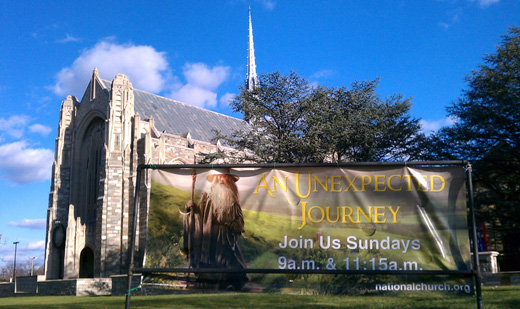
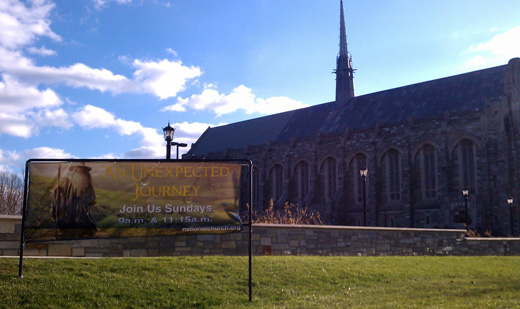
I returned to Tolkien’s essay yesterday after being shown a sign—this one.


That’s Metropolitan Memorial United Methodist Church, across the street from American University here in D.C. This church last appeared on this blog when I spotted the curious “faux-tesques” on its spire, but I hadn’t known it was a locus of Tolkien fandom. (It’s certainly one of the most unexpected examples of public Tolkieniana since the hobbit dumpster and parking signs of Ocean City, Maryland.)

As it turns out, the church’s (presumably unlicensed) banners aren’t just an advertisement of affinity, but an invitation to a series of sermons:

“An Unexpected Journey”
Explore the Gospel Through J.R.R. Tolkien’s Writings
Sermon Series beginning Sunday, January 6
J.R.R. Tolkien’s Lord of the Rings is deeply rooted in the truths of his Christian faith. This powerful story has captivated readers for decades, as well as a new generation of moviegoers. With the new film The Hobbit arriving this winter, it is a good time to explore the Gospel through this wonderful narrative. Our sermon series, “An Unexpected Journey,” will take place on Sundays in January 2013 as we follow the path of Tolkien’s travelers. Echoing Gandalf’s words to Bilbo, worried about his chances of returning home from his journey, “If you do, you will not be the same.”

I’ll let Tolkien experts imagine how the Catholic author might have reacted to The Hobbit being used as a gateway to Methodist Bible study, but as a medievalist he would have understood the impulse. The Germanic literature he loved is tinged with Christian interpolations, revisions, and appropriations, and he knew it was de rigeur in the Middle Ages to outfit the creations of others as couriers of religious ideas.

He also knew that the best stories fight back a little. Here he is again, talking about Beowulf:

The significance of a myth is not easily to be pinned on paper by analytical reasoning. It is at its best when it is presented by a poet who feels rather than makes explicit what his theme portends; who presents it incarnate in the world of history and geography, as our poet has done. Its defender is thus at a disadvantage: unless he is careful, and speaks in parables, he will kill what he is studying by vivisection, and he will be left with a formal or mechanical allegory, and what is more, probably with one that will not work. For myth is alive at once and in all its parts, and dies before it can be dissected. It is possible, I think, to be moved by the power of myth and yet to misunderstand the sensation, to ascribe it wholly to something else that is also present…

Whether he brings in new churchgoers or not, what the minister at MMUMC is doing has medieval roots. Whether it’s Tolkienesque I can’t say, but in its way, a Tolkien-themed sermon series makes more sense than the adoration of The Lord of the Rings by the 1960s counterculture. Whether one great story leads so easily to another remains to be seen, but what Tolkien said about Beowulf grows true of his own works as well: “it must ever call with a profound appeal—until the dragon comes.”

“There’s a beast upon my shoulder, and a fiend upon my back…”

“I’ve always hated dragon stories, hated the entire elf-dragon-unicorn axis. The very notion of high fantasy causes my saliva to get thick and ropy. But as an exercise, I was attempting to create a dragon whom I could respect in the morning.”

That’s what Lucius Shepard told an interviewer in 2001, seventeen years after publishing “The Man Who Painted the Dragon Griaule,” a much-praised (but too-little-known) fantasy story starring one of the best fictional dragons of all time. As it turned out, my first Christmas gift of the season came from someone who knew I’d love this new hardcover volume, which collects all six of Shepard’s hard-to-find “Dragon Griaule” stories for the first time.

Griaule the dragon is 6,000 feet long, 750 feet high, awake, seething, but magically immobilized. Over the course of centuries, communities spring up on and around him, ecosystems flourish in the shadows of his wings, and his very presence casts a pall over fretful locals who’ve repeatedly failed to kill him—until a young artist named Meric Cattenay convinces the town fathers to pay him to spend half a century slathering the ancient dragon in beautiful but highly toxic paint.

“I don’t believe Griaule will be able to perceive the menace in a process as subtle as art,” Cattenay argues, a line that earned a laugh from my students (and from me) when I taught this story in 2009, but “The Man Who Painted the Dragon Griaule” quickly grows far beyond its amusing premise to become an eerie cautionary tale about creativity and the human costs of artistic obsession.

Subterranean Press has given The Dragon Griaule a pretty standard fantasy cover, but don’t be fooled; this isn’t Wyverns of Wonder, Book XXVII, but something cleverer, richer, and far more strange. Reviewers like to claim that a good fantasy or science-fiction book “transcends its genre,” but that’s a dreadful backhanded compliment, and Shepard deserves better than to be compared to the worst. He writes wry, fresh fantasy that uses old tropes to say things few other fantasy writers have bothered to say. Ambivalent about the genre, he tempers wonder with nagging doubt, knowing how hard it is to get others to open their minds. As Meric Cattenay’s admonishes the bitter, dragon-dwarfed townsmen: “It astounds me that you can live next to a miracle, a source of mystery, and treat him as if he were an oddly shaped rock.”