“…and every one of them words rang true, and glowed like burning coal…”

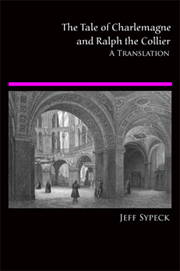
In 2007, I translated the 15th-century romance “The Taill of Rauf Coilyear,” a 972-line Middle Scots poem about the kerfuffle that ensues when Charlemagne, separated from his entourage by a snowstorm at Christmastime, seeks refuge in the home of a proud and irascible collier (a sort of medieval Tommy Saxondale). Combining folklore motifs with burlesque humor and elements of chansons and chivalric romances, “Rauf Coilyear” is a lively but rarely-read tale of courtesy, hospitality, and knighthood. To my knowledge, it’s also the only medieval romance in which Charlemagne totally gets slapped in the face.

The translation was an experiment: I wanted to see if I could imitate all 75 of the original poem’s tricky rhyming, alliterative, 13-line stanzas in a translation that was both readable and entertaining. (Check out “The Taill of Rauf Coilyear” in its original Middle Scots to see what I was up against!) I made the translation available as a free, downloadable PDF in 2007, and then in 2008 I sold the occasional paperback directly through the blog.

This year, I decided it was time to put this book into wider circulation. The Tale of Charlemagne and Ralph the Collier is now available through Amazon as a $10 paperback. There’s also a version specially formatted for the Kindle. (To get a taste of the translation, sample this low-res PDF of the first few pages.)

No one else has ever translated “Rauf Coilyear” into rhyming, alliterative, modern English verse, and I doubt anyone else will be nutty enough to try—so whether you’re a longtime reader of this blog, a student of medieval literature, a fan of old-fashioned poetic formalism, or a collector of truly obscure manifestations of Charlemagniana, I hope you’ll find this translation a satisfying read. Despite what Mamillius claimed, sometimes a sad tale isn’t best for winter after all.

“Well, tell her that I miss our little talks…”

I’m not a book collector, but I am a book accumulator, so I haunt the D.C. area’s secondhand shops in joyful hope of discovering something peculiar and new. Other blogs charmingly document the personal detritus we slough off in our books, but I never find anything to get the Antiques Roadshow crowd all aflutter. Sometimes, I find something better.

While rummaging around the Second Story Books Warehouse recently, I spotted Because the Sea is Black, a 1989 collection of translated poems by Blaga Dimitrova, a Bulgarian anti-communist writer who served as her country’s vice president in the early 1990s. I’d never heard of Dimitrova, but I was happy to meet a new poet for the price of a $7.50 paperback. I was also intrigued by a translator’s note reminding Americans that “writers who live where not everything can be said with impunity develop strategies for expressing concerns that are mortal.”

As with many modern translations, this one doesn’t make clear the poems’ original forms. Dimitrova’s poetry is rendered in semi-free verse intermingled with wordplay and rhyme—although sharp, rhythmic, fun-to-recite passages like this one encouraged me to read on:

                           Memory, what does it mean
to be clear? To be ice? To be twice? To be more?
We are gasping with asking since infancy, answerless—
What is the name of the cure?

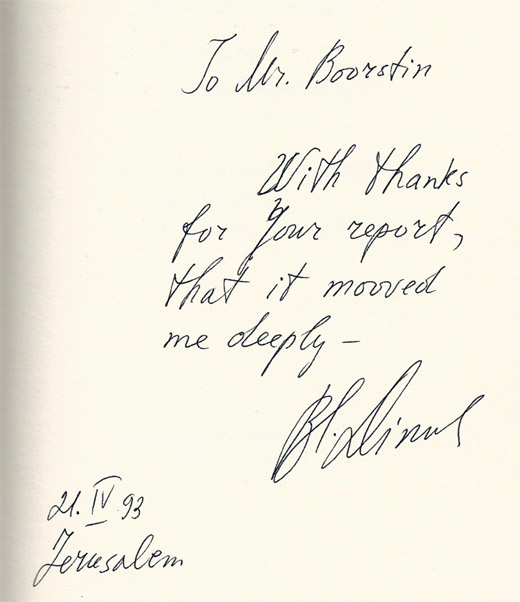
The big surprise, though, was the half-title page, where I found an inscription:

To Mr. Boorstin

With thanks
for your report,
that it mooved [sic]
me deeply —
Bl. Dimitrova

21.IV 93

Jerusalem

“Mr. Boorstin” is prolific historian Daniel J. Boorstin, author of The Discoverers and The Creators and Librarian of Congress from 1975 to 1987. What were he and Dimitrova doing in Jerusalem? An L.A. Times story tells me that they were tasked with kicking around the dreary question of writers as “moral guardians”:

The invitation to be “the conscience of the world” may have seemed like one any writer would accept. Here was a chance to denounce “ethnic cleansing” in the Balkans, starvation in Somalia, anti-Semitism in Europe, racism in America.

But one after another, 16 leading novelists, poets, historians, biographers, essayists and publishers declined the invitation during the Jerusalem International Book Fair this week. At a two-day forum co-sponsored by the fair and the Aspen Institute, many also warned of the danger of any writer acting as a moral arbiter.

“Why is a writer more capable of being a conscience than a jurist or an educator or a philosopher?” asked David Grossman, an Israeli whose books have explored the difficult relationship his country has with Palestinian Arabs and examined the moral dilemmas that result. “No one can serve as someone else’s conscience.”

Cynthia Ozick, an American novelist, poet and literary critic, spoke even more sharply: “Being a writer myself, I know what kind of people we are—and I don’t trust us. Writers are after power, and when writers meddle in politics it can be a cover for their drive for power.”

The L.A. Times article doesn’t report what Boorstin said that left Dimitrova “deeply moved,” but it does provide a snippet of her musings:

The forum concluded that conscience was necessary to inform a writer’s work, wrong as a role for the writer in society, yet in some ways inevitable as they faulted others who would perform the same function.

“A politician and a writer speak with two different languages,” Dimitrova observed, “and it is very dangerous when they get mixed together but we all do this.”

Twenty years on, I don’t know that poets, journalists, novelists, and critics are still this hesitant to declare themselves our consciences.

Dimitrova died in 2003. Boorstin died in D.C. in 2004, and based on the number of signed books I’ve found, I’m thinking the less valuable bits of his poetry library ended up at Second Story. (Sic transit gloria mundi: The remnants of Jack Kemp’s personal library also clutter the bookshelves just three aisles away.)

I don’t suppose we’ll ever know if Boorstin and Dimitrova genuinely liked each other, or if Dimitrova’s inscription represents anything but professional courtesy, but discovering it amid half a million moldering books makes clear how writers—and the words they labor to perfect—slip so readily into oblivion.

That’s reason for reflection, not despair. It’s a worthier challenge to roam the stacks, using this one slim relic of Blaga Dimitrova to find in endless spines not squandered lives, but infinite creation:

Breathing, we go blind
to what exists—whole universes!—
right here, next to us.

“River, I’ve never seen the sea…”

“The evening passed delightfully: we sat out in the moonlight on the piazza, and strolled along the banks of the Patapsco; after which I went to bed, had a sweet night’s sleep, and dreamt I was in Mahomet’s Paradise.”

Washington Irving romanticized his life. In an 1854 letter to his niece, he even found whimsy on the Patapsco River in Maryland, where he stayed at the home of John Pendleton Kennedy: Whig politician, Secretary of the Navy, Maryland Congressman, and a man immersed in the pop-medieval daydreams of his age.

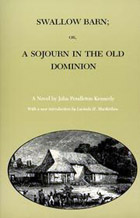
No one reads Kennedy’s 1832 book Swallow Barn anymore, and the author’s own description of it isn’t likely to bring readers back: “There is a rivulet of story wandering through a broad meadow of episode. Or, I might truly say, it is a book of episodes, with an occasional digression into the plot.” Kennedy loved Irving’s Bracebridge Hall, in which an American visitor describes an English manor through a series of character sketches and anecdotes, and he mimics it in Swallow Barn: a northerner visits his cousin’s plantation on the James River in Virginia and describes the place in anecdotal fits and starts. (Swallow Barn so closely resembles Irving’s style that when it was published under the name “Mark Littleton,” the public assumed Irving has simply adopted a coy new nom de plume.)

Medievalism is rampant in Swallow Barn. In his prologue, Kennedy cites the Morte d’Arthur. He likens a miller to a Robin Hood character, an old slave to an ancient crusading knight, and a group of pedantic Virginia lawyers to an Anglo-Saxon “wittanagemote.”

As it turns out, the early 19th-century Virginians of Swallow Barn are as obsessed with the Middle Ages as the narrator is. Here’s Prudence Meriwether, the plantation owner’s sister:

There is a dash of the picturesque in the character of this lady. Towards sunset she is apt to stray forth amongst the old oaks, and to gather small bouquets of wild flowers in the pursuit of which she contrives to get into very pretty attitudes; or she falls into raptures at the shifting tints of the clouds on the western sky, and produces quite a striking pictorial effect by the skillful choice of a position which shows her figure in strong relief against the evening light. And then in her boudoir may be found exquisite sketches from her pencil, of forms of love and beauty, belted and buckled knights, old castles and pensive ladies, Madonnas and cloistered nuns,—the offspring of an artistic imagination heated with romance and devotion.

Next we meet Ned Hazard, a 33-year-old Princeton dropout who stands to inherit Swallow Barn:

A few years ago he was seized with a romantic fever which manifested itself chiefly in a conceit to visit South America, and play knight-errant in the quarrel of the Patriots. It was the most sudden and unaccountable thing in the world; for no one could trace the infection to any probable cause;—still, it grew upon Ned’s fancy, and appeared in so many brilliant phrases, that there was no getting it out of his brain . . . However, he came home the most disquixotted cavalier that ever hung up his shield at the end of a scurvy crusade…

“His mind,” Kennedy insists, “is still a fairy land, inhabited by pleasant and conceited images, winged charmers, laughing phantoms, and mellow spectres of frolic.”

The object of Ned Hazard’s chivalrous amour is Bel Tracy, who’s so obsessed with Sir Walter Scott that she uses his novels to try to teach herself hawking:

In her pursuit of this object she had picked up some gleanings of the ancient lore that belonged to the art; and, fantastic as it may seem, began to think that her unskillful efforts would be attended with success . . . A silver ring, or varvel, was fitted to one leg, and on it was engraved the name of her favorite, copied from some old tale, ‘Fairbourne,’ with the legend attached, ‘I live in my lady’s grace.’ I know not what other foppery was expended upon her minion; but I will warrant he went forth in as conceited array as his ‘lady’s grace’ could devise for him. A lady’s favorite is not apt to want gauds and jewels.

By the time Swallow Barn winds down and “Mark Littleton” heads north, Ned Hazard survives a chivalric duel (a fistfight); slaves decked out to resemble “troubadours and minnesingers” tell ghost stories about nearby Goblin Swamp; and the narrator likens himself to Gregory of Tours and William of Malmesbury and quotes Chaucer’s “Knight’s Tale.”

In an introduction to the most recent reprinting of Swallow Barn, Lucinda H. MacKethan writes that Kennedy “manages merrily both to revere and to ridicule almost all of the Old South’s icons,” adding that reviewers disagreed on whether the book was a faithful depiction of Southern plantation life or blatant satire. I think it’s both: Swallow Barn shows a South in which overprivileged plantation-dwellers are so immersed in chivalric tales that they come to inhabit a shared medieval delusion.

When Washington Irving visited John Pendelton Kennedy in Maryland in 1854, life had been good to both authors, but especially to Kennedy. He had married Elizabeth Gray, daughter of textile baron Edward Gray, and moved into the Gray mansion. Gray liked to see himself as a feudal lord as he surveyed his factories on the Patapsco, a fancy Irving apparently shared.

In an 1854 letter to Elizabeth Gray Kennedy after returning home to Tarrytown, Irving let his inner medievalist romp:

 I envy Kennedy the job of building that tower, if he has half the relish that I have for castle building—air castles, or any other. I should like nothing better than to have plenty of money to squander on stone and mortar, and to build chateaux along the beautiful Patapsco with the noble stone which abounds there; but I would first blow up all the cotton mills (your father’s among the number), and make picturesque ruins of them; and I would utterly destroy the railroad; and all of the cotton lords should live in baronial castles on the cliffs, and the cotton spinners should be virtuous peasantry of both sexes, in silk skirts and small clothes and straw hats, with long ribbands, and should do nothing but sing songs and choruses, and dance on the margin of the river.

Only Washington Irving could look past textile mills and see a medieval peasant fantasy—but as Paul J. Travers points out in The Patapsco: Baltimore’s River of History, “Irving’s words were prophetic”: A great flood in 1868 washed away part of the Gray mansion, Kennedy’s personal library was ruined, and the family was forced to move. (Elizabeth Kennedy kept the factory going for 20 more years—until another devastating flood.)

Today, if you hack through the weeds between down Ellicott City and Patapsco State Park, you can walk in the footsteps of a wide-eyed Washington Irving…

…and spot the “picturesque ruins” Irving joked that he wanted to see. They’re now monuments to a forgotten writer and a half-remembered natural disaster.

Nearby, you’ll find more recent wrecks that put Irving’s romanticism in perspective.

Shops on Main Street in Ellicott City now sell plastic swords, pirate gear, and Viking hats alongside antique shops that burnish the relics of Irving and Kennedy’s age. On the outskirts of town, Marylanders hike and bike; some latter-day rustics fish along the river’s edge. Whether you see timeless fantasies here, as Irving did, depends on your affinity with Swallow Barn’s Bel Tracy, who found “something pleasant in the idea of moated castles, and gay knights, and border feuds, and roundelays under one’s window, and lighted halls.”

Mark Twain saw something else in Southern medievalism: a sort of mass insanity, a “maudlin Middle-Age romanticism” that’s still more tenacious in America than he ever foresaw. Even now, many Americans would answer Twain in the same tone Bel Tracy uses to scold her cousin: “Pshaw!…You haven’t one spark of genuine romance in your whole composition.” When a 19th-century New Yorker can find Virginia medievalism on the banks of a Maryland river, I’m not sure both notions aren’t right.

“Won’t you fly across that ocean, take a train on down…”

“The origin of our city will be buried in eternal oblivion,” wrote Washington Irving in his satirical History of New York, the 1809 book that made the 26-year-old Manhattanite one of America’s first literary celebs. Two centuries later, Irving’s “Knickerbocker History” is by turns funny, baffling, and obscure, but what intrigued me was how full of Charlemagne it is:

The origin of our city will be buried in eternal oblivion, and even the names and achievements of Wouter Van Twiller, Wilhelmus Kleft, and Peter Stuyvesant, be enveloped in doubt and fiction, like those of Romulus and Remus, of Charlemagne, King Arthur, Rinaldo, and Godfrey of Bologne.

As it turns out, Irving was a bit of a Charlemagne buff. Elsewhere in the History, his alter ego Diedrich Knickerbocker looks to the Carolingians to explain why New York City’s “ancient magistrates” were chosen, naturally, by weight:

As a board of magistrates, formed on this model, think but very little, they are the less likely to differ and wrangle about favourite opinions—and as they generally transact business upon a hearty dinner, they are naturally disposed to be lenient and indulgent in the administration of their duties. Charlemagne was conscious of this, and therefore (a pitiful measure, for which I can never forgive him) ordered in his cartularies, that no judge should hold a court of justice, except in the morning, on an empty stomach—a rule, which, I warrant, bore hard upon all the poor culprits in his kingdom. The more enlightened and humane generation of the present day have taken an opposite course…

Jolly old Diedrich Knickerbocker also trots out several mock-heroic references to Roland, the “Orlando” of romance. Two of them occur in battles between Dutchmen and Swedes, while the third anchors a preposterous yarn about the death of trumpeter Antony Von Corlear, whose race to aid his fellow Dutchmen is stymied when a devil drags him to the bottom of the Harlem River:

Luckless Antony! scarce had he buffeted half way over, when he was observed to struggle most violently as if battling with the spirit of the waters—instinctively he put his trumpet to his mouth and giving a vehement blast—sunk forever to the bottom!

The potent clangour of his trumpet, like the ivory horn of the renowed Paladin Orlando, when expiring in the glorious field of Roncesvalles, rung far and wide in through the country, alarming the neighbors round, who hurried in amazement to the spot…

Irving later visited relatives in England (where he wrote two of his most famous stories, “Rip Van Winkle” and “The Legend of Sleepy Hollow”) and spent 17 years wandering Europe. He had mined German folklore for two of his biggest hits and expected further inspiration. “I mean to get into the confidence of every old woman I meet with in Germany,” he told a friend, “and get from her, her budget of wonderful stories.”

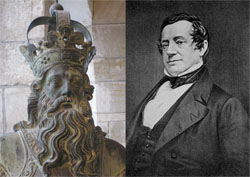
The romantic New Yorker, pushing 40, soon met the drab reality of history. Visiting Aachen in 1822, he noted in his journal that he had seen the “fountain with bronze statue of Charlemagne” and “Charlemagne’s Chair in Town Hall,” both of which are still tourist landmarks, but he saved his grousing for a darkly amusing letter to his sister:

I am disappointed in Aix-la-Chapelle. To me it is a very dull place, and I do not find that others seem more pleased with it.

[. . .]

This is the birthplace, and was once the seat of empire of Charlemagne, that monarch so renowned in history and song. His tomb is in the cathedral, and is only marked by a broad slab of black marble, on which is the inscription, Carolo Magno. The Cathedral is an extremely ancient, venerable-looking pile. Every night I hear the hours chimed on its bells; and the midnight hours announced by the watchman from its tower. The Germans are full of old customs and usages, which are obsolete in other parts of the world . . .

The people have an antiquated look, particularly the lower orders. The women dress in peculiar costumes. As to the company at the hotels and public saloons, it is composed of all nations, but particularly northern nations: Russians, Prussians, Germans, Dutch, &c. Everywhere you see military characters, in fierce moustaches and jingling spurs, with ribbons and various orders at their button-holes. Still, though there are many personages of rank here, the place is not considered the most fashionable, and there are many rough characters in the crowds that throng the saloons. Indeed it is somewhat difficult to distinguish a gentleman from a common man among these northern people; there is great slovenliness of dress and coarseness of appearance among them; they all smoke; and I have often been surprised to hear a coarse-looking man, whom I had set down for some common tradesman, addressed as Monsieur the Count or the Baron. The weather has been very bad for several days past.

A recent biographer points out that Irving was suffering from an illness, perhaps the gout, which the famous waters of Aix-la-Chapelle failed to cure—but he wasn’t the last tourist to find Aachen underwhelming. A 2003 Rick Steves guidebook dismisses “unassuming Aachen” near the “unromantic Rhine,” and when I sat in Aachen Cathedral on a frigid February weekend in 2008, I heard tourists mumble that the place was too small to have been worth the trip.

Despite their gripes, I found that the “concentrated magnificence” of the octagonal chapel at Aachen repays real contemplation, and trying to see it backwards across a 1,200-year gulf is a worthy (if futile) ambition. Tourists to Aachen wish for eighth-century streets; if Washington Irving’s imagination failed him in Charlemagne’s town, what hope can their be for the Lonely Planet crowd?

Two years after sulking in Aachen, Irving wrote in Tales of a Traveller: “The land of literature is a fairy land to those who view it from a distance, but like all other landscapes, the charm fades on a nearer approach, and the thorns and briars become visible.” He later found his European dreamworld in Spain, especially Granada, where he briefly lived and wrote at the Alhambra. As the author of the most popular 19th-century book about Christopher Columbus, Irving convinced Americans, wrongly, that medieval people believed the world was flat. It’s tempting to wonder what myths he might have spun about Charlemagne if he’d just passed through Aachen in sunnier health. Generations of teachers perhaps can be glad he did not.

(Photo of Aachen taken in February 2008.)

“Is this the age of the thunder and rage…”

[This post is a rerun from 2010; I felt like bringing it back for a second spin. – J.S.]

Few medievalists grace the saints’ calendars of American churches, but it’s fitting that back-to-school week coincides with the feast day of Nikolaj Frederik Severin Grundtvig, observed annually on September 2 by the Evangelical Lutheran Church in America and on September 8 by the Episcopal Church in the United States. The Danish bishop and polymath is little known outside his home country, but he was a monumental figure there—and if you’ve read any edition or translation of Beowulf, then N.F.S. Grundtvig was partly responsible for getting it into your hands.

After Icelander Grímur Jónsson Thorkelín published the first printed edition of Beowulf (with the support of the Danish government) in 1815, Gruntvig was the most vocal scholar to point out the many errors in Thorkelin’s transcription and Latin translation, from misreadings of Old English words to Thorkelin’s failure to recognize proper names. Thorkelin, a twitchy careerist, responded by accusing Grundtvig of “sweet dreams, absurd fantasies, and willful distortions of the original and of my work within the Chaos that surrounds him,” but Grundtvig, the superior scholar, was right. Grundtvig was also the first to notice that the Hygelac of Beowulf was the historical figure Chochilaichus named by Gregory of Tours in his History of the Franks, and Grundtvig’s 1820 version of Beowulf in Danish was the first translation of the poem into any modern language.

Although Grundtvig was peeved to see the Danes exeunt two-thirds into Beowulf, he never stopped grappling with the poem, seeking not only its universal lessons within the context of his own faith but also clues to the Scandinavian past. “[T]he language,” he wrote, “is ingenuous, without having the German long-windedness, and without remaining obscure in its brevity as so often in the Eddic poems.” Inspired by Beowulf, Gruntvig became an Anglo-Saxonist while rising through the Lutheran church, studying theology and languages, agitating for Norwegian independence, becoming the father of Danish folk schools, dealing with censorship and fines and exile, marrying three times, briefly serving in the Danish Parliament, and somehow finding time to translate hundreds of hymns and write countless poems and books. (For all I know, he even invented Lego and provided the theological foundation for his nation’s wonderful open-faced sandwiches.)

Something of an Anglophile, Grundtvig practically begged the English to appreciate their native poets, and the tone of his 1831 proposal for an Anglo-Saxon book subscription program will amuse any medievalist who’s been accused of cultivating obscure interests:

I know there are tastes, called classical, which will turn away in disgust when they are told that this poem consists of two fabulous adventures, not very artificially connected, except by the person of the hero,—and that these episodes, which relate to historical traditions of the North, are rather unskillfully inserted. But I think such classical scholars as have a squeamish repugnance to all Gothic productions, should remember that, when they settle themselves down in the little circle of the ancient world, they have banished themselves from the modern, and consequently have made their opinions on such a subject of very little importance.

“For all his faults of expression,” writes Tom Shippey, “Grundtvig read the poem more acutely and open-mindedly than any scholar for decades.” Even those of us who will never be honored with hymns could do worse than aspire to earn such an epitaph. Thanks to scholars like Grundtvig, not only do we better understand how and why the Anglo-Saxons wondered, as others have, “Ubi sunt qui ante nos fuerunt?,” but we can also start to answer the question for ourselves.

“But all the gold won’t heal your soul…”

There’s no more medieval prepared cheese product than Velveeta. That’s the message, I guess, of “Wield the Skillet, Forge the Family Dinner,” a recent ad campaign for Velveeta that stars a manly, quasi-medieval blacksmith.

Although the blacksmith chants his praise of “liquid gold,” orders soccer moms to “smite” noodles—“smite them with the liquid gold until there can be no more smiting!”—and even has his own pointlessly elaborate website, Our Book of Liquid Gold, he’s no Old Spice Guy. The campaign wasn’t funny or distinctive enough to have gone viral, and the brawny mascot’s YouTube playlist hasn’t been updated for months.

So maybe medievalism doesn’t send Velveeta flying off the shelves. The first commercial in a new campaign, rolled out yesterday, features a slackerish broheim who works at the mall. The setting is as current as can be—but the slogan is still gruesomely medieval.

Medieval people associated the consumption of liquid metal with horrific punishments and unbearable pain. In the 12th-century Anglo-Norman Voyage of St. Brendan, the saint discovers Judas on an island, where his unceasing torments include being forced to drink molten lead and copper, which he can’t vomit when subjected to a hellish stench.

Medieval writers also believed that the Roman general Crassus had been executed by being forced to drink molten gold. In canto 20 of Purgatorio, Dante hears talk of “the wretchedness of avaricious Midas, resulting from his ravenous request, the consequence that always makes men laugh,” clarifying a few lines later:

and finally, what we cry here is: “Crassus,
tell us, because you know: “How does gold taste?”

In Book III of Troilus and Criseyde, when Chaucer rants about the inability of the greedy to experience true love, he assumes we’ll understand references to the “hoot and stronge” drinks of Crassus and Midas:

As wolde God tho wrecches that dispise
Servise of love hadde erys also longe
As hadde Mida, ful of coveytise,
And therto dronken hadde as hoot and stronge
As Crassus did for his afectis wronge,
To techen hem that they ben in the vice,
And loveres nought, although they holde hem nyce.

Likewise, one anonymous 15th-century English nun associated this same horrible punishment with Purgatory:

and one broʒt myche gold and syluer, and þat was molten and casten in hyr þrote, and þat ran out of hyr stomake. And he seide, “Take þe þis for þ[i] cursed and wikked coueitise…”

The horror of gold-drinking as punishment survived the Middle Ages. It worked its way into Jewish folklore, 16th-century natives reportedly executed a Spaniard in colonial Ecuador with a drink of molten gold, and in John Ford’s early 17th-century play ‘Tis a Pity She’s a Whore (recently staged in Virginia!), Friar Bonaventura warns of the eternal fate that awaits usurers:

There is a place,
List, daughter! in a black and hollow vault,
Where day is never seen; there shines no sun,
But flaming horror of consuming fires,
A lightless sulphur, choak’d with smoky fogs
Of an infected darkness: in this place
Dwell many thousand thousand sundry sorts
Of never-dying deaths: there damned souls
Roar without pity; there are gluttons fed
With toads and adders; there is burning oil
Pour’d down the drunkard’s throat; the usurer
Is forced to sup whole draughts of molten gold…

Amazingly, there’s at least one positive medieval reference to drinking gold. After suffering her husband’s abuse, a 15th-century Spanish visionary named Tecla Servent is whisked away to Heaven, where she marries Jesus Christ and samples a remarkable beverage:

He then brought her up to heaven, where he ordered the angels to dress her as his wife ought to be clothed. The angels arrayed Tecla like the spouse of a great lord in gold and scarlet brocade. Christ thereupon ordered the angels to bring food and drink for her, and they served her precious stones on golden plates to eat and molten gold and pulverized jewels to drink.

The folks at Kraft can’t be expected to know medieval molten-metal drinking lore, but I’m still surprised that a modern focus group thought that consuming gold sounded desirable—and I say this as someone who enjoys a warm bowl of Ro-Tel/Velveeta dip every now and then. When your target demographic inadvertently becomes Judas, usurers, and brides of Christ, it may be time to rethink a creepy metaphor—and find out what a medieval blacksmith really would have known.

“Then she opened up a book of poems and handed it to me…”

“Imagine a contemporary translation of Dante that includes references to Pink Floyd, South Park, Donald Rumsfeld, and Star Trek,” writes Zachary Lazar at BOMB magazine, praising poet Mary Jo Bang’s new version of the Inferno, which debuted on August 7. As Cynthia at the Book Haven points out, Alexander Nazaryan at the New York Daily News also enjoyed the book, while in a long and far less positive piece for the Wichita Eagle, Arlice Davenport argues that we shouldn’t call this sort of adaptation a translation:

As with so many knee-jerk postmodernists, Bang’s poetics hinge on the belief that the “distinction between high culture and popular entertainment has all but ceased to exist.” So she’s free to throw in references to John Coltrane, “South Park,” Emily Dickinson, Andy Warhol, John Wayne Gacy, Stephen Colbert and Woody Allen, whenever it suits her purposes. Her Dante dwells in a pluralist’s paradise, even if he is in Hell.

But to say that contemporary culture no longer recognizes the difference between high and low art is not to say that there is no difference. It simply means that our culture has given up making the effort to sustain the difference. It is (again, ironically) a form of sour grapes.

When they’re done well, I love anachronistic adaptations—like Christopher Logue’s Homer—as long as no one assigns then to beginning students under false pretenses. That’s why I was bemused by this claim in a Vanity Fair blog post by Elissa Schappell:

Bang’s Inferno already has some corduroy-vested academics tugging on their beards with indignation and beetle-browed translators jabbing at their eyes with pencils.

Say what? As I said at the Book Haven, it’s maddening that in 2012, Vanity Fair can’t provide us with a simple link so we know which “corduroy-vested academics” are supposedly “tugging on their beards with indignation” and which “beetle-browed translators” are “jabbing at their eyes with pencils.” It’s summer, and Bang’s Inferno was out for a only week when the Vanity Fair blog post went live. Few academics, and certainly not the stereotypes who stumbled into Schappell’s imagination from early 1950s New England, have even read the book yet.

(The only time I can remember an angry academic reaction to a mass-market translation was the mid-1990s, when Anglo-Saxonists grumbled about Seamus Heaney’s Beowulf—not necessarily because Heaney took liberties, but because his version was set to replace a more literal translation in the Norton Anthology.)

Dante scholars are, in fact, the medievalists most accustomed to seeing “their” poet made over to reflect the look of the day. In a 1983 issue of Studies of Medievalism devoted to Dante in the modern world, editor Kathleen Verduin explains that in addition to being a rallying point for 19th-century Italian nationalism, Dante was big in France and hugely popular in Victorian England. According to Werner Friederich’s Dante’s Fame Abroad, 1350-1850, Dante’s ghost was suited to every English season:

Robert Browning admired Dante for “the endurance that stood him in such good stead during his happy life.” For Carlyle, Dante was “the hero as poet.” Yet Carlyle also saw in the Florentine a spirit certainly reminiscent of the Scotsman’s Calvinist ancestors . . . Macauley’s Dante, rather like himself, was a public figure, born in great times. [page references removed]

Verduin adds that many Americans saw Dante as a proto-Protestant. The Transcendentalists were beguiled by him; Hawthorne alluded to him; Melville found him “the infernal guide to ever-deepening realms of moral complexity”; Longfellow sought solace in translating him; Charles Eliot Norton founded an academic society around him; and James Russell Lowell considered the Divine Comedy a cathedral in poetic form.

In No Place of Grace: Antimodernism and the Transformation of American Culture, 1880-1920, T.J. Jackson Lears suggests that 19th-century America craved his moral certainty:

Nor was fascination with Dante confined to the Brahmin few. The poet was acclaimed and interpreted by critics in the established press, eulogized and imitated by dozens of magazine versifiers. The Dante vogue pointed not only to aestheticism or vaporous romanticism, but to widespread moral and religious concerns . . . By ignoring the scholastic superstructure of the Divine Comedy, commentators were able to join Dante with simpler medieval types. Like the saints and peasants, he became a prophet of spiritual certainty in an uncertain, excessively tolerant age.

At least three statues of the Big D here in Washington, the most prominent one in a park, attest to a literary wave that has since saturated the culture. Oh yes: You can pop “Dante’s Inferno Balls” candy while playing the Dante’s Inferno game for XBox or Playstation (with accompanying action figure). You can imagine the scent of Dante cigars, fondly recall the “Dante’s Inferno” ride at Coney Island, or show off your snazzy Dante earrings. You can also check out how science-fiction authors Larry Niven and Jerry Pournelle Americanized Dante to make his Hell literally escapable.

“As a figure in the modern imagination, he has been all things to all men,” writes Kathleen Verduin, “enduring repeated reinterpretation according to the tastes and prejudice of the times; but he also unites us, commanding the common respect for the achievement of his art, and the endurance of his vision.” Whether ill-wrought or wonderful, Mary Jo Bang’s Inferno is the latest step in a dance between Dante and his American admirers. Contrary to Vanity Fair, scholars know the tune, too.

“And you know you cannot leave her, for you touched the distant sands…”

[Poet Christopher Logue died on Friday, December 2. The Guardian has a full obituary that nicely sums up his petulance and eccentricity, but it fails to capture the force of his actual work. Here’s a piece I wrote about a performance of Logue’s “War Music” in New York earlier this year.]

For half a century, autodidact and occasional actor Christopher Logue has rallied all the gimmicks of modern poetry to craft a loose, idiomatic version of Homer’s Iliad. “[I]t’s some of the best poetry being written in English today,” wrote Jim Lewis at Slate in 2003, “and it should be read widely and with great pleasure by anyone still interested in the art of verse.” For a few more days, New Yorkers have a rare chance to see Logue’s Homer come to life: With the poet’s approval, director Jim Milton has adapted the first 70 pages, “Kings,” for two actors on a mostly-bare stage. The production, at the Workshop Theater through April 3, is a wild, addictive hour that does remarkable justice to its source.

Literally irreverent, Logue frees himself from the tyranny of the Homeric text through one curious advantage: his ignorance of ancient Greek. Instead, he’s basing his still-unfinished poem on English translations published between 1720 and 1950. His Homer—currently collected in three separate volumes—includes scenes that aren’t in the Iliad; at one point, he cribs a passage from Paradise Lost. Sensitive to the distinction between scholarship and artistry, Logue calls what he’s doing an “account,” not a translation—and if that makes classicists cringe, they’re missing the point.

Known for his gleeful use of anachronism—like his description of Ajax, often cited by reviewers, as “[g]rim underneath his tan as Rommel after ‘Alamein”—Logue deploys evocative modern language to create quick, crisp snapshots. Here’s Agamemnon’s line-up of champions from All Day Permanent Red, a slim volume of battle poetry published in 2003 with a title nicked from a Revlon ad:

Nestor, his evening star.
Ajax, his silent fortress. Good—even on soft sand.
Odysseus (you know him), small but big.
Fourth—grizzled and hook-tap nosed—the king of Crete,
Idomeneo, who:
“Come on!”
Would sign a five-war-contract on the nod.

Logue’s Homer resounds with cries of war, but he also crafts domestic scenes with a deftness that other poets should envy. In “The Husbands,” an exchange between Zeus and a petulant Athena neatly reveals the condescension that defines their relationship:

The armies wait.

“Dearest Pa-pa, the oath said one should die.
The Trojan was about to die. He did not die.
Nobody died. Therefore the oath is dead.
Killed by a Trojan. Therefore Troy goes down.”

Drivers conducting underbody maintenance.

“Father, You must act.
Side with the Trojans, Greece will say,
Were we fools to believe in His thunder?
Why serve a God who will not serve His own?”

And giving her a kiss, He said:

“Child, I am God,
Please do not bother me with practicalities.”

When battle calls, Logue can craft a scene as thrilling as anything in 300, combining heroic deeds with colloquial diction while never undercutting the tone, as in this passage from “Patroclea”:

The air near Ajax was so thick with arrows, that,
As they came, their shanks tickered against each other;
And under them the Trojans swarmed so thick
Ajax outspread his arms, turned his spear flat,
And simply pushed. Yet they came clamouring back until
So many Trojans had a go at him
The iron chaps of Ajax’ helmet slapped his cheeks
To soft red pulp, and his head reached back and forth
Like a clapper inside a bell made out of sword blades.
Maybe, even with no breath left,
Big Ajax might have stood it yet; yet
Big and all as he was, Prince Hector meant to burn that ship:
And God was pleased to let him.

Now either you like this sort of thing or you don’t. I happen to love Logue’s knack for trotting out modern gimmickry not for its own sake, but in the service of narrative— and while Logue finds humor in his ancient source, he never treats Homer like a joke. Both Homer and Logue understand, from different angles, the maddening mindset of warriors. Jim Milton concedes its relevance, too; it’s why his adaptation of “Kings” is so good.

Milton is also lucky to have two nimble actors on his stage. Dana Watkins switches effortlessly between Zeus, Odysseus, Hector, and even a hammy Hephaestus, but he’s at his best as a furious, choked-up Achilles who’s never more than half a slight away from homicide. J. Eric Cook is funny as a shrill Hera and a rash, tipsy Thersites, but he’s also weirdly touching as Thetis, Achilles’ mother. His Agamemnon is unremarkable, but perhaps deliberately so, as Logue’s text renders him a slick politician before his homesick army:

“Thank you, Greece.
As is so often true,
Silence has won the argument.
Achilles speaks as if I found you on a vase.
So leave his stone-age values to the sky.”

Although Cook doesn’t look like a warrior king, he imbues the character with the smiling certainty of a psychopath. Logue’s text helps. As the Trojan Anchises later asks, “Indeed, what sort of king excepting theirs / Would slit his daughter’s throat to start a war?”

Seeing Logue’s Homer performed by two Americans makes clear that the text might be better declaimed by actors with droll British diction; once or twice, Cook and Watkins seemed too busy recalling Logue’s lines to give them their full weight. Still, both actors possess powerful, well-trained voices, and they and the director draw from a deep well of vocal tricks and physical gestures to make this production brilliantly audience-friendly. Before Thursday night’s performance, I heard a couple in front of me whisper that they had no idea what they’d gotten themselves into, but as soon as Watkins and Cook took the stage, they were beguiled. As Logue himself put it, “[i]t was so quiet in Heaven that you could hear / The north wind pluck a chicken in Australia.”

Unfortunately, “Kings” is tantalizingly brief. The show, which clocks in at 75 minutes, ends with howls of war just as the audience is dying to see (even though they know) how it all plays out. I hope the empty seats in the tiny Workshop Theater don’t dissuade director Jim Milton from further adapting Logue. Drearily, the Poetry Foundation can use its $185 million boon to build a $21 million headquarters and publish reams of mediocre verse, but a staging of Logue can’t fill 65 seats in midtown Manhattan. That says less about Logue than it does about the mannered insider-ism of the poetry scene, and Logue himself knows it.

“[N]one of my contemporaries seem to be interested in the things that interest me, such as fast, clear, several-stranded narrative, action, character, violence,” Logue told the Paris Review in 1993. His contemporaries are missing out. If you’re near New York, you have nine days to get to the Workshop Theater, see “Kings,” and hear how poetry sounds with a mouth full of blood.

“But the answers you seek will never be found at home…”

The ghost of Robert E. Howard sleeps fitfully at best. His better stories have been republished by the University of Nebraska Press, but fans still struggle to champion his worth. You know Howard, if you know Howard, from crummy movies about his characters—Kull, Conan, Solomon Kane—even if you’re unaware of the brawny shadow he casts across decades of sword-and-sorcery. Both co-creators of Dungeons & Dragons cited him as an outsized influence, but his prominence as a fantasy writer overshadows the speed with which he also cranked out horror yarns, cowboy tales, historical fiction, and boxing stories from the bedroom of his parents’ Texas home.

Before committing suicide in 1936 at the age of 30, Howard published more in twelve years than most of us will in a lifetime, earning his rep as one of the great writers of the pulp era—but Howard wasn’t just a famously frantic storyteller. He was also, as his gravestone points out, a poet. Until recently, few readers knew how madly poetic he was.

At nearly 800 pages, The Collected Poetry of Robert E. Howard, published in 2009, is a monument to its author’s strange and boyish mind. Several of Howard’s 700-odd poems first appeared in pulp magazines like Weird Tales, either as standalone pieces or as epigraphs to stories; many were never published at all. Gathered in one tome (without the bibliographies compiled on a separate website), they’re an almost overwhelming blast from Howard’s mental universe, a cacophonic orgy of Romans, Babylonians, Vikings, cowboys, Crusaders, Mongols, Zulus, cavemen, and voodoo queens—figures who’ve long since been forced from the realm of respectable verse.

Can the collected works of any other poet boast a 60-page section on Wizardry and Satanism? Ah, but here it is, nestled amid sections covering Heroic Verse, War Poems, Horror Poems, Exoticism and Nature, Personal Poems, Historical Poems, Dialect and Doggerel, and Prose Poems. I’d already known some of Howard’s most effective ballads, especially “The King and the Oak” and “Solomon Kane’s Homecoming,” but it’s enlightening to see the good stuff in context. This comprehensive volume proves how many words even the most manic writer has to fling around before breaking free of his influences and pouncing on bright, fleeting lines of his own.

As befit his youth, Howard was an imitative poet, wedding his own stark worldview to the rhythms of Tennyson, Noyes, Chesterton, and others. His imitation of Robert Service and William Blake is particularly obvious, but his better poems show that they taught him how to write deeply creepy verse. “Zukala’s Jest,” for example, sounds less like the invention of a Texan autodidact and more like an ancient chant heard by a traveler who barely escaped with his life. “Memories of Alfred,” about a Saxon who battles the Danes, ends with a line cribbed from Tennyson: “and friend slew friend, not knowing whom he smote.” In Idylls of the King, this line marks the chaos of Arthur’s final battle and the failure of the Arthurian dream, but Tennyson follows it with a sunrise. Howard admits no hope; fratricide is its own poetic end.

Howard’s lack of military service didn’t stop him from writing about modern war, and the resulting poems are an unsatisfying mishmash of Kipling and Siegfried Sassoon—but then, sometimes, a startling phrase presents itself. In the beguiling “White Thunder,” a Cornishman fighting in Flanders during World War I recalls a faraway land where “the clashing crags re-echoed / like a planetary war.” Outside of pop songs, I can’t recall any poets who’ve used sci-fi similes to describe earthly experiences. Howard makes it work; it rightly describes what he saw in his mind.

I’ve been browsing Collected Poetry for more than a year, and my notes are full of pointers to curious bits like these: nice double meanings in lines like “[a]s clouds blow over the mead,” chilling little images, notable exercises in form, parodies of Longfellow, or bizarre poems that almost work but for a few clunky lines, like a lyric that notes (as God knows I never thought to) the absence of Arcadian centaurs on the Creole lawns of New Orleans. Howard, I think, didn’t strive for maturity, but said his piece in the bleak, angry fury of youth. Even when his diction is derivative, he raises his own voice to a roar to drown out the poets he read. His “Song of the Naked Lands” could never be mistaken for Edna St. Vincent Millay:

You raped the grapes of their purple soul
For your wine-cups brimming high;
We stooped to the dregs of the muddy hole
That was bitter with alkalai.

That verse isn’t perfect, but it’s perfectly Howardian. No other poet would snarl while rehearsing one of his favorite themes, the Thomas Cole royal collapsapalooza:

You lolled by fountain and golden hall
Until that frenzied morn
When we burst the gates and breached the wall
And cut you down like corn.

Weirdly, a few pages away, Howard lays aside his weapons and shines in repose. “A Negro Girl,” a short lyric about African echoes in Harlem, might appear in literary anthologies if someone else’s name were attached to it.

Of course, Howard strikes some awful notes. Collected Poetry includes much juvenilia, doggerel, and diction I’d never defend. In “The Song of the Last Briton,” Howard dubs Saxon longships “millipedes of doom,” and he habitually strides into awful rhymes: prophet/Tophet, strident/trident, lizard/wizard, strange-and-hoary/Purgatory. Some off-rhymes hint at his own accent—”dour” and “moor”—while others reveal the limits of his travels and education. “Lithe,” for example, doesn’t rhyme with “myth.” Perhaps Howard never heard the word spoken, and only read it in books.

Splayed as they are across hundreds of pages, Howard’s flaws are obvious, but dwelling on his clunkers holds him to a standard we’d scarcely meet ourselves. How many high-school graduates, or even educated genre authors, can write a proper ballad or sonnet and conjure hundreds of literary references and historical allusions from sulfurous mental fog? How many boys doze off in English class because no one made clear that poetry is also the province of Satanic wizards, voodoo queens, blood-flecked Vikings, Puritan swordsmen, and frantic barbarian hordes?

Howard holds no place in the history of American poetry. Some entries in Collected Poetry show that he was aware of free verse, but he continued to compose formal, narrative poems for readers whose tastes were undeterred by the literary trends of the day. In keeping with Sturgeon’s Law, much of Howard’s work is derivative, but his worst is no worse than many of the Georgian poets who were his overseas predecessors, and he’s certainly more persistent in his own weird vision than the authors of the wan, formless sighs I skim in Poetry magazine every month. And when Howard is good, he’s a big, brawny blast.

Collected Poetry, which is already out of print, is far more Howard than most people need—I didn’t, and can’t, read every poem in the book—but teachers and parents fretting over “reluctant readers” should explore the shorter Selected Poems, available in print-on-demand. Howard’s works are case studies in form and tone, and they fling open the gates to discussions about medieval lands, ancient empires, violence, decadence, and the decline of civilizations. They’re also grand, lurid proof that poetry sometimes has hair on its chest.

“Howard is manic-depressive, courageous, and self-destructively human,” Steve Eng writes in his 1984 essay “Barbarian Bard,” reprinted as the introduction to Collected Poetry. “At his best, he carries the reader forward like a trussed captive, astride a black horse with crimson hooves, headlong off that final cliff toward the sharp rocks of Death below.” Eng’s epitaph suggests what Robert E. Howard ought to become: the poet laureate of restless boys, whose lives these days lack poetry, but who, as Howard comprehended, crave it more than most.

“…and stained in the blood of a whole generation.”

In Icelandic sagas, it’s not an uncommon motif: Clinging to old ways, warriors flail as the heroic code that defines their lives gives way to something new and strange. Perhaps that’s how lifelong soap fans feel this week, as All My Children succumbs to cancellation after nearly 42 years, while its doomed elder sister, One Life to Live, glares anxiously into its grave.

Baby swaps, preposterous wealth, evil twins, travels through time—soaps are easy to mock, but their sheer continuity is remarkable. (Making All My Children and One Life to Live look like pikers, Guiding Light began on radio in 1937 and wasn’t snuffed out until 2009.) Most of us, medievalists especially, can point to the survival and adaptation of stories across decades and centuries and cultures—Arthurian legends, Icelandic sagas, the Song of Roland—but except for comic strips, I’m hard pressed to think of another example of continuous storylines unfolding five days a week for more than 40 years, sometimes pleasing their audience, sometimes not, rolling with the culture while aspiring, sometimes, to universality:

It starts on a quiet note with a group of people, neither particularly good nor particularly bad, who, because they are the way they are, clash with each other; not violently, but sufficiently hard to cause ill-feeling. This casual ill-feeling is transmitted to kinsmen and descendants, to friends and to allies. More and more people become involved, with fatal results…The early actors of the drama fade out, but the troubles they have started now seem to have a life of their own, until the action is galloping headlong, with brief tantalizing pauses where control seems to have been momentarily asserted, from minor mishap to major tragedy, until finally its inevitable impulse is exhausted in the last elegiac chapter.

That’s from Magnus Magnusson’s introduction to the 1959 Penguin Classics edition of Njal’s Saga, and it’s as fine a summary of the arc of a family saga, medieval or modern, as any you’re likely to find.

Even if the Cortlandts and the Chandlers never shed blood at the Law Rock, and although Erika Kane (who once faced down a grizzly bear) might quail before the ornery, resilient Hallgerd, there’s no harm in hearing outlandish medieval echoes in the death cries of a genre. The soaps’ own echoes carry on; they showed prime-time TV producers the potential of serialized rather than episodic storytelling, and early on, they crowdsourced plot twists to indefatigable fans.

Of course, the medieval/soap-opera connection has been common knowledge since 2009, when a courtly-love subplot on General Hospital showed that at least one of its writers has taken a medieval lit class. As such, we can only wish the citizens of Pine Valley a safe journey into the television afterlife, and hope that there, unlike in medieval Iceland, “face-lift” means something entirely kind.