“Little lines, in the ice, splitting, splitting sound…”

So yesterday, Washington got snowed on; tonight, freezing rain has encrusted the city in ice, which, while all sparkly and picturesque, is sufficiently treacherous to prevent a muddle-headed, flu-fighting medievalist from hitting the streets at 2 a.m. in search of his remedy of choice: an assortment of donuts from 7-Eleven.

And so, donut-deprived, frosting-forlorn, bereft of blueberry filling, I can only squint pensively at the snow from my window and be glad I’m not Charlemagne, who likewise tries to settle his brain with a bit of twilight snow-gazing in Longfellow’s “Eginhard and Emma”:

That night the Emperor, sleepless with the cares
And troubles that attend on state affairs,
Had risen before the dawn, and musing gazed
Into the silent night, as one amazed
To see the calm that reigned o’er all supreme,
When his own reign was but a troubled dream.
The moon lit up the gables capped with snow,
And the white roofs, and half the court below,
And he beheld a form, that seemed to cower
Beneath a burden, come from Emma’s tower…

You’ll have to read the whole thing to find out what Charlemagne spied with his imperial eye. (Hint: it wasn’t a donut.)

The story of Eginhard and Emma was popular during the 19th century: It was retold in corny books about Rhineland legends, Strindberg turned it into a short story, and Schubert made it part of his opera Fierrabras. How the actual fling between Charlemagne’s daughter Berta and his adviser Angilbert got transformed into a romance between Charlemagne’s biographer and a wholly fictional daughter is a mystery to me, but it’s a ready-made thesis for a dissertation, or at least the starting point for an ambitious novelist with a penchant for romantic fantasy.

To his credit, Longfellow kept his version both eloquent and concise, giving us lots of memorable couplets and a lovely description of Alcuin. It’s no donut—but really, what is?

“Turn the clock to zero, honey…”

From time to time, I dig through the poetry of Theodulf, ninth-century bishop of Orleans, looking for nuggets to translate. Theodulf was a wit, so I’ve had fun making modern English versions of his Latin verses about pilgrimages, libations, wildlife, stolen horses, and children’s dreams. But what, I wondered, could Theodulf do for me on New Year’s Day?

I shouldn’t have worried; the old Goth didn’t let me down. In the middle of a dull poem about faith, hope, and charity (Dümmler, MGH Poetae I, 466-467), I found four lovely lines of Latin, and I plucked ’em:

Nam pia dona spei tereti signatur in ovo,
Tegmine obumbratum quod vehit intus habens:
Ut pullum ova tegunt, sic spem praesentia celant,
Hic patet exutus, illa futura parat.

With the reckless optimism of a Leyendecker baby, I give you this translation:

To see the blessed gift of hope, behold
The egg that keeps a secret in its shell:
The present, hiding hope, conceals it well;
The future cracks it: tiny wings unfold.

Those of you who read Latin are shaking your heads at this rather free rendering of the original. So be it! It’s a new year! Old habits limp to their graves, ashamed! Besides, I did some research and found that these four Latin lines have been translated repeatedly throughout the centuries, often by poets who took far greater liberties than I did.

For example, here’s a little-known translation by Langston Hughes:

THEODULF AT THE 125th ST. DINER

The sunny side
An egg supplied
Upon t’morrow gambled.
It hides in a shell
That poached it well
And never got it scrambled.
The present keeps our dreams deferred.
The future hatches: out pops a bird.

And here—dear reader, I was as astonished to discover it as you surely are—is a translation of Theodulf by none other than T.S. Eliot:

PERTELOTE SENESCENS

The sea-birds race inland from the storm
Above the subtile chicken seeking quiet in the barn
Where she dares not hope
“Lasciate ogne speranza, voi ch’intrate“—
But for the egg:
The shell conceals our tatterdemalion past—
The shell incubates our necessitous future
—and hope becomes a farmer
With shards of egg in his desquamative palm
Forgetting the recrudescent monotony of the plow, straining
To hear the eager peeping in the straw.

My translation isn’t looking quite so loose now, is it?

On behalf of Theodulf, T.S. Eliot, Langston Hughes, and a room full of imaginary chickens, I wish you a happy and recklessly hopeful new year.

“…with kitchen prose and gutter rhymes.”

[UPDATE: As of January 2010, information on purchasing or downloading The Tale of Charlemagne and Ralph the Collier can be found here.]

Last December, I posted a PDF of “The Tale of Charlemagne and Ralph the Collier,” a translation of a 972-line Middle Scots romance from the 15th century. This translation was, in part, an attempt to prove to myself that I could turn 75 of those complex, thirteen-line, rhyming, alliterative stanzas into modern English poetry.

Sharp-eyed readers sent me useful comments, and although I hadn’t expected anyone to be looking for a translation of this obscure poem, quite a few people do regularly search for it and find it via Google. As a result, I’ve corrected two typos, made minor edits, and posted a second revision of the text. You can download the new low-res PDF (for free!) from this page.

For students of medieval literature, “Ralph the Collier” has much to recommend it: combat, class warfare, burlesque humor, inclement weather, Yuletide feasts, politically incorrect proselytizing—plus it rhymes and alliterates. As another Christmas hero named Ralph observed, “sometimes, at the height of our revelries, when our joy is at its zenith, when all is most right with the world, the most unthinkable disasters descend upon us.” The hard-earned but ultimately comic lessons learned by Charlemagne and Ralph the Collier suggest that sometimes, a sad tale’s not best for winter after all.

“Then I went off to fight some battle…”

On Saturday, I’ll be sitting on a panel at “Going Freelance,” a workshop sponsored by AIW and the Johns Hopkins writing program. Tilt your head and you can see the medievalist traces in this event if, like me, you were told in grade school that “freelance” was a term to describe medieval soldiers of fortune. Of course, medieval mercenaries did exist, but “freelance” isn’t a medieval word at all. The term was coined by Sir Walter Scott, the 19th-century author who almost singlehandedly inspired quasi-medieval fandom in the English-speaking world.

From The Knight and the Umbrella, here’s Ian Anstruther explaining how Scott lit the fire under the Victorians who romanticized and reinvented the Middle Ages:

It is hardly possible to realize today the immense influence of this author on contemporary drama, literature and art. His early poems like the Lay of the Last Minstrel and Marmion, which were first published in 1805 and 1808 respectively, and his great series of tales in prose which began with Waverley in 1814 and reached its peak, according to many critics, with Ivanhoe in 1819 . . . truly hypnotised all who read them.

The proof of this may be seen at a glance in the catalogues of the major exhibitions throughout the country. In the twenty-five years between the first appearance of the Waverley Novels in 1814 and the Eglinton Tournament in 1839, two hundred and sixty-six different pictures inspired by the pen of the “Wizard of the North” appeared in public galleries; every summer without a break, a scene from Ivanhoe was the subject of two of them.

According to the Oxford English Dictionary, the first use of some version of “freelance” appears in 1820, in chapter 34 of Ivanhoe: “I offered Richard the service of my Free Lances.” The OED cites subsequent uses of “free-lance” or “freelance” as a negative term to describe politicians and journalists with minds of their own. By the early 20th century, “freelance” was a verb; soon, it came to refer to the self-employed.

If, in the spirit of medievalism (or at least dorkiness), freelance writers wanted to liken themselves to an authentic figure who represents the reality of late-medieval English contract law, they might see a kindred spirit in the Franklin from Chaucer’s Canterbury Tales. In the late 14th century, franklins were a newly prominent class of independent landholder. Not bound by hereditary feudal obligations, a franklin could sell his produce to the highest bidder while negotiating or even canceling deals. Like any successful freelancer, a franklin was blessedly exempt from the 14th-century equivalent of corporate team-building exercises, i.e., clearing woodlands, draining swamps, or taking an arrow in the sternum for a leek-breathed feudal lord.

But can you imagine telling your friends you’re a franklin? Can you imagine writing “franklin” under “occupation” on your tax return? It’s a legacy of the romanticized Middle Ages bequeathed to us by Sir Walter Scott and other writers, artists, and poets that we overlook the agricultural drudgery that defined most medieval lives, so that even we who sit and type all day can dream of jousts and banners bright, and tell ourselves we’re charging into battle.

“You will all go directly to your respective Valhallas…”

So one political convention ends, another begins, and I do what I always do during presidential election season: I reach for Njal’s Saga, the story of a 50-year feud that came to a head at medieval Iceland’s great annual judicial and legislative assembly, the Althing. Aside from being a terrific book in its own right, Njal’s Saga is a wise and welcome antidote to two weeks of partisan yakking.
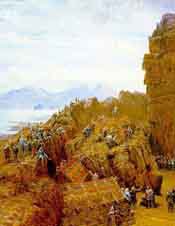
Very little news is actually made at these conventions—so claim the pundits, who argue that the ins and outs of parliamentary wrangling once gave rise to great drama, whereas now we’re stuck with tightly scripted messages and largely mediocre speeches. But consider (he whispered, pushing a mighty army of straw men into place) the alternative. Here, from Njal’s Saga, is what happened at the Althing in A.D. 1011 when human nature grabbed civilized legal procedure by the windpipe and things went all higgeldy-piggeldy:

Thorhall Asgrimsoon said, “There is Skatpi Thoroddsson now, father.”

“So I see, kinsman,” replied Asgrim, and at once hurled a spear at Skapti. it struck him just below the thickest part of the calf and went right through both legs. Skapti was thrown to the ground and could not get up again. The bystanders could do nothing but drag him headlong into the booth of some sword-grinder.

Then Asgrim and his men attacked so violently that Flosi and his men fled south along the river to the Modruvellir booth. There was a man called Solvi standing beside a booth, cooking meat in a large cauldron; he had just taken the meat out, but the water was still boiling furiously. Solvi caught sight of the fleeting Eastfjords men who were almost on him by then.

Solvi said, “Are all these Eastfjords men cowards, fleeing along here? Even Thorkel Geitisson is running. What a lie to say of him, as so many have done, that he is bravery itself, for now he is fleeing faster than anyone else.”

Hallbjorn the Strong was nearby at that moment, and said, “You shall never be able to say that all of us are cowards.” With that he seized hold of Solvi, lifted him high in the air, and pitched him head-first into the cauldron.

Far be it from me to suggest that our political conventions might benefit from kin-based spear battles, but ratings would shoot through the roof. Já, vér kunnum! C-SPAN, are you listening?

“So be quiet tonight, be sure to step lightly…”

Icelandophiles often go years without a new novel to keep them busy, but the next few months offer good reading—and good news—for those of us who need our fix of Icelandic fiction.

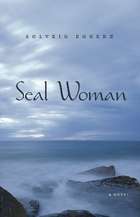
Iceland native and D.C.-area resident Solveig Eggerz recently published her debut novel, Seal Woman, the story of a German artist who flees to rural Iceland after World War II. It’s an honest and disquieting book, and Eggerz poses hard questions: How do you rebuild your life after war has destroyed it? How do you reconcile your new family with the ghosts of the past? Based on the experiences of more than 300 German women who answered newspaper ads for farm laborers, Seal Woman is a rarity—a work of literary fiction that isn’t over-written—and deserves a wider audience. Read the first chapter of Seal Woman at the Bit-o-Lit archive, learn more about Solveig Eggerz at her Web site, or order the book from Amazon.

Back in 2004, Vintage published the first English translation of Iceland’s Bell, Halldor Laxness’s dark, funny novel about his homeland’s most squalid era. (One of the book’s great characters is a fictionalized version of Arni Magnusson, the antiquarian who rescued most of Iceland’s medieval manuscripts from ruin.) The same translator, Philip Roughton, has filled another gap in the English-language canon of Iceland’s only Nobel laureate with The Great Weaver of Kashmir, one of Laxness’s earlier novels. Roughton’s translation comes out in October.

American Icelandophiles will also enjoy the Inspector Erlendur Mysteries, which prove that you can set police procedurals in a country with hardly any murder. The third book, Voices, comes out in paperback in the U.S. next week. The first two novels, Jar City and Silence of the Grave, were unusually eloquent and beautiful examples of the genre—and were nicely translated by the late Bernard Scudder.

Finally, check out Icelandic Online, a free online language course from the University of Iceland. Create a login and conquer the first level, which consists of 45 hours of instruction. Completing the course is the main prerequisite for the university’s new Master’s program in Medieval Icelandic Studies. What’s Icelandic for, “So, just how ambitious are you?”

“He brewed a song of love and hatred…”

In his English translation of The Battle of Kosovo, John Matthias commends his co-translator, Vladeta Vučković, and offers this passage from Vučković’s modern poem about Serbian legend and history:

The Serbs quieted down, but they did not shut their mouths. Idled by the time on their hands they started to sing and sang themselves hoarse in endless poems accompanied by the mourning sounds of the sobbing gusle. The blind guslars gazed into the future, and those who could see covered themselves out of shame and became the leaders of the blind. But what kind of music is this, my poor soul, reduced to just one string!

I was inspired to hunt for this gloomy passage after the Guardian reported that prior to his capture on Monday, Radovan Karadžić liked to jam on the gusle in a Belgrade pub:

In retrospect, it is hardly surprising it was his favourite pub. The walls and bar of the Luda Kuca (the name means madhouse) are adorned with the Serb pantheon – Slobodan Milosevic, Vojislav Seselj, Ratko Mladic and of course, Radovan Karadzic – each one a nationalist hero. For the hardline clientele, the fact that they also shared the distinction of having been charged by The Hague war crimes tribunal only enhanced their status as warriors.

There were many stories being told yesterday about the man the locals knew as Doctor David, psychiatrist holistic health guru and mystic. But one winter’s night in particular was passing speedily into folklore.

That night, there was a jamming session on the gusle, the one-string fiddle played across the Balkans to accompany epic poetry. Dabic turned up to listen and was eventually persuaded to join in. Those present that night shook their heads yesterday in disbelief at the memory. There was Radovan Karadzic, their hero and icon, playing the gusle for them under his own portrait, and no one had a clue who he was. It was the stuff of legend.

Raso Vucinic, a young Serb nationalist who had been playing the gusle that night, was burnishing a tale he would one day tell his grandchildren.

Balkan epic poems are a gift to the world. Early in the 20th century, recorded performances of epics such as The Wedding of Smailagić Meho helped a generation of scholars better understand the compositional techniques behind Beowulf and other medieval works, and the surviving fragments of the Kosovo cycle are tinged with wistful eloquence. The stories they tell are exciting and sad—but these songs can’t be sung in a vacuum.

Five years ago, while visiting Serbian friends, I found myself in an ancient city on the Montenegrin coast. To escape the midday sun, we ducked into a run-down shop full of pirated software and used compact discs. On a high shelf, safe behind glass, was a special item: a cassette case adorned with a somber portrait of Slobodan Milošević. My host squinted at the title and explained, ruefully, that the cassette was a recording of epic poems lamenting the tragic downfall of Milošević, performed in the traditional manner and set to the screech of the gusle. It wasn’t on sale for its philological interest.

Karadžić, by contrast, composed his own tale. In 1992, for the benefit of documentarians, he played the gusle in the house of his 19th-century forefather Vuk Karadžić, a philologist whose work gave Serbian nationalists something to sing about. A poet himself, Radovan knew that moving incognito among his own people as a bearded mystic would be reminiscent of epic, a motif so cleverly adapted that even his own capture would make for a beguiling story.

Medievalists, take note: sometimes, this is how epic heroes are made, under conditions so ugly that lawyers start to wonder whether poetry can be a war crime. If nothing else, the long-overdue capture of Karadžić, dramatic though it is, refutes that old Joseph Campbell baloney: sometimes the hero has only two faces, and neither one is really worth a damn.

“Green thoughts come around every now and then…”

Hark! Open Letters Monthly has posted the fourth installment of Green, Adam Golaski’s funky translation of Sir Gawain and the Green Knight.

Here’s a typical passage, which shows how Golaski’s weird diction brings out the exoticism of the original:

Arthur’nd Arthur’s court
look’d long’nd in wonder, + wondered what kind’v man be-held them,
wondered what this magical spectacle must mean,
f’r’a knight’nd’is horse to’ve accrued such’a hue that is

green

green as th’grass’nd growing greener it seemed
green glow’n’nd bright’nd brighter than enameled gold.

Can Adam Golaski sustain this idiom through an entire translation? I don’t know—but after the past few years, when translations of medieval poems have met with such reverence, it’s nice to read one that’s just fun.

“…when streams are ripe and swelled with rain.”

Each April, references to two poems burst forth like emerald weeds. The month begins with allusions to the opening lines of The Canterbury Tales, and I never mind reminders of Chaucer; but by mid-month, by tax day, even half-literate news anchors will have made eye-rolling references to The Waste Land as well. Yes, yes, April is “the cruelest month.” So we’ve heard. As April-themed allusions go, are these really the best we can do?

Although she’s not easily reduced to quotations and sound bites, let’s turn, this April, to Dame Edith Sitwell, the largely forgotten writer of the heaviest light verse in the world. If you’re familiar with Sitwell, you’ve probably read (or heard) her poem “Waltz,” an evocative ditty about fashion-fickle nymphs and other denizens of pseudo-pastorale:

The Amazons wear balzarine of jonquille
Beside the blond lace of a deep-falling rill;
Through glades like a nun
They run from and shun
The enormous and gold-rayed rustling sun;
And the nymphs of the fountains
Descend from the mountains
Like elegant willows
On their deep barouche pillows
In cashmere Alvandar, barège Isabelle,
Like bells of bright water from clearest wood-well.

If you’re looking at those lines and thinking “What?”, your reaction is understandable—but take a minute, read the poem aloud, or maybe listen to it echo in your head, before you decide you don’t like it. Most poets are highly conscious of diction, but Sitwell was the rare poet who obsessively focused on sound, rhythm, and onomatopoeia almost entirely at the expense of concreteness and clarity. With the typical Sitwell poem, how it sounds is often what it’s about.

That’s why it’s a particular pleasure to discover, among Sitwell’s late works, a poem called “The April Rain,” in which she uses her distinctive style and abstruse allusions not simply to please the ear, but also to evoke springtime and the innocence of young love.

“Such is our world, my love,” declares a boy to a girl, “[a] bright swift raindrop falling”:

The sapphire dews sing like a star; bird-breasted dew
Lies like a bird and flies

In the singing wood and is blown by the bright air
Upon your wood-wild April-soft long hair
That seems the rising of spring constellations—
Aldebaran, Procyon, Sirius,
And Cygnus who gave you all his bright swan-plumage…

As she develops the symbolism of the raindrops, Sitwell falls back on the wistfulness so typical of her lifelong work:

Such are the wisdoms of the world—Heraclitus
Who fell a-weeping, and Democritus
Who fell a-laughing, Pyrrho, who arose
From Nothing and ended in believing Nothing—fools,
And falling soon:
Only the April rain, my dear,
Only the April rain!

That fool-begotten wise despair
Dies like the raindrop on the leaf—
Fading like young joy, old grief,
And soon is gone—

Forgot by the brightness of the air;
But still are your lips the warm heart of all springs,
And all the lost Aprils of the world shine in your hair.

I doubt Sitwell’s closing lines will join the ranks of quotable April verses, but “The April Rain” is a charming poem nonetheless—a reminder that when we discuss the month in poems, it ought to be known as much for its sounds as for its more obvious scents.

“Your face, your race, the way that you talk…”

Recently, the “Charlemagne” column in The Economist declared Playmobil Man its “European of the Year,” noting persuasively that Homo playmobilis offers “a striking snapshot of European aspirations, anxieties and foibles.” That approach to toys, I’d hasten to add, also says something about how they see history:

There are Playmobil knights and barbarians, pirates and Roman legionaries, all wielding lethal weapons. Europeans can even live with American military toys, if they are old enough: there are Playmobil cowboys from the Wild West, and soldiers from both sides in the American civil war.

The difference is philosophical, says Mrs Schauer. There are no more knights and pirates, so their combat is a “resolved story.” Modern war is “really horror.” That is echoed by Gabi Neubauer, a librarian buying toys in Nuremberg. She suggests that “it is more honourable to fight with a sword, somehow.” Not all explanations are as high-faluting. Asked why Playmobil makes any tiny toy guns at all, Mrs Schauer admits “otherwise, we probably wouldn’t be accepted by boys.”

To the modern toy-shopper, a medieval battle may seem more honorable when viewed through the thick lens of history. But when 14th-century conflicts continue to perplex, and frustrate, and threaten to come between allies, it’s iffy to claim that the knights of old Europe belong to a story that’s somehow “resolved.”

If you’re just catching up on the news of the weekend—Kosovo’s declaration of independence and the reaction it’s causing in Serbia—you’ll see that most articles skimp on historical background. They summarize briefly the wars of the ’90s, but doing the subject justice is nigh on impossible. Even for many foreigners with Balkan connections, disentangling the skein of religion and culture and old ideology is the work of at least half a lifetime. Besides, seeing Kosovo with no more than two decades of context, or panning back only a century, is like opening a book more than three-quarters in. To begin understanding what happened this weekend, you have to go back more than 600 years.

The Battle of Kosovo is murky indeed, but shadowy memories of this turning point in Serbian history did survive the centuries, first in oral tradition and then, in the 19th century, in the written records of a patriotic Serbian philologist. (You can order a hard copy from Ohio University Press or read all the poems online.) Commanded by a noble named Lazarus, the Serbs clashed in June 1389 with the invading Turkish forces of Sultan Murad at Kosovo polje, the Field of Blackbirds. The epic tradition is wonderfully vivid: Lazarus doesn’t want war, but he refuses to pay tribute to the sultan. Elijah appears to Lazarus as a falcon and forces him to choose the destiny of Serbia: glory on earth, or glory in Heaven? Lazarus thinks—then he makes his choice fast:

O Dearest God, what shall I do, and how?
Shall I choose the earth? Shall I choose
The skies? And if I choose the kingdom,
If I choose an earthy kingdom now,
Earthly kingdoms are such passing things—
A heavenly kingdom, raging in the dark, endures eternally.

Before the battle, Lazarus celebrates his slava—the feast-day for his patron saint—with a last supper and grim prophecies of betrayal. The Serb leaders know that the Turks vastly outnumber them; Ivan Kosančić declares that “[i]f all the Serbs were changed to grains of salt, / We could not even salt their wretched dinners!” Nonetheless, they agree to tell Lazarus that the Turkish army consists of children, old men, and cripples, but Lazarus seems to know otherwise. The Turks easily slaughter the Serbs, but much of the epic tradition dwells on the poignant stories of individuals, such as the Maiden of Kosovo, who wanders the carnage looking for the man she was supposed to marry; the nine Jugović brothers and their father, whose deaths cause their mother to die of heartbreak; the redemptive bravery of a falsely accused hero; and the treachery of his accuser. Much of the Kosovo epic is unverifiable, even ahistorical, but the fragment we have is a powerful read. Its legacy, though, is both tragic and sad.

Unless you understand the Serb defeat at Kosovo polje, you won’t see the symbolism in Gavrilo Princip assassinating Archduke Ferdinand on the 525th anniversary of the battle, the act that ignited World War I; you won’t know why charmless nationalist Slobodan Milosevic scored a propaganda victory by speaking at the battlefield on the 600th anniversary of the defeat (shortly before his own helicopter-assisted apotheosis); and you won’t appreciate why many Serbs still regard Kosovo not only as their ethnic and religious homeland but also as the site of their national martyrdom. At this point, history fades into vapors; as John Matthias writes, “while the final and conclusive battle was not fought until 1459…it is Kosovo which has lived in the popular imagination and in epic poetry as the moment of annihilation and enslavement.”

Today, we prefer our medievalism sweet: Renaissance festivals, fantasy novels, CGI movies, and Playmobil toys. But the Kosovo conflict is medievalism, too, the sort we would often prefer to forget. In the Balkans, where the scholarly study of Bosnian guslars later shed new light on Beowulf, medievalism also kindled World War I. During the 19th century, as medievalism adapted to the vagaries of national character, the English gave us Tennyson and the Gothic revival; the Scots had their Ivanhoe and the Eglinton Tournament; the Finns found themselves in the charming Kalevala; the Germans gave the world Wagner (not only his music but also, alas, the man) as well as the Monumenta Germaniae Historica; and the French, bless their hearts, gave us Migne. The Balkans bequeathed us their own Middle Ages. The world they created, though grim it may be, springs right from the same source as Tolkien.

Sometimes, medievalism should give us pause, especially us Americans, for whom the phrase “that’s history” is more likely to be dismissive rather than admonitory. The battle of Kosovo resonates still; its legends and lore have profound implications. Playmobil knows this; just look at their toys. They sell Norsemen and Romans and wee Gaulish leaders, but no Lazarus or Sultan Murad. The thought is unnerving, outlandish, and weird. Let’s hope that their story is someday resolved.