“Sve se oko tebe ispravlja i savija…”

[Here’s the latest in an ongoing series of reviews of all of Lloyd Alexander’s non-Prydain books. To see all posts in this series, click on the “Lloyd Alexander” tag.]
“Miss Vesper Holly has the digestive talents of a goat and the mind of a chess master,” admits the befuddled narrator of The Illyrian Adventure, the first of six books to star Lloyd Alexander’s most rambunctious heroine. “She is familiar with half a dozen languages and can swear fluently in all of them. She understands the use of a slide rule but prefers doing calculations in her head.” Vesper has opinions about electromagnetism and women’s suffrage, is fluent in Latin and Turkish, and knows how to play the banjo. She’s also, improbably, 16 years old.

The Illyrian Adventure opens in 1872, as the newly orphaned Vesper is keen to continue her father’s research on the Illyriad, the 12th-century national epic of a “pocket-sized kingdom on the eastern seacoast of the Adriatic.” Vesper and her guardian, Dr. Brinton “Brinnie” Garrett, soon exchange the safety of suburban Philadelphia for a Balkan adventure full of shadowy villains and the ruins of ancient temples. Stuck in the midst of a medieval dispute between the Slavic majority and their Turkic overlords, Vesper and Brinnie hear ominous whispers: Vartan, a mythical hero and centuries-old symbol of Illyrian independence, may still be alive.

While our heroes befriend a monarch, dodge assassins, and put their lives in the hands of a clumsy dragoman with a knack for pithy sayings, Alexander depicts a political standoff perpetuated by conflicting notions of honor: the Zentan king will gladly bestow justice but won’t let it be forced from him, while the oppressed Illyrians won’t accept their king’s largesse but feel obligated to take their freedom by force. To Alexander’s credit, The Illyrian Adventure discourages the book’s young-adult readers from impulsively romanticizing the past by demonstrating that national myths aren’t always benign. Adults won’t fail to notice that The Illyrian Adventure simplifies Balkan strife, ignores religious and ethnic distinctions, and offers improbable solutions—but Alexander was under no obligation to squeeze as much nuance as he did into what is, after all, an adventure story about a female, teenage Indiana Jones.

Wisely, Alexander filters the reader’s view of Vesper through a comically unreliable narrator: Brinnie, a gentlemanly academic bemused to find himself the guardian of a teenage girl. Educated and intelligent but often blinded by Victorian mores, Brinnie provides the necessary distance to make Vesper’s polymathy seem that much less implausible, which frees Alexander to revel in one of his funnier narrative voices. “My knowledge of parental duties was slight,” Brinnie confesses, “something to do with graham crackers and proper underclothing.” During the climax of The Illyrian Adventure, when Brinnie naively provides vital information to a deceptive figure who turns out to be the villain, he remains oblivious to attempts to quiet him. “Vesper must have grown excited by my remarks, for her foot kept twitching against my shin,” he observes, giving the young reader another chance to feel superior to a decent but stuffy adult.

Fortunately, Brinnie doesn’t become an object of ridicule; his presence reinforces the book’s emphasis on intellectual achievement by giving Vesper an adult counterpart who’s equally passionate about learning languages, reading books, and exploring the wider world. Armed with knowledge, Vesper revels in her rambunctious self, a teenage girl supernaturally free of neuroses but also a little bit reckless. When she refuses to wear a veil and robe in the Turkic capital of Illyria, she responds to the ensuing fuss by sneering, “Time they got used to it.” The adult reader, finding her consequence-free precociousness highly implausible, is likely to cringe; your inner brat will cheer her all the way.
“My cat said ‘fiddle-i-fee.'”

[Here’s the latest in an ongoing series of reviews of all of Lloyd Alexander’s non-Prydain books. To see all posts in this series, click on the “Lloyd Alexander” tag.]

One year after writing an entire book about his five house cats, Lloyd Alexander co-authored Park Avenue Vet, the 1962 memoir of Dr. Louis J. Camuti. Fondly remembered as the first vet to devote his practice exclusively to cats, Camuti dealt with fussy socialites, befriended nearly every cat he met, and learned how to respond with patience and diplomacy to the quirks of their eccentric owners.

Camuti’s story is punctuated by felines from beginning to end. He praises the childhood cat who helped him recover from typhoid fever, he memorializes the cat who befriended him while he served in the cavalry during World War I, and he describes the awkwardness of his first solo operation—the spaying of his fiancee’s pet. Camuti also recalls his first house call, when in a clumsy attempt to euthanize a St. Bernard he only wound up chloroforming himself.

Although Camuti ponders cat psychology and offers a brief taxonomy of feline body language, his anecdotes about their owners are often the funniest: the fellow who believed his cat became electrified during thunderstorms; the woman who tried to breed her cats with rabbits; and my favorite Camuti patient of all:

She was past middle age, well dressed, carrying a small cardboard box.

“It’s about my dog,” she said, sitting down nervously beside my desk.

“I live alone,” she went on, naming an excellent apartment house, “and he’s my only companion.”

I asked whether she had brought the dog with her.

“Oh, yes,” she said, “he’s right here.”

She unknotted the string around the box. I looked inside and saw a small dog, a Boston terrier. There wasn’t anything wrong with him. There couldn’t have been. The dog was made of pâpier-maché.

“Well,” I said, wondering what her answer would be, “what seems to be the trouble?”

“The trouble?” she said indignantly. “You’re a veterinarian. Can’t you see for yourself?”

“I don’t want to jump to conclusions,” I said.

“The trouble,” she said, “is ticks.”

With only light evidence of Alexander’s assistance, Camuti tells poignant stories about death and denial, writes disapprovingly of most of his celebrity clients, and documents the lengths to which owners will go for their animals—such as the woman who accumulated so much Japanese crab meat for her finicky Siamese that she aroused official suspicion during World War II. Though only 184 pages, Park Avenue Vet is an fine and insightful collection of veterinary exempla, not because Alexander and Camuti demystify the unknowable ways of the feline but because of the book’s implicit premise: that the best stories about cats tend to say something true about people.

“Into the sea, you and me…”

[Here’s the latest in an ongoing series of reviews of all of Lloyd Alexander’s non-Prydain books. To see all posts in this series, click on the “Lloyd Alexander” tag.]

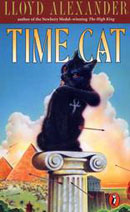
 At your local Barnes & Noble, the Lloyd Alexander selection is probably small. You’ll find all five books in the Prydain series and rarely anything else—but these days, if the store stocks any other Alexander novel, you will see, inexplicably, Time Cat.
By 1963, Alexander had written five books for adults and two books for children, but Time Cat was his first attempt at young-adult fantasy. He sets up the premise hastily: While hiding in his bedroom, a boy named Jason convinces his cat, Gareth, to spend his nine lives taking him on a tour of history. By the fourth page, with no further explanation, Jason and Gareth are romping through ancient Egypt and Roman Britain; soon they’re offering advice to Saint Patrick and posing for Leonardo da Vinci.

Unfortunately, Jason and Gareth never stay anywhere long enough for Alexander to turn his favorite historical figures into memorable characters, and his writing is sometimes awkward. Sentences like “Jason, expecting he didn’t know what, breathed a sigh of relief,” are oddly informal, and the emotion in Time Cat feels false:

“You know, Gareth,” he said, “your whiskers do look like the rays of the sun. And I do think you could hold the moon in your eyes if you wanted to.”
“So the Egyptians say,” Gareth answered.
“Oh, Gareth,” Jason whispered, “why don’t you try?”

The lessons of Time Cat are simple and repetitive. Jason and Gareth humble the Pharaoh when he learns that cats won’t heed his commands; they teach the emperor of Japan the same lesson; and in 16th-century Peru, they frustrate a Spanish captain who also wants cats to do tricks. When Jason and Gareth return to the present, Gareth declares, “If you think back, everybody we met had something to tell you—about themselves, and about yourself. It’s a way of finding out a part of what you have to know to be a grown-up.” Alexander’s later novels made this same point with eloquence and wit; in Time Cat, Gareth’s conclusion isn’t supported by a hasty field trip through history.

For some readers, that field trip may be enough, and I’m sure Time Cat has introduced many children to the study of history. But in the past 45 years, young-adult literature has grown so sophisticated—and Alexander’s later novels are such fine examples of their genre—that the current marketing push behind Time Cat is peculiar. It’s troubling to see Alexander at his most tentative, but I’m heartened by how quickly he bounced back: The Book of Three was published one year later.

“And near me on the grass lies Glanvil’s book…”

[Here’s the latest in an ongoing series of reviews of all of Lloyd Alexander’s non-Prydain books. To see all posts in this series, click on the “Lloyd Alexander” tag.]

Lloyd Alexander described Gypsy Rizka best. “The main character is a young half-gypsy girl named Rizka, as the title says,” he told Scholastic in 1999:

She is so bright and smart and sassy and clever that she outwits the solemn and overblown townsfolk who are trying to do her in. It’s a very funny book because Rizka’s schemes—and she’s brilliant at them—are very comical. I should add that she always wins! And those idiot town dignitaries always lose, which is exactly the way it ought to be.

In this preview for young readers, Alexander highlights the most charming aspect of Gypsy Rizka; he also points out the novel’s significant flaw.

Considered a blot on Greater Dunitsa by the ruling elite, Rizka lives in a wagon on the edge of town. While she waits for her father to return with the rest of the gypsies, she sneaks around town with her tomcat and finds a father figure in the local blacksmith, the only person in Greater Dunitsa who’s even remotely sensible. Rizka, for her part, is implausibly competent: when she plays matchmaker, she unites two feuding families and finds homes for five stray kittens; she out-argues the local magistrate in court; she becomes the unofficial town doctor; and when an absurd law against insulting other people lands the entire fleabag aristocracy of Greater Dunitsa in the town’s only jail cell, Rizka is appointed mayor—and shows the good sense to abdicate for the sake of the greater good.

As the locals bicker, assert themselves, put on airs, and go about their pompous, petty lives, Alexander makes clear that disorder and discord are inevitable symptoms of human nature. Supernaturally clever, Rizka rises above it all, dispensing justice and righting wrongs. Her confidence never falters, and her outlandish schemes never fail. The world of Gypsy Rizka is, of course, inherently comic, but the residents of Greater Dunitsa are presented as fools right from the start; Rizka easily humiliates them, and she never faces any real danger. Alexander may have delighted in a heroine who “always wins,” but her perfection obviates any real dramatic tension.

Fortunately, Alexander also delights in the telling. He describes Rizka as “skinny as a smoked herring; long-shanked, bright-eyed, with cheekbones sharp enough to whittle a stick.” Beginning authors who try to convey character through clothing could learn from his concise, witty descriptions:

Rizka wore her usual costume: a pair of homeless breeches she had rescued; boots cracked and split, hardly a memory of their former selves; an old army coat so outnumbered by patches the original garment had surrendered; her black hair tied with a string; a felt hat cocked on top.

A goulash of indeterminate Slavic, Germanic, Hungarian, and generically Balkan ingredients, the ramshackle town of Greater Dunitsa serves as a fine stage for a shabby comic retelling of Romeo and Juliet, and the perceptive reader may notice a nod or two to Chaucer’s “Miller’s Tale.” As in fabliau, the locals are amusingly provincial: Only one resident, the local war hero, has ever been outside of town, and the city fathers think nothing of putting a cat on trial for burglary. Smiling all the way, Alexander skirts the issue of human evil, asserts the harmlessness of fools, and opts for a comic conclusion: “No one’s as bad as they seem—or as good as they think they are.”

The weekend I discovered Gypsy Rizka in a secondhand bookshop, The Economist published a disheartening report on “the dismal lives and unhappy prospects of Europe’s biggest stateless minority,” the Roma. If you’ve seen real gypsies on the streets of Eastern Europe, you’ve surely never seen a Rizka. The gulf between the lives of actual Roma and the whimsical gypsies of literature is a worthwhile subject, but it’s primarily a concern for adults, who can’t help but sigh over fiction. Gypsy Rizka is a charming book for the way it captures the fantasy of a child: the wish to get one over on the grown-ups.

“…where the reading light was better, meow-meow-meow.”

[Here’s the latest in an ongoing series of reviews of all of Lloyd Alexander’s non-Prydain books. To see all posts in this series, click on the “Lloyd Alexander” tag.]

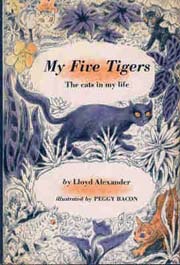
I had expected to kick off this review of My Five Tigers with a story about my own childhood cat: a plump, patient tabby named Scritchy who let us dress her in babushkas, who often sat upright like a human, and who clearly enunciated the word “ham.” I planned to deploy these and similar anecdotes more out of sarcasm than nostalgia, prepared as I was to cringe my way through Lloyd Alexander’s second book. How, in 1956, could a publisher commission an unknown author to write a 118-page account of his five house cats for adult readers? With a dismissive review half-composed in my head, I opened the book and braced for a great wave of treacle.
A few pages in, I grew downright reflective. In a chapter or two, I was near-elegiac. O Scritchy, why did you have to die?

Lloyd Alexander started out skeptical, too. As he explains in My Five Tigers, he and his wife returned from France after World War II and decided to take in a dog. Only when the dog ran away did they stumble into the enigmatic world of the feline. “[A]s I was to realize, humans are not always the most important features in a cat’s life,” Alexander muses, recalling his first encounter with a purring cat. “A strange kitten, in particular, has a number of affairs to settle. There are times, with cats, when we may only watch and try to understand.”

My Five Tigers is a patient philosophical exercise. Alexander admits to barely understanding cats, but he seeks greater understanding by describing what cats are like. New similes spring from every page: his cats are like Dickensian street waifs, Civil War soldiers, and African game beaters. His cat David is “respectful as an Etonian, a proper lower-form boy in a black suit” who, when caught bringing local strays into the house, starts “grinning like a night-club manager.” Moira, Alexander’s only female cat, is Annie Oakley when she’s active but remains at heart “a boudoir revolutionist, a violator of established order, a maker of exceptions who played by boys’ rules when it pleased her—and fell back on female prerogatives the rest of the time.” In keeping with Alexander’s insistence on similes, his conclusions are both tentative and characteristically humble. “At bottom,” he suggests, “cats are like music. The reason for their appeal to us can never be expressed too clearly.”

When My Five Tigers was published, The New York Times noted that the book was graceful but unsentimental. Reviewers might have said that about most of Alexander’s books; throughout his career, he steered free of cloying sentimentality by knowing how to make readers feel without telling them what to feel. Near the end of My Five Tigers, when Alexander introduces Solomon, a neglected and half-starved city kitten, he writes that “[h]is body had the shape of a half-deflated football and his spine showed through his red fur like a string of beads.” This one vivid sentence suggests cruelty and indifference, but it also offers an antidote: a tiny dose of basic human tenderness.

Thanks to Alexander’s talent for making readers care about the mundane—will Rabbit recover from his torn tendon? Can David Blacklamb adjust to new feline housemates?—My Five Tigers is more than a trifle. I can’t imagine a more eloquent first-person narrative about house cats, but Alexander’s discovery of love, heartache, adventure, and mystery in the world of suburban felines also hints at the wonderful novels he hadn’t yet written. This book shows that he already knew how to make a tale timeless: by dabbling in something like myth.

“Wild kind of look to the day…”

[Here’s the latest in an ongoing series of reviews of all of Lloyd Alexander’s non-Prydain books. To see all posts in this series, click on the “Lloyd Alexander” tag.]

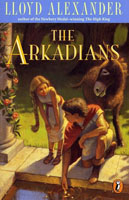
Partway through The Arkadians, Lloyd Alexander indulges an in-joke. Joy-in-Dance, the novel’s heroine, explains that during Arkadia’s golden age, mighty enchanters roamed the land. When she lists these mythic figures, they happen to possess Hellenized versions of names from three of Alexander’s earliest works. “She’s setting the scene very nicely for us,” declares one of her companions, ignorant of this rare wink to the reader. “It’s no doubt one of those tales of sentiment and tender feeling.”

The pleasant confusion of storytelling is, in fact, the entire point of The Arkadians, Alexander’s 1995 novel set in a variant of ancient Greece that’s all the more exciting for its strangeness. Here, the Trojan horse was actually a donkey, Odysseus’s wife wasn’t happy to see him, and American Indians rule the northern plains. With subtle but obvious glee, Alexander reshapes the world of Greek myth as if it’s been filtered through a child’s toy box, painted by Maxfield Parrish, and cast as Shakespearean comedy. The result is an amusing cast of oddballs that includes a befuddled clerk, a real live muse, a poet-turned-jackass, and a professional scapegoat. Each one has a reason for seeking help, Oz-like, from the mysterious Lady of Wild Things—and each one has a story to tell.

Those secondary stories told by the characters are the true delight of The Arkadians. Surprisingly playful for an author in his early 70s, Alexander whips up a prose pastoral romance, complete with digressions just lengthy enough to hold the interest of young-adult readers. Some of these stories are personal histories that retell episodes from Homeric epics. Others are creation myths, including one that reworks the Judeo-Christian story to make the loss of Paradise the fault of the male. Some tales are literally true, while others are shown to be blatantly false. As Lucian, the novel’s hero, tries to explain how he fled the royal court, his friend Fronto, the poet-turned-jackass, demands that he improve his biography:

“Conflict, struggle, suspense—that’s what’s needed to make a tale move along. You don’t just run off. They seize you. You fight them with all your strength, almost win; but they bind you hand and foot, get ready to chop you up with meat cleavers. You escape in the nick of time. I don’t know how. That’s a technical detail.”

“It didn’t happen that way,” Lucian protested.

“My point exactly,” said Fronto. “All the more reason to spice it up. The meat cleavers are an especially nice touch.”

Thanks to these sorts of knowing exchanges, The Arkadians becomes Lloyd Alexander’s clever and self-deprecating commentary on the human impulse to invent and embellish. Even as the novel’s heroes grow increasingly honest about their own stories, they learn that other people simply can’t help themselves: Catch-a-Tick, a starry-eyed young satyr, joins their fellowship, sees what he wants to see, and mythologizes their adventures on the spot.

To say more about The Arkadians would spoil its surprises, especially the in-jokes for readers of mythology. Snake prophets, talking animals, star-crossed lovers, shipwrecks, magic temples, feckless monarchs, goddesses and gods—Alexander recombines these classic elements of storytelling to illustrate such virtues as loyalty, love, mercy, and humility and to emphasize, as Shakespearean comedy often does, the complementary natures of women and men.

Alexander’s glee will displease dour nitpickers who don’t understand that the best myths are destined to mutate. Dogmatically respecting a myth’s provenance? Seeking its literal meaning? None of that, Alexander suggests, is particularly fun; joy in the telling is better by far. As Fronto, the poet-turned-jackass, aptly concludes, “If a storyteller worried about the facts—my dear Lucian, how could he ever get at the truth?”

“…as your little boat struggles through the warning waves.”

[Here’s the latest in an ongoing series of reviews of all of Lloyd Alexander’s non-Prydain books. To see all posts in this series, click on the “Lloyd Alexander” tag.]

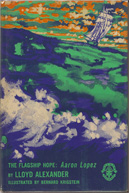
Lloyd Alexander wanted to like Aaron Lopez; the fact that he couldn’t is hardly his fault. In The Flagship Hope, his second novel for children and his second novel in a series “designed to take young people on an adventurous expedition into the realms of Jewish experience,” Alexander spins a highly fictionalized account of the wealthiest merchant in 18th-century Rhode Island. Published in 1960, four years before the first Prydain novel, The Flagship Hope shows what happens when an author is given a story he simply cannot make his own.

The novel begins in Lisbon in 1752, a ghetto of “fruit, spilled wine, and poverty,” as Alexander sketches the history of the Marranos, Portuguese Jews who were forcibly baptized but who practiced their religion in secret for centuries. When 21-year-old Duarte Lopez presses his luck with the authorities, he’s forced to flee to Rhode Island, where he finds a welcoming Jewish community in Newport and a wealth of opportunity. “This is a new world,” his brother assures him, “but you are not alone in it.”

Free to take a Jewish name, Aaron Lopez becomes a shipping magnate and a philanthropist. He lays the cornerstone of Newport’s first synagogue, he endows the town library with books, and he pays for the passage of Jewish refugees after a Portuguese earthquake. His flagship, the Hope, becomes the symbol of the freedom he never enjoyed in Lisbon, and Alexander portrays him as a perceptive man with a poetic soul:

As Aaron looked with satisfaction and thankfulness on the results of his work his thoughts returned to the day, long before, when he and Abigail stood by the ship railing and he pointed out a distant whale. Then, the whale, the leviathan of the deep, had meant all of the New World to him. He had vowed to make a hook to capture it. Had he now, at last, caught the great creature?

As Aaron Lopez courts his wife, speaks fondly of books, and faces harassment by royal agents, Alexander makes him eminently likable. But throughout The Flagship Hope, the nature of Lopez’s business remains vague. Lopez was indeed one of the great merchants of 18th-century New England, and while Alexander specifically mentions his investments in spermaceti candles and rum, he alludes only vaguely to other aspects of his “West Indian trade.” Therein lies the main problem with The Flagship Hope: it never mentions Lopez’s involvement in the slave trade.

Lopez’s outfitting of slave ships is no secret; historians have documented it, and much is made of it on antisemitic Web sites (to which I will not link). Readers of The Flagship Hope who know something about the real Aaron Lopez are bound to approach this issue with varying degrees of sensitivity to historical context that may temper their disappointment or anger. Unfortunately, readers who know Aaron Lopez only through Alexander’s novel aren’t given a chance to determine how much less they might have liked the man. Strangely, Alexander casts Lopez as a freedom fighter who justifies his own reluctance to fight in the Revolutionary War:

And what of liberty? Once Aaron had reproached himself for not taking up a musket. Now he saw clearly that all who worked for freedom, to the full measure of their means, even those who could offer only their suffering, had the proud right to call themselves her children. As Aaron looked across the icy field, he knew that liberty had many sons.

Alexander never saw even his worst characters as inhuman or monstrous, and his task in The Flagship Hope is, of course, to focus on Lopez’s experience as an immigrant, merchant, and patriot. But when a hasty epilogue documents Lopez’s premature death in quicksand at the age of 50, Alexander offers no praise, only the enigmatic graveside prayers of friends and family to “hear the voice of Aaron.” He seems relieved to be rid of a figure whose life story is more informative than it is inspirational, and I can’t really blame him. After enjoying the story of Alexander’s previous Jewish hero, August Bondi, and his principled fight against slavery, a novel about an 18th-century merchant that never mentions the slave trade is a strange and uncomfortable read.

“…and a fire-dance through the night.”

[Here’s the latest in an ongoing series of reviews of all of Lloyd Alexander’s non-Prydain books. To see all posts in this series, click on the “Lloyd Alexander” tag.]

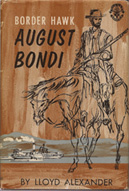
Before he invented the kingdom of Prydain, Lloyd Alexander sought out Jewish heroes on the plains of antebellum Kansas. Published in 1958, six years before the debut of the Prydain series, Border Hawk: August Bondi was the second release from Covenant Books, an ambitious series offering “stories of Jewish men and women to inspire and instruct young people.” Based on Bondi’s own accounts, this fictionalized biography of the Vienna-born Kansas abolitionist was also Alexander’s first book for children. The frequent exclusion of Border Hawk from the author’s later biographical sketches makes sense, perhaps, for marketing reasons, but the book doesn’t deserve its obscurity. For those who know Lloyd Alexander only as a writer of fantasy, this little-known work is a pleasant surprise.
The opening pages of Border Hawk are packed with action, all of it unfolding in tight, economical prose. It’s 1848, and student revolutionaries face off with soldiers on the streets of imperial Vienna:

The drums beat wildly, the bugles blew the piercing notes of the attack. Anshl heard the heavy boots of the advancing soldiers. Desperately he tried to raise himself. Before he could move, he felt a bayonet rip into his back. Another soldier struck him on the head and shoulders with a musket butt. Amid the clouds of smoke hanging over the square, the students struggled against the battalion. Above the rattle of musket fire rose the screams of the wounded and the shouts of the battling students. The attack passed over Anshl. In spite of his pain, he managed to drag Hershel to a side street. Carefully he rested the wounded boy against a doorstep. He tore shirts into bandages and tried to revive his friend.

Nothing in that passage is stylistically remarkable, but its pacing is perfect. Never an indulgent writer, Alexander demonstrates how to put readers in the moment: by letting them imagine the details for themselves.

After 18-year-old Anshl Bondi trades Vienna for New Orleans and changes his name to August, he seeks excitement on a riverboat—until the sight of a slave auction makes him turn away, “sick at heart,” as he remembers Jewish history and his own fights in the streets of Vienna. Later, when he accidentally strikes a defenseless slave, August is overcome with shame at having been proud of such trifles as his riverboat uniform. Resolving to leave the South and join the fight against slavery in Kansas, the young immigrant understands that “true adventure would come from doing something he could believe in and fight for.” In August Bondi, Lloyd Alexander discovers his typical hero.

Alexander’s lifelong focus on ethical quandaries is evident in Border Hawk, but here he specifically roots them in Jewish experience. One subplot focuses on a shopkeeper named Theo Weiner, who wrestles with his conscience, unsure of whether his desire to fight alongside the Free Staters outweighs his obligation to obey the law. A run-in with pro-slavery ruffians who are also antisemitic helps Theo make up his mind. “In the ghetto we feared the law,” he tells August. “But there is no ghetto here. A man makes his own life. In the ghetto we kept our mouths shut and suffered without a word. I left Warsaw. Now I have left the ghetto that was in my own heart.”

In Border Hawk, violence is a sad necessity, but Alexander doesn’t lose sight of its limits. When August and his Jewish friends become gunrunners, the author does not disapprove, but after they join John Brown in his Kansas campaigns, Border Hawk distinguishes between necessary violence and coldblooded vengeance. As Alexander presents him, John Brown is a frightening and ominous figure. When August meets the charismatic, wild-eyed abolitionist, he gets a glimpse of the horrors to come:

August stayed a few minutes longer, then took his leave of the Brown family. Slowly he rode back toward the creek. The image of Old Brown, like a patriarch of the Scriptures surrounded by his sons, remained in August’s mind. Now that he had met the Old Man face to face, August could not really be sure of what he had seen. A rock? An eagle? Yes, but something more. A sense of terrible destruction that was to come, that would consume all, even the Old Man himself.

Seething and tragic, John Brown prefigures Justin, the obsessive revolutionary of the Westmark series. In fact, Border Hawk is full of embryonic character types that recur in Alexander’s novels. In the few lines of speech she’s given, August’s wife, Henrietta, shows herself to be strong-willed and independent, a typical Alexander heroine. Learning new skills as he wanders and matures, August himself resembles Taran of Prydain; like Theo of Westmark, he continuously rethinks the moral calculus of war. Early in Border Hawk, the young hero pries loose the cobblestones of a Vienna street and piles them up to build the first student barricade. Alexander was clearly impressed by August Bondi’s ingenuity: he used that scene again, 26 years later, in the climax of the final Westmark novel.

With its moonlight shootouts and desperate battles between Free Staters and pro-slavery ruffians, Border Hawk is an engaging book, and August Bondi’s involvement in the tumultuous history of Kansas reminds young readers that we live in the events of our times rather than in front of them. Adults who grew up reading Lloyd Alexander will find Border Hawk a revelation, not only because the author handles non-mythological subject matter so deftly, but because the book shows that the heroes of Prydain and Westmark have Jewish-American roots.

“I don’t bother chasin’ mice around…”

[Here’s the latest in an ongoing series of reviews of all of Lloyd Alexander’s non-Prydain books. To see all posts in this series, click on the “Lloyd Alexander” tag.]

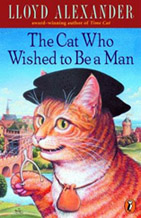
“Let me tell you about men,” complains the wizard Stephanus to Lionel, his restless and talkative cat. “Wolves are gentler. Geese are wiser. Jackasses have better sense.” Despite these warnings, Lionel persists: he wants to be a person. In The Cat Who Wished to Be a Man, Lloyd Alexander follows Lionel’s adventures as he get his wish and trades the secluded wizard’s cottage for the clamor and conflict of the town—and all the contradictions and complexities of being human.

Published in 1973, five years after the end of the Prydain series, this slim comic novel invites comparisons to Alexander’s longer, richer works. Several characters are less interesting versions of old favorites: Stephanus, the cranky wizard, could be Dallben in a particularly bad mood, and the dubious Dr. Tudbelly, a traveling purveyor of “exilirs, tinctures, and unguents” who sprinkles his speech with misused Latin, could have been understudy to Fflewdur Fflam. Although The Cat Who Wished to Be a Man never fails to entertain, its love story is simple, its innkeeper-heroine is underdeveloped, and its overall comic sensibility diminishes the dramatic tension by ensuring that our heroes are rarely in any real danger.

Fortunately, that comic sensibility distinguishes this little novel by giving Alexander opportunities for social commentary and allowing him to develop, in 107 pages, his own philosophy of human nature. Take Mayor Pursewig, the crime boss who rules the town of Brightford by intimidating the locals with legalese:

“These two, knowingly, willingly, and with malice aforethought, removed their corporeal presence from an interriparian structure for the purpose of absconding without disbursement of a legally constituted financial obligation.”

“What he says,” Dr. Tudbelly muttered to the puzzled Lionel, “is that we crossed Brightford Bridge without paying any toll.”

“But we didn’t cross the bridge,” Lionel protested. “We jumped off. And the reason we jumped off is that were were being shot at with those things called crossbows.”

Pursewig owns the bridge, operates its tollgates, and holds the mortgages to half of Brightford’s houses, but he maintains his power by operating outside the law. He floods his competitors’ basements with rats, detains out-of-towners, presides over kangaroo courts, and sentences the “guilty” to thumbscrews. Amusingly, although the township’s lawful government eventually sorts out this mess, Alexander sees the council members as the arbiters of last resort. Well-meaning but clueless, they are so cloistered, and so distracted by Pursewig’s proposal for a new tax on window-panes, that they have no idea how badly their people have suffered.

Despite social critiques that could shade into cynicism, Alexander resists taking a dim view of human nature, opting instead for a pleasantly comic perspective. He once wrote that his books deal with “how we learn to be genuine human beings,” and The Cat Who Wished to Be a Man explores that notion at its most literal. Lionel seems at first to be a tabula rasa: he learns to walk, he struggles to put on clothing, and he misunderstands figurative expressions such as “You’ll eat a big slice of humble pie.” But the former cat is not without human instincts: he is bemused by the corrupt mayor’s manipulations of the legal system, angered by human discourtesy, and shocked when his enemies attempt to murder him. At times, he is tempted to steal and kill—but in the end, he chooses to save a life.

As far as Lloyd Alexander is concerned, even a brand-new human can recognize the difference between good behavior and bad. Decency and cruelty are both innately human traits, but so is the ability to distinguish between them. Lionel’s mastery of his new, competing human instincts should hearten young readers who will soon face moral choices of their own. The hope Alexander offers them belies the misanthropic dictum of Lionel’s former owner: “Be glad you are a cat.”

“Have to believe we are magic…”

When Lloyd Alexander died last year, everyone talked about how much they loved the Prydain books when they were children. Alexander will always be remembered for that series, but while we, his former readers, grew up and moved on, he continued to write for us—and not just the occasional novel, either, but more than two dozen books over 35 years. I’ve already written about his wonderful autobiographical novel, The Gawgon and the Boy. In the months to come, I’ll continue to read his less familiar books and post brief reviews of each one. To see all posts in this series, click on the “Lloyd Alexander” tag.]

Lidi is a charlatan; people pay her money to fool them. “They understand that it’s just make-believe,” explains the heroine of Lloyd Alexander’s 2002 novel The Rope Trick. “[I]t makes life easier to put up with. It’s consoling.” Lidi, alas, is the only one who’s not consoled by magic. As she roams the roads of Campania performing sleight-of-hand for gullible villagers, the young magician obsessively searches for the secret to the one trick her bitter father swore she wasn’t skilled enough to learn: the famous last illusion of Ferramondo, who was rumored to have thrown a rope into the air, climbed it—and disappeared.

Even in his seventies, Alexander remained a humane and genial writer, but in The Rope Trick his whimsy is eerily muted. Protagonists in his other novels often find their tunnel vision mitigated by wise and pithy companions, but when Lidi is presented with typically Lloyd-Alexandrian statements about the inherent quirkiness of the world, her responses are notable for their lack of humor:

“I have to find a magician named Ferramondo. He’s the only one who knows how to do the trick.
“I’m looking for a town—Montalto,” she added. “He might be there.”
“You shouldn’t have any trouble,” Julian said. “We only have a few dozen Montaltos. It means ‘high mountain.’ So if a town has a bump in the road, it gets called Montalto, and everybody walks up and down admiring it. A crazy country, but we like it that way.”
“My father told me it was in the south.”
“Ah,” Julian said. “That makes things easier. In the south, they only have maybe ten or twelve Montaltos. That cuts it down a little.”
“I’ll find it.”

From Lidi’s obsessive quest to prove her dead father wrong to suggestions of abuse suffered by the child savant she rescues from a roadside tavern, The Rope Trick is darker than readers of Alexander’s early novels might expect. The pseudo-Italian world of Campania is populated by characters who are haunted, scarred, mistreated, or lost. Despite the presence of Alexander’s latest good-hearted charlatan, a circus ringmaster with a troupe of dancing piglets, the novel’s villain firmly establishes the tone of the book: he steals from poor farmers, shoots a man in cold blood, and horsewhips a peasant for fun.

Fortunately, The Rope Trick isn’t dreary; it’s a mature work by a children’s novelist who doesn’t talk down to adults. As Lidi and her companions hear bizarre and conflicting stories about Ferramondo, their quest for the fabled magician becomes a genuinely engaging mystery. Alexander also weaves a love story into The Rope Trick as Lidi falls for Julian, a fugitive who longs to take revenge on a corrupt overseer. In keeping with the book’s determined melancholy, Alexander sets an obstacle between the couple in the form of their one shared and potentially tragic trait: an obsessiveness that threatens their instinct to love.

With its quibbling lovers forced to compromise and mature as they confront injustice, The Rope Trick seems to tell a typical Lloyd Alexander story, until something even more magical happens: a strange and beautiful ending unlike anything in Alexander’s better-known novels. The Rope Trick affirms that a magic trick really can be the greatest consolation, although not in the literal way the heroine has come to expect. Exploring the spiritual dimension of life, a topic largely absent in his earliest novels, Alexander redeems his heroes and refutes their cynicism, but he does so with undiplomatic truths about the secrets to living well, baldly stating that some people “get it” while others never will.

The Rope Trick must have baffled many of the children to whom it was marketed; surely the book left some parents scratching their heads. The novel was touted as children’s fantasy only because the author was an acknowledged master of the genre, but The Rope Trick is the sort of fable for grown-ups that only an old man could write. Alexander’s most clever young readers will treasure this story, but only in retrospect, when they’re old enough, and troubled enough by life, to understand it.