“Looking down on empty streets, all she can see…”

“The blog’s been quiet lately,” I hear yon straw man cry. “Why not head out to northwestern Maryland on a torturously cold morning to hunt for gargoyles?”

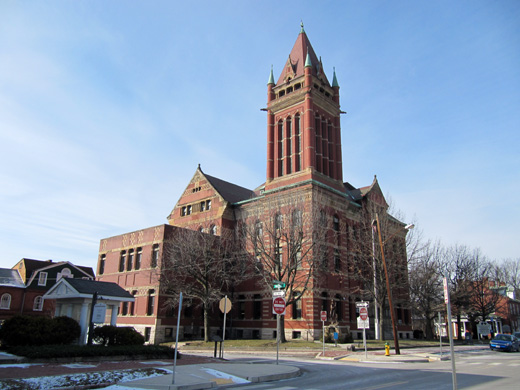
That’s the Allegany County Courthouse, designed in 1893 by local boy Wright Butler in “Richardsonian Romanesque”—the eclectic style popularized by Henry Hobson Richardson. (Butler’s design appears to owe more than a little to Richardson’s Allegheny County Courthouse in Pennsylvania.)

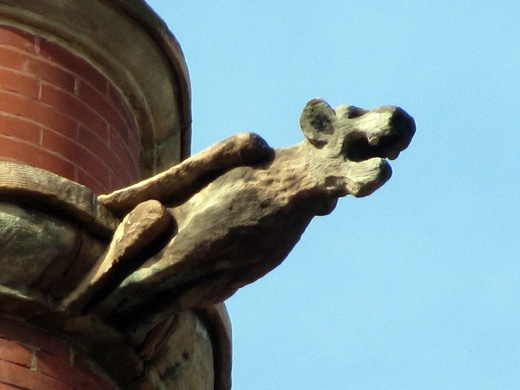
On a freezing Saturday morning, downtown Cumberland is abandoned. Markers and monuments festoon the courthouse grounds—including a statue of George Washington and a tribute to the Ten Commandments—but look up for a good view of the stony creatures large enough to catch the eyes of speeding drivers on nearby I-68.

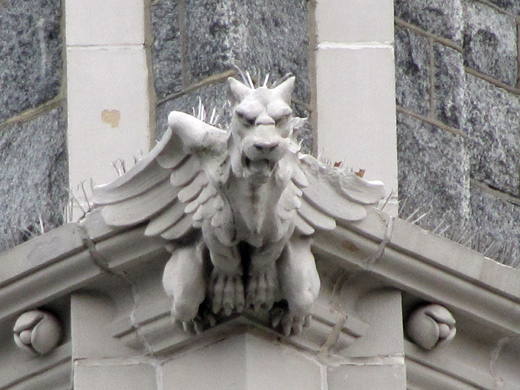
Four porcine fang-bats haunt the corners of the courthouse tower. Were they this roughly hewn when they were raised into place, or have the mountain winds coarsened them in the past hundred years?

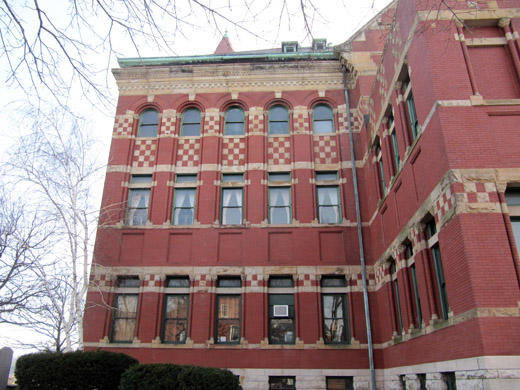
Like other architects of his era, Wright Butler had fun with his facade. He surrounded the main entrance with all sorts of carven vegetation, and it’s not unreasonable to look at his slim and pleasingly complex window bays and see hints of a cathedral, where modern-day windows might once have held saints.

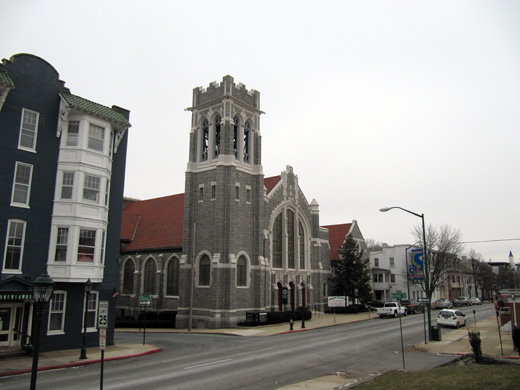
Racing snow-clouds back to D.C., we pass through Hagerstown, stopping to gawk at Trinity Evangelical Lutheran Church, built in 1909.

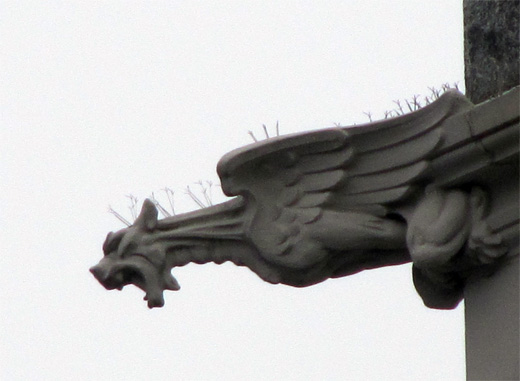
The church’s huge bell tower is home to four magnificent beasties. Photographed head-on, they look as if they just flew in from a Japanese movie…

…but they’re best seen in profile, howling across generations, thwarted, bristling, forever out of time.

“River, I’ve never seen the sea…”

“The evening passed delightfully: we sat out in the moonlight on the piazza, and strolled along the banks of the Patapsco; after which I went to bed, had a sweet night’s sleep, and dreamt I was in Mahomet’s Paradise.”

Washington Irving romanticized his life. In an 1854 letter to his niece, he even found whimsy on the Patapsco River in Maryland, where he stayed at the home of John Pendleton Kennedy: Whig politician, Secretary of the Navy, Maryland Congressman, and a man immersed in the pop-medieval daydreams of his age.

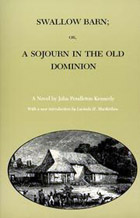
No one reads Kennedy’s 1832 book Swallow Barn anymore, and the author’s own description of it isn’t likely to bring readers back: “There is a rivulet of story wandering through a broad meadow of episode. Or, I might truly say, it is a book of episodes, with an occasional digression into the plot.” Kennedy loved Irving’s Bracebridge Hall, in which an American visitor describes an English manor through a series of character sketches and anecdotes, and he mimics it in Swallow Barn: a northerner visits his cousin’s plantation on the James River in Virginia and describes the place in anecdotal fits and starts. (Swallow Barn so closely resembles Irving’s style that when it was published under the name “Mark Littleton,” the public assumed Irving has simply adopted a coy new nom de plume.)

Medievalism is rampant in Swallow Barn. In his prologue, Kennedy cites the Morte d’Arthur. He likens a miller to a Robin Hood character, an old slave to an ancient crusading knight, and a group of pedantic Virginia lawyers to an Anglo-Saxon “wittanagemote.”

As it turns out, the early 19th-century Virginians of Swallow Barn are as obsessed with the Middle Ages as the narrator is. Here’s Prudence Meriwether, the plantation owner’s sister:

There is a dash of the picturesque in the character of this lady. Towards sunset she is apt to stray forth amongst the old oaks, and to gather small bouquets of wild flowers in the pursuit of which she contrives to get into very pretty attitudes; or she falls into raptures at the shifting tints of the clouds on the western sky, and produces quite a striking pictorial effect by the skillful choice of a position which shows her figure in strong relief against the evening light. And then in her boudoir may be found exquisite sketches from her pencil, of forms of love and beauty, belted and buckled knights, old castles and pensive ladies, Madonnas and cloistered nuns,—the offspring of an artistic imagination heated with romance and devotion.

Next we meet Ned Hazard, a 33-year-old Princeton dropout who stands to inherit Swallow Barn:

A few years ago he was seized with a romantic fever which manifested itself chiefly in a conceit to visit South America, and play knight-errant in the quarrel of the Patriots. It was the most sudden and unaccountable thing in the world; for no one could trace the infection to any probable cause;—still, it grew upon Ned’s fancy, and appeared in so many brilliant phrases, that there was no getting it out of his brain . . . However, he came home the most disquixotted cavalier that ever hung up his shield at the end of a scurvy crusade…

“His mind,” Kennedy insists, “is still a fairy land, inhabited by pleasant and conceited images, winged charmers, laughing phantoms, and mellow spectres of frolic.”

The object of Ned Hazard’s chivalrous amour is Bel Tracy, who’s so obsessed with Sir Walter Scott that she uses his novels to try to teach herself hawking:

In her pursuit of this object she had picked up some gleanings of the ancient lore that belonged to the art; and, fantastic as it may seem, began to think that her unskillful efforts would be attended with success . . . A silver ring, or varvel, was fitted to one leg, and on it was engraved the name of her favorite, copied from some old tale, ‘Fairbourne,’ with the legend attached, ‘I live in my lady’s grace.’ I know not what other foppery was expended upon her minion; but I will warrant he went forth in as conceited array as his ‘lady’s grace’ could devise for him. A lady’s favorite is not apt to want gauds and jewels.

By the time Swallow Barn winds down and “Mark Littleton” heads north, Ned Hazard survives a chivalric duel (a fistfight); slaves decked out to resemble “troubadours and minnesingers” tell ghost stories about nearby Goblin Swamp; and the narrator likens himself to Gregory of Tours and William of Malmesbury and quotes Chaucer’s “Knight’s Tale.”

In an introduction to the most recent reprinting of Swallow Barn, Lucinda H. MacKethan writes that Kennedy “manages merrily both to revere and to ridicule almost all of the Old South’s icons,” adding that reviewers disagreed on whether the book was a faithful depiction of Southern plantation life or blatant satire. I think it’s both: Swallow Barn shows a South in which overprivileged plantation-dwellers are so immersed in chivalric tales that they come to inhabit a shared medieval delusion.

When Washington Irving visited John Pendelton Kennedy in Maryland in 1854, life had been good to both authors, but especially to Kennedy. He had married Elizabeth Gray, daughter of textile baron Edward Gray, and moved into the Gray mansion. Gray liked to see himself as a feudal lord as he surveyed his factories on the Patapsco, a fancy Irving apparently shared.

In an 1854 letter to Elizabeth Gray Kennedy after returning home to Tarrytown, Irving let his inner medievalist romp:

 I envy Kennedy the job of building that tower, if he has half the relish that I have for castle building—air castles, or any other. I should like nothing better than to have plenty of money to squander on stone and mortar, and to build chateaux along the beautiful Patapsco with the noble stone which abounds there; but I would first blow up all the cotton mills (your father’s among the number), and make picturesque ruins of them; and I would utterly destroy the railroad; and all of the cotton lords should live in baronial castles on the cliffs, and the cotton spinners should be virtuous peasantry of both sexes, in silk skirts and small clothes and straw hats, with long ribbands, and should do nothing but sing songs and choruses, and dance on the margin of the river.

Only Washington Irving could look past textile mills and see a medieval peasant fantasy—but as Paul J. Travers points out in The Patapsco: Baltimore’s River of History, “Irving’s words were prophetic”: A great flood in 1868 washed away part of the Gray mansion, Kennedy’s personal library was ruined, and the family was forced to move. (Elizabeth Kennedy kept the factory going for 20 more years—until another devastating flood.)

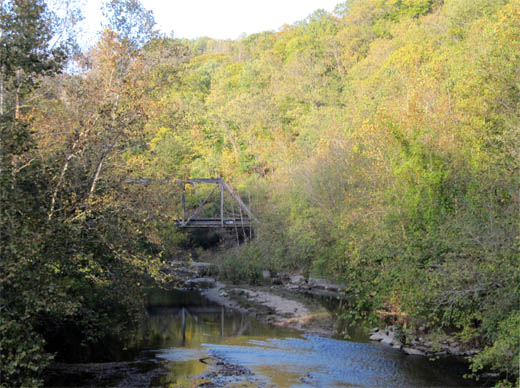
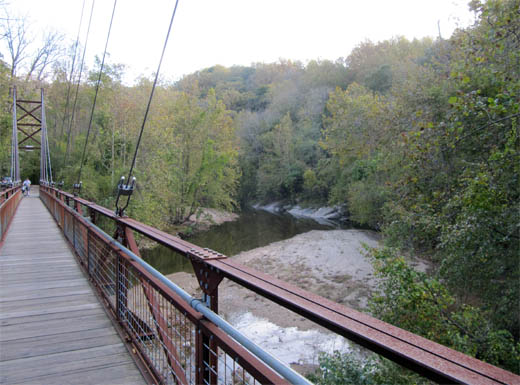
Today, if you hack through the weeds between down Ellicott City and Patapsco State Park, you can walk in the footsteps of a wide-eyed Washington Irving…

…and spot the “picturesque ruins” Irving joked that he wanted to see. They’re now monuments to a forgotten writer and a half-remembered natural disaster.

Nearby, you’ll find more recent wrecks that put Irving’s romanticism in perspective.

Shops on Main Street in Ellicott City now sell plastic swords, pirate gear, and Viking hats alongside antique shops that burnish the relics of Irving and Kennedy’s age. On the outskirts of town, Marylanders hike and bike; some latter-day rustics fish along the river’s edge. Whether you see timeless fantasies here, as Irving did, depends on your affinity with Swallow Barn’s Bel Tracy, who found “something pleasant in the idea of moated castles, and gay knights, and border feuds, and roundelays under one’s window, and lighted halls.”

Mark Twain saw something else in Southern medievalism: a sort of mass insanity, a “maudlin Middle-Age romanticism” that’s still more tenacious in America than he ever foresaw. Even now, many Americans would answer Twain in the same tone Bel Tracy uses to scold her cousin: “Pshaw!…You haven’t one spark of genuine romance in your whole composition.” When a 19th-century New Yorker can find Virginia medievalism on the banks of a Maryland river, I’m not sure both notions aren’t right.

“I had riches too great to count, could boast of a high ancestral name…”

On a sunny September day in 1838, Frederick Douglass escaped slavery in Maryland to become a free man (and one of the most fascinating and indefatigable Americans of his time), so yesterday seemed like as good a day as any to visit Cedar Hill, the Frederick Douglass National Historic Site—and to seek medievalism in this most unlikely place.
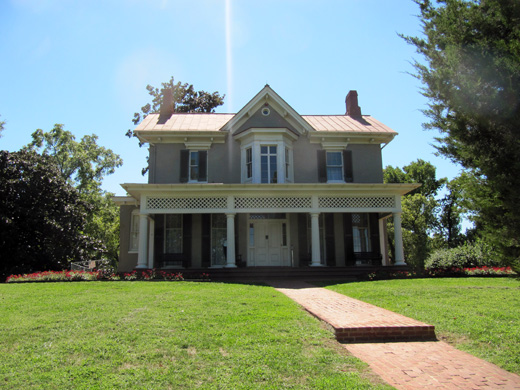
High atop a terraced hill in the Anacostia neighborhood of Southeast D.C., the house was Douglass’s home from 1877 until his death in 1895. The front—parlor, office, dining room—is furnished almost exactly as it was when Douglass was alive, and Cedar Hill is still an impressive home with a panoramic view of downtown Washington.

Many of the decorations in Cedar Hill are neoclassical doodads, but there’s a medievalist gleam or two in Douglass’s life, as long as you know where to look.
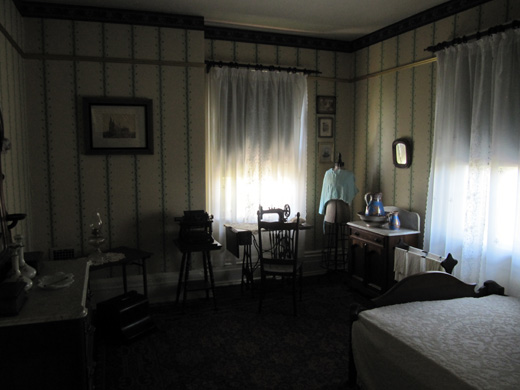
That’s the bedroom of Helen Pitts, Douglass’s longtime secretary and second wife. Their interracial marriage shocked her white abolitionist family and Douglass’s black children, but since I’m me and it’s 2012, I was more surprised by what I saw on the back wall: an engraving of Cologne Cathedral.
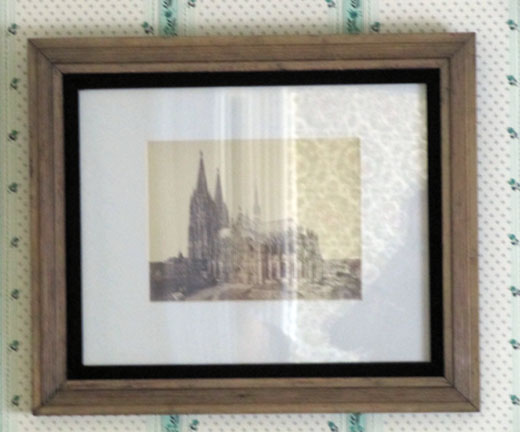
Although Douglass traveled in Europe, he doesn’t appear to have visited Germany, so the engraving was likely a gift from German writer and abolitionist Ottilie Assing. She taught Douglass German, spent 22 summers in his home, and apparently had a long affair with him. The presence of this print in the bedroom of the woman who won out over Assing for Douglass’s final affections is either a curatorial snafu or a memento of profound awkwardness.

More interesting is Frederick Douglass’s medievalist name.

Born a slave in Talbot County, Maryland, around 1818, young Fred was saddled with a moniker that suggested a grand, impossible destiny. “The name given me by my beloved mother,” he wrote, “was no less pretentious than “Frederick Augustus Washington Bailey.'” In 1838, after being moved back and forth between the Eastern Shore of Maryland and downtown Baltimore, he made one heck of an escape: He disguised himself as a sailor, boarded a train, and journeyed from Wilmington, to Philadelphia, to New York City, and finally to New Bedford, Massachusetts.

In New Bedford, “initiated into the new life of freedom,” Frederick Bailey needed a safer surname. He found himself in the home of Nathan and Mary Johnson, a prosperous black couple who harbored escaped slaves. As he explained in 1855, taking their name was out of the question:

“Johnson” had been assumed by nearly every slave who had arrived in New Bedford from Maryland, and this, much to the annoyance of the original “Johnsons” (of whom there were many) in that place.

Down with the pop-culture trends of the day, Nathan Johnson suggested the name “Douglass”:

Mine host, unwilling to have another of his own name added to the community in this unauthorized way, after I spent a night and a day at his house, gave me my present name. He had been reading the “Lady of the Lake,” and was pleased to regard me as a suitable person to wear this, one of Scotland’s many famous names. Considering the noble hospitality and manly character of Nathan Johnson, I have felt that he, better than I, illustrated the virtues of the great Scottish chief. Sure I am, that had any slave-catcher entered his domicile, with a view to molest any one of his household, he would have shown himself like him of the “stalwart hand.”

Once absurdly popular and always unbearably long (and, despite its title, not Arthurian), The Lady of the Lake is an 1810 poem by Sir Walter Scott that tells the story of a rift between King James V of Scotland and James Douglas, his former mentor and protector, as tension mounts between the king and the Highland clans, roused to rebellion by Roderick Dhu.

I’ve never been able to get through the whole miserable poem, but the fact that Frederick Douglass is named after a fictionalized late-medieval earl is truly wonderful. It’s a testament to 19th-century America’s obsession with Scott’s chivalric adventures—and it’s a bit ironic.

Southern slaveowners hung on Sir Walter Scott’s every word, and they saw themselves as his chivalric heirs. Here’s Vernon Parrington in Main Currents in American Thought, Volume II:

The Lay of the Last Minstrel and The Lady of the Lake stirred Southern men to think of themselves as proud knights ready to do or die for some romantic ideal; and the long list of novels . . . seemed to reflect anew the old ideals of fine lords and fair ladies whom Southerners now set themselves to imitate.

“While the rest of America read Scott with enthusiasm,” writes Rollin Osterweis in Romanticism and Nationalism in the Old South, “the South assimilated his works into its very being.” Osterweis points out that plantation bookshelves were packed with Scott’s works; Southerners loved his terms “Southron” and “aristocratical” and ran with them; plantations took their names from his Waverley novels; and steamboats, barges, and stagecoaches in the back country of Louisiana, Tennessee, and beyond often bore names from his books.

In Life on the Mississippi, Mark Twain even blames Scott for the American Civil War:

The South has not yet recovered from the debilitating influence of his books. Admiration of his fantastic heroes and their grotesque “chivalry” doings and romantic juvenilities still survives here, in an atmosphere in which is already perceptible the wholesome and practical nineteenth-century smell of cotton-factories and locomotives; and traces of its inflated language and other windy humbuggeries survive along with it.

It’s amusing to imagine the few Southerners who may have read Douglass’s autobiography sputtering over such blasphemous misuse of their dear Walter Scott.

Delightfully, the black American named for a medieval earl really did rally the Scots. In 1845, Douglass fled to Great Britain to avoid recapture and stayed until 1847. His speeches in Scotland echoed the concerns of British abolitionists that the Free Church of Scotland was funded by slave-holders and slave-traders. In My Bondage and My Freedom, Douglass casts himself as the voice of the man on the Edinburgh street:

“SEND BACK THE MONEY!” stared at us from every street corner; “SEND BACK THE MONEY!” in large capitals, adorned the broad flags of the pavement; “SEND BACK THE MONEY!” was the chorus of the popular street songs; “SEND BACK THE MONEY!” was the heading of leading editorials in the daily newspapers.

The modern Douglass did not prevail:

The deed was done, however; the pillars of the church—the proud, Free Church of Scotland—were committed and the humility of repentance was absent. The Free Church held on to the blood-stained money, and continued to justify itself in its position—and of course to apologize for slavery—and does so till this day. She lost a glorious opportunity for giving her voice, her vote, and her example to the cause of humanity; and to-day she is staggering under the curse of the enslaved, whose blood is in her skirts. The people of Scotland are, to this day, deeply grieved at the course pursued by the Free Church, and would hail, as a relief from a deep and blighting shame, the “sending back the money” to the slaveholders from whom it was gathered.

In his 1899 bio of Douglass, Charles Chesnutt notes that “[i]n Scotland they called him the ‘black Douglass,’ after his prototype in The Lady of the Lake, because of his fìre and vigor.” Chesnutt knew when to strum that mythic chord:

[H]e fell in with the suggestion of his host, who had been reading Scott’s Lady of the Lake, and traced an analogy between the runaway slave and the fugitive chieftain, that the new freeman should call himself Douglass, after the noble Scot of that name. The choice proved not inappropriate, for this modern Douglass fought as valiantly in his own cause and with his own weapons as ever any Douglass fought with flashing steel in border foray.

Although Frederick Douglass was a passionate man, I was sure he was immune to the charms of the phony, romanticized Middle Ages that gave him his name. Nope! According to the National Park Service (PDF here), Douglass owned 18 volumes of Sir Walter Scott.

In his writings and speeches, Douglass had more to say about Dred Scott than Walter Scott, so I’m hesitant to dub him a medievalist, but it says something about America’s weird medievalist undercurrents that they were too strong to escape his notice. They didn’t ebb: In an 1895 eulogy, one poet was quick to cast Douglass in medieval terms. “A hush is over all the teeming lists,” sang Paul Laurence Dunbar, making him the knight the man who named him hoped he’d be: “He died in action with his armor on.”
“And the motorway’s stretching right out to us all…”

So you’re cruising through suburban Maryland on a rainy Sunday afternoon. Daylight is fading, just as a semester spent focused on fantasy and science fiction is drawing to a close, and you idly wonder what you can do to steer your blog back to its original focus on medieval literature and unexpected manifestations of medievalism in everyday life. You round a bend, intent on little more than reaching the Korean supermarket before it closes, and—
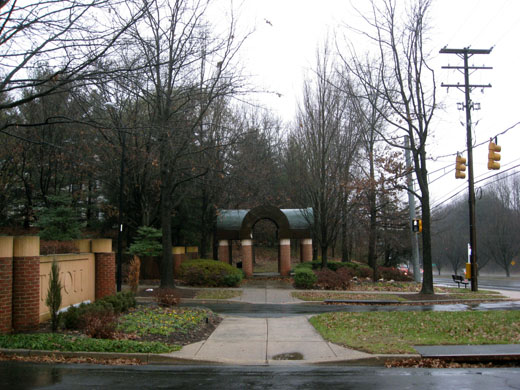
Behind those trees…can that really be a textbook example of Romanesque vaulting?

And can it really be standing on the corner of Medieval Avenue and Renaissance Lane?

Okay, that last detail is wishful thinking. But check out this intriguingly unnecessary structure at the entrance to an otherwise unremarkable townhouse development on Randolph Road.

What’s that, you say? A mere arch? Well, look closer.

Yep, two barrel vaults intersecting, like in the textbook drawing—and just like in many Roman buildings and countless medieval and Renaissance churches (thus achieving the effect which Vasari famously dubbed “criss-cross applesauce”). The major difference here is that the architectural features, including those blank capitals, have been recast in the idiom of a circa-1988 shopping mall.

But lift your eyes above the lintel…

…and you’ll see how the intersecting vaults divide the interior into four bays to create…

…a good, old-fashioned groined vault. (You in the back, stop giggling.)

I don’t know why an architect decided to evoke the history of his profession here, with this whimper of traditional whimsy, in front of a subdivision that bears no other mark of architectural distinction.

However, this Romanesque doodad does serve a practical purpose. When it’s raining, you can seek shelter…

…and wait in grand style for the bus.

UPDATE:

Dave at Studenda Mira points out that this bus stop also suggests a tetrapylon, a four-way triumphal arch placed at street junctions in the Roman Empire. Here’s a well-preserved example from Antioch, and here’s another in Jordan.

“Trumpets, towers, tenements, wide oceans full of tears…”

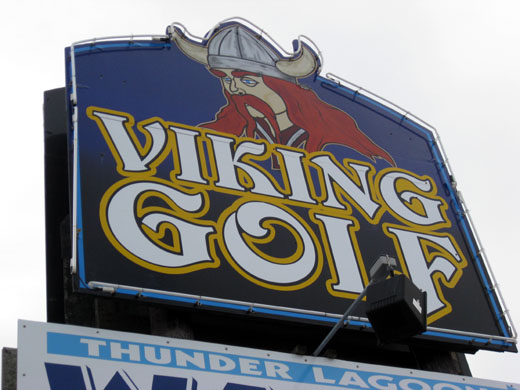
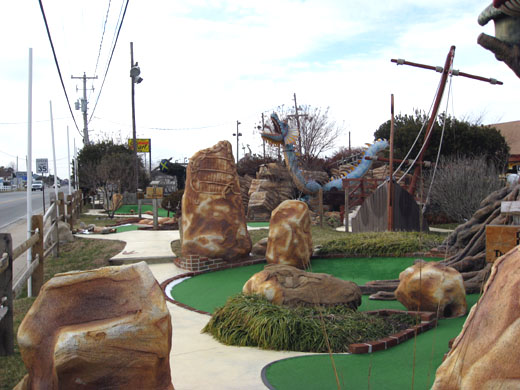
And so the exhausted medievalist flees to Ocean City, Maryland, intent on finding time to become reacquainted with The Hobbit for next Wednesday’s class. (He first read the book here—bought it on the boardwalk—more than 25 years ago.) But after golfing among Vikings and honoring the deathless gods of the dragon temple, what seaside novelty can entertain the Tolkien-minded teacher?

Weary, he rests at the edge of the wintry surf.

What’s that? You say you’ve found something lightly amusing and relevant to my lesson plan? Lead on, O friend of friends!

I say, what rises beyond this eldritch wood? Such a wonder can hardly be the work of man.

Zoom in, O magical steed!

Aye, nothing says “magic elf sanctuary” like storks. But surely, O lavender-maned tour guide, the name of this place is mere coincidence?

I see. So why, O hooféd Vergil ‘mongst the bayside shades, would a hobbit need a parking space?

It’s like a driveway to the Shire! Those round-top doors make me want to go there, and back again!

But wait—what’s that funny smell around back?

Run, fat hobbitses! It’s a cookbook! It’s a cookbook!

“If I listen close, I can hear them singers: oh, oh, oh…”

The first day of my winter jaunt revealed a forgotten outpost of Viking activity in Ocean City, Maryland—or, as I’m now calling it, New South Vinland.

When the sun rose on day two, I beheld an even more astonishing sight: Muslims and Christians uniting against a common foe.

On the east side of North Baltimore Avenue is this oasis for weary mujaheddin:

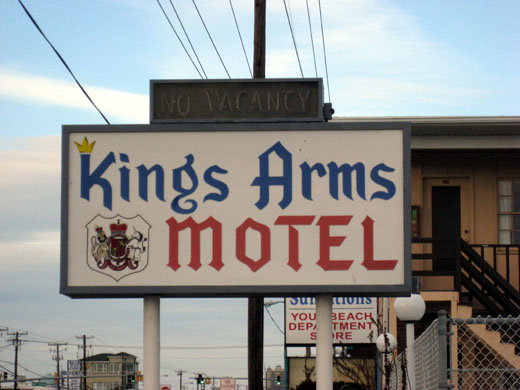
On the west side is a hospice for homesick Crusaders:

These people aren’t fooling around. Their sign bears the coat of arms of the United Kingdom and there’s a crown on the K.

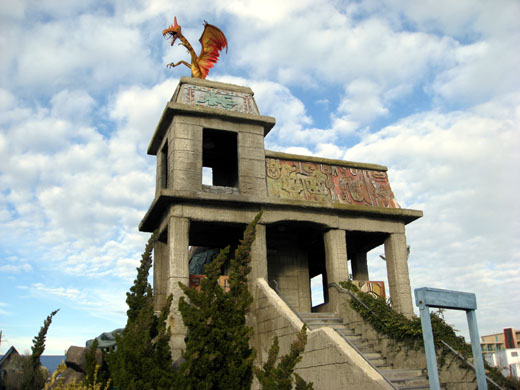
Wait—what’s that structure rising from a nearby parking lot?

A shop that sells string and sealing wax, and other fancy stuff?

No. Sweet Lord, no!

It’s a evil dragon temple!

Why would the high priests of miniature golf build such an unholy structure (apparently from pre-Columbian spolia) and summon these minions of chaos?

“M R dragons.”
“M R not.”
“O S A R. C M wangs?”

Look: this dragon is so dangerous, the other dragons keep him in a cage.

This dragon lives in fear of the day the other dragons discover he’s really just a snake.

“Uh, guys? I’m actually a beloved symbol of prosperity and good fortune. Guys?”

This dragon is the kind of cringingly un-selfaware monster who declares he’s eager to “have you for dinner,” after which that orange suck-up behind him cackles as if he said something hilarious.

Don’t you agree, Curiously Incongruent Easter Island Head?

Storm-clouds gather. Darkness falls. The last dim battle between dragon and man beginneth here, and the mists of death shall sweep over land and sea.

And then everyone will adjourn to eat non-pareils at the nearest Candy Kitchen…but that’s a much less dramatic story.

“Gunter, glieben, glauten, globen…”

Ocean City, Maryland—desolate in January, and surely a place of respite from medievalism in all its myriad forms.

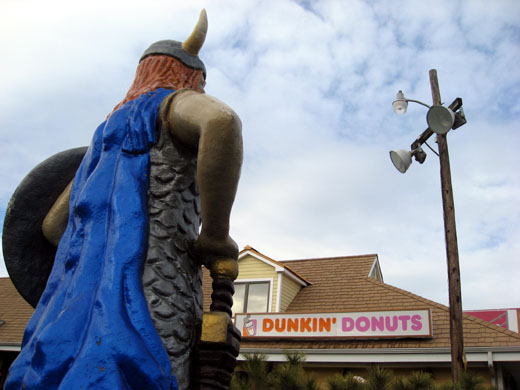
No way! A hammer-wielding madman! Whither doth he beckon?

Great Odin’s opthamologist!

It’s as if I’ve wandered into sixth-century Norway.

Unlike this coward, I am undeterred, for I behold…

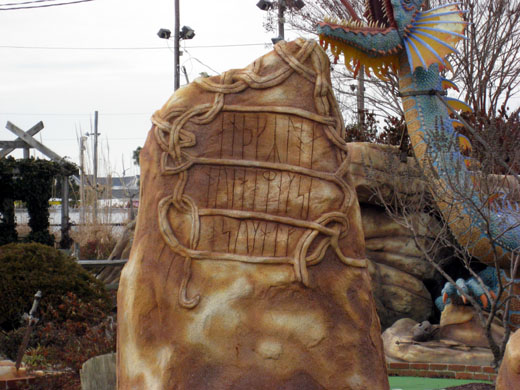
…a runestone! A long-neglected remnant of our distant Viking past!

(Plus the papier-mache skull of a Tyrannosaurus Rex.)

My rune-lore is feeble, but I believe this stone is trying to speak to me. Its approximate message appears to be “anthskloanuijaggnksinsukjtf.”

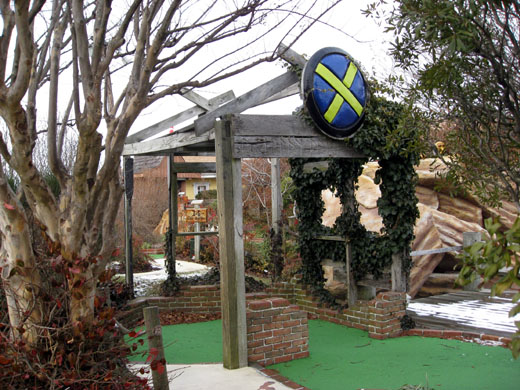
Meanwhile, the runic message carved into the beam on this this miraculously preserved Viking outhouse warns me, “riflthzwarir.”

Great enchantments surely haunt this place.

No matter. I’ll leave trite riddles to less ambitious colleagues. They’ll all go berserk when I publish this photo, which reveals the real reason Erik the Red journeyed westward.

Endowed professorship at Oxford, here I come!