“Relations sparing no expense’ll, send some useless old utensil…”

Christmas approacheth, and the e-mails keep coming, as relentless as pistachio vendors in eighth-century Aleppo: Jeff, what should I get for the medievalist in my life?

Come on, people; shopping for medievalists is easy. Here are some suggestions for unusual presents that are bound to be more gratefully received than those Medieval Times gift certificates everyone got stuck with last year.

You can’t get the Lego Medieval Market Village (which includes, yes, a turkey) in time for Christmas, but it’s not too late to order the very strange 2008 Lego Castle Advent Calendar.

If your medievalist adores Byzantine church history, Got Medieval sells an awesome assortment of household doodads with primates on them.

Do your loved ones live where Beowulf and business markets intersect? Then hit them with gift subscriptions to The Wiglaf Journal, which “comes to the aid of today’s executives in vanquishing their challenges.”

If you own a business in the U.K., perplex your cringing minions with medieval team-building exercises, or smite them with your inflatable morningstar.

Let’s pretend this also doesn’t sound dirty: Set your mouth on fire with Dante’s Inferno Balls.

Medieval Icelanders deployed the term “downward-facing dog” with unseemly specificity. Nonetheless, a lesson in runic yoga will de-stress your workaholic Viking.

Let fly the yams! Defend your Christmas dinner with a tabletop trebuchet, and then lay siege to the sweet, spongy fortress you baked in your castle-shaped bundt pan.

If your kid’s reenactments of the Fourth Lateran Council with R2-D2 and Spider-Man on a dune buggy don’t feel sufficiently reverent, then you’re in luck: get thyself a Pope Innocent III action figure.

Grendel’s mom sez: “Preserve your child’s teeth and hair in a pewter castle-shaped reliquary—but catch the shrieks in a cup of gold.”

From the “Nightmares of Jennifer Lynn Jordan” Collection comes this enchanting clash of the titans: the Unicorn vs. Narwhal Playset. (My money’s on the narwhal. Nothing escapes its vengeful horn.)

Like mistletoe, chipmunks, and cranberry-lamprey casserole, Charlemagne is an essential part of any old-fashioned Christmas. So buy Matt Gabriele’s new book, The Legend of Charlemagne in the Middle Ages, or the new paperback edition of Charlemagne’s Mustache. If cerebral tabletop games are your thing, try the highly abstract Carolus Magnus. If you reek, de-stinkify thyself with Charlemagne Shower Gel.

Incubus wearing you out at night? Secure your bedchamber with a dragon-themed lock and key.

Place a tiara on the brow of the lady in your life. (Or the man. I’m not here to judge.)

Men and women of academia, I ask ye: of what use be tenure if it alloweth ye not to herald your arrival in the classroom?

This year, shop secure in the knowledge that the best medieval-themed gifts can avert the most awful of Christmas disasters. I can hear it now: “The heavenly aroma still hung in the house. But it was gone, all gone! No lamprey! No lamprey sandwiches! No lamprey salad! No lamprey gravy! Lamprey hash! Lamprey à la king! Or gallons of lamprey soup! Gone, all gone!”

(And yes, if you do want to feast like a late medieval big-shot, there’s always tinned sea lamprey from Russia. You would even say it glows…)

“You stand in the shadows, or reach for the sky.”

If you spent any time in an airport this past weekend, you were probably frustrated by crowds, queues, and bureaucracy—but at least your aircraft was able to turn and land. Abbas Qasim ibn Firnas would have envied you. As an article in the latest Saudi Aramco World magazine points out, Ibn Firnas was a music teacher in ninth-century Cordoba whose technological and cultural accomplishments earned him an honored place in the annals of failed medieval attempts to fly:

About 875, Ibn Firnas, who was by then 65 years old, built a flying apparatus by placing feathers on a wooden frame that he could attach to his shoulders and outstretched arms. His is the first documented record of a primitive glider.

Thanks to the 17th-century Moroccan scholar al-Maqqari, two accounts of Ibn Firnas’s flight survive. One states, “Having constructed the final version of his glider, to celebrate its success, he invited the people of Córdoba to come and witness his flight. People watched from a nearby mountain as he flew some distance, but then the glider plummeted to the ground, causing him to injure his back.”

The second account says that he jumped from a wall, flapped up higher than his starting point, turned, and then landed hard back on the wall, claiming afterward that he had not noticed how birds use their tails to land, and that he had omitted to put a tail on his flying apparatus.

Given that he did not attempt to fly again, the first and less successful version of his flight appears most plausible, especially as his death at age 78 appears to have resulted from an ongoing struggle with a back injury.

The article mentions other medieval dreamers who failed to slip the surly bonds of Earth, but Ibn Firnas is arguably the most important symbol of the dream of flight in the Islamic world:

Today, although the name of Ibn Firnas is hardly known in the West, he remains a popular historical figure in the Arab world. In Qatar, the Doha International Airport’s computerized systems management program is named “Firnas.” In Baghdad, a statue of Ibn Firnas stands on the road to the Baghdad International Airport, and a smaller airport in northern Baghdad is named after him. The legacy he would perhaps appreciate most, however, is that his name has been given to a crater on the far side of the moon—the farthest humans have yet explored.

Of course, we Westerners know that the first medieval person to fly was Miles O’Keeffe, who built one heck of a hang glider—but the less said about that, the better…

“Then I went off to fight some battle…”

On Saturday, I’ll be sitting on a panel at “Going Freelance,” a workshop sponsored by AIW and the Johns Hopkins writing program. Tilt your head and you can see the medievalist traces in this event if, like me, you were told in grade school that “freelance” was a term to describe medieval soldiers of fortune. Of course, medieval mercenaries did exist, but “freelance” isn’t a medieval word at all. The term was coined by Sir Walter Scott, the 19th-century author who almost singlehandedly inspired quasi-medieval fandom in the English-speaking world.

From The Knight and the Umbrella, here’s Ian Anstruther explaining how Scott lit the fire under the Victorians who romanticized and reinvented the Middle Ages:

It is hardly possible to realize today the immense influence of this author on contemporary drama, literature and art. His early poems like the Lay of the Last Minstrel and Marmion, which were first published in 1805 and 1808 respectively, and his great series of tales in prose which began with Waverley in 1814 and reached its peak, according to many critics, with Ivanhoe in 1819 . . . truly hypnotised all who read them.

The proof of this may be seen at a glance in the catalogues of the major exhibitions throughout the country. In the twenty-five years between the first appearance of the Waverley Novels in 1814 and the Eglinton Tournament in 1839, two hundred and sixty-six different pictures inspired by the pen of the “Wizard of the North” appeared in public galleries; every summer without a break, a scene from Ivanhoe was the subject of two of them.

According to the Oxford English Dictionary, the first use of some version of “freelance” appears in 1820, in chapter 34 of Ivanhoe: “I offered Richard the service of my Free Lances.” The OED cites subsequent uses of “free-lance” or “freelance” as a negative term to describe politicians and journalists with minds of their own. By the early 20th century, “freelance” was a verb; soon, it came to refer to the self-employed.

If, in the spirit of medievalism (or at least dorkiness), freelance writers wanted to liken themselves to an authentic figure who represents the reality of late-medieval English contract law, they might see a kindred spirit in the Franklin from Chaucer’s Canterbury Tales. In the late 14th century, franklins were a newly prominent class of independent landholder. Not bound by hereditary feudal obligations, a franklin could sell his produce to the highest bidder while negotiating or even canceling deals. Like any successful freelancer, a franklin was blessedly exempt from the 14th-century equivalent of corporate team-building exercises, i.e., clearing woodlands, draining swamps, or taking an arrow in the sternum for a leek-breathed feudal lord.

But can you imagine telling your friends you’re a franklin? Can you imagine writing “franklin” under “occupation” on your tax return? It’s a legacy of the romanticized Middle Ages bequeathed to us by Sir Walter Scott and other writers, artists, and poets that we overlook the agricultural drudgery that defined most medieval lives, so that even we who sit and type all day can dream of jousts and banners bright, and tell ourselves we’re charging into battle.

“A built-in remedy for Kruschev and Kennedy…”

Growing up in Central Jersey, I never thought to pause and ponder quasi-medieval statuary, mostly because we didn’t have any—or so I thought until this weekend, when I drove through Bound Brook and decided, on a whim, to check out a monument that’s landed in my peripheral vision on and off for more than 20 years.
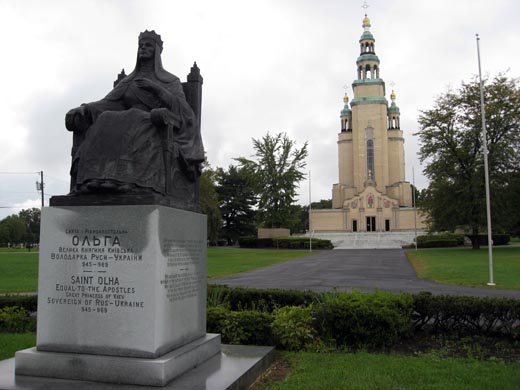
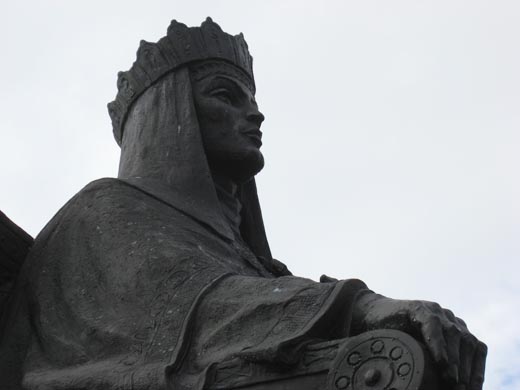
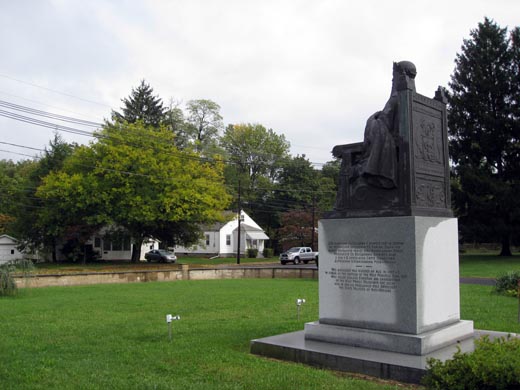
That’s St. Olga, seated in majesty. Behind her is a memorial church for the victims of Stalin’s famines; behind that is a lovely, tree-lined cemetery; and the entire area is part of the larger headquarters of the Ukrainian Orthodox Church of the USA, otherwise known as the Ecumenical Patriarchate of Constantinople.

So who was St. Olga? Before her death in A.D. 969, Olga was the first ruler of the Rus to convert to Orthodox Christianity. Baptized in Constantinople, she ruled Kiev on behalf of her son and sent an embassy westward to Emperor Otto I. She was the grandmother of Prince Volodymyr—Vladimir—who proclaimed Orthodox Christianity the official religion of Rus-Ukraine. You know those emissaries who came back from Constantinople and famously said of Hagia Sofia, “We knew not whether we were in heaven or on earth”? Those were Vladimir’s men.

Olga was not a nice lady. True to her Viking roots, she avenged her husband by burying his killers alive in a ship. She also sent smoldering doves to alight on the thatched roofs of an enemy town, which then burned down.

In Bound Brook, sculptor Petro Kapschutschenko has made a remarkable monument to the Kievan Rus regent. Olga is elevated, as an enthroned Byzantine empress would have been, reminding visitors of her superiority and making it impossible for anyone to look her in the eye. Viewed straight on, Olga seems remote but amused, as if she just condemned the director of a TaTu video—but in profile, her face is a mixture of dignity and visible cruelty.

Next to the church is another striking Kapschutschenko sculpture of a 20th-century archbishop raising his hand heavenward. Also on the grounds are the home and resting place of the local Dutch Reformed dignitary who witnessed the signing of the Declaration of Independence and then returned home to read it aloud to the people of Bound Brook.

But there, reigning at the gates, is Olga. As she deigns to rest her royal gaze on the run-down repair shop across the street, she’s a reminder of the Vikings who lent their name to Russia—and one reason why Russia, a thousand years later, still glares possessively at the Ukraine.
“There’s safety in numbers, when you learn to divide.”

It’s been a wobbly week in the world of finance. AIG—bailed out! Lehman Brothers—bankrupt! Marty’s Shoes—out of business! But, as Charlemagne famously observed, “you roll your dice, you move your mice,” a reminder that the theories behind financial derivatives have a longer pedigree than we often give them credit for. In fact, scholars are currently debating how medieval people assessed, managed, and diversified risk.

First, check this out: in June 2007, the Electronic Journ@l for History of Probability and Statistics devoted an entire issue to “medieval probabilities.” Contributors to the issue explore the medieval roots of the theories and applications of the risk-management industries of later centuries, finding that

[t]he writings of some late XIIIth or XIVth Century Franciscan theologians provide the most interesting place for such discussions. In their view, the aleatory element of a commercial contract could be evaluated in its own terms, and possibly sold separately.

According to another article, which discusses late-medieval maritime insurance, the merchants who underwrote sea voyages didn’t have a statistical basis for evaluating risk, but they did base insurance premiums on such factors as the ship, its captain, the distance of the trip, the season, and the type of cargo. Interestingly, Giovanni Ceccarelli finds that the 16th-century underwriters of one French merchant ship were sensitive to ways that changes to contracts might damage the insurance market as a whole; he also finds that the use of coinsurance, exemption clauses, third-party reassurances, and temporary partnerships meant that “businessmen could rely on a wide range of multi-faceted instruments that allowed a flexible strategy of risk diversification.” Ceccarelli is the author of an entire book about how medieval people became increasingly sophisticated about games of chance until “‘risk’ ultimately became perceived as an ‘object’ that could be commercialized and quantified in economic terms.”

On a side note, there’s currently an active scholarly debate about how medieval people used land to mitigate risk. A 2001 article in Explorations in Economic History suggests that medieval peasants managed risk through land accumulation, and that scattered fields made land “a divisible savings instrument.” Others disagree, contending that landowners became downwardly mobile when they sold off small parcels or that some medieval farmers mitigated risk by joining farmers’ cooperatives.

Are you yawning yet? I hope not; even if, like me, you only dimly understand economic history, you should be able to appreciate these glimmers of medieval ingenuity, belying as they do the lingering modern smugness about the past in general and the Middle Ages in particular. As it turns out, the complicated financial derivatives that are making the market go all higgeldy-piggeldy in 2008 are based on the idea that abstractions like risk can be bought and sold—a concept medieval people, too, were sophisticated enough to understand.

“You will all go directly to your respective Valhallas…”

So one political convention ends, another begins, and I do what I always do during presidential election season: I reach for Njal’s Saga, the story of a 50-year feud that came to a head at medieval Iceland’s great annual judicial and legislative assembly, the Althing. Aside from being a terrific book in its own right, Njal’s Saga is a wise and welcome antidote to two weeks of partisan yakking.
Very little news is actually made at these conventions—so claim the pundits, who argue that the ins and outs of parliamentary wrangling once gave rise to great drama, whereas now we’re stuck with tightly scripted messages and largely mediocre speeches. But consider (he whispered, pushing a mighty army of straw men into place) the alternative. Here, from Njal’s Saga, is what happened at the Althing in A.D. 1011 when human nature grabbed civilized legal procedure by the windpipe and things went all higgeldy-piggeldy:

Thorhall Asgrimsoon said, “There is Skatpi Thoroddsson now, father.”

“So I see, kinsman,” replied Asgrim, and at once hurled a spear at Skapti. it struck him just below the thickest part of the calf and went right through both legs. Skapti was thrown to the ground and could not get up again. The bystanders could do nothing but drag him headlong into the booth of some sword-grinder.

Then Asgrim and his men attacked so violently that Flosi and his men fled south along the river to the Modruvellir booth. There was a man called Solvi standing beside a booth, cooking meat in a large cauldron; he had just taken the meat out, but the water was still boiling furiously. Solvi caught sight of the fleeting Eastfjords men who were almost on him by then.

Solvi said, “Are all these Eastfjords men cowards, fleeing along here? Even Thorkel Geitisson is running. What a lie to say of him, as so many have done, that he is bravery itself, for now he is fleeing faster than anyone else.”

Hallbjorn the Strong was nearby at that moment, and said, “You shall never be able to say that all of us are cowards.” With that he seized hold of Solvi, lifted him high in the air, and pitched him head-first into the cauldron.

Far be it from me to suggest that our political conventions might benefit from kin-based spear battles, but ratings would shoot through the roof. Já, vér kunnum! C-SPAN, are you listening?

“Что кинул он в краю родном?”

On Friday, the world awoke to war in the Caucasus, a region not known for cultivating the neighborly arts. While reporters scramble to explain recent history, medievalists can offer deep background. The medieval pasts of Russia and Georgia are rich and complex in their own right, but look at where they’re fighting: Ossetia. History buffs will emit a happy “aha” when they learn who the Ossetes are: the descendants of those early medieval zeligs, the Alans.

Originally from Iran, the Alans were a nomadic confederation of elite mounted warriors who lived between the Black and Aral Seas. When the central Asian steppes began disgorging people, many Alans rode west, a cloud of lassos and spears just a few hoof-beats ahead of the Huns.

Recruited by Rome, Alans fought for emperors and claimants to the throne; in the late 2nd century, Maximinus the Thracian, whose mother was an Alan, became the first emperor with full barbarian roots, and other Alans rose through the ranks. Alans crossed the frozen Rhine with the Vandals in 406, they helped them lay siege to Hippo, and a 5th-century Alan mini-dynasty briefly ran Constantinople. Bernard S. Bachrach, author of A History of the Alans in the West, thinks the feigned retreat may have been the Alan contribution to Western military tactics. He also entertains a curious but unprovable notion: that if aspects of the Arthurian legend passed to Britain through Armorica, where Alans were known to have settled, then the sword-in-the-stone motif may be a distant echo of the Alan depiction of their war god, “a naked sword thrust into the bare earth.”

The Alans left no record of their language and little trace of their culture. We know they existed because others wrote about them, but you can find their old homes if you know where to look: in France, in place-names such as Alençon, Alaincourt, Alland’huy, and Allamont; Alagno, Alan d’Riano, Allegno, and Alano di Piave in northern Italy. Of course, the Alans who came west are no more, having long since been assimilated by other European peoples—but the Alans who stayed in the Caucasus are back in the news, partly because they rummaged through their medieval past.

After the breakup of the Soviet Union, with North Ossetia as part of Russia and South Ossetia lumped in with Georgia, the Ossetians looked to historians, philologists, and archaeologists to tell them who they were. Was “Ossetia,” a Georgian term filtered through Russian, the name they should use? Shouldn’t they call themselves “Alans”? As Victor Shnirelman explains, speakers of the two Ossetian dialects, Digor and Iron, argued over whose speech was more pure; North Ossetia became North Ossetia-Alania; and the Alan name was slapped on everything from soccer teams to supermarkets. Never mind that “Alans” may have been a term used only by outsiders; or that the name “Ossetia” probably comes from *ās, which the Alans used to refer to themselves; or that the original Alans were famously inclined to assimilate and be assimilated. The Alanian nationalism of the 1990s soon took on moral and racial overtones, especially as neighboring enemies tried on the name for size. The Ossetes should have looked westward for precedent and warning: Once you buttress your national identity with medievalism, expect politicized folklore to beguile the public —and to take on a life of its own.

If you’ve paid attention to another conflict with medieval roots, then you saw this war coming. When Kosovo declared independence in February, the South Ossetia separatist leader insisted that his people had an even stronger case for autonomy, while Russia sent ominous signals that confirmed the earlier fears of EU foreign policy types. In the days to come, journalists will try to explain the matrix of grudges between Russia, Georgia, the two halves of Ossetia, and nearby Ingushetia and Chechnya. Chances are they’ll overlook this snippet from a 5th-century poem by Claudian about an Alan warlord

cui natura breves animis ingentibus artus
finxerat inmanique oculos infecerat ira;
vulneribus pars nulla vacat rescissaque contis
gloria foedati splendet iactantior oris.

whom nature had moulded with small limbs but great courage and dyed his eyes with a terrible anger. No part of his body was free of wounds and, torn by spears, the glory of his disfigured face shone more proudly.

Expect to see more anger, wounds, and disfigurement out of the Caucasus. And when you start to hear talk about glory and pride, don’t be surprised if it takes on a medieval tinge.

“He brewed a song of love and hatred…”

In his English translation of The Battle of Kosovo, John Matthias commends his co-translator, Vladeta Vučković, and offers this passage from Vučković’s modern poem about Serbian legend and history:

The Serbs quieted down, but they did not shut their mouths. Idled by the time on their hands they started to sing and sang themselves hoarse in endless poems accompanied by the mourning sounds of the sobbing gusle. The blind guslars gazed into the future, and those who could see covered themselves out of shame and became the leaders of the blind. But what kind of music is this, my poor soul, reduced to just one string!

I was inspired to hunt for this gloomy passage after the Guardian reported that prior to his capture on Monday, Radovan Karadžić liked to jam on the gusle in a Belgrade pub:

In retrospect, it is hardly surprising it was his favourite pub. The walls and bar of the Luda Kuca (the name means madhouse) are adorned with the Serb pantheon – Slobodan Milosevic, Vojislav Seselj, Ratko Mladic and of course, Radovan Karadzic – each one a nationalist hero. For the hardline clientele, the fact that they also shared the distinction of having been charged by The Hague war crimes tribunal only enhanced their status as warriors.

There were many stories being told yesterday about the man the locals knew as Doctor David, psychiatrist holistic health guru and mystic. But one winter’s night in particular was passing speedily into folklore.

That night, there was a jamming session on the gusle, the one-string fiddle played across the Balkans to accompany epic poetry. Dabic turned up to listen and was eventually persuaded to join in. Those present that night shook their heads yesterday in disbelief at the memory. There was Radovan Karadzic, their hero and icon, playing the gusle for them under his own portrait, and no one had a clue who he was. It was the stuff of legend.

Raso Vucinic, a young Serb nationalist who had been playing the gusle that night, was burnishing a tale he would one day tell his grandchildren.

Balkan epic poems are a gift to the world. Early in the 20th century, recorded performances of epics such as The Wedding of Smailagić Meho helped a generation of scholars better understand the compositional techniques behind Beowulf and other medieval works, and the surviving fragments of the Kosovo cycle are tinged with wistful eloquence. The stories they tell are exciting and sad—but these songs can’t be sung in a vacuum.

Five years ago, while visiting Serbian friends, I found myself in an ancient city on the Montenegrin coast. To escape the midday sun, we ducked into a run-down shop full of pirated software and used compact discs. On a high shelf, safe behind glass, was a special item: a cassette case adorned with a somber portrait of Slobodan Milošević. My host squinted at the title and explained, ruefully, that the cassette was a recording of epic poems lamenting the tragic downfall of Milošević, performed in the traditional manner and set to the screech of the gusle. It wasn’t on sale for its philological interest.

Karadžić, by contrast, composed his own tale. In 1992, for the benefit of documentarians, he played the gusle in the house of his 19th-century forefather Vuk Karadžić, a philologist whose work gave Serbian nationalists something to sing about. A poet himself, Radovan knew that moving incognito among his own people as a bearded mystic would be reminiscent of epic, a motif so cleverly adapted that even his own capture would make for a beguiling story.

Medievalists, take note: sometimes, this is how epic heroes are made, under conditions so ugly that lawyers start to wonder whether poetry can be a war crime. If nothing else, the long-overdue capture of Karadžić, dramatic though it is, refutes that old Joseph Campbell baloney: sometimes the hero has only two faces, and neither one is really worth a damn.

“Between our quests, we sequin vests…”

Over at Unlocked Wordhoard, Scott Nokes has written a long and thoughtful post about why he’s taken his interest in medieval literature beyond the confines of the campus.

For those of you who don’t know Scott, he teaches medieval literature at Troy University. His very accessible, medieval-themed blog attracts not only academics but also writers, reenactors, gamers, students, fantasy authors, and pretty much anyone else who’s intrigued by medieval subjects.

If you’re interested in the relationship between academia and the rest of society, you should check out what Scott has to say. His suggestions for broadening the academic culture, and his ideas for encouraging “fanboys” to explore the scholarly side of the humanities, apply to many other fields as well.

Scott is also, I should state for the record, extremely hospitable—not like Egil Skallagrimson at all.

“Medicine is magical, and magical is art…”

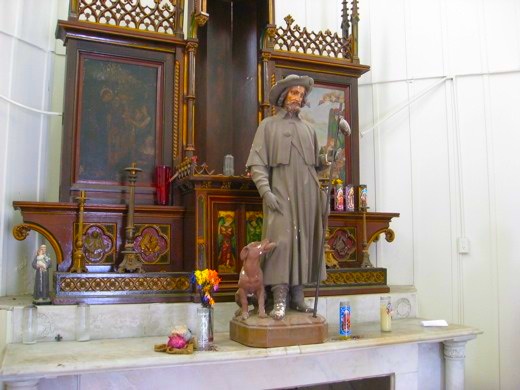
After he’s wandered the French Quarter for the thousandth time and snapped a sufficient number of crawfish in half, what does the errant medievalist do when he’s in New Orleans? Demonstrating a disregard for common sense which he urges his dear readers not to emulate, he seeks out a shrine to a medieval saint in the city’s Ninth Ward.

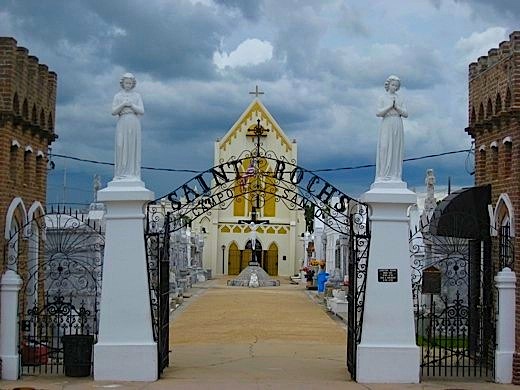
In the heart of a half-abandoned neighborhood, the small, above-ground cemetery occupies two compact blocks.

The saint’s shrine is pleasant but unremarkable—until you look at it from the side. Then it become an apse whose cathedral has flown away.

Inside the shrine stands the saint, with a friend. According to medieval legend, Roch miraculously cured the sick while making the pilgrimage to Rome. Eventually he also came down with the plague, but miracles—and food provided by a dog—kept him alive. The dog’s name is unknown, but “it has been reported that some people think the dog is at least as holy as Roch and offer prayers to the dog.”

In 1867, after his entire congregation survived a yellow fever outbreak, the New Orleans priest who prayed for the saint’s intercession raised this shrine in thanks—and, as an inscription over the front door reveals, “in fulfillment of vow.”

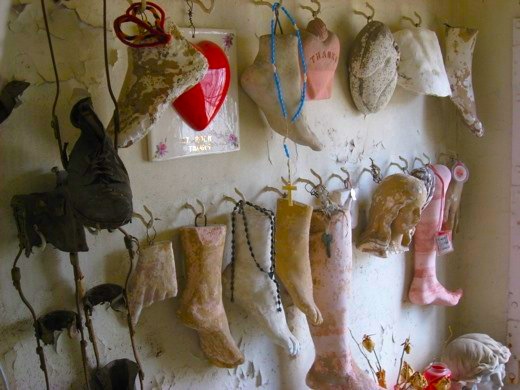
A barred alcove holds a collection of tokens offered by the grateful. Most of them represent body parts believed to have been cured through the saint’s intercession. Several pairs of old, awful crutches hang against the wall.

Outside, even as a storm rolls in, the cemetery is peaceful: empty, but hardly sad.

A hint of sadness waits across the street, where a monument to miraculous cures faces the troubles of the 21st century. Rarely have the Middle Ages seemed like the more hopeful place to be.