“And the fox is on the town-o…”

Do you ever feel like a crepuscular critter in a diurnal world? I do, because I am, but sleeplessness hath its benefits: while most of Washington is lost in slumber, I can go outside, walk ’round the corner, and catch a rare glimpse of our neighborhood fox.

Foxes are uncommon in the middle of cities, but this one appears to be prospering; he’s getting so big that he’s easy to mistake for a coyote. I worry, though, because he’s been spotted darting across our busy intersection at night. The life of a fox is, alas, precarious. How long can his good fortune hold out? I pose this question as a flimsy pretext for reproducing this wonderful medieval image of foxes on the Wheel of Fortune.

For more about this illustration (which comes from a medieval psalter) and to learn more about the foxes of story and song, check out Carl’s latest post at Got Medieval (whence swiped I yonder image) or hark back to his April post, which he illustrates with a medieval fox behaving rather lewdly. Both posts will introduce you to Reynard, the ultimate bad-boy of medieval animal stories and a varmint who always seems to be at the top of Fortune’s wheel.

If you’re more keen on seeing a fox get busted—perhaps you’ve lost a chicken to the jaws of le renard?—enjoy a little “Quid Plura?” flashback and read a poem by Theodulf of Orleans about an incident at the monastery of Charroux. Fortune’s wheel is always whirling, even for a fox in dapper clothing.

While I’m going on about foxes, here’s Nickel Creek’s rendition of the folk song “The Fox,” and here are several video variations on a modernized medieval beast fable: the “Oo-De-Lally” scene from Disney’s Robin Hood in English, German, Swedish, Russian, French, Catalan, Hebrew, and Arabic. Let it not be said that we’re not multicultural on this site—or that we can’t find ways to string together a variety of trifles to give you something, however flimsy, to browse on a humid June morning.

“…as the flames rose to her Roman nose…”

Puppets on fire: what could be better? Over at Per Omnia Saecula, the inimitable Jennifer Lynn Jordan brings us another episode of Today in Medieval History, a most triumphant video to remind us that May 23 is the anniversary of Joan of Arc’s capture by the Burgundians in 1430.

A most bodacious soldier and general, Miss Of Arc totally rousted the English from France. Then she turned this dude, the dauphin, into a king. And all this by the time she was seventeen!

After you’ve watched Jenn put a puppet on trial and then burn it to death, here are a few more Joan of Arc videos to aid in your weekend reflections.

Joan of Arc played an important role in the most important historiographic statement of our time.

The Smiths mention Joan of Arc in the song “Bigmouth Strikes Again.”

Leonard Cohen got in on the action with his own song about Joan of Arc.

If you have 80 minutes, you can watch the 1928 silent film La Passion de Jeanne d’Arc.

If you have only ten minutes, check out two songs recorded by OMD, the dauphins of synth: “Joan of Arc” and “Maid of Orleans.”

(If you judge me for knowing that last bit, you’re no better than the people who set the real Joan of Arc on fire.)

“And God said, ‘SYS 49152.'”

In Cologne, no traveler looks past the cathedral; its spires fly upward just steps from the train station, the Gothic delights of a large public space that’s otherwise stolid and boxy. Started in the 13th century but not finished until the 19th, the cathedral is full of minute modern touches that seem, at first glance, quite medieval.

Still, when I went to Cologne back in March, I didn’t expect to find a stained-glass window tuned in to such bright modern static. I took one (admittedly terrible) photo and thought to myself, “Just imagine what medieval builders might have done if they hadn’t been stuck with those 8-bit computers.”

It seems my dumb joke was more right than I knew. Designed by artist Gerhard Richter, the 65-foot window was installed only last year, and there’s a method to its pixelated madness. According to Wired, Richter

devised a mathematical formula to systematically mix permutations of the three primary colors and gray. Funny coincidence: 4,096 is also the number of “Web-smart” colors that display consistently on older computer screens, a limitation some Web designers still take into account.

Richter’s new window pops up this week in a New Yorker piece about—mirabile visucontroversial European stained glass commissions. Specifically, the contemporary design has prompted the locals to ponder the link between art and religion:

More seriously, the city’s archbishop, Cardinal Joachim Meisner, complained to a local newspaper that it “belongs equally in a mosque or another house of prayer,” adding, “If we are going to have a new window, then it should be one that reflects our faith, not just any faith.” He would seem to have a point, his doubtful reference to Islam aside. (Cologne has been roiled by plans to build a mosque for the city’s hundred and twenty thousand Muslim residents, with minarets that would share the skyline with the cathedral’s towers.)

The window does feel ecumenical . . . The literally paradoxical, if not quite heretical, results of these two projects pose a question of whether, in Christian Europe today, art on celebrated artists’ terms has risen to equality with religion or if religion has sunk to the level of mere art.

At the Kölner Dom, religion is hardly vestigial: when I visited on that gloomy March weekend, any tourists who didn’t wish to sit for prayers and a German-language homily were asked to leave for a while at noon. With its simple commingling of art and religion and framed by concerns about Islam, Richter’s window continues a medieval story; this “finished” cathedral is still being built.

“In the house of the gods, where no mongrels preach…”

Are conditions in Thai shrimp factories “medieval”? Matt Gabriele considers the use of the m-word in a report quoted by CNN:

Maybe it’s just an adjective that means “other,” an uncritical, enlightenment perception of a darker past that we, generally, have moved beyond. And generally, I might like to agree. The problem, then, is that this kind of thinking asserts that such behavior—torture, kidnapping, etc.—are aberrant in our society, when in fact they’re really not. Certainly, all that stuff was there in the Middle Ages too. The thing is though, it never left.

Matt’s conclusion—that misery and human cruelty aren’t consigned to the past—is sensible, and worth reiterating; people do have a tough time getting beyond the pejorative implications of “medieval.” My Chaucer students, for example, know that Chaucer himself was well connected, and they understand that the Powers That Be had neither the resources nor the inclination—nor, for that matter, any real reason—to persecute him for his poetry. And yet my students wonder: Feisty women, farting, harshing on friars—how did Chaucer get away with so much?

The misperception that Chaucer “got away with” something isn’t surprising; his humanity, sensibility, and wit run counter to stereotypes about those oppressive Middle Ages. It takes gentle persuasion to convince students to see Chaucer as a poet who can illuminate his era for modern readers, allowing them to put aside preconceptions and behold his world anew—and then, if they’re lucky, rediscover their own.

But sometime it’s fruitful to try the reverse: to ponder a modern subject that puts the medieval world in context. That’s why I couldn’t help but consider Chaucer recently while reading a new biography of a decidedly un-medieval figure: pioneering black filmmaker Oscar Micheaux.

Born in 1884 to former slaves, Micheaux worked as a Pullman porter before becoming a homesteader in South Dakota. He self-published and promoted three autobiographical novels; then, between 1919 and 1948, he wrote, directed, and produced more than 40 movies for black audiences. Motivated by his near-worship of Booker T. Washington and inspired by stories of self-made men, Micheaux was an entrepreneur, an auteur, a fascinating American figure.

He was also a wonderfully Chaucerian guy. Attentive to the quirks of human nature, Micheaux made films that featured, but didn’t glamorize, the black underworld, where a motley pageant of lowlifes and gamblers spouted racial epithets; he even offered the occasional hint of nudity. Micheaux dabbled in multiple genres, sometimes recombining beloved story elements in bizarre and amusing ways: a musical comedy about a haunted house, for example, or a morality play about racial segregation that also featured Alaskan frontiersmen, wild dream visions, and an assortment of scoundrels and saints. Micheaux was something of a scoundrel himself, a raconteur who traveled the country and who would happily lie, cheat, and even plagiarize to promote the few prints of his films he was able to afford. Cheerful, beguiling, optimistic, and perceptive, Oscar Micheaux was was a grand character: Chaucer’s plowman, pardoner, squire, and alchemist all rolled into one.

So yes, Micheaux was interesting—but why strain to see a connection between him and Chaucer? Because Micheaux, a modern artist, suffered “medieval” repercussions that Chaucer never experienced. Beyond having to deal with blatant racism, Micheaux faced the wrath of both church and state when his films were literally snipped to shreds. Sometimes, censors banned his films outright, denying black audiences the opportunity to see his take on black people who “passed” as white, or depictions of lynching, or—Heaven forbid—black and white people dancing together. State and local censors were often clergy who objected, naturally, to one of Micheaux’s recurring character types: the corrupt, hypocritical preacher.

Treated as a fourth-class citizen, denied the ability by clergy and government officials to show his films as he envisioned them, Micheaux was often broke, even bankrupt, and was completely ignored by the mainstream white press. Although film historians recently rediscovered him and restored a few of his movies, his persecutors can’t be said to have failed. They succeeded at suppressing him; his obscurity was their victory. Today, we have a greater percentage of Chaucer’s 14th-century corpus than we have surviving films by Oscar Micheaux, who faced the sort of institutional censorship my students expect from the medieval world, even though Micheaux died only in 1951.

“Maybe,” Matt Gabriele writes in his post about “medieval” shrimp factories, “we all should acknowledge that good stuff and bad stuff happens to all people, at all times, in all places.” That’s one of many lessons to take from the life of Micheaux. Unlike Chaucer, who had little to fear, Micheaux “got away with” much, but he suffered much as well.

If the poetry of Geoffrey Chaucer reminds us not to judge all medieval people by the worst aspects of the Middle Ages, then the career of Oscar Micheaux warns us not to judge our own era only by its best. The life story of an ambitious black filmmaker reminds us that the modern world is hardly bereft of “medieval” indignities. We live in more comfortable, prosperous times, but we ought to think twice before assuming we’ve nothing in common, really, with medieval people.
“What was the question? I was looking at the big sky.”

The past is a foreign country—and, as David Brooks has discovered, they don’t hold presidential elections there. The New York Times columnist recently read an essay about C.S. Lewis and the medieval view of the cosmos and became rather fond of it. Imagining the world through medieval eyes is, Brooks claims, a “refreshing dip in a cool and cleansing pool” after covering politics for more than a year:

There’s something about obsessing about a campaign—or probably a legal case or a business deal—that doesn’t exactly arouse the imaginative faculties. Campaigns are all about message management, polls and tactics. The communication is swift, Blackberry-sized and prosaic. As you cover it, you feel yourself enclosed in its tunnel. Entire mental faculties go unused. Ward’s essay has been a constant reminder of that other mental universe.

It’s a pleasure to see a political columnist, someone who’s immersed in the dreary ephemera of campaign journalism, pause to contemplate a subject as profound as conflicting views of the heavens across the centuries. It’s also gratifying to see an op-ed writer acknowledge that medieval people were not mental primitives, but that they may in fact have made better use than we do of certain mental faculties.

Unfortunately, Brooks stops short of neo-medievalist epiphany:

The medievals had a tremendous capacity for imagination and enchantment, and while nobody but the deepest romantic would want to go back to their way of thinking (let alone their way of life), it’s a tonic to visit from time to time.

Notice his last-minute change of heart: what has been a “constant” reminder of the medieval world will, in the end, only be useful to him “from time to time”—and then only as a form of escapism.

Brooks’ cheerful hesitance reminds me of some of the students I’ve met. Happy students tend to fall into two camps: the friendly, chatty souls who chirp “fun class!” as they hand in their finals and forget what they’ve read; and their more serious classmates, the ones who know that having been amused or distracted for fourteen evenings is hardly enough, the folks who hearten me by emphasizing, when they say goodbye, how much they learned during the semester. Most of them will never be medievalists, but a tiny piece of the Middle Ages—a character, a stand-out scene, a piece of historical context, a few lines of life-changing poetry—will always be a part of them.

In his column, Brooks demonstrates that he’s willing to ponder a new notion, turn it over a few times, and marvel at the alien beauty of a mindset other than the modern. But he’s reluctant to make that more audacious leap, the one that requires him to return to the present with what he’s learned in the hope of seeing the modern world anew. The Michael Ward essay clearly dazzled him, but the resulting aesthetic and intellectual experience remains a novelty he can’t or won’t internalize. Medieval history, he implies, will not enhance his analysis of polling data, inform his ruminations on current trends, or alter his understanding of social dynamics; it’s simply a distraction. Like students who are so happy to be entertained that they can’t be bothered to think a little harder, Brooks is denying himself, after 15 months on the campaign trail, what more political writers surely need: a fresh, overwhelming perspective.

“Perfume came naturally from Paris…”

Open Letters, which bills itself as “a monthly arts and literature review,” is a good read, but it’s turning out to be of particular interest to the medieval-minded. Not only are they serializing Adam Golaski’s quirky translation of Sir Gawain and the Green Knight and running a blog review of Runemarks, a novel for teens about what happens after Ragnarok, but the latest issue also includes an appreciation of Gregory, the 6th-century bishop of Tours, and his monumental History of the Franks.

Advising against modern smugness when evaluating the beliefs and behavior of medieval people, Steve Donoghue laments Gregory’s present obscurity:

In the past two hundred years, he’s had some half-dozen competent translators and many talented annotators. But he isn’t read anymore by the general public that was in his own day very much his target audience, and this is a shame. The darkness is still there, howling just out of reach, and faith is still a prickly, dangerous undertaking, and lavatories are still perilous places. We proceed now without one of our readier guides, at a time when every saint is needed.

Donoghue makes an enthusiastic argument for Gregory’s modern relevance, drawing an iffy contrast between Christian piety and medieval storytelling but rightly pointing out that one of the enduring appeals of the History is its author’s penchant for the memorable anecdote:

We should be grateful Gregory isn’t so pious that he can resist a good story — his History teems with them, most presented with a slightly wry bemusement that fits as naturally in our cynical age as it did in his more naïve one, that is, in fact, evergreen.

When we studied Gregory of Tours in grad school, my classmates and I had a great time comparing our favorite lurid incidents from Merovingian history. Donoghue’s article prompted me to mosey over to my bookshelf, grab my own shabby copy of Gregory, and find this episode on one of several earmarked pages:

Rigunth, Chilperic’s daughter, was always attacking her mother (Fredegund), and saying that she herself was the real mistress, whereas her mother ought to revert to her original rank of serving-woman. She would often insult her mother to her face, and they frequently exchanged slaps and punches.

“Why do you hate me so, daughter?” Fredegund asked her one day. “You can take all your father’s things which are still in my possession, and do what you like with them.”

She led the way into a strong-room and opened a chest which was full of jewels and precious ornaments.

For a long time she kept taking out one thing after another, and handing them to her daughter, who stood beside her. Then she suddenly said: “I’m tired of doing this. Put your own hand in and take whatever you find.”

Rigunth was stretching her arm into the chest to take out some more things, when her mother suddenly seized the lid and slammed it down on her neck. She leant on it with all her might and the edge of the chest pressed so hard against the girl’s throat that her eyes were soon standing out of her head. One of the servant-girls who was in the room screamed at the top of her voice: “Quick! Quick! Mistress is being choked to death by her mother!” The attendants who had been waiting outside for them to emerge burst into the strong-room, rescued the princess from almost certain death and dragged her out of doors.

The quarrels between the two were even more frequent after this. There were never-ending outbursts of temper and even fisticuffs. The main cause was Rigunth’s habit of sleeping with all and sundry.

That’s good stuff; outside of the sagas, medieval prose rarely offers a lovelier combination of trenchant observation, casual internecine violence, and deadpan Germanic delivery.

I don’t know if I agree with Donoghue’s claim that modern people are that much more lost for being unfamiliar with Gregory of Tours, but I do know that Gregory is a master of the sensational anecdote, the sort of episode that gets modern students thinking about the difference between behaviors that are typically medieval and traits that are universally human. For that, I’d count Gregory useful even if the old bishop hadn’t already taught me the most valuable life lesson of all: when a Merovingian matriarch offers you jewelry, don’t think twice; run.

“If you’re in the swing, money ain’t everything…”

Blog, and you open yourself to charges of unseriousness; blog frequently, and your prejudice shines before all. Because we Americans tend to cite each other’s work and link to each other’s blogs, I worry that casual readers and newcomers to the field will wrongly assume that writing about the Middle Ages is a purely American phenomenon.

In the interest of combating such base parochialism, here are some notable accomplishments in medievalism by non-Americans, all of whom deserve credit for insights that no American could approximate.

The French uncover new evidence for Carolingian education of women.

Canadian scholars reconstruct a medieval village.

A Latin teacher from England explores a connection between Glastonbury and Canute.

Some lads from the West Midlands explore the history of Eastnor Castle.

A Swiss scholar expands our understanding of vampire legends.

The descendant of a Roman historian dramatizes pagan backsliding in the Middle Ages.

A Swede elucidates questions 50 through 64 of the first part of the Summa Theologica.

“I go out into the market, where I can buy or sell…”

If you’re curious about the journeys of 14th-century Islamic scholar Ibn Battuta, you can always read his own account of the decades he spent traveling in India, the Middle East, Africa, and Europe. But if you prefer a more tactile and commercialized approach to medieval Islamic travel narratives and you happen to need a new pair of sneakers, then think about hopping a flight to Dubai, where the Ibn Battuta Mall is open for business.

According to the latest issue of Saudi Aramco World Magazine, “the largest themed shopping center in the world” is divided into six courts based on the lands Ibn Battuta visited. If you’re but an amateur Battutaologist, never fear: you can partake of an “interactive learning experience” about the intrepid rambler:

The cultural message was getting through to the mall’s younger visitors, too. A screen showing the animated adventures of the Young Ibn Battuta (in appearance an Arab cousin of Pinocchio) attracted a small but enthralled audience. But for one of these at least, there was another star that even the cartoon hero couldn’t upstage: Adam Bashir, aged eight, from Manchester, England, didn’t have to think twice when I asked him what was the best thing in the mall. “The elephant!” he declared. (“Phew!” said his father. “I thought he was going to say McDonald’s.”)

My cynical self was by now so thoroughly disarmed that I went and had my photo taken with Ibn Battuta, or rather the young cartoon version of Ibn Battuta, brought to life by a roaming actor in a padded suit. I could see the real Ibn Battuta having some reservations about being played by a character out of Disneyland’s central casting, but at the same time, I couldn’t help feeling that he might have rather approved of his mall. After all, his own aim, stated in the introduction to his book, was to offer “entertainment … delight … edification … interest”—and what is that but “edutainment”?

Incidentally, if you don’t get Saudi Aramco World, why not subscribe? It’s free, it’s edutaining, the photos are lovely, and you’re already paying for it at the pump.

“Behind bolted doors, talent and imagination…”

Two blocks south of the city center of Aachen, near the cathedral that encases Charlemagne’s famous chapel, you’ll find a gaming store with a window full of tiny knights and monsters. Its existence in this medieval city of emperors is an amusing reminder of the complex relationship between the actual past and the fantasy version of the Middle Ages we’ve never been able to shake. That relationship is always worth pondering, but it’s especially poignant today in light of the news about the fellow who was arguably one of the most influential medievalists of the latter half of the 20th century: “Dungeons & Dragons” co-creator E. Gary Gygax, who died yesterday in Wisconsin at the age of 69.

Four years ago, when hardcore gamers celebrated “Worldwide Dungeons & Dragons Game Day” amid the shuffling of graph paper and the plaintive plinking of dice against Coke cans, the event was mostly a nostalgia trip, not a notable phenomenon in its own right. That wasn’t because the culture had abandoned D&D, but because old-school paper-and-dice gaming had evolved as the larger culture embraced RPGs, developed them for new media, and midwifed their mass appeal. Online gaming? Tolkien and Beowulf movies? Girls who are unafraid to enter comic shops? All of these wonders, at one time unimaginable, can be traced back to “Dungeons and Dragons”—specifically, to the bearded sage of Lake Geneva and the arcana he co-bequeathed to the skinny-armed boys who raised fistfuls of dice in geeky solidarity during the early 1980s.

Contrast those humble nerdlings of yore with the polished, professional women who flip through Harry Potter novels during their subway commutes. These valkyries are the goddaughters of Gary Gygax and the unknowing heirs to the mainstreaming of fantasy. So are their kids, from the girls who swooned over Orlando “Legolas” Bloom—girls who, a generation ago, wouldn’t have been caught dead watching a fantasy movie—to the boys who have slain every goblin the XBox can throw at them.

It was not always thus. When I was in middle school in the dark days of 1983, a science teacher rescued me from study hall with a weekly session of RPGs and military wargaming. That class, for which several of us received academic credit, solved the mystery surrounding the sprawling scale models of the European countryside that took up half of the chemistry room and the elaborate maps of imaginary places stapled to the classroom walls. The teacher, a retired two-star general, was always an iconoclast. Years later, when faculty were forbidden to smoke on school grounds, he reportedly researched the property limits and spent his lunch hours loping just outside the borders, puffing away in furious protest. Those were the sorts of adults who embraced fantasy back then: outsiders, autodidacts, guys who literally brought their vast knowledge of military history to the table, and similar pre-Internet obsessives who made their classmates and co-workers—the type whom every eight-year-old in the Western Hemisphere now knows to call “Muggles”—very, very nervous.

Of course, for those of us who were raised outside of an academic milieu, D&D also offered a valuable experience that later served us well: the game offered a preview of the systems, organization, and culture of a worldwide scholarly community. Hardcover tomes served as authoritative published sources. Pages of rules, charts, graphs, classifications of moral and ethical philosophies, and endless systems of nomenclature were all punctuated with academic abbreviations (“cf.,” “q.v.,” and so on) that required training and memorization. Like knowing how to use the Patrologia Graeca and its accompanying scholarly apparatus, mastering the material in the various D&D manuals was a skill not easily acquired. All of this stuff was, like the foundational scholarship of any field, composed by sages whom we knew primarily through their written pronouncements. They published regular supplements, such as Dragon magazine, which featured articles as specialized and as arcane as anything in Byzantinische Forschungen. From disquisitions on the ecologies of imaginary creatures to lengthy debates about the physics of falling and its effect on the proper way to calculate hit-point damage taken by characters wearing variously configured armor, Dragon was a newsletter, marketplace, and academic journal all rolled into one. Its luminaries even hosted annual and regional meetings; in-the-know players became attuned to rumors of contentious professional politics among the inner circle.

As an adult, I’m too self-conscious and jaded to return to the world of old-school gaming. That initial interest didn’t die; it simply matured, thank goodness, and now I seek a similar buzz in hiking, traveling, teaching, and writing. I’ve never worn armor, I don’t attend Renaissance festivals, and I can’t tell one scion of the house of Gondor from another. I will admit, though, that while working on Becoming Charlemagne, I drafted sprawling, D&D-like maps of Aachen, Baghdad, Constantinople, and Rome, simply to give myself a mental picture of each setting. I loved it. So help me, I felt like I was ten again.

At this moment, countless kids are watching their Lord of the Rings DVDs, reading Harry Potter, or playing fantasy games on their computers; perhaps their parents are logging onto Web sites under handles and encountering no stigma as they play at being someone else. Twenty years ago, most of them wouldn’t have touched a set of polyhedron dice with a ten-foot pole; today, they all know what a hobbit is, and they find nothing odd about wizards and magic and the trappings of popular medievalism, recast as they have been into forms that have decreased in intelligence but certainly gained in charisma. So here’s to Gary Gygax, an unlikely popularizer whose almost wholly derivative work broadened the appeal of medievalism by energizing the geek culture that now reigns supreme. I wish him a tomb protected by ingenious traps, and an adventurous afterlife where all of the hallways are perfectly ten feet square.

“Dragging behind you the silent reproach…”

On Friday, a very medieval thing happened here on my corner: a car skidded on some ice, jumped the curb, smashed the fence and flowerbeds in front of the public library, and ran over a defenseless sign.

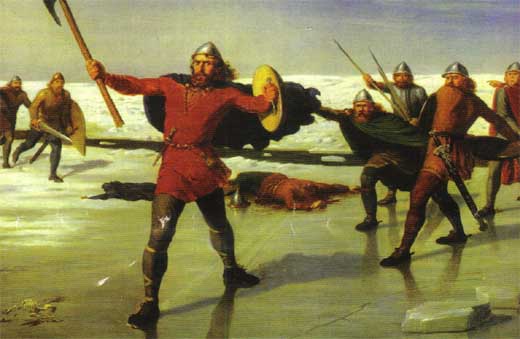
What’s so medieval about that? Well, for one thing, it reminded me of the ice-borne derring-do of Skarp-Hedin in Njal’s Saga:

Skarp-Hedin jumped up as soon as he had tied his shoe, and hoisted his axe. He raced down straight towards the river, which was much too deep to be forded anywhere along that stretch. A huge sheet of ice had formed a low hump on the other side of the channel. It was as smooth as glass, and Thrain and his men had stopped on the middle of this hump. Skarp-Hedin made a leap and cleared the channel between the ice-banks, steadied himself, and at once went into a slide: the ice was glassy-smooth, and he skimmed along as fast as a bird.

Thrain was then about to put on his helmet. Skarp-Hedin came swooping down on him and swung at him with his axe. The axe crashed down on his head and split it down to the jaw-bone, spilling the back-teeth onto the ice. It all happened so quickly that no one had time to land a blow on Skarp-Hedin as he skimmed past at great speed. Tjorvi threw a shield into his path, but Skarp-Hedin cleared it with a jump without losing his balance and slid to the other end of the sheet-ice.

Kari and the others came running up.

“That was man’s work,” said Kari.

Think I’m stretching things to draw a medieval connection? Just wait until the kin of that library sign and the foster-brothers of those murdered azaleas decide to seek revenge. My genteel neighborhood will erupt into hot-blooded discord. They’ll be burning down mead-halls (or at least shooting burning glances at the local California Tortilla), carving rune-spells into their enemies’ yoga mats, pitting book club against book club…I tell you, sometimes the foreknowledge provided by medieval literature is little more than a curse.