“He met the gazes, observed the spaces…”

It’s a pleasantly medieval Monday around the Web. Here are a few links for your reading pleasure…

At Studenda Mira, Dave ponders nomads, then and now.

Scott at Unlocked Wordhoard is reading the 1970s Beowulf comic books so you don’t have to. How bad are they? A sample: “Again, let’s say I buy that their alien spacecraft is crashing over Atlantis…”

Iceland Review Online presents photos and an audio tour of a reconstructed marketplace that was mentioned in the sagas.

News For Medievalists highlights a Sunday Telegraph review of a new Charlemagne novel.

Giving new meaning to the term “starving artist,” Wil at Moyen Age is trying out a medieval diet.

Mary Kate at Old English in New York catches Christopher Hitchens slighting Anglo-Saxonists.

Matthew at Modern Medieval meets the gaze of Otto III.

Thanks, as always, for stopping by! More to come later in the week…

“He couldn’t quite explain it, they’d always just gone there…”

Ignatius J. Reilly may not be back at his post, but my spies in New Orleans have alerted me to two Ignatius sightings in the New Orleans Times-Picayune.

The first, a letter to the editor, remembers the meeting between Thelma Toole and the recently deceased Tom Snyder:

When that amazing novel was drawing attention from readers all over the world, Mrs. Toole flew with a friend, Joel Fletcher, to New York one morning and flew back that night—like Ignatius Reilly, unwilling to spend more time out of her native city. As Ignatius proclaimed, “Out there is the heart of darkness.”

She bantered and flirted with Snyder, who repeatedly called her “Mrs. O’Toole.” They joked about their Irishness and discussed the novel that had made her son posthumously famous. I’m not sure Snyder, who probably expected to interview some sedate elderly lady, was prepared for the phenomenon that was Thelma Toole on her mission to keep the memory of her son and his work before the public.

The other sighting occurs in this article about the Church of St. Henry, where the church, the pastor, the deacon, and the custodian are all named Henry. Unsurprisingly, this “confederacy of Henrys” is the church that convinced Ignatius to stop attending mass. The parish, the reporter tells us, is “as New Orleans as it gets.”

Can the return of Ignatius to Canal Street be far behind? Stay tuned…

“Flying birds, excellent birds…”

When you keep an eye on the media for references to Charlemagne, the results are sometimes peculiar—for example, this recent leadership profile in, of all places, Investor’s Business Daily—but even I didn’t expect to find Charlemagne in a preview of a video game based on the Lego version of Indiana Jones.

But there he is, mentioned by a writer who lists the scenes he hopes will be included in an Indiana Jones Lego video game:

A favourite funny moment from The Last Crusade… Indiana and his father, Professor Henry Jones, are in a car being chased by a couple of German aeroplanes and end up crashing on a beach. One plane turns through the air and bears down on the hapless pair. Professor Jones suddenly opens up his umbrella, flaps it around and starts clucking like a chicken while advancing on birds on the sand.

Indy looks at him as if he’s saying, ‘WTF?’, but the birds are scared into flight and the plane collides with the flock and crashes and burns. “I suddenly remembered my Charlemagne”, says Professor Jones. “Let my armies be the rocks and the trees and the birds in the sky…” What a guy.

The line attributed to Charlemagne by Sean Connery’s character has proven to be remarkably durable. It’s a favorite epigram on quotation sites, .sig files, and MySpace pages, and Wikipedia cites it as an example of Charlemagne’s “cultural significance.”

I’ve never seen any evidence that Charlemagne actually said it.

Granted, I haven’t read every word written about Charlemagne, nor have I read every romance, chanson, or miscellaneous fragment of the Matter of France. However, I have read everything that an inquisitive screenwriter with a Charlemagne fixation might have encountered, such as sources translated into English. But the line cited by Dr. Henry Jones, Sr., isn’t in Einhard or Notker; it isn’t in any of the commonly republished capitularies, annals, or letters; it’s not in The Song of Roland or in popular translations of the Italian Charlemagne stories; and it’s not in the main American source for modern, fictionalized Charlemagniana: Bulfinch’s Legends of Charlemagne.

Furthermore, the line doesn’t even appear in major literary and historical sources that would have been unfamiliar to most non-scholars when the movie was made in 1989. “The Battle of the Birds,” a political allegory by Theodulf of Orleans, sounds like the first place to look, doesn’t it? But Theodulf wrote his poem three years after Charlemagne’s death, and while he does liken flocks of birds to warring armies, he doesn’t much dwell on the rocks and the trees. The Visio Wettini, in which Walahfrid Strabo recounts the deathbed visions of his mentor, also seems like a likely source for philosophical musings, but even though Walahfrid does include a vision of Charlemagne in Hell, the emperor is too busy having his genitals eaten by an animal to utter anything as lovely as the line from the film.

More pedantically, the line quoted by the elder Dr. Jones is a dubious thing for the real Charlemagne to have said. According to Bernard Bachrach, the Carolingian army drew on a pool of approximately 2 million men between the ages of 15 and 55. They had inherited late Roman military tactics, the troops were well trained, and morale was high. Despite the wise observations his scholars sometimes attributed to him, Charlemagne had no pressing reason, beyond accounting for the role of topography and weather in military planning, to speculate about nature either as an aid to military power or as a peaceful, metaphysical alternative to it.

But those aren’t the only plausible readings of the pseudo-Carolingian quote. It might be the cry of a Luddite, the sigh of a nature lover, or the reassuring mantra of a pacifist. It might also be the credo of a Christian warlord who wants God’s creation to be his ally—or who fervently believes that it already is.

In the movie, the bemused reaction of Indiana Jones to the bird episode suggests that we’re meant to see his father’s literal enactment of the line as surprising, even ironic, as if its original context were more solemn or noble. Adding to the allure of the quote is its meter: it’s a pentameter line, but the final four feet are anapests; that many anapests signal formal poetic intentions to the ear of an English speaker. Finally, by attributing the quote to a medieval figure whose name is synonymous with legend—or whose French name is at least a euphonious enigma—the screenwriter cleverly evokes a mystical past while hinting at credible history behind lots of implausible fantasy. By seeming to allude to religion, nature, legend, and poetry, this little line plays right into modern assumptions about things medieval. It seems authentic, even if it’s not.

For centuries, medieval storytellers used Charlemagne to evoke a mythic past, and while it’s fittingly medieval of their modern counterparts to do the same by citing sources that never existed—just like Sir Thomas Malory claiming that “the Freynsh booke makyth mencion” of something that the French book maketh no such mention of at all—I find it charming that the Indiana Jones screenwriter wound up inventing the only Charlemagne “quote” that most people are likely to remember.

A few years ago, someone on the Mediev-L listserv asked about this elusive quote. The list archive is offline, but I do remember that the question stumped the scholars who responded. Dr. Jones’s pseudo-scholarly quip may have a genuine source; if so, I’d be pleased if a sharp-eyed scholar could come along to render this blog post obsolete.

In the meantime, I can easily see why a plausible but spurious reference to Charlemagne by an elderly, fictional medievalist has intrigued and enamored so many. Before 1989, this lyrical line didn’t mean anything to anyone, so today you can say it—let my armies be the rocks and the trees and the birds in the sky—and evoke a universe of medieval mystery, while really saying nothing at all.

[January 12, 2008: I posted an update of sorts here.]

[November 30, 2025: With the recent death of Tom Stoppard, people have been discussing his role as an uncredited script doctor for “Last Crusade.” Could he have added this line to the script? Perhaps a Stoppard scholar might offer a clue or two.]

“All around the world, statues crumble for me…”

Two weeks ago, while visiting family in Louisiana, I posted about the unfortunate removal of the Ignatius J. Reilly statue from its place of prominence on Canal Street in New Orleans.

Yesterday, an intrepid and inquisitive relative informed me that Ignatius hasn’t yet resumed waiting for his mother under the clock outside the old D.H. Holmes department store. However, the clock—which had been removed earlier this month—is now back in place. Can Ignatius (who is, perhaps, just off shopping for lute strings) be far behind?

I’ll await word of further developments from my family—and I invite updates from any New Orleans-based readers as well. Keep checking this blog for all your breaking cult-novel-protagonist-statue-restoration news.

“I’ve got my helmet on, nothing can do me wrong…”

Can the life of an Anglo-Saxon warrior be both heroic and delicious? Dave at Studenda Mira thinks the answer to this question is an emphatic “gese” after noticing this cake in the shape of the Sutton Hoo helmet.

King Alfred was clearly nowhere in sight when Charm City Cakes in Baltimore concocted this confection. If Beowulf had possessed such a mighty war-helm, Grendel might have abandoned his mindless slaughter in favor of wandering off to deal with his diabetes—and victory, though hardly noble, certainly would have been sweet.

“You spend all day looking for a parking spot…”

Over at her journal “Even in a Little Thing,” Gillian Polack hosts the latest edition of Carnivalesque, which is full of nifty links to blog posts about ancient and medieval history. They’re all cleverly arranged and organized according to a grocery-shopping theme—so check them out, bearing in mind that a regular dose of medievalism makes your clothes white, keeps your breath fresh, contains less than five percent fruit juice, and provides nearly half your recommended daily allowance of riboflavin.

“Just a glimpse, and then a quiver, then they shiver to the bone…”

From Matthew at Modern Medieval comes news of “The Kingdom,” which The Hollywood Reporter describes, unpromisingly, as “a medieval ‘Entourage.'”

Did the networks think to involve the author of a certain recent book about a medieval king who had, in fact, a very interesting entourage? No—but that article suggests that their oversight is probably for the best. “Costume dramas have had a rough time on broadcast television,” the writer claims, and boy, is she right, especially when they’re set in the Middle Ages. As far as I can remember, the last time such a show appeared on American network television was 15 years ago, when seven episodes of “Covington Cross” limped across the prime-time schedule.

If you don’t remember “Covington Cross,” head over to the invention that always makes me glad I don’t live in the Middle Ages—namely, YouTube—and watch the opening titles, which appear to combine the arming sequence from Sir Gawain and the Green Knight with surplus equestrian footage from the “Blackadder” credits.

You can also enjoy a few scenes from the show, including some that feature the enchanting Ione Skye as the tomboyish Eleanor. Unfortunately, no one on YouTube has posted my favorite scene: the one where a young squire spends the evening outside Eleanor’s tower window holding a box over his head. (Tragically, nothing happens, because D-cell batteries for boom boxes wouldn’t be invented for another 500 years.) Right after that, Eleanor’s father takes her aside and reminds her, in a tender and memorable moment, “Wotest thu wel, thu canst enye thynge seye unto me.”

Ah, nostalgia. It’s enough to make one praise the resolution of all those fruitless searches and buy the DVDs…

“When I am king, dilly dilly, you will be queen…”

What happens when a clever medievalist spends the summer nannying at Cambridge? She watches cartoons and then questions the legitimacy of princesses:

As many are probably aware, especially those caring for small children, there are certain characters in the Disney film vault who lay claim to some sort of royal title. Most popular today are the Disney princesses who have shown up everywhere from dolls to lunchboxes to elaborately planned birthday parties. Generally the princesses include Belle from “Beauty and the Beast,” Jasmine from “Aladdin,” Cinderella from “Cinderella,” Aurora from “Sleeping Beauty,” Ariel from “The Little Mermaid,” and Snow White from “Snow White.” But are these princesses, in fact, legitimate? What is the strength of their claims to the royal title and right to rule? Under careful scrutiny it appears that only a few of these Disney characters can actually bear the lawful name of princess and only one is uncontested.

The pseudonymous Carolingian may discover that material for this line of inquiry will grow right along with her wee charges, as my friend Kate Marie suggested a couple of months ago after the movie The Queen prompted her to ponder not only the state of the actual British monarchy, but also the strangely malformed and immature legal philosophy of Mia, Princess of Genovia.

Be sure to check out both posts—especially if, like me, you’re a sucker for intelligent women speculating about fake medieval institutions.

“Just a slob like one of us…”

“In the shadow under the green visor of the cap Ignatius J. Reilly’s supercilious blue and yellow eyes looked down upon the other people waiting under the clock at the D.H. Holmes department store, studying the crowd of people for signs of bad taste in dress.”

But wait. Where’s Ignatius?

According to the desk clerk at the former D.H. Holmes—now the Chateau Sonesta Hotel—Ignatius was removed two days ago because “someone kept tryin’ to steal him.”

Such an offense against taste and decency! Clearly it reflects the would-be thief’s lack of theology and geometry. Why, it even casts doubts upon one’s soul…

“I will walk in the garden, and feel religion within…”

On Sunday mornings, the ringing of church bells rolls right down the side-streets and echoes through the bushes and trees. Heed their call and hike up the hill; at the top you’ll find a gothic cathedral. Stunning in its own right, it also looms over one of Washington’s prettiest places: the Bishop’s Garden, a thriving reminder of 14th-century monastic life.

In one corner of the garden is something even older: an anachronism within an anachronism, a massive stone baptismal font encircled by special plants. This little “garden room,” a small sign explains, is here to evoke the ninth century, with each leaf and shoot a living monument to the era of Charlemagne. The emperor might have approved, in passing, of this collection of flowers and herbs. But twelve centuries later, its existence owes less to Charlemagne and more to the legacy of a mostly forgotten man, a monk named Walahfrid Strabo.

Walahfrid first beheld Reichenau at the age of eight. His parents were humble and poor, but the brothers on the island in Lake Constance saw promise in this strange little boy, this strabo—this “squinter”—who readily took to the life of the mind. In his later writings, he wryly recalled his barbaric roots, but the library at Reichenau was truly where Walahfrid Strabo was born.

Walahfrid’s heart never left that quiet island, not even after he was sent to Fulda for further study, nor during his nine years at Aachen, where he tutored Charles, the son of Emperor Louis. In 838, when Louis rewarded Walahfrid with an abbacy, the monk, then thirty, went home to Reichenau at last. Except for two years of political exile and the occasional diplomatic mission, Walahfrid spent the rest of his brief life there. In the decade left to him, he polished his poems, he wrote to a scandalous friend, and he worked, when he could, in his garden.

We know about the garden because of one poem: Walahfrid’s 444-line De Cultura Hortorum, “On the Cultivation of Gardens,” now more commonly known as his Hortulus, “the little garden.”

In a lively preface, Walahfrid exhorts others to share his commitment to gardening:

For whatever the land you possess, whether it be where sand
And gravel lie barren and dead, or where fruits grow heavy
In rich moist ground; whether high on a steep hillside,
Easy ground in the plain or rough among sloping valleys—
Wherever it is, your land cannot fail to produce
Its native plants. If you do not let laziness clog
Your labor, if you do not insult with misguided efforts
The gardener’s multifarious wealth, and if you do not
Refuse to harden or dirty your hands in the open air
Or to spread whole baskets of dung on the sun-parched soil—
then, you may rest assured, your soil will not fail you.

Although bookish by nature, Walahfrid makes clear that he is not merely transmitting found knowledge:

This I have learnt not only from common opinion
And searching about in old books, but from experience—
Experience of hard work and sacrifice of many days
When I might have rested, but chose instead to labor.

With quiet joy, Walahfrid walks the reader through his garden, a former mess of nettles and weeds now made useful and neat through careful springtime tending. His tour leads past rows of long-necked poppies, brilliant purple irises, pungent rue, and sprigs of fragrant mint. At every step, he catalogs the practical uses of his garden plants: wormwood, he claims, can cure a headache; fennel loosens the bowels, and it cures a cough when added to wine.

But Walahfrid’s thoughts range far beyond his humble garden, and his Hortulus is a fertile bed of budding notions. In sage, when new growth chokes its old leaves, Walahfrid sees “the germ of civil war.” Gourd-vines remind him of shields, ladders, and girls spinning wool; he admires their tenacity in a storm, and he marvels at how they aspire “to grow high from a humble beginning.” He points out that horehound counteracts the poisons of an evil stepmother, while pennyroyal lets him marvel at God’s bounty and contemplate the economics of scarcity. In a fit of Virgilian whimsy, Walahfrid even invokes the Muse, “who in sacred song / Canst stablish monuments of mighty wars / And mighty deeds,” all so he can more eloquently praise the heartburn-reducing properties of chervil.

Practical advice and classical flourishes, political allegory and good humor, philosophical musings and mock-epic—here and there, modest ideas and tender allusions break through the surface of the Hortulus, intertwine a little, and grow toward nothing in particular. In the end, Walahfrid’s garden path leads to the lily and the rose, Christian symbols both, each leaning against the other; he spots them just as he begins to tire. It would be odd indeed if a ninth-century abbot did not end his gardening book in this way—but it is odd already that Walahfrid has left this literary garden, in which he glimpses all creation, at fewer than 500 lines.

To understand Walahfrid’s brevity, close his Hortulus. Tuck it under your arm, pass beneath the open archway, and visit the real hortulus, which blooms in the shadow of a cathedral that Walahfrid never could have imagined. Here grows rosemary; here grows the fleur de lys; here grow fennel, black cumin, and green-leafed Gallic rose. In patches, bowing in their raised beds, the flowers and herbs surround the baptismal font, while around them grows a larger garden still.

Tourists and pilgrims walk its stone-paved paths. Beautiful women lounge on benches and bathe in the sun. Toddlers rush for the goldfish pond, while clergy lead visiting dignitaries beyond the bushes and bees. Across the lawn, and frozen in stone, a father forgives his lost son.

Sit and sweat in the swampy heat. Relish this riot of flowers and bushes and vines. Savor every scent. And look, if you can, for the gardener.
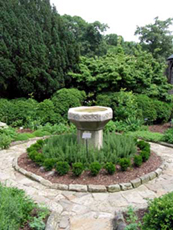
Squint, and you’ll see him; he peers back at you across twelve hundred years. He lives in the dear freshness of this garden, where his work is remembered by those who now spend their mornings exactly as he did: spreading dung, contending with vermin, and tending to fistfuls of moist, fragrant soil.

He wonders why your hands aren’t hardened by labor; then he glimpses his book. His smile is kind, but his glare is reproachful. He is, after all, an abbot.

“A poem is only a poem,” he tells you, his voice made tender by time, “but a garden, dear brother, is art.”