“Asking for more only got us where we are today…”

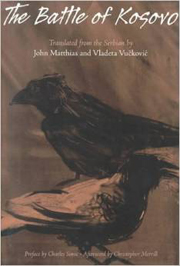
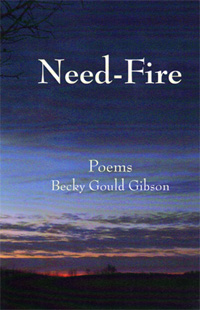
A while back, two poets independently responded to my gargoyle-poem book by asking me if I knew Maryann Corbett. I didn’t, but when I looked her up, I was pleasantly stunned to find someone whose modus operandi I understood: a poet who tends to the formal, a medievalist who holds a non-academic day job. Her latest book, Mid Evil, collects only 40 poems, but together they show how we frame our yearnings with fragments of the past—both the world’s and our own.

At first, all I saw was Corbett’s medievalism. Mid Evil takes its title from a poem about an blasé student’s chronic misspellings; the book also includes poems about studying medieval manuscripts, facing cancer in light of Cathar heresies, seeing The Return of the King with costumed teenagers, and imagining J.R.R. Tolkien’s inner life. Corbett is a skilled translator, so Mid Evil includes modern English versions of several medieval poems: the Old English “Deor” and three Exeter Book riddles, all of them in a form that recalls Anglo-Saxon alliterative lines; two balades from the French of Christine de Pizan; and verses from Alcuin about a nightingale, rendered in a meter that evokes the long Latin lines of the original.

When medievalism inspires new works of art, I’m intrigued and delighted, so I might have decided that all this was enough. On a hunch, though, I decided to read Mid Evil not as a miscellany but as a collection with purposeful organization. What emerged was an even more meaningful book: the story of a halting but ongoing pilgrimage.

Appropriately, Mid Evil opens with two poems in which old books provoke unexpected emotion. In “Paleography,” Corbett describes the intermingled confusion and enthusiasm that comes from trying to read 16th-century handwriting, which leaves her feeling “like the child who listened, puzzled / by the cries in the next room.” She lets the reader decide whether her experience is a sign of cosmic immaturity or a rare opportunity for the renewal she later craves. In “Hand,” she finds a colophon in a Middle English manuscript that reads “pray for him that made this book,” which pits skepticism against faith but leads Corbett to contemplate the actual, physical existence of the long-dead scribe and to “wonder how long the bones of a hand would last.”

In Corbett’s poetry, such relics are forever surprising us; they suggest a larger, more more challenging context to our lives. A teacup, for example, is a tribute to centuries of human activity—slavery, alchemy, religion, myth—culminating in the morning sip that affords the poet a moment of peace. A blue bowl tells the story of the aging and the dead and holds memories of a loud, insulting father:

“Depression glass.” Imagine it: her mother,
using that gimcrack thing for sixty years,
remembering how a speechless misery feels.
A kind of sore the mind keeps picking at.
I think she’s kept a lot of things like that.

And see, the mother’s still around. That’s why
she hasn’t sold it yet to an antique store.
I’ve often told her that would be a mercy.
Honey, it would. That’s what collecting’s for.
Restoring things. We clear the clouds away
so people see good things for what they are.

If mundane objects can resonate with meaning, so can our lives, as long as we’re open to seeing them as stories. In “The Return of the King Screens at Midnight at the Multiplex,” Corbett’s disputatio between skepticism and faith takes on a secular cast as she notes a conflict familiar to medievalists: the detached study of the scholar versus the playfulness of the costumed fan. She realizes it’s not a conflict at all, but reason for an overdue reprimand:

And I
am riven in the dark, remembering
how, long ago, I swore the only way

into these glamours was to learn to sing
in ancient grammar. Oh my misspent youth:
As well escape your life with imagining

as riddle through the words of some dead mouth.

Settling into her theater seat, she bids herself “[t]o hear the tale that salves the sting of truth” and to think about the fleeting value of fantasy and escapism. “So make your minds / more bloody,” she later exhorts girls shopping for Halloween costumes at Goodwill, hoping they’ll revel in pretending to be monsters. Otherwise, they’ll miss a youthful opportunity, however modest, to experience something beyond themselves, like the hapless undergraduate of “Mid Evil”:

And the last blow is this, your final exam,
in which, over and over, you call the course
mid evil literature. Yes, I suppose
for you that is the word. We both are lost here,
mapless in Middle Earth and muddling through.
You’ll claim your paper. Mild civilities
will be exchanged, and then you’ll lope away,
a sad C minus in your grip ensuring
we’re done. It’s mid-December. Snow will fall—
hrim ond hrið, but no one says that now,
since this is the sphere of Time, beneath the moon,
where everything must change, and where the poems
evaporate like hoar-frost in the sun.

Poems, movies, stories, myths—they shore us against aimlessness, but they also nudge us toward generosity. Faced with a storyteller in “The Pandhandler’s Tale,” Corbett puts aside her reservations and welcomes “the willing suspension of disbelief, / which lets us yield ourselves to the tale of wonder,” even though she only ends up attracting more panhandlers. The experience is real regardless; we’ve avoided a mystery, perhaps even a moment of grace, by assuming a story is false. Imagining one of the Brothers Grimm rewriting tales told by a cowherd’s wife, Corbett wonders: “Does it matter / that now we know how far from truth it falls?” A poem about Abelard and Eloise finds fault with all parties, but encourages interpretation: “What can we know? Perhaps less love than pride / led to their woes. Read their own words. Decide.”

But myth, fantasy, stories, and scholarship all have their limitations, as Corbett makes clear in several poems with a tragic edge. A fond memory of watching the rousing “Victory at Sea” on television in the 1950s darkens with the adult realization that the veteran who was dozing in a nearby armchair likely saw horrific things; simple stories are for children. The myths in fashion magazines prove useless decades after our teenage years; a mysteriously returned gift from a daughter’s long-ago lover shocks us out of our personal fables and into complex reality. Even history itself has limited value: in “The Historian Considers the End Time,” a scholar wracked by cancer is tempted by the Cathars’ heresy of the evil of the body, but her medievalism is useless. She can only hope to leave behind scant relics that give meaning to someone else:

They must, those thirteenth-century prelates,
have known it with a blazing certainty,
the truth he’s going to know then, when he hugs
the clothes that hold her fragrance, when his chest knots
as he cleans her closet, when months past the funeral
he finds in a broom strands of the long, dark hair.

So what do we do when the shadow of nothingness looms? All of Corbett’s thematic strands rise and converge in “Sing, My Tongue,” the final section of Mid Evil. These seven poems find strength and revelation in singing as Corbett invites us to join her in church. “On Singing the Exultet” puts us in the choir at the start of the Easter Vigil, where the singer marvels at the audacity of what she is about to do:

It’s candlelight that makes it possible.
How otherwise could you, with your puny pipes,
expect to do this? yell to the end of space—
where air won’t carry sound—and order the nebulae
Exult? But here you are: you’re going to dare it.

Even feeling insignificant implies a cosmic context for our lives, as “the light of the unforeseen”

burnishes a quiet table
where lover and beloved look at each other
weighing a question that will change the world.
That has already changed it.

In these closing poems, Corbett grapples with doubt while singing at a funeral; one page later, she crashes to earth after the high of singing Mozart with an orchestra in a cathedral. “I’ve come to feel / how all my feasts are haunted,” she says after a child interrupts her attempt to find focus in church, and she falls back on translating Alcuin, who exhorts the nightingale to sing without end: “Sour as my soul had become, you could fill it with honeying sweetness.” She ends on a note of fatigue, physical and spiritual, but despite being disheartened by “wheezing gasps where nothing is inspired,” she still hopes for profundity:

I want it back: the confidence in air—
ruah, pneuma, spiritus—the breath
that stirs the vocal folds of nuns in choir.
The breath that Is. The sound of something there
guiding this gusty round of birth and death.
The rush of driving wind. The tongues of fire.

Mid Evil starts with scholarly study and ends in a wish for religious exultation; it begins with writing and ends in song, becoming a prayer for inspiration, confidence, purpose, and grace. Whether that prayer can or will receive an answer remains, for Corbett, an open question, but she comes to a conclusion I gladly endorse: that myth and medievalism are promising places to start.

“Turn on these theater lights and brighten the darkest skies…”

(Dante in D.C.: solarized Polaroid negative)

Most aspects of medievalism in America don’t baffle me. I understand why we want to lay down European roots through Gothic architecture, I get why the pedigreed chivalry of Charlemagne and King Arthur might appeal to us, and the imaginative pleasures of medieval-ish fantasy are (mostly) self-evident. But Dante? I’ve never grasped what Americans hope to do with him—maybe because the answer turns out to be “everything.”

While Dante helped rally Italian nationalism in the early 19th century, Americans looked to him for different shades of inspiration. Melville saw him as a guide through moral quagmires; Emerson considered him a simple genius; and others longed for his unshakeable certainty in their own supposedly weak-willed and overly tolerant age. Charles Eliot Norton, who promoted the study of Dante at Harvard and established the Dante Society of America, praised the poet for representing “the mediaeval spirit found in the highest and completest expression”—namely, an ahistorical vision of independence, individualism, and curiosity he hoped would prosper in post-Civil War America.

After American Protestants dunked Dante in their own ecstatic rivers, Eliot and Pound dwelt largely on his words, adoring him as a poet who wed precision to faith. More recently, the Big D has thrived in a popular culture beguiled by mysticism and the occult. Oh yes: You can pop “Dante’s Inferno Balls” candy while playing the Dante’s Inferno game for XBox or Playstation (with accompanying action figure). You can imagine the scent of Dante cigars, fondly recall the “Dante’s Inferno” ride at Coney Island, or show off your snazzy Dante earrings. You can also check out how two science-fiction authors Americanized Dante to make his Hell literally escapable.

So is Dante nothing more than a leering cadaver we clothe in our whims? In a blog post about two new Dante books, Cynthia Haven at Stanford suggests that il Poeta has something greater to offer us, a vision as priceless as it is stark:

A more interesting question might be: what does Dante tell us about our world that we do not recognize ourselves? Here’s my take: we live in a time and in a generation that thinks everything is negotiable, and that every psycho-spiritual lock can be jimmied. As W.H. Auden put it, we push away the notion that “the meaning of life [is] something more than a mad camp.” For us, there’s always a second, third, and fourth chance. It’s a strength – but it’s a weakness, too. Maybe that’s why we resist Dante. We don’t realize that some things are for keeps. There’s not always another day. Not all choices can be reversed with every change of heart – and no, our heart isn’t always in the right place. Words unsaid may remain forever unsaid. And perhaps no choice is trivial or innocent: it is the choices that bring us to ourselves, the choices that reveal and work as a fixative for our loves, our priorities, and our direction.

Just before Christmas, I checked out “The Divine Comedy: Heaven, Purgatory and Hell Revisited by Contemporary African Artists” at the SCAD Museum of Art in Savannah. The title was misleading, since the art wasn’t inspired by Dante; the works only echoed his concepts and themes. “The concern here is not with the Divine Comedy or Dante,” explained the curator, “but with something truly universal.” How gloomy, but how unsurprising, that another interpreter of Dante, another artist in search of the timeless, doesn’t discern that they’re one and the same.

“It’s not the way you have your hair, it’s not that certain style…”

After the artists at a major art center in Virginia asked me to do some writing for them, I was delighted when they kept me busy for nearly two years—and surprised when their work pushed me back toward the visual arts after a 20-year lapse. I’m now fumbling with media I saw others handle so masterfully, but the most challenging project by far has been prying (sometimes literally prying) interesting photographs from three mid-1960s Polaroid Land Cameras.

As I’ve written before, A Land Camera is not versatile. Although it has a focus bar and other manual controls, an electric eye presumes to do much of the squinting. There’s no zoom, development time depends on the air temperature, and the prints leave behind photographic placentas in strips of chemical-drenched litter.

I don’t aspire to be a photographer; I’m learning to use only this type of camera, with all its quirks and severe limitations and almost no reliance on Photoshop. Using a Land Camera is like writing a poem within strict formal constraints: Certain flourishes are simply impossible—but if we practice a little, what can we make it do?

It helps to have an obsessive theme—and so from time to time, I haul my cameras out into the world in the hope of framing glimpses of medievalism in snapshots. Over time, maybe, this project will find its focus.

* * *


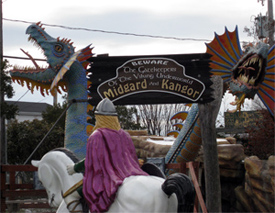
I love the little neon mujahed on this sign in Ocean City, Maryland. Four things helped me take this low-light photo: a tripod, a homemade Lego camera stand, electrical tape, and a beatifically indifferent night manager.

Although Ocean City is flashy and bright, I had to keep the shutter open for five seconds, which shows you just how light-hungry these old cameras can be.

* * *

I spent the day before Columbus Day doing research at the Johns Hopkins library—but when I was done, I roamed the city looking for something medieval to photograph. There’s a statue of William “Braveheart” Wallace along the reservoir in Druid Hill Park, but the afternoon light fell far more serendipitously on this Christopher Columbus monument from 1892.

What hath Columbus to do with the Middle Ages? He loved the travel stories of Mandeville and Marco Polo, he was beguiled by medieval legends about marvelous islands to the west, and on his third journey, he was sure he’d located the Earthly Paradise. He hoped his Atlantic voyages would ultimately convert the Chinese emperor to Christianity and help fund a new crusade to reclaim Jerusalem. Quoth historian Luis Weckmann: “Columbus, the first link between the Old World and the New, stands in a clearer light, perhaps, if we envisage him not so much as the first of the modern explorers but as the last of the great medieval travelers.”

* * *

No, gnomes aren’t medieval, but they are rooted in 19th-century European medievalism, and there’s certainly a medieval tradition of wee woodland beings making trouble for us humans. Some Anglo-Saxon charms even blame certain types of pain and disease on wicked little “elves.” (Plus, this gnome is made out of felt, the discovery of which is rather dubiously attributed to saints Clement and Christopher.)

At only four inches high, this fellow gave me a excuse to practice using the special Polaroid “close-up kit.” This picture doesn’t illuminate anything particular about the American penchant for medievalist fantasy, but it did teach me that when you’re on your belly in the grass at noon on a hot summer day photographing gnomes with an antique camera, the cops slow down to get a better look at you.

 * * *

This Gothicpalooza facade on the bagel shop at 36 East Main Street in Newark, Delaware, contrasts sharply with the quaint Colonial Revival campus of the University of Delaware campus just footsteps away. The facade’s two beasties have looked down on the drunk and the un-drunk alike since 1917, when the building was a pharmacy. As I wrote back in 2013, I’m convinced they were inspired by specific grotesques at Notre-Dame in Paris.

* * *
“…but alle shalle be wele, and alle shalle be wele, and alle maner of thinge shall be wel.”

Sometimes you get lucky. In the crypt of the National Cathedral, there’s a stark little chapel lit only by indirect sun. On a frigid afternoon last January, I leaned on a pew and snapped a quick picture of this Good Shepherd statue. The resulting image startled me; with these old cameras, light and luck are always intertwined.

Last year, Fuji stopped making this fast black-and-white film, so I’m brooding, dragon-like, over a hoard of it. It’s possible that I’ve chosen the wrong tools for the task, and that lingering traces of the Middle Ages demand a sharper lens. We’ll see. For now, I’ll keep learning how to use old cameras that thrive on what shadow and sunlight demand.

“…but as for fame, it’s just a name…”

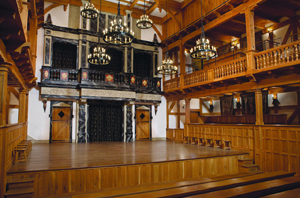
Blackfriars Playhouse interior. Photo by Lauren D. Rogers.

What was it like to see a play in the 1590s? The good folks at the Blackfriars Playhouse in Staunton, Virginia, answer that question at least five nights a week, as unflagging actors stage the work of Shakespeare and his contemporaries in a cozy recreation of Shakespeare’s first theater in London. The Blackfriars is now in the throes of its Actors’ Renaissance Season, the annual late-winter whirlwind where a dozen actors direct themselves and play all of the roles in five plays at once, with only a few days to prepare and rehearse. (There’s a prompter nearby, but it’s a sign of the actors’ immersion in their work that they rarely need to “prithee” him.)

This weekend, we drove down to Staunton for two shows: Aphra Behn’s “The Rover,” which taught me a useful new 17th-century exclamation—‘sheartlikins!—and John Webster’s “The White Devil,” a lurid, over-the-top revenge tragedy packed with vivid metaphors and similes about death and the cruel indifference of nature. “But keep the wolf far thence, that’s foe to men, / For with his nails he’ll dig them up again”—T.S. Eliot parodied those lines, and I was startled to hear the originals spoken by a grieving mother; it’s rare to spot a footnote from “The Waste Land” running loose in the wild.

Because I’ve written so much about Charlemagne, I was also surprised to hear a character name-check the Carolingians during one of Webster’s most frantic scenes: Two women think they’re tricking a scoundrel named Flamineo into a complex, three-way suicide pact, but he’s actually tricking them into revealing their falseness by giving them pistols loaded with blanks. As he feigns preparation for death, he muses on his afterlife—so the Blackfriars actor said something like this:

Whither shall I go now? O Lucian, thy ridiculous purgatory! To find Alexander the Great cobbling shoes, and Julius Caesar making hair buttons, and King Pippin crying apples in a cart.

A reference to one of the Pippins, but not Charlemagne? That surprised me, so I looked up the full text of the play, and sure enough, the Big C is right where I thought he would be:

Whither shall I go now? O Lucian thy ridiculous purgatory! To find Alexander the Great cobbling shoes, Pompey tagging points, and Julius Caesar making hair buttons, Hannibal selling blacking, and Augustus crying garlic, Charlemagne selling lists by the dozen, and King Pippin crying apples in a cart drawn with one horse.
Whether I resolve to fire, earth, water, air,
Or all the elements by scruples, I know not
Nor greatly care—Shoot, shoot,
Of all deaths the violent death is best,
Far from ourselves it steals ourselves so fast
The pain once apprehended is quite past.

What intrigued me here is that either the actor, overwhelmed by having to learn five plays at once, skipped over several of the mighty men who are reduced to menial labor in purgatory—or, more likely, he and his castmates cut the play for time, paring down this overwrought passage to the three names an early 21st-century audience might know: Alexander, Julius Caesar, and…Pippin?

Although they all had the same name, Charlemagne’s disfavored hunchback son who inspired the 1972 jazz-hands musical wasn’t the same guy as Charlemagne’s other son Pippin, who ruled Italy, or Charlemagne’s father Pippin, the first Carolingian king. The fact that a Pippin made the cut but Charlemagne didn’t hints at the priorities of theater people, who know the musical but not necessarily the history behind it—but that’s not a complaint. The Blackfriars’ productions are engrossing and smart, historical figures are doomed to whirl ’round Fortune’s wheel, and Webster knew that drawing sustenance from the mouldering past is part of the natural and necessary gloom of life:

Or, like the black and melancholic yew-tree,
Dost think to root thyself in dead men’s graves,
And yet to prosper?

“The walls are white, and in the night…”

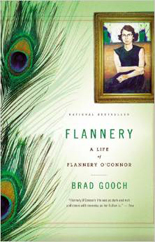
“Perhaps I have created a medieval study,” wondered Flannery O’Connor in 1960 after a professor of medieval literature penned a piece in a Catholic magazine that likened her novel The Violent Bear It Away to the movie The Seventh Seal. Sharing the essay with a friend, O’Connor was bemused: “Which reminds me, have you seen any films by this man Ingmar Bergman? People tell me they are mighty fine & that I would like them. They too are apparently medieval.”

I wonder, then, what O’Connor, a rigorous Catholic, would have made of the news that the Episcopalians just made her a literary saint:

This week, Flannery O’Connor was inducted into the American Poets Corner at St. John the Divine, the “only shrine to American literature in the country” (or so a church representative told me). Upon entering the cathedral for the small induction ceremony, attendees were greeted by two gigantic, sparkling sculptures suspended from the ceiling—they are phoenixes, part of an installation by the Chinese artist Xu Bing, but at first glance you might mistake them for peacocks, like the ones that O’Connor raised on her family’s Georgia farm, Andalusia . . . Those who spoke during the ceremony stood in front of a shining cross, towering choir stalls, and giant pillars illuminated with glowing yellow lights. A booming echo made them sound like somewhat unintelligible voices from beyond. The effect was fitting, evoking simultaneously O’Connor’s keen sense of the ominous, the numinous, and the ironic.

I don’t know if O’Connor visited the magnificent cathedral when she lived in New York City for a while in 1949. As a Catholic, she might have found modern Protestant cathedral-building a marvelous, misguided quest for transcendence, but the vast Gothic interior also might have engaged her intellect and gladdened her soul. After all, O’Connor grew up across the street from a gargoyle-festooned cathedral in Savannah and later lived on a farm called Andalusia, a name she encouraged her mother to restore. It’s been a while since she was seen only as a “Southern Gothic” writer; she also deserves to be remembered as a committed American medievalist.

By the time O’Connor attended college in 1942, her medievalism was apparent. She wrote poetry only briefly, but her later dismissal of her own juvenalia is knowing and sly. “All of my poems sounded like ‘Miniver Cheevy,'” she quipped, recalling the pathetic drunk in E.A. Robinson’s 1910 poem who wishes he’d been born in an age of chivalry. As an adult, she had little interest in romance and legend: Her philosophy professor would recall how much she hated the irreligious dismissal of the Middle Ages in the textbook he assigned, how passionately she studied the work of St. Thomas Aquinas, and how keen she was to debate with him when he argued, from an anthropological perspective, that medieval Christianity was polytheistic.

“She knew Aquinas in detail, was amazingly well read in earlier philosophy, and developed into a first-rate ‘intellectual’ along with her other accomplishments,” George Beiswanger later wrote. “It soon became clear to me that she was a ‘born’ writer and that she was going that way.” Beiswanger took such pleasure in their sparring that he recommended her to his alma mater, the University of Iowa, and helped her land a scholarship for graduate school.

In 1948, while wandering the grounds of Yaddo, O’Connor described herself to other artists at the colony as “thirteenth century” as she immersed herself in a book on scholasticism and medieval art by French Thomist Jacques Maritain. “Do not make the absurd attempt to sever in yourself the artist and the Christian”—she underlined that passage in Maritain’s book, and when she visited the Cloisters during her stint in New York City the following year, she was amazed to find support for Maritain’s exhortation in a Virgin and Child statue that showed both figures laughing—”not smiling,” she emphasized to a friend, “laughing.”

While writing her first novel, O’Connor read the lives of three female saints—Catherine of Siena, Catherine of Genoa, and Teresa of Avila—and was irked when the public found the resulting book pessimistic rather than comic. “Everybody who has read Wise Blood thinks I’m a hillbilly nihilist,” she told a friend, “whereas I would like to create the impression over the television that I’m a hillbilly Thomist.” Fascinated and challenged by the prolific saint, she joked about applying Thomist principles to the least events in daily life, including her mother scolding her to go to bed during her nightly readings:

If my mother were to come in during this process and say, “Turn off that light. It’s late,” I with lifted finger and broad bland beatific expression, would reply, “On the contrary, I answer that the light, being external and limitless, cannot be turned off. Shut your eyes,” or some such thing.

Soon after she was diagnosed with the lupus that would destroy her kidneys, O’Connor made two commitments: the first, to write like mad; the second, less formally, to St. Thomas Aquinas himself. In 1953, O’Connor purchased the 690-page Modern Library volume of selections from his work—and settled in for the rest of her life.

As she hobbled around Andalusia on the crutches she called “flying buttresses” and immersed herself nightly in Thomistic theology, O’Connor did what other medievalists do, from malevolent nationalists to benign reenactors: She redacted the Middle Ages down to the aspects that gave her full purpose and strength.

As for being enshrined as a poet by Episcopalians in an unfinished Gothic cathedral in Manhattan, O’Connor was too Southern to have told them that she was anything but flattered but also too Catholic not to have issued gleeful theological challenges to priests who would have stammered and sought for rejoinders in vain. Then, in private, mindful of her favorite statues, she would have laughed, and let her amusement linger long after the light went out.

“The story is old, I know, but it goes on…”

With its mix of sunshine and harmless bluster, September brings back-to-school nostalgia—ivy-covered professors, that first fall riot, scoldings for being insufficiently euphoric over sports—and perhaps that’s why the past two weeks have swirled with stories about the woes of humanities types in academia. I’ve watched would-be scholars expire en route to the ferne hawle of full professorhood for 20 years, so I’m guessing that many grad students and adjuncts have newly discerned, with the sort of creeping, pitiless dread otherwise confined to Robert E. Howard stories, that they won’t find long-term employment.

First, at the Atlantic, Jordan Weissmann asked why the number of grad students in the humanities is growing. Then, Slate ran a piece about the awkwardness that still hangs about people with doctorates in the humanities who land “alt-ac” careers—that is, jobs where they don’t teach college. Apparently, though, there aren’t enough such lucky people, because a few days later, Salon covered adjunct professors on food stamps.

With all the attention this subject now gets in the press, I can only hope that fewer souls will fling themselves into the hellmouth—but maybe academia shouldn’t have undone quite so many in the first place. While reading about medievalism in recent days, I found two historians who sensed where things were headed long ago.

The first was Karl F. Morrison, who wrote “Fragmentation and Unity in ‘American Medievalism,'” a chapter in The Past Before Us, a 1980 report commissioned by the American Historical Association to explain the work of American historians to their colleagues in other countries. Morrison writes candidly about his field, but he also makes an especially prescient extrapolation, which I’ve bolded:

There was also an expectation in the “guild” that investment in professional training would, in due course, fetch a return in professional opportunity.

By 1970, these benefits could no longer be taken for granted. By 1974, even the president of Harvard University was constrained to deliver a budget of marked austerity, reducing “the number of Assistant Professors substantially while cutting the size of the graduate student body below the minimum desirable levels.” The aggregate result of many such budgets across the country was a sharp reduction in the number of professional openings for medievalists, and an impairment of library acquisitions and other facilities in aid of research. Awareness of this changed climate impelled a large number of advanced students to complete their doctoral dissertations quickly, producing a bulge that is noticeable around 1972-1974 in our tables. For many reasons, including the deliberate reduction or suspension of programs in some universities, it also resulted in a decline in the number of graduate students proceeding to the doctorate.

In effect, the historians who became qualified during this period without being able to secure professional employment constitute a generation of scholars that may be in the process of being lost, casualties of abrupt transition. There is no reason to expect that the demographic and economic trends that so sharply reversed their professional expectations will alter before the end of the century, and this projection raises certain quite obvious possibilities regarding the diversity and renewal of the profession.

Fast forward to 1994. Norman Cantor was gearing up for his fourth year of professional besiegement after the release of Inventing the Middle Ages, a book for non-academic readers in which he sought to show how the formative experiences of certain 20th-century medievalists explained the ways they interpreted history. Fellow historians didn’t like his blunt biographical approach—and so in “Medievalism and the Middle Ages,” a little-read article in The Year’s Work in Medievalism, Cantor hammered back at “establishment dust-grinders” and noted, in passing, the crummy academic job market and the prevalence of certain “alt-ac” career paths even then:

Within academia a fearful conservative conformity prevails. The marginal employment situation has a twofold negative impact. First, it discourages innovative minds and rebellious personalities from entering doctoral programs in the humanities. People in their late twenties and thirties today with the highest potential to be great medievalists and bridge academic medieval studies and popular medievalism are a phantom army, a lost generation. Instead, for the most part, of climbing the ladder at leading universities they are pursuing careers (often regretfully and unhappily if well-paid) in major law firms.

Second, even if imaginative people take Ph.D.’s in medieval disciplines, they face the job market and particularly once they get a prized tenure track post they encounter a chilling intellectual conservatism that frustrates expressions of their best thoughts and deepest feelings.

I like Cantor’s claim that academia is literally conservative. After all, people are still fretting over problems that he and Morrison noticed decades ago. It’s September 2014, yet Rebecca Schuman at Slate can still write: “The academic job market works on a fixed cycle, and according to a set of conventions so rigid that you’d think these people were applying for top-secret security clearances, not to teach Physics 101 to some pimply bros in Sheboygan.”

The early blogosphere was rife with humanities grad students and adjuncts wavering between disgruntlement and despair; the much-praised Invisible Adjunct rose up to unite them in discussions so civil that I can scarcely believe I saw them on the Internet.

As someone who writes about people who use the imagined past to carve out identities, argue from authority, resist mainstream culture, or seek respite from the real world, I think I understand why the number of new students in arts and humanities doctoral programs grew by 7.7 percent in 2012, but I can’t claim a moment’s nostalgia for the geeky excitement they surely must feel. Morrison and Cantor both imagined a lost generation, but their jobless contemporaries were merely wandering. For this next generation, that luxury is long gone—as is the prospect of claiming that nobody warned them.

“A legacy of romance from a twilight world…”

Last night, when the U.S. began walloping ISIS militants in Syria, our jets also hit the Khorasan group, hardcore Al-Qaeda veterans who are reportedly expert bomb-makers. When I first heard the news on the radio in my car, I wondered why Al-Qaeda had a group called “Corazón”—some Spanish-speaking faction, perhaps?—but then I realized I’d already written about the original Khurasanis. They were the muscle behind the Abbasids: the third Islamic caliphate, the dynasty associated with Baghdad’s founding and golden age, and the contemporaries of the Carolingians.

The fourth chapter of Becoming Charlemagne takes readers on a tour of Baghdad around the year 798:

In the ritzy Harbiya suburb of northwest Baghdad, the families of soldiers started each day with expectant prayers. In summer, they awoke in their cool basement apartments, or on their rooftops within sight of the Round City, where they greeted the dome at the hub of their city.

As a boy, the current caliph, Harun, had led their fathers and husbands to the frontiers against the Rum, the so-called Romans of Constantinople, the ones whom poets called al-asfar, “the yellow ones.” More recently, they had been paid to quash local rebellions, commanding armies in the service of the caliph. In a caliphate that stretched from northern Africa to India, there was a constant market for well-armed men. Praised by their contemporaries in story and song, these generals rarely lacked for work.

The comfortable estates of Harbiya had been built on that same military might. Only a few generations earlier, these soldiers had stormed out of the eastern province of Khurasan, bringing to power the descendants of al-Abbas, the uncle of the Prophet Muhammad, in a show of force and a flurry of black banners. The Abbasid caliphs had rewarded the Khurasanis with desirable land and jobs for their children, who now commanded the palace guard and ran the police force.

As this blog has long shown, Europeans and Americans love to dress up in medieval costumes, follow pseudo-medieval soap operas on television, construct medieval-ish buildings, and otherwise evoke or re-create the Middle Ages, sometimes to spurn the modern world, more often to carve out a place in it, whether individually or in groups. With their choice of name, the Khorasan nutjobs are heeding that same inexhaustible impulse. I can respond only by marching out one of my favorite observations from scholar Tom Shippey: “There are . . . many medievalisms in the world, and some of them are as safe as William Morris wallpaper: but not all of them.”

“Holding their own, last orders commanding attention…”

Some of us are so busy spotting medievalism in the modern world that sometimes we need to stop and notice the moments when the lack of it is literally remarkable.

Three days before Thursday’s referendum on Scottish independence, the Wall Street Journal ran a curious piece by foreign affairs writer Bret Stephens, who harks back to the 1919 Paris Peace Conference. Stephens suggests that the Wilsonian emphasis on national self-determination backfired, leading people around the world to the perilous realization that “nations are almost endlessly divisible into smaller entities.” Wilson and his advisers (some of whom were medieval historians) did get it wrong when they cobbled together a doomed Yugoslavia, but Stephens believes that when smaller countries go it alone, they may become dangerous, poor, corrupt, or insignificant.

The point is interesting and debatable—but Stephens’ conclusion is inarguably weird:

Some Scots may imagine that by voting “Yes” they are redeeming the memory of William Wallace. Maybe. The other way of looking at it is as a vote for medievalism over modernity.

Memo to wannabe Bravehearts: The 13th century wasn’t all that fun.

“Medievalism over modernity”! That might seem like a fair way to talk about a referendum that was almost slated for June 24, the 700th anniversary of the battle of Bannockburn, a key moment in the medieval fight for Scottish independence.

The thing is, I followed the news surrounding the referendum, which was actually held on an otherwise unimportant date in Scottish history. I browsed the “Yes” websites and sat through the videos. Knowing that European nationalists love to dig up and reanimate their shambling medieval ancestors—benignly in countries like Finland, malevolently in places like Germany and Serbia—I kept an eye out for William Wallace, Robert the Bruce, and other heroes hauled from the pages of Sir Walter Scott.

I saw economic arguments, anti-nuke and anti-English rhetoric, sentimental appeals to independence, and other pleas—but outside of news articles reporting on Scotland’s history of pre-1707 independence, I saw nary a trace of sword-wielding medieval warriors. I don’t doubt that in recent weeks, somebody decked out in costume and kit spoke glowingly of Scotland’s medieval glory, and I hope readers will send me examples—but overwhelmingly, the “Yes” side rooted its arguments not in some politicized dreamland of castles and kings, but in the here and now.

The press has been keen to emphasize that separatist movements in Catalonia, the Basque region, Flanders, the Crimea, and even Venice were watching to see what the Scots would decide. I assume there was interest in Wales and Cornwall as well. I suppose it’s possible that these movements will conclude that the “Yes” campaigners failed because the Scots didn’t sufficiently use their medieval heritage to inflame nationalistic pride—but if so, that won’t be Scotland’s fault.

As a distant, disinterested observer, I had no opinion on the outcome of the referendum except to note that the Scots set a worthy and decent precedent: asserting their identity and affirming their independence while keeping their medieval forefathers silent and snug in their graves.

“Empty-handed on the cold wind to Valhalla…”

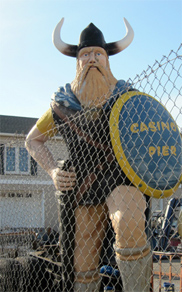
For all the violence the Vikings unleashed, their enemies and victims might find cold comfort in the torments Americans now inflict on them. We’ve twisted them into beloved ancestors, corny mascots, symbolic immigrants, religious touchstones, comic relief—and, this week, proponents of gender equity on the battlefield. The medieval past is grotesque, uninviting, and indifferent to our hopes. We wish so badly that it weren’t.
“Shieldmaidens are not a myth!” trumpeted a Tor.com blog post on Tuesday, sharing tidings of endless Éowyns in the EZ-Pass lane to the Bifröst:

“By studying osteological signs of gender within the bones themselves, researchers discovered that approximately half of the remains were actually female warriors, given a proper burial with their weapons . . . It’s been so difficult for people to envision women’s historical contributions as solely getting married and dying in childbirth, but you can’t argue with numbers—and fifty/fifty is pretty damn good.

Great Odin’s ophthalmologist! Holy hopping Hávamál! Half of all Viking warriors were women?

Alas, no. “Researchers discovered” nothing of the sort—but that didn’t stop wishful linkers from sharing the “news” hundreds of times via Twitter and countless times on Facebook.

So what’s going on here? Besides conflating “Viking” with “Norse,” the pseudonymous author of the Tor.com blog post misread a two-year-old USA Today summary of a 2011 article by scholar Shane McLeod, who most definitely has not delivered forsaken warrior maidens from their long-neglected graves. No, McLeod simply did the un-newsworthy work of reassessing burial evidence for the settlement of Norse women in eastern England in the late 800s, with nary a Brunhilde or Éowyn in sight.

You can find “Warriors and women: Norse migrants to eastern England up to 900 AD” in the August 2011 issue of the journal Early Medieval Europe. If you don’t have institutional access to scholarly databases, the article is imprisoned behind a $35 paywall, which is a shame, because although McLeod’s piece requires a slow, patient read, you don’t need expertise in ninth-century English history or modern osteology to understand it—just the ability to follow an argument about a couple dozen skeletons in a tiny corner of England at a very specific time in history, plus an openness to the possibility that McLeod hasn’t brought your “Game of Thrones” fantasies to life.

Here’s the gist of McLeod’s article, as concisely as I can retell it:

Focusing only on the area of eastern England occupied by the Norse in the 800s, he looks at one sample of six or seven burials from five locations dating from 865 to 878 A.D. where scholars had made assumptions about the sex of the dead based on the stuff buried with them. He compares them to a second sample: 14 burials from five sites (dating from 873 to the early 10th century) where osteologists determined the sex of the dead by examining their bones.

In the first group, only one person was tagged as female. In the second group, between four and six of the dead, perhaps half of the sample, were found to be female, even though based on grave goods, at least one of them might previously have been assumed to be male, because one of those women was buried with a sword. (Ah, but that woman was also interred with a child of indeterminate sex. What if the sword belonged to her young son? And look: someone in the first group who might have been a woman was buried with a sword, too…)

McLeod’s assessment is this: If we scientifically determine the sex of the dead based on their bones rather that assume their sex based on grave goods, we find more evidence (to pile atop existing evidence from jewelry finds) that Norse women came to England with Norse armies, earlier and in greater numbers than previously thought, rather than in a later wave of migration and settlement. Perhaps the men weren’t “a demobbed Norse army seeking Anglo-Saxon wives,” but intermarried with local women in smaller numbers than historians previously believed.

For the lay reader, that’s a disheartening hoard of unsexy conclusions—and a far cry from the Tor.com blogger’s claim, mindlessly brayed across social media, that “Half of the Warriors were Female.” It’s fantasy, not scholarship, and certainly not science, to interpret one woman buried with a sword, maybe two, as evidence for Norse women in combat.

Shane McLeod deserves better. Working with limited data pried out of ninth-century crevices, he recognizes that his sample size is tiny, that it’s tough to identify burials as “Norse” for sure, and that his findings are only “highly suggestive.” He’s precise, tentative, and conscious of counter-arguments, and he seems willing to go wherever the evidence takes him. His biggest accomplishment, however, is highlighting a major scholarly error. Experts who made assumptions about male versus female grave goods failed to reassess the biases they project backwards onto the Middle Ages—even though doing so is one of the traits even the most pop-minded academic medievalists will often claim distinguishes them from the duct-tape-sword-wielding masses.

Likewise, science-fiction fans are forever congratulating themselves for holding the right opinions on such subjects as evolution, but this time they lazily succumbed to fannish fantasies, failing to question a claim that deserved to be pummeled by doubt. I’ve done tons of social-media copywriting, so I get why that blogger just wanted to throw something out there after a holiday to beguile weekend-weary eyeballs—but come on.

Science doesn’t always tell us what we want to hear. Truth demands nuanced consideration of evidence, and reason demands skepticism, neither of which flourish on social media—so if you shared or re-tweeted the Tor article, congratulations! This week, in the name of medievalism, you made the world stupider.

[2019 update: Research into this subject has developed quite a bit since 2014, but I’m keeping this post online because it’s still a good example of how careful academic research gets turned into misleading clickbait. Feel free to leave links to updated scholarly research in the comments for future readers who find this post via Google.]

“Crossing the central reservation of my imagination…”

I was heartened to find them right where I left them: the Notre Dame chimera and his beak-faced buddy leering over the baggage carousels at Denver International Airport. I landed in Colorado just as the news broke that the state’s cutest pests were busily vectoring some good, old-fashioned plague, and my first thought (after “¡ay caramba!“) was to wonder what other medieval grotesquerie I might encounter.

Medieval Europe casts a strange, slanting shadow across the American West, even before you take into account the culture and traditions of Spanish speakers. (It’s not for nothing that the 1984 book The Medieval Heritage of Mexico is 600 pages long.) For generations, we Americans were fond of imagining that we’d made a clean break from Europe—“Shrouded bards of other lands! you may sleep—you have done your work”—but in the deserts and prairies, that belief is still duking it out with evidence that we’re the blatant heirs to medieval traditions.

False starts abound there, too. At Mesa Verde National Park, we were gawking at Far View House, the ruin of an Ancestral Puebloan home built between 1100 and 1300 A.D., when my wonderfully indulgent traveling companion spotted this:

Could it be? The remains of an Ancestral Puebloan gargoyle that once spewed forth some of the mesa’s 18 inches of summer rain—set in place at the same time Europeans were building great Gothic cathedrals? Could a medieval French architect have been shipwrecked on our shores and then whisked away to the desert by a super-tornado? Perhaps with the aid of medieval Welsh UFO abductees?

Alas, no. Those drainage stones only look old; they were placed there by the National Park Service to draw water away from the fragile sandstone ruins. The two rangers who answered my questions seemed awfully embarrassed that somebody noticed.

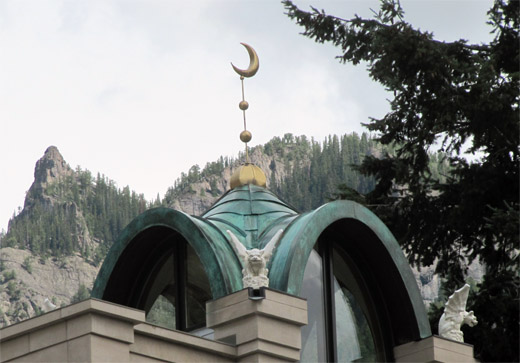
In Ouray, Colorado, which bills itself as “the Switzerland of America,” I spotted familiar beasties atop the local pharmacy museum:

As common as prairie dogs, these grotesques are variants of a standard garden-store and souvenir-shop species known as the “Florentine gargoyle.” They usually have dog or cat faces, and they often have chains around their necks. If their ancestors actually lurk on a landmark in Florence, I’m still hunting for them.

Fortunately, other, more perspicacious medievalists have moseyed down this road. In his 1965 article “The Legacy of the Middle Ages in the American Wild West,” historian Lynn White, Jr., argued that pioneers were “particularly beneficiaries of the Middle Ages” whose “essential equipment was largely the culture of the mediaeval lower classes.” Log cabins? A medieval building style brought to North America by Swedes, reintroduced by the Germans and the Swiss, and carried westward by Scotch-Irish settlers. Stirrups? Eighth century. Spurs? Late 13th century. The distillation of spirits, card games, garter belts, the title “sheriff,” and even lynching? All of them, White argues, were “medieval patterns of preference” that shaped the American West.

Of course, White belonged to a school of historians who were obsessed with showing irrefutable continuity from the Middle Ages to the present. “Indeed,” he surmised, “a good case could be made for the thesis that today the United States is closer to the Middle Ages than is Europe.” In his 1965 article, he’s eager to believe it’s so. He’s not wrong when he claims that the revolver, barbed wire, and the windmill couldn’t have existed without medieval innovations in gunpowder, drawing wire, and water pumping—but sometimes he seems to be trying too hard.

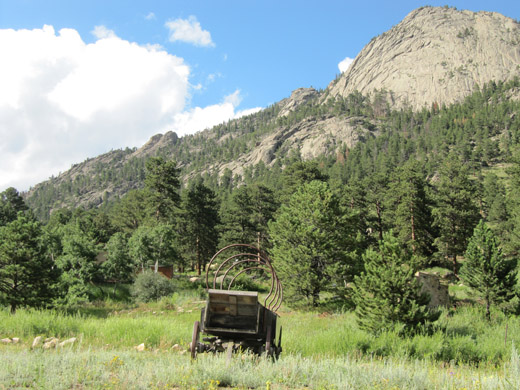
That said, one of White’s revelations is particularly neat. To find traces of the Middle Ages in Colorado, you need to look no further than the countless squares, parks, and museums for the carcasses of a conveyance that most people don’t consider “medieval” at all.

The Conestoga wagon! To generations of Americans—and to the throngs of European tourists I saw at the national parks last week—it’s an icon of the Old West. I’d assumed it was the culmination of 19th-century New World ingenuity, but White makes a case for its medieval-ness.

The Romans, he argues, had nothing quite like it. The earliest example of a harness with padded collars and lateral traces or shafts pops up only around the year 800. Nailed horseshoes, which gave horses traction and reduced wear on their hooves, first appear in the 890s. Finally, around 1070, we see the first evidence for the humble but ingenious “whipple tree,” the rod across the front of a cart that connects the sides of tandem animals to the front and center of the cart, equalizing the pull and making the whole contraption safer and more efficient.

Capable of hauling several people and heavy loads, the large frontier wagon, the longa caretta, is now feasible—just add youthful sinewy races full of manly pride and friendship. “In the early twelfth century,” White concludes, “it appears in essentially the same form which came to dominate the American West in the Conestoga wagon.” O pioneers!

Is he right? I don’t know. Historians bicker mightily about the timing of the first nailed horseshoes, and when I look at the marginal doodad on the Bayeux Tapestry that White believed was the first evidence for the whipple-tree, I just don’t see it. But his explanation is plausible (and great fun), as is his underlying belief in the medieval-ness of the United States:

We Americans greatly puzzle Europeans, including Britons, because whereas every European state assumes absolute sovereignty, even over religion, we are still happily mediaeval in political concepts and deliberately splinter sovereignty quite minutely. The central issue in American domestic politics at present is whether, or the extent to which, our mediaeval legacy of pluralism is still viable.

“The Legacy of the Middle Ages in the American Wild West” is nearly half a century old, but White could have written those words yesterday—or a decade from now. The road goes ever on and on, leading us back to medieval Europe, even when we’re positive we’re headed west.