“Not under the thumb of the cynical few…”

“In fact, the great champions of liberty against oppression, if their own words are to be trusted, have fought for the maintenance of liberties inherited from the Middle Ages. In our own day such traditional conceptions of liberty appear less seldom perhaps, for many liberals, and certainly most extreme radicals, are now frequently struggling for rights for which the Middle Ages can furnish few precedents. But this should not blind us to the all-important fact that for a long period in this historic struggle, indeed for the whole of the early part of it, it was for their medieval inheritance that all opponents of oppression engaged.”

—C.J. McIlwain, “Medieval Institutions in the Modern World,” Sixteenth Annual Meeting of the Medieval Academy of America, April 26, 1941, Princeton, N.J.

“He brewed a song of love and hatred…”

One hundred years ago today, Gavrilo Princip gunned down Archduke Franz Ferdinand in Sarajevo, making World War I inevitable—but few of today’s retrospectives are likely to tell you why. Of course, the 19-year-old assassin wanted a united home for Slavs in what would later officially become Yugoslavia, and he wanted it free of Austrian influence. But why did he and his co-conspirators choose June 28?

The timing of the archduke’s visit must have struck them as auspicious. The day was the 525th anniversary of a symbolically crucial battle that almost nobody outside the Balkans remembers, although more of us should; Princip’s medievalism sent millions of men to their deaths.

The Battle of Kosovo is murky indeed, but shadowy memories of this turning point in Serbian history did survive the centuries, first in oral tradition and then, in the 19th century, in the written records of a patriotic Serbian philologist. (You can order a hard copy from Ohio University Press or read all the poems online.) Commanded by a noble named Lazarus, the Serbs clashed in June 1389 with the invading Turkish forces of Sultan Murad at Kosovo polje, the Field of Blackbirds. The epic tradition is wonderfully vivid: Lazarus doesn’t want war, but he refuses to pay tribute to the sultan. Elijah appears to Lazarus as a falcon and forces him to choose the destiny of Serbia: glory on earth, or glory in Heaven? Lazarus thinks—then he makes his choice fast:

O Dearest God, what shall I do, and how?
Shall I choose the earth? Shall I choose
The skies? And if I choose the kingdom,
If I choose an earthy kingdom now,
Earthly kingdoms are such passing things—
A heavenly kingdom, raging in the dark, endures eternally.

Before the battle, Lazarus celebrates his slava, the feast-day for his patron saint, with a last supper and grim prophecies of betrayal. The Serb leaders know that the Turks vastly outnumber them; Ivan Kosančić declares that “[i]f all the Serbs were changed to grains of salt, / We could not even salt their wretched dinners!” Nonetheless, they agree to tell Lazarus that the Turkish army consists of children, old men, and cripples, but Lazarus seems to know otherwise.

The Turks easily slaughter the Serbs, but much of the epic tradition dwells on the poignant stories of individuals, such as the Maiden of Kosovo, who wanders the carnage looking for the man she was supposed to marry; the nine Jugović brothers and their father, whose deaths cause their mother to die of heartbreak; the redemptive bravery of a falsely accused hero; and the treachery of his accuser. Much of the Kosovo epic is unverifiable, even ahistorical, but the fragment we have is a powerful read. Its legacy, though, is both tragic and sad.

When you understand the Serb defeat at Kosovo polje, you see why Gavrilo Princip must have reveled in the symbolism of assassinating the archduke on that day, imagining heavenly victory but actually inviting earthly calamity. World War I failed to bury this centuries-old nationalism: On June 28, 1989, charmless nationalist Slobodan Milošević scored a propaganda victory by speaking at the battlefield on the 600th anniversary of the defeat (shortly before his own helicopter-assisted apotheosis), and many Serbs still regard Kosovo not only as their ethnic and religious homeland but also as the site of their national martyrdom. At this point, history fades into vapors; as John Matthias writes, “while the final and conclusive battle was not fought until 1459…it is Kosovo which has lived in the popular imagination and in epic poetry as the moment of annihilation and enslavement.”

Today, we prefer our medievalism sweet: Renaissance festivals, fantasy novels, CGI movies, and Playmobil toys, with occasional forays into “Game of Thrones” grimness. Every European culture craves its own brand of medievalism: During the 19th century, the English gave us Tennyson and the Gothic revival; the Scots had their Ivanhoe and the Eglinton Tournament; the Finns found themselves in the charming Kalevala; the Germans gave the world Wagner (not only his music but also, alas, the man) as well as the Monumenta Germaniae Historica; and the French, bless their hearts, gave us Migne.

The Balkans bequeathed us their own Middle Ages. The century that resulted, with its awful world wars, springs from the same source as Tolkien. Today, the 625th anniversary of the Battle of Kosovo, is the ideal day to ponder what scholar Tom Shippey has long pointed out: “There are . . . many medievalisms in the world, and some of them are as safe as William Morris wallpaper: but not all of them.”

“Like flames reaching out from the sun…”

“Your life will be written / your written life lost”: That’s the prophecy a noblewoman dreams about her unborn daughter in the eerie prelude to Need-Fire, a slim but remarkable book that I can scarcely believe someone wrote. That girl will grow up to become one of the most influential women in Anglo-Saxon England, but most of her story will be forgotten, giving poet Becky Gould Gibson a chance to rescue her from obscurity—and to demonstrate that using poetry to tell longer, more complicated stories is an art we haven’t yet lost.

In 25 interconnected poems, Need-Fire dramatizes the lives of Hild and Aelfflaed, the two women who ran the double monastery that housed both men and women at Whitby in North Yorkshire during the seventh century. Hild educated five bishops, presided over the synod that pushed the English church closer to Rome, and served as abbess when the cowherd Caedmon, the first named English poet, reluctantly sang his first verse. Unfortunately, only a few pages in Bede’s Ecclesiastical History hint at Hild’s profound influence, and the other 29 women known to have run double monasteries in Anglo-Saxon England are hardly more than names. Gibson’s goal is to commemorate them, intertwining her own imagination with copious research to sing them back into life.

And so Gibson invents her own form: short, sparsely punctuated lines that resemble Anglo-Saxon verse, printed with a caesura in the middle of each. These lines don’t follow the rules of Old English meter and alliteration, which makes them feel like fragments straining to be heard across 1,400 years. The result is a stream-of-consciousness narrative that derives subtle power from the poet’s decision to rely on words derived only from Old English. Here’s Hild’s mother’s lament as she bathes her infant daughter:

Glass crosses the water     from Gaul
for church windows     in your name
yet nothing you say     will be found
only the little     said of you
Why then stay up late     daughter
evening by evening     candle by candle
shaping thoughts     never to be kept
in your smooth     steady hand?

Of course, you don’t need to know Anglo-Saxon scansion to enjoy Gibson’s poetry, nor do you need to scrutinize the historical notes and scholarly addenda that follow each poem. I enjoyed them—Need-Fire is one of those rare books for which I feel like the ideal reader—but you don’t have to be a medievalist to step into Gibson’s weird and haunting world. You just need to be willing to read an historical novel in telegraphic verse.

In Gibson’s hands, Hild is a “child with a will     never settled.” We meet her as a teenager eavesdropping on her uncle, King Edwin, as he and his advisers kick around the pros and cons of Christianity. Overhearing the parable about a sparrow that flies through a mead-hall in winter, enjoying a moment of safety and comfort before it returns to the harsh unknown, Hild doesn’t assume, as the king’s men do, that any religion shedding a bit more light on past and future mysteries is worth considering. Instead, she imagines that the sparrow is as lost as she feels:

She’s seen that sparrow     beat wild
about the walls     looking for a way out
how she feels     most of the time
when grownups talk     Where will she go
after she dies?     Where’s Father now?
She shivers     damp to the bone

A keen observer of a land where “[f]olks still/worship sticks,” Hild is beset by secret doubts. The real Hild was all packed up and ready to live with her sister near Paris, but she turned back at the last minute and established a hardscrabble monastery along the North Sea. Gibson might have chalked up this decision to an irrefutable religious vision, but her Hild believes it’s her duty to found institutions that promote peace and education in her war-torn kingdom. And so Gibson takes up the tricky task of dramatizing the apprehension that accompanies faith:

          Truly I wonder
when bone     becomes spindle
cliffs whittle     to teeth
how many     or rather how few
will have traded     their wooden war gods
for this sad-eyed     Hebrew man

As Hild lives a harsh life of religious service that demands great leaps of faith, her doubts mature into greater complexity. She worries less about the “the idle or giddy” in her flock and more about the monks and nuns who are unquestioning and meek, a sensibility that at times feels too 21st century. It flatters us to believe, for example, that a seventh-century woman couldn’t possibly have cared how monks cut their hair or what the date of Easter ought to be. Fortunately, Gibson understands the medieval mind, and she knows that a woman like Hild would eventually conclude that regularity rather than fervor offers solace and bolsters faith:

Belief’s a skill     like any other
we’re schooled in     must work at daily
What I’ve learned     keep learning
rule gives us     rooms of time
to breathe in     Without rule we are lost

Though Gibson’s form never varies, Need-Fire offers a fine and convincing array of other voices and perspectives: a monk terrified by an eclipse, a young nun dying of the plague, and another nun forced to write a thank-you letter to the author of a virginity handbook for women. (“At least we won’t die    in childbirth,” she quips, “though we may die    of boredom.”) Mothers and nuns have prescient dreams, abbesses’ bones cry out from their graves, and even God Himself weighs in, gently chiding his seventh-century children in verses they’re bound not to hear.

Gibson’s imagery is fresh, too. When Etheldreda, abbess of Ely, writes to her husband to warn him of a sneak attack, she muses on the extent to which her life revolves around eels. She spears them, salts and skewers them for Lent, observes their mating habits, and finds in them a homely metaphor:

What is man     in the clutches
of sin     but an eel
on an eel-fork     shivering?
Eels     by the thousands
eels     almost bodiless

[…]

God will keep you     He keeps
us all     How does an eel go
with no fins     to speak of?
Yet she takes     to the sea
knowing she’ll     get there
lay eggs     and die
knowledge older     than man
deep in her brain

The eel poem helps Need-Fire build to a thematic climax. Through layers of fine detail, Gibson builds her seventh-century world with careful references to native animals and plants and the things humans make from them, from salted herring to wormwood mulled in ale. Above all, this book pays tribute to forgotten women who did important work, but it also challenges readers to marvel at the infinite variety of nature, which Gibson sees, like many medieval people before her, as reflecting the nature of God. Simply walking outside is an inexhaustible antidote to boredom and, as a nun named Begu finds when she holds a mussel shell, a potential bestower of greater rewards:

        When I stare
into its pool     of blackness
it tells me     I’m here
Small wonder!     God always
shines back     if we’re looking

Blending scholarship, biography, and historical fiction, Need-Fire needs to be read at a careful pace that duly honors its subjects’ lives. Writers who rescue obscure figures from history’s margins aren’t always capable of dropping them into good stories, but by retelling the lives of Hild and Aelfflaed in stark, anecdotal poetry rather than a novel, Gibson crafts scenes that defy the monotony of the form she’s chosen to labor within, just as her characters do. Need-Fire isn’t a dutiful exercise in social history, but an eloquent argument that these abbesses and the men and women around them were real and alive, not stock characters in medieval-ish fiction.

Europeans and Americans have never been able to decide whether medieval people were our predecessors and brethren or the makers of a world that was grotesque, alien, unfathomably strange. There’s no reason both can’t be true, and Gibson shows us that an age we’d find physically and culturally inhospitable is also emotionally and intellectually welcoming. Fourteen centuries on, she hears familiar notes of doubt, desperation, and hope:

what is any of us     but one
of God’s beings     scrambling
for a foot-hold     on crumbling cliffs?

“I give you my armour, I give you my glory…”

Back in December, when I picked up a mid-1960s Polaroid Land Camera at an antique shop in Savannah, I was eager to see if I could restore a neglected contraption to life—and of course, in keeping with the long-running theme of this blog, I wondered: Could it be used to find new angles on American medievalism?

A Land Camera is not versatile. There’s a manual focus bar, a two-option “lighting selector,” a wheel that makes pictures lighter and darker, and an electric eye that presumes to do the squinting for you. Development time depends on the air temperature, and each print leaves behind a photographic placenta in strips of chemical-drenched litter.

I don’t aspire to be a photographer; I’m learning how to use only this type of camera, with all its quirks and severe limitations. Quite a few people purport to post “Land Camera” photos online, but the artsiest shots are often produced by old cameras modified with newer professional lenses or attachments that let you use Polaroid instant film with sophisticated SLRs. That’s cheating. I want to coax good photos out of this clunker exactly as it is. Using a Land Camera is like writing a poem within strict formal constraints: Certain flourishes are simply impossible—but if we practice a little, what can we make it do?

With form in mind, but without further ado, here a few of my first decent attempts to capture day-to-day medievalism through the lens of an obsolete Polaroid. (Click on each photo to see a larger version.)

* * *
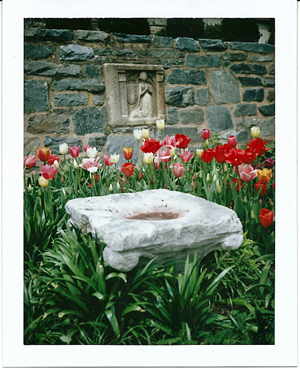
Every Easter, the All Hallows Guild at Washington National Cathedral plants gorgeous rows of tulips along the northern border of the Bishop’s Garden. This year, I saw Easter Sunday as an opportunity to test the Land Camera’s eye for color.

This picture was taken just to the right of the cathedral’s charming and temperamental medlar tree. That’s a 15th-century granite bas relief in the background; in the foreground, a weather-worn 13th-century limestone capital from Cluny now does humble duty as a birdbath.

When Fuji decides to stop producing this last line of color film for old Polaroids, the camera that took this photo will immediately become less useful after only five decades than this capital remains after 800 years.

* * *

Polaroid didn’t offer an extensive line of accessories for the Land Camera, but their add-ons did include a “close-up kit” consisting of a snap-on lens and viewfinder for subjects 9 to 15 inches away. Polaroid co-founder Edwin Land was an optics genius; the camera’s bulk and its imprecise focus lever make the macro kit hilariously difficult to use, but it’s remarkable that such a lens exists for this camera at all.

I know what you’re thinking: “But Jeff, everyone knows that gnomes aren’t medieval! They spread across 19th-century Europe, especially France and England, after becoming highly popular home and garden decorations in German-speaking lands during the 18th century!”

Yes, that’s true—but see those tiny purple flowers? This is actually a photo of a patch of alehoof, the mint-like weed the Anglo-Saxons used in place of hops to give their ale its bitterness. The gnome? Totally just wandered into the shot.

* * *
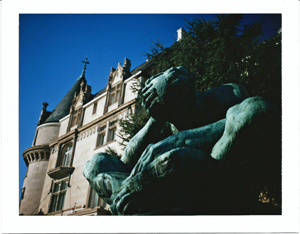
This statue in front of the Embassy of Croatia is one of my favorite modern interpretations of a saint. It depicts a naked St. Jerome hunched over a large book and clearly in the midst of some unknowable fugue of frustration, perplexity, and fascination. That’s also the pained posture my grad-school friends and I assumed when we struggled our way through Jerome’s complex, sophisticated Latin.

At the mercy of the position of the sun and an old camera that over-emphasizes shadows, I’ve returned several times to try to re-do this shot. It’s not quite right, but I like the angle, and the suggestion, at first glance, of a larger story.

* * *
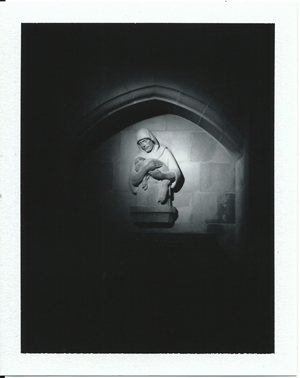
 “…but alle shalle be wele, and alle shalle be wele, and alle maner of thinge shall be wel.”

Sometimes you get lucky. In the crypt of the National Cathedral, there’s a stark little chapel lit only by indirect sun. On a frigid January afternoon, on one of my first Polaroid outings, I leaned on a pew and impulsively took a picture of a statue of the Good Shepherd. The resulting image stunned me; I couldn’t do it again if I tried.

Earlier this year, Fuji stopped making this fast black-and-white film, and I’ll deplete my own hoard of the stuff by early next year. Until then, I’ll expand my repertoire of tricks, try to reframe medieval-ish subjects when I see them, and keep learning how to use this camera based on what shadow and sunlight demand.


“Dust you down from tip to toe…”

[Matters of health and wealth—or, to be clearer, a pronounced lack of both—have kept this blog silent for longer than I’d like, so here’s a timely but updated post from 2012.]

For seven years, this blog has argued that medievalism is durably American. From Gothic synagogues in the South to killer queens in New Jersey, from Cajun jousters and the saints of New Orleans to the gargoyles of Perth Amboy, from rivalries on the Potomac to dragons and Vikings at seaside resorts, from late-blooming scholars on postage stamps to courtly love on General Hospital, American medievalism is rooted in an unresolvable clash of classical and medieval aesthetics, the persistence of religious traditions, and complex nostalgia for Europes that never were.

But did it have to take root in my garden?

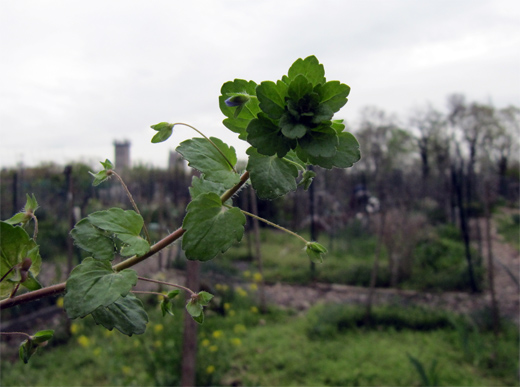
Meet Glechoma hederacea, the mint-like ground ivy called “creeping Charlie” in the United States and known, at least around my place, as “existence’s bane.” Rampant, sinister, nigh-unstoppable, this weed was brought to North America by early European settlers, who presumably appreciated its value as ground cover and its not-unpleasant scent.

Medieval people found Glechoma hederacea medicinally useful, as shown by a drawing of the stuff in a tenth-century manuscript from Constantinople. At the Metropolitan Museum of Art, you can buy a watch and other jewelry based on its depiction in a 15th-century woodcut, gifts apparently intended for people who’ve never torn intractable fistfuls of the stuff from the contumacious earth.

More interesting is its etymology in England, where it’s known as Gill-on-the-ground or, intriguingly, alehoof. Britten and Holland’s 1886 A Dictionary of English Plant-Names claims the word comes from “‘Ale-hoove,’ meaning that which will cause ale to heave, or work,” because in an era sans hops, the Anglo-Saxons used the plant to give their ale its bitterness. (The 2007 Dictionary of Plant Lore quips, too defensively, that “there have been other attempts at its etymology which may safely be ignored.”) The Bosworth-Toller Anglo-Saxon Dictionary finds the plant simply called “hófe,” with references to mersc-hófe, “marsh-hove,” túnhófe, “yard-hove,” brúnhofe, “brown-hove,” and phrases in medicinal texts such as genim hófan, “take hove.” If *ealu-hófe was an Old English word, no written trace of it survives.

The word may be gone, but the plant endures, creeping just beneath the soil, breeding pernicious new nodes as it roams. You can slow its advance, but smother it in mulch and it summons demonic strength and pushes ever upward. Like a neglected chip of pure evil smoldering in a toaster oven, alehoof is almost impossible to eliminate. “[P]ut every scrap of the plant in a bag and throw it away,” one site advises, “or it will reroot and take over again.” Other sites suggest tracing the runners several feet to their origin and, like Beowulf before you, destroying the monster’s mother, even if doing so leaves craters in your lawn.

Whatever medicinal purposes medieval people found in alehoof, it’s now thought to be toxic in large amounts. And don’t be fooled by those dainty, bumblebee-pleasing flowers; when alehoof goes berserk, as it did in a neighboring plot, it can help bring down an unsturdy fence.

It’s enough to make a despondent gardener fall back on an Old English plea to the forgotten goddess Erce:

Geunne him,
ece drihten,
(and his halige
þe on heofonum synt),
þaet hys yrþ si gefriþod
wið ealra feonda gehwaene,
and heo si geborgen,
wið ealr bealwa gehwylc,
þara lyblaca geond land sawen.

[“Grant to him, eternal ruler (and his holy ones, who in heaven are), that his ploughing be protected against any and all enemies and it be guarded against each and every evil, against those spells sown through the land.” trans. K.A. Laity]

Or maybe, in the proper spirit of the Anglo-Saxons, magic needs to surrender to stoicism. “Most subject is the fattest soil to weeds,” shrugged a poet who put words in the mouth of a king. Like medievalism, alehoof has taken perennial root; from gift shops to gardens, it’s fated not to fade.

“Oh, we won’t give in, let’s go living in the past…”

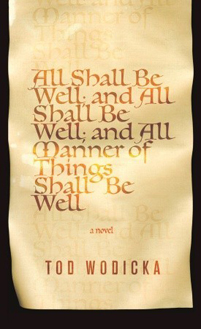
Because I’m always on the lookout for medievalism, I was naturally drawn to Tod Wodicka’s 2008 novel All Shall Be Well, and All Shall Be Well, and All Manner of Things Shall Be Well, with its gloriously unmarketable title based on a famous line from 14th-century English mystic Julian of Norwich. I expected an enjoyable story that didn’t show much awareness of medievalism or the Middle Ages, but instead I found just the opposite: characters and a plot that didn’t thrill me, but which were wrapped up in fresh, perceptive ideas about why some Americans throw themselves headlong into the medieval past.
The narrator of All Shall Be Well, homely and awkward 63-year-old Burt Hecker, owns an inn in upstate New York, but the true focus of his life is the Confraternity of Lost Times Regained, the medieval living-history society he founded in 1965. Burt makes his own clothing, brews his own mead, treats ailments with pinches of herbs, and spurns potatoes because they’re OOP, “out of period.” He’s the father of medieval reenactment in America but a lousy family man in every other respect. His son is a brilliant but deeply introverted musician, his daughter is a resentful sci-fi geek, his mother-in-law is obsessed with the persecution of her Carpathian countrymen—and all of them hate his guts.

The American wretch pining for the Middle Ages has become a recognizable literary type—think Miniver Cheevy or Ignatius Reilly in A Confederacy of Dunces—and there are obvious hints of Ignatius in Burt. He dislikes the modernity of California, reacts prissily to a Prague strip club, and regrets when necessity pulls him “toward the crashing promiscuity of the century waiting outside.” Unfortunately, his persnickety moralism is too inconsistent to be plausible, and any comparison with Confederacy would be misleading. All Shall Be Well isn’t anti-heroic farce; it’s a novel about alcoholism, family estrangement, and the burdens of the past. Much of the laughter here is rueful.

As Burt plods through a series of misadventures—in Europe in the 1990s and in flashbacks in upstate New York—we learn about his past, particularly the incidents that made his family flee. Can several strong, strange personalities forgive each other when the one woman who held them together is dead and gone? Wodicka doesn’t seem to know, and I confess that between Burt’s awkward passivity and the dislikability of his family, I was tempted not to care. Fortunately, All Shall Be Well takes on, however indirectly, a bigger and more interesting question.

Throughout literature and pop culture, medieval reenactors and Ren Fest aficionados tend to get one of two treatments: They’re either enlightened oddballs whose willful weirdness makes them morally superior to the rest of us Muggles, or they’re portrayed as dysfunctional losers who couldn’t possibly hold jobs, have sex, or survive in the world. Wodicka toys with both of these notions, but he sees that there’s more to American medievalism than mere escapism. He’s sensitive to the disorientation and frustration of “historically displaced people”—but he’s blunt about them too.

When Burt falls in women whose medieval music-therapy workshop focuses on Hildegard of Bingen, he finds them silly, but also he appreciates their need to decorate their inner lives with medieval spolia:

And though Hildegard affirmed the lowliness of womankind and the subjugation of female sexuality, Tivonia and the girls saw her as a proto-feminist New Age icon, not the Catholic scold she undoubtedly was. No matter. History is ever ours for the reliving . . . To the girls, the medieval woman was a person capable of great self-assertion, so they studied what they believed to be instances of this, ferreting out kernels of sassiness from the most minor of references, building a fairy-tale history and peopling it with sisters-in-arms. The medieval woman was them, only more real. Them, with a less cluttered connection to the eternal.

When Burt and the tunic-clad singers arrive in Germany as emissaries from the “vulgar, unself-conscious land of American make-believe,” he discerns that the medieval world exists far more vividly in his own imagination than in the European landscape outside the car window:

I plunge my thoughts back into the roadside tumult of greens and browns. How to reconcile these lands, this scroll of Bundesrepublik Deutschland with my Middle Ages? It happened here once. But where? Despite the castles and churches, and all those townships still adhering to thousand-year-old plans, modern Germany seems a most non-historical kingdom. Safe, well-ordered, tame, all mystery long since burned away in the conflagrations of this last century.

Wodicka has noticed, rather astutely, that Americans can write themselves into an ersatz Middle Ages unburdened by actual history. For us, medievalism is personal; for Europeans, it’s unavoidably political.

Burt’s mother-in-law drives this point home. Snarling and confrontational, Anna lives for the thankless task of donning her folk costume to tell the world about the persecution of her own Lemko people in the Carpathian Mountains. Her cause is righteous, but Wodicka, in an effective bit of dark humor, portrays the Lemko as backwards and cruel, making Anna a one-woman living memorial to people no one else cares to remember. Her nationalism and ethnic pride are, as these things tend to be in Eastern Europe, a dead end—but Burt wonders, in a moment of clarity, if his own frivolous approach to history mocks her cause.

Does whimsical reenactment of the past belittle real people who suffered and died? I’ve never seen this question asked in fiction, and I’ve rarely seen reenactors or their critics address it. “I believe that some of us were ourselves only during the act of re-enacting,” Burt says, arguing out that daily life is already a series of masks, costumes, and roles, even as he concedes that he may have taken it way too far. As he tries to reconcile with his family, he describes them as “twenty yards and six hundred years away,” finding in history an unfortunate metaphor for the awful consequences of his actions.

Although I wanted a more decisive plot, I found plenty to like in All Shall Be Well, including some good writing in two harrowing deathbed scenes and a beautiful prose poem from the perspective of Hildegard of Bingen that frames the entire book. Wodicka has thought deeply about how Americans mash-up European history to give their lives meaning, and his conclusions are stark: We don’t reenact the past, but reinvent it for our own purposes; eccentrics can cause their loved ones terrible pain; and there’s only so much hope for the unfortunate souls trapped in “the rotting present of of a life lived perpetually out of period.”

“Safe were the folk words of truth would upset…”

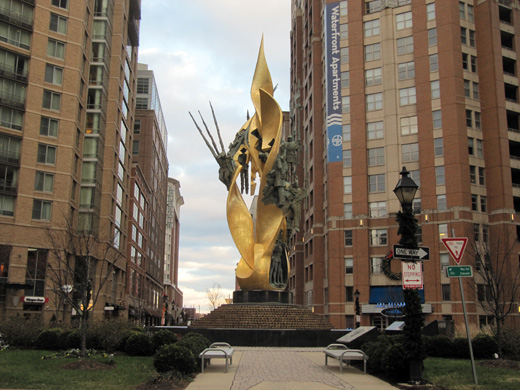
Baltimore is a rewarding place to hunt for traces of the Middle Ages, from the extensive collection at the Walters Art Museum to the ersatz medievalism of the Bromo-Seltzer Tower —but a few weeks ago, in a redeveloped circle where the Inner Harbor meets Fells Point, I was struck by a column of burning knights.

Conquistadors? Crusaders? No—they represent something far more serious than I’d expected to find alongside J. Crew, Starbucks, and Haagen-Dazs.

That’s the National Katyn Memorial, designed by sculptor Andrzej Pitynski and dedicated in 2000. It reminds the world that in 1939 and 1940, the Soviets massacred thousands of Polish military officers, most of them reservists—teachers, doctors, priests, rabbis, lawyers, and civil servants who resisted Stalinist indoctrination in prison camps. For decades, the Soviet secret police tried to cover up the slaughter.

Putin’s Olympics are a fitting time to remember the Katyn massacre. You can learn more about it at the National Katyn Memorial website, the National Archives, and the PBS website—but what makes this memorial a suitable subject for this blog is its medievalism.

According to the plaque beneath the sculpture, the 44-foot flame symbolically “envelops the Katyn martyrs . . . and raises them spiritually into the pantheon of national heroes of Poland.” Three Polish officers (including the only known female victim) burn at the base, while other bound victims writhe higher up.

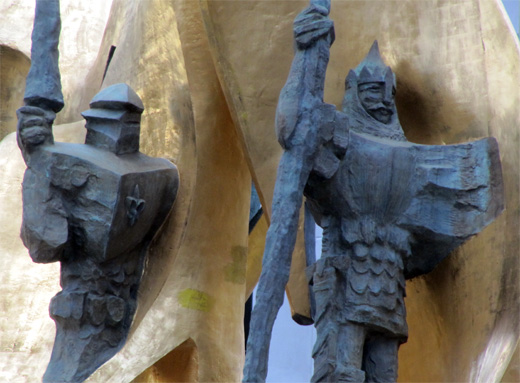
Throughout the flames stand the souls of medieval knights.

On the right is Boleslaw the Brave, the first crowned king of Poland, born in the year 967. Alongside him is Zawisza the Black, the 15th-century knight who died trying to keep the Ottoman Turks out of the Balkans. Elsewhere, you’ll find King Wladyslaw III, who also died fighting the Turks in 1444, plus a few more recent heroes: Jan Sobieski, Kasimir Pulaski, and Tadeusz Kosciuszko.

The Katyn Memorial is sobering, but at 44 feet high, it also conveys heroic permanence. We now expect atrocities to be memorialized through grim slabs of black marble with no features other than the names of strangers, but here, recognizable human figures united by defiant nationhood illustrate an ongoing story of human evil purified by the fires of patriotism.

When medievalism flares in central and eastern Europe, it’s rarely charming: Ossetian separatism, Kyrgyzstani terrorism, Serbian nationalism, royal Ukrainian saints who buried their enemies alive—the list goes on, and it’s not confined to the largely benign medievalism that thrives in the United States.

It’s an old story in Europe: Leaders rally their restless tribes by exploiting their medieval roots. What’s happening in Baltimore is more typical of the way America tempers medievalism: The worst burns away, leaving the laudable goal of simple remembrance.

“But I say it’s only mountains and the sea…”

Nestled in the Caucasus like a goblet of leopard blood in Vladimir Putin’s mailed fist, Sochi is basking in worldwide attention. The Black Sea site of the Winter Olympics is just up the coast from the Georgian border, and the media is starting to ponder this umbrous and ungenteel land: Sky News offers a primer on the violent history of the Caucasus, al-Jazeera reports that a “forgotten insurgency” called the Caucasus Emirate is simmering, and the National Geographic website reminds readers that the Caucasus are a “cauldron and pretty unstable” and that “the games themselves are reigniting deep enmity.”

Dutiful and dull, these news reports fail to capture the sheer sheep-face stew of regional history. For that, you need to seek out one of the great, gonzo books about the Caucasus: W.E.D. Allen’s A History of the Georgian People.

Published in 1932, Allen’s tome was once the standard history of Georgia in English, but the author of a recent survey calls it “antiquated.” Perhaps he’s thinking of passages like this one:

Between the time when the oceans drank Atlantis and the rise of the sons of Aryas, there was an age undreamed of. And unto this, Conan, destined to wear the jeweled crown of Aquilonia upon a troubled brow. It is I, his chronicler, who alone can tell thee of his saga. Let me tell you of the days of high adventure!

I’m kidding—but only a little. Here’s W.E.D. Allen’s take on the Caucasus in the 7th century B.C.:

And when the Swarming Time was over, and men began to rule in cities, and others to write again, these shifting peoples emerge into the light of history; with changed names, moulding languages and old traditions, borrowed from the word-of-mouth anthologies of conquerors and conquered, woven to the doubtful fabric of a common history.

Here’s Allen’s snappy summary of how a medieval quasi-state emerged in the Caucasus:

For two generations or more there were difficult manoeuvres, obscure dynastic skirmishes, ferocious little wars between the pushful princes of young mediaeval Georgia.

Here’s Allen’s description of the Georgian national character, which I think he considers flattering:

The Georgians retain in a remarkable degree, both individually and as a people, the clear and gentle outlook, the free and inquiring intelligence and the high amoral and untrammelled mind of primitive man. The generosity, the loving simplicity and the humanity, the animal love of life which characterizes the Homeric poems and the ancient literature of the Celts and Scandinavians lights the pages of the mediaeval Georgian epics and declares indeed the mind of the Georgian these days.

At the same time the climate is a mellow joyous climate and the wine is good, so that neither the air nor the diet are conducive to the worrying over principles and the gnawing over grievances.

And here—and oh, how I love this one—is Allen’s ode to the ancient city of Kutais:

In the last foothills of the Caucasus fineing to the Colchian plain, in the sparkling sunshine, the river gleaming past down from the mountains to the sea, the lovely city stretches lazy brave and laughing, like as it were to some free woman who has known so many grasping dirty masters, and remains fresh in all her shame.

I’ll admit, I didn’t expect to find an affectionate city-as-whore simile in an overview of Georgian history. By that point, I was lost in a twisting maze of tribes, dynasties, and place-names—but I was also determined to find out what Allen, with his own strange sense of decorum, intended to swoon over next.

Who was W.E.D. Allen? Born in 1901 to Ulster Protestant stock, Allen was the Eton-educated scion of a printing-and-advertising family. In addition to A History of the Georgian People, which he wrote when he was 29, his scholarly work included the much-touted Caucasian Battlefields and the journal Georgica. Allen served as a war correspondent, worked for the Foreign Office in Beirut, Mosul, and Ankara, and endowed the National Gallery in Dublin with Orthodox icons and other treasures, many of which he had found being sold as “debris” in Istanbul bazaars. At the time of his death in 1972, his private library on Russia and the Caucasus was hailed as “probably one of the best on the subject outside the Soviet Union.” Allen also represented West Belfast in Parliament as an independent Unionist, and—although his scholarly biographer passes over the fact in silence—he was a behind-the-scenes Fascist who wrote for the periodical The Blackshirt under a pen name.

What Allen’s biography doesn’t tell you is that A History of the Georgian People is not a logical endeavor. No, it’s a glorious mess—a rhapsodic brain-dump by a scholar so sunk in his subject that he can no longer outline it for newcomers. Calling his own treatment of Georgia “horizontal rather than chronological,” Allen assumes his readers possess encyclopedic knowledge of Caucasian, Byzantine, and Middle Eastern history. His narrative, too detailed to convey the wider drama and too burdened by minutiae to be novelistic, often gets ahead of itself: Why herald the death of King Bagrat III—a would-be Charlemagne of the Caucasus—when you haven’t yet told us who he was?

I’ve found it impossible to get more than 100 pages into Allen’s history, but I confess that with the regret of a traveler who longs to return to some far-flung place. I’m beguiled by the promise of more florid musings like this:

Here are no serried ranks of causes and effect, no steady march of progress, no smug train of evolution. All the nations of the world have drifted through the Caucasus; all their leavings are to find—but little has been built. Here are the ways of God and men, most horrible and lovely, uncertain and not comprehensible. Such things we may contemplate, learn somewhat, understand a little, and wonder at the colour and the clouding and the sun upon it all.

A History of the Georgian People may be obsolete, but only as scholarship. As a love letter to the Caucasus, it’s remarkable—and, like a love letter, it’s worth digging out every now and again for the lingering whiff of a past that refuses to die.

“And it’s true, if all this around us is paradise…”

I don’t actively look for these things. No, sometimes I just happen to be visiting family in New Jersey when I pull off the highway to skirt some traffic, drive through an unfamiliar downtown, and HOLY CROW—

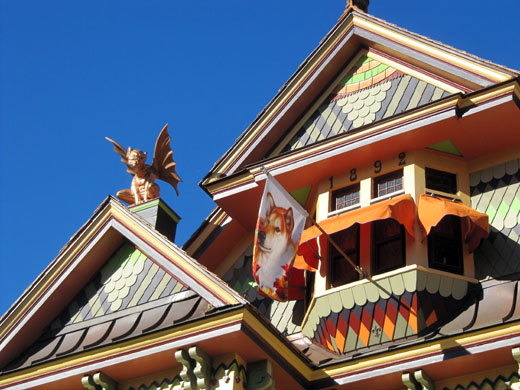
This glorious seventeen-minute Thompson Twins dance remix of a house was built in 1892 by the local mortician as a wedding gift for his bride. All of the other mansions on Stockton Street in Hightstown gaze on it in wonderment and envy, because even though the asymmetrical Elmer Rogers House isn’t really Gothic in design (it’s more of a Queen-Anne’s-flashy-American-cousin), check out what it does have.

Monsters on the roof!

Leering beasties on the highest peaks!

A wingèd sentinel eyeing intruders with eerie patience.

Every shingle, every tile, every baluster and brace sports a carefully chosen color, and other photos show that the flags and awnings change with the seasons. (The house is also festooned with little fleurs-de-lys.)

The front yard is a choreographed riot of medievalism: an angel, a saint…

…a gryphon…

…and dragons.

So why has the Rogers House spawned a quasi-medieval fantasy world? Maybe that round turret screams “castle” to the current owners, or perhaps the meticulous, old-fashioned care necessary to restore and curate such a monumental home feels “medieval” to Americans who are inclined to collapse the past into a blur of “olden times,” when skilled craftsmen begat gargoyles, dragons, angels, and saints.

Or maybe their motive is more timeless. People variously perceive the medieval world as teetering between austerity and chaos, ignorance and enlightenment, but the owners of the Rogers House endorse a different predilection, one that’s never as common as it ought to be but which does have its place in the Middle Ages, as long as you know where to look: a pure, prismatic delight.

“…and in a yellow taxi turn to me and smile…”

As the Dennis DeYoung of medievalism-themed blogs, “Quid Plura?” loses its voice from time to time, only to come screaming back amid synthesizer-fueled fanfare. These days, I’m working on two books, one of them a translation of a medieval poem, but blogworthy medievalism is never far from my mind—because I live in what is arguably the most medieval neighborhood in Washington.

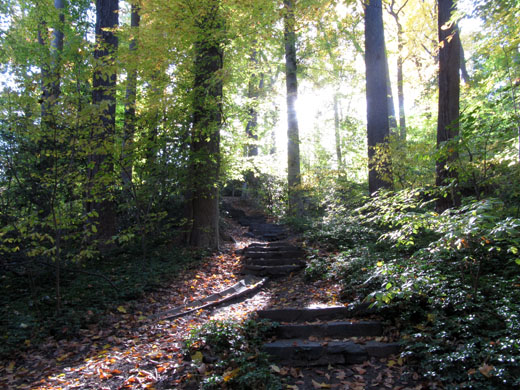
I’ll show you what I mean. First, hike uphill through my substitute for a back yard, a nature conservancy named for a 13th-century Welsh market town…

…to emerge beneath the watchful eyes of these elementary school elves…

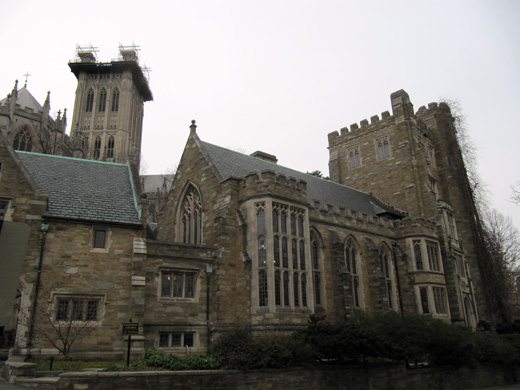
…before we hurry past the castellated, gargoyle-festooned (and recently shuttered) preachers’ college…

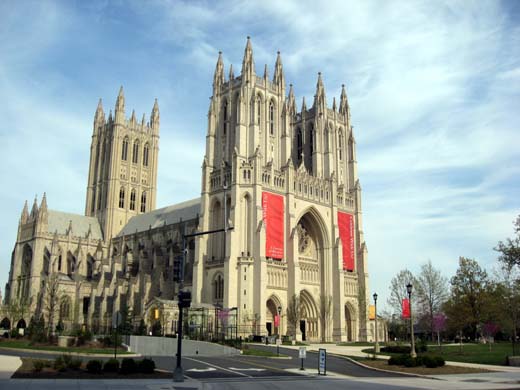
…to explore the grounds of our neighborhood English Gothic cathedral (shown here pre-earthquake)…

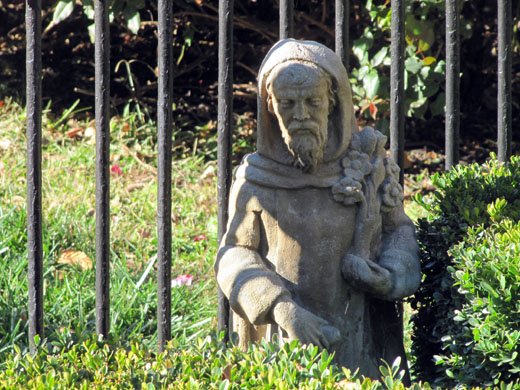
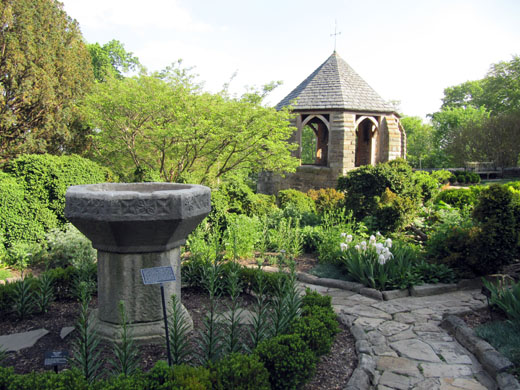
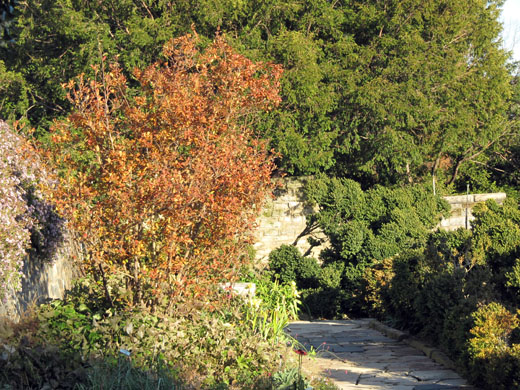
…with its thriving garden devoted in part to Walafrid Strabo, tutor to Charlemagne’s grandson…

…and decorated with a medlar tree right out of Chaucer and a worn capital from the monastery of Cluny, all of it just footsteps from a tree grown from the Glastonbury Thorn…

…and across from an apartment house with a Gothic, grotesque-festooned facade.

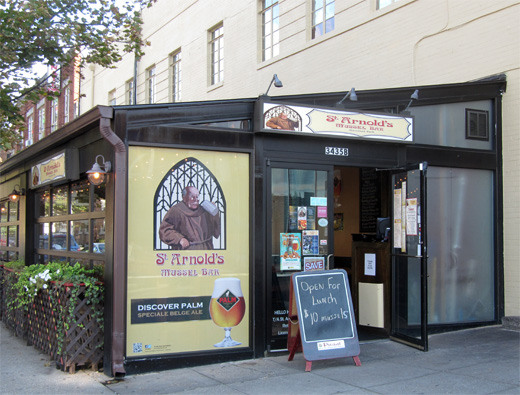
Touring romanticized reminders of medieval culture can be tiring, so trudge downhill and relax with a pot of mussels and Belgian beer at a joint named for a mash-up of the Merovingian Saint Arnulf of Metz and an 11th-century saint from Soissons.

Last week, I stopped to gawk at a troupe of Morris dancers outside a nearby pub, and sometimes there’s a bust of Dante in a shop window down the block—but why chase them down? I won’t soon run out of material, and this unlikely pageant of saints, gargoyles, and European ghosts only makes it easier to work on medieval-themed books. Even in a neighborhood where few others hear them, the echoes of the Middle Ages never end.