“Where the scent of wild roses turns the milk to cream…”

What hath the Renaissance faire to do with psychedelic rock? The vogue for “world music”? The frilly shirts of Jimi Hendrix? The rise of craft breweries? The House Un-American Activities Committee? Before reading Well Met: Renaissance Faires and the American Counterculture, I hadn’t thought to ask—but Rachel Lee Rubin’s book is a useful reminder that pseudo-medieval pursuits are sometimes more about the present than they are about the past.

Rubin starts with the basics: how the first faire grew out of a children’s commedia dell’arte troupe organized at a California youth center by teacher Phyllis Patterson. In May 1963, Patterson and others organized the first “Renaissance Pleasure Faire and May Market” as a fundraiser for left-wing Pacifica Radio, drawing more than 3,000 revelers to a North Hollywood ranch. Associated with hippies and drugs by local detractors, the event quickly outgrew Pacifica. It spawned its first imitators in Minnesota and Texas in the early 1970s; more than 200 Ren fests of varying sizes now thrive across the United States.

So how did a countercultural crafts-and-music romp evolve into a nationwide subculture overseen, in some cases, by a large entertainment corporation? Well Met doesn’t chart the growth and commercialization of the Ren faire. Instead, Rubin has two goals: to explain “the ways in which various forms of cultural expression ‘tried out’ first at the faire became recognizable staples of American social and cultural life,” and to restore the Renaissance faire to a central place in the history of the counterculture. Once I got past my initial disappointment that the book wasn’t a history, I was won over by Rubin’s argument for the importance of the Renaissance faire to the culture of the 1960s and 1970s—and its long-overlooked ubiquity.

Her evidence is legion: how the Los Angeles Free Press began as the Ren faire newspaper; how Americans, who now consume beer from nearly 2,500 craft breweries, first sampled ale at the faire; how fashion choices and even the typefaces on psychedelic album art recall early faire fliers; how the faire anticipated renewed markets for handmade crafts and set precedents for large outdoor rock concerts; how occasional faire-goer Michael Jackson mimicked the moves and style of faire mime Robert Shields; how the Flying Karamazov Brothers, the Firesign Theater, and Penn and Teller all got their start at Ren faires; and how the faire coincided with a Middle Eastern cabaret boom in California that helped build an audience for international music. Rubin even suggests that the Ren faire helped revive interest in the klezmer. Who knew?

Although Well Met is packed with wonderful “aha!” moments, the book does wander. Sometimes, disorganization drives Rubin to interesting places, as when she asks black faire-goers and plus-sized women about their experiences, or when she randomly chats up knights and wenches about the faire as a gay-friendly environment, a refuge for misfits, and an escapist haven where costumes deliberately obscure real-world class signals. At the same time, there’s way too much detail about the history of a couple of psychedelic bands, and a chapter about Ren fests in fiction feels like a conference paper brought in to serve as padding. It’s particularly jarring when patches of academic jargon turn up in such an accessible and pleasantly written book, as when Rubin muses on “the ways in which the faire has enabled (perhaps paradoxical) strategies of resistance to the very forces of corporatism and cultural centrism that have inexorably resituated it in the American expressive landscape.” Surely there’s a less turgid way to say that.

Well Met also frustrated me with the tantalizing questions it doesn’t ask. Rubin mentions conservative critics of those first California Ren faires, but she provides almost no information about or firsthand commentary from them. Why not? Did neighbors’ complaints about traffic, drugs, and crime have no validity? Picking though pseudonymous rants on message boards and blogs, Rubin devotes one chapter, shorter than the others, to “Hating the Faire.” She catalogs all the usual gripes about Ren faires, pointing out that accusations of nerdish celibacy exist alongside the contrary complaint that faires are over-sexualized. But are there no valid criticisms of Ren-faire culture beyond the ones Rubin handily swats down? Are the only disillusioned folk the wistful souls who wish the faire were as spontaneous and uncommercial as it was in the ’60s? Are there credible witnesses to the dark side of faire life? What does it mean that so many faire-goers told Rubin they’re “working class,” and can we trust their self-reporting? Rubin sometimes seems so charmed by Ren-faire subculture that it delights the cold spirit of scholarly inquiry right out of her.

Of course, I’m in danger of faulting Rubin for the book she didn’t write, when she’s clear about the purpose for the one she did. Perceptive and engaging, Well Met proves something the rest of us shouldn’t have missed: that the Ren faire isn’t an isolated cultural strand but a subculture that’s more interwoven with the rest of American life than even many faire-goers appreciate.

Well Met also answers, mirabile visu, a question that’s long nagged me: Why the heck aren’t they called “medieval faires”? According to Rubin, co-founder Phyllis Patterson did pitch the first faire to Pacifica Radio as a medieval-style open-air festival, but “[a] lawyer on KPFK’s board reportedly objected on the grounds that human rights in medieval Europe were so few, so Patterson swiftly suggested calling it a ‘Renaissance Faire.'” I appreciate Rubin digging this nugget out of a book of historic photos; even if Well Met doesn’t answer all of my questions, it does answer several I hadn’t known to ask—a rare feat for a cultural-studies book from an academic press, and well worth a hearty huzzah.

“We’re just fol-low-ing ancient his-to-ry…”

Every so often, I stumble onto some relic of American medievalism that seems charming but inconsequential—until a bit of digging brings out something more.

Behold: “I dreamed I was a medieval maiden in my Maidenform bra,” an ad that ran in magazines in 1959 and 1960. (Click here to see it larger.) The ad is based on the late-15th-century “Lady and the Unicorn” tapestries designed in Paris, woven in Flanders, and now on display at the Musée National du Moyen Âge in Cluny. Five of the tapestries are devoted to the senses; a sixth tapestry has been variously interpreted.

Maidenform’s “I Dreamed…” campaign, which began in 1949 and ran for 20 years, was apparently so successful that it’s still studied in business schools. The other ads weren’t medievally themed, but they all showed a shirtless woman in some professional or historical setting. The “medieval maiden” ad stands out, though, for its fidelity to its source.

Place the ad and the tapestry side by side and you can see how little got removed (other than the maiden’s blouse).

The heraldic symbols on the banner (and on the unicorn’s little Thundershirt-shield) are intact, even though they’re meaningless now. The grimacing lion is gone; modern people might have have been distracted by him or found him comical. The woman no longer holds the unicorn’s horn but caresses it near its mouth. She’s also been decked out in a hat on loan, I would guess, from the neighborhood gnome.

Maidenform was determined to portray not just some fantasy scene, but a real and very specific medieval work. Why?

For one thing, the decade leading up to this ad was florid with chivalry, at least at the movies: Rogues of Sherwood Forest, Ivanhoe, Richard and the Crusaders, Knights of the Round Table, Prince Valiant, Lady Godiva, The Court Jester, Saint Joan, The Vikings, and at least two TV versions of A Connecticut Yankee. (With The Seventh Seal and The Virgin Spring, Ingmar Bergman cast a pall over these Technicolor revels, but he was an anomaly.) It’s no wonder that a couple years later, the press was quick to cast John F. Kennedy’s candidacy and presidency in terms of fair ladies and storybook heroes—even if there’d be no “Camelot” talk until after his assassination.

But maybe the Maidenform maiden is more of a high-culture dream. At the end of the 1950s, tapestries were big news: A decade earlier, the Metropolitan Museum of Art had hosted a show about French tapestries from 1375 to the present, and in 1958 and 1959 the Cloisters made two major tapestry acquisitions. In 1959, the Philadelphia Museum of Art acquired several tapestries about the exploits of Constantine, while the Brooklyn Museum showed off Norwegian tapestries from the 16th through 18th centuries.

(…and curiously, the New York Times reported in May 1958 that sculptor Elbert Weinberg had installed a terra-cotta lady-and-unicorn in the lobby of 405 Park Avenue.)

In 1959, American medievalism was enjoying a sort of historicist autumn. Renaissance fairs were a few years off and Tolkienesque fantasy had yet to go mainstream, so when people thought of the Middle Ages, they imagined the tidy past they enjoyed in movies—and, apparently, in magazine ads.  It took me only a few minutes to find several advertisements from 1958 to 1960 that make the Middle Ages look as pleasant as it did in the movies of the time.

Plymouth Gin evoked jousting to invite Americans to join an international band of drinkers, pharma giant Parke-Davis paid tribute to hospitals in 12th-century France, Chivas Regal reveled in Scottish heritage, and the Grant Pulley and Hardware Corporation, makers of sliding doors, assumed you would know what a “portcullis” was. The medieval people in these ads—knights, nurses, architects—set precedents, and served as examples.

When Austrian historian Herwig Wolfram considered American medievalism in the 1970s, he saw more than folly. “What might sometimes appear to a European as slightly comical is nevertheless an expression of astonishing vitality,” he wrote. “And what many a dry pedant might dismiss as low-brow is in reality a kind of learning experience on a level different from that to which most Europeans are accustomed.” Interweaving high and not-so-high culture, the Maidenform ad shows the mass appeal of America’s medieval dream, even if nobody’s heeding the small print: “The past was never quite this perfect!”

“Not under the thumb of the cynical few…”

“In fact, the great champions of liberty against oppression, if their own words are to be trusted, have fought for the maintenance of liberties inherited from the Middle Ages. In our own day such traditional conceptions of liberty appear less seldom perhaps, for many liberals, and certainly most extreme radicals, are now frequently struggling for rights for which the Middle Ages can furnish few precedents. But this should not blind us to the all-important fact that for a long period in this historic struggle, indeed for the whole of the early part of it, it was for their medieval inheritance that all opponents of oppression engaged.”

—C.J. McIlwain, “Medieval Institutions in the Modern World,” Sixteenth Annual Meeting of the Medieval Academy of America, April 26, 1941, Princeton, N.J.

“You really ought to give Iowa a try…”

Fireworks! Barbecues! The Fourth of July approacheth, and as Americans dwell on traditions, origins, and independence from the Old World, it’s a fine time to reconsider American Gothic. Everyone knows the painting, but few people really look at it—but when you do, you’ll find that Grant Wood uses serious medievalism to find humor in a 200-year identity crisis.

Wood based his painting around a modest house in Eldon, Iowa, whose only flourish was a Gothic window he found both delightful and pretentious. Wood’s sister and a local dentist posed as the sorts of people he imagined would live in such a house; most of the time, Wood insisted that his characters were father and daughter, not husband and wife. The painting was a smash at both a 1930 Art Institute of Chicago exhibition and the 1933 World’s Fair, and in 1934 the entire country saw American Gothic in full color in Time magazine.

Art historian Thomas Hoving has pointed out the painting’s clever composition: how the top of the middle pitchfork tine marks the center of the painting; how the three tines are echoed in the stitching of the man’s overalls and in the window tracery; how the bulb at the top of the lightning rod echoes the button on the man’s collar; and how the lines of the peaked roof point directly to the man and the woman. “The house and the couple are utterly unified, like the statues on thirteenth-century cathedrals,” Hoving writes—which is appropriate, because it’s remarkable how European American Gothic actually is.

Grant Wood’s name normally evokes the Midwest, not the Middle Ages. After a stint in France and a fling with Impressionism, Wood hurried back to his Iowa home and happily let the press turn him into the champion of a new regionalism in American art. He donned overalls, sought out local subjects, and created an icon of Americana that either enshrines or mocks its subjects, depending on your point of view. “The farther a critic lived from the Midwest, the more predisposed he or she was to read the painting as satire or social criticism,” one art historian quipped about American Gothic—but what if most viewers for 80-odd years have focused way too much on the “American” and not nearly enough on the “Gothic”?

Quoth Wood biographer R. Tripp Evans: “Wood’s attraction to the Arts and Crafts movement—which advocated hand craftsmanship, rural simplicity, and even the revival of the guild system—had led him from an early age to associate his work with that of medieval artisans.” Yes, but Wood didn’t just imitate the medieval past; he found humor in comparing the Middle Ages and modern America. Last year at the Cedar Rapids Art Museum, I got a kick out of Wood’s “Mourner’s Bench,” a medieval church pew that stood outside the principal’s office at the local junior high. (The tops of the posts are faces: two disciplinarians and a wailing student.)

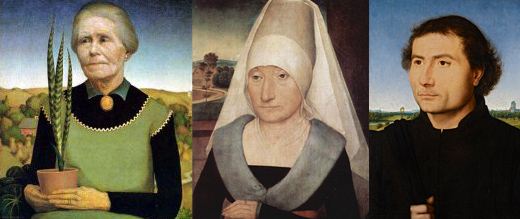
“The lovely apparel and accessories of the Gothic period appealed to me so vitally,” Wood wrote, “that I longed to see pictorial and decorative possibilities in our contemporary clothes and articles.” One art historian points out that Wood was fascinated by late Northern Gothic painters, especially 15th-century German-born Flemish artist Hans Memling. When you put some Memling portraits alongside Woman with Plants, Wood’s painting of his mother, it’s clear what he was imitating—the landscape, the poses, the stark black clothing and cloudless blue skies—with humor implicit in the comparison.
Other art historians have listed Wood’s many medieval and early Renaissance influences. Biographer R. Tripp Evans finds that the tiny bathing figures in Arnold Comes of Age (below left) look like miniature depictions of Adam and Eve being expelled from Paradise in the backgrounds of Nativity and Crucifixion scenes on medieval altarpieces, and he points out that Wood’s huge Dinner for Threshers evokes the Last Supper and mimics a medieval triptych. In Adoration of the Home (below right), Wood expert Wanda Corn sees a medieval altarpiece with a Madonna and Child surrounded by saints.

After Wood died in 1942 at the age of 50, trendier critics condemned him as nationalistic and reactionary, and some ludicrously likened his work to Nazi art. The joke’s on them: They missed the centuries-old motifs that linked Wood’s “regionalism” to traditions more venerable than most of the century’s fads.

Then again, they were only doing what most of us do: obsessing over the American while ignoring the Gothic. Photographer Gordon Parks was the first to parody the painting in 1942, and since then it’s become a boon for lazy political cartoonists, ad agencies, movie-poster designers, and anyone who wants to suggest that a stuffy, old-fashioned sensibility is being tweaked, surpassed, desecrated, defied, or redefined. Nothing is more establishmentarian than parodying American Gothic.

…and while everyone looks at the people in the painting, no one considers that silly little window behind them.
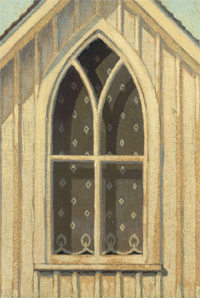
According to his recent biographer, Wood focused on arched windows and doors in his early French paintings, and he specifically said that American Gothic was meant to feature “American Gothic people” whose features complemented architecture that emphasized vertical lines. “These particulars, of course, don’t really matter,” Wood wrote in a 1941 letter. “What does matter is whether or not these faces are true to American life and reveal something about it. It seemed to me that there was a significant relationship between the people and the false Gothic house with its ecclesiastical window.”

Wood toyed with the idea of a companion painting that would have put squat Americans in front of the horizontal lines of Mission architecture, but of course he never created it—because he was beguiled by the Gothic, as two generations before him had been.

By 1930, America was coming off a multi-decade Gothic Revival bender. Since the second half of the 19th century, architects across the country had been dreaming up American Gothic buildings: churches, cathedrals, college campuses, prep schools, factories, skyscrapers, courthouses, apartments, at least one synagogue, and even crummy “Carpenter Gothic” houses like the one in Eldon. Their neo-medieval look was sometimes democratic, sometimes aristocratic, sometimes religious, sometimes secular, old and European but American and new. It’s a fine, precarious ambivalence: Are we making a New World here, or not?

Wood’s painting is satiric, but it pokes fun at pretensions that weren’t (and still aren’t) confined to the Midwest. Sometimes, Americans aspire to be medieval; other times, we’re medieval by accident. What’s great about American Gothic is that Grant Wood, however fond he is of his subjects, exposes them to democratic judgment. Each of us gets to look over the heads of two imaginary Iowans and decide for ourselves whether our collective pretensions are noble or foolish, or if we really are late Gothic people just posing in latter-day garb.

“Brand-new dandy, first-class scene-stealer…”

Civitas amoena, Wynlicburh—whatever faux-archaic nickname Baltimore deserves, the city has much of the medieval about it. The Walters Art Museum has a wide-ranging medieval collection, medieval Poles appear on an anti-Stalinist monument, countless neo-Gothic churches linger in varying states of neglect, and in Druid Hill Park, there’s a statue of a Scottish superstar.

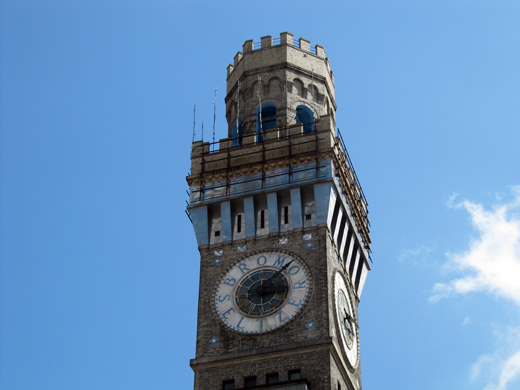
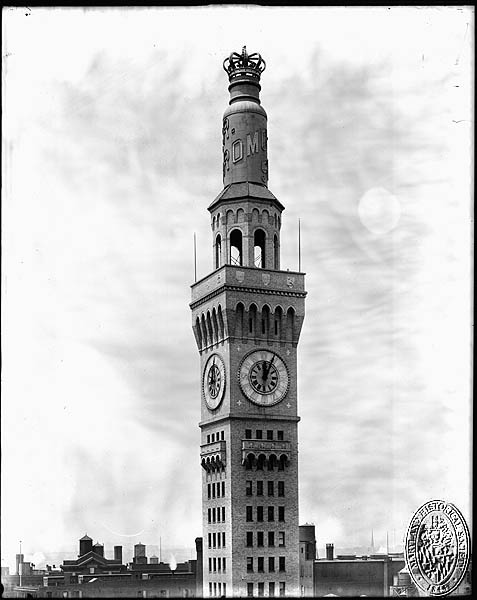
That’s why it’s easy to miss the obvious example of Charm City’s ersatz medievalia: the Bromo-Seltzer Tower, a major downtown landmark. When he leads tours, the current manager of the place calls it “the world’s only novelty clock tower built to advertise a tranquilizer-laden hangover cure.” I don’t doubt him—but the Bromo-Seltzer Tower is also Bawlmer’s monument to America’s love for medieval-ish architectural follies.

Built in 1911, the Bromo-Seltzer Tower originally had a factory at its base. Now there’s a parking deck and a fire house, while the tower provides studio space for artists who invite the public to peek inside on Saturdays. Bromo-Seltzer founder “Captain” Isaac Emerson, a flamboyant and famously insufferable businessman, built the tower to advertise his wares: Until 1936, the tower supported a ludicrously huge and glowing blue bottle with a crown on top.

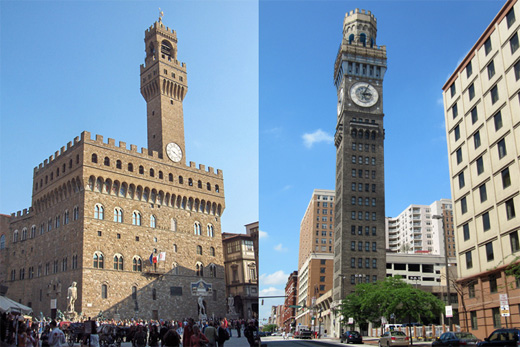
Emerson’s aesthetic was passing strange. A few years earlier in Florence, he’d seen the Palazzo Vecchio and apparently thought to himself, “I want one.” Architect Joseph Sperry, known for light eclecticism, did what he could to bring 13th-century Tuscany to the corner of Lombard and Eutaw Streets.


(Left: the Palazzo Vecchio, from Wikimedia Commons. Right: a photo I took this weekend.)

The Bromo-Seltzer Tower is clearly more of an omaggio to the Palazzo Vecchio than an exact replica, but it is closer to its source than the squat “Palace of Florence” Apartments built 13 years later in Tampa, Florida.

However, stepping inside on a summer day leads you not to medieval Italy, but back to the sweltering days of early 20th-century office life, while the timeworn interior of the clock tower looks like a cross between a Coen Brothers movie set and a vintage superhero lair. (I’ve always remembered the tower for its role as a sniper’s nest on a 1996 episode of “Homicide: Life on the Street.”)

When the Bromo-Seltzer Tower went up in 1911, H.L. Mencken was the first to hate it. “All Baltimoreans may be divided into two classes,” he wrote. “[T]hose who think that the Emerson Tower is beautiful, and those who know better.” Like Mark Twain, Mencken couldn’t see that something deeper was going on with America’s love of pseudo-medieval stuff—that we used this kind of architecture in our churches, colleges, prep schools, factories, and office buildings to brag, to be trendy, or to claim some link to the past.

Nostalgia later makes some aesthetics irresistible. Almost every brick or mechanism inside the clock tower is black, white, or gray, which makes the room seem art-directed and hyper-real. Like the tower itself, the huge, clattering, circa-1964 computer that still runs two tiny, nerve-wracking elevators is now a fascinating relic rather than an eyesore.

Facilities manager Joe Wall, a Baltimore native who’s full of great stories, told me that at some point, repair work on the tower’s rooftop cupola-thingie meant that someone added two levels of castellated ramparts that clearly weren’t there in 1911. As a result, the Bromo-Seltzer Tower is now less Italianate, more generically medieval, and a bit more like the palace-fortress that inspired it. No longer a monument to crass commercialism, it defends the notion that indulgent medievalism ages well—after the inevitable hangover.

“You should know, time’s tide will smother you…”

“You watch ‘Game of Thrones,’ right?” I often hear this question not only because people assume that medievalists are transfixed by pseudo-medieval fantasy, but also because everyone is weirdly hungry to talk about the show’s intense scenes of violence—a subject that medievalists eventually ought to confront.

Innocents nailed into spiked barrels and chucked off cliffs, prisoners of war with their eyes gouged out, tortured saints described in such awful detail by poets like Prudentius that some of my classmates got queasy—as a grad student, I couldn’t escape stuff like this, but our teachers laughed it off. One Penguin Classics edition of the Song of Roland showed a mounted knight chopping his adversary cleanly in half to expose his insides, a fate one of my professors dubbed “the bagel treatment.” We snickered at lurid maimings in the Historia Francorum and the wry post-dismemberment quips in Icelandic sagas. We were rarely invited to imagine how we’d feel if these horrors had happened to us.

All week, the Internet was abuzz over the blood-drenched “Red Wedding” episode of “Game of Thrones”; one YouTube compilation of audience reactions got more than 7 million hits in less than a week. Watch it and you’ll see ostensible adults sobbing over a TV show, a reaction I find harder to fathom as I get older and crankier and methodically work through my “bummer shelf,” which includes books about Maoist famine, Rwandan genocide, the Balkan wars—and, a few weeks ago, Jan Karski’s Story of a Secret State.

Karski was a relatively well-to-do Polish military officer who seemed destined for a bookish life—until the Germans invaded. After being taken prisoner by the Soviet army, Karski escaped and joined the well organized Polish Underground. He oversaw several key operations, survived capture and torture by the Nazis, and was smuggled into the Warsaw Ghetto so that he could describe it to the outside world. “These were still living people, if you could call them such,” Karski wrote. “For apart from their skin, eyes, and voice there was nothing human left in these palpitating figures. Everywhere there was hunger, misery, the atrocious stench of decomposing bodies, the pitiful moans of dying children, the desperate cries and gasps of a people struggling for life against impossible odds.”

Karski also recounts his 1942 infiltration of a Nazi transportation hub. Disguised in an Estonian uniform, he was there to bear witness to atrocities before smuggling himself westward to report to the (largely skeptical or dismissive) Allies. The mass execution he saw—a train car lined with quicklime, packed with Jews, and then ignited—is so horrifying that I won’t excerpt his description. After fleeing from guards who cracked jokes and took pleasure in slowly burning people alive, Karski vomited blood and bile all night, but never purged the memory:

The images of what I saw in the death camp are, I am afraid, my permanent possessions. I would like nothing better than to purge my mind of these memories. For one thing, the recollection of those events invariably brings on a recurrence of the nausea. But more than that, I would like simply to be free of them, to obliterate the very thought that such things ever occurred.

For all the horror Karski records, he also shows heroism: not only his own, implicitly, but also that of his countrymen and colleagues who endured torture, braced for arbitrary mass executions, and were ready to commit suicide to help defeat the Nazis. What shines through isn’t some Spielbergian triumph-of-the-human-spirit baloney, but the real, disquieting knowledge that although heroism arises naturally, it’s agonizing, often unremembered, and overshadowed by murder on an unimaginable scale.

When you close a book like Story of a Secret State, if you’ve spent even a little time thinking about the victims as people—not as abstractions or actors or flickering images, but as individuals like you, except that they felt every minute of burning and choking to death over several days—how do you then turn to “Red Wedding” for mere entertainment?

I won’t argue that “Game of Thrones” or shows like it “glorify violence,” an Orwellian cliché, even if I believe they do something strange to our relationship with the real thing. I’m not arguing that anyone ought to shut down violent entertainment, or that the industry should police itself or cater to my sensitivities, or that violence isn’t a vital part of literature, art, entertainment, and games. Often it’s purgative to read or write about violence, and my favorite book of the past year involves two scenes of unnerving brutality. This isn’t a call to action or a political jeremiad. I am not a pacifist.

I marvel, though, that audiences are so bound up in the selective realism of fantasy that they’ll accept the existence of dragons but will obsess, along with a forensic expert from the O.J. Simpson trial, over whether the blood spurting during the throat-slitting scenes was accurate. When an audience cares that much, is it still entertainment, or a stand-in for something else?

Last week, “Game of Thrones” author George R.R. Martin spoke sensibly about “Red Wedding” to Entertainment Weekly:

 People read books for different reasons. I respect that. Some read for comfort. And some of my former readers have said their life is hard, their mother is sick, their dog died, and they read fiction to escape. They don’t want to get hit in the mouth with something horrible. And you read that certain kind of fiction where the guy will always get the girl and the good guys win and it reaffirms to you that life is fair. We all want that at times. There’s a certain vicarious release to that. So I’m not dismissive of people who want that. But that’s not the kind of fiction I write, in most cases. It’s certainly not what Ice and Fire is. It tries to be more realistic about what life is. It has joy, but it also had pain and fear. I think the best fiction captures life in all its light and darkness.

I like Martin’s thinking—but it seems to me that the largely comfortable, middle-class viewers who can’t stop talking about his show’s violence find the darkness more beguiling than the light.

When I chat with friends about “Game of Thrones,” they speculate that the series offers a rare and refreshing sense of what the Middle Ages must have really felt like. Martin is arguably the most popular fantasist of the moment, taking up the banners of earlier authors like Sir Walter Scott and Sidney Lanier, who also served up the precise flavor of medievalism their cultures craved. They and their readers believed they had taken laudable steps toward re-creating the “real” Middle Ages, when in fact they were picking through the medieval past according to their own notions of virtue and vice—as we still do.

“No matter how much I make up,” Martin says, “there’s stuff in history that’s just as bad, or worse.” He’s right, but there’s no urgent reason to elevate fantasy by highlighting its historical echoes, and no need to absolve Martin’s work of the most grave accusation leveled at fantasy: escapism. Martin’s readers and viewers are guilty as charged only if they turn away from humanity’s pervasive worst, whether the immediate evils in the daily news or the horrors Jan Karski could never forget. Many obviously do just that, but I’ll give Martin credit for intending his books to accomplish what good fantasy should: not distancing us with flattering amusements from the way life supposedly used to be, but providing a stark, imaginative look at the way it invariably is.

“When I’ve walked in the garden, when I’m walking offstage…”

Spring is a time to remember Walahfrid Strabo: abbot, scholar, tutor to Charlemagne’s grandson, and the best known gardener of the Carolingian age. He’s memorialized at the National Cathedral garden (and got a poem of his own in Looking Up), and his 444-line poem De Cultura Hortorum, “On the Cultivation of Gardens,” intermingles plant lore, political allegory, practical advice, and philosophical musings with an exhortation to get out there and work:

For whatever the land you possess, whether it be where sand
And gravel lie barren and dead, or where fruits grow heavy
In rich moist ground; whether high on a steep hillside,
Easy ground in the plain or rough among sloping valleys—
Wherever it is, your land cannot fail to produce
Its native plants. If you do not let laziness clog
Your labor, if you do not insult with misguided efforts
The gardener’s multifarious wealth, and if you do not
Refuse to harden or dirty your hands in the open air
Or to spread whole baskets of dung on the sun-parched soil—
then, you may rest assured, your soil will not fail you.
(trans. Payne)

In the March and April dankness, I followed Walahfrid’s example—and today I reaped the year’s first harvest from my little realm of dirt.

I checked to see if Walahfrid had anything to say about radishes. Indeed he did:

RAFANUM

Hic rafanum radice potens latoque comarum
Tegmine sublatum extremus facit ordo videri
Cuius amara satis quatientem viscera tussim
Mansa premit radix, triti quoque seminis haustus
Eiusdem vitio pestis persaepe medetur.

Here’s a loose and hasty translation into pseudo-Anglo-Saxon alliterative verse:

THE RADISH

Powerfully rooted,   it raises the vaults
Of its broadening leaves    and lies waiting,
The radish you find   in the final row.
Its flesh-root shortens    that shattering cough,
Or grind up a draught    and drink the seeds:
That dose often    will do the trick too.

Walahfrid died in A.D. 849 while trying to cross the Loire. He was only in his early thirties, but he seems to have grown to prefer plants to politics—an insight rare in places of power, then and now.

(The garden in June 2012.)

“Here comes another winter, waiting for Utopia…”

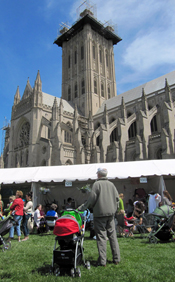
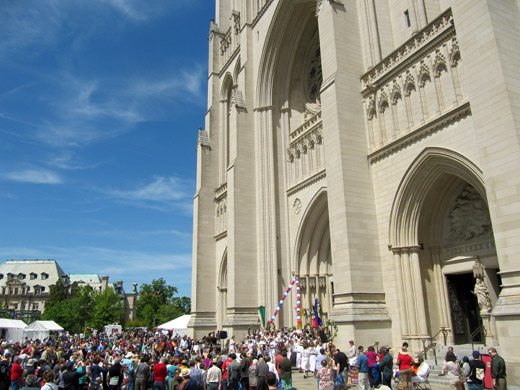
This weekend, commerce and revelry engulfed the National Cathedral at Flower Mart, the annual shindig that funds the beautification of my favorite Gothic neighbor’s gardens and grounds. Folks shopped for seedlings and dug into fried food, while I stumbled upon this NPR story about Brendan O’Connell, who paints scenes from Wal-Mart based on something he thinks he discerns there:
Wal-Mart stores, he notes, are “probably one of the most trafficked interior spaces in the world.” In the tall, open, cathedral-like ceilings of Wal-Mart’s big-box stores, he sees parallels to church interiors of old.

“There is something in us that aspires to some kind of transcendence,” he told me back in February. “And as we’ve culturally turned from religious things, we’ve turned our transcendence to acquisition and satisfying desires.”

I don’t buy the comparison. Having warehouse-high ceilings doesn’t make Wal-Mart “cathedral-like.” What does make a big box store akin to a Gothic cathedral is more banal: Look up, and you’ll see that the architectural supports in both buildings aren’t covered or obscured. (As for transcendence, Americans seek that elsewhere: sports, Vegas, the movies, and occasionally—mirabile dictu—at actual houses of worship.)

Still, artists and writers love to cast gigantic stores as misbegotten cathedrals. Five minutes on Google turns up unflattering “cathedrals of consumerism” quips in countless news stories and scholarly articles—as well as the work of artist Michelle Muldrow, who paints the interiors of big box stores for her “Cathedrals of Desire” series. Muldrow outlines her goals in a genre that would have vexed even the most patient of medieval exegetes, the artist’s statement:

“Cathedrals of Desire” investigates the experience of the repulsion and seduction of the American landscape. This new body of work incorporates the landscape painting tradition with awe-inducing elements of cathedrals to evoke a contemporary sublime. My paintings of big box stores are intended to elicit fear and awe at the vast American consumer landscape.

[…]

This series is inspired by the theories of Edmund Burke’s treatise on the sublime and its relationship with terror. This, paired with the concept of the divine power of the sublime, heavily influenced my depiction of these consumer spaces as Cathedrals of Desire.

[…]

The obtrusive massive structures built with no attempt at aesthetic beauty reveal the most naked of American consumer desires. The language of American desire can be reduced to vignettes of patio furniture and gingham covered tables set like small picnics.

I like Muldrow’s art, and she’s smart to turn her landscape-painter’s eye toward the vast places where Americans shop—but nothing about “Icon,” her painting of two shopping carts against a jumbled background, actually evokes icons, or implies anything about icons through their absence, or says anything about the absence of icons through the presence of shopping carts. While her lovely “Altar in Orange” captures the bright, asymmetrical beauty of an unmanned Target check-out line, the painting doesn’t fit its title: Altars aren’t like box store check-out stations in location, function, design, decoration, number, or sacrality.

Artists and critics have been down this aisle before. Émile Zola called the grand arcades of 19th-century Paris “cathedrals of commerce,” and Walter Benjamin “spent the final 13 years of his life…trying to fashion a theory of modernity based on the arcades.” A century ago, the Woolworth Building, one of countless American skyscrapers inspired by the Gothic, was approvingly dubbed the “Cathedral of Commerce.” By now, the comparison is cliché. It flatters medieval cathedrals by making stores seem all the more crass by contrast—but what a limited view of cathedrals.

Unlike Wal-Marts and Targets, cathedrals were each architecturally unique. They were shrines where people hoped and prayed but rarely sated their earthly desires. They were religious institutions whose spiritual offerings didn’t cater to market demands. They were political centers overseen by men who wielded far more local power than any store manager. As distinctive hubs of pilgrimage and tourism, they attracted seekers from straunge strondes in ways no standardized big-box store could, drawing worshippers from all strata of society.
One point of these art projects is to suggest that shopping is America’s religion, and a degraded one at that—but isn’t it possible that rural shoppers at big-box stores like Wal-Mart are more likely than their countrymen to attend actual religious services and distinguish between shopping and praying? Why focus on modest people who go to unfancy buildings to buy low-priced stuff that meets their earthly needs? What about wealthier people who’d never set foot in Wal-Mart but do make pseudo-religious pilgrimages to ornate boutiques to overpay for luxury goods based on a label or a name?

Two centuries after the Hudson River School painters begged Americans to adore the New World, our artists still seek the cachet of medieval European precedents. Medievalism runs rampant in America, and for six years this blog has chased it, from Gothic synagogues in Savannah to killer queens in New Jersey, from Cajun jousters and the saints of New Orleans to the gargoyles of Perth Amboy, from Oxbridge rivalries on the Potomac to dragons and Vikings at Maryland resorts, from late-blooming scholars on postage stamps to courtly love on General Hospital—but sometimes medievalism just isn’t there, or it thrives only in a critic’s misperception.

Let’s kill this “cathedrals of commerce” cliché. A vast, bustling megastore has little in common with a medieval cathedral either socially or architecturally. The wonders that landscape painters like Michelle Muldrow find at Target—man-made vistas of color and light—are worth seeing for what they are; don’t let Gothic spires warp the view.

“I focus on a face in Samarkand…”

Tom Shippey, Studies in Medievalism XIV (2005), p. 3:

“The issues, however, remain, and no modern reader can quite escape a sense, once again, that the medieval world with all its cruelty and fanaticism has not been entirely buried, is all too capable of returning to haunt us. Medievalisms remain dangerous, and dangerously vital: that is one reason why they require careful and dispassionate study, of the kind they too rarely receive inside or outside the academy.”

Eliza Shapiro, The Daily Beast, April 19, 2013:

Amir Temur, also known as Tamerlane, was a Central Asian ruler and warlord who lived in the 14th and 15th centuries. Scholars estimate that his military campaigns throughout Central Asia, Africa, Europe, and the modern Middle East killed about 17 million people, or 5 percent of the world’s population at the time.

Identifying strongly with Mongol culture, Tamerlane wanted to restore the empire of Genghis Khan and conquered the modern nations of Iran, Turkey, Georgia, Azerbaijan, Syria, India, and southern regions of Russia. He was a devout Muslim who referred to himself as the “Sword of Islam,” even though he razed many of the Islamic world’s greatest cities at the time.

Although Tamerlane died six centuries ago, his legacy still carries enormous weight throughout Central Asia. The Tsarnaev brothers are Chechen, and Tamerlan, the older of the two, fled Chechnya with his family in the early 1990s to escape the bloodshed that followed the fall of the Soviet Union. He came to the United States with his family in either 2002 or 2003 under refugee status from Kyrgyzstan.

“To say Tamerlane evokes mixed reaction across Central Asia would be an understatement,” Justin Marozzi, author of Tamerlane: Sword of Islam, Conqueror of the Worldtold the Daily Beast. “Respected as a national hero in Uzbekistan, site of his imperial capital of Samarkand, he is regarded with loathing—with good reason—by the country’s neighbors, who remember, more than 600 years after his death, the numerous outrages he committed against them.”

Tom Shippey, Studies in Medievalism XVII (2009), p. 52:

“There are . . . many medievalisms in the world, and some of them are as safe as William Morris wallpaper: but not all of them.”

“Look, a golden-winged ship is passing my way…”

My Garden State relatives and friends survived Hurricane Sandy with incredible stories to tell about living in darkness, dealing with looting and theft, and almost being flattened by trees. Over the weekend, while hanging out with family in my great homeland, I drove down the shore to see the worst of it for myself.

The ride along Route 35 was as heartbreaking as I expected, but Jersey attitude is a universal constant. On a sunny April weekend, one of the surviving chunks of the Seaside Heights boardwalk was so busy that a carny let down his guard to marvel at how “jumpin'” it was.

Folks were there to wander around, chow down on pizza and pork roll—and yes, to gawk. If you’re from New Jersey, then someplace you love was likely destroyed.

For example, beyond this sign, there used to be a 200-foot pier.

I’m not about to share gratuitous disaster photos; this blog is about finding medievalism. Even in the aftermath of Sandy, Dame Medievalism staggers drunkenly up and down the Jersey Shore—as long as you know where to look.

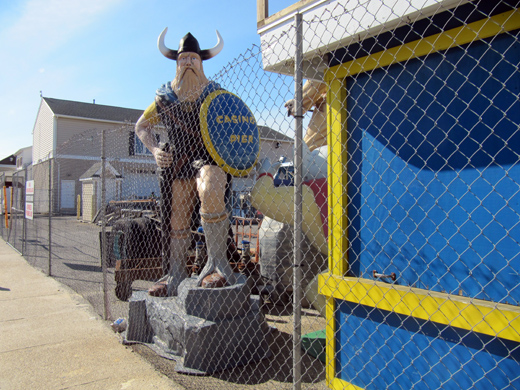
Although the storm wiped out Casino Pier in Seaside Heights, its jolly streetside facade survives, keeping out the curious…

…while across the street, a Viking watches and waits.

At Point Pleasant Beach, Jenkinson’s Boardwalk is mostly restored. The tiki bar is open, the zeppoles smell terrific, and the kiddie amusements are whirring away—including this iconic ride that invites you to fling yourself inside a dragon’s gaping chest cavity.

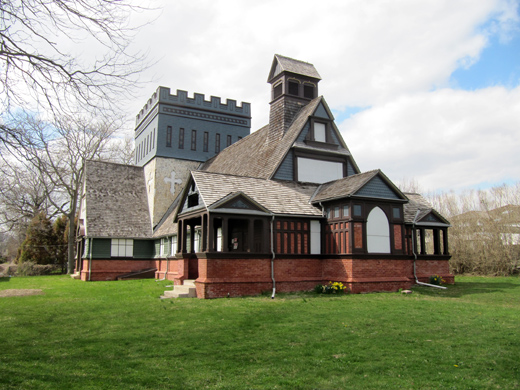
Up the road in Long Branch, my new favorite building defied Sandy: the Church of the Presidents, an 1879 masterpiece of carpenter Gothic that highlights what the Jersey Shore has always been known for: restraint and good taste.

Up in Rumson, on a charmingly landscaped plot around 1,500 feet from the beach, St. George’s-by-the-River looks like a nice, straightforward Episcopal church…

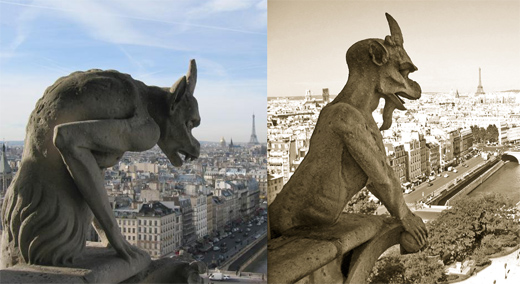
…until you realize that from one corner of its tower looms a gargoyle—the only such monster I can recall with an identifiable, even incontrovertible sex.

This weekend I saw awful sights: oceanside streets still buried in sand, bungalows tossed into piles and smashed, and one of my favorite childhood places destroyed. I also saw residents busy with shovels and saws, workers rebuilding boardwalks with heroic speed, and locals who want the world to know they’re very much open for business. At the risk of irreverence, all I can say is that if a topless gargoyle from 1908 can survive Sandy, the Jersey Shore will too, with the tenacity of medieval myth. It’s amazing what endures.