“You say, ‘ere thrice the sun done salutation to the dawn…'”

If you’re wont to ask, “Where can I see plays that have rarely been staged for 400 years?”, then hie thyself posthaste anon to Staunton, Virginia, where the American Shakespeare Center reanimates old scripts in a reconstruction of London’s Blackfriars Theater, and under truly humbling conditions: The actors perform in as many as five plays at a time, with multiple roles in each.

We popped down to Staunton this weekend to see The Two Noble Kinsmen, an adaptation of Chaucer’s “Knight’s Tale” by John Fletcher with an assist from William Shakespeare. The play is supposedly “deeply flawed,” but a dozen actors (who directed themselves) made it engaging and sharp. They earned a standing ovation—and propelled the Canterbury pilgrims through the 17th century and onto the sidewalks of a small Virginia town.

With my own ful devout corage, I did what I do in any new place: I hunted for further medievalism. After good finds in other Virginia towns—Williamsburg, Richmond, Annandale, and the imaginary Swallow Barn—I knew Staunton would come through, and it did, just up the hill from the theater.

Welcome to Thornrose Cemetery, designed by Staunton’s own Thomas Jasper Collins, who built eclectic homes and churches throughout his adoptive hometown.

Although Collins never visited Europe, he did (according to James Madison University) study Gothic Revival architecture in Baltimore, Richmond, and Norfolk. Just inside the cemetery gates is a monument to his medievalism: a stocky little keep.

When Collins went medieval by the cemetery walls, his work was striking, if too weighty to be whimsical.

Collins also designed the lovely Effinger family mausoleum, which looks like a stone drawer pulled from the facade of a Gothic cathedral.

One of the weirder corners of Thornrose leads to a monument to the Confederate dead. There’s good reason to associate faux-medieval castle ramparts with Southern chivalry, but look:

A huge neoclassical urn! A chuppah with square stone pillars and Tudor half-timbering! Civil War artillery! The committee-driven incoherence is wonderfully American.

Like Staunton itself, Thornrose grows ever more eclectic. Its wind-worn headstones aren’t lurid or sad; there’s a matter-of-factness here that harks back to The Two Noble Kinsmen:

This world’s a Citty full of straying Streets,
And Death’s the market place, where each one meetes.

A few blocks away, on a gloomy Sunday morning, you might spot the fellows who play Chaucer’s knights leaning into freezing rain and muttering lines that have only been heard from a handful of actors in 400 years. Later, on stage, they’ll offer up a fine reminder for the week before Easter: not everything that dies is gone for good.

“Look down, look down, there’s twenty years to go…”

When you’re young, it’s easy to miss the obvious. Skulking around the University of Delaware in days of yore, I wasn’t unaware of this building on Newark’s Main Street, just footsteps from the campus—but I didn’t appreciate its striking Gothic facade, and until last weekend I hadn’t really looked at…

…the canine gargoyles on either side of the entrance.

Now prospering as Newark Deli and Bagels, the storefront at 36 East Main Street began life in 1917 as the Rhodes Pharmacy. The building was designed by Richard A. Whittingham, an architect of the Maryland division of the Pennsylvania Railroad. (His other works include a now-gone greenhouse on the U.D. campus and the reviewing stand for William McKinley’s 1897 presidential inauguration.)

I’ve not yet found reason to believe that either Whittingham or his client, pharmacist George W. Rhodes, were gung-ho for Gothic architecture—but maybe this cool little building says it all. (It used to have parapets!)

By 1917, American Gothic was passing its prime among church architects even as it picked up steam among the designers of college campuses. Its use on a commercial building is rare enough to earn 36 East Main Street a spot on the National Register of Historic Placesbut I’m convinced that the gargoyles of Newark, Delaware, were influenced by a much grander building thousands of miles away.

Notre-Dame de Paris! Its gargoyles are iconic—especially the bitter critter on the cover of this book—but even many medievalists aren’t aware that he and 53 of his fellows aren’t medieval at all, but the products of an ambitious 19th-century restoration.

Michael Camille tells this story well in The Gargoyles of Notre-Dame: Medievalism and the Monsters of Modernity. By the 1840s, Notre Dame was a ruin; the cathedral had been cursed as a symbol of medieval irrationality, denuded of royal statues and other symbols of féodalité, and wrecked by weather and time. In 1843, in the wake of Victor Hugo’s fictional tribute to the cathedral’s former glory, architect Eugène-Emmanuel Viollet-de-Duc began restoring Notre Dame—which included commissioning sculptors to create the replacement monsters he dubbed chimères. Camille documents how these modern “chimeras” entered European and North American popular culture through engravings, etchings, photographs, postcards, paintings, and books—and how quickly the world forgot that they weren’t medieval creatures at all.

The 54 chimeras are a lurid lot. Partly inspired by France’s 19th-century fascination with Egypt, their fellowship includes demonic birds, a goat, an elephant, a pelican, a wild boar, a two-headed dog, a (now destroyed) unicorn, and (lamentably) a Wandering Jew. Most of them, though, are humanoid animals—which brings us back to the dog-faced beasties of Newark, Delaware.

Look at this fellow, and then consider a few of the chimeras from Notre Dame:

(Above left: Michael Reeve, via Wikimedia Commons; above right: Chosovi, via Wikimedia Commons.)

(Above left: vintage postcard of the “ape-satyr”; right: John Taylor Arms, “A Devil of Notre Dame,” c. 1929)

The Newark grotesques don’t look like any one of the chimeras on Notre Dame, but they’re arguably a loose composite of several of them. Those big, bent arms that allow the creature to lean menacingly forward are common to several of the chimeras, and we could easily build the (relatively tame) faces of the 1917 Delawareans from the ears, mouths, brows, and noses of some of these 19th-century forebears.

So did Richard Whittingham or George Rhodes dream, like Miniver Cheevy, of medieval glory?

Did they see the Notre Dame chimeras in illustrations of Victor Hugo’s Hunchback of Notre Dame? Or in the paintings of Winslow Homer? In the photography of Alvin Langdon Coburn? On postcards from family and friends?

Are Newark’s chimeras barking in defiance of home-grown architectural forms? (Weirdly, these creatures came to life the same year the University of Delaware settled on Colonial Revival, a sensible but decidedly un-Gothic style that still predominates across the campus.)

Or maybe Rhodes considered his pharmacy a cathedral and saw his work as a sacred calling?

The fun thing about American medievalism is that there’s rarely a single reason for this stuff. Just as people in 2013 have complicated motives for studying, idealizing, or reenacting the Middle Ages, Whittingham and Rhodes might have offered explanations that combined the personal, the social, the religious, and the political.

Twenty years after ignoring 36 East Main Street for reasons I’ve long since forgotten, I’m glad I looked up. You never know when the place where you first met Charlemagne and Chaucer will reveal to you, just over your head, the bewildering traces of somebody’s medieval dream.

“So we go inside, and we gravely read the stones…”

“[P]ioneering, erratic, and irascible”—that’s how scholar Andrew Wawn introduces a medievalist I’d never heard of, apparently because his spectre haunts only a few narrow stacks in Scandinavian libraries. Although George Stephens published more than 500 books, articles, pamphlets, translations, and plays, his Wikipedia entry is a sorry 120 words long, and it isn’t likely to be lengthened or annotated by legions of Tolkienesque fans. Even so, Wawn’s engaging 1995 article about him—“George Stephens, Cheapinghaven, and Old Northern Antiquity”—makes an amusing but sympathetic case for looking back at scholars of yore-days and seeing not pitiable caricatures, but weird, vivid, quizzical lives.

Wawn calls George Stephens “a fascinatingly marginal figure, an exile by choice, a rebel by temperament, cocooned in his book-lined Copenhagen study glowering across the North Sea at the (in his view) wretched condition of England.” Born in England in 1813, Stephens moved to Sweden in 1834 to teach English before taking a lectureship, and then a professorship, at the University of Copenhagen. (Hearken, jobless scholars! Three years earlier, the enterprising Stephens circulated an English-language pamphlet with the efficacious title Hurrah for Denmark.)

Stephens is one of many unsung souls who hammered out the cogs of the medieval-studies machine. He was an influential collector and classifier of folk tales, his work on runic inscriptions founded a sub-field, and he published the first translation of an Icelandic saga into English—albeit from Swedish. “He translated Icelandic sagas,” Wawn writes, “while contributing to their reoralization by writing saga-based parlor songs; he taught Shakespeare whilst himself writing plays on Viking subjects in Elizabethan style; and he contributed vigorously and unashamedly to popular polemics, finding it no mark of virtue to proclaim the virtues of a democratized literary-critical process in an impenetrable and robotic meta-language.”

He’s also easy to mock. Wawn devotes most of his article to Stephens’ virtually unread 1857 play, Revenge, or Woman’s Love, in which King Edgar of Mercia is waylaid by Vikings while on pilgrimage to Sweden, where he’s forced to summon his wife to be sacrificed to Odin. Wawn is patient with Stephens’ “pyrotechnic display of newly minted compounds, anaphoric elaboration, and (alas) syntactic congestion,” and I enjoyed picturing the climax featuring “the return of the cave-dwelling witch, accompanied by much smoke and many explosions,” but why snicker? “Notwithstanding its breathless and somewhat confusing denouement,” Wawn says, “there is much spirited and good-humored writing in the play, and it would be ponderously sobersided to miss the element of jeu d’esprit which helps to drive the whole work.”

What Wawn does here is humane. Seeing an eccentric medievalist rendered all the more comical by time, Wawn doesn’t “deconstruct,” “interrogate,” “negotiate,” or (good Lord) “problematize” him. Instead, Wawn peers into a bundle of contradictions—”the English Anglophile exiled in Scandinavia, the modern Christian fundamentalist fascinated by ancient paganism, the British Tory radical who translated a treatise in favor of an hereditary Danish monarchy”—and in 40 pages, reckons his humanity.

To my surprise, Wawn contrasts Stephens with another philologist whose life and work were shaped by Mercia. “George Stephens, it need hardly be said, was no Tolkien,” he admits, “and Revenge, it need hardly be added, is no Lord of the Rings. The play could number its nineteenth-century readers in tens, and its twentieth-century ones on the healthy fingers of a severely maimed hand.” I laughed at that line, because it’s tempting to see Stephens as a prevenient Ignatius Reilly bumbling around Copenhagen, crusading for influence, obsessed with tomorrow’s obscurities, repelling his colleagues with political rants. It’s harder, but kinder, to place this minor scholar alongside a famous one, in an article that’s more subtly and sensitively written than anything its subject could have mustered, and not lose him in the shadow.

“That one should succeed commandingly whilst another fails eccentrically needs (and finds) no explanation in the self-preoccupied world of modern literary theory,” Wawn concludes. “We might rather look to the chaos theory of real human lives.” In his choice of subject and through his own example, Wawn affirms something that isn’t always clear: there are people behind the scholarship we read.

“…and a cross of gold as a talisman.”

“A light starts—lixte se leoma ofer landa fela—and there is a sound of music; but the outer darkness and its hostile offspring lie ever in wait for the torches to fail and the voices to cease.” Although that line could describe the experience of seeing The Hobbit: An Unexpected Journey in a movie theater, it is, in fact, one of several lovely passages in J.R.R. Tolkien’s “Beowulf: The Monsters and the Critics,” the 1936 essay that helped scry a certain Anglo-Saxon poem on the prow of every English lit syllabus.

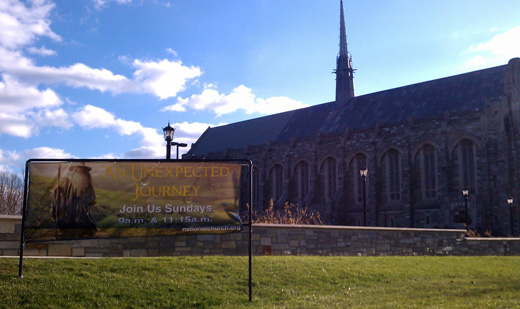
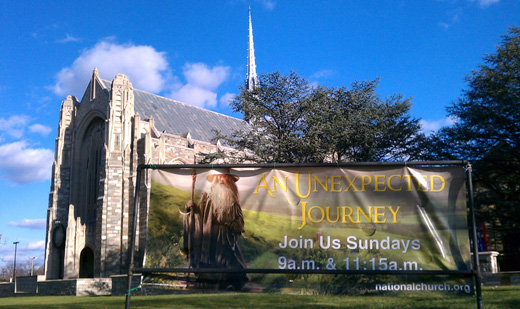
I returned to Tolkien’s essay yesterday after being shown a sign—this one.


That’s Metropolitan Memorial United Methodist Church, across the street from American University here in D.C. This church last appeared on this blog when I spotted the curious “faux-tesques” on its spire, but I hadn’t known it was a locus of Tolkien fandom. (It’s certainly one of the most unexpected examples of public Tolkieniana since the hobbit dumpster and parking signs of Ocean City, Maryland.)

As it turns out, the church’s (presumably unlicensed) banners aren’t just an advertisement of affinity, but an invitation to a series of sermons:

“An Unexpected Journey”
Explore the Gospel Through J.R.R. Tolkien’s Writings
Sermon Series beginning Sunday, January 6
J.R.R. Tolkien’s Lord of the Rings is deeply rooted in the truths of his Christian faith. This powerful story has captivated readers for decades, as well as a new generation of moviegoers. With the new film The Hobbit arriving this winter, it is a good time to explore the Gospel through this wonderful narrative. Our sermon series, “An Unexpected Journey,” will take place on Sundays in January 2013 as we follow the path of Tolkien’s travelers. Echoing Gandalf’s words to Bilbo, worried about his chances of returning home from his journey, “If you do, you will not be the same.”

I’ll let Tolkien experts imagine how the Catholic author might have reacted to The Hobbit being used as a gateway to Methodist Bible study, but as a medievalist he would have understood the impulse. The Germanic literature he loved is tinged with Christian interpolations, revisions, and appropriations, and he knew it was de rigeur in the Middle Ages to outfit the creations of others as couriers of religious ideas.

He also knew that the best stories fight back a little. Here he is again, talking about Beowulf:

The significance of a myth is not easily to be pinned on paper by analytical reasoning. It is at its best when it is presented by a poet who feels rather than makes explicit what his theme portends; who presents it incarnate in the world of history and geography, as our poet has done. Its defender is thus at a disadvantage: unless he is careful, and speaks in parables, he will kill what he is studying by vivisection, and he will be left with a formal or mechanical allegory, and what is more, probably with one that will not work. For myth is alive at once and in all its parts, and dies before it can be dissected. It is possible, I think, to be moved by the power of myth and yet to misunderstand the sensation, to ascribe it wholly to something else that is also present…

Whether he brings in new churchgoers or not, what the minister at MMUMC is doing has medieval roots. Whether it’s Tolkienesque I can’t say, but in its way, a Tolkien-themed sermon series makes more sense than the adoration of The Lord of the Rings by the 1960s counterculture. Whether one great story leads so easily to another remains to be seen, but what Tolkien said about Beowulf grows true of his own works as well: “it must ever call with a profound appeal—until the dragon comes.”

“Winter is the glad song that you hear…”

Christmas songs are quick to commemorate the sounds and the sights of the season, but rarely do they dwell on smells. Most people, I gather, fondly recall the fragrance of spruce needles or the cloying whiff of cookies, but this year I’ll pine for a more medieval Christmas scent: the sweet, pseudo-oenomelic aroma of tiny, rotting fruit.

Meet the National Cathedral medlar! Planted in 1962 to honor Florence Bratenahl, the medievalist who refined Frederick Law Olmsted’s plan for the cathedral garden, the tree goes unnoticed by nearly everyone. There aren’t many medlars in America, and when the cathedral horticultural staff and garden guild kindly let me harvest the fruit of their medlar in December 2010 (in exchange for writing two articles for the garden guild newsletter), I soon learned why: this is one persnickety tree.


Every spring, the medlar’s large white flowers blossom with absurd brevity, at a day and hour determined by the tree’s own inscrutable whim. (Most years, the medlar stubbornly hangs onto its red-gold leaves well into December, long after other trees are as bony and cold as Dickensian waifs.) During the summer, the flowers turn into grotty little fruit with deservedly obscene medieval nicknames. The French knew the medlar as the cul de chien, and Chaucer called it the “open-arse”; his bitter Reeve likened himself to a medlar in The Canterbury Tales. More recently, Shakespeare denigrated the medlar in four different plays, and D.H. Lawrence, not one to be outdone, dubbed them “wineskins of brown morbidity” and “the distilled essence of hell.”

You see, here’s the thing about medlars: The fruit is hard, acidic, and inedible until a good early-winter cold snap, after which it has to “blett,” or ripen into the semblance of rottenness, under precise conditions known only to God and the medlar itself. (Some sources even warn you not to jostle the fruit or let them touch each other. Medlars are the Happy Fun Ball of obsolete produce.)

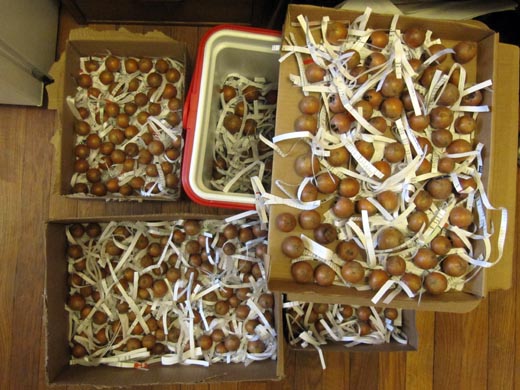
Medieval people would have bletted their medlars in wooden crates filled with straw. As a modern-day apartment dweller, I bletted ten pounds of medlar fruit in cardboard boxes lined with shredded credit-card courtesy checks.

Bletting medlars is a lost art. Hours turn into days, days turn into weeks, acids turn into sugars, and the end result is…most inelegant.

Did I mention they sometimes sigh or whistle when squeezed?

Ah, but holy crow, the smell of a home full of bletting medlars is truly divine. They smell like they taste: a robust blend of applesauce, cinnamon, and cheap wine. Charlemagne ordered the medlar to be grown on royal estates; a barn or fruit cellar full of bletting medlars must have been heaven for the Carolingian nose.

Participating in one medlar harvest made clear to me why this fruit, well known to medieval people, is barely a novelty now. For one thing, despite my best efforts at climate control, at least two pounds of fruit took the express lane straight past “bletted” and into genuine rot. Also, once you get past the five gigantic seeds in each fruit, you’ve not much of the squishy stuff to eat. In the U.K., Tiptree sells a lovely medlar jelly, but when a dear friend and I decided to try a medlar tart recipe from an Elizabethan cookbook, we spent hours mutilating hundreds (hundreds!) of weeping squishballs to make just two of these:

That tart’s tastiness was inversely proportional to its beauty, but it was also ludicrously labor-intensive. Medieval and early modern Europeans ate the fruit straight-up or enjoyed mashed and boiled jellies; a tart was a rare luxury.

As medlars lack widespread commercial value—did I mention concerns about their “violent laxative properties”?—the wizards of modern food science haven’t bothered to demystify them. For the latest medlarology, you have to dig up a 1989 Economic Botany article that documents (with remarkable encyclopedicity) everything now known about them, from passing references in classical texts to the chemical composition of the wood. Still, even in our Internet age, no one can tell you exactly how to blett the fruit, and I’m currently preparing to answer a barrage of riddles in a crumbling, booby-trapped crypt so a thousand-year-old crusader will pass on to me the mystic secret of cultivating medlars from seeds.

I hit the wrinkly rare-fruit jackpot in 2010. Since then, the medlar tree at the National Cathedral has (the chief horticulturalist tells me) suffered from fire blight, which is common among trees in the apple family. The fruit blackens and dies before maturing; a cool, wet spring may cause the problem to recur. (Lacking the ability to do anything useful, I’ve worked several medlar references into the poems in Looking Up.)

The truth is, if the medlar sprouted elf heads or started singing madrigals, it couldn’t befuddle me more than it already has, but I’ll never forget the aroma that welcomed me home every time I returned from some tedious holiday errand. The National Cathedral medlar reminds me that the road back to the Middle Ages is not only endless, but also endlessly strange. Relieved to know I’ll never run out of things to write about, I can only wish the readers of this blog a blessedly olfactive Christmas—and a New Year as hopeful and sweet as a medlar-blessed home.

“Let us close our eyes; outside, their lives go on much faster…”

In modern cities, crowds and commerce and cars drown out the ring of mere bells—but this Sunday, if you hear a faint pealing from an Episcopal church, know that it marks the feast-day for three medievalists. Two of them, English-born church architect Richard Upjohn and painter and stained-glass artisan John LaFarge, deserve to be remembered, but pause a bit longer to consider the third and most eccentric, architect Ralph Adams Cram, who clamored to rebuild the medieval world in a greener, more placid America.

Born in New Hampshire in 1863, Cram was the son of a Unitarian minister, but seeing the cathedrals of Europe at 23 drew the young man to Catholicism—almost. Enamored of medieval ritual at a time when becoming Roman Catholic would have been gauche, Cram instead embraced Anglo-Catholicism, a form of High Church Anglicanism, as did many Episcopalian intellectuals in the urban Northeast who adored Catholic aesthetics more than they loved the theology.

Cram looked at every skyline and imagined it dwarfed by spires. He was the architect who changed the style of St. John the Divine in New York City from Romanesque to Gothic; he worked for a time on Washington National Cathedral; he designed “collegiate Gothic” halls and other buildings with medievalist touches at Princeton, Wheaton, Richmond, Sweet Briar, and USC; and his firm built scores of churches that stand as neo-Gothic monuments from Pittsburgh to St. Paul. (In 1901, Cram literally wrote the book on church building.)

For Cram, medievalism was more than an aesthetic conceit. After World War I, he saw ruined societies doomed to one of two fates: a slide into a new Dark Age, or a return to ugly, worn-out modernism. Doubling down on his historical predilections, Cram offered, instead, a third way.

“It is in no sense a programme,” he insisted in 1919, with doubtful modesty,

it is still less an effort at establishing an ideal. Let us call it “a way out,” for it is no more than this; not “the” way, nor yet a way to anything approaching a perfect State, still less a perfect condition of life, but rather a possible issue out of a present impasse for some of those who, as I have said, peremptorily reject both of the intolerable alternatives now offered them.

Cram’s proposal? Americans should live, like medieval people, in walled towns.

Much of Walled Towns, Cram’s truly peculiar 1919 book, is a vision of Beaulieu, an imaginary burg situated “about forty miles from one of the largest cities of New England” in a spot that meets Cram’s criteria: arable land, a river, and “some elements of natural beauty.” We can drive to this happy outpost, but the gate house is our last chance to hail the outside world by telephone and telegraph. We’re required to garage our car—but we may, if we wish, pass through the gate on a rented horse. The walls of Beaulieu defend the reveries of an architectural fanatic: a gate that resembles Warwick Castle, a church like St. Cuthbert’s in Wells, a college that blends New College, Oxford with St. John’s, Cambridge, and a town hall inspired by the Hôtel de Ville.

In No Place of Grace: Antimodernism and the Transformation of American Culture, 1880-1920, T.J. Jackson Lears notes that “[s]ince Cram’s death in 1942, historians have dismissed him as an elitist crank, a reactionary in art and politics,” which oversimplifies his life and work. What makes Cram so interesting today is how awkwardly his equal hatred of democracy, socialism, communism, and anarchism meets the political assumptions of the early 21st century.

Cram’s Walled Towns forbid usury, stock markets, production of goods for profit, and all forms of advertising. Walled Towns forbid steam power, but not water mills or, surprisingly, hydroelectricity. A Walled Town is self-sufficient:

That one town or district should be given over to to the weaving of cotton or the spinning of wool; that shoes should chiefly be produced in Lynn, furniture in Grand Rapids, glass in Pittsburgh, beer in Milwaukee, hams in Chicago; that from all over a vast district the raw material of manufacture should be transported for hundreds, perhaps thousands of miles, to various howling wildernesses of highly specialized factories, only to be shipped back again after fabrication to be used or consumed by many of the original producers, was and is one of the preposterous absurdities of an industrial system supported on some of the most appalling sophistry that ever issued out of the Adullamite caves of political economy.

In the Walled Towns all this is changed . . . As each town has its own special products, maintained always at the highest standard, the market never fails.

In a Walled Town, only landholders may vote, and daily life is ruled by guilds—not, Cram stresses, the folk sentimentalized by a wistful William Morris, but a true restoration of the medieval guild system, which Cram calls “the precise antithesis of collectivism, socialism and trades-unionism of whatever form.”

Everyone in a Walled Town shares the same religious convictions; if you’re an Episcopalian knocking at a Catholic gate, seek your coreligionists down the road. Here, knowledge of Latin and a grounding in reading, writing, music, and math are universal, but education, which isn’t apportioned equally, focuses on character. The local college is run by faculty and alumni, not by corrupt or neglectful trustees. Walled Towns have no museums, because old and beautiful objects, such as medieval altarpieces, have been restored to their original uses. Walled Towns have fine art theaters, but no movie houses or sensationalistic shows—because in a Walled Town, “all life is couched in terms of true drama and living beauty.”

Given Cram’s fervent pursuit of applied medievalism, he seems to have overlooked “walled towns” that had recently failed. By World War I, American Arts and Crafts communities had waned; New Clairvaux, a commune of Massachusetts farmers and craftsmen founded in 1902 according to medievalist principles, had flopped; Rose Valley, a Pennsylvania arts-and-crafts project based on the utopianism of William Morris, was suburbanized; and the Americans most likely to retreat into anti-modern self-sufficiency were communists and anarchists, like the founders of my failed hometown commune, Fellowship Farm. Did Cram really believe that a Walled Town could be “at the same time individualist, coöperative and aristocratic”?

Cram does leave himself an out, claiming that his proposal need not be taken literally:

“The phrase ‘Walled Towns’ is symbolical only; it does not imply the great ramparts of masonry with machicolated towers, moats, drawbridges and great city gates such as once guarded the beautiful cities of the Middle Ages. It might, of course; there is no reason why a city should not protect itself from the world without, if its fancy led in this pictorial direction…

For Cram, “pictorial direction” is all. Here’s what he sees in 1919: “ragged and grimy children,” “a surly labourer” who “scowled coarsely, and swore, with his cigar between his teeth”; “men in dirty shirt-sleeves”; “children and goats [that] crawled starvedly around or huddled in the hot shadow”; “the mob of scurrying, pushing men and women, a mob that swelled and scattered constantly in fretful confusion”; “dirt, meanness, ugliness everywhere—in the unhappy people no less than in their surroundings.”

By contrast, Cram’s medieval “way out” abounds with “a great lady on a gaily caparisoned palfrey, with an officious squire in attendance, or perhaps a knight in silver armour, crested wonderfully, his emblazoned shield hanging at his saddle-bow.” There is “the pleasant clamour of voices, the muffled chanting of cloistered nuns in some veiled chapel, the shrill cry of street vendors and children, and the multitudinous bells sounding for worship.” Cram may decry utopians from Plato to H.G. Wells, but his Walled Town is itself the trite utopia of an architectural sketch: happy, faceless people strolling through pristine shopping malls or public squares, doing only what their designer envisions, never misusing, abusing, or defacing their earnest surroundings, freed by architects alone from the ugliness of human nature.

A century after Cram built his mental Beaulieu, no one lives in neo-medieval towns, but Cram still left his mark. Countless Americans first encounter medieval forms in the churches and cathedrals he designed, and his neo-Gothic spires and arches adorn campuses where, in the 1920s, Americans began studying the Middle Ages with greater zeal.

Notice, though, how American medievalism has changed. These days, few academics, ecclesiasts, and architects want to live in the Middle Ages. They tend to look back with detachment, while medievalist nostalgia thrives in genre fiction, video games, and Renaissance Faires. Meanwhile, Cram’s odd brand of aristocratic idealism lives on, split into bits across the ideological spectrum.

When Ralph Adams Cram, fiery nemesis of the impersonal, the imperial, the commercial, the cacophonous, writes that “the only visible hope of recovery lay in a restoration of the unit of human scale, the passion for perfection, and a certain form of philosophy known as sacramentalism,” he makes himself easy to dismiss, even as he drapes precious new lights on humanity’s evergreen dreams. But if, in a slough of disillusionment, you’ve ever pined for agrarian simplicity, religious or political uniformity, stark self-sufficiency, aesthetic transcendence, or lasting peace, then you’ve been, however fleetingly, a pilgrim to one of Cram’s Walled Towns—although it’s been a church, a Ren Fest, a Tea Party, an Occupy rally, or a perfectionist corner inside your own mind where you visit your will on the world.

So on Sunday, if you laugh at the impulse to build a Walled Town, be more charitable than you imagine he was, and let the bells ring for old Ralph Adams Cram. They’re always ringing somewhere.

“A long time ago, we used to be friends…”

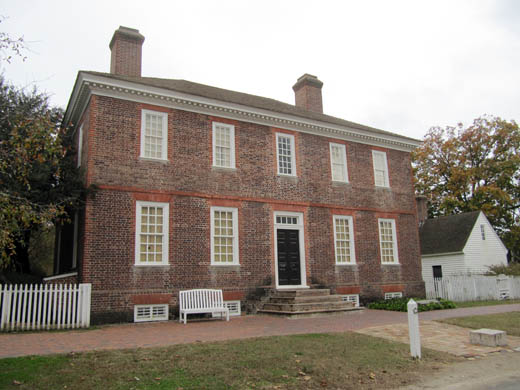
On the day after a national election, it’s bracing to stroll through the blustery streets of Colonial Williamsburg—which, lucky for me, is just footsteps away from a conference I’m attending. I’d hoped to find some trace of American medievalism, and the colonial city did not disappoint: along the green leading to the Governor’s Palace is a house where a Virginia lawyer lit a medieval torch in the mind of a Founding Father.

That’s the home of George Wythe, signer of the Declaration of Independence and delegate to the Constitutional Convention. Fresh out of William and Mary, a young Thomas Jefferson spent five years here as Wythe’s law apprentice and stumbled early into one of his innumerable lifelong hobbies: the study of Old English.

Poring over a 15th-century legal tract, Jefferson encountered a modern preface arguing that a student should learn “Saxon” to understand the essence of English law. Already intrigued by languages, the young man was hooked; Stanley R. Hauer points out (in “Thomas Jefferson and the Anglo-Saxon Language”) that the future third president of the United States collected Old English textbooks, painstakingly copied footnotes in Anglo-Saxon script into a 1778 legal treatise, and made sure that the University of Virginia was the first American institution to offer Anglo-Saxon language courses when it opened in 1825. According to Hauer, Jefferson’s grasp of Anglo-Saxon was weak—often he couldn’t distinguish it from Middle English—but if you’ve studied Old English, or even if you’ve read Beowulf in a college class, its presence was partly Jefferson’s doing.

Jefferson’s obsession with Old English resonated far beyond the English department. During his five years in Wythe’s study, he imaginatively plunged into what historians have dubbed the “Saxon myth,” the common belief among Whigs of his era that the best English institutions—parliament, trial by jury, common law—were the unbroken legacy of freedom-loving Germanic tribes who’d crept into Britain as early as the fifth century. (This idea was itself the legacy of 16th- and 17th-century reformers who’d tried to prove that both the Church of England and Parliament were continuations of ancient, primitive democracy.)

In letters and treatises, Jefferson trumpeted his belief that America had directly inherited liberty from the Anglo-Saxons. His strongest statement on the matter was surely his (unsuccessful) push to decorate the Great Seal of the United States with the figures of Horsa and Hengist, “the Saxon chiefs from whom we claim the honor of being descended, and whose political principles and form of government we have assumed.”

I suppose we are the political heirs of the Anglo-Saxons, since Jefferson believed it to be so when he helped establish our republic. He knew, though, that his contemporaries held conflicting views. “It has ever appeared to me,” he wrote to English political reformer John Cartwright in 1824, “that the difference between the Whig and the Tory of England is, that the Whig deduces his rights from the Anglo-Saxon source, and the Tory from the Norman.” It’s instructive, two centuries later, to see how our predecessors reached into the past for conflicting myths to answer a perennial question: What sort of people are we to be?

“River, I’ve never seen the sea…”

“The evening passed delightfully: we sat out in the moonlight on the piazza, and strolled along the banks of the Patapsco; after which I went to bed, had a sweet night’s sleep, and dreamt I was in Mahomet’s Paradise.”


Washington Irving romanticized his life. In an 1854 letter to his niece, he even found whimsy on the Patapsco River in Maryland, where he stayed at the home of John Pendleton Kennedy: Whig politician, Secretary of the Navy, Maryland Congressman, and a man immersed in the pop-medieval daydreams of his age.

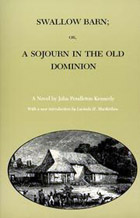
No one reads Kennedy’s 1832 book Swallow Barn anymore, and the author’s own description of it isn’t likely to bring readers back: “There is a rivulet of story wandering through a broad meadow of episode. Or, I might truly say, it is a book of episodes, with an occasional digression into the plot.” Kennedy loved Irving’s Bracebridge Hall, in which an American visitor describes an English manor through a series of character sketches and anecdotes, and he mimics it in Swallow Barn: a northerner visits his cousin’s plantation on the James River in Virginia and describes the place in anecdotal fits and starts. (Swallow Barn so closely resembles Irving’s style that when it was published under the name “Mark Littleton,” the public assumed Irving has simply adopted a coy new nom de plume.)

Medievalism is rampant in Swallow Barn. In his prologue, Kennedy cites the Morte d’Arthur. He likens a miller to a Robin Hood character, an old slave to an ancient crusading knight, and a group of pedantic Virginia lawyers to an Anglo-Saxon “wittanagemote.”

As it turns out, the early 19th-century Virginians of Swallow Barn are as obsessed with the Middle Ages as the narrator is. Here’s Prudence Meriwether, the plantation owner’s sister:

There is a dash of the picturesque in the character of this lady. Towards sunset she is apt to stray forth amongst the old oaks, and to gather small bouquets of wild flowers in the pursuit of which she contrives to get into very pretty attitudes; or she falls into raptures at the shifting tints of the clouds on the western sky, and produces quite a striking pictorial effect by the skillful choice of a position which shows her figure in strong relief against the evening light. And then in her boudoir may be found exquisite sketches from her pencil, of forms of love and beauty, belted and buckled knights, old castles and pensive ladies, Madonnas and cloistered nuns,—the offspring of an artistic imagination heated with romance and devotion.

Next we meet Ned Hazard, a 33-year-old Princeton dropout who stands to inherit Swallow Barn:

A few years ago he was seized with a romantic fever which manifested itself chiefly in a conceit to visit South America, and play knight-errant in the quarrel of the Patriots. It was the most sudden and unaccountable thing in the world; for no one could trace the infection to any probable cause;—still, it grew upon Ned’s fancy, and appeared in so many brilliant phrases, that there was no getting it out of his brain . . . However, he came home the most disquixotted cavalier that ever hung up his shield at the end of a scurvy crusade…

“His mind,” Kennedy insists, “is still a fairy land, inhabited by pleasant and conceited images, winged charmers, laughing phantoms, and mellow spectres of frolic.”

The object of Ned Hazard’s chivalrous amour is Bel Tracy, who’s so obsessed with Sir Walter Scott that she uses his novels to try to teach herself hawking:

In her pursuit of this object she had picked up some gleanings of the ancient lore that belonged to the art; and, fantastic as it may seem, began to think that her unskillful efforts would be attended with success . . . A silver ring, or varvel, was fitted to one leg, and on it was engraved the name of her favorite, copied from some old tale, ‘Fairbourne,’ with the legend attached, ‘I live in my lady’s grace.’ I know not what other foppery was expended upon her minion; but I will warrant he went forth in as conceited array as his ‘lady’s grace’ could devise for him. A lady’s favorite is not apt to want gauds and jewels.

By the time Swallow Barn winds down and “Mark Littleton” heads north, Ned Hazard survives a chivalric duel (a fistfight); slaves decked out to resemble “troubadours and minnesingers” tell ghost stories about nearby Goblin Swamp; and the narrator likens himself to Gregory of Tours and William of Malmesbury and quotes Chaucer’s “Knight’s Tale.”

In an introduction to the most recent reprinting of Swallow Barn, Lucinda H. MacKethan writes that Kennedy “manages merrily both to revere and to ridicule almost all of the Old South’s icons,” adding that reviewers disagreed on whether the book was a faithful depiction of Southern plantation life or blatant satire. I think it’s both: Swallow Barn shows a South in which overprivileged plantation-dwellers are so immersed in chivalric tales that they come to inhabit a shared medieval delusion.

When Washington Irving visited John Pendelton Kennedy in Maryland in 1854, life had been good to both authors, but especially to Kennedy. He had married Elizabeth Gray, daughter of textile baron Edward Gray, and moved into the Gray mansion. Gray liked to see himself as a feudal lord as he surveyed his factories on the Patapsco, a fancy Irving apparently shared.

In an 1854 letter to Elizabeth Gray Kennedy after returning home to Tarrytown, Irving let his inner medievalist romp:

 I envy Kennedy the job of building that tower, if he has half the relish that I have for castle building—air castles, or any other. I should like nothing better than to have plenty of money to squander on stone and mortar, and to build chateaux along the beautiful Patapsco with the noble stone which abounds there; but I would first blow up all the cotton mills (your father’s among the number), and make picturesque ruins of them; and I would utterly destroy the railroad; and all of the cotton lords should live in baronial castles on the cliffs, and the cotton spinners should be virtuous peasantry of both sexes, in silk skirts and small clothes and straw hats, with long ribbands, and should do nothing but sing songs and choruses, and dance on the margin of the river.

Only Washington Irving could look past textile mills and see a medieval peasant fantasy—but as Paul J. Travers points out in The Patapsco: Baltimore’s River of History, “Irving’s words were prophetic”: A great flood in 1868 washed away part of the Gray mansion, Kennedy’s personal library was ruined, and the family was forced to move. (Elizabeth Kennedy kept the factory going for 20 more years—until another devastating flood.)

Today, if you hack through the weeds between down Ellicott City and Patapsco State Park, you can walk in the footsteps of a wide-eyed Washington Irving…

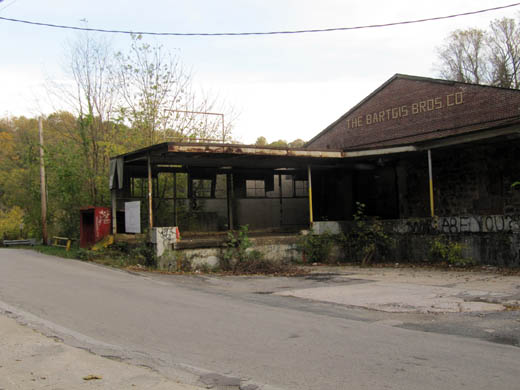
…and spot the “picturesque ruins” Irving joked that he wanted to see. They’re now monuments to a forgotten writer and a half-remembered natural disaster.

Nearby, you’ll find more recent wrecks that put Irving’s romanticism in perspective.

Shops on Main Street in Ellicott City now sell plastic swords, pirate gear, and Viking hats alongside antique shops that burnish the relics of Irving and Kennedy’s age. On the outskirts of town, Marylanders hike and bike; some latter-day rustics fish along the river’s edge. Whether you see timeless fantasies here, as Irving did, depends on your affinity with Swallow Barn’s Bel Tracy, who found “something pleasant in the idea of moated castles, and gay knights, and border feuds, and roundelays under one’s window, and lighted halls.”

Mark Twain saw something else in Southern medievalism: a sort of mass insanity, a “maudlin Middle-Age romanticism” that’s still more tenacious in America than he ever foresaw. Even now, many Americans would answer Twain in the same tone Bel Tracy uses to scold her cousin: “Pshaw!…You haven’t one spark of genuine romance in your whole composition.” When a 19th-century New Yorker can find Virginia medievalism on the banks of a Maryland river, I’m not sure both notions aren’t right.

“The stairs creak as you sleep, it’s keeping me awake…”

“How solemn and thrilling the scene as we anchored at night at the foot of those mountains, clothed with overhanging forests; and every thing grew dark and mysterious…”

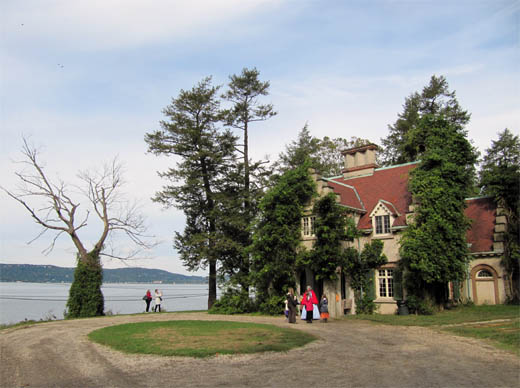
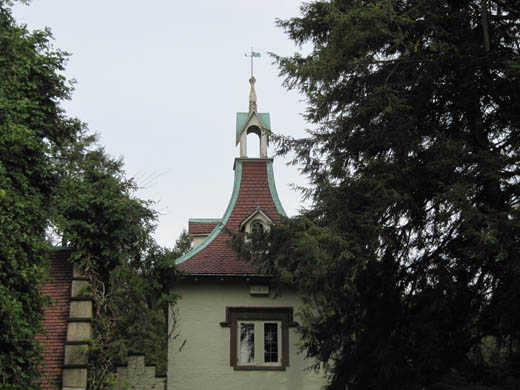
So wrote an awed teenaged Manhattanite in 1800 about his first voyage up the Hudson River. If you ever find yourself in Tarrytown, New York, and if you can find (as I did this morning) a brief break in your business there, stroll down the street and visit Sunnyside, the late-life home of the wide-eyed mythologist who likened the Hudson to the Rhine: Washington Irving, one of America’s great unacknowledged medievalists.

It’s fitting to poke around Sunnyside on Columbus Day. Biographer Andrew Burstein notes that Irving’s A History of the Life and Voyages of Columbus went through 175 editions between 1828 and 1900, and that “[a]ccording to a recent survey of the contents of American libraries, rural and urban alike, in the mid-nineteenth century, Irving’s Columbus was the most commonly owned book. It undeniably influenced how American schoolchildren were taught their country’s origins for the balance of the nineteenth century.” As Nancy Marie Brown recently mentioned, Irving’s book almost certainly popularized the misperception that medieval people believed the world was flat.

Washington Irving loved the Middle Ages. In 1804, at 21, he admired Gothic architecture in France, and he was apparently so enamored of St. Agatha’s Cathedral in Sicily that while he gaped at the place, someone picked his pocket. He later included references to Charlemagne in his satirical “Knickerbocker History” of New York City, and he also whipped up a scene where one of his Dutch forefathers, Oloffe, has a medieval-style dream vision of Saint Nicholas, the city’s patron.

Irving’s Sketch-Book (most famous today for the German-inspired “Rip Van Winkle” and “The Legend of Sleepy Hollow”) also features a dream vision in which Irving’s alter ego, Geoffrey Crayon, visits the library at Westminster Abbey, where medieval books literally speak to him. Irving’s 1821 novel Bracebridge Hall, with its character sketches of squires, old yeomen, and romantic lovers, teems with a love of medieval tradition and even includes a chivalric digression: “The Student of Salamanca.” Irving also adored medieval Spain, romanticizing history and legend in Tales of the Alhambra and Chronicle of the Conquest of Granada.

I don’t think it’s unreasonable to call Washington Irving one of America’s first pop-medievalists—although interestingly, he didn’t use the word “medieval.”

In “Medievalism: Its Linguistic History in Nineteenth Century Britain,” Clare A. Simmons notes that Washington Irving avoided the term “Middle Ages,” probably because it was then associated with Roman Catholicism—but the word “medieval” never leaks from Irving’s pen either. Instead, he opts for phrases like “olden times,” “days of yore,” and “the age of chivalry.” The word “medieval” was in currency in England at least as early as 1827, but if Irving heard it during his extensive time abroad, he doesn’t seem to have brought it home with him.

Irving bought and moved to Sunnyside in 1835. Around that time, he abandoned medieval subjects and wrote books about America: A Tour of the Prairies; the Western novel Astoria; the romance The Adventures of Captain Bonneville; and a five-volume biography of George Washington.

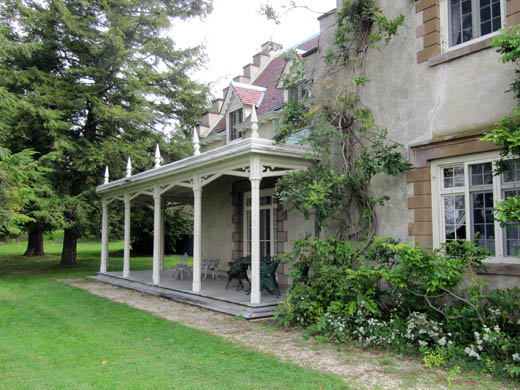
Still, Sunnyside reflects Irving’s continued interest in a romanticized Middle Ages, from its “Italian Gothic” piazza…

…to the “Spanish Tower,” which I image Irving found very olden-timey…

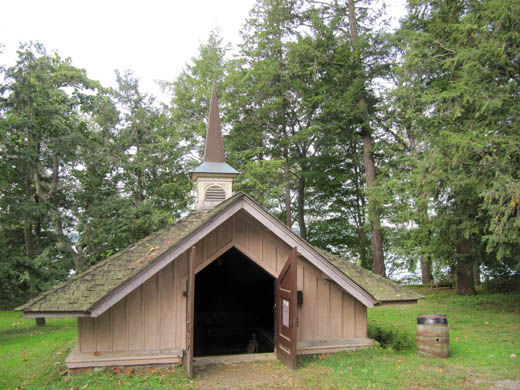
…to the ice house, designed by Irving himself in what a placard calls “a whimsical fashion conveying the look of a small Gothic chapel.”

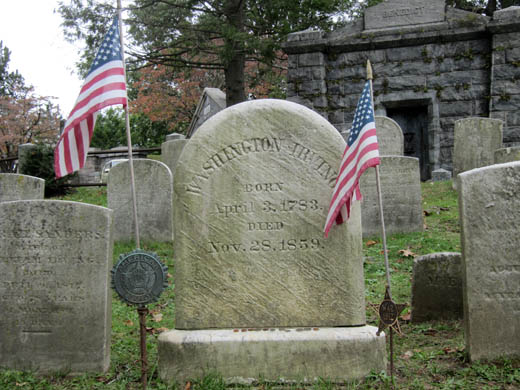
Irving died in 1859, late enough to see the early medievalization of the Hudson Valley at nearby estates such as Lyndhurst but too soon to see just how nuts Americans would get about Gothic architecture. Many castle-like estates loom over the Hudson, including one built in Tarrytown between 1897 and 1910, just three miles from Irving’s home. Some of them have fallen into disrepair.

Irving would have enjoyed seeing medievalist follies sprout like mushrooms from New York cliffsides, but as his lively era recedes into obscurity, I wonder what he would have thought of his own reputation, if not his influence, becoming as much a part of “days of yore” and “olden times” as the real Middle Ages themselves.

Or maybe the era he never named helped prepare him for that: “And all for what? to occupy an inch of dusty shelf—to have the title of their works read now and then in a future age, by some drowsy churchman or casual straggler like myself; and in another age to be lost, even to remembrance. Such is the amount of this boasted immortality.”

“Won’t you fly across that ocean, take a train on down…”

“The origin of our city will be buried in eternal oblivion,” wrote Washington Irving in his satirical History of New York, the 1809 book that made the 26-year-old Manhattanite one of America’s first literary celebs. Two centuries later, Irving’s “Knickerbocker History” is by turns funny, baffling, and obscure, but what intrigued me was how full of Charlemagne it is:

The origin of our city will be buried in eternal oblivion, and even the names and achievements of Wouter Van Twiller, Wilhelmus Kleft, and Peter Stuyvesant, be enveloped in doubt and fiction, like those of Romulus and Remus, of Charlemagne, King Arthur, Rinaldo, and Godfrey of Bologne.

As it turns out, Irving was a bit of a Charlemagne buff. Elsewhere in the History, his alter ego Diedrich Knickerbocker looks to the Carolingians to explain why New York City’s “ancient magistrates” were chosen, naturally, by weight:

As a board of magistrates, formed on this model, think but very little, they are the less likely to differ and wrangle about favourite opinions—and as they generally transact business upon a hearty dinner, they are naturally disposed to be lenient and indulgent in the administration of their duties. Charlemagne was conscious of this, and therefore (a pitiful measure, for which I can never forgive him) ordered in his cartularies, that no judge should hold a court of justice, except in the morning, on an empty stomach—a rule, which, I warrant, bore hard upon all the poor culprits in his kingdom. The more enlightened and humane generation of the present day have taken an opposite course…

Jolly old Diedrich Knickerbocker also trots out several mock-heroic references to Roland, the “Orlando” of romance. Two of them occur in battles between Dutchmen and Swedes, while the third anchors a preposterous yarn about the death of trumpeter Antony Von Corlear, whose race to aid his fellow Dutchmen is stymied when a devil drags him to the bottom of the Harlem River:

Luckless Antony! scarce had he buffeted half way over, when he was observed to struggle most violently as if battling with the spirit of the waters—instinctively he put his trumpet to his mouth and giving a vehement blast—sunk forever to the bottom!

The potent clangour of his trumpet, like the ivory horn of the renowed Paladin Orlando, when expiring in the glorious field of Roncesvalles, rung far and wide in through the country, alarming the neighbors round, who hurried in amazement to the spot…

Irving later visited relatives in England (where he wrote two of his most famous stories, “Rip Van Winkle” and “The Legend of Sleepy Hollow”) and spent 17 years wandering Europe. He had mined German folklore for two of his biggest hits and expected further inspiration. “I mean to get into the confidence of every old woman I meet with in Germany,” he told a friend, “and get from her, her budget of wonderful stories.”

The romantic New Yorker, pushing 40, soon met the drab reality of history. Visiting Aachen in 1822, he noted in his journal that he had seen the “fountain with bronze statue of Charlemagne” and “Charlemagne’s Chair in Town Hall,” both of which are still tourist landmarks, but he saved his grousing for a darkly amusing letter to his sister:

I am disappointed in Aix-la-Chapelle. To me it is a very dull place, and I do not find that others seem more pleased with it.

[. . .]

This is the birthplace, and was once the seat of empire of Charlemagne, that monarch so renowned in history and song. His tomb is in the cathedral, and is only marked by a broad slab of black marble, on which is the inscription, Carolo Magno. The Cathedral is an extremely ancient, venerable-looking pile. Every night I hear the hours chimed on its bells; and the midnight hours announced by the watchman from its tower. The Germans are full of old customs and usages, which are obsolete in other parts of the world . . .

The people have an antiquated look, particularly the lower orders. The women dress in peculiar costumes. As to the company at the hotels and public saloons, it is composed of all nations, but particularly northern nations: Russians, Prussians, Germans, Dutch, &c. Everywhere you see military characters, in fierce moustaches and jingling spurs, with ribbons and various orders at their button-holes. Still, though there are many personages of rank here, the place is not considered the most fashionable, and there are many rough characters in the crowds that throng the saloons. Indeed it is somewhat difficult to distinguish a gentleman from a common man among these northern people; there is great slovenliness of dress and coarseness of appearance among them; they all smoke; and I have often been surprised to hear a coarse-looking man, whom I had set down for some common tradesman, addressed as Monsieur the Count or the Baron. The weather has been very bad for several days past.

A recent biographer points out that Irving was suffering from an illness, perhaps the gout, which the famous waters of Aix-la-Chapelle failed to cure—but he wasn’t the last tourist to find Aachen underwhelming. A 2003 Rick Steves guidebook dismisses “unassuming Aachen” near the “unromantic Rhine,” and when I sat in Aachen Cathedral on a frigid February weekend in 2008, I heard tourists mumble that the place was too small to have been worth the trip.

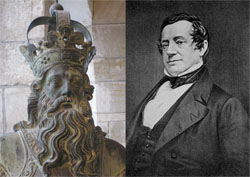
Despite their gripes, I found that the “concentrated magnificence” of the octagonal chapel at Aachen repays real contemplation, and trying to see it backwards across a 1,200-year gulf is a worthy (if futile) ambition. Tourists to Aachen wish for eighth-century streets; if Washington Irving’s imagination failed him in Charlemagne’s town, what hope can their be for the Lonely Planet crowd?

Two years after sulking in Aachen, Irving wrote in Tales of a Traveller: “The land of literature is a fairy land to those who view it from a distance, but like all other landscapes, the charm fades on a nearer approach, and the thorns and briars become visible.” He later found his European dreamworld in Spain, especially Granada, where he briefly lived and wrote at the Alhambra. As the author of the most popular 19th-century book about Christopher Columbus, Irving convinced Americans, wrongly, that medieval people believed the world was flat. It’s tempting to wonder what myths he might have spun about Charlemagne if he’d just passed through Aachen in sunnier health. Generations of teachers perhaps can be glad he did not.

(Photo of Aachen taken in February 2008.)