“When I was their age, all the lights went out…”

If you’ve barreled through Georgia on I-95, you may have noticed a strange sight on the east side of the highway: a B-47 Stratojet bomber in front of what appears to be a medieval English church. Rejected cover art for A Canticle for Liebowitz?

Not hardly. You’re catching a glimpse of the Mighty Eighth Air Force Museum. The 8th Air Force was activated in Savannah in 1942 before being sent to England to join the RAF in bombing runs over Germany. The museum, just outside Savannah in Pooler, tells the Mighty 8th’s story in the context of the air war in Europe.

Inside, thoughtful and thorough exhibitions give you a harrowing sense of what life as a bomber crewman was like, especially when you turn a corner and behold a B-17 being painstakingly restored by volunteers.

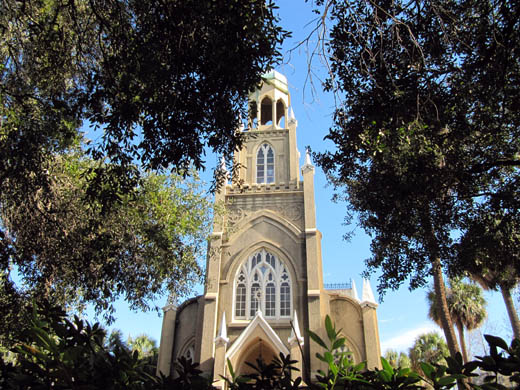
On the grounds, countless plaques and monuments are sobering reminders of the dead. Among them stands an unlikely medievalist sight.

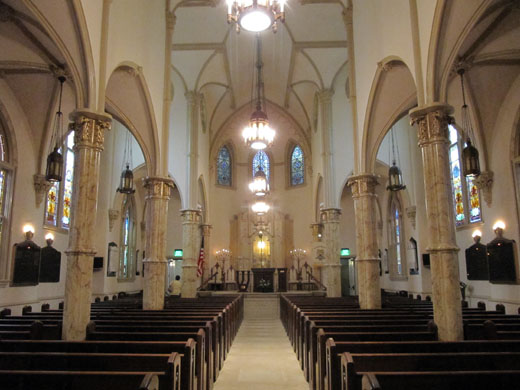
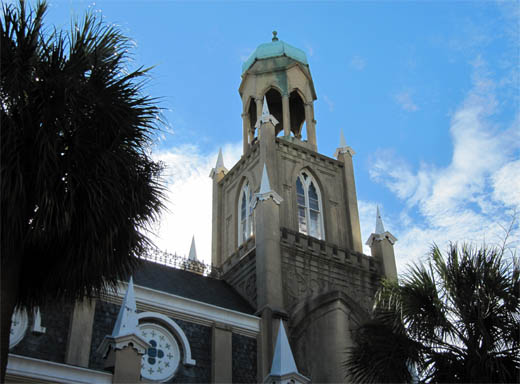
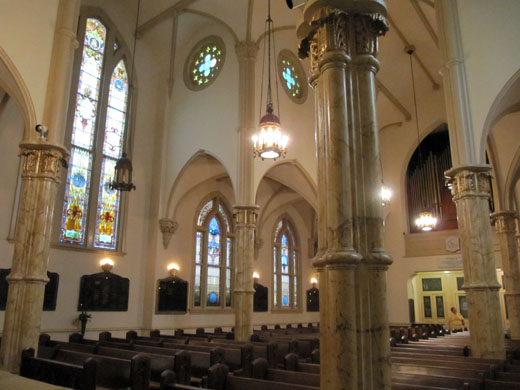
The American vogue for neo-medieval churches faded in the early 20th century, so I was surprised (and delighted) by how recently the Chapel of the Fallen Eagles was dedicated: May 2002. According to the firm that built it, the chapel is based on no one church but generally evokes medieval English styles:

The design for the non-denominational chapel is based on English parish church architecture, which generally developed between the fifth and sixteenth centuries. The design reflects both the traditional site orientation and building elements consisting of a west facing tower, central nave, and east facing chancel. The stonework and interior finishes are typical of country churches as they evolved through the centuries.

I’d like to imagine that Gothic window tracery left a vivid impression on the men of the 8th Air Force, but the chapel’s stained-glass tribute to All Saints Church in the Cambridgeshire village of Conington hints at more pressing concerns.

According to a Conington-area historical society, “a red light was installed on one of the pinnacles of the Church tower to help guide the planes back from their missions during World War II.” Appropriately, the village sign at Conington shows the church tower beneath the silhouette of a B-17.

After all these years of chasing down medievalism in America, I shouldn’t have been surprised to find a pseudo-medieval chapel on a Georgia interstate—but I was. Yes, medievalism is everywhere, but the Chapel of the Fallen Eagles represents a use for it we don’t often see. Unlike many of their countrymen, the vets of the 8th Air Force weren’t dreaming of castles and chivalric frills. Instead, they imagined, and sanctioned in stone, a monument to Anglo-American friendship.

“I had riches too great to count, could boast of a high ancestral name…”

On a sunny September day in 1838, Frederick Douglass escaped slavery in Maryland to become a free man (and one of the most fascinating and indefatigable Americans of his time), so yesterday seemed like as good a day as any to visit Cedar Hill, the Frederick Douglass National Historic Site—and to seek medievalism in this most unlikely place.

High atop a terraced hill in the Anacostia neighborhood of Southeast D.C., the house was Douglass’s home from 1877 until his death in 1895. The front—parlor, office, dining room—is furnished almost exactly as it was when Douglass was alive, and Cedar Hill is still an impressive home with a panoramic view of downtown Washington.

Many of the decorations in Cedar Hill are neoclassical doodads, but there’s a medievalist gleam or two in Douglass’s life, as long as you know where to look.

That’s the bedroom of Helen Pitts, Douglass’s longtime secretary and second wife. Their interracial marriage shocked her white abolitionist family and Douglass’s black children, but since I’m me and it’s 2012, I was more surprised by what I saw on the back wall: an engraving of Cologne Cathedral.

Although Douglass traveled in Europe, he doesn’t appear to have visited Germany, so the engraving was likely a gift from German writer and abolitionist Ottilie Assing. She taught Douglass German, spent 22 summers in his home, and apparently had a long affair with him. The presence of this print in the bedroom of the woman who won out over Assing for Douglass’s final affections is either a curatorial snafu or a memento of profound awkwardness.

More interesting is Frederick Douglass’s medievalist name.

Born a slave in Talbot County, Maryland, around 1818, young Fred was saddled with a moniker that suggested a grand, impossible destiny. “The name given me by my beloved mother,” he wrote, “was no less pretentious than “Frederick Augustus Washington Bailey.'” In 1838, after being moved back and forth between the Eastern Shore of Maryland and downtown Baltimore, he made one heck of an escape: He disguised himself as a sailor, boarded a train, and journeyed from Wilmington, to Philadelphia, to New York City, and finally to New Bedford, Massachusetts.

In New Bedford, “initiated into the new life of freedom,” Frederick Bailey needed a safer surname. He found himself in the home of Nathan and Mary Johnson, a prosperous black couple who harbored escaped slaves. As he explained in 1855, taking their name was out of the question:

“Johnson” had been assumed by nearly every slave who had arrived in New Bedford from Maryland, and this, much to the annoyance of the original “Johnsons” (of whom there were many) in that place.

Down with the pop-culture trends of the day, Nathan Johnson suggested the name “Douglass”:

Mine host, unwilling to have another of his own name added to the community in this unauthorized way, after I spent a night and a day at his house, gave me my present name. He had been reading the “Lady of the Lake,” and was pleased to regard me as a suitable person to wear this, one of Scotland’s many famous names. Considering the noble hospitality and manly character of Nathan Johnson, I have felt that he, better than I, illustrated the virtues of the great Scottish chief. Sure I am, that had any slave-catcher entered his domicile, with a view to molest any one of his household, he would have shown himself like him of the “stalwart hand.”

Once absurdly popular and always unbearably long (and, despite its title, not Arthurian), The Lady of the Lake is an 1810 poem by Sir Walter Scott that tells the story of a rift between King James V of Scotland and James Douglas, his former mentor and protector, as tension mounts between the king and the Highland clans, roused to rebellion by Roderick Dhu.

I’ve never been able to get through the whole miserable poem, but the fact that Frederick Douglass is named after a fictionalized late-medieval earl is truly wonderful. It’s a testament to 19th-century America’s obsession with Scott’s chivalric adventures—and it’s a bit ironic.

Southern slaveowners hung on Sir Walter Scott’s every word, and they saw themselves as his chivalric heirs. Here’s Vernon Parrington in Main Currents in American Thought, Volume II:

The Lay of the Last Minstrel and The Lady of the Lake stirred Southern men to think of themselves as proud knights ready to do or die for some romantic ideal; and the long list of novels . . . seemed to reflect anew the old ideals of fine lords and fair ladies whom Southerners now set themselves to imitate.

“While the rest of America read Scott with enthusiasm,” writes Rollin Osterweis in Romanticism and Nationalism in the Old South, “the South assimilated his works into its very being.” Osterweis points out that plantation bookshelves were packed with Scott’s works; Southerners loved his terms “Southron” and “aristocratical” and ran with them; plantations took their names from his Waverley novels; and steamboats, barges, and stagecoaches in the back country of Louisiana, Tennessee, and beyond often bore names from his books.

In Life on the Mississippi, Mark Twain even blames Scott for the American Civil War:

The South has not yet recovered from the debilitating influence of his books. Admiration of his fantastic heroes and their grotesque “chivalry” doings and romantic juvenilities still survives here, in an atmosphere in which is already perceptible the wholesome and practical nineteenth-century smell of cotton-factories and locomotives; and traces of its inflated language and other windy humbuggeries survive along with it.

It’s amusing to imagine the few Southerners who may have read Douglass’s autobiography sputtering over such blasphemous misuse of their dear Walter Scott.

Delightfully, the black American named for a medieval earl really did rally the Scots. In 1845, Douglass fled to Great Britain to avoid recapture and stayed until 1847. His speeches in Scotland echoed the concerns of British abolitionists that the Free Church of Scotland was funded by slave-holders and slave-traders. In My Bondage and My Freedom, Douglass casts himself as the voice of the man on the Edinburgh street:

“SEND BACK THE MONEY!” stared at us from every street corner; “SEND BACK THE MONEY!” in large capitals, adorned the broad flags of the pavement; “SEND BACK THE MONEY!” was the chorus of the popular street songs; “SEND BACK THE MONEY!” was the heading of leading editorials in the daily newspapers.

The modern Douglass did not prevail:

The deed was done, however; the pillars of the church—the proud, Free Church of Scotland—were committed and the humility of repentance was absent. The Free Church held on to the blood-stained money, and continued to justify itself in its position—and of course to apologize for slavery—and does so till this day. She lost a glorious opportunity for giving her voice, her vote, and her example to the cause of humanity; and to-day she is staggering under the curse of the enslaved, whose blood is in her skirts. The people of Scotland are, to this day, deeply grieved at the course pursued by the Free Church, and would hail, as a relief from a deep and blighting shame, the “sending back the money” to the slaveholders from whom it was gathered.

In his 1899 bio of Douglass, Charles Chesnutt notes that “[i]n Scotland they called him the ‘black Douglass,’ after his prototype in The Lady of the Lake, because of his fìre and vigor.” Chesnutt knew when to strum that mythic chord:

[H]e fell in with the suggestion of his host, who had been reading Scott’s Lady of the Lake, and traced an analogy between the runaway slave and the fugitive chieftain, that the new freeman should call himself Douglass, after the noble Scot of that name. The choice proved not inappropriate, for this modern Douglass fought as valiantly in his own cause and with his own weapons as ever any Douglass fought with flashing steel in border foray.

Although Frederick Douglass was a passionate man, I was sure he was immune to the charms of the phony, romanticized Middle Ages that gave him his name. Nope! According to the National Park Service (PDF here), Douglass owned 18 volumes of Sir Walter Scott.

In his writings and speeches, Douglass had more to say about Dred Scott than Walter Scott, so I’m hesitant to dub him a medievalist, but it says something about America’s weird medievalist undercurrents that they were too strong to escape his notice. They didn’t ebb: In an 1895 eulogy, one poet was quick to cast Douglass in medieval terms. “A hush is over all the teeming lists,” sang Paul Laurence Dunbar, making him the knight the man who named him hoped he’d be: “He died in action with his armor on.”

“Is this the age of the thunder and rage…”

[This post is a rerun from 2010; I felt like bringing it back for a second spin. – J.S.]

Few medievalists grace the saints’ calendars of American churches, but it’s fitting that back-to-school week coincides with the feast day of Nikolaj Frederik Severin Grundtvig, observed annually on September 2 by the Evangelical Lutheran Church in America and on September 8 by the Episcopal Church in the United States. The Danish bishop and polymath is little known outside his home country, but he was a monumental figure there—and if you’ve read any edition or translation of Beowulf, then N.F.S. Grundtvig was partly responsible for getting it into your hands.

After Icelander Grímur Jónsson Thorkelín published the first printed edition of Beowulf (with the support of the Danish government) in 1815, Gruntvig was the most vocal scholar to point out the many errors in Thorkelin’s transcription and Latin translation, from misreadings of Old English words to Thorkelin’s failure to recognize proper names. Thorkelin, a twitchy careerist, responded by accusing Grundtvig of “sweet dreams, absurd fantasies, and willful distortions of the original and of my work within the Chaos that surrounds him,” but Grundtvig, the superior scholar, was right. Grundtvig was also the first to notice that the Hygelac of Beowulf was the historical figure Chochilaichus named by Gregory of Tours in his History of the Franks, and Grundtvig’s 1820 version of Beowulf in Danish was the first translation of the poem into any modern language.

Although Grundtvig was peeved to see the Danes exeunt two-thirds into Beowulf, he never stopped grappling with the poem, seeking not only its universal lessons within the context of his own faith but also clues to the Scandinavian past. “[T]he language,” he wrote, “is ingenuous, without having the German long-windedness, and without remaining obscure in its brevity as so often in the Eddic poems.” Inspired by Beowulf, Gruntvig became an Anglo-Saxonist while rising through the Lutheran church, studying theology and languages, agitating for Norwegian independence, becoming the father of Danish folk schools, dealing with censorship and fines and exile, marrying three times, briefly serving in the Danish Parliament, and somehow finding time to translate hundreds of hymns and write countless poems and books. (For all I know, he even invented Lego and provided the theological foundation for his nation’s wonderful open-faced sandwiches.)

Something of an Anglophile, Grundtvig practically begged the English to appreciate their native poets, and the tone of his 1831 proposal for an Anglo-Saxon book subscription program will amuse any medievalist who’s been accused of cultivating obscure interests:

I know there are tastes, called classical, which will turn away in disgust when they are told that this poem consists of two fabulous adventures, not very artificially connected, except by the person of the hero,—and that these episodes, which relate to historical traditions of the North, are rather unskillfully inserted. But I think such classical scholars as have a squeamish repugnance to all Gothic productions, should remember that, when they settle themselves down in the little circle of the ancient world, they have banished themselves from the modern, and consequently have made their opinions on such a subject of very little importance.

“For all his faults of expression,” writes Tom Shippey, “Grundtvig read the poem more acutely and open-mindedly than any scholar for decades.” Even those of us who will never be honored with hymns could do worse than aspire to earn such an epitaph. Thanks to scholars like Grundtvig, not only do we better understand how and why the Anglo-Saxons wondered, as others have, “Ubi sunt qui ante nos fuerunt?,” but we can also start to answer the question for ourselves.

“Diamond rings, and all those things…”

For five years, this blog has documented medievalism from Louisiana to Serbia to Ossetia to the banks of the Potomac and the putting greens of Ocean City, but there’s one manifestation I’ve dreaded: Nazism. I don’t hesitate to point out dreary forms of medievalism, but I figured the Third Reich’s version of it would be especially awful. It is—so I’m grateful to Sidney D. Kirkpatrick for summarizing it in what’s probably the only book to feature both Nazis and art historians that can properly be called a great “beach read.”


Published in 2010, Hitler’s Holy Relics tells the story of the late Walter Horn, known to medievalists as co-founder of the art history department at UC-Berkeley and co-author of The Plan of St. Gall. As World War II wound down in Europe, Horn was a 36-year-old lieutenant for the U.S. Army; he was born and educated in Germany and had fled as recently as 1938, which made him useful as an interrogator. In February 1945, after a desperate prisoner squealed about a secret bunker under Nuremberg Castle, Lieutenant Horn investigated an incredible stash of artwork and relics, including the reputed Holy Lance and the coronation garments of the Holy Roman Emperor.

There was one problem: the Crown Jewels of the Holy Roman Empire—the crown, globe, scepter, and two swords—were missing, and the Allies feared the objects might be used to rally neo-Nazis as the Nuremberg trials began.

Horn was uniquely qualified to search for them. He had studied under magisterial art historian Erwin Panofsky at Hamburg and personally knew many of Germany’s top curators, art historians, and dealers. Plus, unlike many members of the Army’s commission on monuments and antiquities, he wasn’t a curator looking to enhance a museum collection back in the States. (A true academic, Horn carried a draft of his scholarly article about a Florentine basilica across seven countries. He fearlessly interrogated Nazis but was reluctant to submit his work for peer review.) In late July 1945, Horn was given just three weeks to find the lost Crown Jewels before a repatriation conference in Munich would render his mission moot—and the faster he could get it done, the more time he’d have to search the Soviet Zone for the family he left behind.

Kirkpatrick tells this story well, painting a dense, believable picture of postwar chaos. As the occupying army compromises with conquered locals, Walter Horn sees his birth nation in ruins, wonders about the fate of his family and friends, and hunts for treasure even when questions of cultural patrimony pale against the enormity of the entire war. Despite its lurid cover, Hitler’s Holy Relics is sensitive to the stories of individuals, not armies, from a Nazi museum curator who survives by hiding his homosexuality to the personal interest Patton himself takes in the Crown Jewels.

It’s also sensitive to the allure of medievalism, as Kirkpatrick sketches out the creepy ways in which high-ranking Nazis mixed medieval myth with occultism in an effort to raise up a truly freakish world. Kirkpatrick summarizes the legends surrounding the Holy Lance, which beguiled a young Hitler when he saw it in an Austrian museum. He also describes the work of the Ahnenerbe, the SS “think tank” dedicated to such projects as locating the Holy Grail and forcing Finnish psychics to contact Nordic spirits. Kirkpatrick details Hitler’s plans to turn Nuremberg, home of the Crown Jewels, into a bizarre neo-medieval theme park, and he takes us, via Walter Horn, to Heinrich Himmler’s insane castle, which was renovated by enslaved Jehovah’s Witnesses, furnished with an Arthurian Round Table and rune-inscribed teacups, and designed to resemble, from the air, the tip of the Holy Lance.

Notably free of the usual Discovery Channel baloney—there’s only one dubious case of wild speculation, and it comes from Walter Horn himself—Hitler’s Holy Relics is a terrific read. Kirkpatrick corrects errors in earlier, more lurid accounts of Horn’s adventures and makes clear to a non-scholarly audience why art and architecture aren’t mere ornamentation, but powerful political tools. In doing so, he confirms a chilling observation by scholar Tom Shippey that’s worth keeping in mind as you suit up for the Ren Fest this fall: “There are…many medievalisms in the word, and some of them are as safe as William Morris wallpaper: but not all of them.”

“But all the gold won’t heal your soul…”

There’s no more medieval prepared cheese product than Velveeta. That’s the message, I guess, of “Wield the Skillet, Forge the Family Dinner,” a recent ad campaign for Velveeta that stars a manly, quasi-medieval blacksmith.

Although the blacksmith chants his praise of “liquid gold,” orders soccer moms to “smite” noodles—“smite them with the liquid gold until there can be no more smiting!”—and even has his own pointlessly elaborate website, Our Book of Liquid Gold, he’s no Old Spice Guy. The campaign wasn’t funny or distinctive enough to have gone viral, and the brawny mascot’s YouTube playlist hasn’t been updated for months.

So maybe medievalism doesn’t send Velveeta flying off the shelves. The first commercial in a new campaign, rolled out yesterday, features a slackerish broheim who works at the mall. The setting is as current as can be—but the slogan is still gruesomely medieval.

Medieval people associated the consumption of liquid metal with horrific punishments and unbearable pain. In the 12th-century Anglo-Norman Voyage of St. Brendan, the saint discovers Judas on an island, where his unceasing torments include being forced to drink molten lead and copper, which he can’t vomit when subjected to a hellish stench.

Medieval writers also believed that the Roman general Crassus had been executed by being forced to drink molten gold. In canto 20 of Purgatorio, Dante hears talk of “the wretchedness of avaricious Midas, resulting from his ravenous request, the consequence that always makes men laugh,” clarifying a few lines later:

and finally, what we cry here is: “Crassus,
tell us, because you know: “How does gold taste?”

In Book III of Troilus and Criseyde, when Chaucer rants about the inability of the greedy to experience true love, he assumes we’ll understand references to the “hoot and stronge” drinks of Crassus and Midas:

As wolde God tho wrecches that dispise
Servise of love hadde erys also longe
As hadde Mida, ful of coveytise,
And therto dronken hadde as hoot and stronge
As Crassus did for his afectis wronge,
To techen hem that they ben in the vice,
And loveres nought, although they holde hem nyce.

Likewise, one anonymous 15th-century English nun associated this same horrible punishment with Purgatory:

and one broʒt myche gold and syluer, and þat was molten and casten in hyr þrote, and þat ran out of hyr stomake. And he seide, “Take þe þis for þ[i] cursed and wikked coueitise…”

The horror of gold-drinking as punishment survived the Middle Ages. It worked its way into Jewish folklore, 16th-century natives reportedly executed a Spaniard in colonial Ecuador with a drink of molten gold, and in John Ford’s early 17th-century play ‘Tis a Pity She’s a Whore (recently staged in Virginia!), Friar Bonaventura warns of the eternal fate that awaits usurers:

There is a place,
List, daughter! in a black and hollow vault,
Where day is never seen; there shines no sun,
But flaming horror of consuming fires,
A lightless sulphur, choak’d with smoky fogs
Of an infected darkness: in this place
Dwell many thousand thousand sundry sorts
Of never-dying deaths: there damned souls
Roar without pity; there are gluttons fed
With toads and adders; there is burning oil
Pour’d down the drunkard’s throat; the usurer
Is forced to sup whole draughts of molten gold…

Amazingly, there’s at least one positive medieval reference to drinking gold. After suffering her husband’s abuse, a 15th-century Spanish visionary named Tecla Servent is whisked away to Heaven, where she marries Jesus Christ and samples a remarkable beverage:

He then brought her up to heaven, where he ordered the angels to dress her as his wife ought to be clothed. The angels arrayed Tecla like the spouse of a great lord in gold and scarlet brocade. Christ thereupon ordered the angels to bring food and drink for her, and they served her precious stones on golden plates to eat and molten gold and pulverized jewels to drink.

The folks at Kraft can’t be expected to know medieval molten-metal drinking lore, but I’m still surprised that a modern focus group thought that consuming gold sounded desirable—and I say this as someone who enjoys a warm bowl of Ro-Tel/Velveeta dip every now and then. When your target demographic inadvertently becomes Judas, usurers, and brides of Christ, it may be time to rethink a creepy metaphor—and find out what a medieval blacksmith really would have known.

“Then she opened up a book of poems and handed it to me…”

“Imagine a contemporary translation of Dante that includes references to Pink Floyd, South Park, Donald Rumsfeld, and Star Trek,” writes Zachary Lazar at BOMB magazine, praising poet Mary Jo Bang’s new version of the Inferno, which debuted on August 7. As Cynthia at the Book Haven points out, Alexander Nazaryan at the New York Daily News also enjoyed the book, while in a long and far less positive piece for the Wichita Eagle, Arlice Davenport argues that we shouldn’t call this sort of adaptation a translation:

As with so many knee-jerk postmodernists, Bang’s poetics hinge on the belief that the “distinction between high culture and popular entertainment has all but ceased to exist.” So she’s free to throw in references to John Coltrane, “South Park,” Emily Dickinson, Andy Warhol, John Wayne Gacy, Stephen Colbert and Woody Allen, whenever it suits her purposes. Her Dante dwells in a pluralist’s paradise, even if he is in Hell.

But to say that contemporary culture no longer recognizes the difference between high and low art is not to say that there is no difference. It simply means that our culture has given up making the effort to sustain the difference. It is (again, ironically) a form of sour grapes.

When they’re done well, I love anachronistic adaptations—like Christopher Logue’s Homer—as long as no one assigns then to beginning students under false pretenses. That’s why I was bemused by this claim in a Vanity Fair blog post by Elissa Schappell:

Bang’s Inferno already has some corduroy-vested academics tugging on their beards with indignation and beetle-browed translators jabbing at their eyes with pencils.

Say what? As I said at the Book Haven, it’s maddening that in 2012, Vanity Fair can’t provide us with a simple link so we know which “corduroy-vested academics” are supposedly “tugging on their beards with indignation” and which “beetle-browed translators” are “jabbing at their eyes with pencils.” It’s summer, and Bang’s Inferno was out for a only week when the Vanity Fair blog post went live. Few academics, and certainly not the stereotypes who stumbled into Schappell’s imagination from early 1950s New England, have even read the book yet.

(The only time I can remember an angry academic reaction to a mass-market translation was the mid-1990s, when Anglo-Saxonists grumbled about Seamus Heaney’s Beowulf—not necessarily because Heaney took liberties, but because his version was set to replace a more literal translation in the Norton Anthology.)

Dante scholars are, in fact, the medievalists most accustomed to seeing “their” poet made over to reflect the look of the day. In a 1983 issue of Studies of Medievalism devoted to Dante in the modern world, editor Kathleen Verduin explains that in addition to being a rallying point for 19th-century Italian nationalism, Dante was big in France and hugely popular in Victorian England. According to Werner Friederich’s Dante’s Fame Abroad, 1350-1850, Dante’s ghost was suited to every English season:

Robert Browning admired Dante for “the endurance that stood him in such good stead during his happy life.” For Carlyle, Dante was “the hero as poet.” Yet Carlyle also saw in the Florentine a spirit certainly reminiscent of the Scotsman’s Calvinist ancestors . . . Macauley’s Dante, rather like himself, was a public figure, born in great times. [page references removed]

Verduin adds that many Americans saw Dante as a proto-Protestant. The Transcendentalists were beguiled by him; Hawthorne alluded to him; Melville found him “the infernal guide to ever-deepening realms of moral complexity”; Longfellow sought solace in translating him; Charles Eliot Norton founded an academic society around him; and James Russell Lowell considered the Divine Comedy a cathedral in poetic form.

In No Place of Grace: Antimodernism and the Transformation of American Culture, 1880-1920, T.J. Jackson Lears suggests that 19th-century America craved his moral certainty:

Nor was fascination with Dante confined to the Brahmin few. The poet was acclaimed and interpreted by critics in the established press, eulogized and imitated by dozens of magazine versifiers. The Dante vogue pointed not only to aestheticism or vaporous romanticism, but to widespread moral and religious concerns . . . By ignoring the scholastic superstructure of the Divine Comedy, commentators were able to join Dante with simpler medieval types. Like the saints and peasants, he became a prophet of spiritual certainty in an uncertain, excessively tolerant age.

At least three statues of the Big D here in Washington, the most prominent one in a park, attest to a literary wave that has since saturated the culture. Oh yes: You can pop “Dante’s Inferno Balls” candy while playing the Dante’s Inferno game for XBox or Playstation (with accompanying action figure). You can imagine the scent of Dante cigars, fondly recall the “Dante’s Inferno” ride at Coney Island, or show off your snazzy Dante earrings. You can also check out how science-fiction authors Larry Niven and Jerry Pournelle Americanized Dante to make his Hell literally escapable.

“As a figure in the modern imagination, he has been all things to all men,” writes Kathleen Verduin, “enduring repeated reinterpretation according to the tastes and prejudice of the times; but he also unites us, commanding the common respect for the achievement of his art, and the endurance of his vision.” Whether ill-wrought or wonderful, Mary Jo Bang’s Inferno is the latest step in a dance between Dante and his American admirers. Contrary to Vanity Fair, scholars know the tune, too.

“…at a place where you can walk across, with five steps down…”

Starting today, more than 3,000 scholars, profs, and students will flock to Kalamazoo, Michigan, for the annual International Congress on Medieval Studies, an event that often prompts yuksters to claim it’s peculiar that medievalists should convene in a small city in the Midwest, as if the coasts, or bigger cities, are inherently more hospitable to historical musings.

…which, of course, is silly. Having just rolled back into D.C. after a 3,600-mile roadtrip, I’m pleased to share a few postcards from the medievalist Midwest, evidence that the Middle Ages wind also through the prairies and plains—if not as vitally as the Mississippi, then at least with the same circuitous certainty.

“The hammer of the gods will drive our ship to new lands….” You’ll find a Smithsonian-funded scale replica of a Viking knarr in Alexandria, Minnesota, a town with a gigantic Viking statue and a thriving spurious-runestone-based economy.

In downtown Minneapolis, look up to spot these funny, blockheaded grotesques on the spire at Central Lutheran Church, which just completed its neo-Gothic bell tower after nearly 80 years.

At the Cedar Rapids Museum of Art, you can see how Iowa’s own Grant Wood (painter of America’s great medievalist icon) combined his usual humor with a designer’s eye for medieval church pews to create this early-1920s “mourner’s bench” for the principal’s office at the local junior high.

At the Plaza in Kansas City, Missouri, you can’t miss this gawkworthy replica of La Giralda, a minaret-turned-cathedral-tower in Seville. The Kansas City Giralda (shown here artlessly photographed from a moving car) represents the tower after its adornment with post-medieval doodads. (To the best of my knowledge, the one in Seville never had a Cheesecake Factory on the ground floor.)

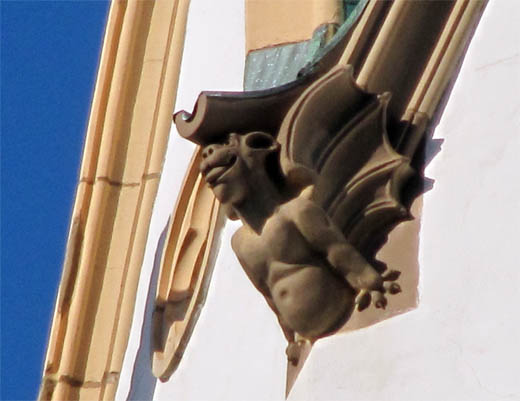
On North 18th Street in Kansas City, Kansas, look up to see this grotesque on all four sides of the tower at St. Paul’s Episcopal Church, designed by an artistic medievalist rector. According to a friendly parish worker we met, the church plans to sell reproductions of this mascot; he’s known as “the Grinning Gargoyle.”

Whether you’re en route to Kalamazoo or writing and teaching in what some would consider a far-flung place, look up and gaze around. Chances are, a deliberate reworking of something medieval is craving a chance to leer back.

“Dust you down from tip to toe…”

For five years, this blog has argued that medievalism is durably American. From Gothic synagogues in the South to killer queens in New Jersey, from Cajun jousters and the saints of New Orleans to the gargoyles of Perth Amboy, from rivalries on the Potomac to dragons and Vikings at seaside resorts, from late-blooming scholars on postage stamps to courtly love on General Hospital, American medievalism is rooted in an unresolvable clash of classical and medieval aesthetics, the persistence of religious traditions, and complex nostalgia for Europes that never were.

But did it have to take root in my garden?

Meet Glechoma hederacea, the mint-like ground ivy called “creeping Charlie” in the United States and known, at least around my place, as “existence’s bane.” Rampant, sinister, nigh-unstoppable, this weed was brought to North America by early European settlers, who presumably appreciated its value as ground cover and its not-unpleasant scent.

Medieval people found Glechoma hederacea medicinally useful, as shown by a drawing of the stuff in a tenth-century manuscript from Constantinople. At the Metropolitan Museum of Art, you can buy a watch and other jewelry based on its depiction in a 15th-century woodcut, gifts apparently intended for people who’ve never torn intractable fistfuls of the stuff from the temperamental earth.

More interesting is its etymology in England, where it’s known as Gill-on-the-ground or, intriguingly, alehoof. Britten and Holland’s 1886 A Dictionary of English Plant-Names claims the word comes from “‘Ale-hoove,’ meaning that which will cause ale to heave, or work,” because in an era sans hops, the Anglo-Saxons used the plant to give their ale its bitterness. (The 2007 Dictionary of Plant Lore quips, too defensively, that “there have been other attempts at its etymology which may safely be ignored.”) The Bosworth-Toller Anglo-Saxon Dictionary finds the plant simply called “hófe,” with references to mersc-hófe, “marsh-hove,” túnhófe, “yard-hove,” brúnhofe, “brown-hove,” and phrases in medicinal texts such as genim hófan, “take hove.” If *ealu-hófe was an Old English word, no written trace of it survives.

The word may be gone, but the plant endures, creeping just beneath the soil, breeding pernicious new nodes as it roams. You can slow its advance, but smother it in mulch and it summons demonic strength and pushes ever upward. Like a neglected chip of pure evil smoldering in a toaster oven, alehoof is almost impossible to eliminate. “[P]ut every scrap of the plant in a bag and throw it away,” one site advises, “or it will reroot and take over again.” Other sites suggest tracing the runners several feet to their origin and, like Beowulf before you, destroying the monster’s mother, even if doing so leaves craters in your lawn.

Whatever medicinal purposes medieval people found in alehoof, it’s now thought to be toxic in large amounts. And don’t be fooled by those dainty, bumblebee-pleasing flowers; when alehoof goes berserk, as it did in a neighboring plot, it can help bring down an unsturdy fence.

It’s enough to make a despondent gardener fall back on an Old English plea to the forgotten goddess Erce:

Geunne him,
ece drihten,
(and his halige
þe on heofonum synt),
þaet hys yrþ si gefriþod
wið ealra feonda gehwaene,
and heo si geborgen,
wið ealr bealwa gehwylc,
þara lyblaca geond land sawen.

[“Grant to him, eternal ruler (and his holy ones, who in heaven are), that his ploughing be protected against any and all enemies and it be guarded against each and every evil, against those spells sown through the land.” trans. K.A. Laity]

Or maybe, in the proper spirit of the Anglo-Saxons, magic needs to surrender to stoicism: hófe bið ful araed. Like medievalism, alehoof has taken perennial root; from gift shops to gardens, it isn’t fated to fade.

“Throw the world off your shoulders tonight, Mr. Smith…”

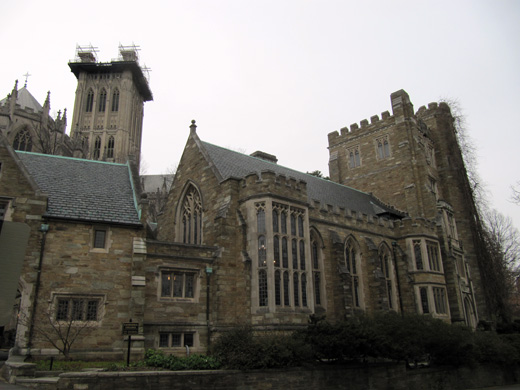
Silly and serious, profane and sacred, the gargoyles at the National Cathedral have become tourist attractions all their own. You can buy a book about them, the cathedral offers special tours, and I hear some strange neighbor is even writing gargoyle-themed poems.

They’re not, however, the only gargoyles and grotesques in town, or even on the cathedral grounds. Turn northeast and stroll a few steps and you’ll bump into Cathedral College (formerly the College of Preachers), dedicated in 1928 just as American neo-Gothic church building was waning and collegiate Gothic was on the rise.

Mostly Anglophilic neo-Gothic with Tudor-ish outbuildings and annexes, Cathedral College closed for budgetary reasons in 2009, but gray winter is a fine time to peep through leafless vines and trees…

…to see the grotesques on the large corner tower.


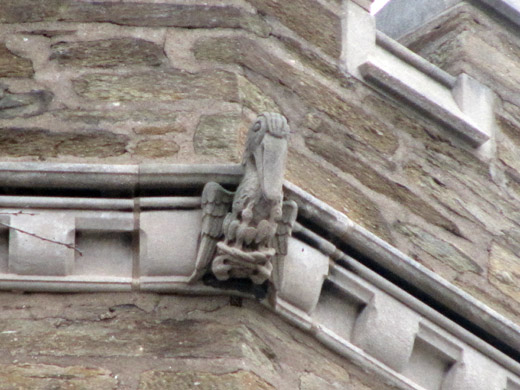
First up: a pelican feeding her young with the blood of her breast, a medieval Christian symbol of self-sacrifice that’s hardly unknown in the American South.

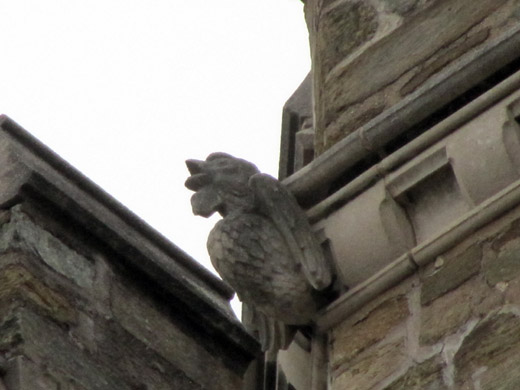
Harder to see: a rooster, medieval symbol of (among other things) vigilance.

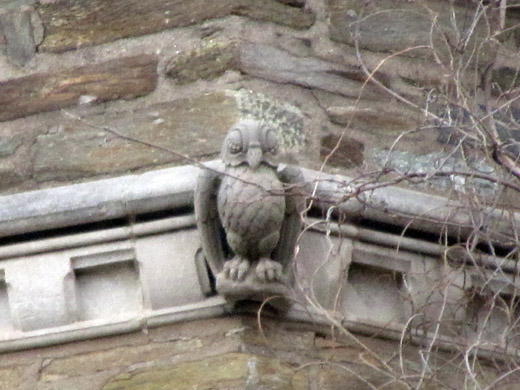
This owl’s shut eyes may suggest modesty, or sinners refusing to see and do the good, or, not inconceivably, Jews rejecting Christianity.

Everyone knows that in the Middle Ages, anthropomorphized frogs gesturing sincerely symbolized…um…

Exposed only in winter, this embrambled goat-devil is suitably eerie.

The College of Preachers was built by Frohman, Robb, and Little, one of several firms that made America look a little more medieval: Philip Frohman designed more than 50 American churches, and FR&L gave Trinity College Chapel in Hartford its neo-Gothic air. Frohman himself is best known for stepping in to re-design the National Cathedral in 1919. To a large extent, the building is “his”; he reportedly still climbed the scaffolding to oversee construction until his retirement in 1971. (Like many Episcopalian medievalists of his generation, Frohman was drawn to Catholicism; unlike most, he eventually converted.)

If Frohman, his partners, and their stonemasons intended the grotesques on Cathedral College to tell an obvious story, then I’m missing their meaning—beyond, perhaps, “please decorate the tower drainage system.”

“Ne can Ich eu namore telle. / Her nis namore of þis spelle”—but I’m open to generous and creative interpretations, even wild ones, of this medieval-ish menagerie that countless Washingtonians stomp past every day without ever stopping to see.

“She shouldn’t oughta try to be that way…”

“She would rise before us then, a vision to win us, not repel: a lithe young slender figure, instinct with ‘the unbought grace of youth,’ dear and bonny and lovable, the face beautiful, and transfigured with the light of that lustrous intellect and the fires of that unquenchable spirit.”

So wrote Mark Twain about Joan of Arc, the sole figure who could make him mute his famous disdain for medievalism. “[S]he is easily and by far,” he swooned, “the most extraordinary person the human race has ever produced.” (Twain considered Personal Recollections of Joan of Arc his favorite of his own books; his heroine’s penchant for mottos—”Work! Stick to it!”—prompted Shaw to brand her “an American school teacher in armor.”)

It’s hard to overstate what a big deal Joan of Arc was in America at the dawn of the 20th century—but like most spirited forms of medievalism, Joanolatry first rose overseas. In 1870, when the French lost Alsace-Lorraine to the Prussians, humiliated nationalists—when Europeans rouse medieval heroes from their graves, nationalism is usually the reason—made a symbol of the Maid of Orleans. American writers as early as John Daly Burk in 1798 cast Joan as an emblem of patriotism and pre-modern innocence, but by the late 19th century, European-influenced children’s books and chivalric romances about female heroes fired up men and women alike, as T.J. Jackson Lears points out:

The life of the chivalric warrior, male or female, ranged far outside the realm of reading circles and parlor chitchat. “Oh, to be a wild Kossack!” Emily Greene Balch wrote in her commonplace book after reading Taras Bulba. “Fight hard and drink hard and ride hard . . . Our clothes grow strait. Oh, for a horse between the knees, my blood boils, I want to fight, strain, wrestle, strike . . . To be brave and have it all known, to surpass and be proud, oh the splendor of it.”

Lears further argues that the American Cult of Joan was about more than escapism. For late 19th-century Americans, saints also “embodied instinctive communion with nature, simple faith unhampered by learning, and sexual purity. Personifying shibboleths of romantic liberal Protestantism, they entered the pantheon of the genteel tradition.”

World War I only gouged Joan further into American culture: She was immortalized on the Hudson in 1915, beloved by readers of Lucy Foster Madison’s 1918 novel (with its gorgeous Frank Schoonover illustrations), and brought to the screen by Cecil B. DeMille. Decades later, Joan was still sufficiently famous that OMD could write not one but two songs about her, while the Smiths could mention her and know that the image would stick.

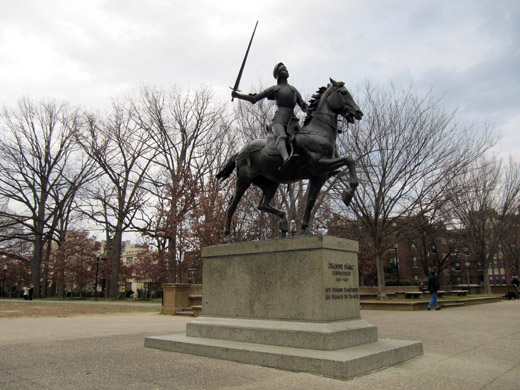
According to the Book Haven, yesterday was the 600th birthday of Joan of Arc. Fortuitously, I learned this morning via D.C. neighbor and blogger George that the Joan of Arc statue in Meridian Hill Park, dedicated by President Harding on the saint’s birthday in 1922

…but (as this 2007 photo shows) disarmed for decades…

got her sword back just last month! (And got a full body scrub too.)

Congrats to locals, who reportedly lobbied the Park Service for two years to make this happen, and happy 600th to Miss of Arc, who was, as one of history’s greatest thinkers put it, “a most bodacious soldier and general.