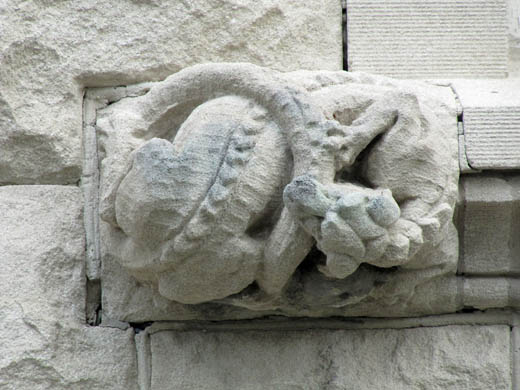
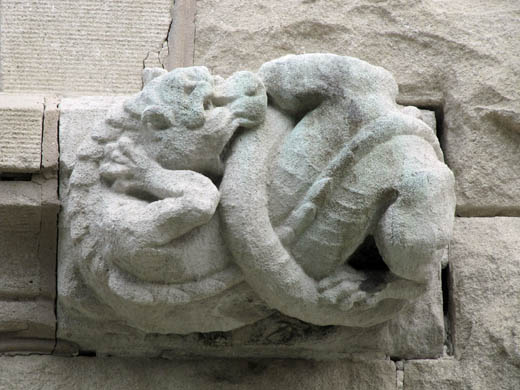
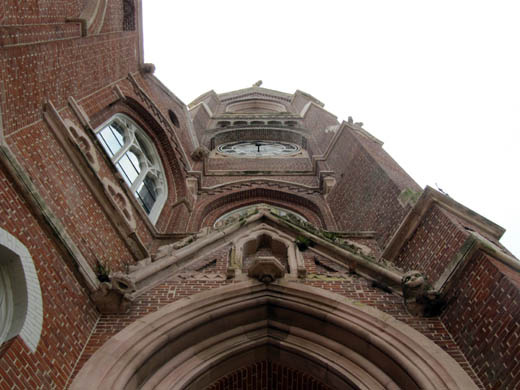
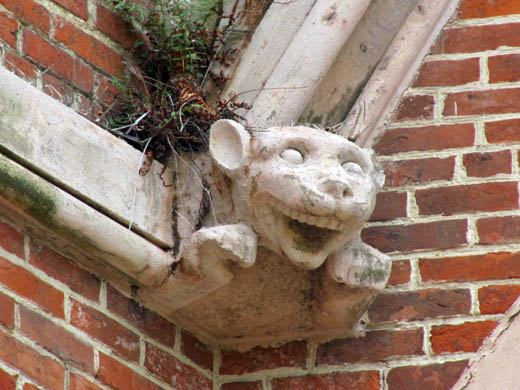
“Wheel in a wheel, way in the middle of the air…”

Savannah is famous for its gorgeous and walkable squares. One in particular, Monterey Square, was the site of drama in Midnight in the Garden of Good and Evil—but when I tromped through the square during Christmas week, I was drawn instead to a Gothic Revival church…

…that’s not, in fact, a church. Behold: Temple Mickve Israel! Dedicated in 1878, it’s the third home of a congregation founded in 1733 when 41 Jewish colonists, most of them Sephardic, sailed to Georgia (where Catholicism was illegal, but Judaism wasn’t) with the support of Jews in London.

Last week, I heard a passing tour guide announce that the congregation chose the Gothic Revival style to honor the cathedrals of their Spanish and Portuguese hometowns. That claim is specious; this building was dedicated nearly 150 years after the colonists arrived. According to the docents, the 19th-century Jewish congregants, like their Christian neighbors, simply got caught up in the Gothic Revival craze. Boy, did they ever.

For a synagogue, Mickve Israel is a weirdly pure model of a neo-Gothic church. It was designed by English-born Henry G. Harrison, a renowned Episcopalian church architect and a disciple of Gothic Revival master A.W.N. Pugin. Harrison’s background shows: Mickve Israel has a basic cruciform shape with a nave and transept; pointed arches; stained-glass windows with tracery; quatrefoil designs everywhere; buttresses; pinnacles; and a castellated multi-story tower. The ark is also neo-Gothic, as are the chairs alongside it.

The big difference, of course, is the swapping-out of a steeple with what the authors of Synagogue Architecture in America call “a Middle Eastern element hinting at the true Jewish nature of the building.”

I’d say it does far more than hint. That cupola insists, with confidence and grace, “Our roots are European, the Gothic style is ours to use—but we’ll top it off with a sign of our deeper origins and our present difference.”

A surprising schmeer of myth adheres to this synagogue: that the Jewish congregation bought it from the local bishop; that it’s based on a specific Spanish or Portuguese cathedral; and that the choir loft was once segregated seating for women.

Those tales aren’t true—but it is true that while other Gothic Revival synagogues used to exist, and while others still standing can boast neo-Gothic doodads, Mickve Israel is (as far as I can tell) the only remaining full-on Gothic Revival synagogue in America.

Today, this 200-family congregation reveres its medievalist gem, a building that bravely (but not brashly) asserted that Judaism belonged in a Southern city in the 19th-century—and well beyond. In 1927, when a fire destroyed the tower, the people of Mickve Israel rebuilt it…

…just as it was, and probably always will be: Gothic reverie, Middle Eastern memory, persistent American dream.

“I can hear people singing, it must be Christmastime…”

Medievalism is intertwined with the history of the American South. In cities like Richmond and New Orleans, where magazines helped popularize Sir Walter Scott novels and promote chivalric virtues, Gothic revival architecture felt right—but Savannah, where I’m spending Christmas, went its own wonderful way. Here, in a city with countless monuments but surprisingly few statues, you’re more likely to find Georgian, Italian, Federal, and Colonial styles, intermingled but insistently American beneath layers of picturesque moss.

So when you’re the new guy in Savannah, exploring the city’s public squares on foot on Christmas Eve, the search for medievalism seems downright futile…

…but after all these years, I know when to heed the signs. They’re rarely as obvious as this one on Liberty Street.

And so we trudge from moss-bedecked square to moss-bedecked square, wondering as we wander…


Is a lamppost resembling a bishop’s crozier the most medievalism the streets of Savannah can offer?

“No,” says a monstrous sconce on Bay Street. “Look lower, fool!”

Any Jesuit will tell you this totally counts as a gargoyle…

…as does this Seussian goof on the Cathedral of St. John the Baptist, though his architect spared him the spitting.

But what’s that in nearby Troup Square?

A neoclassical armillary sphere!? Isn’t there anyone in Savannah who knows what medievalism is all about?

“Sure, Charlie Brown,” says one of six bronze turtles in tiny Santa caps, “I can tell you what medievalism is all about.”

Yep, along this square is the Unitarian church where J.P. Morgan’s uncle served as minister when he published “Jingle Bells.” (Until today, it had never occurred to me that anyone had actually written “Jingle Bells,” or that controversy would attend upon its provenance.)

Amusingly, in the 1850s, Pierpont’s church wasn’t in this square, but a few blocks away. During a low point for Savannah Unitarians, the building was bought by African-American Episcopalians, who industriously rolled it away and set it down here.

So yes, it’s a cosmic treat to stumble around Savannah on Christmas Eve and find a neoclassical Christmas turtle that points you to the relocated church whose minister composed “Jingle Bells”—but what’s medieval-ish about an overplayed ode to the secular sleighing culture of 19th-century New England?

Aha! The composer’s church itself—castellated, Americanized neo-Gothic! Its discovery is hardly a miracle, but the sight of it is fitting end to a charming quest—and a fine way to wish “Quid Plura?” readers a merry (and hopeful, and gargoyle-rich) Christmas.

“Let us close our eyes; outside, their lives go on much faster…”

In modern cities, crowds and commerce and cars drown out the ring of mere bells—but this Friday, if you hear a faint pealing from an Episcopal church, know that it marks the feast-day for three medievalists. Two of them, English-born church architect Richard Upjohn and painter and stained-glass artisan John LaFarge, deserve to be remembered, but pause a bit longer to consider the third and most eccentric, architect Ralph Adams Cram, who clamored to rebuild the medieval world in a greener, more placid America.

Born in New Hampshire in 1863, Cram was the son of a Unitarian minister, but seeing the cathedrals of Europe at 23 drew the young man to Catholicism—almost. Enamored of medieval ritual at a time when becoming Roman Catholic would have been gauche, Cram instead embraced Anglo-Catholicism, a form of High Church Anglicanism, as did many Episcopalian intellectuals in the urban Northeast who adored Catholic aesthetics more than they loved the theology.

Cram looked at every skyline and imagined it dwarfed by spires. He was the architect who changed the style of St. John the Divine in New York City from Romanesque to Gothic; he worked for a time on Washington National Cathedral; he designed “collegiate Gothic” halls and other buildings with medievalist touches at Princeton, Wheaton, Richmond, Sweet Briar, and USC; and his firm built scores of churches that stand as neo-Gothic monuments from Pittsburgh to St. Paul. (In 1901, Cram literally wrote the book on church building.)

For Cram, medievalism was more than an aesthetic conceit. After World War I, he saw ruined societies doomed to one of two fates: a slide into a new Dark Age, or a return to ugly, worn-out modernism. Doubling down on his historical predilections, Cram offered, instead, a third way.

“It is in no sense a programme,” he insisted in 1919, with doubtful modesty,

it is still less an effort at establishing an ideal. Let us call it “a way out,” for it is no more than this; not “the” way, nor yet a way to anything approaching a perfect State, still less a perfect condition of life, but rather a possible issue out of a present impasse for some of those who, as I have said, peremptorily reject both of the intolerable alternatives now offered them.

Cram’s proposal? Americans should live, like medieval people, in walled towns.

Much of Walled Towns, Cram’s truly peculiar 1919 book, is a vision of Beaulieu, an imaginary burg situated “about forty miles from one of the largest cities of New England” in a spot that meets Cram’s criteria: arable land, a river, and “some elements of natural beauty.” We can drive to this happy outpost, but the gate house is our last chance to hail the outside world by telephone and telegraph. We’re required to garage our car—but we may, if we wish, pass through the gate on a rented horse. The walls of Beaulieu defend the reveries of an architectural fanatic: a gate that resembles Warwick Castle, a church like St. Cuthbert’s in Wells, a college that blends New College, Oxford with St. John’s, Cambridge, and a town hall inspired by the Hôtel de Ville.

In No Place of Grace: Antimodernism and the Transformation of American Culture, 1880-1920, T.J. Jackson Lears notes that “[s]ince Cram’s death in 1942, historians have dismissed him as an elitist crank, a reactionary in art and politics,” which oversimplifies his life and work. What makes Cram so interesting today is how awkwardly his equal hatred of democracy, socialism, communism, and anarchism meets the political assumptions of the early 21st century.

Cram’s Walled Towns forbid usury, stock markets, production of goods for profit, and all forms of advertising. Walled Towns forbid steam power, but not water mills or, surprisingly, hydroelectricity. A Walled Town is self-sufficient:

That one town or district should be given over to to the weaving of cotton or the spinning of wool; that shoes should chiefly be produced in Lynn, furniture in Grand Rapids, glass in Pittsburgh, beer in Milwaukee, hams in Chicago; that from all over a vast district the raw material of manufacture should be transported for hundreds, perhaps thousands of miles, to various howling wildernesses of highly specialized factories, only to be shipped back again after fabrication to be used or consumed by many of the original producers, was and is one of the preposterous absurdities of an industrial system supported on some of the most appalling sophistry that ever issued out of the Adullamite caves of political economy.

In the Walled Towns all this is changed . . . As each town has its own special products, maintained always at the highest standard, the market never fails.

In a Walled Town, only landholders may vote, and daily life is ruled by guilds—not, Cram stresses, the folk sentimentalized by a wistful William Morris, but a true restoration of the medieval guild system, which Cram calls “the precise antithesis of collectivism, socialism and trades-unionism of whatever form.”

Everyone in a Walled Town shares the same religious convictions; if you’re an Episcopalian knocking at a Catholic gate, seek your coreligionists down the road. Here, knowledge of Latin and a grounding in reading, writing, music, and math are universal, but education, which isn’t apportioned equally, focuses on character. The local college is run by faculty and alumni, not by corrupt or neglectful trustees. Walled Towns have no museums, because old and beautiful objects, such as medieval altarpieces, have been restored to their original uses. Walled Towns have fine art theaters, but no movie houses or sensationalistic shows—because in a Walled Town, “all life is couched in terms of true drama and living beauty.”

Given Cram’s fervent pursuit of applied medievalism, he seems to have overlooked “walled towns” that had recently failed. By World War I, American Arts and Crafts communities had waned; New Clairvaux, a commune of Massachusetts farmers and craftsmen founded in 1902 according to medievalist principles, had flopped; Rose Valley, a Pennsylvania arts-and-crafts project based on the utopianism of William Morris, was suburbanized; and the Americans most likely to retreat into anti-modern self-sufficiency were communists and anarchists, like the founders of my failed hometown commune, Fellowship Farm. Did Cram really believe that a Walled Town could be “at the same time individualist, coöperative and aristocratic”?

Cram does leave himself an out, claiming that his proposal need not be taken literally:

“The phrase ‘Walled Towns’ is symbolical only; it does not imply the great ramparts of masonry with machicolated towers, moats, drawbridges and great city gates such as once guarded the beautiful cities of the Middle Ages. It might, of course; there is no reason why a city should not protect itself from the world without, if its fancy led in this pictorial direction…

For Cram, “pictorial direction” is all. Here’s what he sees in 1919: “ragged and grimy children,” “a surly labourer” who “scowled coarsely, and swore, with his cigar between his teeth”; “men in dirty shirt-sleeves”; “children and goats [that] crawled starvedly around or huddled in the hot shadow”; “the mob of scurrying, pushing men and women, a mob that swelled and scattered constantly in fretful confusion”; “dirt, meanness, ugliness everywhere—in the unhappy people no less than in their surroundings.”

By contrast, Cram’s medieval “way out” abounds with “a great lady on a gaily caparisoned palfrey, with an officious squire in attendance, or perhaps a knight in silver armour, crested wonderfully, his emblazoned shield hanging at his saddle-bow.” There is “the pleasant clamour of voices, the muffled chanting of cloistered nuns in some veiled chapel, the shrill cry of street vendors and children, and the multitudinous bells sounding for worship.” Cram may decry utopians from Plato to H.G. Wells, but his Walled Town is itself the trite utopia of an architectural sketch: happy, faceless people strolling through pristine shopping malls or public squares, doing only what their designer envisions, never misusing, abusing, or defacing their earnest surroundings, freed by architects alone from the ugliness of human nature.

A century after Cram built his mental Beaulieu, no one lives in neo-medieval towns, but Cram still left his mark. Countless Americans first encounter medieval forms in the churches and cathedrals he designed, and his neo-Gothic spires and arches adorn campuses where, in the 1920s, Americans began studying the Middle Ages with greater zeal.

Notice, though, how American medievalism has changed. These days, few academics, ecclesiasts, and architects want to live in the Middle Ages. They tend to look back with detachment, while medievalist nostalgia thrives in genre fiction, video games, and Renaissance Faires. Meanwhile, Cram’s odd brand of aristocratic idealism lives on, split into bits across the ideological spectrum.

When Ralph Adams Cram, fiery nemesis of the impersonal, the imperial, the commercial, the cacophonous, writes that “the only visible hope of recovery lay in a restoration of the unit of human scale, the passion for perfection, and a certain form of philosophy known as sacramentalism,” he makes himself easy to dismiss, even as he drapes precious new lights on humanity’s evergreen dreams. But if, in a slough of disillusionment, you’ve ever pined for agrarian simplicity, religious or political uniformity, stark self-sufficiency, aesthetic transcendence, or lasting peace, then you’ve been, however fleetingly, a pilgrim to one of Cram’s Walled Towns—although it’s been a church, a Ren Fest, a Tea Party, an Occupy rally, or a perfectionist corner inside your own mind where you visit your will on the world.

So on Friday, if you laugh at the impulse to build a Walled Town, be more charitable than you imagine he was, and let the bells ring for old Ralph Adams Cram. They’re always ringing somewhere.

“…to get a little conversation, drink a little red wine…”

I doubted, briefly, à moitié fou, that Louisiana was the most medievalist place in America. Yes, the state is home to the shrine to a French saint, an assortment of monsters and patrons, the castellated capitol that horrified Twain, the medievalist banks of the old Pontchartrain, even the statue of an infamous fictional medievalist—but surely c’est tout?

Au contraire. On a sunny Sunday in October—yesterday, in fact—twenty Cajun knights rode into an industrial park 175 miles northwest of New Orleans, bearing the past beneath perfect blue skies.

Welcome to the Louisiana Tournoi de la Ville Platte, held in the seat of Evangeline Parish on the closing day of the Louisiana Cotton Festival. Across three rounds, twenty competitors—the Knights of Cotton—run a semicircular course, using a lance to snag rings hanging from posts that stand for the seven enemies of cotton: Flood, Drought, Silk, Boll Weevil, Boll Worm, Rayon, Nylon, and Silk.

Each run takes between 12 and 20 seconds, and each lanced ring knocks 10 points off a starting score of 210. Officials average each rider’s time, multiply it by 5, then divide it by 3, and then add it to the ring score. The competitor with the lowest score wins.

What’s fascinating about the Tournoi is that it evolved independent of other recent medievalist traditions that look so much like it. The Tournoi is no Renaissance festival, nor is there the slightest whiff of historical reenactment or genre-fiction whimsy. Instead, it’s a hyper-local sporting event, complete with country music, color commentary on the radio, and tailgating.

If you show up in a car rather than a truck, and without a tent, a grill, and beverages, everyone will spot you as the lone out-of-towner.

According to the Tournoi’s web site, the first mayor of Ville Platte brought the ring joust to town in the early 19th century. The sport enjoyed a 90-year run, then locals revived it after World War II.

As documented by Esther J. Crooks and Ruth W. Crooks in their 1936 book The Ring Tournament in the United States, chivalric contests based on medieval tournaments once drew thousands of spectators. After the Civil War, mayors from Virginia to Mississippi counted on guest appearances by Robert E. Lee, P.G.T. Beauregard, Nathan Bedford Forrest, and other big-name vets to raise money for widows, orphans, and monuments to the dead. The Crookses cite a strong interest in the sport in Cajun country, where the Acadians had a tradition of breeding saddle horses and ponies dating to at least the mid-18th century.

Ville Platte, in most regards a deeply traditional town, seems indifferent to the old Southern obsession with the Middle Ages that birthed the Tournoi. Modern medievalism often comes bundled with anxiety about “authenticity”; the Tournoi just shrugs. Behold: a four-wheeler smoothing the track with a giant rake ballasted by an idle knight—a medieval Cajun zamboni.

You can see jousting at Renaissance fairs, and there’s even a National Jousting Association, but the good people of Ville Platte ride on regardless. Adapting a medieval tournament to modern sports culture, they rest in shady pavilions and wear t-shirts in the color of their favorite knight, keeping both eyes on the ring-joust even as they keep one ear on radios blaring the Saints game. When you ask them if anyone ever brings in a “ringer” from outside, they laugh. “No one outside of here does this!” insisted a friendly man parked next to us, burgers ablaze on his grill. “If anyone does this, I’d sure like to know.”


“Well, it’s a long way to Richmond, rollin’ north on 95…”

Before the Civil War, Richmond was, in the words of historian Rollin Osterweis, the “intellectual headquarters” of the upper South. In days of yore, it was also, not by chance, the regional capital of trendy medievalism.

In a state formed by the manners and patterns of English life, the Richmond-based Southern Literary Messenger (edited by Edgar Allan Poe) reinforced the romanticism of its readers by treating them to Gothic yarns, the pageantry of Sir Walter Scott, the thought of Thomas Carlyle, and, in the twenty years before the Civil War, mountains of chivalric poems. The wealthy in and around antebellum Richmond adored chivalric pageants and tournaments; by the 1850s, writes Osterweis, “[i]nstead of longing awkwardly for the days of knighthood, the gentry is now convinced that it is living in them.”

This weekend, I was honored to be a guest at the annual James River Writers Conference, an event hosted by what may be the most hospitable writers’ group in the country. New to a city that was once obsessed with knighthood, courtliness, and English heritage, I took advantage of glorious weather to track down charming traces of old, neo-medieval Richmond.

Crammed between newer buildings on 5th Street is the Second Presbyterian Church, completed in 1848. Here, we’re told, the first pastor “proclaimed that he was ‘tired of Grecian temples with spires on them'” and “determined to build the first Gothic church in Richmond, a city noted for its classic Greek architecture. His building committee persuaded the noted New York Architect Minard Lafever, one of the leading masters of the Gothic Revival in America, to design the building.”
Ages later, the parking deck next door feebly acknowledges its Gothic elder.

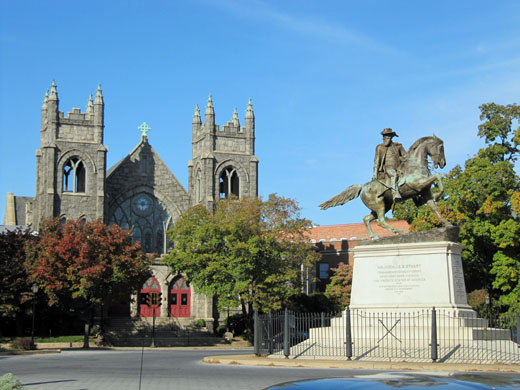
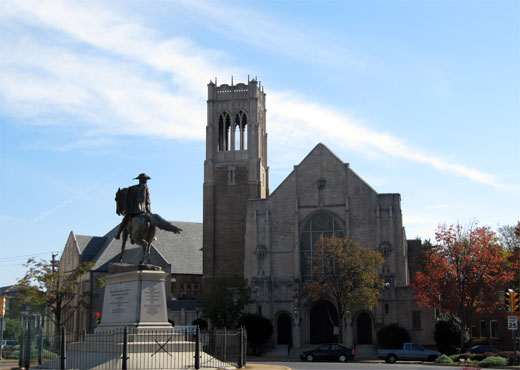
Old buildings in Richmond favor classical and Federal styles intermingled with eclectic Victoriana, but on the eastern edge of Monument Avenue, Jeb Stuart, statuesque, presides over a Gothic revival.

It’s the right assignment for a general whose biographer calls him “the Confederacy’s knight-errant . . . Amid a slaughterhouse, he had embodied chivalry, clinging to the pageantry of a long-gone warrior. He crafted the image carefully, and the image befitted him. He saw himself as the Southern people envisaged him. They needed a knight; he needed to be that knight.”

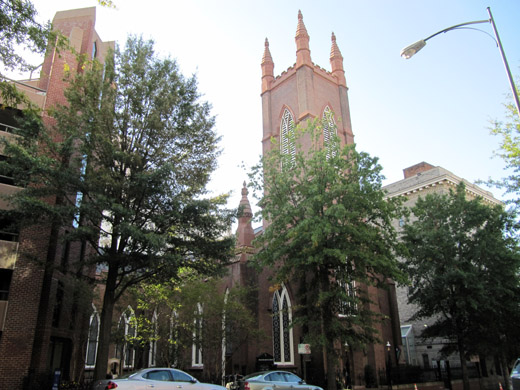
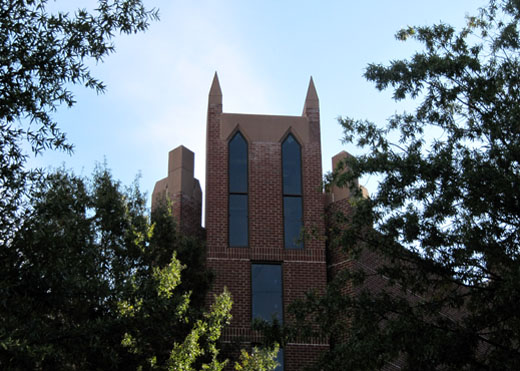
Around the statue of Stuart rise the First English Lutheran Church (above), St. John’s UCC (below), and Grace Covenant Presbyterian (photo).

Here, the Gothic fought the Federal to a standstill, if only in facades.

On the north end of town, at Union Presbyterian Seminary, whimsy is the prime mover at Watts Hall, designed by Charles H. Read and built in 1897. Gleefully asymmetrical, Watts is one of those buildings that gets weirder the longer you look at it.

With its buttresses and blind triforium (those little rows of fake indented windows), its chapel could, at first glance, almost pass for medieval, but for that clock tower…

…and the quatrefoil-mad chimneys with wild Corinthian capitals.

Still, one terrific detail on the front of Watts Hall is all-American Gothic, perhaps befitting an age in which religious architecture is no longer a prominent carrier for medievalist ideas:

A lone grotesque, fleeing the scourge of theology.

“Catch the mist, catch the myth…”

Mark Twain was beguiled by medieval minds. Most Americans remember his satiric use of medieval spolia in A Connecticut Yankee in King Arthur’s Court, but Twain returned to the Middle Ages with telling regularity. He celebrated the jubilee of Queen Victoria by writing in the voice of a noble at a 1415 Agincourt victory parade, and he considered Personal Recollections of Joan of Arc his favorite of his own books. Like many late 19th-century Americans, even non-Catholics, Twain was obsessed with the French saint, finding “no blemish in that rounded and beautiful character” and calling her “easily and by far the most extraordinary person the human race has ever produced.”

Later, Twain taught his children medieval English history by linking pictures to pathways in his yard, and he even journeyed to Bayreuth, where his only mild appreciation of Wagner’s Tannhauser and Parsifal made him feel “like a heretic in heaven,” even as he declared the pilgrimage “one of the most extraordinary experiences of my life.”

As Twain knocked around Europe, he sometimes grumbled when the Middle Ages intruded on his vision of a more rational world. In Switzerland, after hearing a tale about a skeleton who testified in a medieval trial, he spat that it spoke of “a time so remote, so far back toward the beginning of original idiocy, that the difference between a bench of judges and a basket of vegetables was as yet so slight that we may say with all confidence that it didn’t really exist.” Still, even Sam Clemens, hostile to notions of nobility, could get swept up in the romanticism of Europe’s medieval past, provided it stayed on the far side of the Atlantic.

I pondered Twain’s medievalism last week while passing through Baton Rouge, a city he knew from his riverboat days. In Chapter 40 of Life on the Mississippi, Twain revisits the city, alive with magnolia blossoms: “For we were in the absolute South now—no modifications, no compromises, no half-way measures.” Like Twain, I found “a tropical sun overhead and a tropical swelter in the air,” and one of his more memorable rants still hanging in the August haze:

And at this point, also, begins the pilot’s paradise: a wide river hence to New Orleans, abundance of water from shore to shore, and no bars, snags, sawyers, or wrecks in his road.

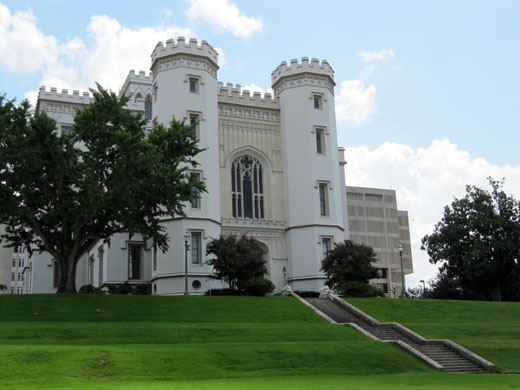
Sir Walter Scott is probably responsible for the Capitol building; for it is not conceivable that this little sham castle would ever have been built if he had not run the people mad, a couple of generations ago, with his medieval romances.

The South has not yet recovered from the debilitating influence of his books. Admiration of his fantastic heroes and their grotesque “chivalry” doings and romantic juvenilities still survives here, in an atmosphere in which is already perceptible the wholesome and practical nineteenth-century smell of cotton-factories and locomotives; and traces of its inflated language and other windy humbuggeries survive along with it.

It is pathetic enough, that a whitewashed castle, with turrets and things—materials all ungenuine within and without, pretending to be what they are not—should ever have been built in this otherwise honorable place; but it is much more pathetic to see this architectural falsehood undergoing restoration and perpetuation in our day, when it would have been so easy to let dynamite finish what a charitable fire began, and then devote this restoration-money to the building of something genuine.

[. . .]

By itself the imitation castle is doubtless harmless, and well enough; but as a symbol and breeder and sustainer of maudlin Middle-Age romanticism here in the midst of the plainest and sturdiest and infinitely greatest and worthiest of all the centuries the world has seen, it is necessarily a hurtful thing and a mistake.

* * *

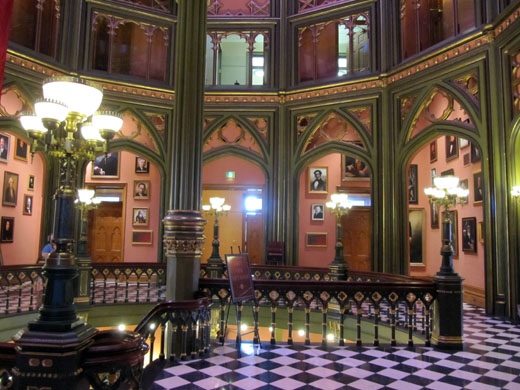
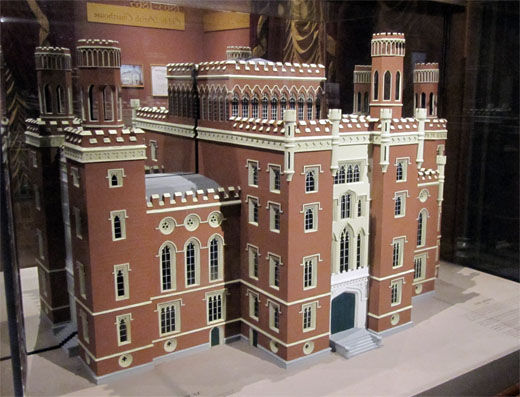
That’s Louisiana’s Old State Capitol, designed in a “castellated Gothic” style by New York-born James Harrison Dakin in 1847 and open for business (albeit 400 percent over-budget) by 1850. The designer of several neo-Gothic churches and college buildings, Dakin hated the idea of another derivative neoclassical statehouse and opted for a Capitol with “a decided distinctive, classic, and commanding character.”

Since the Civil War, the Old State Capitol, occupied and almost accidentally burned down by Union troops, has been stuck in a cycle of abandonment, decay, destruction, renovation, and rebirth. Although Twain recalled a “whitewashed castle,” Louisianans who picked up Life on the Mississippi between 1883 and 1902 knew a bolder folly, painted red and festooned with iron turrets that even I find excessive.

The people of Louisiana appear to have adored the Old State Capitol, but one political giant shared Twain’s hatred of the place: Huey Long. As governor, Long left the building’s fire insurance unrenewed, believing—perhaps hoping—that “it was about to fall down, and there was nothing left to patch,” according to Carol K. Haase. “He said there wasn’t another building in the whole country that was such a disgrace and that he wouldn’t pay twenty-five dollars for the whole thing.”

By 1932, a new capitol, an art-deco skyscraper, loomed over Baton Rouge. Twain would have been pleased. Infuriated by the stubborn Southern medievalism exemplified by plantation owners’ obsession with the works of Sir Walter Scott—more on that in a future post!—he wanted to see Americans spell out their culture in a homegrown, progressive idiom, shorn of courtiers and kings. After sighting the emperor’s daughter-in-law in Bavaria in 1891, Twain found her beautiful, kind, and humane, which troubled him all the more. “There are many kinds of princesses,” he sighed, “but this kind is the most harmful of all, for wherever they go they reconcile people to monarchy and set back the clock of progress.”

Browsing Life on the Mississippi and The Complete Essays in recent days, I’ve been impressed by the breadth of Twain’s knowledge and insistent rationality—but I’m also struck by also by how badly he misjudged the grip of medievalism on the American mind. Even as Twain mocked, in that same chapter of Life on the Mississippi, an advertisement for a Tennessee finishing school that played up its “resemblance to the old castles of song and story, with its towers, turreted walls, and ivy-mantled porches,” the United States was on the verge of a 40-year “collegiate Gothic” building binge that makes Twain seem far from prescient about his era and the culture of the century since. Were Twain to hear my four-year-old niece swooning over the Old State Capitol in Baton Rouge, he’d be despondent. “It’s like a real castle, where princesses live,” she gushed to an amazed friend. “I wish I could go back tomorrow. I wish I lived there.”

Like many Americans, Twain wandered the medieval world of his own imagination; it’s both humanizing and absurd that he thought he could write new lives for saints and kings without stirring the waves of medievalism that ceaselessly lap at American shores. His ambivalence also shows that you don’t need to like the Middle Ages to be a medievalist, as long as you fancy yourself that rare, rational aesthete who can thrill to monarchical pageantry without endorsing monarchies themselves. “One can enjoy a rainbow,” Twain claimed, suppressing a romantic twinge, “without necessarily forgetting the forces that made it.”

“You can’t plant me in your penthouse, I’m goin’ back to my plough…”

It’s a sluggish season for blogging, but here at “Quid Plura?,” we’ve been called away from things online by the ageless yawp of agriculture.

Two weeks ago, I inherited a local garden plot. Although abandoned by humanity, this desperate parody of circumcrescence was dearly beloved of weeds, roots, seashells, rotten bamboo, and countless plastic shards. The very sight, especially so late in the summer, was dispiriting; even Gerard Manley Hopkins might have let fly a guilty dream or two about the glorious symmetry of the lawnmower.

So I turned for inspiration to Walahfrid Strabo, the 9th-century abbot and scholar memorialized at the National Cathedral garden (and remembered there by at least one gargoyle). In De Cultura Hortorum, his famous gardening poem, Walahfrid recounts the nettled disaster he faces each spring, then calmly resolves to tame it:

So I put it off no longer. I set to with my mattock
And dug up the sluggish ground. From their embraces
I tore those nettles though they grew and grew again,
I destroyed the tunnels of the moles that haunt dark places,
And back to the realms of light I summoned the worms.
(trans. Raef Payne)

And so, ten days ago, buoyed by the spirit of Walahfrid, I set about turning this…

…into this.

In his little garden, Walahfrid raised bountiful herbs alongside vegetables, flowers, and fruit. While cautioning that hard work trumps book-learning in these sorts of labors, he offers, across twelve centuries, a mote of hope:

If you do not let laziness clog
Your labor, if you do not insult with misguided efforts
The gardener’s multifarious wealth, and if you do not
Refuse to harden or dirty your hands in the open air
Or to spread whole baskets of dung on the sun-parched soil—
Then, you may rest assured, your soil will not fail you.

We’ll soon see if this modern hortulus can bring forth plants that a sensible human will want to smell, admire, or eat. If so, I’ll be thankful for Walahfrid, and grateful, too, for the promise of applied medievalism.

“…to holes of their own making in the cracks within the walls…”

For four years, “Quid Plura?” has chased medievalist echoes in New Orleans—the statue of Ignatius Reilly, a shrine to a French saint, the glitter of Joan of Arc—as well as medieval-ish statuary in Cajun country and miscellaneous medievalism on the North Shore.

Yes, here there be saints—but where are the medieval monsters?

Earlier this week, on a hot afternoon, we sought to answer that question by turning to someone who slays them.

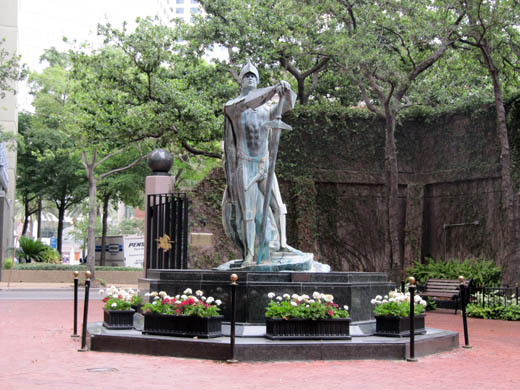
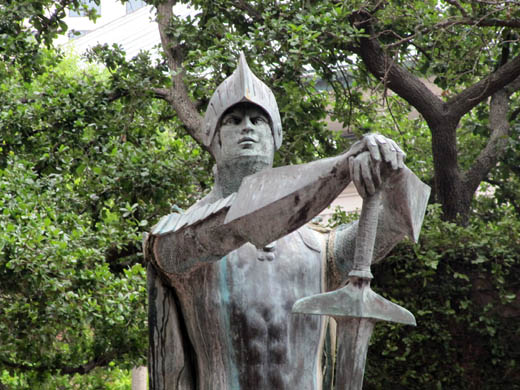
What say you, heroically-abdomened St. George in a hotel courtyard just outside the French Quarter?


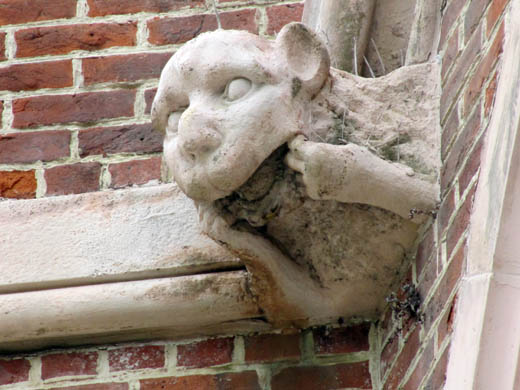
George points west, so we’re off to the 16th Ward, where the beasts atop Tilton Memorial Hall at Tulane are timelessly monstrous rather than strictly medieval…

…but the alley behind the building hides a clutch of caudophagic dragons.

Heeding the call of the neo-Gothic, we take the streetcar east into Ward 12 and trudge down to the impressive St. Stephen Church on Napoleon Avenue…

…and when we look up…


…the neo-medieval mocks us.

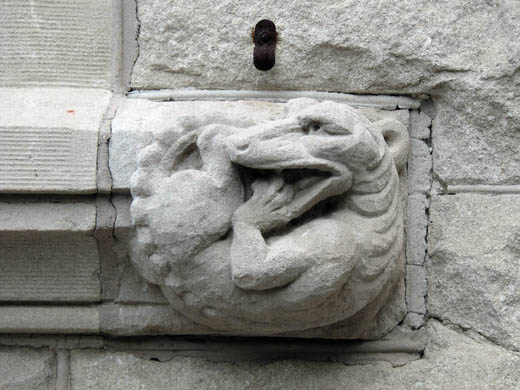
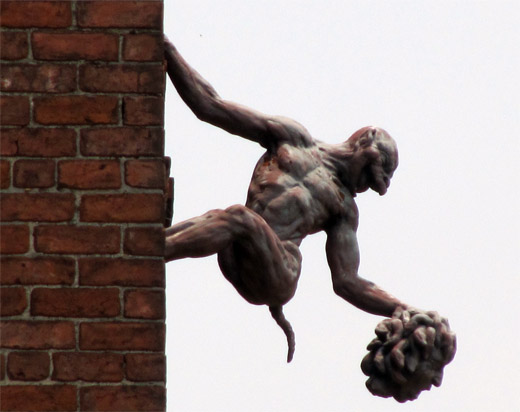
Yet we cling to the hope of grotesquerie, just as two miles to the east, on Jackson Avenue in Ward 10, something clings to the side of a gutted 19th-century synagogue…

…a creature not quite medieval…

…but poised to petrify your inner ten-year-old.

“Probi fuimus, sed non durabimus…”

[The trappings of Christmas, though bountiful, always include reruns. Here’s a seasonal “Quid Plura?” flashback from 2008.]

For all its opulence, the palace was a hall of drear. It glittered, the chamberlain knew, but it long ago ceased to shine. Enthroned, the pope passed the afternoon without the hint of a whisper. He was now another of the chamber’s countless statues, a decoration to be dusted, an object of occasional veneration. Clerks and notaries flitted beneath him; they attended to petitioners and saw to the snuffing out of candles.

The chamberlain sighed. He wished for a window. How many more hours of misery awaited him? The incense stung his nose. He ached for a cup of wine.

“A chanter from Seville to see you, sir.”

The chamberlain blinked. The small priest before him was sweaty and red. Was this forgettable creature always so twitchy? No matter; it was time to be a tyrant.

“The Holy Father has no interest in Andalusian vagrants. Send him away.”

“Sir, you really want to see this.”

They always promised marvels. What came instead? Puppet shows. Mimes. That donkey with the law degree.

“Have we no legitimate business to conduct?”

“No, sir, not after this.”

The chamberlain gave his old hand-wave of resignation. Boredom trumped tyranny on dull winter days; regret would soon bury them both.

Moments later, a dark-haired man wearing humble clothing entered the room. The chamberlain approached him, mindful of protocol.

The Spaniard strode past him and burst into speech.

“Holy Father! Far have I traveled, and strange sights have I seen, but today I bring music that shall warm men’s hearts and give glory to Almighty God!”

The chamberlain rolled his eyes.

“Your Holiness, in Sevilla, the city of my birth, I was a scholar of music in all its myriad forms. I knew the call of the muezzin, the savage chanting of ancient Gaul, the bawdy refrains of the Genoese shipmen. From Cordoba to Samarkand, my name was known to many. Raspy minstrels, cantors from the patriarchal tombs—strangers came from far and wide that I might discover their songs.

“But to my enduring shame, O Holy Father, one form of music was entirely unknown to me. Rumors reached me of a marvelous style of singing, a sound full wondrous to hear. Its secret, travelers told me, was guarded by monks at the ends of the earth, where they sang unending hymns of Saint Nicholas and other Christian subjects too numerous to mention. Desiring to know this music which few living scholars had heard, I left my comfortable home and my company of flatterers, and I chased vague whispers over strange and lonely paths.”

The chamberlain glanced at the motionless pope. Was he asleep? Was he breathing? Had this long-winded fool at last bored the pontiff to death?

“Holy Father, I sought this heavenly choir in the terrible places of the world. I sailed through ice in the realms of the north, where hard men laughed at my desperate quest. I traveled eastward into Araby, but I journeyed in vain, for there I heard only frivolities, and never celestial sound.

“Winter came. Forlorn, clad only in rags, I faced starvation on frigid mountain peaks. Through the intervention of God—for how else to explain that fortuitous day?—I was rescued by the brothers of an order whose patron I am forbidden to name. But there, Holy Father, while I rested, healing through Our Lord’s salvific grace, strange music amazed me as I lay in my cell.

“That miracle I bring to Rome this day.”

At the far end of the chamber, golden doors opened. Three tiny, hooded figures glided silently over the marble.

Bile rose in the chamberlain’s throat. A dwarf act! He crossed himself. These always ended in sacrilege. Where were the guards?

The Spaniard raised his right hand.

“Hit it, boys.”

A weird, piercing music filled the air: an unearthly chant that flowed magically from beneath three tiny cloaks, an eerie, impossible singing that bathed the great hall in a strange and transcendent cheer. Priests and monks froze where they stood, beguiled by a falsetto that not even castrati could create.

Tears welled in the chamberlain’s eyes. Was this the choir of Heaven or of Hell? The verse of these singers was in some alien tongue—foreign, yes, yet oddly familiar. He understood none of it, not one single word—but he knew it would haunt him for the rest of his life.

And then, as quickly as it had begun, the singing ended.

The hall was silent. Eternities passed. No priest or monk dared blaspheme the place with motion—not a cough. Everyone stared at the singers.

Finally, with trembling voice, the chamberlain found nerve enough to ask: “Are you men…or angels?”

The three beings reached up with tiny hands and reverently lowered their cowls. Solemn faces peered out at the world, wide-cheeked faces with prominent teeth set beneath large, benevolent eyes. Their features were mingled in brown, shaggy fur.

The chamberlain gasped.

“What manner of monk are these?”

From far behind him came a stir of precious robes and a voice not heard here in ages.

“Non monachi,” declared the quaking, agitated pope, “sed chipmonachi.”

The giggling of the pontiff resounded through the hall. Priests rushed to his side, desperate to calm him. The chamberlain fell to his knees as confusion around him swirled.

The stranger from Seville folded his arms; then he looked at his singers and frowned.

“If they think that’s something,” he muttered, accustomed to such chaos, “just wait ’til they see you fellas dance.”

“Angels we have heard on high, tell us to go out and buy…”

“Now, the world don’t move to the beat of just one drum,” Alcuin famously advised Charlemagne in a letter that outlined the dangers of proselytizing to conquered tribes, “and what might be right for you may not be right for some.”

Medievalists know this better than anyone—which is why, as Christmas approacheth, the e-mails keep coming, as relentless as pistachio mongers in eighth-century Aleppo: Jeff, what should I get for the medievalist in my life?

Shopping for medievalists is easy. Here are ideas for unusual presents, all of which will be more gratefully received than those Medieval Times gift certificates you gave everybody last year.

APPLIED PALEOBROMATOLOGY

Turn tesserae of taste into a floor mosaic of flavor with A Taste of Byzantium: The Cuisine of a Legendary Empire.

Wipe away that gazelle-milk mustache and dine like a caliph with Medieval Cuisine of the Islamic World.

Dig for traces of medieval history in Joan Nathan’s new book, Quiches, Kugels, and Couscous: My Search for Jewish Cooking in France.

Let fly the yams! Defend the Land of Cockayne with a tabletop trebuchet (I’ve built this one! It’s pretty neat), and then lay siege to the sweet, spongy fortress that falls from your castle-shaped bundt pan.

Pretend this doesn’t sound dirty: Set your mouth on fire with Dante’s Inferno Balls.

“The heavenly aroma still hung in the house. But it was gone, all gone! No lamprey! No lamprey sandwiches! No lamprey salad! No lamprey gravy! Lamprey hash! Lamprey à la king! Or gallons of lamprey soup! Gone, all gone!” So go on, order tinned sea lamprey from Russia and feast like Havelok the Dane.

THE BUSINESSE OF MEDIEVALISM IS BUSINESSE

Do your loved ones live where Beowulf and strategic pricing techniques intersect? Refer them to Wiglaf Pricing, which “take[s] up Wiglaf’s example and seek[s] to aid executives in making the right decision under difficult circumstances to yield dramatic strategic improvements.”

If you own a business in the U.K., perplex your cringing minions with medieval team-building exercises, or smite them with your inflatable morningstar.

“VITÐ ÉR ENN, EÐA HVAT?”

Medieval Icelanders deployed the term “downward-facing dog” with unseemly specificity. Nonetheless, a lesson in runic yoga will de-stress your workaholic Viking.

The next time someone whines that medieval texts are unfilmable, hit them, literally, with this: the Icelandic adaptation of Gisli’s Saga on DVD. (While you’re ordering across the whale-road, why not snag some soda named after Egil Skallagrimsson?)

FROM THE SNORRI STURLUSSON BATHTIME FUN COLLECTION

You’ll be eager to hit the clubs and father all of Europe after scrubbing with Charlemagne Shower Gel.

I don’t know what to say about soap inspired by Dante’s Purgatorio, beyond “don’t get any in your eyes!”

Like Ibn Fadlan, I have mixed feelings about Beowulf soap made from honey and beer.

Wife of Bath bath salts may give your ablutions auctoritas, but they’re no substitute for experience—or penicillin.

HALL, HEARTH, AND HOVEL

Swing by the Got Medieval store, where Carl sells an awesome assortment of household doodads featuring medieval manuscript monkeys.

Make your den look all the jauntier with details from English cathedrals. (I especially like the hedgehog.) Or line your mantle with Chaucer-themed art tiles from the Moravian Tile Works in Pennsylvania.

Stop using the Exeter Book as a beer-mat! Rest your flagon on medieval story tiles: Celtic musicians, Tristan and Isolde, a scribe, or a Viking insult stone.

While waiting for your vowels to shift, have a drink and admire the Norman knights coaster set.

How tired must Martin Foys be of nodding and smiling every time he unwraps these Bayeux Tapestry cushion covers?

BAUBLES FROM THE GIFSTOL

Develop a new ear for Middle English with Ellesmere mini-Chaucer earrings.

Don’t just study Chaucer’s Prioress; be her, with this AMOR VINCIT OMNIA bracelet.

Every woman longs to hear it: “He went to the Pierpont Morgan Library!” This Christmas, give her jewelry based on the cover of the Lindau Gospels.

There’s a poem in this: a heart encased in chain mail.

MIRABILE VISU (ET DICTU)

Grendel’s mom sez: “Preserve your child’s teeth and hair in a pewter castle-shaped reliquary—but catch the shrieks in a cup of gold.”

Incubus wearing you out at night? Secure your bedchamber with a dragon-themed lock and key.

Write a check for $64,350 and that 15th-century printed copy of Boethius can be yours. (Take heart: shipping is only $10.)

In the “Quid Plura?” household, we’re all about the True Meaning of Christmas: the anniversary of Charlemagne’s imperial coronation. This year, rock like a tinsel-draped Carolingian with Christopher Lee’s weighty-brass concept album, Charlemagne: By the Sword and the Cross.

A mere $3.3 million can buy you the lifestyle of a heavy-metal medievalist: the late Ronnie James Dio’s house is for sale.

No one ever gets me what I really want: a picture of Dante and Beatrice in the Lincoln Tunnel.

LUDICRAE SUMUS

It’s Iceland, or Fontenoy, or Hastings, or this place, when your head’s down over the pieces of the Lego Castle chess set or the Lego Viking chess set. (They can always pillage the Lego Medieval Market Village.)

If cerebral tabletop games are your thing, try the highly abstract (and fascinating looking) Carolus Magnus.

Pre-order The Sims Medieval, though you won’t see it until March.

“AND EEK IN WHAT ARRAY THAT THEY WERE INNE…”

This isn’t strictly medieval, but those of you in academia may want the Lands’ End “FeelGood Professor Cardigan.” (If you’ve a Ph.D, students can call you “Doctor FeelGood.”)

If you further need to look the part, the Canterbury Cathedral Shop sells a necktie featuring the heraldic shield of the Black Prince of Wales and a Canterbury Tales stained-glass window scarf.

Washington National Cathedral also has gargoyle ties, and no Celticist should be without the Book of Kells tie. 

Maybe Christmas isn’t the right season to draw attention to a sexy female Robin Hood costume, but it’s a fine time to remind you not to dress your child like a medieval monk. (And please, I beg you, don’t dress your dog as a jester.)

Happy shopping—and nowell!