“And the little wheel runs on faith…”

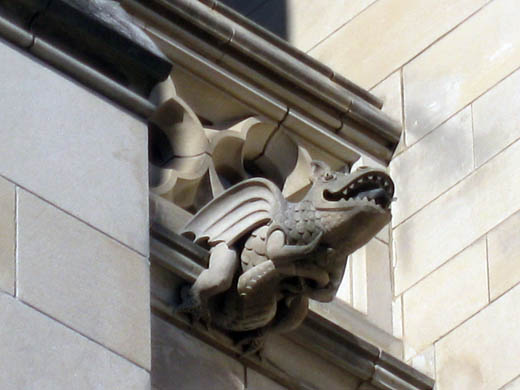
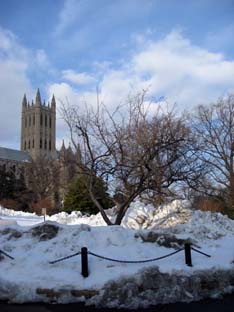
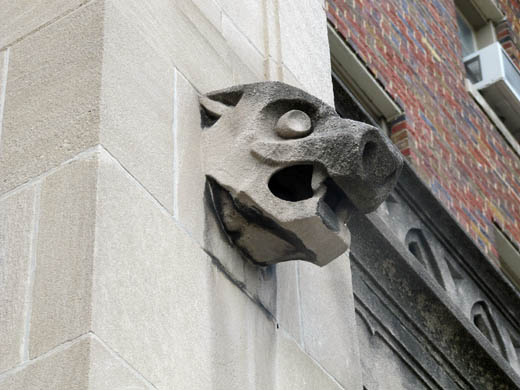
Tourists never notice it, but then neither do most locals. Behold: Alto Towers, catty-corner to the National Cathedral at 3206 Wisconsin Ave NW.
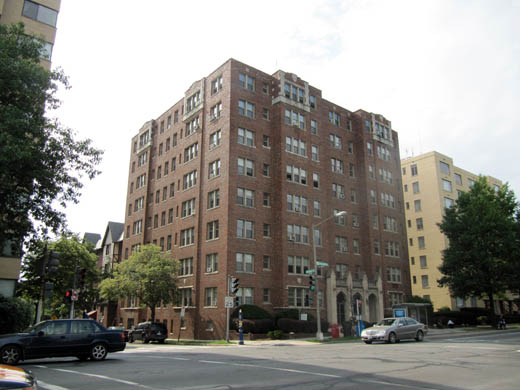
Alto Towers went up in 1932, in the heyday of D.C. suburbanization. This eight-storey apartment house is the work of Arthur B. Heaton, a half-forgotten architect who’s partly responsible for the look and feel of northwest Washington—and who was, briefly, an unabashed medievalist.

Heaton was ridiculously versatile. In 1901, he built Tudor Revival apartments and later designed the Altamont, a local apartment house with an Italian Renaissance twist. In 1914 and 1931, he put Classic Revival additions on the National Geographic Society building. In 1926, he gave his (now-demolished) Capital Garage a funny, car-themed facade, and his interest in the automobile led him to design our local “Park and Shop,” the prototypical strip mall, in a Colonial Revival style. Heaton oversaw the construction of new facilities on the GWU campus while also designing banks, churches, and countless other D.C. buildings and homes, apparently without ever developing an identifiable “Heaton style.”

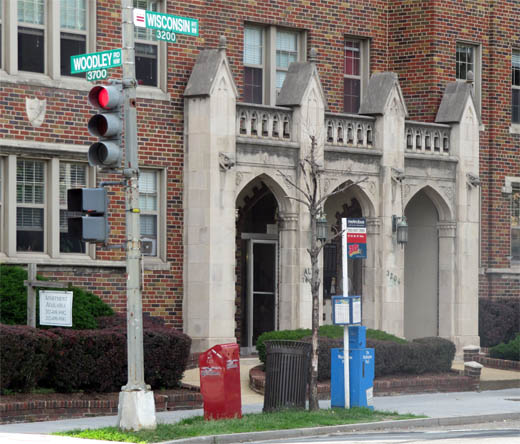
…and that’s what makes Alto Towers a treat for the medievalist. Take a gander at the entryway.
When Heaton wasn’t serving as president of the local chapter of the American Institute of Architects, co-founding the Washington Building Congress, or spearheading the “Renovize” movement during the Depression, he was also, from 1908 through 1920, the supervising architect for the National Cathedral, where he helped chief architect Henry Vaughan oversee construction during the cathedral’s first 12 years.

In 1932, more than a decade after Heaton’s time there, the cathedral was little more than an overgrown apse festooned with a few angelic grotesques. Given a chance to design an apartment house across the street, Heaton—who could have built damn near anything—set loose his inner medievalist.
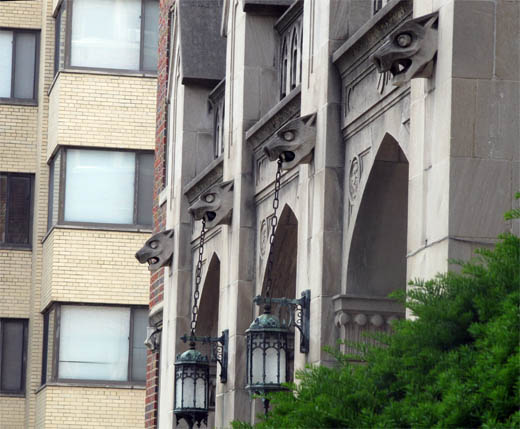
Those snarling, gargoylish grotesques are the most blatantly cool thing about Alto Towers, but the whole arcaded entryway is a neo-medieval romp.
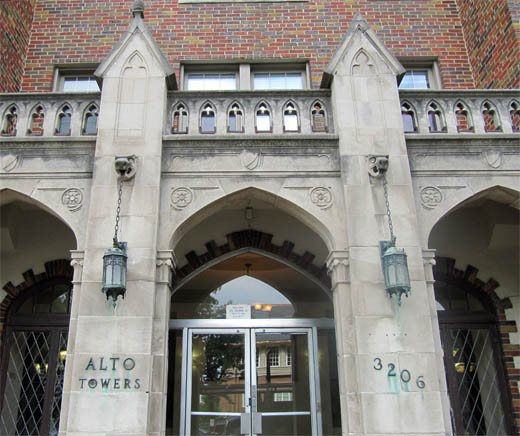
The quatrefoils (four-leaf clovers) in the spandrels (the warped triangles above each arch) are pretty standard, but those thick, gabled supports are an architect’s fancy. Each one resembles a cathedral buttress while also containing blind tracery of a Gothic arch.

At Alto Towers, periods and cultures trip over one another and have a good laugh. The pine cone finials hark back to ancient buildings and the medieval fascination thereof, while those funny little nubs at the tops of the smaller arches—including the little ones in the triforium, the upper row—strike me as very American. Meanwhile, on both sides of the interior of each large arch are squared, Art Deco-ish shadows of Corinthian columns. Behind them, the brick-lined inner doors whisper “Cordoba” in an American accent.

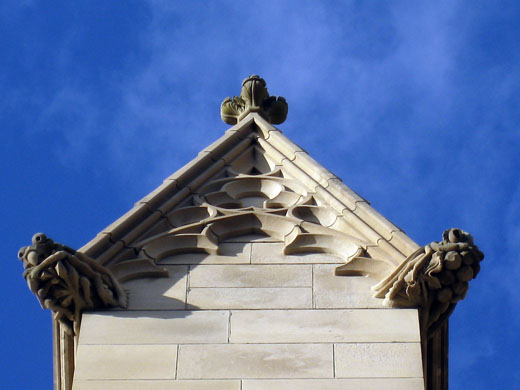
Most of Alto Towers is plain brick, but Heaton decorated just enough of its topmost level to show that the neo-medievalish entryway wasn’t an afterthought.
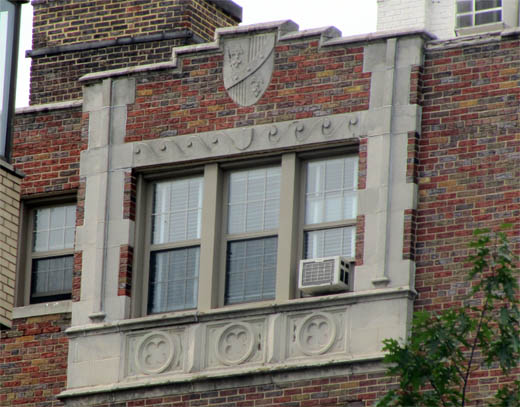
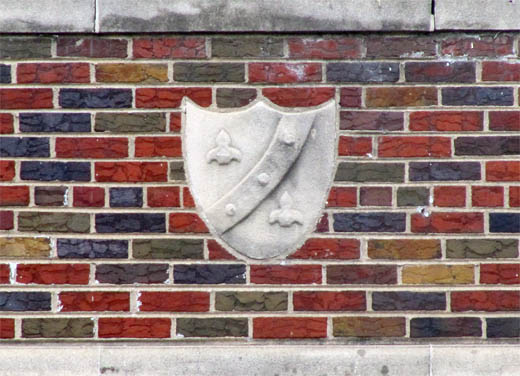
Note the two types of ornamented shield. They may be purely decorative, but I’ll gladly send a free book to any heraldry buff who can show that they’re meaningful.
While Heaton’s 1926 Capital Garage (PDF with photo) featured large, leonine gargoyles, Alto Towers is his full medievalist statement, the rhapsody of a restless architect who knew he wouldn’t live to see the cathedral completed.

When Heaton died in December 1951 at 76, the new apartment buildings rising around the cathedral were blocky and bland. Today, tourists tromp right past them, fixated on the promise of sighting quirky gargoyles on the Gothic spires beyond.

Of course, the cathedral’s first proper gargoyles weren’t put in place until around 1960, so if the beasties at Alto Towers forever bare their fangs, I can’t really blame them. No one remembers that they were here first.
“I’ll build you a kingdom in that house on the hill…”

Around the cathedral, few creatures say what they actually mean. When the lovelorn cicada on the south nave needed advice on impressing the silent insect with whom he shares a buttress, I shrugged and loaned him a book on ghazals. Cicadas are well suited to the form: They respect tradition, they’re enigmatic by nature, and they know how to flutter indecisively around a perfectly bright idea.

GHAZAL

The scullions ma’am’d and sir’d to the Abbasids;
The lusts of locusts whirred through the Abbasids.

Salaam, she sighed. A serpent shed a city,
And in, a starving bird, flew the Abbasids.

In wine, in witless words, in bloodshot mornings,
The gift of gardens blurred to the Abbasids.

A general’s eye surveyed the rheumy rooftops,
And frozen by a word grew the Abbasids.

You sang, “the bow his brow, his lashes lances…”
Our dawn campaign referred to the Abbasids.

“It’s cool,” the in-crowd says, “to dig this chanting.
A ban would be absurd to the Abbasids.”

Her angel raises ribbons, blue and scarlet,
But wasting in the third queue? The Abbasids.

I studied senseless serifs on your postcard,
A lore I long preferred to the Abbasids.

Spines align. He scans her posture sidewise:
El Cid, Beginner’s Urdu, The Abbasids…

The old cicada sang, his soul emerging,
And yet you never heard. Do the Abbasids?


(For all the entries in this series, hit the “looking up” tab.)

“Feathered, look, they’re covered in a bright elation…”

Too few Washingtonians have hobbies; for many people here, cultivating a career is apparently amusement enough. Fortunately, I sometimes encounter locals—like this fellow on the west front of the cathedral—who enjoy a pastime I’d never really thought much about, and I like when they explain its appeal in terms I can understand.

A SIMPLE DESULTORY PROSOPOPOEIA
(or, HOW I WAS RICHARD WAGNER’D INTO TRADITION)

“I do not think that they will sing to me”:
Impulsive mermaids drown in shallow words.
Await no witless warbling by the sea;
Rather, seek the songs of simple birds.
From perch and peak they twitter truths profound:
A woodbird stirs the Volsung in his blood;
A parliament of eagles circles ’round;
A curlew chills the farer on the flood.
The cuckoo croaks that sumer is icumen;
“Keep well thy tongue!” confesses Chaucer’s crow;
The nightingale her owl will merr’ly summon;
Despite their flyte, one insight they bestow:
Be still, but heed the rustle of a wing;
A legendary pigeon waits to sing.


(For all the entries in this series, hit the “looking up” tag.)

“Unicorns and cannonballs, palaces and piers…”

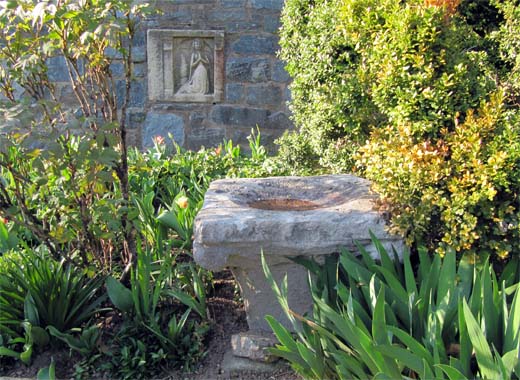
Yes, there’s a winged unicorn at the National Cathedral, but she hides in a shady nook along the south nave, and the horn that rests flat against her back can’t be seen from the ground. Below her, over the wall in a corner of the garden, sits a birdbath, a 12th-century capital salvaged from the ruins of Cluny. One never can tell what a unicorn will find intriguing.

EASTER 2010

A whisper in the medlar, Father Hugh:
“I found a cloister crook’d in splintry beams
And stood it straight in marble. Fresh regimes
Reigned higher still; our rule they overthrew.
As songbirds shrink from thunder, we withdrew,
And now the sun we kindled scarcely gleams
Above the murk of misremembered dreams.
This capital will never rise anew.”
To which I field a future all my own:
A thousand summers wither in a blink.
A sparrow spots my hooves and broken horn
Through churchyard brambles, grear and overgrown,
And droplets on my wing she stoops to drink;
Then she will be refreshed, and I reborn.


(For all the entries in this series, hit the “looking up” tag.)

“Don’t leave me hanging in a city so dead…”

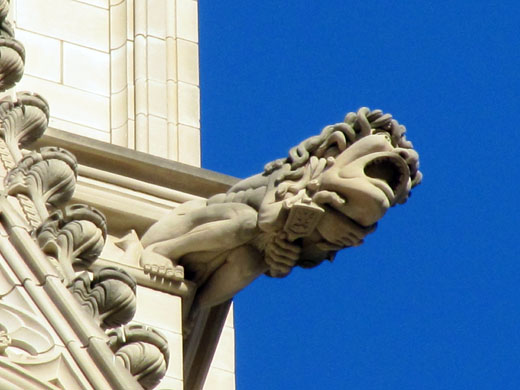
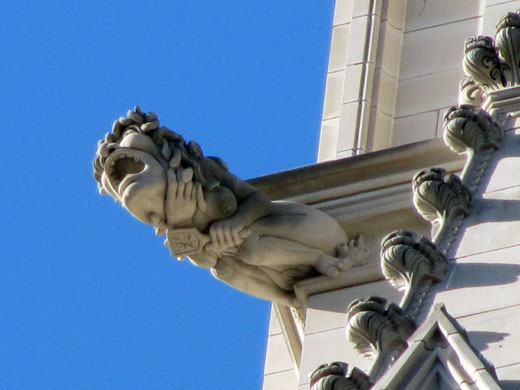
Sometimes gargoyles are so high up—in this case, nearly 200 feet—that few people see them, and nobody hears them. Alas.

On either side the arches fly,
The buttress-blocks that half-imply
A sort of creamy stonework thigh,
And thro’ the calf and knee-crook high
Soar carven brutes profuse; a
Docent notes them, up and down,
Pent-up pilgrims crane and frown
’Neath the nag of no renown,
The southwest-tower Medusa.

A tourist twirls, a ballerina
Sensing o’er her Neutrogena
Grills that send a scent subpoena
From a cactus-themed cantina,
Corn-and-meat pupusa;
Bus-groups pained by prickly towers
Overlooking Gothic powers
Seek instead tequila sours
Ere southwest-tower Medusa.

Still, she sneers by day and night,
A myth amasked in aspish fright,
Damning each commercial flight,
Heedless of the blear and blight
She blusters to induce; a-
Ware of what her curse may be,
Alone she seetheth steadily,
Spitting on the bourgeoisie,
The southwest-tower Medusa.

And, skirting ’round her mirror’s haze,
Limestone saints avert their gaze,
Lest a glance condone her craze:
A kraken kind she howls to raise
To shake her prison loose; a
Waste, when distant dumpsters crash,
Reaping reams of beer-dark trash.
She hath no hope for titans’ clash,
The southwest-tower Medusa.

Like a queen of ninth-grade spites
Brooding on imagined slights,
Texting vapid acolytes,
Curls a-twirl through tween-dazed nights,
She taps jejune abuse; a
Tome she scans with deep’ning dread;
No sandaled Zeus-brat hunts her head.
“I am half sick of Bulfinch,” said
The southwest-tower Medusa.

She’s left to wail, she’s left to loom,
She sets her face to scowl and fume,
She sees the horrid garden bloom,
She sees no glad, galumphing groom
To suffer and seduce; a-
Las, no roof-beam waits to rise,
Nor any man half Ares’ size.
“No curse has come upon me!” cries
The southwest-tower Medusa.

There is no river, chain, nor boat,
No pithy rhyme for profs to quote,
No knight to heed her final note;
For her, no verse will e’er be wrote
By laureates obtuse; a
Captive crone, denied release,
She envies maids whose poems cease.
No tender curse can promise peace
To southwest-tower Medusa.

No one wonders, “What is here?”
High above, some starry sphere
Screeches thro’ another year;
Now the dusk-light drowns in drear
And failing, fades to fuchsia;
For no one mused a little space,
And no one praised her fang-bit face,
And none of flesh will e’er embrace
The southwest-tower Medusa.

(For all the entries in this series, hit the “looking up” tag.)

“And he plays at stocks and shares, and he goes to the regatta…”

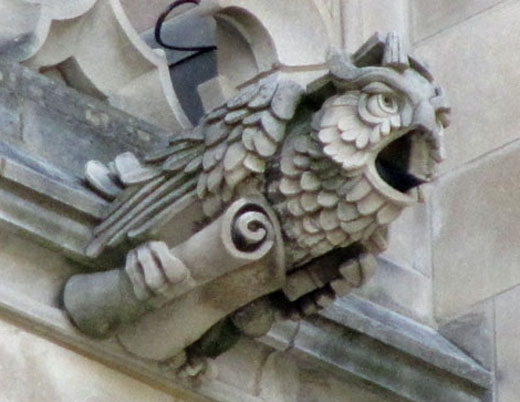
When I asked the owl on the north nave to contribute a poem to this project, I assumed from his mortarboard, scroll, and book that he’d hand me a pile of self-aggrandizing verse. Instead I got this shamefully loose translation of a pseudo-Ovidian poem written sometime between the 12th and 14th centuries. I guess a gargoyle, like the occasional human, reserves the right to remain enigmatic.

THE LOMBARD AND THE SNAIL

Loudly, the Lombard lopes over the landscape, and stops;
Leery, he lights on the lushest and loveliest crops.
Frabjous he feels, for his fields are not fated to fail—
Then forth springs a spectacle strange and stupendous: a snail.
Cowed and confounded, he quivers and quavers and groans;
Witless, he whitens, as wonderment welters his bones.
Seizing his senses, he summons the sangfroid to say:
“Fie on a felon! My fortune is forfeit today!
No suchlike scoundrel has slithered or skulked here before.
Mark well his message: he musters to meet me in war.
Horns are his heralds; his shield makes his handiwork plain.
Shall I not spurn him? No—better, in sooth, to be slain.
What if I poke and provoke him? Perhaps I’ll prevail!
Minstrels and merchants will mimic my marvelous tale.
What am I saying? To fight with a fiend is uncouth!
Easier warfare abounds; it’s a world-weary truth.
Men will say ’madness!,’ maligning me under their breath:
’It’s not meet and fitting to seek an uncivilized death.’
What if my children should walk by this waelstow and see?
Faced with this fiend, they would fathom his fierceness and flee!
Still, they’d concede that this combat is clearly unfair:
Armed is this beast, but no buckler or broadsword I bear.”
Fretful, he freezes, as Fear grapples fiercely with Shame;
Shame is pugnacious, but Fear keeps his temperament tame.
Competent counsel can kindle a capable life;
Thus he petitions the heavens, and checks with his wife.
Promptly, the gods promise palms for the victor, and praise;
Nervous, he nurtures no trust in their numinous ways.
Thence to his wife; she is timorous, tearful, and true:
“Listen, you lunatic, what are you looking to do?
Scuttle your strife; let your spirit sit safe on a shelf.
Mind no more monsters—and muse over more than yourself.
Spurn not your children and spouse! Let your senselessness stall;
Ill-omened days will bring dolor and doom to us all.
Hector would crumble, and even Achilles would quail;
Fast would the firmness of Hercules fracture and fail!”
Roused, he retaliates: “Rein in your runaway fears!
We who dare Death are undaunted, dear woman, by tears.
Great be the gods, for they grant me a glorious name.
You and the family fare well! For I follow my fame.”
Forth to the field, where he faces the fiend in the fray;
Stalking around him, he steadies his stomach to say:
“Beast, you are feral, unnatural, immoral, and vague!
Monster of monsters, as mean as the mortalest plague,
Hold high your horns! I am horrified hardly at all.
Show me your shield! Into no stealthy shell shall you crawl.
Righteous, I raise my right hand! Now your ruthless reign stops!
Savagely sully no more my salubrious crops!”
Swinging and swatting and shaking and sticking his spear,
Panting, he presses; the palm of the victor is near.
For heroes who rate such renown, what reward is supplied?
The matter is lofty; their lawyers will likely decide.


(For all the entries in this series, hit the “looking up” tag.)

“The girls would turn the color of the avocado…”

According to Gasch’s Guide to Gargoyles and Other Grotesques, the cathedral’s beret-wearing, paintbrush-toting deer is a verbal and visual pun: “This ‘endearing’ artist is undoubtedly ‘fawning’ on art.” Forever facing south toward the city’s museums, this creature is finding that a life in the arts, or in Washington, is about acquiring far more than the proper costume or kit.

ARS GRAVIS, VITA LEVIS

“Oldenburg, Rauschenberg, Klimt, or Klee:
When will I know what my passion should be?
Bierstadt, Bearden, de Kooning, Kinkaid:
How will their worth and my wisdom be weighed?
Is Calder too cutesy? Is folk art still fab?
Must Modern mean morbid? Devotional drab?
Are Memmi’s Madonnas deserving of fame?
Is liking them rightly ironic, or lame?
Is Flagg too American? Catlin taboo?
Is Russell too western? Is Parrish too blue?
Is Fauve far too Fauvist? Is Nevelson fluff?
Noguchi not nearly noetic enough?
What if I’m cornered, but plead my release
By deftly decrypting a daring new piece?
‘Problematizing. Pedantic. Profane.
Derivative. Kitschy. Impassioned but vain.’
Stone-faced, I’ll suffer no pleasure to show.
What if they squint through my brilliance, and know?”

(Say God replies. His pronouncement drifts down:
“Art’s not an adjective, only a noun.”)

(For all the entries in this series, hit the “looking up” tag.)

“It’s the only the thing that never gets old.”

The conversations one overhears around the cathedral are enlightening. An eavesdropper soon learns that there are answers to seemingly impossible questions, including this one: “Why is that gargoyle smiling?”

A MOTHER CONSOLES HER DAUGHTER

“Lizards must perish, as sure as they’re born;
Children who love them are fated to mourn.
Yet lizards live on when their season is flown:
Scales fall away; the remainder is stone,
And wings, like green legends, burst forth and unfold.
The beasts they become covet altars of gold;
They roost on cathedrals, unnoticed and gray,
Watching the centuries die in a day.
Well may you wonder, ‘But what happens next?’
This question leaves even the wisest perplexed.
The wyrd of these wyrms is a subtle decree,
But here’s what a wyvern once whispered to me:
When Time bids these buttresses buckle and break,
Scattering rubble and ruin in their wake,
Things wearing wings will awake and take flight.
On towering temples a few will alight;
Some will watch kobolds construct them a shrine;
Some will stalk longships, their prows to entwine;
Some will grind gryphons to dust in their claws;
One may remember a child, and pause.
So listen, for wings carry comforting truth:
Honor the monsters that creep through your youth,
And never make light of a reptile’s pride;
A lizard, though small, is a dragon inside.”


(For all the entries in this series, hit the “looking up” tag.)

“There is a green hill far away…”

Despite the presence of noble-minded buffoons sitting around tables making futile plans, Washington is not an Arthurian town. Sure, there’s that suburb with corny Arthurian names, but Washington culture may be better suited for mocking fabliaux than the charming fictions of medieval romance.
Still, this city never stops sprouting quasi-medieval surprises. Trudge through the snow three days after a blizzard, and you do so alone; no one’s out taking pictures anymore, not even at the perpetually lovely Bishop’s Garden. Climb over a wall or two, send a few squirrels bounding away from the racket you make, and you’ll stumble onto this, in the driveway of a neighborhood school: a tree which the gardening guild claims was grown from the Glastonbury Thorn.

Of course, the “real” Glastonbury Thorn, dubiously rooted in history, has died several times over the centuries, and there’s reason to believe that my neighbors occasionally replace the local offshoot. Interest in the Washington thorn peaked in the 1950s, which partly explains why I’ve spent many a summer afternoon dozing on the Bishop’s Lawn unaware that this trace of Arthuriana prospered a few yards away, the quiet center of its own Tennysonian scene:

“The cup, the cup itself, from which our Lord
Drank at the last sad supper with his own.
This, from the blessed land of Aromat–
After the day of darkness, when the dead
Went wandering o’er Moriah–the good saint
Arimathaean Joseph, journeying brought
To Glastonbury, where the winter thorn
Blossoms at Christmas, mindful of our Lord.
And there awhile it bode; and if a man
Could touch or see it, he was healed at once,
By faith, of all his ills. But then the times
Grew to such evil that the holy cup
Was caught away to Heaven, and disappeared.”

It’s a silly thing, really, but after a week of Washingtonians grousing about winter, I’ll be glad when they’re back to chasing political grails. In a city that imports its legends, we could do worse than remember stories that teasingly promise perpetual spring.

“It’s nothing but time and a face that you lose…”

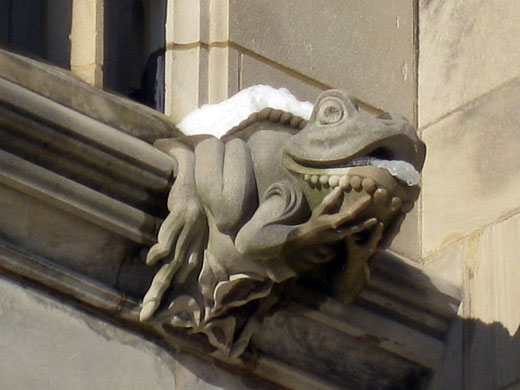
Where the south nave meets the south transept, near the entrance to the gift shop, is this fellow. As gargoyles go, he’s not lurid or menacing, but he does know his role in architectural tradition.

FEBRUARY 14

“On a skull in Salamanca
High within a grand façade
Croaking notes of grace eternal
Roosts a rana loved by God.”

So the tourist told his lover
Smiling up through falling snow.
“Strange,” she said, “sounds Salamanca.
What bright boon do frogs bestow?”

“Should two souls in Salamanca
Chance to see the frog,” he said,
“Blessed days are bound to follow;
In a year, the two will wed.”

Glancing down, she glimpsed a garden;
Frozen roses felt her sigh:
“We are not in Salamanca.”
Windy whipped the winter sky.

Side by side, the silent strangers
Shuffling slowly through the snow
Spoke no more of Salamanca;
Where they went, I do not know.

(For all the entries in this series, hit the “looking up” tag.)