Yep, we’ve fallen into lazy summer hours here at “Quid Plura?” headquarters. August is about writing, reading, and walking in gardens—but new posts are coming soon.
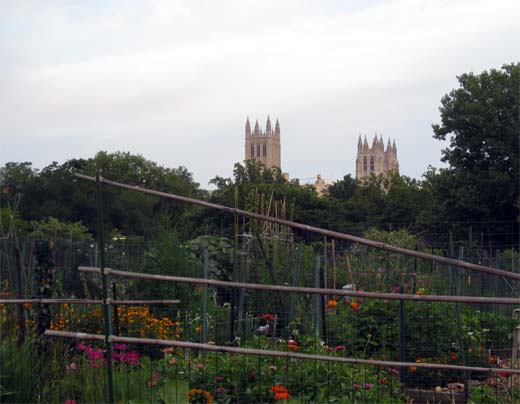

Yep, we’ve fallen into lazy summer hours here at “Quid Plura?” headquarters. August is about writing, reading, and walking in gardens—but new posts are coming soon.
Walahfrid Strabo is always at work on the grounds of my local cathedral. The ninth-century abbot who tutored Charlemagne’s grandson is remembered in the garden, where a stone baptismal font is surrounded by plants he described in a poem. Gardening gave Walahfrid the metaphors he needed to talk about the world. Plurima tranquillae cum sint insignia vitae was the sum of his teaching: “A quiet life has many rewards.”
More than eleven centuries later, Walahfrid would probably be as troubled as today’s neighbors were when they learned the cathedral is closing its greenhouse.
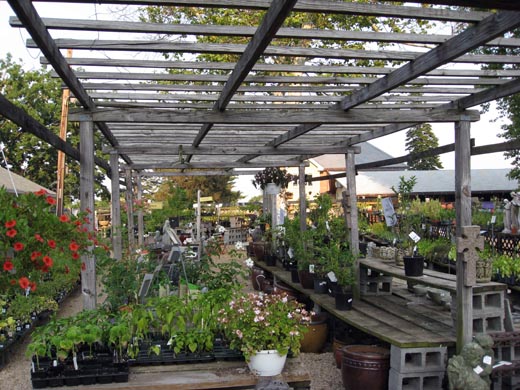
In “On the Cultivation of Gardens,” Walahfrid wrote that a plot full of flora was evidence of hard work repaid, a notion that made him an optimist:
True, that part there
Below the high roof is dry and rough from the lack
Of rain and the heaven’s benison; true, this
Part here is always in shade, for the high wall’s
Solid rampart forbids the sun to enter.
Yet of all that was lately entrusted to it, the garden
Has held nothing enclosed in its sluggish soil
Without hope of growth.
Friends of the greenhouse aren’t nearly as hopeful; the cathedral insists its decision is final. Walahfrid, who found poetry easy but gardening hard, would likely see metaphors here.
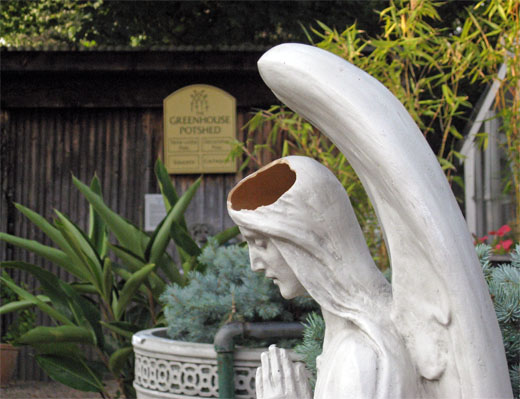
The closing will make us one metaphor poorer. In a city that thrives on ephemeral matters, it’s a pity to lose a place that hints at the timeless rewards of a quiet life.
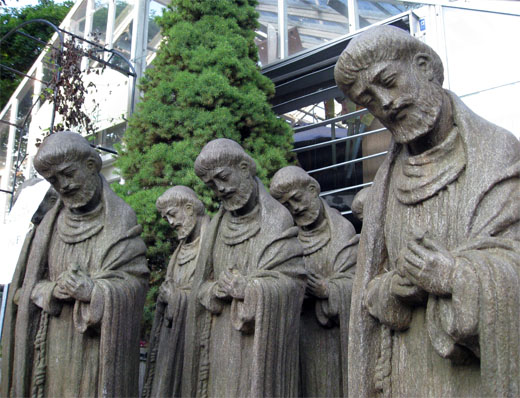
You may be enriching your knowledge and refining your scholarship, American Blogging Medievalist Community, but one Washington cathedral is having the best weekend ever.
For three nights, Swiss artist Gerry Hofstetter is projecting a colorful slide show onto the western and southern sides of the National Cathedral. Supposedly, the images are devoted to “illustrating [the cathedral’s] mission of reconciliation, spotlighting its role as a spiritual beacon for the nation, and proclaiming hope for all humankind,” but mostly they’re just eye-popping fun.
Thousands of people gathered on the grounds tonight. Traffic slowed; families kept their kids up late; couples huddled in the gardens and on moonlit benches; a group of frat guys cheered like sports fans every time the colors changed; and an older lady told me that the light show was “better than fireworks, because here you have time to think about each one.”

Groovy, baby!

We are stardust, we are golden…
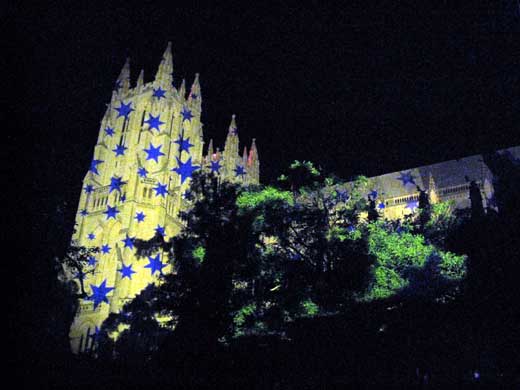
One passerby muttered, “How much artistic skill does it take to project an image onto a building?” There’s an argument to be made from that, but how often do workaholic Washingtonians pause to look up and reflect? Making stressed people patient with lights, shapes, and symbols—that, in itself, is an art.
As Today in Literature reminds us, yesterday, April 18, was the day Chaucer’s pilgrims set out for Canterbury. Appropriately, my block was packed with pilgrims passing to and fro, some of them heading to the zoo, the hooly blisful pandas for to seke, others hiking up the hill to our friendly neighborhood Gothic cathedral.

The cathedral grounds were in full bloom today: camera-toting tourists, elderly couples asleep in the grass, wedding parties, flirting lovers, romping puppies, children fleeing bees, even bagpipers, as if to lead us grandly out of town. Beauty intermingled with chaos; Chaucer no doubt would approve.
But not every medieval poet took the path of the pilgrim for granted. Writing six centuries before Chaucer, that old wit Theodulf, bishop of Orleans during the reign of Charlemagne, rolled his eyes at peregrinatory pretensions:
Qui Romam Roma, Turonum Turonove catervas
Ire, redire cupis cernere scande, vide.
Hinc sata spectabis, vites et claustra ferarum;
Flumina, prata, vias, pomiferumque nemus.
Haec dum conspicies, dum plurima grata videbis,
Auctoris horum sis memor ipse dei.
Here, inspired by an afternoon on the green alongside the Bishop’s Garden, is a shamefully loose translation:
You clamor for the crowd, for something more;
So take your tour of Rome, and roam to Tours.
The tender crops are all we gather here,
By berries, brooks, and barns, and byways clear.
So go—for if you stay, you’ll just recall
In simple sights the one who made it all.
I know! Spring fever is my only defense. The tulips made me do it.
In denying the pilgrimage instinct, Theodulf fought, with snide futility, the tide of human nature. Geoffrey Chaucer better understood his fellow man—in fact, I think Geoffrey better understood a great many other truths as well—but Theodulf was right about one thing: Some days, whatever it is you’re looking for, that unnamed source of fulfillment and beauty which seems like it ought to be elsewhere, may turn up outside your own door.
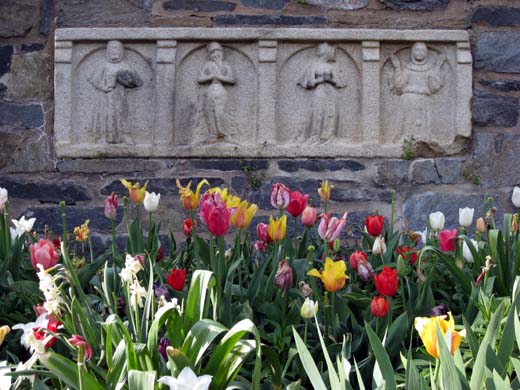
On Sunday mornings, the ringing of church bells rolls right down the side-streets and echoes through the bushes and trees. Heed their call and hike up the hill; at the top you’ll find a gothic cathedral. Stunning in its own right, it also looms over one of Washington’s prettiest places: the Bishop’s Garden, a thriving reminder of 14th-century monastic life.
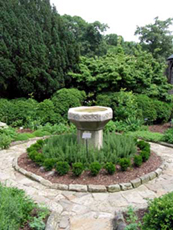
In one corner of the garden is something even older: an anachronism within an anachronism, a massive stone baptismal font encircled by special plants. This little “garden room,” a small sign explains, is here to evoke the ninth century, with each leaf and shoot a living monument to the era of Charlemagne. The emperor might have approved, in passing, of this collection of flowers and herbs. But twelve centuries later, its existence owes less to Charlemagne and more to the legacy of a mostly forgotten man, a monk named Walahfrid Strabo.
Walahfrid first beheld Reichenau at the age of eight. His parents were humble and poor, but the brothers on the island in Lake Constance saw promise in this strange little boy, this strabo—this “squinter”—who readily took to the life of the mind. In his later writings, he wryly recalled his barbaric roots, but the library at Reichenau was truly where Walahfrid Strabo was born.
Walahfrid’s heart never left that quiet island, not even after he was sent to Fulda for further study, nor during his nine years at Aachen, where he tutored Charles, the son of Emperor Louis. In 838, when Louis rewarded Walahfrid with an abbacy, the monk, then thirty, went home to Reichenau at last. Except for two years of political exile and the occasional diplomatic mission, Walahfrid spent the rest of his brief life there. In the decade left to him, he polished his poems, he wrote to a scandalous friend, and he worked, when he could, in his garden.
We know about the garden because of one poem: Walahfrid’s 444-line De Cultura Hortorum, “On the Cultivation of Gardens,” now more commonly known as his Hortulus, “the little garden.”
In a lively preface, Walahfrid exhorts others to share his commitment to gardening:
For whatever the land you possess, whether it be where sand
And gravel lie barren and dead, or where fruits grow heavy
In rich moist ground; whether high on a steep hillside,
Easy ground in the plain or rough among sloping valleys—
Wherever it is, your land cannot fail to produce
Its native plants. If you do not let laziness clog
Your labor, if you do not insult with misguided efforts
The gardener’s multifarious wealth, and if you do not
Refuse to harden or dirty your hands in the open air
Or to spread whole baskets of dung on the sun-parched soil—
then, you may rest assured, your soil will not fail you.
Although bookish by nature, Walahfrid makes clear that he is not merely transmitting found knowledge:
This I have learnt not only from common opinion
And searching about in old books, but from experience—
Experience of hard work and sacrifice of many days
When I might have rested, but chose instead to labor.
With quiet joy, Walahfrid walks the reader through his garden, a former mess of nettles and weeds now made useful and neat through careful springtime tending. His tour leads past rows of long-necked poppies, brilliant purple irises, pungent rue, and sprigs of fragrant mint. At every step, he catalogs the practical uses of his garden plants: wormwood, he claims, can cure a headache; fennel loosens the bowels, and it cures a cough when added to wine.
But Walahfrid’s thoughts range far beyond his humble garden, and his Hortulus is a fertile bed of budding notions. In sage, when new growth chokes its old leaves, Walahfrid sees “the germ of civil war.” Gourd-vines remind him of shields, ladders, and girls spinning wool; he admires their tenacity in a storm, and he marvels at how they aspire “to grow high from a humble beginning.” He points out that horehound counteracts the poisons of an evil stepmother, while pennyroyal lets him marvel at God’s bounty and contemplate the economics of scarcity. In a fit of Virgilian whimsy, Walahfrid even invokes the Muse, “who in sacred song / Canst stablish monuments of mighty wars / And mighty deeds,” all so he can more eloquently praise the heartburn-reducing properties of chervil.
Practical advice and classical flourishes, political allegory and good humor, philosophical musings and mock-epic—here and there, modest ideas and tender allusions break through the surface of the Hortulus, intertwine a little, and grow toward nothing in particular. In the end, Walahfrid’s garden path leads to the lily and the rose, Christian symbols both, each leaning against the other; he spots them just as he begins to tire. It would be odd indeed if a ninth-century abbot did not end his gardening book in this way—but it is odd already that Walahfrid has left this literary garden, in which he glimpses all creation, at fewer than 500 lines.
To understand Walahfrid’s brevity, close his Hortulus. Tuck it under your arm, pass beneath the open archway, and visit the real hortulus, which blooms in the shadow of a cathedral that Walahfrid never could have imagined. Here grows rosemary; here grows the fleur de lys; here grow fennel, black cumin, and green-leafed Gallic rose. In patches, bowing in their raised beds, the flowers and herbs surround the baptismal font, while around them grows a larger garden still.
Tourists and pilgrims walk its stone-paved paths. Beautiful women lounge on benches and bathe in the sun. Toddlers rush for the goldfish pond, while clergy lead visiting dignitaries beyond the bushes and bees. Across the lawn, and frozen in stone, a father forgives his lost son.
Sit and sweat in the swampy heat. Relish this riot of flowers and bushes and vines. Savor every scent. And look, if you can, for the gardener.
 Squint, and you’ll see him; he peers back at you across twelve hundred years. He lives in the dear freshness of this garden, where his work is remembered by those who now spend their mornings exactly as he did: spreading dung, contending with vermin, and tending to fistfuls of moist, fragrant soil.
He wonders why your hands aren’t hardened by labor; then he glimpses his book. His smile is kind, but his glare is reproachful. He is, after all, an abbot.
“A poem is only a poem,” he tells you, his voice made tender by time, “but a garden, dear brother, is art.”
 Quid Plura?