“And the little wheel runs on faith…”

Tourists never notice it, but then neither do most locals. Behold: Alto Towers, catty-corner to the National Cathedral at 3206 Wisconsin Ave NW.
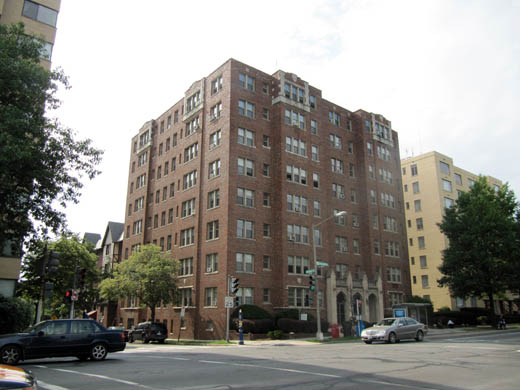
Alto Towers went up in 1932, in the heyday of D.C. suburbanization. This eight-storey apartment house is the work of Arthur B. Heaton, a half-forgotten architect who’s partly responsible for the look and feel of northwest Washington—and who was, briefly, an unabashed medievalist.

Heaton was ridiculously versatile. In 1901, he built Tudor Revival apartments and later designed the Altamont, a local apartment house with an Italian Renaissance twist. In 1914 and 1931, he put Classic Revival additions on the National Geographic Society building. In 1926, he gave his (now-demolished) Capital Garage a funny, car-themed facade, and his interest in the automobile led him to design our local “Park and Shop,” the prototypical strip mall, in a Colonial Revival style. Heaton oversaw the construction of new facilities on the GWU campus while also designing banks, churches, and countless other D.C. buildings and homes, apparently without ever developing an identifiable “Heaton style.”

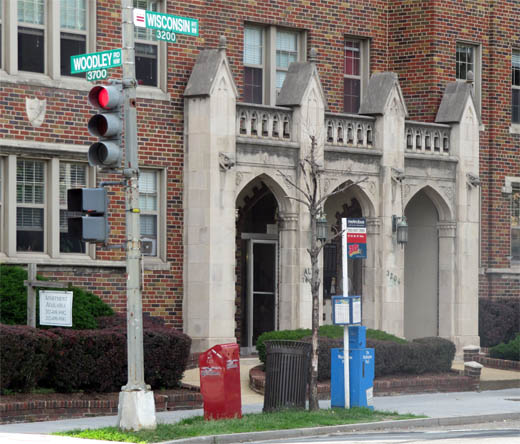
…and that’s what makes Alto Towers a treat for the medievalist. Take a gander at the entryway.
When Heaton wasn’t serving as president of the local chapter of the American Institute of Architects, co-founding the Washington Building Congress, or spearheading the “Renovize” movement during the Depression, he was also, from 1908 through 1920, the supervising architect for the National Cathedral, where he helped chief architect Henry Vaughan oversee construction during the cathedral’s first 12 years.

In 1932, more than a decade after Heaton’s time there, the cathedral was little more than an overgrown apse festooned with a few angelic grotesques. Given a chance to design an apartment house across the street, Heaton—who could have built damn near anything—set loose his inner medievalist.
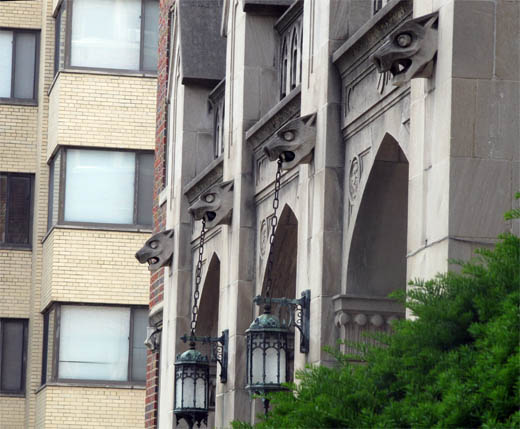
Those snarling, gargoylish grotesques are the most blatantly cool thing about Alto Towers, but the whole arcaded entryway is a neo-medieval romp.
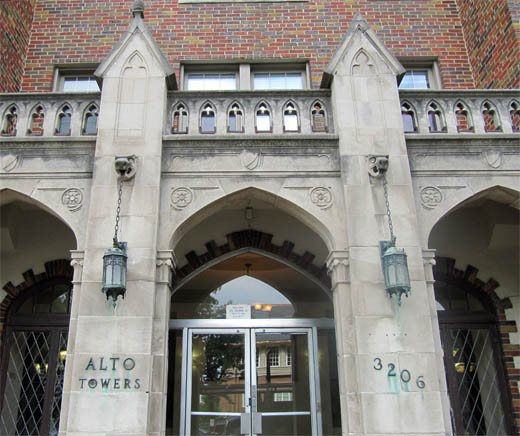
The quatrefoils (four-leaf clovers) in the spandrels (the warped triangles above each arch) are pretty standard, but those thick, gabled supports are an architect’s fancy. Each one resembles a cathedral buttress while also containing blind tracery of a Gothic arch.

At Alto Towers, periods and cultures trip over one another and have a good laugh. The pine cone finials hark back to ancient buildings and the medieval fascination thereof, while those funny little nubs at the tops of the smaller arches—including the little ones in the triforium, the upper row—strike me as very American. Meanwhile, on both sides of the interior of each large arch are squared, Art Deco-ish shadows of Corinthian columns. Behind them, the brick-lined inner doors whisper “Cordoba” in an American accent.

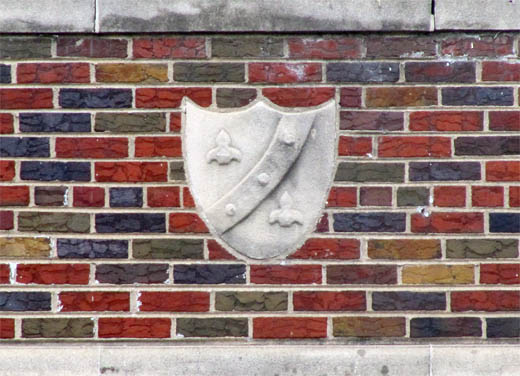
Most of Alto Towers is plain brick, but Heaton decorated just enough of its topmost level to show that the neo-medievalish entryway wasn’t an afterthought.

Note the two types of ornamented shield. They may be purely decorative, but I’ll gladly send a free book to any heraldry buff who can show that they’re meaningful.
While Heaton’s 1926 Capital Garage (PDF with photo) featured large, leonine gargoyles, Alto Towers is his full medievalist statement, the rhapsody of a restless architect who knew he wouldn’t live to see the cathedral completed.

When Heaton died in December 1951 at 76, the new apartment buildings rising around the cathedral were blocky and bland. Today, tourists tromp right past them, fixated on the promise of sighting quirky gargoyles on the Gothic spires beyond.

Of course, the cathedral’s first proper gargoyles weren’t put in place until around 1960, so if the beasties at Alto Towers forever bare their fangs, I can’t really blame them. No one remembers that they were here first.


“I thought it was confetti in our hair…”

Like all clouds, the cherry blossoms bring their own sort of storm. Their petals swirl on the sidewalks, they mingle in your hair, they fall among the tulips that spring like rested children from their beds. Smacked with the sweat and smells of premature summer, Washingtonians don’t notice, behind the blossoms and buds, the hardy, faithful lavender, the modest source of a half-forgotten nursery rhyme:

Lavender’s blue, dilly dilly, lavender’s green,
When I am king, dilly dilly, you shall be queen.
Who told you so, dilly dilly, who told you so?
‘Twas my own heart, dilly dilly, that told me so.

Maybe you know this song. Burl Ives popularized it in 1948, and Sammy Turner and Gene Vincent covered it, too. The Jackson Five gave it a Motown spin, Lloyd Robinson made it Jamaican, and in 1985 Marillion reimagined it as the love song a drunk, regretful poet dearly wished he had written. Many lovely amateur versions hark back to Ives, but “Lavender Blue” predates the modern hit parade. On hot spring days, the song might almost be medieval.

The oldest recorded version of “Lavender Blue” is “Diddle Diddle, or, The Kind Country Lovers,” a ballad that dates to the 17th century:

Lavender’s green, diddle diddle, lavender’s blue
You must love me, diddle diddle, ’cause I love you.
I heard one say, diddle diddle, since I came hither,
That you and I, diddle diddle, must wed together.

You can see for yourself that it does goes on, with eight additional verses that focus far more on sly young rustics all a-diddle than on the whole lavender business. Still, it’s charming, and maybe revealing, that later versions so fondly return to the line about lavender, even when singers smile and pass it off as a bit of nonsense, since it may point to the deeper roots of the song itself.

According to the OED, “lavender” as a word to describe a color—specifically, the color of the plant—goes back only to 1882, and “lavender” as a verb meaning “to perfume with lavender” pops up in 1820. In English, the plant name Lavandula dates to 1265, plucked from medieval Latin as a corrupt form of a diminutive rooted in a Latin term connoting things to be washed, and hinting (in ways the OED declares “obscure”) at associations with perfumed baths and freshly washed linen. Thus do the modern English words “launder” and “laundry” tumble forth.

More definitively, the 14th century gave us lauendere, the Middle English term for a washerwoman, as in this nugget from the Harley Lyrics:

prude wes my plowe fere
lecherie my lauendere

And here’s Chaucer, from the F-text of the prologue to The Legend of Good Women:

Envie ys lavendere of the court alway,
For she ne parteth, neither nyght ne day

So did “Lavender Blue” grow out of a medieval ode to a washerwoman amused by the prospect of a royal life with her rustic “king”? Is it a later tribute, knowing or half-knowing, to the roots of the word itself? No academic paper is forthcoming; these questions are simply the fancy of a sunstruck medievalist who suspects that an inscrutable mention of lavender in a ballad about “kind country lovers” wasn’t always meaningless.

One further usage from around 1300 gives us a dash or two more: a reference to the seizure of the chattels of fugitive “Johannis le lavendere”  to remind us that there were washermen as well. Appropriately, modern versions of “Lavender Blue” give the “queen” a chance to pipe up on equal terms:

I love to dance, dilly dilly, I love to sing;
When I am queen, dilly dilly, You’ll be my king.
Who told me so, dilly dilly, Who told me so?
I told myself, dilly dilly, I told me so.

So are the young man and woman laboring side by side, crooning on the banks of some gnat-clouded river or stealing kisses over the washbasin, loving their lives even though there’s nary a courtier or castle in sight? It’s spring, for Heaven’s sake; go outside, and imagine whatever you wish. And if and when you stop to smell the flowers, spare a sniff for the lavender, and don’t be shy; dig deep for a story, whether you’re inspired by scents—or by quasi-medieval nonsense.

“There is a green hill far away…”

Despite the presence of noble-minded buffoons sitting around tables making futile plans, Washington is not an Arthurian town. Sure, there’s that suburb with corny Arthurian names, but Washington culture may be better suited for mocking fabliaux than the charming fictions of medieval romance.

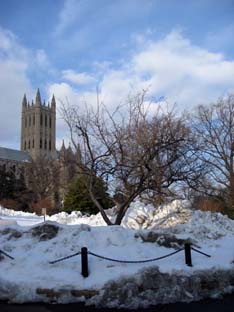
Still, this city never stops sprouting quasi-medieval surprises. Trudge through the snow three days after a blizzard, and you do so alone; no one’s out taking pictures anymore, not even at the perpetually lovely Bishop’s Garden. Climb over a wall or two, send a few squirrels bounding away from the racket you make, and you’ll stumble onto this, in the driveway of a neighborhood school: a tree which the gardening guild claims was grown from the Glastonbury Thorn.

Of course, the “real” Glastonbury Thorn, dubiously rooted in history, has died several times over the centuries, and there’s reason to believe that my neighbors occasionally replace the local offshoot. Interest in the Washington thorn peaked in the 1950s, which partly explains why I’ve spent many a summer afternoon dozing on the Bishop’s Lawn unaware that this trace of Arthuriana prospered a few yards away, the quiet center of its own Tennysonian scene:

“The cup, the cup itself, from which our Lord
Drank at the last sad supper with his own.
This, from the blessed land of Aromat–
After the day of darkness, when the dead
Went wandering o’er Moriah–the good saint
Arimathaean Joseph, journeying brought
To Glastonbury, where the winter thorn
Blossoms at Christmas, mindful of our Lord.
And there awhile it bode; and if a man
Could touch or see it, he was healed at once,
By faith, of all his ills. But then the times
Grew to such evil that the holy cup
Was caught away to Heaven, and disappeared.”

It’s a silly thing, really, but after a week of Washingtonians grousing about winter, I’ll be glad when they’re back to chasing political grails. In a city that imports its legends, we could do worse than remember stories that teasingly promise perpetual spring.

“What a good girl, what a smart girl, what a pretty girl…”

Wide-eyed freshmen straining to seem a little older, straight-on rain hitting sideways bikes—when I hike to American University to use the library, I’m struck by how autumns on campuses all feel the same, how the mood falls and rises according to rhythms that no one can sense only two blocks away. Science fiction writer James Tiptree, Jr., AU class of 1959, certainly felt it; in November 1957, after nine months at American, Tiptree wrote to a friend:

The first semester is like an arctic trip; in the warm weather you sign up for the long plunge into the dark tunnel of winter, and you sail North with the weeks; the trek across the campus growing colder, the inside of the night bus hotter; darkness coming earlier, and finally closing in to the tough struggle of the exams, an inhuman time—and suddenly the lights and confusion, the camp of Christmas . . . And then the voyage home out of the darkness, back up the tunnel to the great blaze of Spring ahead….

“James Tiptree” was, of course, Alice Sheldon, who returned to college at 41 after serving in the Army and working for the CIA. According to Julie Phillips, author of James Tiptree, Jr.: The Double Life of Alice B. Sheldon, AU’s campus oddballs found Sheldon awfully compelling. In a letter to her mentor, Sheldon half-jokingly rued her status as a weirdness magnet: “It’s plain, now no more than ever, will I meet the normal sunshine people of this world.”

Flash forward a few years to find Alice Sheldon, graduate student, working toward a Ph.D in experimental psychology at GWU and teaching classes in statistics and psych at her alma mater. In a letter to a friend, she recalled making the mistake of estimating her hourly earnings, thus inspiring her own formulation of the adjunct’s lament:

Stupid kids come up and say I’ve been here three years and you’re the first faculty member that ever TALKED to me—and bang goes three hours. Or bright kids, and you find they went to some progressive so-called school and can’t read or write an English sentence, and want to. And piss goes ten hours. And they aren’t getting the material so you revamp your whole series. And you give real exams, essay exams, and READ them. Yeah. $.75 with your fucking Ph.D.

When I’m on the AU campus, I can’t imagine Sheldon there. For one thing, there’s no trace of either her real name or her pseudonym on the AU Web site; the school doesn’t claim her as one of its own. Maybe the circumstances of her death, a murder-suicide pact with her bedridden husband, made her alma mater disown her—or maybe they simply forgot. If any of Sheldon’s worshipful oddballs from the class of ’59 pause to recall her at Friday’s reunion, will any of them know she was also an acclaimed science-fiction author? That an award is named for her alter ego? Will anyone remember her at all?

In Sheldon’s sardonic 1973 story “The Women Men Don’t See,” a government librarian from D.C. tries to explain to her male traveling companion that women’s rights are insecure, so clever women must scramble to survive. “We live by ones and twos,” Ruth Parsons says, “in the chinks of your world machine.” When the clueless Don Fenton likens her comments to the manifesto of a guerrilla movement, Ruth counters with a more pathetic metaphor: “Think of us as opossums, Don. Did you know there are opossums living all over? Even in New York City?”

And Washington too. In a city that’s hopelessly, willfully normal, where even the artists are sleeping by ten, the Sheldon-Tiptrees pass unseen, less like opossums than aliens—not the dome-faced, squid-fingered monsters that float through Sheldon’s story, but lonely, troubled, rain-drenched blurs.

“It’s uncanny,” Sheldon wrote, “they come to me—the one just out of shock therapy, the one in love with an older woman, the one who drove a taxi for five years and only goes out at night, with big dark eyes.” Fifty years later, they seek out each other in library niches or clear across dimly lit classrooms, the oddballs, aliens, and opossums, astounded when somebody sees them.

“I never talk to my neighbours, I’d rather not get involved…”

“A gargoyle, Mother, is perched on the gable,
It searches and lurches, befickled by fable.
The gargoyle, Mother, has eaten the cat!”
“And what shall we do about that, my child,
What shall we do about that?”

“A gargoyle, Mother, is stalking our roof,
Its claw-pricks primeval, primordial proof.
The gargoyle, Mother, has eaten dear brother!”
“And why can’t we get us another, my child,
Why can’t we get us another?”

“A gargoyle, Mother, alights in the hall,
Its grindings and growlings begrizzled by gall.
The gargoyle, Mother, has eaten poor father!”
“And why must you be such a bother, my child,
Why must you be such a bother?”

“A gargoyle, Mother, is greedy for gore,
Befouled and bedeviled, beframed by the door.
The gargoyle, Mother, is coming for you!”
“And what do you dream I can do, my child,
What do you dream I can do?”

“A gargoyle, Mother, has eaten you whole,
Its hellmaw begobbling you, body and soul.
The gargoyle, Mother, is spitting you out!”
“And why did you have any doubt, my child,
Why did you have any doubt?”

“A gargoyle, Mother, bespews its hot breath,
Its burning and burbling betoken my death.
The gargoyle, Mother, has torn me in two!”
“And why must you mourn only you, my child,
Why must you mourn only you?”

(For all the entries in this series, hit the “looking up” tag.)

“She rules her life like a fine skylark…”

The National Mall on the Fourth of July: America! Motherhood! Hot lunch for orphans! Red, white, and blue! Patriotic explosions!

…and a Welsh woman retelling stories from The Mabinogion?

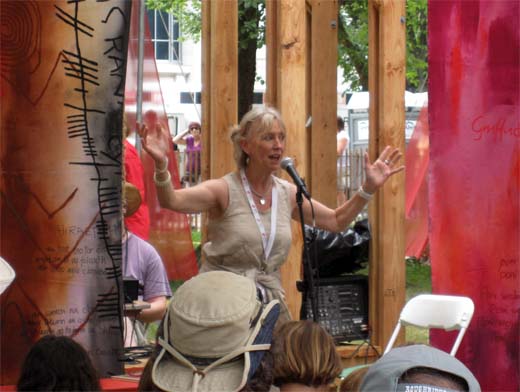
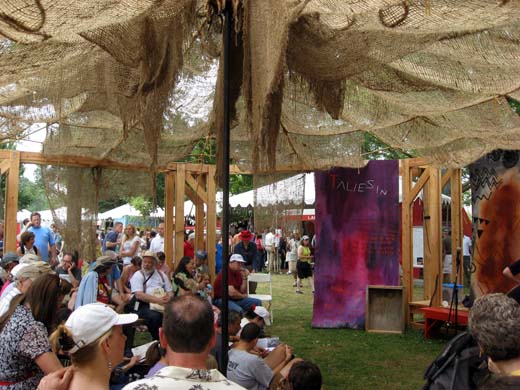
Yep: Wales is one of the three cultures featured at this year’s Smithsonian Folklife Festival. If you’re local, it’s not too late to hie thyself down to the Mall and take in some music, storytelling, crafts, and food. Maybe you’ll even get to hear spirited retellings of the stories of Branwen and Rhiannon adorned with violence, humor, and quirky modern digressions. Medievalism, you see, never takes a holiday.

“Ran down, and the lady said it…”

When the U.S. Postal Service issues a stamp tomorrow to honor Anna Julia Cooper, she’ll be remembered, rightly, as a remarkable woman. Born into slavery around 1858 in North Carolina, Cooper earned a degree in mathematics but also taught Latin and Greek. As principal of the nation’s best public high school for black children, she fought for high educational standards and prepared her students for top universities. In essays and lectures, she addressed racism, the concerns of black women, and other issues of the day. When women’s rights groups turned out to be white women’s rights groups, she started her own.

But Anna Julia Cooper was also a Charlemagne buff—and an inspiration to exhausted grad students everywhere.

From 1911 to 1913, Cooper spent summers studying French literature and history in Paris. In 1914—at the tender age of 56—she enrolled in the Department of Romance Languages at Columbia University with plans to earn her doctorate. Scholars of medieval French literature were clamoring for an accessible version of the epic Le Pèlerinage de Charlemagne to replace a hard-to-find German edition, and Cooper gave them one, but Columbia didn’t grant her a degree. As a widow raising her dead brother’s five children while holding down a full-time job as a teacher and principal in Washington, D.C., she couldn’t fulfill the one-year residency requirement.

In response, Cooper sought out a university with no such requirement. The Sorbonne accepted her credits but her work on the Pèlerinage didn’t meet their dissertation requirements, so Cooper wrote a second dissertation. In 1925, she earned a Ph.D. from the Sorbonne and found a Parisian publisher for her edition and facing-page translation of Le Pèlerinage de Charlemagne. She was 66 years old.

Cooper’s Pèlerinage was never published in America. When she offered the book and all its proceeds to her alma mater, Oberlin, the school hemmed and hawed—and then nervously declined. Even so, the book was the standard edition and translation for decades, American libraries and language departments sought it out, and several pages were included in an anthology of medieval French literature reprinted as recently as the 1960s.

Beyond its manageable size, it’s not clear what drew Cooper to the Charlemagne project she cheekily called her “homework,” but few American teachers have so aptly encouraged students, then or now, through indefatigable example. Cooper, who lived to be 105, understood the pedigree of that tradition:

Being always eager to carry out your wishes faithfully, I have sent back to you this dear pupil of mine as you asked. Please look after him well until, if God so wills, I come to you myself. Do not let him wander about unoccupied or take to drink. Give him pupils, and give strict instructions that he is to teach properly. I know he has learned well. I hope he will do well, for the success of my pupils is my reward with God.

Alcuin wrote that. It’s a Carolingian sentiment, but one that Cooper, a proper medievalist, could easily endorse.