“The tap-tap-tapping of the typewriter pays…”

Twenty-three years ago this month, I convinced my folks to drive me to the toy store to buy something that toy stores no longer sell. Most people didn’t know what a modem was, but when I whipped up an ASCII animation showing us making the trip as a family and emerging in triumph from the Toys R Us, my parents were amused enough to give me a lift, if understandably skeptical. In 1986, the online world was too tiny to be mythologized. Wild stories about local kids “changing the positions of satellites up in the blue heavens” sometimes made the news, but online bulletin-boards were “here there be dragons” outlands for all but a few, and no one noticed gaming pioneers as they racked up monstrous Compuserve bills playing Hangman at 300 baud.

Lacking any real plan, I used my modem to connect to a suburban archipelago of slow, single-line BBSes, not knowing that the experience would teach me how to write. A few years later, when I was the only English major banging out e-mail on an X-term in the basement of the computer science building, I didn’t know I was an early adapter of a network that would soon link millions of offices and homes while uprooting the business models of several industries, including publishing. I only knew that I sensed opportunity.

I thought about those days when I read Jake Seliger’s post about a New York Times article pointing out the obvious: the online market for used books is a boon for readers. Jake wondered how cheap books will affect the business of publishing, and while I don’t know what the future holds for companies that can’t adapt, I told him I didn’t think a bonanza of secondhand books was necessarily bad for authors:

As someone who recently entered the publishing world as a lower-midlist author, I’ve thought quite a bit about the implications of the online market for used and discount books. When someone buys my book used on Amazon for $4 instead of paying $12 for a new paperback, that’s around 75 cents in royalties I don’t see—but I’d be awfully short-sighted to gripe about that, because the glorious churn of the used-book market may help me in the long run. Today’s budget-conscious undergraduate may be tomorrow’s history teacher; perhaps he’ll assign my book to his class of twenty students five years from now. Or maybe he’ll recommend the book to a friend who then downloads a copy to his Kindle, thereby putting around $2 in my pocket. Or maybe he hates the book so much that he strenuously avoids my next one, thus sparing me a one-star Amazon review that would have dissuaded potential readers.

Who knows? I do know that I’d be a fool to gripe about the Internet, because thanks to the Web–which includes everything from Amazon to bloggers to podcasts to the online BookTV archives—I’ve sold more copies of my book than the 50 or so secondhand copies currently listed on Amazon. Fretful authors and publishers who dread the advent of the hyper-efficient online book market may yet be vindicated, but I’m not convinced that budget-conscious book-buyers are the only ones who stand to benefit from it.

Compared to a fantasy world in which Amazon, the big bookstore chains, and used-book dealers simultaneously thrive (and where all of our orders are, presumably, delivered by a Deschanel sister on a flying unicorn), the current situation looks bleak—but as an author, a voracious book-buyer, and someone who’d be nowhere without the Internet, I prefer the here-and-now to the real world of twenty years ago, when a suburban “bookstore” was a nook in the mall stocked only with bestsellers, a few shelves of genre fiction, some classics, and the latest comic-strip anthologies.

Whether my career thrives or stalls, I’m glad I’m a writer now. I can get obscure articles in minutes rather then weeks, and people on the subway can use a telephone to order and read my books from stores that never close. Best of all, my cable modem is more than 6,500 times faster than the modem I bought in 1986, but it cost the same amount: around 60 bucks (or half the price in 1986 dollars). Confusion may be justified, but hold off on the Anglo-Saxon elegies; not everything is worse than it used to be.
“…and we can all sit watching our Hawaiian island world.”

Becoming Charlemagne is not a racy book, but when I wrote it, I marveled at the rich potential of medieval history to perplex and offend. Wine-guzzling Muslims, Jews owning slaves, knife-wielding Christians who tried to relieve a pope of his eyeballs and tongue—to be honest, I had expected more complaints from readers who found that the eighth century either defied their Tolkienesque caricatures of the Middle Ages or failed to conform to their religious preconceptions. Instead, debates and discussions at book-talks and lectures have been downright genial, and to my knowledge, the harshest thing I’ve been called is a “Catholic apologist,” a charge that surprised and amused me. (Eat your heart out, Tertullian.)

Years ago, as a college cartoonist, I would have been disappointed by such a placid reaction, but today life feels way too short to make shocking the easily offended the highest goal of art. I’d much rather inform and entertain—but I do reserve the right to offend, a right I hadn’t thought to affirm until I read the review of Sherry Jones’s novel The Jewel of Medina in Sunday’s New York Times.

Jones’s novel is a highly fictionalized retelling of the story of A’isha, the third and youngest wife of the prophet Muhammad. Last year, after a scholarly expert on A’isha suggested that the novel might incite violence, Random House dropped the book and a small press quickly picked it up. In last weekend’s Times review, journalist and novelist Lorraine Adams lists some of the historical errors in The Jewel of Medina, dismisses the book as a bad example of genre fiction, and calls Jones’s prose “lamentable.” As a reviewer, she’s entitled to her opinion, even if the extent to which a novelist must hew to historical facts is debatable, but her conclusion is stunning and strange:

An inexperienced, untalented author has naïvely stepped into an intense and deeply sensitive intellectual argument. She has conducted enough research to reimagine the accepted versions of Muhammad’s marriage to A’isha, thus offending the religious audience, but not nearly enough to enlighten the ordinary Western reader. Should free-speech advocates champion “The Jewel of Medina”? In the American context, the answer is unclear. The Constitution protects pornography and neo-Nazi T-shirts, but great writers don’t generally applaud them. If Jones’s work doesn’t reach those repugnant extremes, neither does it qualify as art. It is telling that PEN, the international association of writers that works to advance literature and defend free expression, has remained silent on the subject of this ­novel. Their stance seems just about right.

That’s one bizarre paragraph, suddenly contrasting as it does Constitutional protections for “repugnant extremes” with what “great writers” applaud while suggesting that a book must “qualify as art” to be defended on the grounds of free expression. Sherry Jones may be no Salman Rushdie, but when it comes to The Jewel of Medina, the question of her free expression is not hypothetical: Adams notes earlier in her review that shortly after last year’s controversy, “somebody pushed a firebomb through the mail slot at the home office of Jones’s London publisher.”

Which leads me to wonder: If tomorrow I should find my car on fire, or death threats nailed to my door, or a dagger protruding from my sternum as I step outside my office, will Lorraine Adams think I had it coming? I suspect not, but in her zeal to pen a clever takedown of a book she thought was lousy, she implies that defending me from violent reader responses depends on whether or not critics and literary mandarins decide my book is art. Call me quaint, but I don’t have to like, or even read, The Jewel of Medina to know that Sherry Jones and her publisher deserve freedom from firebombing. I don’t have to read a novel by a glib reviewer to know that its author deserves the same defense as well.

“…writing books on the way it should have been.”

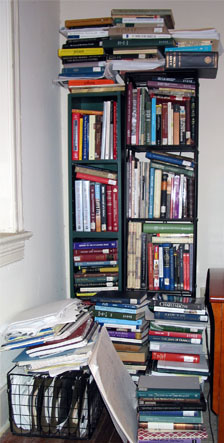
That’s a photo of the bibliography of Becoming Charlemagne; I shot it the morning the final manuscript flew like the Winged Victory of Samothrace to my editor’s desk in New York. Large-scale maps scrawled with timelines and trade routes, teetering towers of library books—by that point, my workspace looked like a cross between the lair of a serial killer and Tom Hanks’ bedroom in Mazes and Monsters. So this past Thursday night, I was both honored and relieved to sit on a research-themed panel hosted by James River Writers, which taught me that this obsessive, it-puts-the-lotion-in-the-basket behavior is, at least among authors, something close to normal.

My co-panelists were Phaedra Hise, journalist and author of the meticulously reseached Pilot Error: Anatomy of a Plane Crash, and Maggie Stiefvader, whose young-adult novels about homicidal faeries and “werewolf nookie” are informed by her college study of medieval languages. (Her children are named Wulfnoð and Æðelðryð. She is hardcore.) Our trusty moderator, fantasy writer Bill Blume, did a great job. Bill writes the funny and trippy webcomic The Wildcat’s Lair, where he contends with stuffed dragons and technicolor cats in their natural habitat: the gaming table.

Writing is often dreary work. You’re up all night, flipping between the Monumenta Germaniae Historica and a twilight block of Felicity episodes (don’t judge me), paranoid that you might not meet your deadline, wondering if anyone is going to care about the ninth-century Islamic pistachio trade. Publishing a book rarely brings the wealth, the fame, or the power over life and death that many aspiring writers believe it will. When your book hits the shelves, it’s a happy day, but life just doesn’t change all that much.

…and then, once in a while, you’re invited to yak it up at a writers’ event, and you retire to a pizza joint for a late night of unrepeatable stories with smart, funny people, and you begin to understand the value of your 300-page calling card beyond the reviews and royalty statements. Writers like to gripe and whine, but when it comes to this one benefit, don’t let authors tell you otherwise, not even my fellow recluses. The social aspect, unlike the process of writing itself, is even more fun than you think it will be.

“Then I went off to fight some battle…”

On Saturday, I’ll be sitting on a panel at “Going Freelance,” a workshop sponsored by AIW and the Johns Hopkins writing program. Tilt your head and you can see the medievalist traces in this event if, like me, you were told in grade school that “freelance” was a term to describe medieval soldiers of fortune. Of course, medieval mercenaries did exist, but “freelance” isn’t a medieval word at all. The term was coined by Sir Walter Scott, the 19th-century author who almost singlehandedly inspired quasi-medieval fandom in the English-speaking world.

From The Knight and the Umbrella, here’s Ian Anstruther explaining how Scott lit the fire under the Victorians who romanticized and reinvented the Middle Ages:

It is hardly possible to realize today the immense influence of this author on contemporary drama, literature and art. His early poems like the Lay of the Last Minstrel and Marmion, which were first published in 1805 and 1808 respectively, and his great series of tales in prose which began with Waverley in 1814 and reached its peak, according to many critics, with Ivanhoe in 1819 . . . truly hypnotised all who read them.

The proof of this may be seen at a glance in the catalogues of the major exhibitions throughout the country. In the twenty-five years between the first appearance of the Waverley Novels in 1814 and the Eglinton Tournament in 1839, two hundred and sixty-six different pictures inspired by the pen of the “Wizard of the North” appeared in public galleries; every summer without a break, a scene from Ivanhoe was the subject of two of them.

According to the Oxford English Dictionary, the first use of some version of “freelance” appears in 1820, in chapter 34 of Ivanhoe: “I offered Richard the service of my Free Lances.” The OED cites subsequent uses of “free-lance” or “freelance” as a negative term to describe politicians and journalists with minds of their own. By the early 20th century, “freelance” was a verb; soon, it came to refer to the self-employed.

If, in the spirit of medievalism (or at least dorkiness), freelance writers wanted to liken themselves to an authentic figure who represents the reality of late-medieval English contract law, they might see a kindred spirit in the Franklin from Chaucer’s Canterbury Tales. In the late 14th century, franklins were a newly prominent class of independent landholder. Not bound by hereditary feudal obligations, a franklin could sell his produce to the highest bidder while negotiating or even canceling deals. Like any successful freelancer, a franklin was blessedly exempt from the 14th-century equivalent of corporate team-building exercises, i.e., clearing woodlands, draining swamps, or taking an arrow in the sternum for a leek-breathed feudal lord.

But can you imagine telling your friends you’re a franklin? Can you imagine writing “franklin” under “occupation” on your tax return? It’s a legacy of the romanticized Middle Ages bequeathed to us by Sir Walter Scott and other writers, artists, and poets that we overlook the agricultural drudgery that defined most medieval lives, so that even we who sit and type all day can dream of jousts and banners bright, and tell ourselves we’re charging into battle.

“…and I bought us two tickets on that Coast City bus.”

If you’re a bookish sort, and if you find yourself near Philadelphia this Saturday, be sure to swing by the Collingswood Book Festival. The good people of Collingswood, N.J., work all year to put together a terrific day that includes six blocks of author talks, writing workshops, children’s programs, and booths for local writers, booksellers, and artists—and all events are free.

I spoke at Collingswood last year and had a great time. (A memorable time, too: I had to follow sports legend Pat Croce and compete with an Elvis impersonator down the block.) This year, keep an eye out for Steven Hart, a friend of this blog and, more importantly, the author of The Last Three Miles: Politics, Murder, and the Construction of America’s First Superhighway. Steven has written a fine book, but don’t take my word for it; check out the effusive praise it’s recieved. When you buy the book at the festival, ask Steven for the “Quid Plura?” discount. He’ll give you a confused look, but don’t be fooled; that’s how New Jersey authors always look…

“The answers to all this lie with their psychoanalysts…”

“Quid Plura?” readers regularly suffer through evidence of my terrible taste in music—but you probably didn’t know that Becoming Charlemagne also has a hokey soundtrack all its own. It’s true!

Recently, Julie K. Rose interviewed me about the music that accompanied the writing of the book. Next week, you’ll be able to read the complete interview (with rationalizations for each song choice, I swear), but for now you can hear tantalizing snippets in the podcast on the Writers and Their Soundtracks Blog. If you’re an iTunes user, you can sample the playlist, too. No one but iTunes makes any money if you buy a song, but I assure you, these tunes weave trancelike melodies that slip over the transom of social consciousness and insinuate themselves into your dreams.

As for the weird faces you’re making as you read the playlist: Go on. Really. I’m used to it. As a deejay for my high school radio station, I shared the afternoon airwaves with a committed metalhead and his polar opposite, a lovestruck soul who punctuated our show with mellow R&B dedications to his girlfriend. They found common ground by speaking unkindly of what they called “Jeff music.” Under those conditions, you learn strength of character—because really, there’s no reason not to associate the age of Charlemagne with 1980s English synth-pop. Is there?

“But she didn’t understand; she just smiled and held my hand.”

In recent weeks, Matt Gabriele at Modern Medieval has hosted a blog forum about communicating the relevance of the Middle Ages to people outside of academia. I took him up on his open invitation and wrote a short piece about the pleasures and pitfalls of “applied medievalism.” Because if there’s one thing I’ve learned after two years of book promotion, it’s that going on the road to talk about Charlemagne is a lot like touring with Mötley Crüe, if the Crüe attracted small, sober, courteous crowds whose health-care regimen never included a visit from “Dr. Feelgood.”

(That said, the next time a book festival fails to remove the yellow M&Ms from the candy dishes in my dressing room, I shall be forced to raise my voice. Surely Vince Neil would approve.)

“Les yeux sans visage…”

Humidity be darned, here are some writing-themed links for a stuffy summer weekend.

At The Story’s Story, Jake revists the cheeseball novel Day of the Triffids and contemplates the signals he’s receiving from the publishing industry as he shops around his science-fiction novels.

Ephemeral New York finds written proof that the East Village never changes.

Steven Hart notes that Philip K. Dick’s Library of America editions are selling well.

Art Durkee says not to seek out advice about writing. (Link via Books, Inq.)

Market research may not be the publishing industry’s strong point, but Random House and Zogby International have started to put faces to pairs of anonymous eyes. Their nationwide poll (12-page PDF here) does help explain who purchases books, but it won’t tell you why people bought your book—so authors, keep those runestones and pigeon livers handy!

Finally, since it’s going to be a scorching outside, here are two videos to keep you cool: Jose Iturbi listening patiently to “Route 66” and then demonstrating the real way to play the song. After that, who needs air conditioning?

“It’s a thousand pages, give or take a few…”

Want to be a writer? Want to be a better writer? At the end of a busy week, here are some useful posts by authors, agents, editors, and critics—perfect reading for a quiet, sunny weekend.

Noting that American writers tend to eschew the adverb, Kevin Wignall ponders a famous passage in which adverbs get things done.

New York Times readers debate the seven deadly words of book reviewing.

Kevin Holtsberry proposes Small Book Appreciation Week.

Richard S. Wheeler builds characters out of beliefs.

BookEnds readers point out books they’ve judged by their covers.

Steven Hart highlights vital advice for novice authors.

Leslie Pietrzyk identifies her best posts about the writing process.

Meg Gardiner summarizes “a few things that make writing ring false.”

The tap-tap-tapping of the typewriter pays…”

For the past 16 months, I’ve relentlessly hawked my own book—which, in case you hadn’t heard, is now available in a compact, affordable paperback and even a Kindle edition—but as I glance over at my blogroll, I see an impressive roster of authors, novelists, and scholars whose productivity I admire and whose work deserves attention and praise.

Michael Drout at Wormtalk and Slugspeak is the author of How Tradition Works: A Meme-Based Cultural Poetics of the Anglo-Saxon Tenth Century, an intriguing study of the Benedictine Reform. He also edited The J.R.R. Tolkien Encyclopedia, to which a certain D.C.-based blogger contributed the first and last word on Tolkien and postage stamps.

Alexis Fajardo, the cartoonist who created the all-ages comic Kid Beowulf, has an online shop full of goodies, including Book One of Kid Beowulf, a preview of Kid Beowulf and the Song of Roland, and an anthology of mythological action tales.

Matthew Gabriele at Modern Medieval is the editor of the forthcoming The Legend of Charlemagne in the Middle Ages: Power, Faith, and Crusade, a collection of articles I am rather eager to read.

My Garden State broheim Steven Hart is the author of The Last Three Miles: Politics, Murder, and the Construction of America’s First Superhighway. He also wrote a much-needed piece debunking the hallowed George Lucas-Joseph Campbell connection.

Michael Livingston, who teaches medieval lit at The Citadel, is a prolific writer of short stories. He also edited John Gower’s In Praise of Peace and The Siege of Jerusalem for the invaluable TEAMS Middle English Texts series. (His intro to The Siege of Jerusalem is an enlightening primer on a highly unpleasant medieval poem.)

The very busy C.M. Mayo, who divides her time between D.C. and Mexico, has written a traveler’s guide to literary Mexico, an award-winning story collection, and a forthcoming novel, The Last Prince of the Mexican Empire.

My pal Scott Nokes at Unlocked Wordhoard co-edited Global Perspectives on Medieval English Literature, Language, and Culture, a new collection of articles about such wide-ranging subjects as Chaucer, Narnia, and the Popol Vuh.

Last fall, I met Work-in-Progress blogger Leslie Pietrzyk at a fundraiser in Virginia. She’s the author of two lovely novels, A Year and a Day and Pears on a Willow Tree. (The latter, which focuses on several generations of Polish-American women, recently won the Jeff’s Mom Seal of Approval, an honor not lightly bestowed.)

Alan Sullivan, the poetic helmsman of Seablogger, co-translated a strong and highly readable version of Beowulf for Longman.

The authors at Contemporary Nomad have more books to their credit than I can list, but I particularly recommend the haunting series of Eastern European spy novels by Olen Steinhauer, who writes literary fiction disguised as genre fiction.

I hope you’ll decide to learn more about these hard-working writers; please support their efforts by purchasing some of their books.